

 by
by Fruit Loaf
Growing up in Australia, a typical breakfast for me before heading to school was either a bowl of Weetbix, some toast smeared with butter and Vegemite, or some toasted fruit bread with a generous slather of butter and perhaps some Orange Marmalade.
As my parents ran a bakery when I was a child, there was always a loaf of fresh bread at home at breakfast, still warm from the oven which my mother would bring home after her early morning shift, in time to drop me off for the bus to school. I was always happiest if she came home with a fruit loaf (as well as a croissant or two!).

Fruit Loaf Recipe
When I came across this recipe for Fruit Loaf in Warm Bread and Honey Cake by Gaitri Pagrach-Chandra, I knew I had to try it because, quite frankly, I couldn’t remember the last time I had had toasted fruit bread for breakfast.
As with most food memories associated with growing up in Australia, I was excited to try this fruit loaf recipe because fruit bread itself is hard to find in Switzerland. Well, not the sort that Aussies are used to anyway.
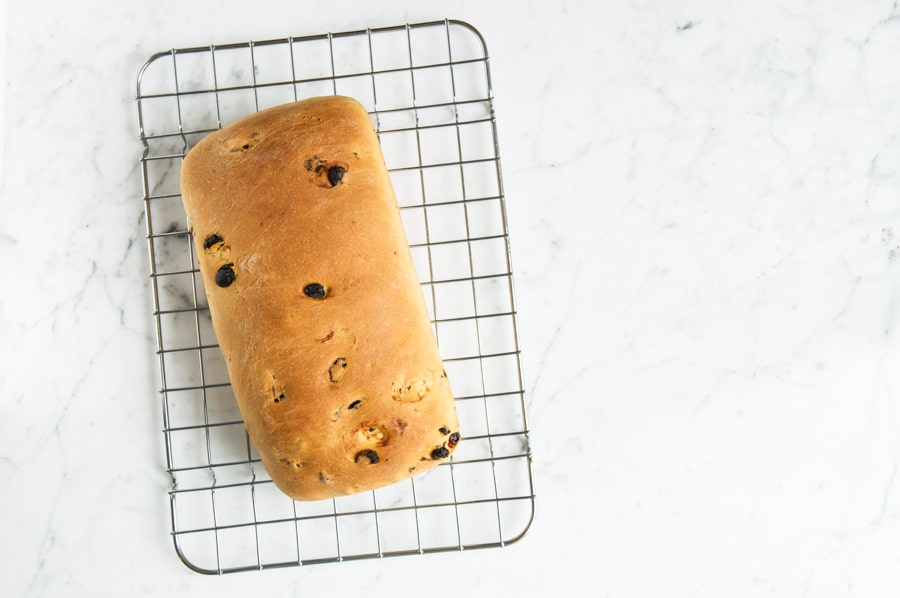
The result was a surprisingly easy-to-make fruit loaf which was wonderfully delicious. I find it to be a good blue-print for fruit loaf which you can customise to your liking.
I don’t like too much dried fruit in my fruit bread, so I have reduced the amount of dried fruit from the original recipe. You could also add ground cinnamon for a hint of spice and a slight nod to Hot Cross Buns.
What to Serve With Fruit Bread or Fruit Toast
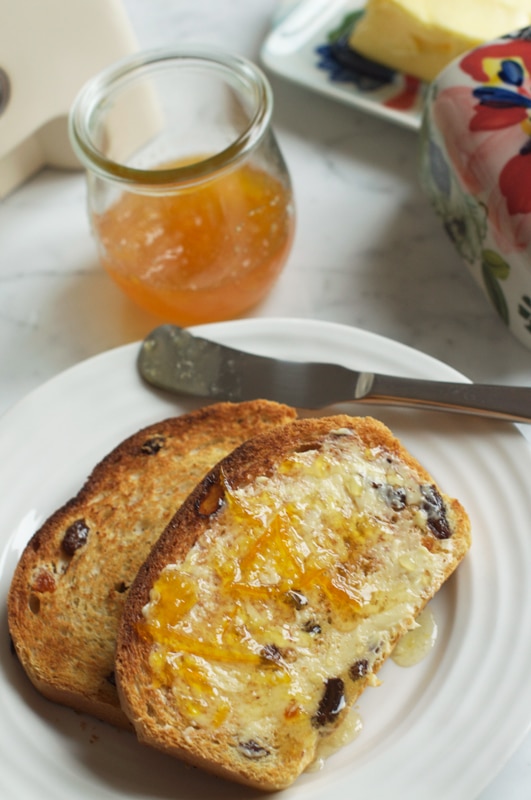
If you are making this Fruit Loaf for breakfast, it is delicious served warm from the oven with a generous spread of butter.
It goes without saying that Fruit Loaf is delicious toasted, and the following jam recipes would work perfectly here:
How to Make Fruit Loaf
For a printable recipe, please scroll down.
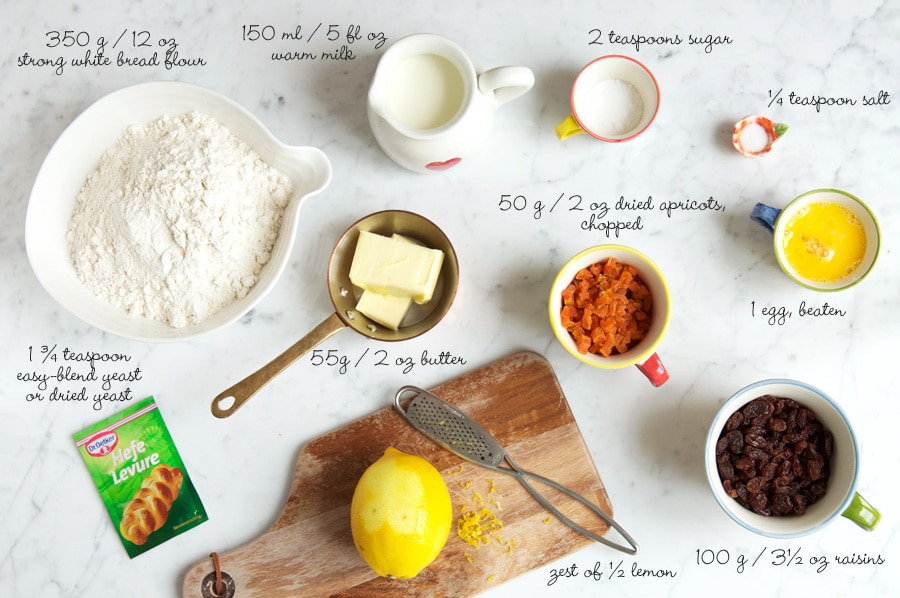
Step 1
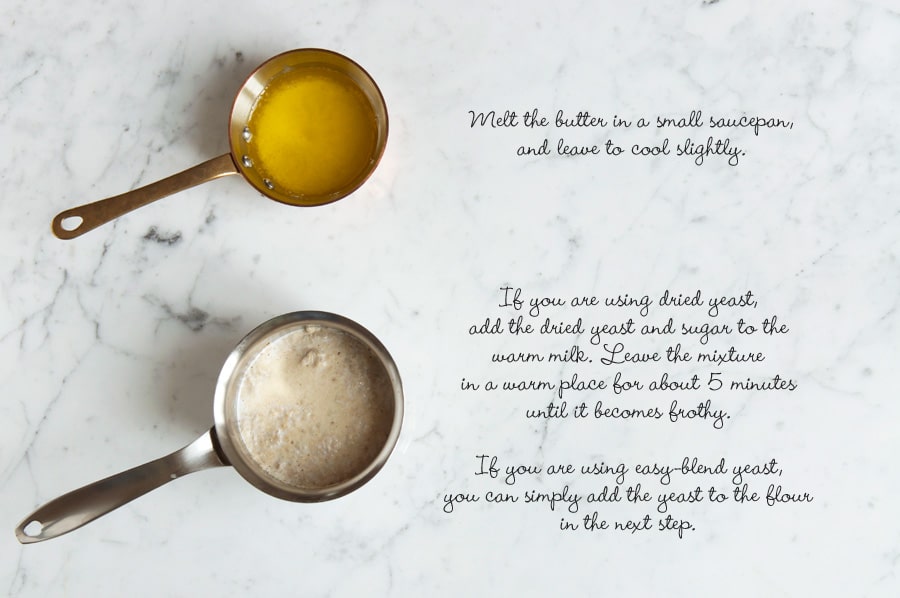
Melt the butter in a small saucepan and leave to cool slightly.
If you are using dried yeast which needs to be activated first, add the dried yeast and sugar to the warm milk. Set the mixture aside for about 5 minutes until it becomes frothy.
Otherwise, if you are using dried instant yeast or easy-blend yeast, i.e. the sort which does not need to be activated first, you can add this directly to the flour.
Step 2
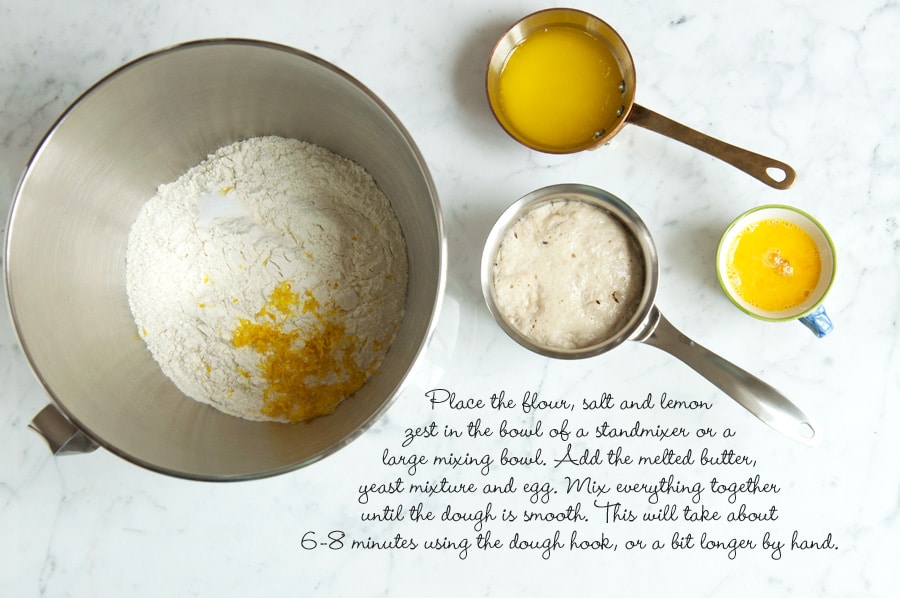
Measure the flour and salt into the bowl of a stand mixer. Grate in the lemon zest. Add the melted butter, yeast mixture, and egg.
Use a dough hook to give everything a good mix, and knead lightly until you have a soft and smooth dough. This should take about 6-8 minutes using the stand mixer, or a bit longer if you are doing this by hand.
Step 3
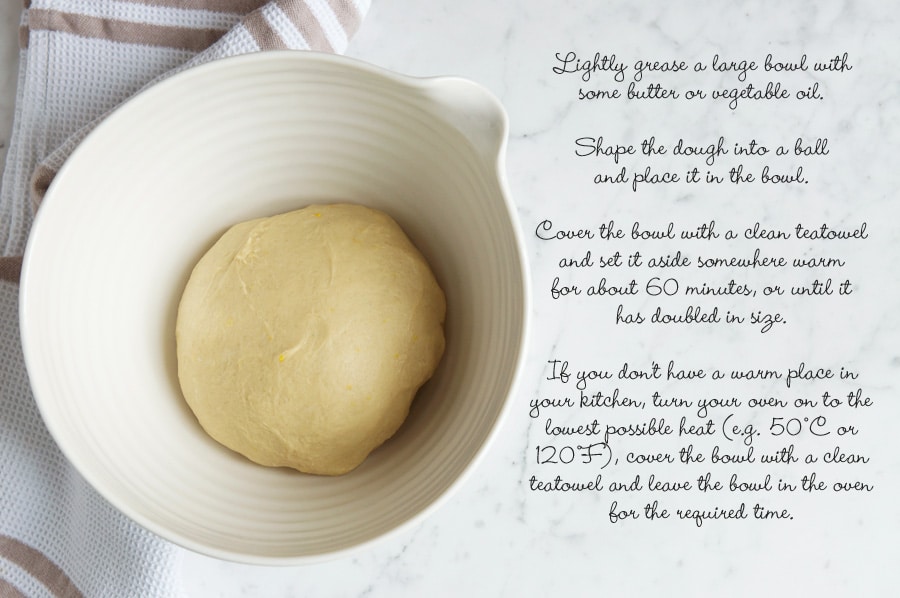
Lightly grease a large bowl with some butter or vegetable oil.
Place the dough in the bowl, cover with a clean tea towel, and leave it somewhere warm for about 1 hour, or until it has doubled in size.
Step 4
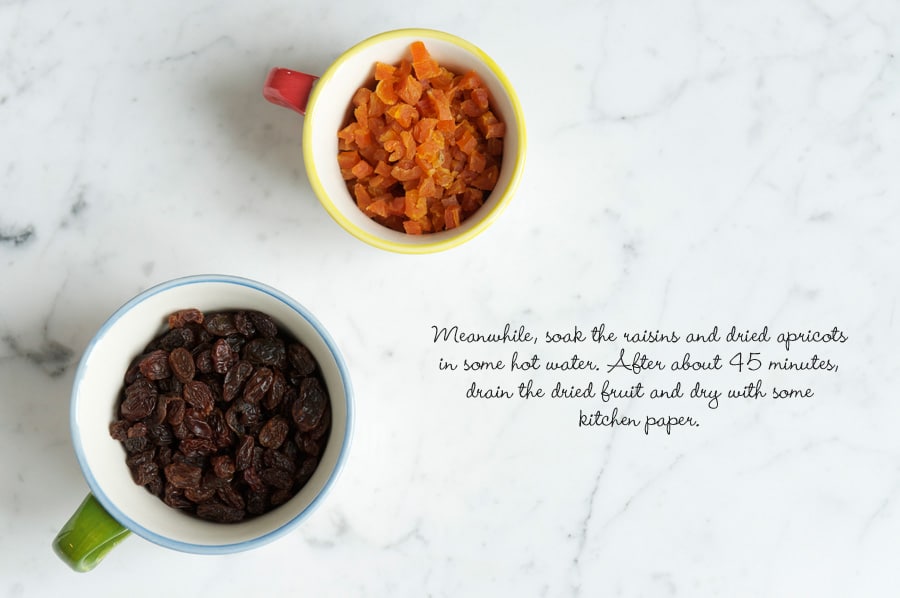
Meanwhile, soak the dried fruit in some hot water so that they can soften. Drain the dried fruit thoroughly and pat it dry with some kitchen paper before adding to the dough later.
Step 5
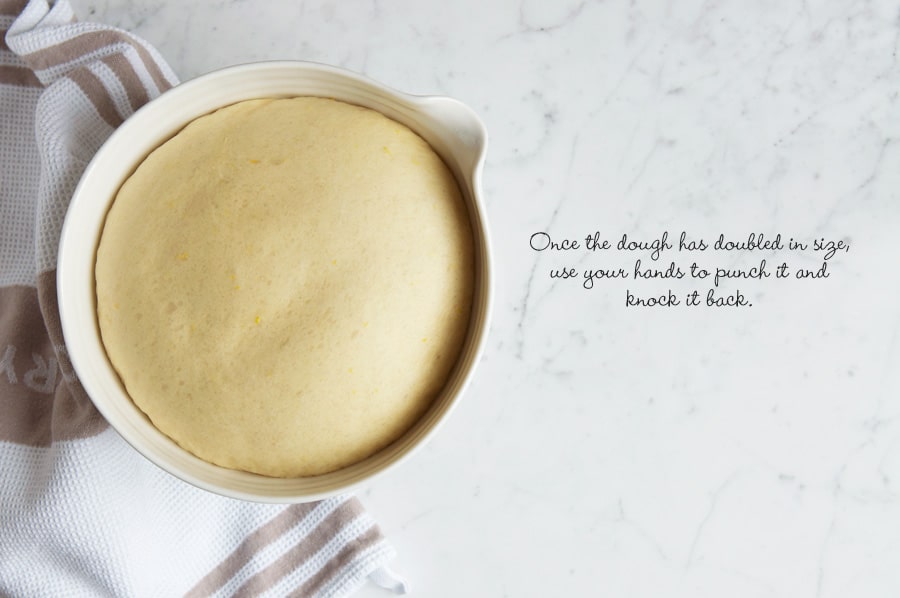
Once the dough has doubled in size, use your fist to punch in down to release the air.
Step 6
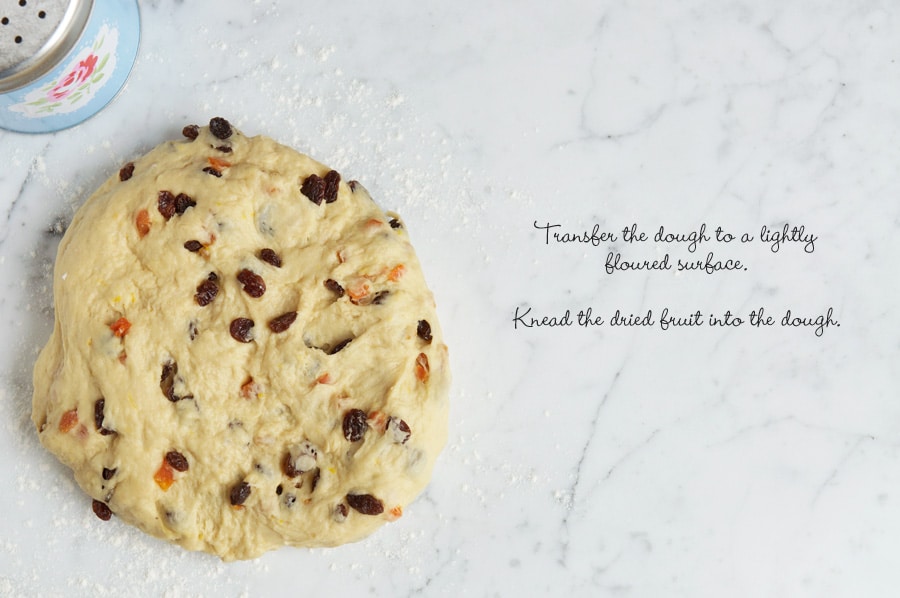
On a lightly floured surface, knead the dough a few times to bring it back into shape. Sprinkle the dried fruit over the dough, and knead the dried fruit into the dough.
Step 7
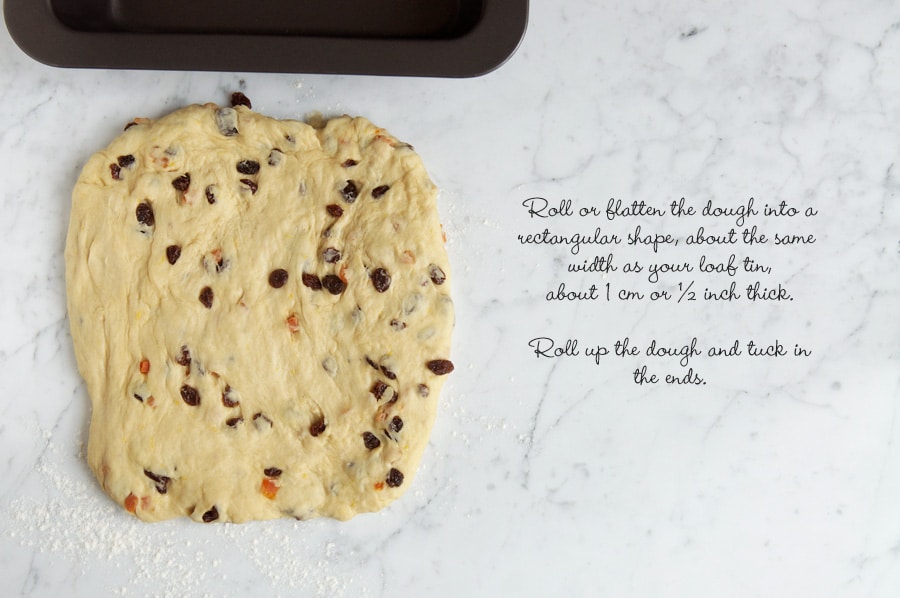
Roll out or flatten the dough into a rectangular shape about the same width as the loaf pan, about 1 cm/0.5 inch thick.
Roll up the dough and tuck in the ends.
For this recipe, I use a standard loaf pan which measures 13 x 23 cm (5 x 9 inches).
Step 8
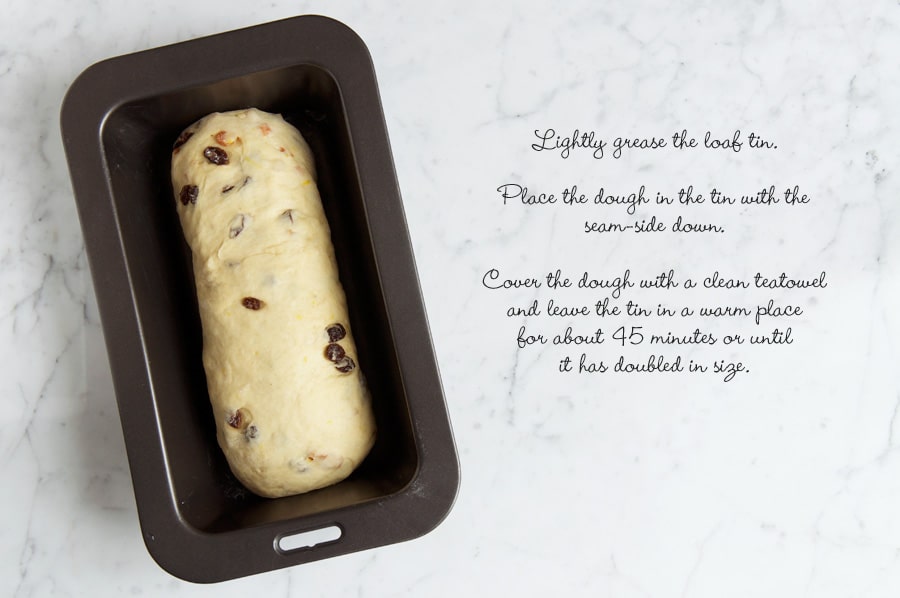
Lightly grease a loaf pan. Place the rolled up dough into the pan, with the seam-side facing down.
Cover the loaf pan with a clean tea towel, and place the pan somewhere warm for about 45 minutes, or until the dough has doubled in size.
Step 9
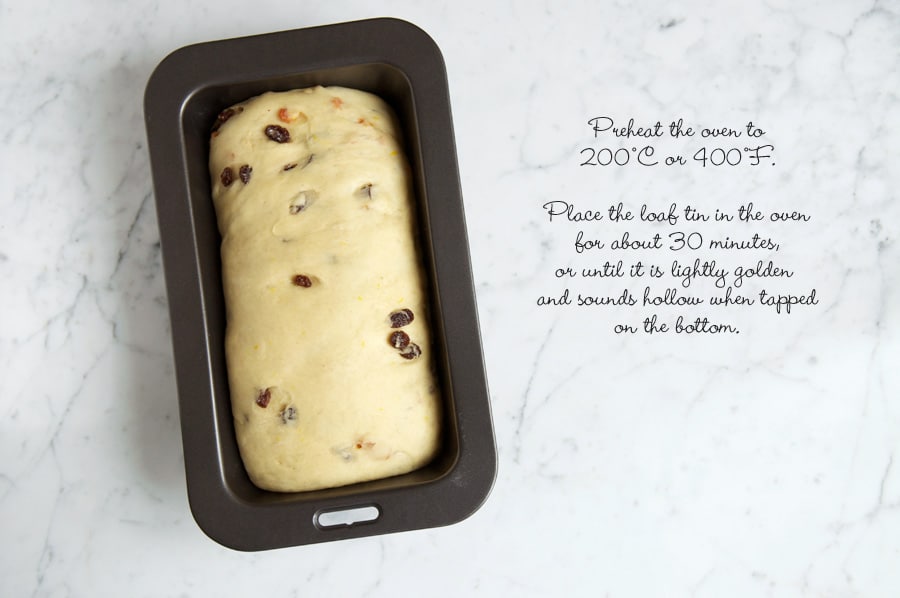
Preheat the oven to 200°C/400°F (without fan). Bake the fruit loaf for about 30 minutes, or until it is lightly golden.
If you have a digital thermometer, the bread is cooked if the internal reading is 85°C/185°F.
Step 10
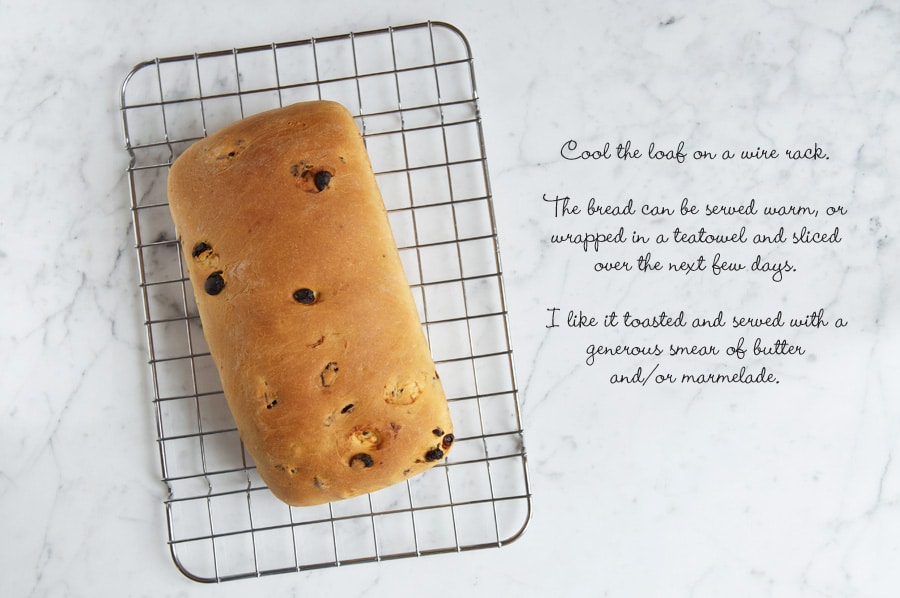
Remove the fruit loaf to a wire rack and let it cool a bit before slicing. The fruit loaf will be difficult to slice while it is still hot or warm, so it is best to let it rest a little.
Fruit Loaf

Ingredients
- 350 g (2 ⅓ cup) white bread flour
- ¼ teaspoon fine salt
- 2 teaspoons granulated sugar
- 1 ¾ teaspoon instant dried yeast, see Kitchen Notes
- ½ lemon, zested
- 55 g (½ stick) unsalted butter, melted and cooled slightly
- 150 ml (½ cup plus 2 tablespoons) milk, warmed to 37°C/98°F
- 1 egg, beaten
- 50 g (¼ cup) dried apricots, chopped
- 100 g (½ cup) raisins
Instructions
To make the dough
- Place the flour, salt, sugar, yeast and lemon zest in the bowl of a stand mixer or in a large mixing bowl.
- Add the melted butter, milk and egg.
- Mix everything together until the dough is smooth. This will take about 10-15 minutes using the dough hook, or a bit longer by hand.
First proving session
- Lightly grease a large bowl with some butter or vegetable oil.
- Shape the dough into a ball and place it in the bowl.
- Cover the bowl with a clean tea towel and set it aside somewhere warm for about 1 hour, or until it has doubled in size.
- Meanwhile, soak the raisins and dried apricots in some hot water. After about 45 minutes, drain the dried fruit and dry with some kitchen paper.
To shape the dough
- Once the dough has doubled in size, use your hands to punch it and knock it back.
- Transfer the dough to a lightly floured surface.
- Knead the dried fruit into the dough.
- Roll or flatten the dough into a rectangular shape, about the same length as your loaf pan, and about 1 cm or ½ inch thick. For this recipe, I use a standard loaf pan which measures 13 x 23 cm/5 x 9 inches.
- Roll up the dough and tuck in the ends.
Second proving session
- Lightly grease the loaf pan.
- Place the dough in the pan with the seam-side down.
- Cover the dough with a clean tea towel and leave the pan in a warm place for about 45 minutes or until it has doubled in size.
To bake the fruit loaf
- Preheat the oven to 200°C/392°F (without fan).
- Place the loaf pan in the oven for about 30 minutes, or until it is lightly golden and sounds hollow when tapped on the bottom. If you have a digital thermometer, the bread is cooked if the internal reading is 85°C/185°F.
- Cool the loaf on a wire rack.
- The bread can be served warm, or wrapped in a tea towel and sliced over the next few days.
Kitchen Notes
- MAKE AHEAD TIPS
To start the dough the night before:
* Make the dough as per the recipe.
* Place the bowl of dough (covered) in the fridge to proof overnight, or for at least 8 to 10 hours. During this time, it should have at least doubled in size.
* The next day, proceed with the rest of the recipe. As the dough will be cold, it may require a bit more time for the second proofing period. - DIFFERENT TYPES OF YEAST
* Please note that there is a difference between instant yeast (also called instant dried yeast or fast-action dried yeast) and dried yeast (also called active dry yeast). If you are not sure what type of yeast you have, please check the packaging for instructions on how to use the yeast.
* With instant yeast, you can add it directly to the flour mixture without having to activate it first.
* With dried yeast, you will need to activate it first as per the recipe above. - DIFFERENT TYPES OF FLOUR
For Swiss readers, I use Zopfmehl (or farine pour tresse) when making bread and enriched dough. - VARIATIONS
I like my fruit bread with more bread to dried fruit ratio, so I reduced the quantities of dried fruit in this recipe and restricted it to only raisins and dried apricots the first time I made it. On the second occasion, I added raisins and chopped dried figs. You can also spice up the bread with some ground cinnamon and/or ground cardamon. Really, the variations are quite up to you. - RECIPE CREDIT
Recipe adapted from Warm Bread and Honey Cake by Gaitri Pagrach-Chandra. This is a very simple fruit loaf – think white bread studded with dried fruit. But given it’s simplicity, it lends itself well to any personal variations which you desire. In terms of dried fruit, the original recipe calls for:
100 g / 3 1/2 oz currants
55 g / 2 oz sultanas (golden raisins)
2 tablespoons dried cranberries
1 tablespoon candied orange peel - OVEN TEMPERATURES
All recipes on this website state temperatures for a regular oven (i.e. a conventional oven without fan). If you have a convection oven with a fan, please consult the manufacturer’s handbook on how to adjust the temperature and baking time accordingly. - CONVERSIONS
To convert from cups to grams, and vice-versa, please see this handy Conversion Chart for Basic Ingredients.


Yum! I just finished eating some raisin toast and am now finishing the last of my cup of coffee. I think I might have to give this recipe a go later in the week seeing as I’m on holidays. I love fruit toast and your adaptation of this recipe looks lovely! Hold the mixed peel though!
I’m not a fan of mixed peel either! Despite being a bread recipe involving yeast, this was a surprisingly easy bread to make. But as with all recipes working with yeast, you just need to set aside some time for the two stages of proving the dough. So a perfect recipe to try when you are on holidays 🙂
This loaf is lovely! What a fun recipe!
Thank you! It was quite fun to make, given how easy the recipe was 🙂
Awesome pictures!! (especially the risen dough one & the prepared loaf cooling on the rack). I will have to keep coming back to admire them 🙂
It looks beautifully delicious, I can happily have 3-4 slices of this loaf smeared with marmalade for breakfast and a slice or two with butter during evening tea and one or more slices smeared with nutella for dessert after dinner! How about you?
You are right, this book is an absolute winner, thanks to Caroline for bringing this our notice.
Oh thank you! I like the photo of the risen dough too. I also took a photo once I punched back the dough, but it didn’t look too pretty then 😉
I have a fairly lengthy list of things to make from this book … hopefully I will get around to it soon! I see you have also had your nose in this book lately 🙂
How absolutely gorgeous! Nothing like a good fruity loaf hot from the oven.
I love your ingredients shot and the little cups that holds the items.
Thank you! I have an obsession with kitchenware and, thankfully, they’re getting a bit of use now as props in my photos 🙂
What a gorgeous post! This is the perfect recipe to do whilst on holidays.
Thank you! Indeed, holidays mean more time to linger in the kitchen and this fruit loaf is a real treat to make for breakfast the next day.
Spooky! I just made this this week Thanh and I’m smitten, as is hubby. I used just raisins, no candied peel and I definitely went with ground cardamom (and orange zest). The result was an almost hot cross bun effect and I am kicking myself for not trying it sooner. I’m thinking I might even make one each week so I can have it for breakfast everyday I love it so much. I love your photos here – the step by steps you do here are my personal favourite ones of yours. 🙂
Thanks Jo! Perhaps you like these photos because you are quite the keen bread baker yourself? 😉
I love that this recipe lends itself well to many variations. I think once you add ground cardamom and cinnamon, you have something quite close to a hot cross bun, which is nothing bad at all! On both occasions when I’ve made this bread, I made it on a Friday so that it was ready for the weekend breakfast. I think making it once a week sounds like an idea because it is rather quick and easy (if you manage to plan the proving times well).
What a stunning post ! It’s made my day..I love to always READ you.And today’s reading made me realize how we women folks miss this fabulous meal of the Day ! Even when we are aware of the magic it brings…You are absolutely right.
And the loaf,It’s just PERFECT !
I’m happy to hear that my post gave you a good start to the day 🙂 You so often hear how busy people tend to miss the most important meal of the day, but I never really stopped to think *why* it was the most important meal of the day. In such a short time, breakfast went from being non-existent for me during the week to my favourite meal 🙂
I like it!!! It’s perfect for breakfast!!
Happy Monday 😉
Hi Manu! Yes, this is definitely a bread which is perfect for breakfast, but I wouldn’t say no to a slice for afternoon tea, either 🙂
Gorgeous pictures as usual! I don’t like fruit in my bread but yours looks so nice that I would give it a try (that says a lot for me!). Breakfast is my favorite meal of the day too even though I tend to eat the same thing every morning: toasted slices of my own bread (that I make using the no-knead recipe) with a bit of butter and cenovis (the local Vegemite)..yum, sooo good! If I feel fancy, I will replace the butter and cenovis with slices of avocado, a poached egg and a drizzle of balsamic vinegar..very delicious too.
I don’t normally like dried fruit. In fact, I detest fruit cake of most sorts. But fruit bread seems to be something quite different for me, provided that it is not too dense with dried fruit. So the great thing about making your own fruit bread is adding as little or as much dried fruit as you like, and also using whatever dried fruit you like.
You sound so virtuous to have homemade bread everyday! I wish I could have the same!
So Cenovis is Swiss Vegemite?? I never knew that … I really ought to try it!
Yes, Cenovis is a Swiss vegemite-like paste and it’s very popular in the French-speaking part of Switzerland (much less so in the rest of the country from what I noticed). I made a taste comparison with the British version (Marmite) and Cenovis was the clear winner 🙂 Not sure how different it is from Vegemite but you should definitely try it. It can be found in all Coop and Migros stores (most have at least the tube version, bigger stores also carry the small tub version which I prefer since it lasts me a lot longer and costs less).
Most people think it involves a lot of time to enjoy homemade bread every day but actually it doesn’t at all. I bake one loaf a week (usually on Sunday), slice it, wrap a couple of slices separately in foil and freeze. Every morning I just throw my still frozen slices in the toaster and voila, delicious breakfast in seconds!
You have me all curious about Cenovis! I’ve always seen it at the supermarket but didn’t know what it was. I find it rather interesting that many Coop stores now stock Marmite regularly. If only they knew that Vegemite tastes better 😉 And I’m intrigued that you prefer Cenovis over Marmite!
I love how you make your own bread once a week. I wish I could be as diligent, although my husband and I go through a loaf per day. But you’ve given me the idea of perhaps making this fruit bread and freezing it in slices, ready to toast. We, unfortunately, have one of those teeny tiny bar-fridge freezers so we can’t fit a lot in there, but there’s definitely room for sliced bread. Thanks for the tip!
You’re so right, breakfast is such an important meal and one people completely overlook. This fruit loaf looks absolutely gorgeous – I’d happily eat it for breakfast or smothered in butter for afternoon tea 🙂
It’s so easy to skip breakfast, isn’t it? But once I got into the mindset that it doesn’t have to be a leisurely meal like it might be on the weekends, I realised that it was totally doable during the week. Everyone should find at least 5-10 minutes for a quick bite in the morning.
Oh yes – the little people are going to love this. I love the step by step shots, really classy and such a good idea. I picked more artichokes this weekend and am cracking on with your suggestion tomorrow as home alone!!
Oh good on you! I love nothing more than a whole artichoke to myself for a solitary meal 🙂 Enjoy!
I love breakfast so much, but as you, at work-days, I also value more sleep a little more.
I tried to solve this at weekend 😛 And this bread sounds nice to do it, the toast reminds me when I toast panettone, it has to be delicious!!!
Oh I love toasted panettone! I’m looking forward to Christmas when the shops here are filled with an assortment of panettone. My favourite is one that is soaked with limoncello. It obviously is not one I would toast as it remains rather moist from the alcohol 🙂 But I think I love toasted panettone because, yes, it does remind of toasted fruit bread too.
Breads stuffed full of fruit like this are one of my favorite breakfasts too. Looks wonderful!
Hi Thanh!
I love fruit bread… Normally I just use a hot cross bun recipe done in a loaf tin, but I’ve not tried different fruits before. I think it might be time! And my favourite photo of this post is the 2nd last one 🙂
Hi Anna!
I’ve also once made a loaf out of a hot cross bun recipe … that is definitely an idea. Would it be wrong to make hot cross buns when it’s not Easter?? This mention of hot cross buns has me craving some all of a sudden! And I fondly remember the chocolate hot cross buns from Brumby’s … mmmm …
Oooooh lovely pics Thanh. I might try this loaf using whole wheat, I’m supposed to stay off white flour and don’t want to miss out all the yummy stuff. I love fruit in my bread, well I love any kind of bread, I could live in a house made of bread 🙂
I tend to skip breakfast when I’m feeling lazy or just busy but now I’m making smoothies and I make granola bars so that I can have a quick snack. I used to think making bread was so difficult but once you get the hang out it you just can’t stop and the possibilities are endless.
I’m also a big fan of bread 🙂 Whilst I like nearly all types of bread, I have a soft spot for crusty baguette … if I ever get my hands on one which is fresh from the oven, it takes a lot of willpower to not eat it right away!
You could most definitely substitute the white flour in this recipe for wholemeal or whole wheat. And you are right about how easy it is to make bread. I think once you get the hang of working with yeast, it’s all rather simple. I can’t wait to experiment more.
I agree, breakfast is also my favorite meal. I have made a similar loaf to this, tasted a bit like hot cross buns. Absolutely lovely.
Oh yes, fruit loaf can taste a lot like hot cross buns once you add ground cinnamon, cloves and/or other spices. As I mentioned above, I have a serious craving for hot cross buns now!
I like the new format of how you show each step in pictures! My favorite part of yeast baking is watching the dough rise! It’s like pillow magic!
I am of the same opinion: breakfast is the best meal of the day. I look forward to it the moment I fall asleep at night.
Whenever I check on the dough and see that it has risen beautifully, I am first relieved that the yeast is actually active, and then I am in awe because, as you describe, it’s like magic.
You allude to a good point … if breakfast is one’s favourite meal of the day, it makes getting out of bed in the morning much easier 🙂
Oh bless! Hey, likewise, I’m on here for daily inspiration too!
I just ADORE your stages shots, you really do have a knack for it and the perfect background! The rising loaf looks perfect, so smoooooth! Glad you made it and more importantly, enjoyed it.
I wish I were more of a breakfast person. I suppose I can be, depending on the food! Cereals are an absolute no-no, but a masala dosa and hot chutney will have me running down the stairs in no time!
WBHC is filled with such easy-to-work-with doughs so if anyone is worried or nervous about yeast, it would be the recipes from this book that I would recommend. She is, I think, deliberately unspecific about timing, which I think is an advantage to the home baker, as you have no choice but to lean on instinct. For me, it’s the most satisfying type of baking.
Ooh, an Indian-inspired breakfast would also have me hopping out of bed pronto!
To be honest, I felt a bit in the dark with the lack of timing in this recipe. As someone who only makes bread once in a blue moon, I would have preferred a bit more guidance on how long to knead the dough, roughly how long to wait before the dough has risen, etc.
If this fruit loaf was my first ever attempt at making bread, I think I would have found it really difficult. But because I’ve made bread before, I knew that the dough had to be kneaded for at least 5 minutes or so until it was soft and elastic in texture. Likewise, I knew that dough would require roughly an hour or so to double in size. So I’ve included my own timings in the recipe above, just in case it is helpful to others who are not so familiar when working with bread and yeast. You are perhaps a more instinctual baker than others 🙂
Hmmm, I haven’t considered that point before! I suppose breads are very much a product of the environment. The quality/activeness (is there such a word??) of the yeast, the temperature of the room etc, not to mention humidity and it all affects the bread. I wonder if that’s why she left out timings. Usually, she explains texture or describes the outcome needed as a guide. The thing is if she mentioned an hour, but it takes upto two in your kitchen, it’s a panic striken extra hour lol! The Duivekaater in the recipe took FOUR hours to rise, something she didn’t mention and I’m quite glad she didn’t cos I know I’d be flapping about the kitchen trying to decide to follow instinct or instruction.
Yes, yes I know, I am extremely biased!!! LOL!
LOL!! As I mentioned before, I think you have better instincts in the kitchen than others 😉 Goodness, if something took 4 hrs to rise and I didn’t know that in advance, I probably would have aborted the recipe. But you are right that there are many variables to take into consideration. As my stepfather is a baker, I’ve always known that bread-making requires a warm room temperature, something which many books don’t mention other than to “let the dough rise in a warm place”. In the absence of knowing this, it could take much longer for a dough to rise in one kitchen compared to another. But you are the real champion of Warm Bread & Honey Cake … I have so many recipes I want to try but so little time at the moment. Thankfully I can drool over your photos instead 🙂
Haha! Well live vicariously, for the moment 🙂 Richard Bertinet says the same and has a good, if perhaps wasteful tip (depending on how you use it). He says to get the oven on full whack before you start making the dough. That way, the room heats up to the right temperature (between 20 -24 deg) for proving. Too warm a room, like an airing cupboard, ferments the dough apparently. But I’ve found that it’s the ‘state’ of the dough that counts more than the time really. I do hope you get time to give some more recipes a go but that’s a debatable at present lol! The Appeltaart is gloriously, comfortingly good and oh, you would SO make a beautiful post with it.
i doubled up on all the ingredents and made 2, i uesd plain flower and it worked ok. not bad for my first loaf.
thanks
You were smart to make two loaves! Happy to hear that it worked out for you 🙂
Excellent recipe! I’ve made it a few times and added different dried fruits and more ground spices. But overall, a great base recipe to follow. The step by step photos were very helpful too.
Yum!!
As a fellow Zürich-Aussie, when I was looking for a fruit bread recipe to try (man, I miss raisin toast) I knew I had to try yours. Totally delicious – I like mine fruity & spicy, so I fiddled with it, but the base recipe is *amazing*. Thank you!
Hi Jody! Oh that’s really wonderful to hear! Yeah … I really miss raisin toast too ? Coop used to sell a nice fruit loaf in their bakery section which was great for toasting, but it lacked the spices you normally get with raisin toast back in Australia. I still really liked it and was disappointed that they discontinued selling these loaves a few months ago. I would definitely up the spices in this recipe and glad you played around with the recipe to your liking. Thanks for popping by!
This recipe looks incredible! This is the perfect breakfast for me! YUM!
Holiday baking extravaganza with my 10 year old…. we are adding chocolate!
this was my first try it was a little solid not very light my yeast isn’t new could that be a reason or something else
Hi Sharon,
It’s always best to work with fresh ingredients, so if your yeast was old, that would prevent the loaf from rising and, hence, why you might have had a dense loaf. I hope you will give this recipe another try soon!
Hi! Can you make this fruit loaf without eggs?
Hi Anita,
Sorry, I’ve never tried this recipe without egg or with an egg substitute.
Mines in the bin. 🙁 I followed the recipe, I had to warm in oven as no where to prove. But still my dough did not double in size. I added the fruit and attempted to prove again but no change. I went for the bake, hoping it would be ok. All I got was a stodgy inside, the middle on the outside was sunken. Although it smelt nice, I didn’t dare feed any of my family with it. Not sure where I went wrong.
Hi Laraine,
Sorry to hear that your fruit loaf did not work out. It sounds like there was something wrong with your yeast. Did you activate your yeast first and did the mixture froth like that shown in the photos? Also, if your yeast has passed the expiry date, that could also be a problem. Generally, if the dough does not rise after the first session of proving, that is a sign that either the yeast is not working and/or that you need more time for it to rise (depending on how warm the conditions are). Another thought is, if your oven was too hot when you were using it to prove the dough, the heat can also kill the yeast. I hope this helps.
I made this fruit loaf twice this weekend and I love the recipe! The second time, I added more ground cinnamon and more dried fruit. Thank you for such an easy recipe – the step by step photos were very helpful. I will be making this fruit loaf very often.
Made this yesterday for brunch and it turned out great. Next time, I will add more spices but it this is a good base recipe to work from. I used dried yeast and had no problems with the dough rising but I had to put the bowl near a radiator as our home is fairly cold. Thanks for the recipe. Looking forward to trying more of your recipes.
Such an easy, lovely recipe. Thank you!
So glad you enjoyed this fruit loaf recipe! 🙂
Thanks for the recipe, i follow it and my first time white bread which is fluffy, i baked for 20 minutes only instead of 30 minutes! My first success fluffy bread as compared to others i made with tesco breadmaker which is too hard to pull!
That’s great to hear that this fruit bread recipe worked well for you!
Simply delicious. I reduced the raisins and added more apricots. The dough was quite wet after adding the soaked fruits which was worrisome but it actually turned out really well. Thebread was moist and soft. The recipe is a keeper.
Hi Nadia,
I’m glad to hear that the recipe worked out for you 🙂 I like a lot of dried apricots in my fruit bread too.
It’s also good soaking the fruit in tea and using mixed spice 1 teaspoon and ½ teaspoon of cinnamon
Hi Anthony,
Soaking the dried fruit in tea is a great idea! Thank you for your suggestions 🙂
Please could you advise me how to use fresh yeast in this recipe and the quantity required?
Many thanks.
Hi Susan,
I have only made this Fruit Loaf using instant yeast. For fresh yeast, I recommend referring to this guide here: https://www.thespruceeats.com/baking-yeast-dry-and-fresh-yeast-measurements-1446706
I hope this helps!
This worked really well, thanks very much.
Hi Cat,
Glad to hear that you enjoyed this fruit loaf recipe! Thanks for popping by 🙂
Best fruit loaf that I have ever made! Thank you so much for sharing! I am making more now!!!!
Hi Fiona,
That’s great to hear! Enjoy your fruit loaves!
Thank you for this recipe. I am also an Australian living in Switzerland, and whenever anyone asks what food I miss from home, I always reply that I miss eating raisin toast. But this really hits the spot and fulfils that craving. It’s so tasty!
Hi Andrew,
Lovely to hear from a fellow Australian 🙂 I’m with you on the raisin toast … it’s the only reason why I started making my own fruit bread at home. Thanks for trying out this recipe!
Can you do a overnight rise in the fridge and bake the loaf next morning?
Hi Lilian,
Yes, you can do an overnight rise in the fridge.
For an overnight rise for the first proof: place the dough in a large bowl, cover the bowl, and place it in the fridge overnight. The next morning, let the dough come to room temperature before proceeding with the rest of the recipe.
For an overnight rise for the second proof: shape the dough and place it in the loaf pan, cover the loaf pan, and place it in the fridge overnight. The next morning, let the dough come to room temperature before baking as per the recipe.
I hope you will enjoy this recipe!
Milk warmed to blood temperature????
Blood temperature is about 37°C/99°F 🙂
This is a really nice recipe, thank you. The loaf is lovely fresh and great toasted – and lasts surprisingly well.
I added 1/2 tsp of mixed spice and it tasted just like the bread my grandmother dished up at tea time!
Hi Becks,
Thank you for your comment! So glad to hear that you could make something that reminds you of your grandmother’s baking 🙂
Hi, I followed the recipe and ingredients carefully but before I put it to the first proving, it felt quite dry and definitely did not smooth out like in your pictures. The yeast was ok and I have used the same brand in other recipes with no problems. Has anyone else had this problem?
Nice and easy! I did use glaced cherries instead of apricots, and I liked how the dough is not too sweet! I would say though if you’re going to talk about different yeast that you should put a little note that it is NOT nutritional yeast that’s used! I know better, but I see on a few forums that some people are confused about this.
Hi Deb,
Thank you for your feedback! I’m glad you enjoyed this recipe too.
I am mixing by hand, how to mix yeast into flower to get it to a smooth dough
My dough was dry.
Hi Audrey,
It sounds like you needed to add a touch more liquid to your dough. Flour absorbs liquid at a different rate. If your dough is too dry, you just need to keep adding a dash of liquid until you have the right consistency. Hope this helps.
Could this loaf be made by hand?? Dyeing to try it . Sounds delicious!!!
Hi Vanessa,
Yes, of course you can make this bread by hand. It will take a bit longer by hand, and the dough will be quite sticky from the butter and eggs, but it is definitely doable if you don’t mind a bit of upper-body workout. I used to make dough by hand before I bought my stand mixer 🙂 Hope you will enjoy this recipe!
Lovely recipe. I add cinnamon. Family and friends ask me to make it regularly. Thanks for sharing.
Hi Paul,
Thank you for your wonderful feedback! That’s so great to hear that your family and friends love this recipe 🙂