

 by
by Plain Scone Recipe
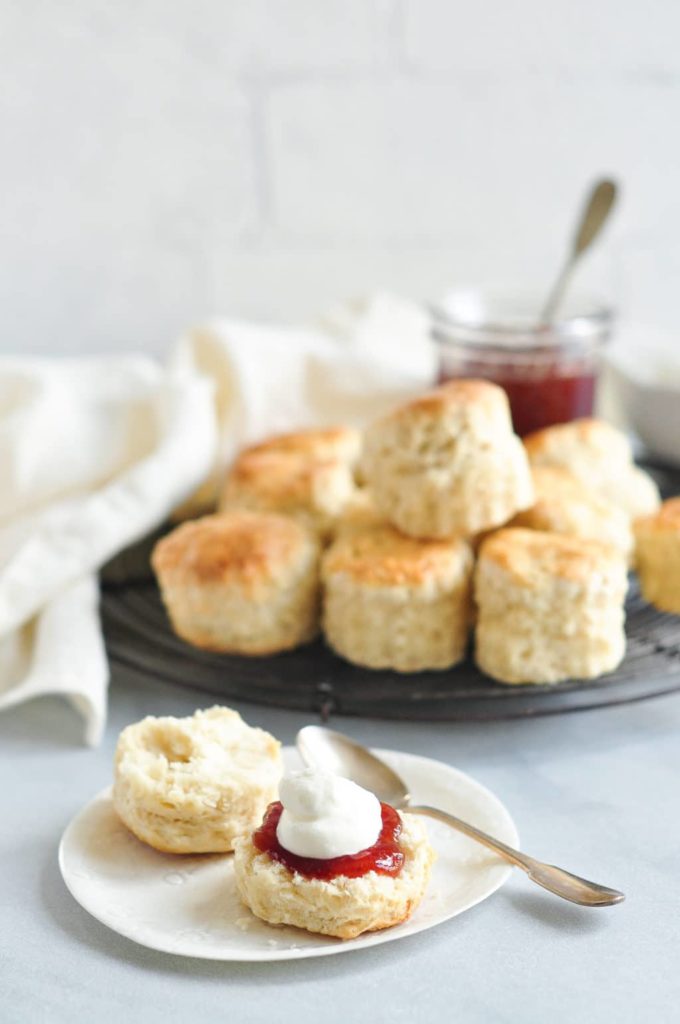
When I was in London a few years ago, I was reminded of my fond affection for Devonshire Tea, which is essentially a plain scone served with jam and cream.
As scones are not widely available in Zurich, I made it my mission to eat as many scones as I could, in between visiting the museums and shopping on the High Street.
I adore the British ritual of having High Tea in the afternoons, which I think is just a fancy version of afternoon tea, goûter or fika in other parts on the world. There is something just so comforting about sitting down to a hot cup of tea (with milk and sugar for me), with a small selection of sweet cakes to see you through the afternoon.
And for me, if I can have a warm scone with my tea or coffee, I am in heaven.
Why This Recipe Works
- These scones take a mere 10 minutes to put together.
- These plain scones are deliciously light and fluffy.
- You can freeze a batch of these scones and bake them from frozen.
Easy Scone Recipe
Scones are really easy to make and, if you don’t mind getting your hands a bit dirty, it’s possible to make a batch of scones and have it ready to serve in less than 30 minutes.
For a really long time, my favourite (and only) scone recipe came from Nigella Lawson’s How to be a Domestic Goddess, called Lily’s Scones.
Nigella’s recipe produces really lovely fluffy scones and I would wholeheartedly recommend this recipe to anyone. The only drawback for me with the recipe was the use of cream of tartar, an ingredient which is hard (sometimes impossible) to find in Zurich, but which I know is widely available in countries like the UK, US and Australia.
Recently, in the spirit of exploring more recipes, I started experimenting with other scone recipes and eventually arrived at my own easy recipe for scones.
How to Make Scones
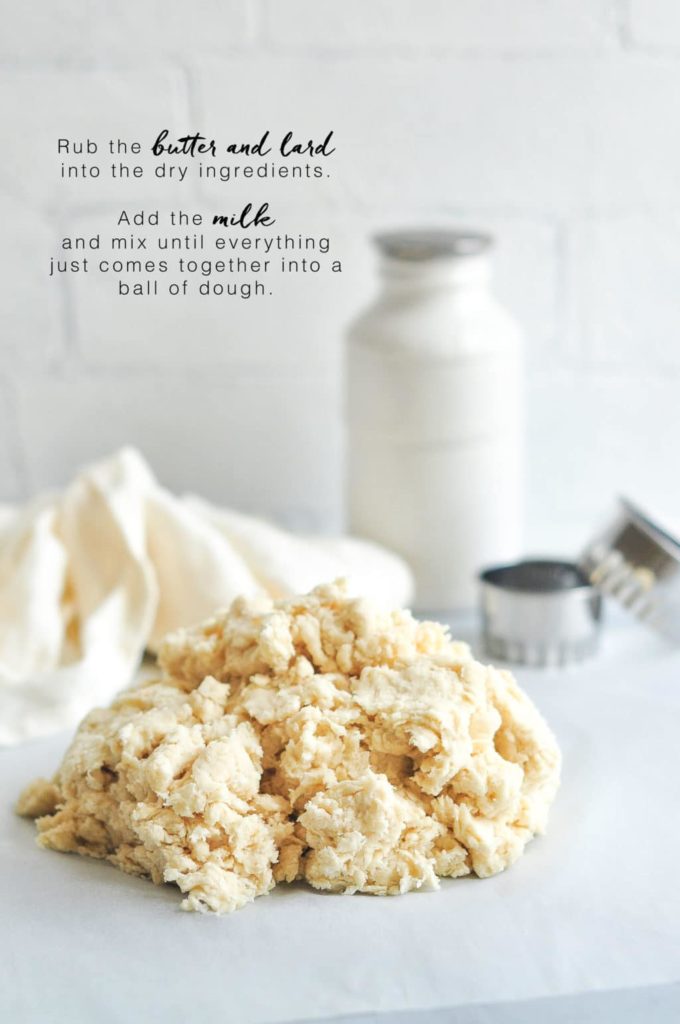
To make plain scones, you start by rubbing cold butter into the dry ingredients until the mixture looks crumbly and resembles wet sand. I also use lard or vegetable shortening to make the scones extra soft. For this task, I like to use my stand mixer with the flat paddle attachment, but you could of course simply use your fingertips.
Milk is added to the dry ingredients to bring everything together into a soft dough. At this stage, you should handle the dough as little as possible to ensure that the scones turn out light and fluffy. Over-working or handling the scone dough too much will result in tough scones.
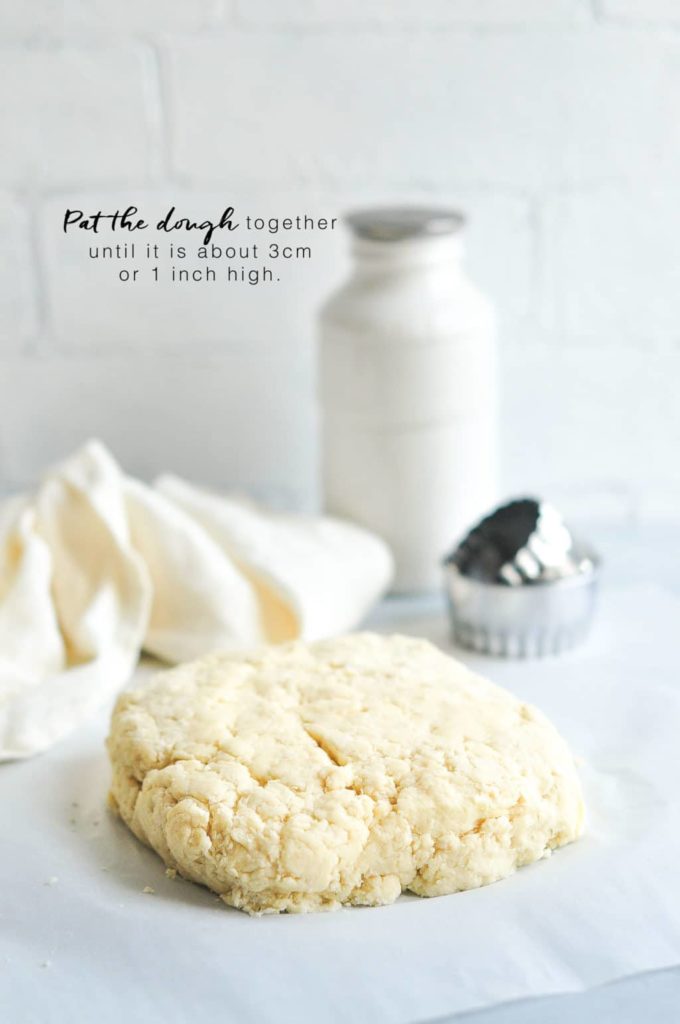
Once the scone dough has formed, I use a patting motion to shape the dough into a rectangular or square shape, about 3cm or 1 inch high.
You should never knead the dough as you would risk over-working the dough.
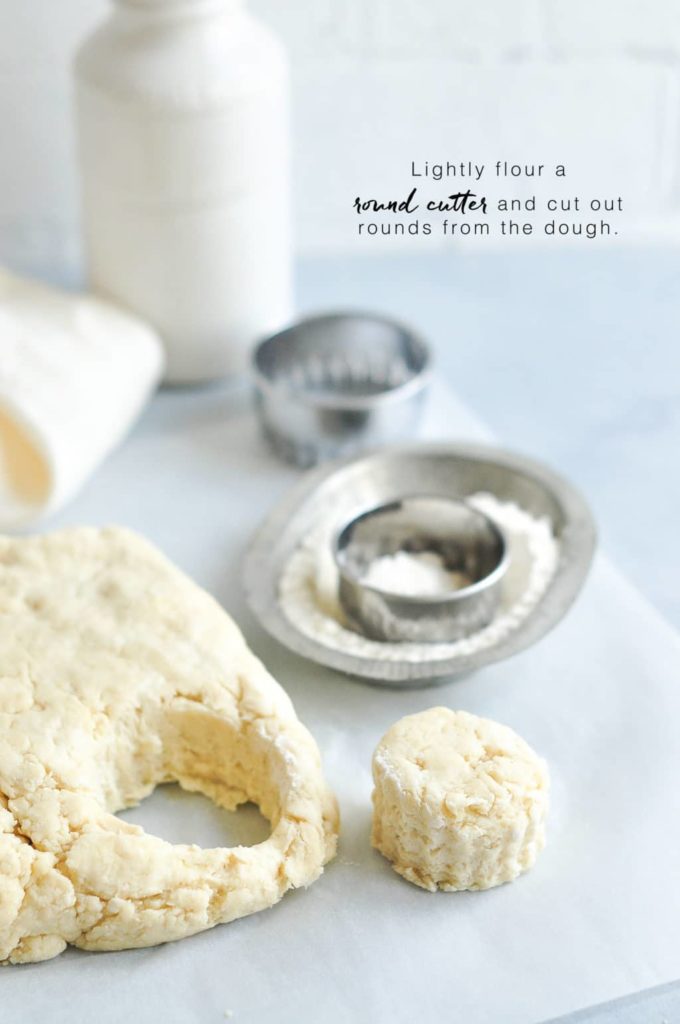
You can make the scones as big or as small as you like. I usually use a fluted cookie cutter or scone cutter, but you could also use a plain cutter, or even a small glass jar.
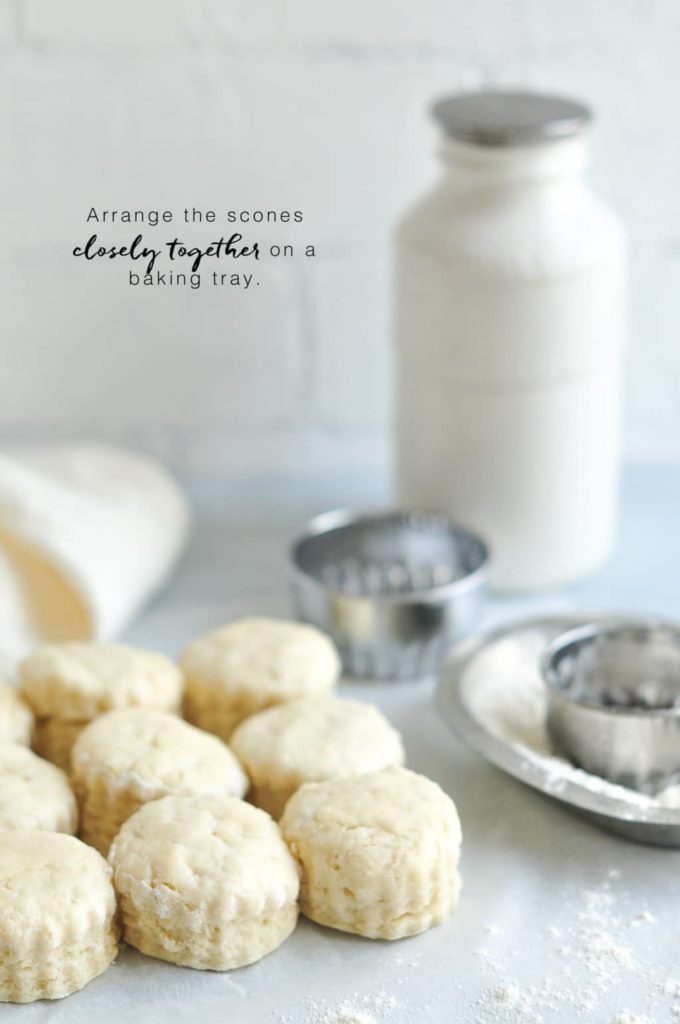
For really soft scones, I like to bake them close together so that they expand and stick together as they cook, thereby ensuring a greater soft and fluffy surface area.
Wrapping the hot scones in a clean tea towel will also help to keep the scones soft by trapping steam to prevent a hard coating from forming.
But if you like the crunchy coating on scones, I would bake the scones spaced apart on the baking tray so that they bake individually.
More Scone Recipes
- To make Fruit Scones, simply add a handful or more of raisins or sultanas.
- Date Scones are an Australian classic. Please see my recipe for Date Scones with step-by-step photos.
- For a Cheese Scone or Savoury Scone, I would omit the sugar from the recipe below, and add about 75 g (1/2 cup) grated cheddar or Gruyère.
- Make Pumpkin Scones by adding adding pumpkin purée to the recipe below. Please see my recipe for Pumpkin Scones for more details.
How to Eat Scones
I didn’t know that the topic of how to eat scones was a contentious one, but apparently it is!
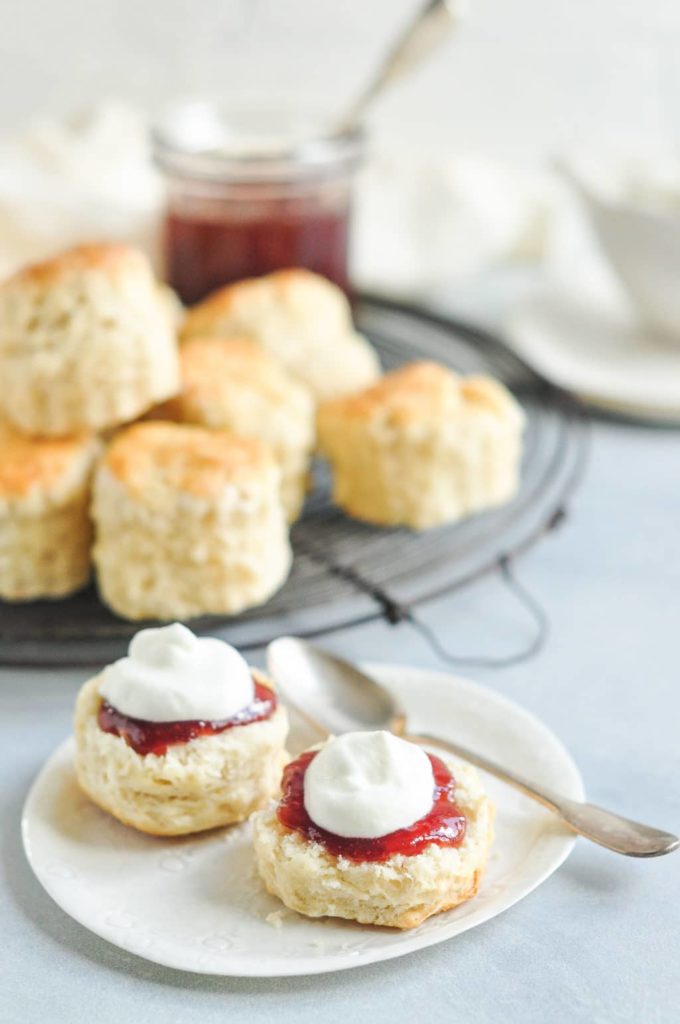
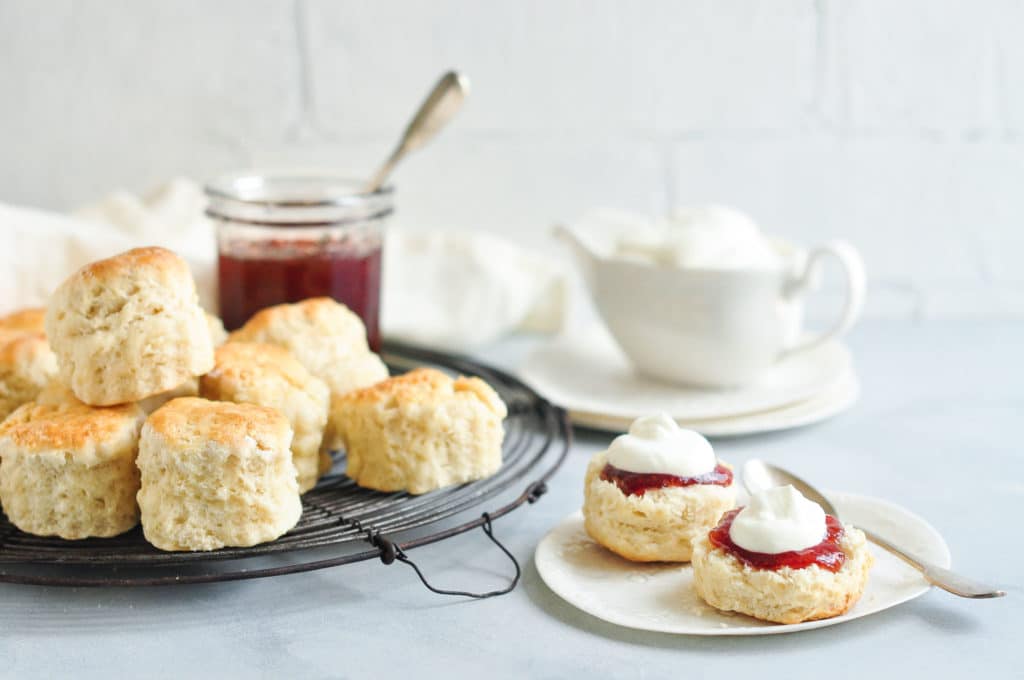
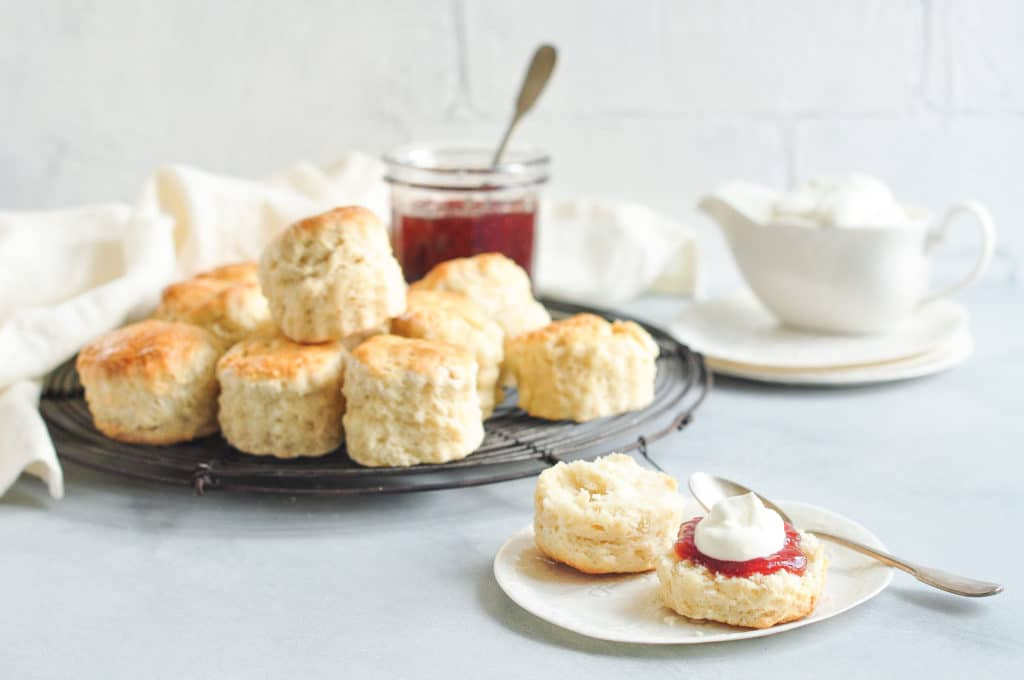
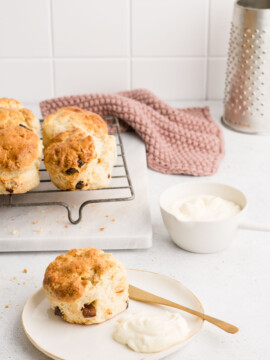
My way of eating a scone is to gently split it open with my hands, thereby allowing all of the fluffy layers of the scone to be intact. If you were to use a knife to cut the scone, you would effectively flatten the layers inside the scone.
Next, you should place a small amount of jam onto each half of the scone, followed by a good dollop of clotted cream, whipped cream or Chantilly cream. If you place the cream onto the scone first, the jam would simply slide off and eating your scone will become a messy affair!
However, if you are skipping the cream altogether, I would suggest a generous spread of butter on the scones, which would melt into the scones if they are warm, followed by a topping of jam.
What to Serve with Scones
The following recipes would be perfect for serving with a batch of plain scones:

Plain Scones

Ingredients
For the Scones
- 500 g (3 ⅓ cup) plain flour, (all-purpose flour)
- 6 g (1 teaspoon) fine salt
- 25 g (2 tablespoons) caster sugar, (superfine sugar)
- 10 g (2 teaspoons) baking powder
- 50 g (½ stick) unsalted butter, cold and cut into cubes, see Kitchen Notes
- 25 g (1 ½ tablespoons) lard or vegetable shortening , or simply use butter
- 250-300 ml (1 cup plus 3 tablespoons) milk
For the Egg Wash
- 1 egg
- 1 tablespoon milk
For the Chantilly Cream
- 250 ml (1 cup) double cream, (heavy cream)
- 1-2 teaspoons caster sugar, or vanilla sugar
Instructions
For the Scones
- Preheat the oven to 220°C (430°F) (without fan).
- Place a baking tray in the middle shelf of the oven to warm up while you are making the scones.
- Place the flour, salt, sugar and baking powder into the bowl of a KitchenAid or stand mixer.
- Add the butter and lard (or vegetable shortening), and briefly mix with the flat paddle attachment until the mixture resembles damp sand. Alternatively, you can do this by hand by simply rubbing the fats into the flour with your fingertips.
- Slowly add the milk and quickly mix everything together. You may not need all of the milk – just add enough milk until the mixture just comes together into a rough dough. Try not to overwork the dough as this may lead to tough scones later.
- Place the dough onto a floured work surface and pat it into a rectangle or circle shape about 3 cm (1 inch) high.
- Cut your scones with a round cutter. You could also use a teacup or small glass to shape your scones. Dip the cutter into some flour to prevent the dough from sticking to it.
- You can make the scones as little or as big as you like, adjusting the baking time accordingly. I use a 6 cm (2.5 inch) crinkle-edged cookie cutter to make fairly small scones.
- Lightly re-shape the dough as necessary, but try to handle the dough as little as possible.
- Arrange the scones closely together on a baking tray.
- Make an egg wash by lightly beating together the egg and milk.
- Brush the scones with some egg-wash.
- Bake the scones in the oven for about 10-15 minutes (depending on size), or until they are lovely and golden.
- You may need to test a scone to make sure that it is fully cooked through in the centre. A digital thermometer inserted in the centre of a scone should read about 85°C (185°F).
- These scones are best served hot or warm, but they are also lovely served at room temperature.
- Serve the scones with some Chantilly Cream (recipe below) and strawberry jam.
- To stop the scones from developing a hard crust as they cool, cover the warm scones with a clean tea towel. The steam trapped under the tea towel will help to keep the scones soft.
For the Chantilly Cream
- Place the cream and sugar into a large bowl and whisk until until soft peaks form.
- The cream should be soft, but still be able to hold its shape.
Kitchen Notes
- SMALL BATCH
This recipe also halves well to produce a smaller batch of scones. - USING FROZEN BUTTER
You can use frozen butter in this recipe and simply grate it into the dry ingredients. - MORE SCONE RECIPES
Date Scones
Pumpkin Scones
Raspberry & Almond Scones
Raspberry Scones with Homemade Clotted Cream - STORAGE TIPS
The scones are best eaten right away, or at least on the day of baking. But I find that if you individually wrap them in clingfilm, they still taste quite fresh one or two days later. - FREEZER TIPS
The scones can be made ahead of time and stored in the freezer. Simply prepare the scones as per the instructions above until Step 9. I like to freeze 2 or 4 scones together in a small zip-lock freezer bag for easy handling. To bake, simply proceed with the remaining instructions above using the frozen scones (there is no need to defrost them first), but they will require an extra 5-10 minutes in the oven (depending on size). - OVEN TEMPERATURES
All recipes on this website state temperatures for a regular oven (i.e. a conventional oven without fan). If you have a convection oven with a fan, please consult the manufacturer’s handbook on how to adjust the temperature and baking time accordingly. - CONVERSIONS
To convert from cups to grams, and vice-versa, please see this handy Conversion Chart for Basic Ingredients.
Did you make this recipe?
Please leave a comment below and share your photos by tagging @eatlittlebird on social media and using #eatlittlebirdUpdate
This recipe was first published on 21 September 2012. It has been updated with new photos and more comprehensive recipe notes.
More Scone Recipes


Scones – yes! A definite favourite of mine. Your recipe is very different to mine though and I shall have to give it a try. I use a simple 2 cups of SR flour and 1 tbs of caster sugar with 40g of butter rubbed in before cutting through 3/4 to one cup of milk. It is very simple and healthy but not decadant. I make scones wiht my Year 9s every year. Many of them produce some decent results with this recipe, but some of them come out with rocks when the over knead and work the mixture! Your strawberry jam recipe sounds great. Strawberries are cheap here at the moment so I may need to test your jam recipe too!
Your recipe sounds lovely and simple, and easy to remember as well. Self-raising flour is not available where I live so I tend to go for recipes with baking powder added, or a combination of bicarb and cream of tartar. I remember making scones as a kid at school and loved it! It’s a recipe which uses so few ingredients, and common ingredients at that, that it’s a good way of getting kids involved, I think. I know there are a million and one recipes for strawberry jam out there, but this one worked well for me so I wanted to share it 🙂
My favourite scone without a doubt is Rachel Allen’s from Bake, ironically enough! I did not get along with Lily’s scones – they were very soda tasting and step monster spat it out when I made them for her and my dad! There’s a Pat Val in Liverpool but I’ve never ventured in. I love still warm homemade scones so much I would be scared of a mass catering joint messing them up lol! Am not much of a patisserie fan either but I know you are Thanh so it must be better than I think! I can’t wait for a blog post about London from you – pleeeeease do do one. I bet it would be exquisite 😀
Funnily enough, I haven’t noticed the scone recipe in Bake! Must look that up now … And shame that Nigella’s scones did not work out for you. I find them to be quite light and fluffy and they work everytime for me. That said, I would be interested in trying new recipes just to compare!
The scones from Patisserie Valerie were really buttery and lovely. I don’t think they make them fresh each day, but as they are served warm, it’s hard to tell. For me, they hit the spot 🙂
I’m afraid I didn’t take as many photos in London as I ought to have, so my London post will be quite short … it just means that I have to go back soon! 😉
Ah Scones! love them and they always remind me of London which was my home until 2 years ago when we moved back to India.. and what I love about them is that scones are a perfect playground.. I don’t think there is any count on the different types of scones that one can make 🙂
Cheers,
Ashima
There is something very English about scones, isn’t there? The Americans have their “biscuits” which are quite similar, though they tend to be more on the savoury side. I would never say no to a side of biscuits with fried chicken 🙂
And you are right about the variety. I particularly love pumpkin scones and, as pumpkins are coming into season, I might need to make a batch soon!
now I have a craving for scones! These look great!
Well they take hardly any time to make 😉
These have to be some of the best looking scones I have ever seen, definitely have to give them a try 🙂
A scone a day keeps the doctor away, right?
Oh thank you!! And I like your philosophy … something I would happily live by 😉
wow Thanh, What a treat! I love scones but have never tried making them at home. I am tempted to do so very soon! Though, I have made the American version of it.. ‘biscuits”.
The jam looks delicious too !
I think biscuits and scones are pretty much the same thing … both are easy to make and very easy to eat! This mention of biscuits has me craving fried chicken with gravy all of a sudden, LOL!!
It seems nice that Patisserie Valerie 😉
And, I think I have already said it to you, but I love scones!! And they’re great as breakfast with jam, but at home, we have used even for a hamburguer!!!
Nice photos 😉
Wow, you are right … scones can be quite versatile! In the US, they often serve scones (or biscuits) at breakfast, split with bacon and a fried egg in the middle. It’s delicious!
Thank you for this detailed recipe. I have never had luck making scones. Everyone who hears me says its the easiest thing to do but I fail every time. I’m going to give this one a go. I always find them tough as bricks because of never knowing how much liquid it’s going to take and in turn kneading too much.
I think the trick is to avoid over-working the dough – the less you touch it, the better! Having said that, I was also very light-handed with other recipes but they still turned out tough. Perhaps it was the ratio of ingredients. These scones are quite light, perhaps due in part to the bicarb and cream of tartar. Good luck the next time you make them!
Could be the cream of tartar which I never used. I will let you know for sure.
Certainly will try this recipe. My mother makes the most divine scones, her secret she swears is using slightly sour milk!! Anyhow it seems to work, that and cooking them in an Aga – !
I’ve been curious to try scones using buttermilk. Nigella has a recipe in her book, Kitchen, which I have been eyeing for some time. Thanks for reminding me! And I’m sure an old-fashioned Aga would make a lot of difference for many cakes … I’m envious of anyone who has an Aga.
This post takes me back to the time when I had just started baking. I was finding my baby steps through the strict measurements and baking time matrix and one of the first things I attempted was chocolate chip scones. they turned out delightful that fueled by ambition to try something more daring. I haven’t looked back since.
Scones taste amazing when they are just out of the oven.
Yours look so delightful and the jam is something I would quickly buy if it were for sale.
you should have an online sale or something, if possible.
Ooh, I love the sound of chocolate chip scones! I think scones are one of the first things that a lot of Australian kids learn how to make at school. As my parents ran a bakery when I was growing up, I didn’t make scones so much at home because there was always a constant supply at the bakery! I also love eating scones straight from the oven … I love my food piping hot, so a fresh scone with a nice smear of butter is heaven to me!
And thank you for your lovely comments about my jam 🙂 I’ve contemplated making and selling jam but it is perhaps not the most economical business in Switzerland, LOL! But my neighbours get to profit from my jam exploits so that we don’t always have to eat the same flavoured jam week in, week out. Plus it’s nice to be able to share 🙂
Ooh yum I love scones – yours look like perfect little specimens!
Oh my, what a perfect combination. I love to add a bit of whipped cream on the side.
I fell in love with scones in London too, just couldn’t have enough of them. I was brave enough to try two versions, one using buttermilk and the other using lemonade back home and I was pretty pleased with the result. I’ve never tried Nigella’s but your post made me want to try them out. Scones with cream and lots of jam, yum yum yum 🙂
You lucky thing, to grow up in your parent’s bakery and now I want to move next door to you just so that I’d be able to sample your delicious treats 😀
Oh lemonade sounds interesting! I would be curious to try such a recipe, too.
I’d like to think that my neighbours are happy to sample my baking here and there but, more often than not, I’m worried that I’m force-feeding them fatty food, LOL!!
These pictures are beautiful! I’m actually studying in London right now (for the fall term), and if you’d love to visit a really adorable little café with a phenomenal scone, try Bea’s of Bloomsbury! I literally just visited yesterday and am completely enamored with it. Thanks for the recipes as well-I’m a student on a budget so simple recipes like this are so appreciated 🙂
Thank you for the tip! I will have to seek out Bea’s of Bloomsbury the next time I am in London (hopefully soon :-)). Scones are indeed very economical and can also be very filling, something which I also discovered when I was a student. Good luck with your studies!
Yum! This is such a classic British recipe, executed so beautifully here.
I love how incredibly chic your blog is, a real treat for the eyes 🙂
Oh thank you! I hope you will enjoy your visits here 🙂
It’s way past midnight and I’m considering making some scones! I just love them and they’re so easy! It took me a while to make them work, though. But I now I have two recipes I can trust – maybe I’ll have a third, after trying yours 😉
What is cream of tartar? I’m from Belgium and have no idea what this is 🙂
Would love to make some scones myself!
Thanks!
Hi Sarah,
Cream of tartar is a raising agent. It’s not commonly available or used in Europe, I’m afraid. I buy my cream of tartar from specialty shops which stock baking goods from the UK and US. Hopefully you will find some in Belgium so you can try this lovely recipe.
I bet those flavors are amazing! it really impresses. I can’t WAIT to try this! Thank you for this great recipe!
Oh dear ! Exactly my cup of tea ! Thank you so much !
You’re welcome! Enjoy!
Thanks for sharing! Do they keep long?
Hi Vanessa,
These scones keep for a few days when wrapped in plastic.
I haven’t made the scones yet but I wanted to comment on a small mistake you have made. High tea is a meal eaten with a knife and firk and especially popular with children e.g. scrambled egg on toast or beans on toast. The meal with a pot of tea and scones etc. is called afternoon tea.
Thanks for re-publishing this recipe. I love the idea of being able to freeze and bake later.
Thank you! I hope you will enjoy this recipe 🙂
Hi Thanh,
I was just wondering how long can the chantilly cream last in the fridge?
Hi Brenda,
The chantilly cream can last a few days in the fridge, covered with plastic wrap. I generally don’t keep it longer than 1-2 days in the fridge. Hope this helps!
Wow. These scones!
I’ve never made scones before and so was looking for a recipe that was easy to follow without needing 100 ingredients. Safe to say I don’t think I will be looking elsewhere for another recipe as these scones came out so beautifully!
Couple of notes, I had only semi-skim milk but thought I’d risk using that anyway, plus I had no eggs so only “eggwashed” with a few brushes of my milk which may have affected the flavour a little, but they still came out wonderfully fluffy and taste great! Definitely making more!
Thank you for this recipe!
Thanks for the recipe! These scones were perfect. I wish I had made a double batch!
These look so good! They are so cute and simple! I love that it is versatile too!
Thanks for sharing! Does it matter whether I use fresh or dried fruit?
Absolutely wonderful, and simple, scones!
Hi Sarah,
So glad to hear that you love this scone recipe 🙂
Easy to make
Hi Gail,
I’m glad you enjoyed this recipe!
These scones are so simple and fabulous! I added a honey glaze and nuts to some which was lovely as well as some cheese to others. Definitely recommend 🙂
Hi Phoebe,
I’m happy that you enjoyed this recipe! I love the tweaks you made to some of the scones as well – what a great idea to serve a small variety!
Made this for my morning tea. Absolutely wonderful recipe. The tips were extremely helpful too. Thank you for passing on your knowledge and secrets!
Hi Faith,
You’re welcome! So glad you enjoyed this recipe. Scones with morning tea sounds pretty perfect to me!
You can actually eat scones either way. Neither is right or wrong, however, clotted cream is preferable.
Cream then jam is the Devonshire way.
Jam then cream is the Cornish way.
Personally, I prefer the former.
Best scones are those found in independent bakeries and tea rooms, not the chains such as Patisserie Valerie where they are mass produced and not freshly baked on the premises.
Next time I make scones I’ll give your recipe a go. Agree, the secret to light, fluffy scones is in the handling, ie minimal and definitely no kneading.
Simple and taste really good
Easy to make and delicious!
Beautiful scone recipe! I made two batches for afternoon tea today and they disappeared in a flash!
Yummy
My favourite scone recipe! I now double the recipe so that I can keep some in the freezer. Nothing beats a warm scone with clotted cream and jam!
Cream of tartar is called Weinstein Pulver here.
The only scone recipe I use now. Delicious!
Beautiful scone recipe. I’ve made them several times now. Thank you!
Best scones ever!!! My daughter, who lived in Edinburgh, for a while, says they rival the ones there! Highest compliment ever!
These are the most wonderful scones! Absolutely perfect!
Beautiful! I baked a double batch today to watch the Queen’s Platinum Jubilee and they disappeared within seconds! I will be baking more this weekend.
These were absolutely delicious scones. One of the best recipes I have tried. Thank you!
I just visited Devon and Cornwall this summer so I was excited for more scones back in cold Germany. I was not disappointed, the Scones are super buttery and light, just perfect. They don´t crumble up at all too. I had some black current yam and a microwave version of clotted cream (which is not like the original, but keeping the oven on for so long costs one heck of energy). Now I can have a proper Cream tea party whenever I feel like it. Thank you!
Hi Caro,
I’m so glad you enjoyed this recipe! I’m curious to try the microwave version of clotted cream – thanks for the idea!
Simply delicious! I highly recommend this recipe!!
I’ve made this 3 times already. I’ve been testing with other scone recipes and this one comes up as favorite in our home.
Hi Carmen,
I’m so glad you and your family enjoy this recipe 🙂
Would like to make GLUTEEN FREE SCONES and would love to have a recipe that is GLUTEEN FREE
Your help would be much appreciated
Turned out lovely, just like good British scones should taste and looked like (I used vegetable lard in addition to butter). Thanks for the easy recipe and the good descriptions!
Hi Hannah,
So glad you enjoyed this recipe! Yes, this recipe works great with vegetable fat too, which I have more often at home than proper lard 🙂
Great easy recipe. These scones turn out beautifully each time.
Hmmmm yum! Just made these and are eating with strawberry jam and clotted cream. Very easy recipe, and they turned out perfect! Have saved this recip.
I’m so glad you enjoyed this recipe! Strawberry jam and clotted cream are also a must for me 🙂
Awesome. Very easy and cost effective.
Hi Alvan,
So glad you enjoyed this recipe!
I have been making scones since l was 10 years old now l am 80. In recent years l have found the texture of the scones are rather dry and not as fluffy, What improvements should l make to improve this.
Hello,
Dry and tough scones can be due to over-working the mixture, so I recommend to try and handle the scone dough as little as possible, i.e. as soon as the mixture comes together into a cohesive ball of dough, you should stop mixing/kneading the mixture. My other tip is to use lard for soft, fluffy scones. I hope you will give this recipe a try!
i like your recipe can you please send e biscuits recipe
I tried this recipe and it was absolutely divine. My entire family loved them and it was very easy to make. My daughter tried to make them and she ended up making them for her food tech assessment. Well done!
Hi Savannah,
Wow! That’s so great that your daughter made these scones for her assessment – I hope she passed with flying colours! ❤️ Thank you for sharing the news with me!
I loved the recipe, they came out fine
Hi Hellen,
So glad you enjoyed this recipe!
so do u have a recipe where you dont add milk to the scones