

 by
by Given the amount of jam which my husband and I go through (about 1 jar of Bonne Mamam per week), it’s rather surprising that I only recently got into jam-making. For a long time, I always thought that you needed a gluttony of fruit in order to make jam. And in Switzerland, a gluttony of fruit comes at an extortionate price.
I recently had some good friends from Germany come to stay with me at rather short notice. They had been hiking in the Swiss alps but were forced to abandon their trek due to bad weather. So they wound up at my place, thoughtfully bringing with them a box of apricots which they bought on the way down the mountain (and a bottle of sweet wine for hubby).

There were more apricots than I could eat on my own, not to mention that I was going to be in Cardiff for several days. So I dug out some cookbooks to look up different recipes for jam, and surprisingly discovered that I didn’t need a lot of fruit after all to make a few pots of jam. In fact, it is recommended to make jam in small batches in order to retain more flavour. The various recipes which I came across all had a common blueprint – equal weight in fruit and sugar, some water to cook the fruit in, and some lemon juice to help the jam to set.
My first attempt produced a fairly good batch of jam, perhaps a little too thick in consistency but still easily spreadable.
My second batch turned out beautifully 🙂 And now that I am hooked, I don’t think we will be buying jam ever again. In fact, I find myself looking at the fruit bowl in a new light! Watch this space for more jam recipes!
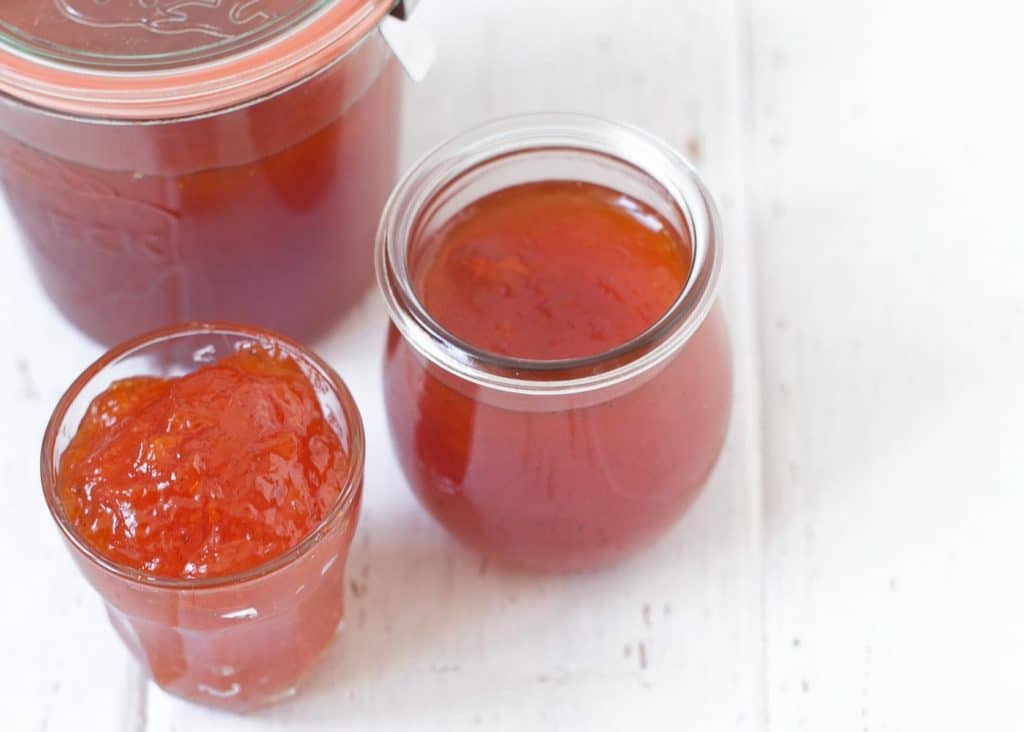
Apricot Jam

Ingredients
- 700 g (1 ½ lb) apricots, ripe or frozen
- 30 ml (2 tablespoons) water
- 1 vanilla bean, optional
- 700 g (3 cups plus 3 tablespoons) caster sugar, (superfine sugar)
- 80 ml (⅓ cup) lemon juice
Instructions
- If you are using fresh apricots, remove the stones from the apricots and roughly chop the fruit.
- Place the apricots and water into a medium and deep saucepan, and simmer over medium heat for about 20 minutes, or until the apricots have completely softened and cooked through. Stir frequently with a wooden spoon.
- If you do not like small chunks of fruit in your jam, keep simmering until the apricots have more or less broken down into a smooth purée.
- If you are using a vanilla bean, split the vanilla bean and scrape out the seeds, and add both to the saucepan.
- Stir in the sugar and lemon juice, and bring the mixture to the boil.
- Once the jam has come to the boil, reduce the heat to medium and simmer for about 15 minutes until the mixture has thickened. If you are using a sugar thermometer, the temperature should reach about 105°C (225°F).
- While the jam is simmering, use a large metal spoon to skim off any foam from the surface.
- Remove the vanilla bean.
- Pour the jam into warm, sterilised glass jars and seal. Once the jars have cooled down to room temperature, place the jam jars into the fridge (or a fairly cold and dark larder) until ready to serve.
Kitchen Notes
- To sterilise glass jars, I simply wash them on the hottest cycle in the dishwasher, and I pour the jam in the jars while they are still hot.
- I should mention that most recipes call for the jam to be cooked until the temperature reaches 105°C (225°F). However, my sugar thermometer sometimes don’t reach that temperature, even though it has reached setting point. So I recommend to just keep an eye on the mixture as it is bubbling away – if it starts to look like it has thickened but your thermometer has not reached 105°C, you should take the pan off the heat.
-
OVEN & STOVE TEMPERATURES
All recipes on this website have been tested on an induction stove and/or with a conventional oven (i.e. an oven without fan). All recipes on this website use temperatures for a conventional oven, unless otherwise mentioned. Convection ovens (i.e. fan-forced ovens) are typically 20°C/70°F hotter than conventional ovens, but please check your manufacturer’s handbook.  CONVERSIONS
To convert from cups to grams, and vice-versa, please see this handy Conversion Chart for Basic Ingredients.
 CONVERSIONS
Its so rewarding making your own!! This looks so delicious as well
The photos are stunning. Looks delicious
There is such, may I say, smug satisfaction to be derived from making your own jams! I love it and its far superior to anything bought I feel. Lovely of your mates to bring you a box of them Thanh…oh and I absolutely ADORE the Weck jars! 😉
*Smug* … that was the word I was looking for! 🙂 And I love Weck jars too, not just for their lovely design but they happen to quite cheap over here! I can’t wait to stock up on some more.
Oh my gosh, it looks amazing!
I’m like you were in that I feel that one needs a huge glut of fruit to make jam, it’s nice to hear that that’s not the case!
Hi Anna! Maybe you’ll try your hand at making some jam too? If you and your family eat a lot of jam, it’s certainly worth the effort 🙂
I usually get bitten by the jamming bug around this time of year, and this year is no exception – I made one pot (yes, just one 250g jar) of blueberry jam with blueberries from my garden. Used to accompany some freshly baked scones with clotted cream, I can safely say this is another pot of jam that won’t be around for long!
I much prefer to make my own jam and now the wild blackberries are almost ready, need to dig out all my saved jam jars and stock up on sugar…
Enjoy all your future jammin’ sessions Thanh, great reward for very little effort.
Claudine x
Hi Claudine! Ooh blueberry jam sounds delicious! And how much more satisfying that the fruit came from your garden! We recently moved apartments and now have two balconies, so I’m doing a bit of research to see what fruit and veg I can grow on the balcony. I hope berries will be on the list!
The great and wonderful darina allen says you can make jam with as little as one punnet of fruit. I love making it either with bargain fruit from the supermarket (three punnets of red currants for 50p) or abundance from my trees. Any which way the joy of making your own is unsurpassed. Yours are simply stunning :o)
Oh thank you, Julia! Indeed, it can be quite cost-effective to make jam from bargain-priced fruit. I’m just happy to know that I don’t necessarily need kilos and kilos of it! And as you are the pro at making jams and preserves, I would welcome any tips you might have!
This jam looks so delicious! I adore home made jam but I hardly ever make it myself..I’m beginning to wonder why not! Although having said that, I have tried a few jams from Nigella’s HTBADG and they were all lovely. Also good to know you don’t need to have a massive glut of fruit to make jam.
Hi Nicola! I’m now trying to decide what type of jam to make next, especially before a lot of the stone fruit and berries start to go out of season. Thanks for reminding me about HTBADG … I’ll have a browse now 🙂
As always, nice photos!!
Even if there are some jam brands I love, I always enjoy making my own at home!! And one of my favourites is apricot vanilla jam, if I have vanilla bean, I always think about making a jam!!
This week I want to make a fig (perhaps with pear) jam 🙂 I want to be ready for the new season!! 😛
Sometime ago I used to make the jam with lemon juice, sugar, and a little of apple, but now, at a German shop I can find the gelificant sugar, and it’s easier for me 😉
Can I say again that I love how you make so cute photo of a simple thing???
Thank you, Paula!!
I made apricot jam again this week and it was my first time using sugar with pectin added (gelificant zücker). I assume that you still boil the jam until 105°C? I guess we’ll find out!
I would love to make some fig jam also. The combination with pear sounds wonderful! Do you have a special recipe that you use, or generally equal quantity of fruit to sugar? With my apricot jam this week, I used half the quantity of sugar as I realised that we would probably eat the jam pretty soon. It was nice to use less sugar for once 🙂
Than, my gelificant sugar doesn’t ask for any specific temperature, it indicates only time and texture.
In terms of quantities, I use two gelificant sugars, same brand, and one asks for 3 parts of fruit for each one of sugar, and the other has a ratio of 2 parts fruit for one sugar. I prefer 3×1 cos the texture is the same, but the taste is more fruity. However, depending on the fruit you use, is better one or the other 😉
Wow, I don’t explain very good in english, I fear 😛
Perfectly understood! 🙂
Silly me … I didn’t read the instructions on my packet of gelificant sugar! So I boiled it until it read 105°C. It looks a bit on the thick side, but I think it is ok.
I also prefer to use less sugar as you can definitely taste more of the fruit. As we tend to go through our jars of jam very quickly, I don’t think we need to use equal weight in fruit to sugar.
I’ve noticed that figs are everywhere at the moment at the markets and in the supermarkets. I hope to make some fig jam soon! Thanks for the inspiration 🙂
Oh my goodness this look absolutely amazing! It truly looks delicious! Thank you for sharing this great recipe!