

 by
by 
Züricher Geschnetzeltes
Züricher Geschnetzeltes (or Zürcher Geschnetzeltes) is a popular dish in Switzerland, particularly in and around the Zurich region.
Pronouncing the name of the dish in German is a bit of a mouthful, even more so in Swiss German, the latter being Züri Gschnätzlets.
It is often translated on the local restaurant menus as “Zurich-style veal”.
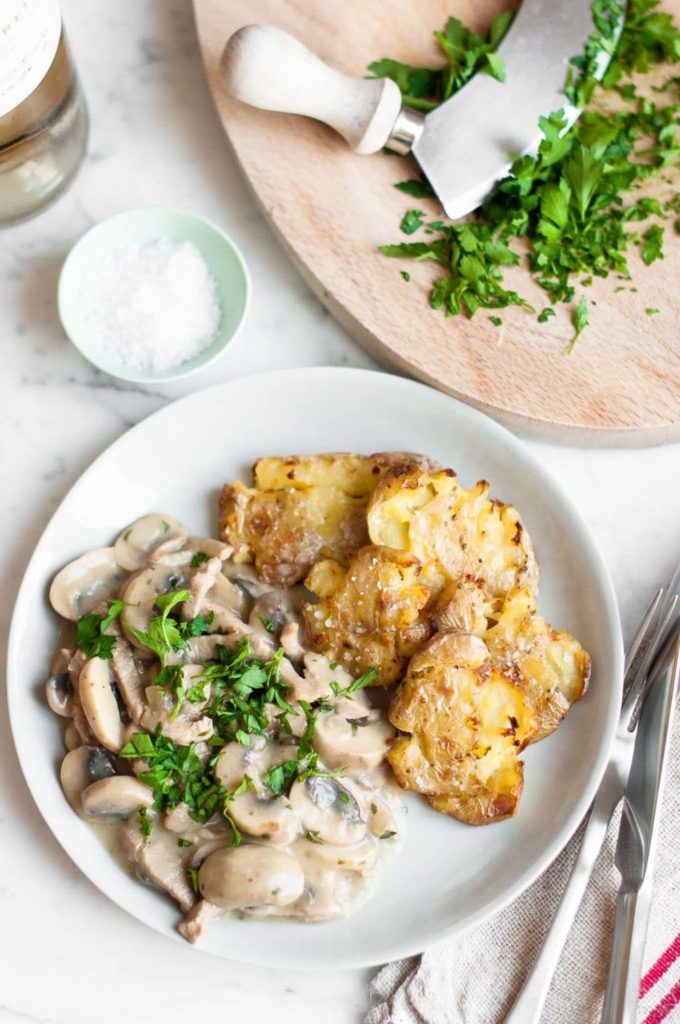
Veal in a Creamy Mushroom Sauce
This classic dish from Zurich consists of thinly sliced veal fillet, served with a creamy mushroom sauce.
Some restaurants also include kidneys in their recipe, but the dish is almost always served on a bed of golden and crispy Rösti, which is a large potato cake or hash brown made from grated potatoes.
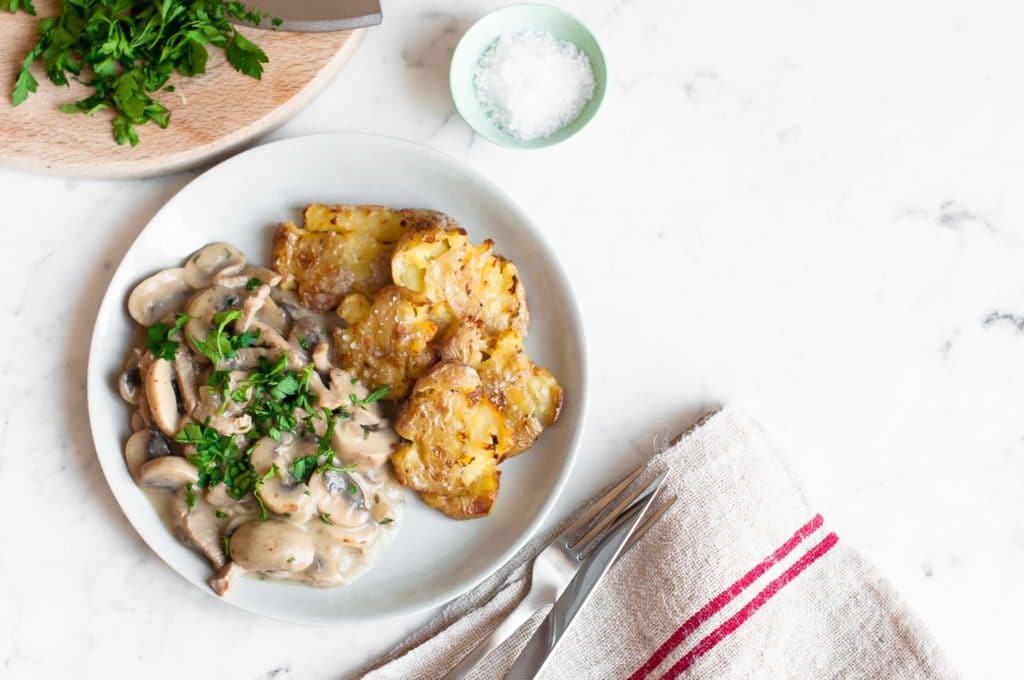
How to Eat Züri Gschnätzlets
Züricher Geschnetzeltes is almost always presented in two serves in restaurants, allowing the diner to enjoy the meal while it is still piping hot.
This means that while you are enjoying the first serve, the remainder of the dish is kept warm for you on the side until you are ready to help yourself to more.
Züri Geschnetzeltes Recipe
Züri Geschnetzeltes is a quick and tasty dish to make at home. This recipe, which is adapted from Betty Bossi, a popular Swiss food magazine and cookbook publisher, is a local favourite.
I’m not a big fan of meat-heavy dishes, so I like to add a lot more mushrooms to my version of Züricher Geschnetzeltes. You can play around with the quantity of veal and mushrooms as you wish.
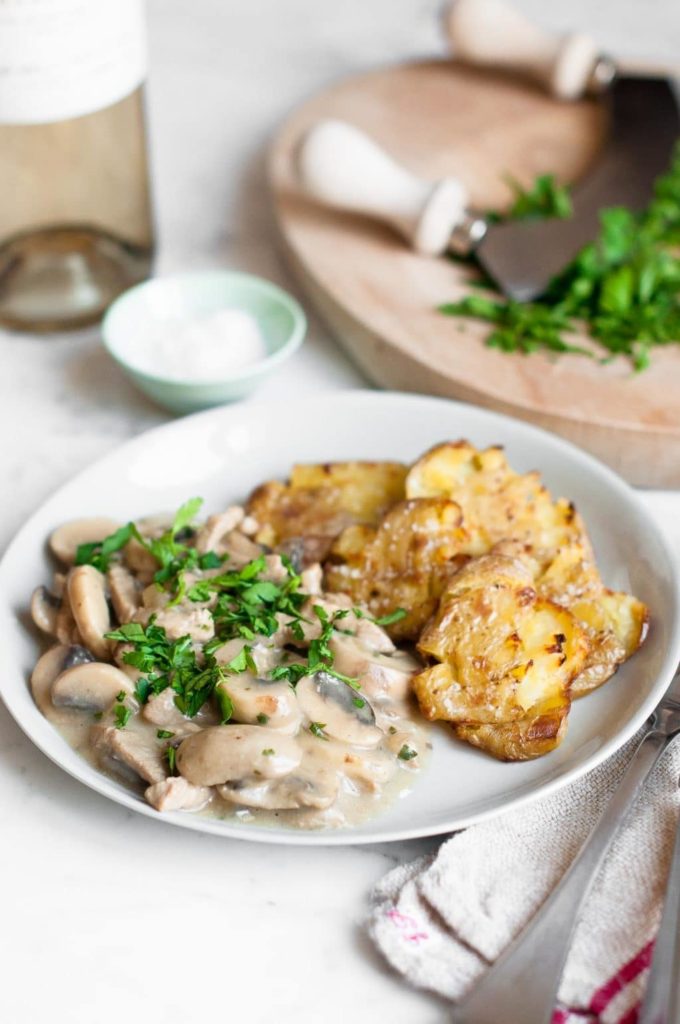
Smashed Potatoes
This dish is best paired with Rösti but my lazy alternative at home is to serve it with Smashed Potatoes.
Smashed Potatoes are simply boiled new potatoes which you lightly squash with a fork or a potato masher, drizzle over some olive oil, sprinkle with some sea salt and then bake in a hot oven until they are bronzed and golden.
This is my way of jazzing up cold, leftover boiled potatoes – a fabulous recipe from Jill Dupleix which I came across in an early issue of Delicious magazine.
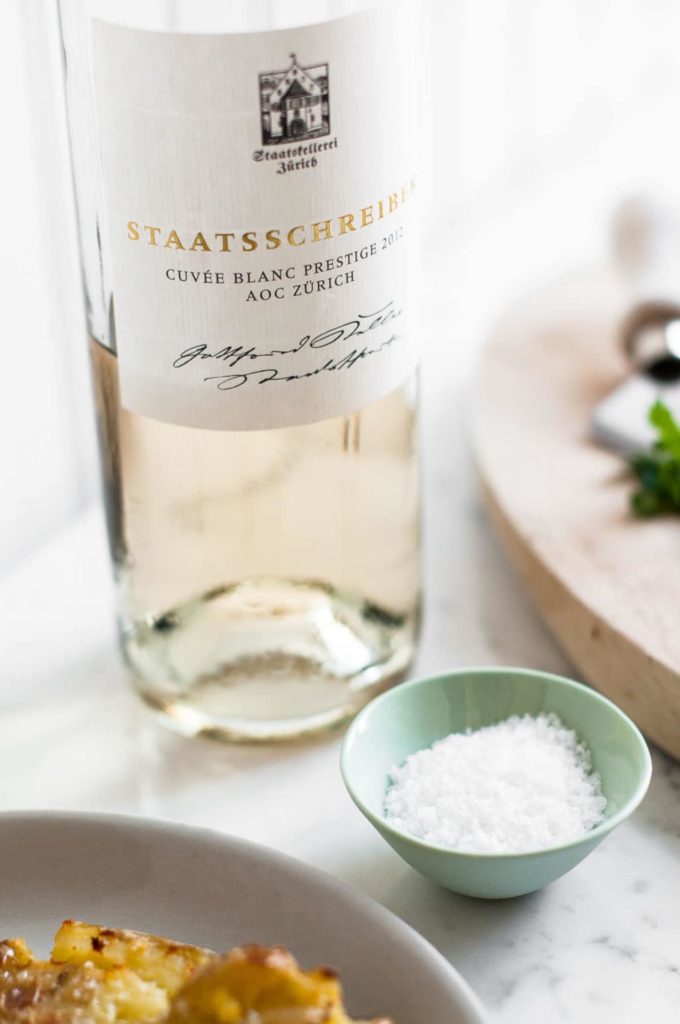
How to Serve Zürcher Geschnetzeltes
You could also serve Zürcher Geschnetzeltes with rice or pasta (such as linguine or tagliatelle), and this option is often also available in the local restaurants as a “lighter” alternative to the traditional Rösti.
This dish also works superbly as a pie filling and topped with puff pastry … just don’t tell the Swiss!
En Guete!
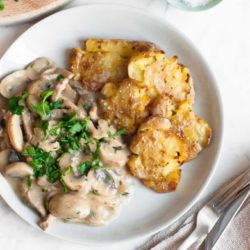
Zurich-Style Veal with Creamy Mushroom Sauce

Ingredients
For the Zurich-Style Veal
- 400 g (14 oz) veal fillet, thinly sliced
- 2 tablespoons unsalted butter
- 500 g (1 lb) white mushrooms, thinly sliced
- 1 small brown onion, finely chopped
- 1 garlic clove, finely chopped
- 125 ml (½ cup) dry white wine
- 250 ml (1 cup) double cream, (heavy cream)
- 125 ml (½ cup) chicken stock, or beef stock
- 1 tablespoon cornflour, (US: cornstarch)
- sea salt
- black pepper, freshly cracked
- flat-leaf parsley, finely chopped
For the Smashed Potatoes
- small new potatoes, boiled (the amount depends on how many you want to serve per person)
- olive oil
- sea salt
- black pepper, freshly cracked
Instructions
For the Zurich-Style Veal
- Heat 1 tablespoon of butter in a large frying pan.
- Sauté the veal in batches for a few minutes until they are just cooked.
- Use a slotted spoon to remove the meat to a bowl and set aside.
- Add the remaining butter to the pan and cook the mushrooms, onion and garlic until they have softened.
- Add the white wine and let it bubble away for about 1 minute.
- In a small jug or bowl, mix together the double cream, stock and cornflour (cornstarch). Add this liquid to the pan and let everything simmer gently for a few minutes.
- Taste for seasoning.
- If the sauce is too thin, add more cornflour (cornstarch) by making a slurry – simply dissolve about 1 tablespoon of cornflour (cornstarch) in a small bowl with 1 tablespoon of water. Pour this slowly into the pan and stir until you have the right consistency.
- If the sauce is too thick, you can thin the sauce with some boiling water or cream.
- Return the meat to the pan and stir it through the sauce for about 1 minute to warm through.
- Sprinkle with parsley before serving.
For the Smashed Potatoes
- Preheat the oven to 200°C (400°F) (without fan).
- Arrange the potatoes on a large baking tray.
- Use a potato masher to gently squash each potato. Try not to flatten them completely as you want some lumpy and uneven bits which will become crunchy upon roasting.
- Drizzle some olive oil over the potatoes.
- Generously sprinkle over some sea salt and freshly cracked pepper.
- Bake for about 30-40 minutes (depending on the size of your potatoes), or until they are lovely and golden.
Kitchen Notes
- SMASHED POTATOES
Cold leftover boiled potatoes are great for transforming into Smashed Potatoes. If you are boiling potatoes specifically for this recipe, I would suggest letting them cool for 10-20 minutes before proceeding with this recipe. - OVEN & STOVE TEMPERATURES
All recipes on this website have been tested on an induction stove and/or with a conventional oven (i.e. an oven without fan). All recipes on this website use temperatures for a conventional oven, unless otherwise mentioned. Convection ovens (i.e. fan-forced ovens) are typically 20°C/70°F hotter than conventional ovens, but please check your manufacturer’s handbook. - CONVERSIONS
To convert from cups to grams, and vice-versa, please see this handy Conversion Chart for Basic Ingredients.
Did you make this recipe?
Please leave a comment below and share your photos by tagging @eatlittlebird on social media and using #eatlittlebirdUpdate
This recipe was first published on 14 January 2014. It has been updated with new photos and more comprehensive recipe notes.


Oh, Thanh, you know I was hoping to see that Zürcher Geschnetzeltes. Thank you!! I can’t wait to try it!! Love that!!
I saw on Facebook that you have had a good time thes days, glad for you!! 🙂
I bought lots of things of Betty Bossi on Switzerland. But, you know? What a pity!! Didn’t find the thing (truc must I say??) to make Spätzle!! But next time (because it will be next time) maybe find and buy also book or magazine of her.
It’s funny to me that you say you like to add mushrooms because some meat dishes are heavy. I say this, because, to me, it seems that sauces and dishes with mushrooms (although I love them) make heavier dish!! It’s silly. but I find funny to see how we can have so different perceptions of the same thing 😛
I love to make that crash hot potatoes, my favourite side dish, have you try with goose fat??? Once a year, but it makes them sooooooooo good!! But I also love Rösti, my favourite side dish (also Spätzle, okey!!) when I travel to Germany and around.
I’m boring you, Thanh!!! I left now…. OK? Write the recipe in my notebook and say Tschüss!!
Have a nice week!!!
Hi Paula,
Happy New Year! I’m glad to hear that you bought a lot of Betty Bossi products when you were in Switzerland. I love their books – they recipes are simple, but good.
I love eating Spätzli but have never really made it at home, something I must try soon. I bought something to make Spätzli from Tupperware … I think I should use it soon! I will let you know if it is any good.
That’s funny that you think adding mushrooms would make the dish heavier 😉 I should confess that mushrooms are maybe my favourite vegetable so perhaps that is why I love them in this dish. I hope you will enjoy this recipe!
Looks great again! I love the fact you can now download your recipe in one page 🙂 That’s an improvement I feel 🙂
Those potatoes are to die for, it is indeed such an easy way to make the blunt potato much more than just a boiled potato 🙂
A dish I will try (or give to hubs since he is cooking a lot over the week nowadays).
I’m glad you like this recipe layout 🙂 I’m experimenting with a few different styles at the moment so it’s good to know that you like this format. And I’m also happy to hear that you also know of this recipe for Crash-Hot Potatoes. We often have leftover boiled potatoes (especially after raclette!), so this recipe is a great way of reheating the potatoes. I hope you will enjoy this dish!
Such a sumptuous treat to the senses. Gorgeous photos
Thanks, Anita! I’m sure you could do a vege version of this dish. In fact, I have made a vege version … I might have to post about it soon.
Looks like a lovely easy meal and I especially like your description of the potatoes. Sometimes I don’t think I make enough meat-based dishes for my hubby’s liking, so will be giving this a try!
I hope your husband will enjoy this dish! And these potatoes are fantastic, like all roast potatoes 🙂
I was waiting for this one after you put it on Instagram, I love this dish and your pictures as well!
Thank you! A few people emailed me about this recipe after I posted the photo on Instagram so I’ve tried to get it up as soon as I can 🙂
This sounds and looks amazing! A great dinner any night of the week! 🙂
Thanks, Jess! It’s a rather quick and easy dish to make, so definitely do-able during the week. The potatoes might take a bit of time, especially if you’re not using cold leftover boiled potatoes, but pasta is a lovely alternative. Enjoy!
Thanh it occurs to me you could make beautiful postcard-style recipe cards from your blog recipes! I can so imagine having a wee little box on my counter top with all your beautifully photographed recipes in. This looks delish too – hubs would love it I’m sure 😀
Ah that’s a great idea! I do already make some recipe cards as gifts but it never occurred to me to use the ones which I have prepared for my blog … thanks for the idea! 🙂
Thanh, lovely to see a new blog post 🙂 I must say that I like the new recipe layout too. I’ve got a bowl of boiled spuds that need to be used up and your crash hot potatoes might just be the fix.
Hi Rushi! Crash-Hot Potatoes are the only remedy for leftover boiled potatoes, I think 😉
I’ve got a taste for raclette after returning from Switzerland 30/6/2017. Live in Cincinnati, OH and am 1/2 German…will try this recipe that looks DELISH!!!!!!!!!!
Funny you should mention raclette because I will posting a recipe for raclette very shortly!
This is such a delicious recipe, and I think it tastes better than in the restaurants! I used to always order this in restaurants as it never occurred to me to make it at home. But this was so easy. Thank you for the recipe!
Would love to try this. This is absolutely fantastic. Beautiful presentation.
SO happy to see you’ve shared my photo under the Instagram posts 🙂 I was really happy with this recipe. It was so good and creamy. I will absolutely be making this dish again in the future.
Thank you for your lovely comment and for also trying this recipe! I love your blog, by the way, and how adventurous you are with your recipes from around the world. So inspiring!
This looks like a lovely recipe. What can you recommend as a substitution for the white wine in the sauce?
Hi Adri,
I recommend substituting the white wine for more stock. The taste of the sauce will be slightly different, but it will still be delicious 🙂 Hope this helps!
Hi, I always order this when in Zurich but for making at home what wine would you suggest to use in cooking and serving? Swiss wines are hard to find in the US so I doubt I can find a Swiss white wine to use. Thanks!
Hi Betty,
Any dry white wine should work in this recipe, and it doesn’t need to be expensive. I often cook with an inexpensive French chardonnay or sauvignon blanc. For serving, either the same wine that I cooked with, or perhaps a Sancerre or Puilly-Fumé (both are nice to drink but maybe too expensive to cook with). En Guete!