

 by
by 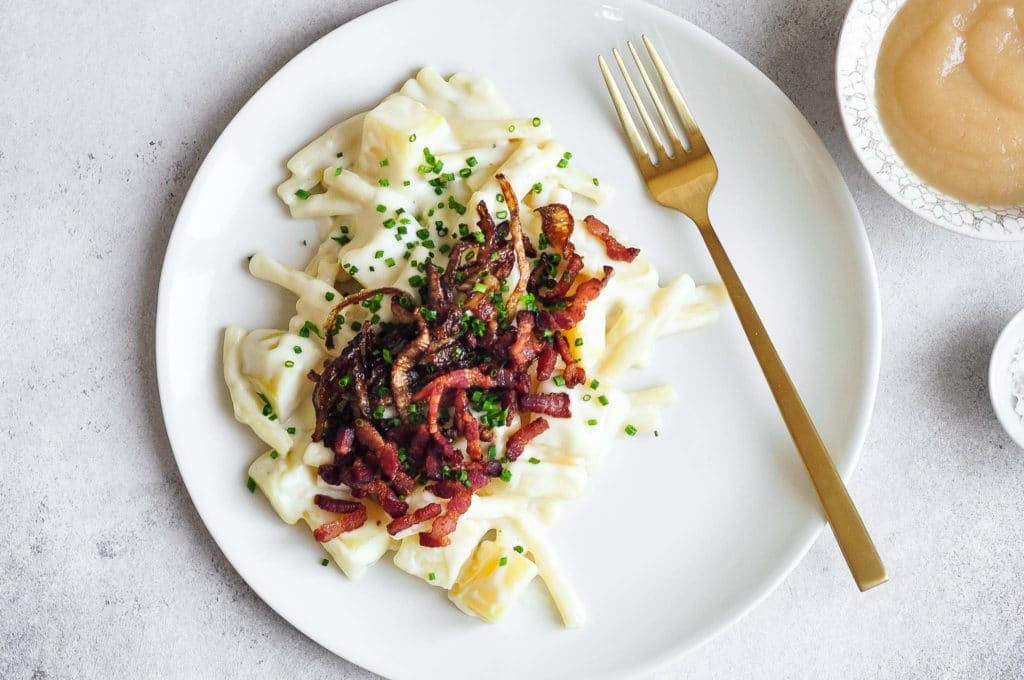
Swiss Macaroni and Cheese
Every winter, my family and I try to make the most of the ski season by spending most of our weekends skiing. And every winter, we always spend a few weeks in the Swiss alps for some downtime in the snow.
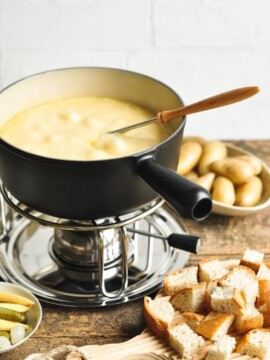
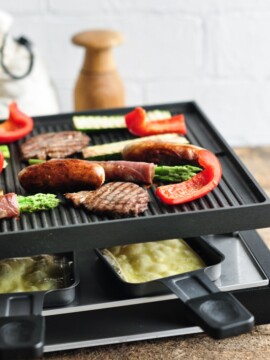
Another reason why I love being in the mountains is the alpine food. There’s something about the crisp air and wooden chalets which makes one crave rich food like Cheese Fondue, Raclette, and this Swiss Macaroni and Cheese with Applesauce.
What is Swiss Macaroni and Cheese?
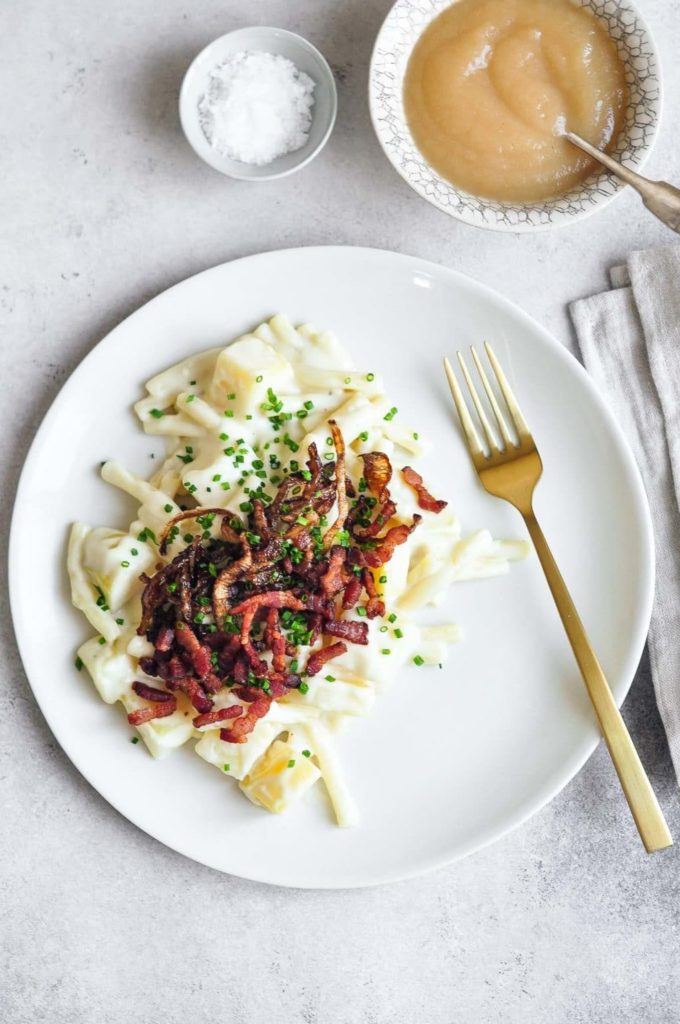
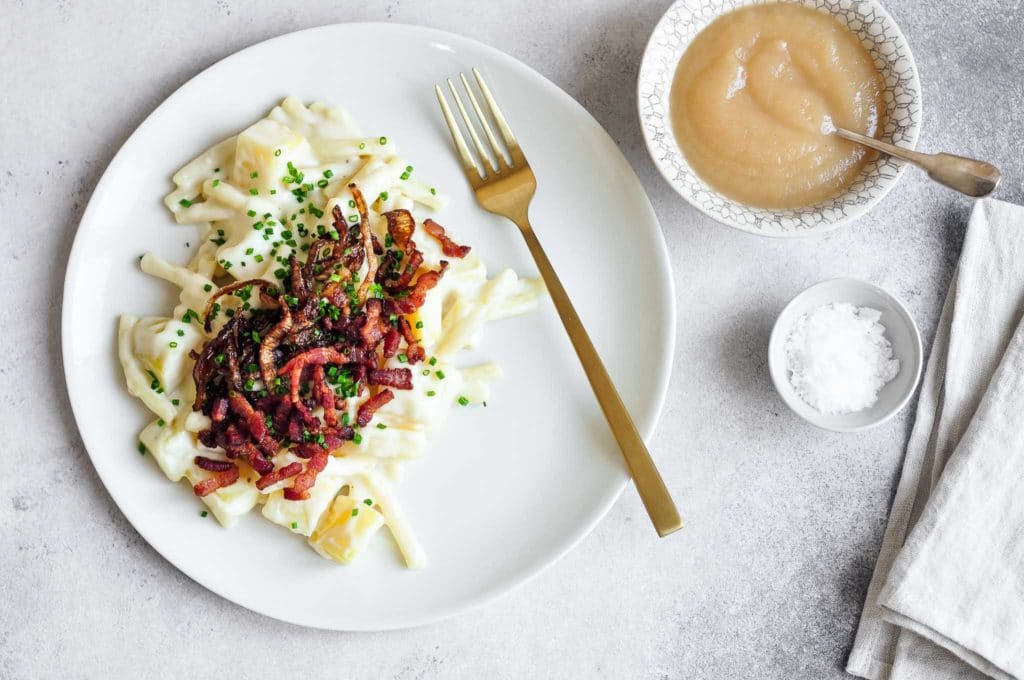
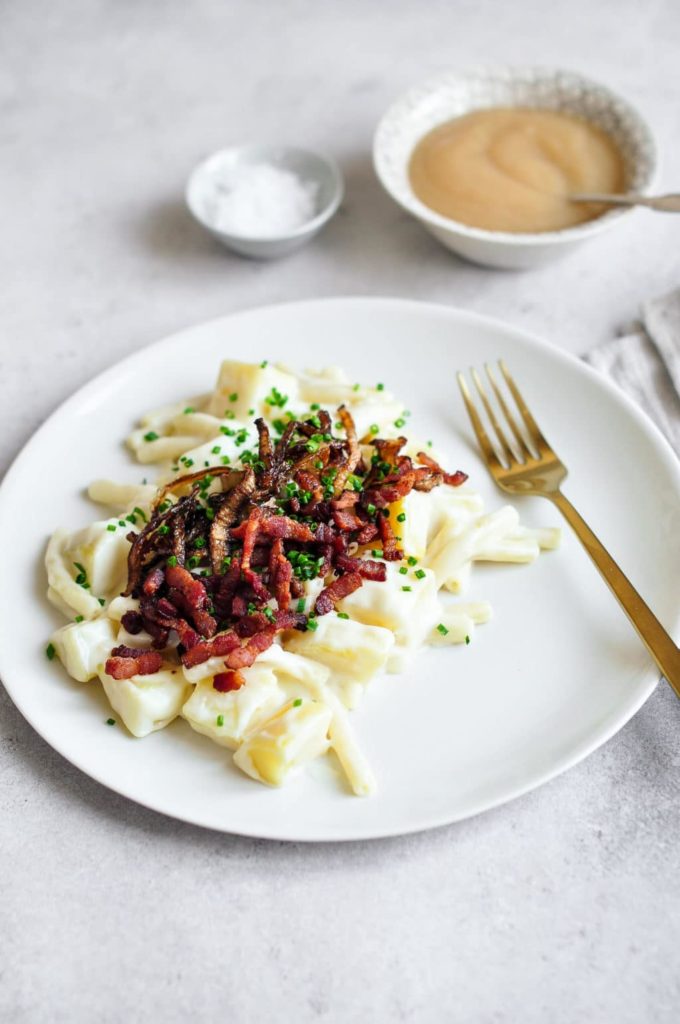
Swiss Macaroni and Cheese is similar to the American version, but with the addition of boiled potatoes, topped with crispy onion and bacon, and served with a bowl of apple compote (applesauce) alongside.
In Swiss-German, mac and cheese is called Älplermagronen, which roughly translates as alpine macaroni.
Macaroni and Cheese Recipe
My recipe for a simple macaroni cheese always starts with a Béchamel Sauce, to which I add cheddar and/or Gruyère cheese.
For a Swiss Macaroni Cheese, I boil cubes of potatoes with the pasta, and I also take the time to make some crispy fried onion and bacon to use generously on each dish.
If time is on my side, I also like to make my own apple compote, but store-bought is completely fine here.
How to Make Swiss Macaroni and Cheese
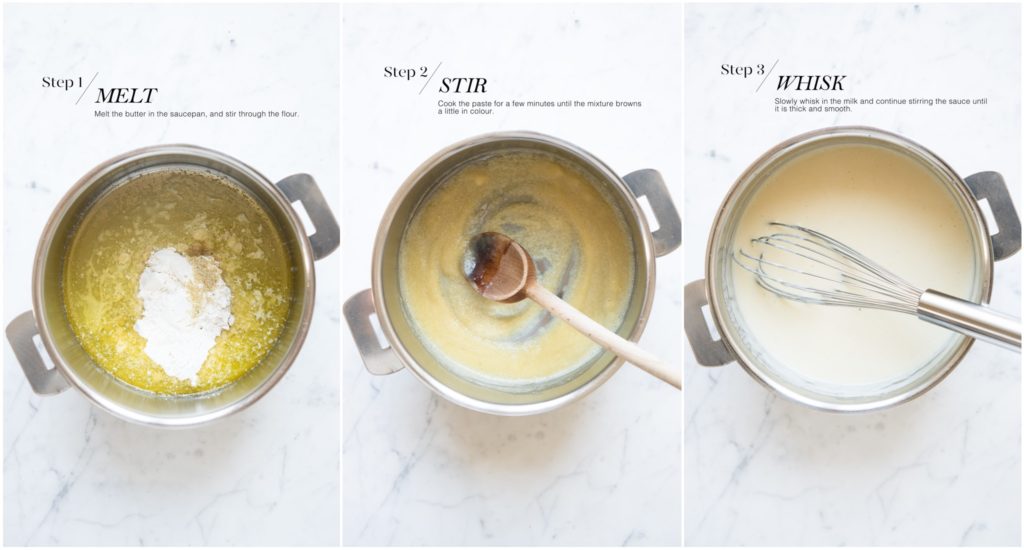
Like a classic macaroni and cheese, you start this dish by making a Béchamel sauce (or white sauce). To see step-by-step photos, please see my recipe for Béchamel Sauce.
For the cheese component, I like to use a really strong and aged Gruyère cheese, but any mild Gruyère or Emmentaler cheese would work too.
Crumbled crispy bacon is an obligatory garnish for meatlovers, and I particularly love this dish served with fried onion rings which add a lovely sweetness and crunch against the soft pasta.
Some restaurants give this dish an extra carbohydrate kick with the addition of diced boiled potatoes.
But what makes this dish truly Swiss is the small bowl of applesauce (or apple compote) served alongside.
How to Eat Swiss Macaroni and Cheese
I used to think that the apple compote on the side was to be eaten either as a palate cleanser, or at the end of the meal like a dessert.
Upon observing my Swiss friends and colleagues eat Älplermagronen, there seems to be no hard and fast rule about whether the applesauce should be eaten together with the main dish or as a dessert. To my shock and horror, I have even observed people mix the applesauce into their mac and cheese! I guess you do as you wish 😉
I personally prefer to eat it as a dessert; the tart sweetness of the apple compote is a nice end to a rich and creamy meal.
Swiss Macaroni and Cheese with Applesauce

Ingredients
For the bacon topping
- 1 tablespoon olive oil
- 200 g (7 oz) pancetta or thick bacon, sliced into thick batons
For the fried onion topping
- vegetable oil, for shallow frying
- 1 large brown onion, thinly sliced
For the Applesauce
- 2 Braeburn apples, or other cooking apples
- 2-3 tablespoons water
- 1-2 tablespoons sugar, to taste
For the Cheese Sauce
- 75 g (¾ stick) unsalted butter
- 75 g (½ cup) plain flour, (all-purpose flour)
- ½ chicken stock cube
- 1-2 teaspoons Dijon mustard
- 1 litre milk
- 100 g (3 ½ oz) Gruyère, grated
- 100 g (3 ½ oz) cheddar cheese, grated
- sea salt
- white pepper, freshly cracked
For the Pasta
- 300-400 g (10-14 oz) dried macaroni
- 3-4 large potatoes, peeled and cut into large dice
To Serve
- parsley and/or chives, finely chopped
Instructions
For the bacon topping
- Heat the oil in a medium frying pan.
- Cook the bacon or pancetta until it is golden and crispy.
- Remove the bacon or pancetta to a plate lined with kitchen paper to absorb the excess oil.
For the fried onion topping
- Fill a small saucepan with vegetable oil to about 2.5 cm (1 inch) depth and heat until the temperature is about 180°C (350°F).
- Fry the onion over medium-high heat until it is golden and crispy.
- Remove the onion to a plate lined with kitchen paper to absorb the excess oil.
For the Applesauce
- Peel, core and chop the apples.
- Place the apples into a small saucepan, together with the water.
- Cook over medium heat, stirring occasionally, until the apples soften and break down. Some apples release a lot of water upon cooking, whilst others absorb a lot of water. So keep a close eye on the pan to make sure the apples do not stick to the bottom of the pan. Add more water if necessary.
- Once the apples have completely cooked down, either mash the apples with a wooden spoon or purée the apples with a stick blender. Some types of apples cook and break down more easily than others so you may not need to always use a blender. However, the Swiss like to serve their applesauce very smoothly puréed.
- Taste for sweetness to see how much sugar you want to add.
- Set aside to cool slightly.
For the Cheese Sauce
- Heat the butter in a large saucepan over medium-high heat.
- Once the butter starts to melt, add the flour, stock cube and Dijon mustard.
- Stir until everything comes together into a paste. Cook this paste for 2-3 minutes, stirring continuously so that the flour can cook off.
- Slowly whisk in the milk. I do this a bit at a time to make sure there are no lumps in the sauce.
- Once all of the milk has been added, use a wooden spoon to stir the sauce continuously over the heat until it has thickened nicely. If the sauce is too thick, add some more milk to thin it out.
- Take the saucepan off the heat and mix through the grated cheese.
- Season with salt and pepper.
For the Pasta
- Cook the pasta according to packet instructions in a lot of salted boiling water, together with the potatoes. Alternatively, boil the potatoes separately.
- Drain the pasta and potatoes well.
To Serve
- Mix the cooked pasta and potatoes through the sauce while it is still hot and over low-medium heat.
- Garnish generously with the fried bacon or pancetta, fried onions, and herbs.
- Serve with a bowl of applesauce alongside (I like to serve the applesauce warm).
Kitchen Notes
- OVEN & STOVE TEMPERATURES
All recipes on this website have been tested on an induction stove and/or with a conventional oven (i.e. an oven without fan). All recipes on this website use temperatures for a conventional oven, unless otherwise mentioned. Convection ovens (i.e. fan-forced ovens) are typically 20°C/70°F hotter than conventional ovens, but please check your manufacturer’s handbook. - CONVERSIONS
To convert from cups to grams, and vice-versa, please see this handy Conversion Chart for Basic Ingredients.
Did you make this recipe?
Please leave a comment below and share your photos by tagging @eatlittlebird on social media and using #eatlittlebirdUpdate
This recipe was first published on 14 December 2016. It has been updated with new photos and more comprehensive recipe notes.

Must be so exciting your son is ready to ski! Our little one is just one, and I’m already waiting for that day 🙂
Everyday, I tell myself that our children are growing so quickly … too quickly! As much as I miss the time with them when they were tiny babies, it is actually very exciting and fulfilling to see them grow and blossom. And when you see the happiness they get from trying something new like learning to ski, it’s just an awesome feeling 🙂
Oh boy that looks awesome, and my fella would LOVE it! Thanks for sharing 🙂
Jane x
Hope you will enjoy the recipe!
Oh wow! This looks so good! I love Gruyere cheese. Congrats on being in Home and Gardens 🙂
Thanks, Deanna! Gruyère cheese is perfect in this dish 🙂
Definitely fancier than American mac & cheese, lol. Love the fried onions and Gruyere!
Nothing wrong with American mac & cheese! But Gruyère cheese and fried onions does take it to another level 😉
Wow – am so intrigued by the applesauce eaten alongside “Älplermagronen” aka “alpine macaroni” or American mac and cheese!
It feels a bit unusual at first, but now I’m used to it. In fact, I love apple sauce so much that I often order this dish just because there is apple sauce!
This is one of my favourite Swiss recipes! Love the addition of applesauce.
Interesting idea! Very tasty! And quite original! I definitely want to try it! Thank you for the recipe!
We just returned from Switzerland where we enjoyed this same dish with the applesauce!! I was so happy to find your recipe!! It is difficult for me to find Raclette cheese that is used in Switzerland so this was a nice option! We eat the applesauce in the pasta! My grandkids loved it!!!
Hi Tammy,
So glad you enjoyed this recipe! I have also encountered more and more people who eat the applesauce with the pasta – I ought to try it next time 🙂
Woo hoo, what a lovely recipe. I only heard of this dish a week ago, and I’m now trying to make my second version of it. I have no idea if it’s authentic, but this recipe is definitely delicious straight out of the pot (the previous recipe I tried just had milk and cream without a bechamel sauce, and it felt a bit wanting), and I’m hoping it will be even better when I bake it.
Thanks so much!
Hi Kevin,
So glad you enjoyed this recipe! I agree that it is delicious straight out of the pot, hence I often don’t bake it. But the crispy bits that you get from baking are hard to resist 🙂
Thank you so much for sharing! Just made this for my Mum’s we are missing Swizterland this year and this meal was perfect!!
Hi Jess,
So glad you and your mum enjoyed this recipe! It’s something we always look forward to eating when we go skiing … not sure if skiing will happen this year, but maybe I will still make this dish 🙂
Delicious. Took a while to make but worth it
Hi Elise,
So glad you enjoyed this recipe!
This looks delicious! I cannot wait to make it.
Hi Elizabeth,
I hope you will enjoy this recipe 🙂