

 by
by 
Friands
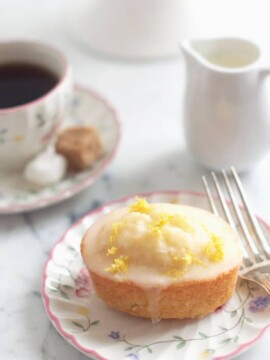
One of the most popular recipes here on Eat, Little Bird is for Lemon Drizzle Friands, a little cake which is widely popular in Australia and which has surprisingly intrigued so many readers worldwide.
What is a Friand?
A friand is based on the same recipe as that used for a popular French cake called a financier; the latter are baked in a special tin so that the cakes resemble gold bars (think of a mini loaf cake but with a height of about 1 cm).
The story goes that, in the early 1990s, a French chef working in Double Bay in Australia reinvented the financier by baking it in a metal aspic mould, thus producing a much larger cake which ultimately had more appeal to the Australian public. The friand was hence born, its name simply meaning “little cake” in French.
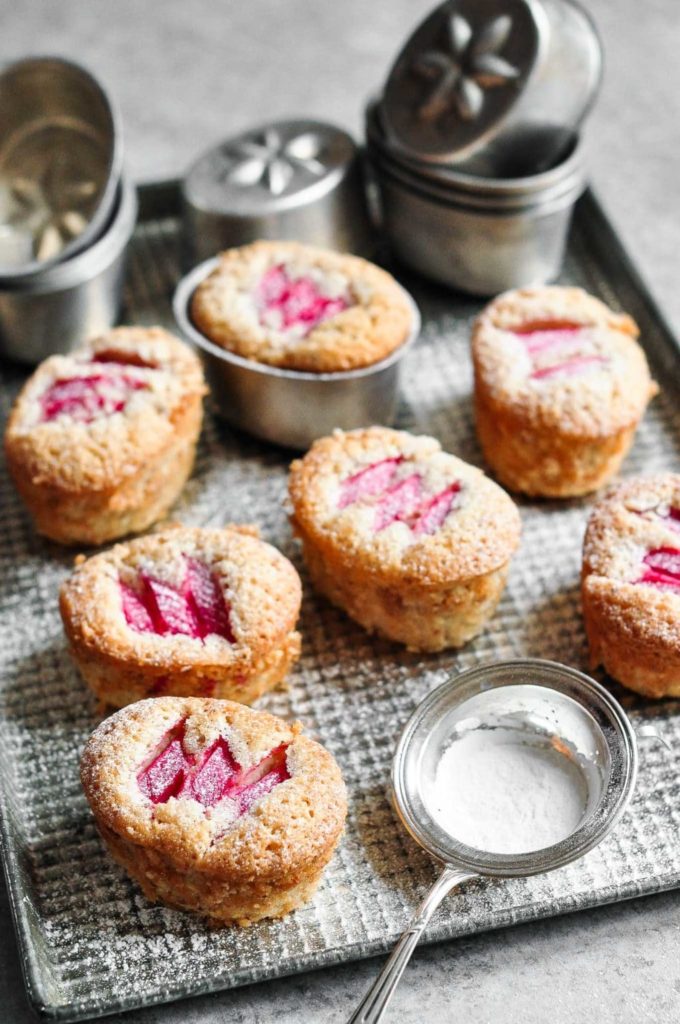
Friands vs Financiers
However, a word of warning: if you were to walk into a pâtisserie in France and asked for a friand, you would literally be asking for a “little cake”, of which there are many different types.
What the Australians call “friands” seems to exist only in Australia, and despite its growing popularity internationally, it remains unknown in France. Because in France, they have the “financier”. Comprend?
And as my French mother-in-law once queried, why would someone bake a cake in an aspic mould?
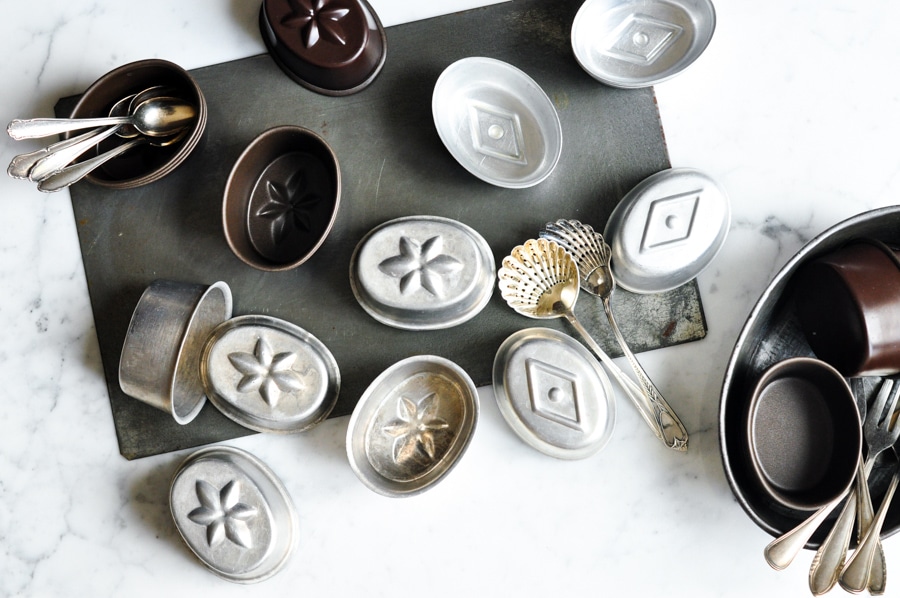
Friand Pans
The aspic moulds in question are intended to be used to make oeufs en gelée, or eggs in aspic. They are oval in shape and typically have a star or diamond embossed in the bottom of the tin, although the former is what is generally used to make friands.
It is also possible to find similarly-sized oval tins without any shape embossed in the bottom.
Where to Buy Friand Tins
These aspic moulds can be found in most specialty kitchenware stores in France, such as at E. Dehillerin. They are sold individually as plastic moulds, or as metal tins with or without non-stick coating.
If you come across these moulds and want to buy them for making friands, I would recommend buying the non-stick ones; the star embossment will produce a nice pattern on the bottom of your cakes, but the plain moulds will allow your cakes to sit flat.
These individual moulds are also great for storage as they stack easily and take up almost no space.
In Australia, where aspic moulds have sensibly been recycled as bakeware, you can find a 6 or 12-hole friand pan wherever cake and muffin tins are sold.
If you live outside of France and Australia, your best bet for finding a friand mould is on the internet (see links below).
If you can’t find a friand mould, don’t fret – a normal muffin tin will work just as well. See below for my tips on using other shapes to make these delicious cakes.
Traditional Financiers
In France, financiers tend to be plain cakes which derive most of their flavour from the butter in the recipe, which is traditionally melted and browned to produce a nutty flavour.
The Australians use the recipe for financiers merely as a blueprint for their friands and always add other ingredients, such as lemon or berries.
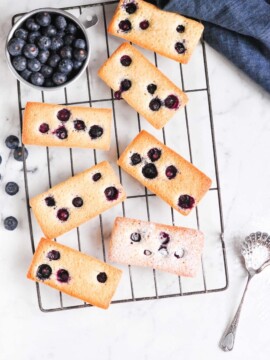
Please see my recipe for Blueberry Financiers for a twist on the traditional financier.
Forced Rhubarb
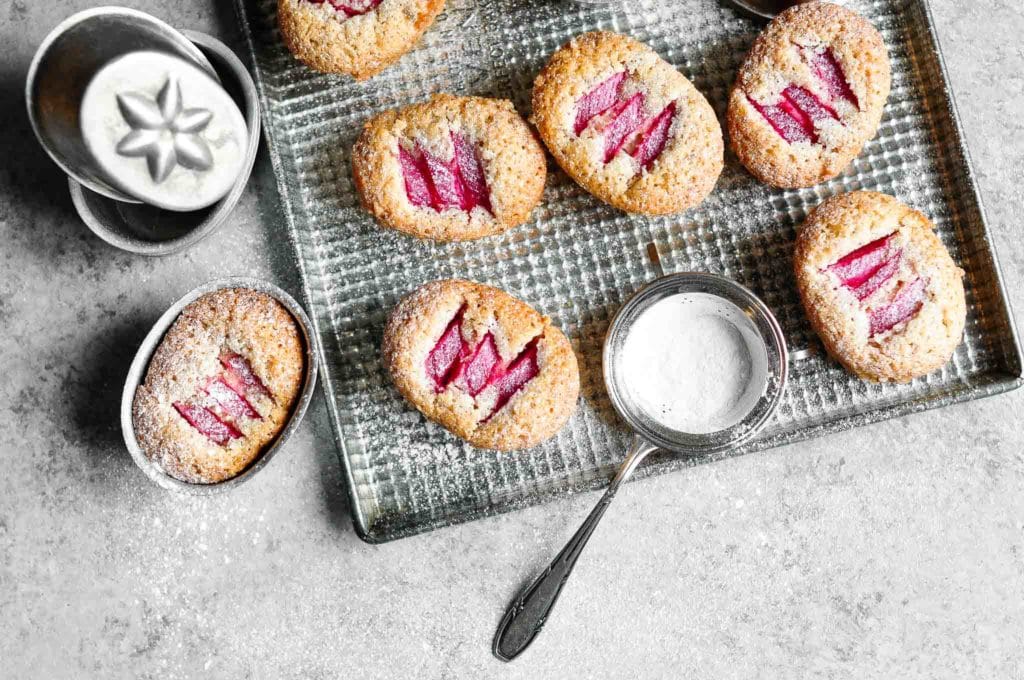
Now that forced rhubarb is in season, I couldn’t resist adding them to a batch of friands recently, and they worked magically.
Forced rhubarb has a very short season – between late winter and early spring – and range in colour from pale pink to dark crimson.
When used in baking, the rhubarb keeps it shape and hue, thus adding a dramatic pop of colour.
I love to use forced rhubarb in cakes (such as this ever-popular Rhubarb Custard Tea Cake) and I am completely addicted to this Rhubarb & Strawberry Crumble which I make at least once a week during the forced rhubarb season (hint – it’s delicious eaten cold at breakfast!).
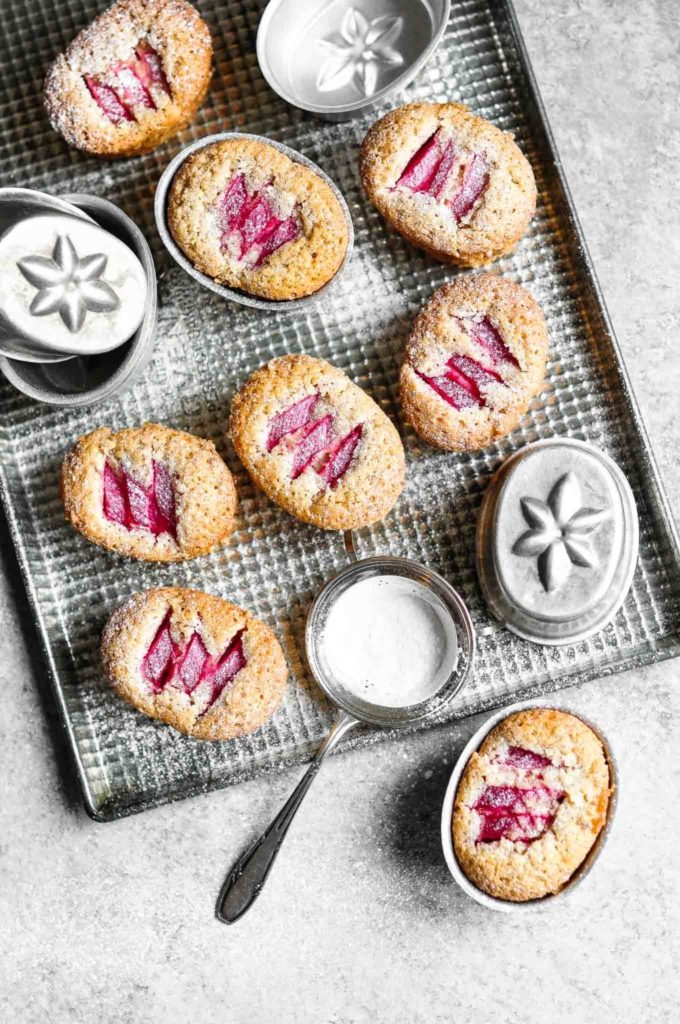
How to Make Friands
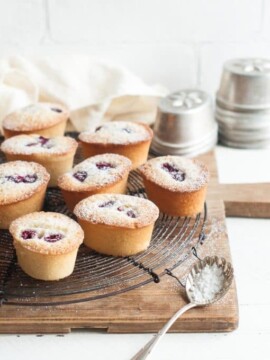
To see my step-by-step photos for making friands, please have a look at my recipe for Lemon Drizzle Friands or Raspberry Friands.
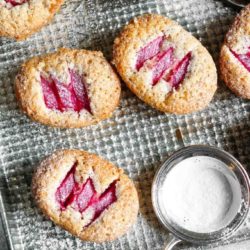
Rhubarb & Vanilla Friands

Ingredients
- 160 g (1 ½ stick) unsalted butter
- 100 g (⅔ cup) plain flour, (all-purpose flour)
- 250 g (1 ⅔ cup) icing sugar, (powdered sugar)
- 125 g (1 cup) ground almonds, (almond meal)
- 6 egg whites
- 1 teaspoon vanilla extract
- 1-2 rhubarb stalks
Instructions
- Preheat the oven to 180°C (355°F) (without fan).
- Melt the butter in a small saucepan until it turns a pale golden colour, but be careful not to let it burn.
- Use some of the butter to lightly grease the friand moulds.
- Let the butter cool slightly to use later in the recipe.
- Sift the flour and icing sugar (powdered sugar) into a large bowl and stir through the ground almonds.
- Place the eggwhites into another large bowl and whisk until they are white and frothy.
- Gently mix the frothy eggwhites into the flour mixture.
- Add the melted butter and vanilla extract, and stir everything together.
- Fill the friand pan until each mould is ⅔ full. Using an ice-cream scoop will help you to divide the batter evenly and to make even-sized friands.
- Slice the rhubarb on a diagonal with about 1 cm width.
- Arrange 3 slices of rhubarb on top of each mould, pushing them lightly into the batter.
- Bake the friands in the oven for about 20-25 minutes, or until they are lightly golden and a skewer inserted in the middle comes out clean.
- Let the friands cool in the pan for about 5 minutes before removing them to a wire rack to cool completely.
- Serve the friands warm or cold with a dusting of icing sugar.
Kitchen Notes
- USING A MUFFIN PAN
The friand moulds are about 1/2 cup in capacity and are deeper than the standard muffin mould. So if you are using a muffin pan to make these friands, you may need to adjust the cooking time a little. - MINI MUFFINS
In France, it is common to find financiers sold in mini muffin shapes, often sold in little packets which are great to give as gifts. You can use this recipe to make about 20 mini muffins, but be sure to adjust the cooking time accordingly. - USING OTHER BAKING MOULDS
To that end, you could make friands or financiers in any shape, but just adjust the cooking time accordingly. One of my favourite cafés in Zurich makes financiers in a small flat pie tin. There is something so welcoming about a cake in such a generous size! - OVEN TEMPERATURES
All recipes on this website state temperatures for a regular oven (i.e. a conventional oven without fan). If you have a convection oven with a fan, please consult the manufacturer’s handbook on how to adjust the temperature and baking time accordingly. - CONVERSIONS
To convert from cups to grams, and vice-versa, please see this handy Conversion Chart for Basic Ingredients.
Did you make this recipe?
Please leave a comment below and share your photos by tagging @eatlittlebird on social media and using #eatlittlebirdUpdate
This recipe was first published on 7 March 2016. It has been updated with new photos and more comprehensive recipe notes.

I always wondered what the difference between financiers and friands was. Now I know, thank you Thanh!
These look so delicious, the colour is beautiful.
Glad I could help 😉 I love baking with forced rhubarb – they make everything look beautiful!
These little cakes sound amazing! I am definitely saving this recipe AND the lemon version. So delicious!
I hope you will get to try these recipes one day 🙂
It is definitely worth buying a friand tin, I got mine on the internet! I make them whenever I have spare egg white. I do love the bright pink of forced rhubarb, these look so pretty, I am going to try them whit it is still in season. x
I think this recipe is a great way of using eggwhites! For some reason, I always have a freezer full of eggwhites … but it’s then a good excuse to make pavlova often 😉 But these friands actually use more eggwhites than one pavlova, so it’s a good recipe to have. I hope you will get to try this recipe soon, especially since you already own an elusive friand tin 😉
Love friands! Your molds are beautiful, and this is an excellent way to use rhubarb! So so pretty, Thanh! <3
Thank you! These friand moulds are amongst my treasured possessions (of which there are many ;-)).
I love your moulds!!!!!
I feel a weakness for the chocolate ones you did, but I love those. Rhubarb is so delicious!!!! Oh, I always remember your rhubarb custard cake!!
By the way, you know that I’ve made a mental note, and next time we put a foot (in Spanish this would be an expression, but I think it sounds bad in English!!!) in Zurich, I’ll let you know!!
If you had known, you wouldn’t have said it, but, Thanh, our intention is to go back next year! For this year we have other destinations, I’ll tell you!!!
Have a nice end of week, Thanh!!!
Oh you’re referring to the Gooey Chocolate Cakes with Raspberries & Nutella which I baked in the friand moulds. That recipe is also in the top 5 on my blog 🙂
Please do let me know next time you are in Zurich – it would be so lovely to meet you! And I would love to hear about your holiday plans for this year too 🙂
They look wonderful, but what do you do with 8 yolks? Need an excuse to justify this!
LOL! Make a custard! And you can turn that custard into ice-cream 😉 I seem to be always making custard at home for dessert, and I also make my own mayonnaise quite frequently. Both of these recipes use only egg yolks (or mostly egg yolks), so I then always freeze the eggwhites to use later. I typically freeze the eggwhites in little freezer bags, 1-2 eggwhites at a time, so that they don’t take long to defrost on the kitchen counter. My freezer is often overrun with bags of eggwhites and these friands are a great way of using them up. Hope this gives you some ideas 🙂
Thank you. That is why I didn’t know as I never make either of these! However I might have a go at custard, just to make these friands. I’ve ordered a friand tin. Plus my chickens have been laying well lately so I’ve lots of eggs. lOoking forward to a good bake! Thanks for your inspiring website.
Oh you’re welcome! I hope you will get much use out of your friand tin. And just note that you can also use it to make normal muffins 🙂 I always use Nigella’s recipe for custard from How to be a Domestic Goddess. It’s similar to the recipe at the following link, except it has 500ml of single cream: http://www.cookstr.com/recipes/custard
Thanh love the recipe and can’t wait to try it. I bought myself those aspic moulds thanks to you a while back and speaking of financiers I love the chocolate and pistachio ones in the bakery close to my best friend’s home. They sell them in tiny packs and they are so so tiny (guessing they’re a tinier veron of the financiers).
Anyway lovely photos as always.
xx
You can get oval friands and friand tins in New Zealand too! That is where I have come across them 🙂
Ah good to know that our friendly neighbours in New Zealand also love friands! ?
Wow! Thanks for the lesson on Friands versus financiers. I had no idea that Friands were an Australian reinvention. And those friand tins. . .so perfect for me and my pint sized kitchen. I’m definitely ordering a set.
These friand tins are perfect for any small kitchen as they stack so nicely. I speak from experience 😉
Gorgeous! Love the mini pans!! Definitely need to get some of those!
Thank you! I have a BIG collection of these now 🙂
Hi, can you freeze these friands
Hello,
I’ve never tried to freeze these friands, so I’m afraid I can’t answer your question. They do, however, keep quite well for a few days on a covered cake stand 🙂
Beautiful recipe! Great way of using up egg whites too!
I would love to try this! Sounds perfect! So YUMMY!!!
Can you freeze these?
Hi Harriet,
I don’t have much experience with freezing cakes (our freezer only fits a tub of ice-cream!), but I imagine that friands will freeze well. However, this version with rhubarb may not be ideal for freezing because the rhubarb might become mushy upon defrosting. I would suggest making instead the Lemon Drizzle Friands for freezing, but freeze them without the glaze. Hope this helps!