

 by
by 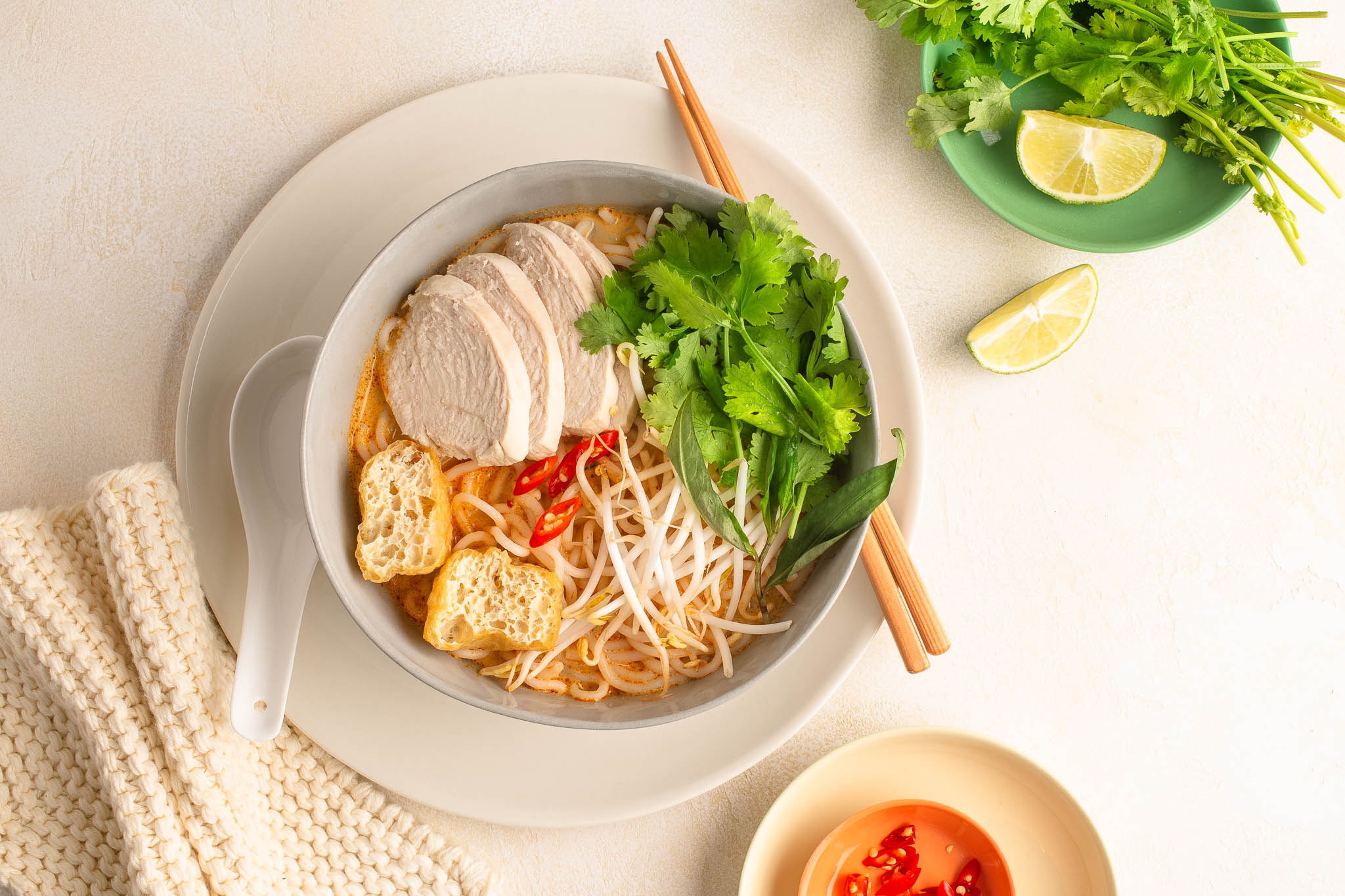
Quick Chicken Laksa
I love all noodle soups (give me noodles over rice any day), and I have a particular soft spot for a Chicken Laksa. Growing up in Australia, I used to love the cheap and cheerful Singaporean/Malay restaurants for their fiery, but comforting, bowls of laksa. It’s one of the first meals I seek whenever we visit Australia because it is a dish not available in Zurich, unless I make it home.
It goes without saying that it is also hard to find laksa paste in Zurich, which is more fragrant and aromatic than Thai red curry paste. Thankfully, the latter is available almost everywhere, and it makes a good substitute for laksa paste in a pinch, especially if you can jazz up the broth with a few extra ingredients.
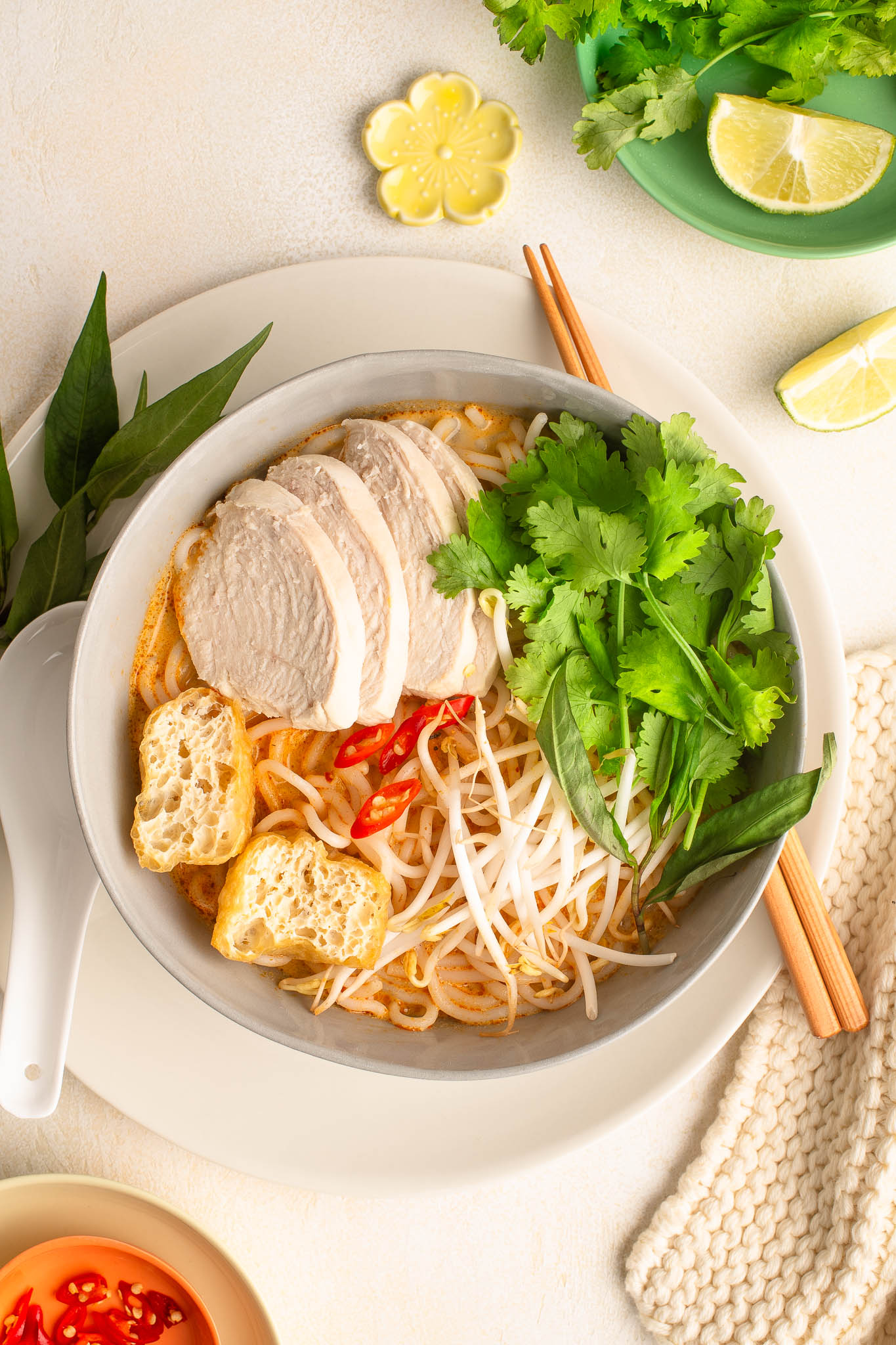
What is Laksa?
A laksa is a spicy curry noodle soup with origins in Singapore and Malaysia. The broth is often rich with coconut milk and fragrant with fresh herbs and different vegetables for a textural affair.
Laksa Paste
One ingredient I am always buying on my travels are jars of laksa paste because I rarely see them at the Asian grocers in Zurich. And whenever I visit Brisbane, my dear friend always gives me a giant 1 kg tub of her favourite laksa paste, which will last me a good year, i.e. many delicious bowls of laksa before I have to start hunting for laksa paste again.
Of course, I have tried making my own laksa paste from scratch many times and, to be honest, I have tried several excellent recipes. The problem is just that I don’t always have the time to shop for all of the different specialty ingredients, toast and grind the spices, cook down the paste, and so on. When it comes to curries and laksa, it’s one recipe where I am happy to reach for a jar of good quality, ready-made paste.
But if you can’t find laksa paste where you live, you can substitute with Thai red curry paste, which is readily available in all supermarkets everywhere. In fact, I use a mixture of both – the Thai red curry paste gives a boost of curry flavour, as well as heat and colour. It is a tip given to me by my friend who makes an absolutely delicious laksa, so I do as I am told!

Chicken Laksa Recipe
This recipe for Chicken Laksa is a quick and easy version using store-bought laksa paste and, if need be, store-bought chicken stock.
More often than not, I have homemade Asian Chicken Stock in the freezer which I will use in a recipe like for this Chicken Laksa. But I have also made it many times with chicken stock cubes and it tastes just as delicious.
When using ready-made products, I think it is important to add a few extra ingredients to boost the flavours and to add more freshness. That’s why I like to add makrut lime leaves and coriander roots to the broth to add some citrus notes, but also for their beautiful aroma.
Store-bought curry pastes and stock both vary in flavours and saltiness, so you may have to adjust the recipe below to taste.
And like for many Asian dishes, I think fresh herbs make a big difference. A laksa is not complete without a generous garnish of laksa leaves, which are also commonly called Vietnamese mint. This herb has a unique peppery and citrus flavour, which works well against the bold curry flavours. I grow it on my balcony and, like most mint varieties, it survives our sub-zero winter temperatures, making it a great investment.
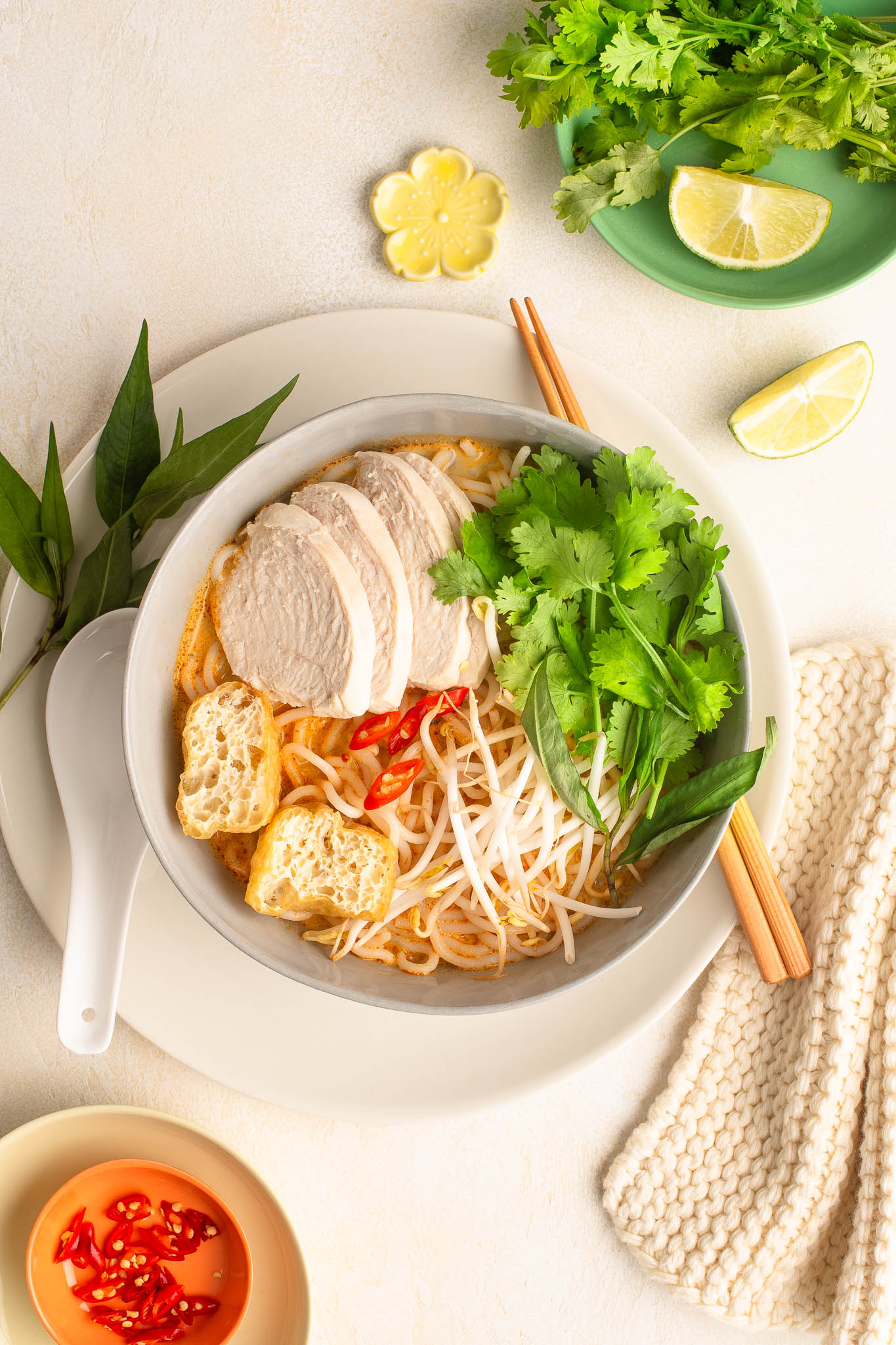
Variations
Although this is a recipe for Chicken Laksa, more often than not, I skip the protein and make it a vege version with the addition of different vegetables. Here are some other ideas:
- Prawns or shrimps. Peel and devein the prawns, and cook them in the broth for just a few minutes before serving.
- Fish balls. Asian-style fish balls (fried or non-fried) can be found at the Asian grocer in the freezer section, but homemade is always better. Just heat them in the broth.
- Rotisserie chicken. Swap the chicken breasts for shredded BBQ chicken or rotisserie chicken.
- Crispy roast pork belly. This is my favourite! Whether homemade or store-bought, add a few generous slices upon serving.
- Firm tofu. Slice thickly and cook them in the in the broth for just a few minutes before serving.
- Bok choy. Blanch them until they are just tender (I do this before cooking the noodles, and then use the same water to cook the noodles). Alternatively, cook them in the laksa broth.
- Baby corn. Slice in half and cook in the broth.
- Broccoli or broccolini. Cut into thin florets and cook in the broth.
- King oyster mushrooms. Slice thickly and cook in the broth.
Quick Chicken Laksa

Ingredients
For the Chicken Laksa Broth
- 1 tablespoon vegetable oil
- 4 tablespoons laksa paste, or substitute with Thai red curry paste
- 2 tablespoons Thai red curry paste
- 500 ml (2 cups) coconut milk
- 1 litre (4 cups) Asian Chicken Stock, or chicken stock with stock cubes
- 2-3 teaspoons fish sauce, or to taste
- 1 teaspoon sugar, or to taste
- 4 makrut lime leaves
- 2 coriander roots
- 2 large chicken breast fillets
- 8 fried tofu puffs, cut in half diagonally
To Serve
- 400 g (14 oz) dried vermicelli noodles, cooked according to packet instructions, see Kitchen Notes
- bean sprouts, I like to blanch them first
- coriander, (cilantro)
- Vietnamese mint, (laksa leaves)
- red chillies, sliced
- limes, quartered
Instructions
To Make the Chicken Laksa Broth
- In a large pan, heat the oil over medium-high heat.
- Add the laksa paste and Thai red curry paste.
- Stir and cook for about 1 minute, or until the the paste looks like it is separating.
- Stir in the coconut milk.
- Then add the chicken stock, fish sauce, sugar, makrut lime leaves, and coriander roots.
- Bring the broth to a gentle simmer.
- Add the chicken breast fillets.
- Turn the stove down to low-medium heat, place the lid on the pan, and cook the chicken breasts for about 12-15 minutes. The water should be simmering gently during this time.
- Once the chicken breasts are cooked through, remove them to a plate.
- Remove and discard the makrut lime leaves and coriander roots.
- Add the tofu puffs.
- Taste for seasoning. Laksa pastes and curry pastes vary in saltiness, so you may need to add more fish sauce (or salt) or water to taste.
To Serve
- Cut the chicken breast fillets into thick slices.
- Place the noodles into large noodle bowls.
- Top the noodles with the bean sprouts and a few slices of chicken per person.
- Ladle over the laksa soup broth.
- Garnish with coriander (cilantro) and Vietnamese mint.
- Serve with chillies and limes.
Kitchen Notes
- WHAT TYPE OF STOCK TO USE
* A homemade Asian Chicken Stock is best for this recipe. But if you are short on time, I find a broth made with chicken stock cubes or chicken stock powder works rather well with the bold curry flavours.
* For a vegetarian option, use vegetable stock. - WHAT TYPE OF NOODLES TO USE
Laksa can be served with different types of noodles, so you can choose the type you prefer, for example:
* thick vermicelli noodles
* thin vermicelli noodles
* thick egg noodles (Hokkien noodles)
* a combination of thin vermicelli noodles and thick egg noodles - HOW TO COOK DRIED VERMICELLI NOODLES
Instructions vary by brand, but they are usually as follows:
* Soak the dried noodles in tap water for 30 minutes for a better texture, but you can skip this step without noticing too much of a difference.
* Cook the noodles in boiling water until they are al dente, i.e. cooked but with still a bite. The timing will vary depending on the thickness of the noodles. Thin vermicelli noodles might only need 1 minute, whilst thick vermicelli noodles might need up to 12 minutes. The noodles need to be slightly undercooked because they will finish cooking in the hot broth later.
* Rinse and drain the noodles under cold water.
* Portion the noodles while they are still wet as they are easier to handle at this stage. - OVEN & STOVE TEMPERATURES
All recipes on this website have been tested on an induction stove and/or with a conventional oven (i.e. an oven without fan). All recipes on this website use temperatures for a conventional oven, unless otherwise mentioned. Convection ovens (i.e. fan-forced ovens) are typically 20°C/70°F hotter than conventional ovens, but please check your manufacturer’s handbook. - CONVERSIONS
To convert from cups to grams, and vice-versa, please see this handy Conversion Chart for Basic Ingredients.

Very tasty and so easy to make for dinner. This recipe will be a regular in our home for sure.
Great recipe, thanks! I made it with chicken stock cubes and it was perfect.
Hi James,
Great that you enjoyed this recipe!
This is now one of my favourite weeknight recipes 😊
Hi Eva,
That’s great to hear!
Just made this recipe for maybe the 10th time! It’s so easy and so delicious. I add different vegetables each time and have even tried it with different noodles. My kids love it.
Hi Lindsay,
I’m so glad you love this recipe! It is indeed an easy recipe, especially since you can use whatever veges you have in the fridge.