

 by
by 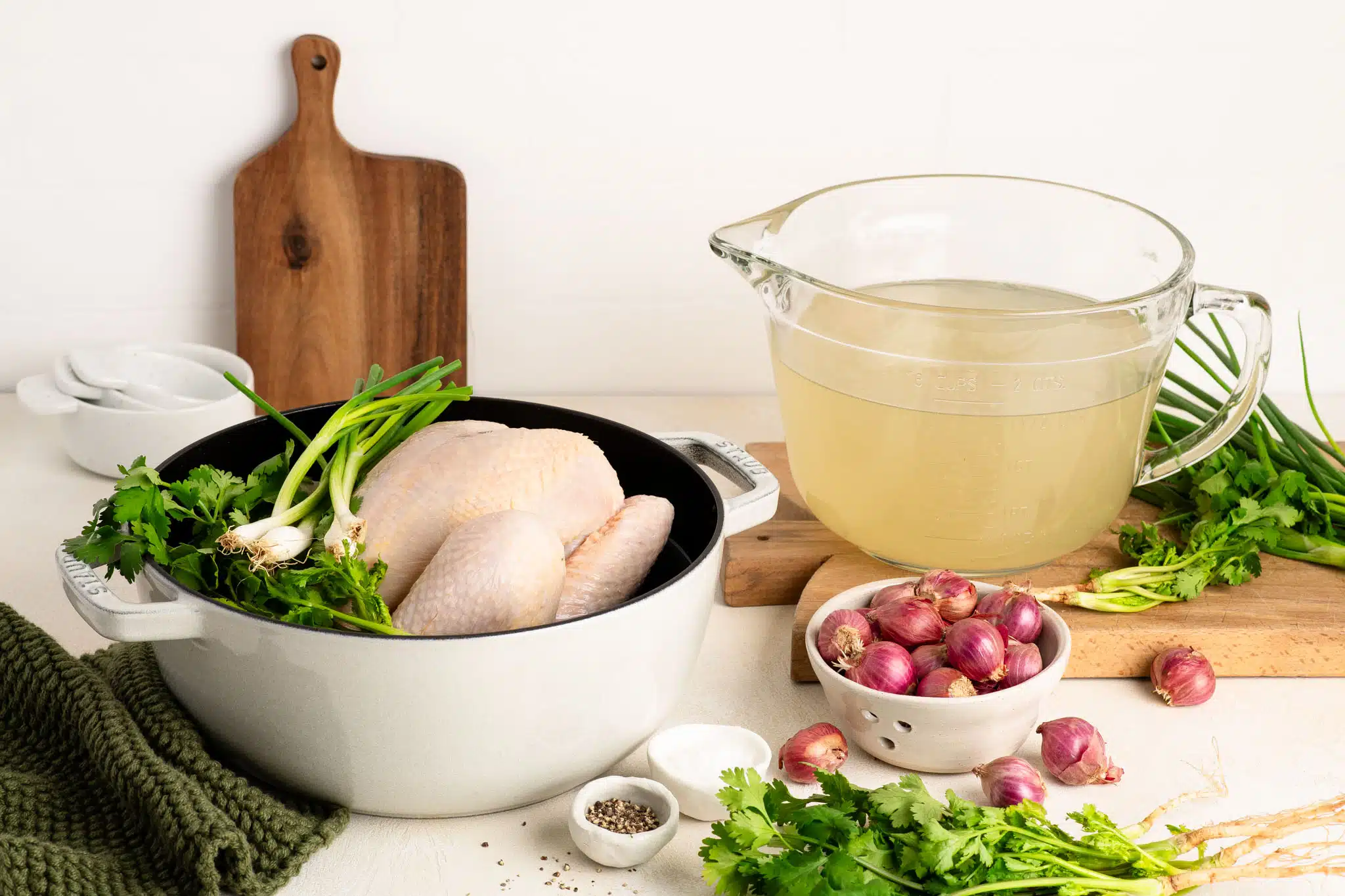
Asian Chicken Stock
A staple recipe in any Asian home is a good quality homemade chicken stock. It forms the basis of many Asian dishes, especially soups and noodle soups.
I make this Asian Chicken Stock at least once a week because my family loves noodle soups, but also a clear soup served alongside a shared Asian-style family meal. This recipe is used as a basis for so many recipes here on my website where, even though you could always use a stock cube as a quick alternative, if you have some time up your sleeves, it’s worth making a chicken stock from scratch.
Why This Recipe Works
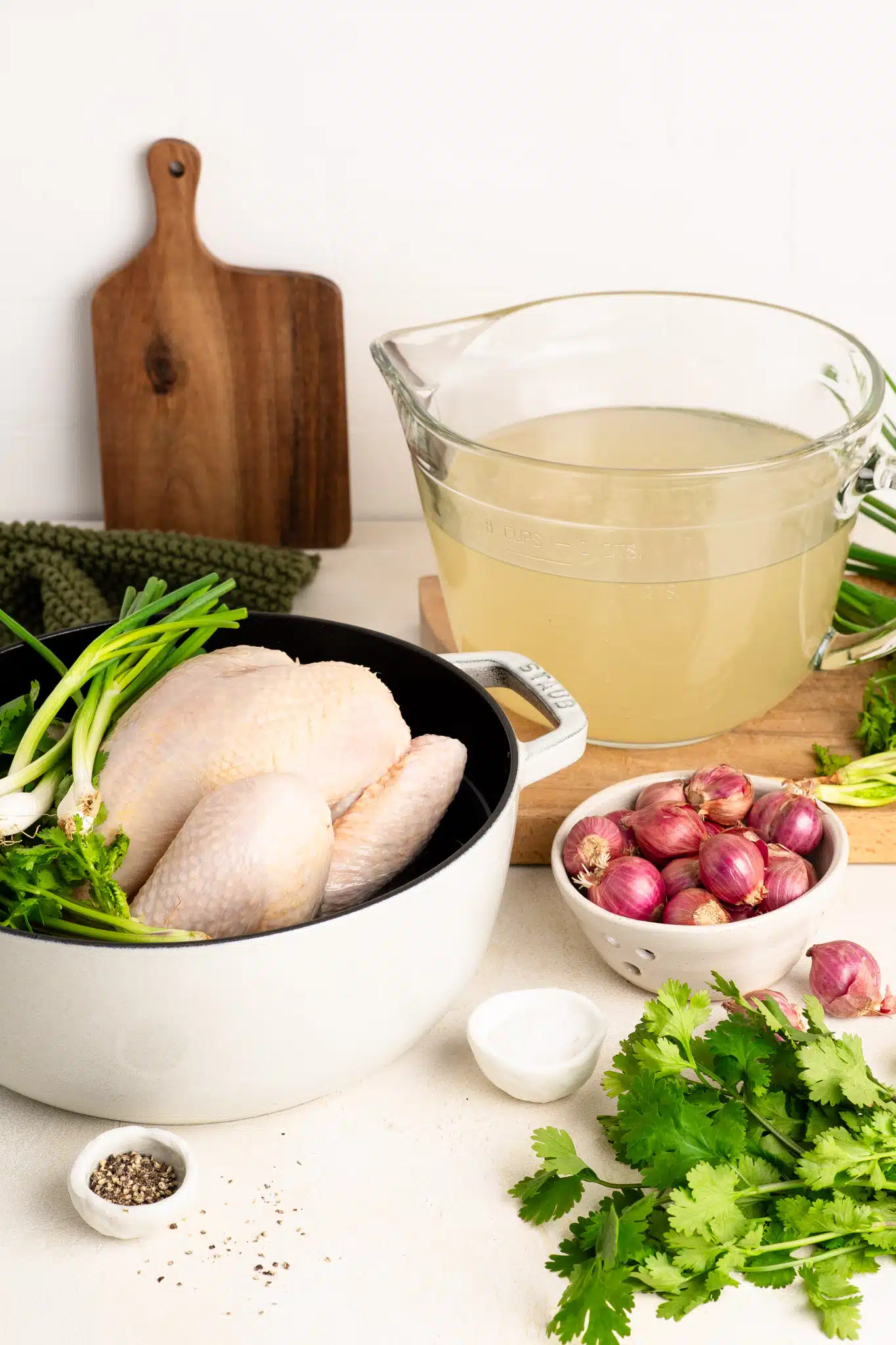
This Asian Chicken Stock is a basic chicken stock which can be used in many Asian recipes, or it can be adapted with additional ingredients to suit any specific dish or recipe you wish to make.
How to Use Asian Chicken Stock
Here on this website, you can use this Asian Chicken Stock in all of my Asian soup recipes or noodle soup recipes, wherever the recipe calls for chicken stock.
My kids love this Asian Chicken Stock as the basis of a Vietnamese-style noodle soup loaded with veges and either pasta shells or my Chinese Chicken Dumplings. I will often join them in this simple meal, but I frequently transform this Asian Chicken Stock into a Chicken Laksa for my husband and I by simply adding Thai red curry paste and coconut milk.
Another family favourite is my Chinese Chicken and Corn Soup, and this Asian Chicken Stock forms the perfect base with just a few additional ingredients.
I particularly love this Asian Chicken Stock mixed with the satay from my Bun Bo Hue recipe for a spicy Chicken noodle soup.
In the colder months, this Asian Chicken Stock forms the basis of many Chinese Steamboats in our home.
I hope this gives you a few ideas for using this Asian Chicken Stock 🙂
What is the Difference between Western Chicken Stock and Asian Chicken Stock?
Both cultures use chicken stock to give a savoury depth to a recipe.
In most western-style chicken stock, the broth is often flavoured with some or all of the following ingredients:
- bay leaves
- carrots
- celery
- parsley
- peppercorns
- thyme
By comparison, Asian-style chicken stock is generally very minimalist because the stock is then often used in recipes where other stronger flavours will be added later, such as in a curry or noodle soup.
An Asian Chicken Stock will often contain:
- carrots, to give sweetness and colour
- coriander (cilantro), either the roots or whole sprigs
- garlic, more common in Thai-style recipes
- ginger, more common in Chinese-style recipes
- spring onions (scallions), either the roots or whole sprigs, and/or shallots
What Type of Chicken to Use When Making Stock
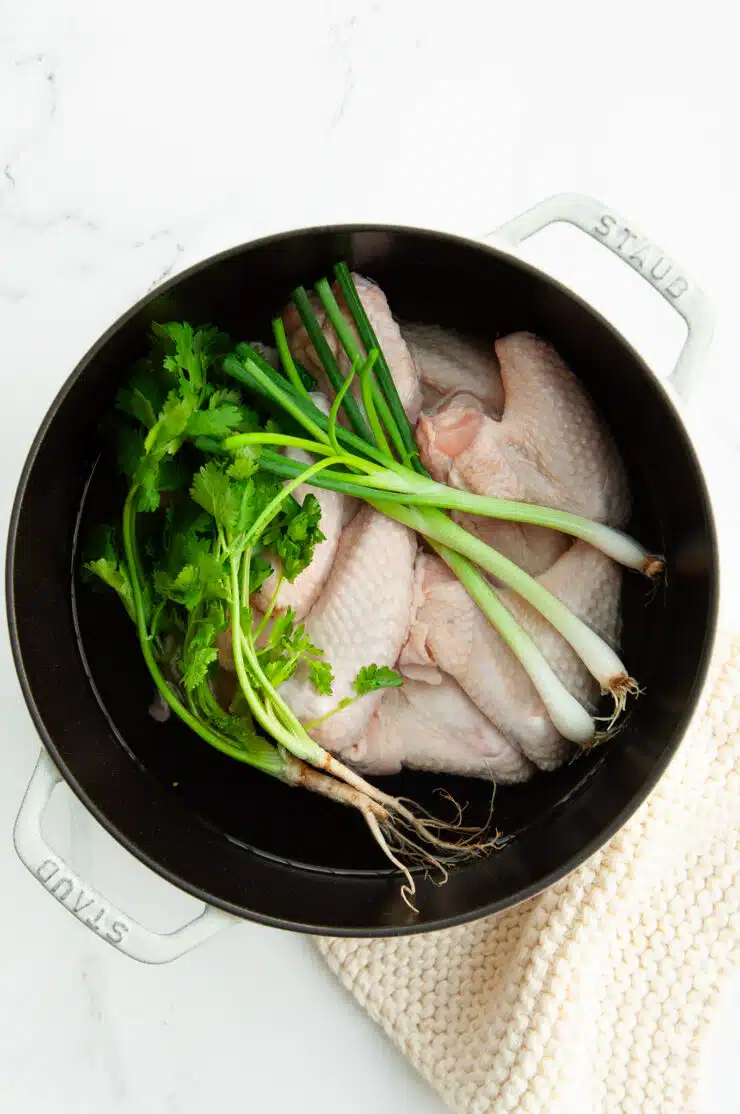
If you plan to make a soup with shredded chicken, you should use a whole chicken.
If you plan to make a stock where you don’t need any accompanying meat, you can use chicken wings, chicken bones (e.g. thigh bones) or chicken carcasses. A mix of all three would give a better flavour. You could also use chicken thighs with bones, but this tends to be an expensive cut.
Chicken wings are particularly good for making chicken stock because they contain a lot of bones and cartilage which give the stock a nice, gelatinous quality. In fact, a sign of a good-quality stock is one which has a jelly-like texture when it is cold.
Chicken bones and carcasses are sometimes sold in supermarkets, but they are more commonly found at the butcher’s counter, or you may have to order in advance.
After the cooking time, the meat on the chicken wings and carcasses will be very soft and almost mushy, but still edible. My kids love it, so I always save some of the meat for them. But I think it would be too soft to serve to more picky and/or esteemed guests.
Note that the flavour and depth of your stock will change depending on what type of chicken part you are using. But the more often you make chicken stock, and the more often you experiment with different ways of making the stock, the more you will learn about your preferences and how to make the stock exactly the way you like it.
How I Make Asian Chicken Stock
For me, personally, whenever I make an Asian Chicken Stock:
- I double or triple the recipe below.
- I generally use 1 whole chicken (approx. 1 kg/2 lb), plus the rest of the weight in chicken wings.
- I shred the meat from the chicken to use right away, and any leftovers are kept in the fridge for another meal. I save about half of the chicken wings because my kids like the soft meat.
- I freeze the remaining stock in 1 litre/4 cup portions. This is roughly 2-3 serves for a noodle soup.
How to Freeze Chicken Stock
Chicken stock can keep in the fridge for 3-4 days, but larger quantities are better stored in the freezer. Freeze the stock in portions that make sense for you and your family. As I typically use chicken stock to make soups, I like to freeze it in portions of 2-3 servings, which gives me the most flexibility.
You can freeze chicken stock as follows:
- Freezer bags. Date and label the bag, then fill the bag with the appropriate quantity. Lay the bags flat on a tray that will fit into your freezer, so that the bags can freeze flat, which will be easier to store in your freezer. When using ziplock freezer bags, I prefer to defrost anything in them in the fridge overnight, or on the kitchen counter at room temperature. The main disadvantage of these bags is that they are often very thin, so the contents can sometimes leak upon defrosting. Also, because they are thin, they are generally not suitable for defrosting in the microwave.
- Silicone containers. A few years ago, in an effort to reduce plastic waste from our home, I invested in some thick silicone containers which happen to be great for freezing liquids. They are quite sturdy, which means I can fill them with hot liquid, and they are also suitable for defrosting in the microwave. The only disadvantage is that you cannot stack these containers, so they take up more space than I would like. But once the contents are frozen, you can get creative and store them upside down. I have found them to be useful enough to have bought more of them over the years.
Tips for Making Asian Chicken Stock
- Use chicken wings, bones or carcass. These cuts are cheap and perfect for making soup or stock. If you want to use shredded meat as part of the meal (such as in a Chicken Pho), you should use a whole chicken. You could even use a mix of whole chicken with wings or carcass.
- Freeze coriander and spring onion roots. As soon as I buy a new packet of coriander (cilantro) or spring onions (scallions), I chop off about 5-10 cm from the roots and store them (separately) in the freezer. Whenever I make an Asian Chicken Stock from scratch, or any Asian-style noodle soup, I will add a few of these roots to the broth to add a delicious herbal note.
- Freeze vegetable scraps. I often cut out decorative shapes from carrots and daikon for other recipes (namely Chinese Steamboat), and then freeze the scraps to use in stocks like this one. Carrots give a nice sweetness and colour to the broth.
- Double or triple the recipe. If you make a lot of Asian-style soups, it is worth keeping some homemade Asian Chicken Stock in the freezer. I typically make a double or triple batch, and freeze the stock in portions.
- Start with a concentrated broth. I always only use just enough water to cover the bones in the pot, and I will top up the water to this level during cooking. This generally means that your broth will taste quite concentrated at the end of the cooking time, which you can easily dilute with boiling water. If you add too much water at the beginning, you risk creating a weak broth which will be hard to correct. Also note that, depending on what type of chicken cuts you are using, some produce more flavour than others, e.g. meaty chicken wings are more flavourful than carcasses with little meat. Hence, it is better to start with less water than too much.
- Use less flavourings. Many recipes for Asian chicken stock call for ginger, which is totally fine if you wish to use the stock to make a recipe where ginger is a key ingredient (often in Chinese recipes). But I prefer to make my Asian Chicken Stock without ginger so that it can be adapted to more recipes; you can always flavour the broth with ginger at a later time.
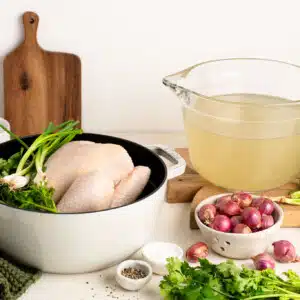
Asian Chicken Stock

Ingredients
For the Asian Chicken Stock
- 1 kg (2 lb) chicken wings, chicken carcass OR whole chicken
- 2-3 coriander roots or coriander sprigs, (cilantro)
- 2-3 spring onions, (scallions)
- 1-1.5 litres (4-6 cups) water
- 1 teaspoon sugar
- 1 teaspoon fine salt
- 1 teaspoon MSG, optional
- 1 tablespoon fish sauce
Optional Ingredients
- 5 cm (2 inches) ginger, thickly sliced
- 1-2 carrots, thinly sliced
Instructions
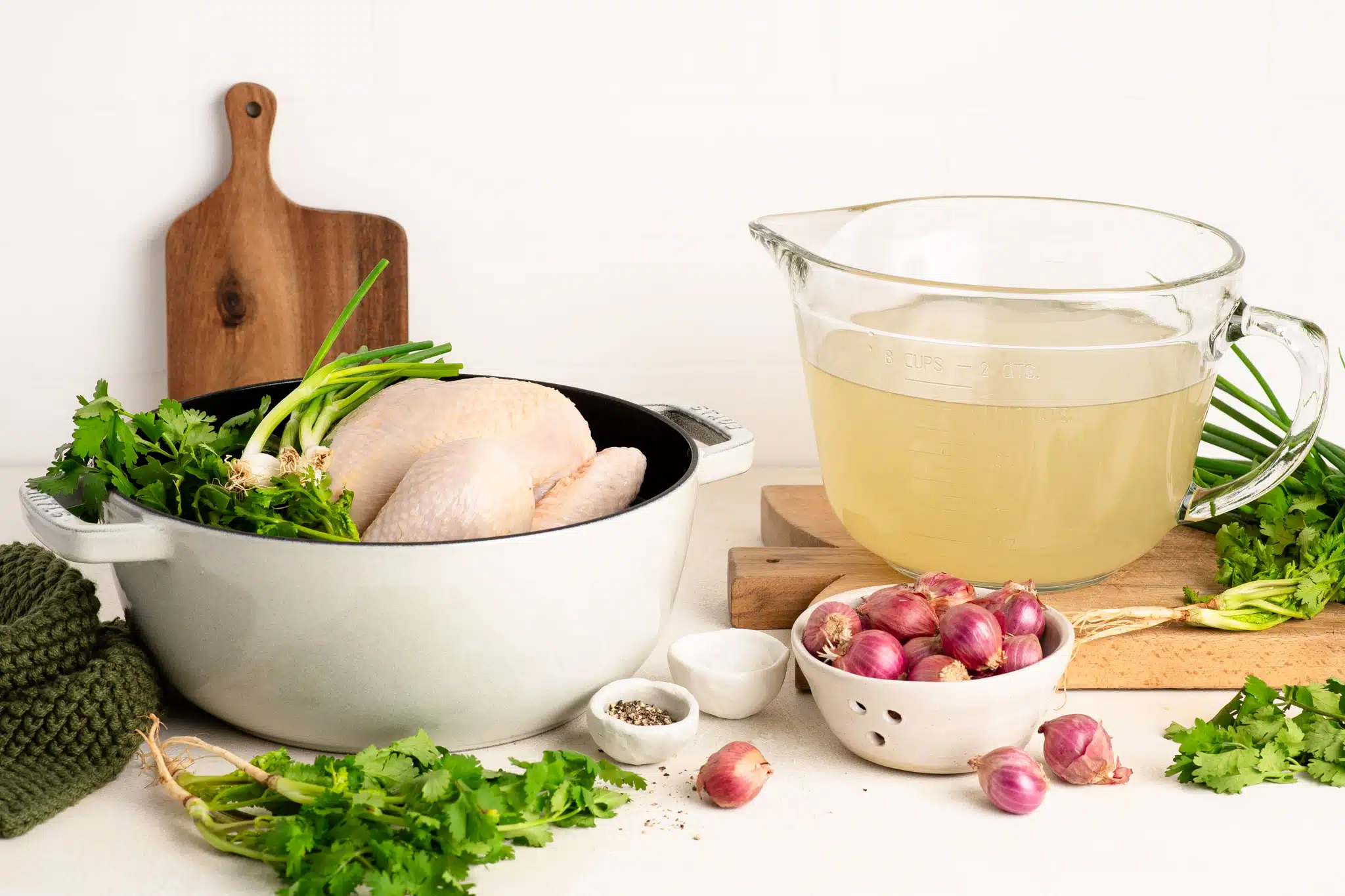
- In a large pot which will fit all of the ingredients snugly, place the chicken, coriander (cilantro), spring onions (scallions), and any optional ingredients.
- Add enough cold water to just cover the ingredients.
- Slowly bring the pot to a gentle simmer over medium heat. If the heat is too high and the water boils for too long, the stock will go cloudy.
- Once the stock starts heating up, you will notice some scum and impurities rising to the surface. Remove the impurities with a fine strainer or a ladle. Repeat this step throughout the cooking process until you no longer see any impurities.
- Simmer the broth gently on low-medium heat for 75 to 90 minutes (generally 90 minutes if you are using a whole chicken).
- During the cooking time, remove any impurities from the surface, and top up the broth with more boiling water to maintain the same water level.
- After 60 minutes, add the sugar, salt, MSG (if using) and fish sauce.
- After 75 to 90 minutes, remove and discard the coriander roots (cilantro) and spring onions (scallions), and ginger (if using).
- Strain the broth through a fine sieve into a large, clean pot. I do this by placing a fine sieve over the clean pot and use a large ladle to transfer the broth from one pot to another.
- Taste the broth for seasoning. It will generally taste a bit strong/salty at this stage, but you can easily dilute the broth with some boiling water, about 250 ml/1 cup at a time. I like to make my broths a bit salty because it is easier to dilute a strong-flavoured broth than to add flavour to a weak broth.
- The strained broth is now ready to serve or store.
- If you are using chicken wings or chicken carcass, any meat will generally be very soft but still edible. The wings should be falling apart at this stage. You can shred the meat to serve with the broth or to use in another recipe.
- If you are using a whole chicken, shred the meat to serve with the broth or to use in another recipe.
- The stock keeps in the fridge for 3 to 4 days, or in the freezer for up to 3 months.
Kitchen Notes
- OVEN & STOVE TEMPERATURES
All recipes on this website have been tested on an induction stove and/or with a conventional oven (i.e. an oven without fan). All recipes on this website use temperatures for a conventional oven, unless otherwise mentioned. Convection ovens (i.e. fan-forced ovens) are typically 20°C/70°F hotter than conventional ovens, but please check your manufacturer’s handbook. - CONVERSIONS
To convert from cups to grams, and vice-versa, please see this handy Conversion Chart for Basic Ingredients.

I love the simplicity of this recipe. The broth is so light and delicious.
Thank you for the helpful tips in this recipe! I just used your recipe to make my first batch of stock and it is so delicious, very similar to how my mum used to make stock. I’m going to add winter melon when I reheat the leftovers.
Hi Anna,
Oh winter melon would be so delicious in this broth. Yum!