

 by
by 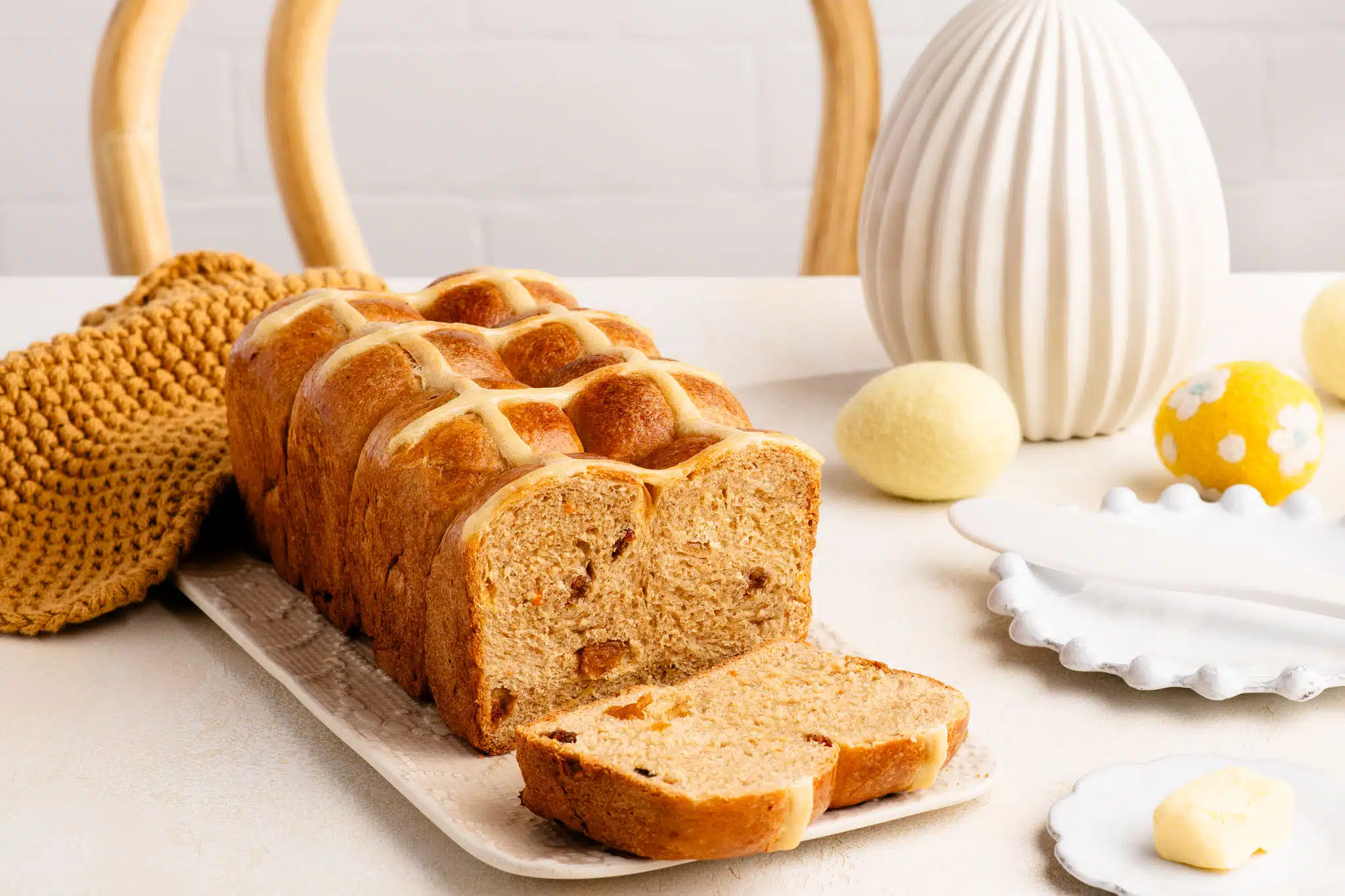
Hot Cross Buns
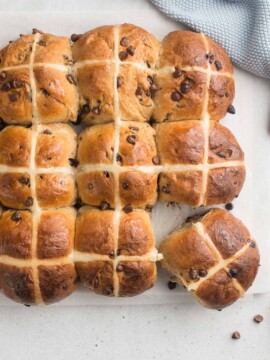
I always look forward to the lead up to Easter because it means I get to indulge in one of my favourite types of bread – the Hot Cross Bun. They are not sold where I live, so I have to make them from scratch every Easter. But as I love Hot Cross Buns so much, I rejoice in this activity and happily make several batches at the same time. Moreover, a toasted Hot Cross Bun for breakfast is one of the best things in life. A very close second is a slice of Hot Cross Bun Loaf.
Hot Cross Bun Loaf
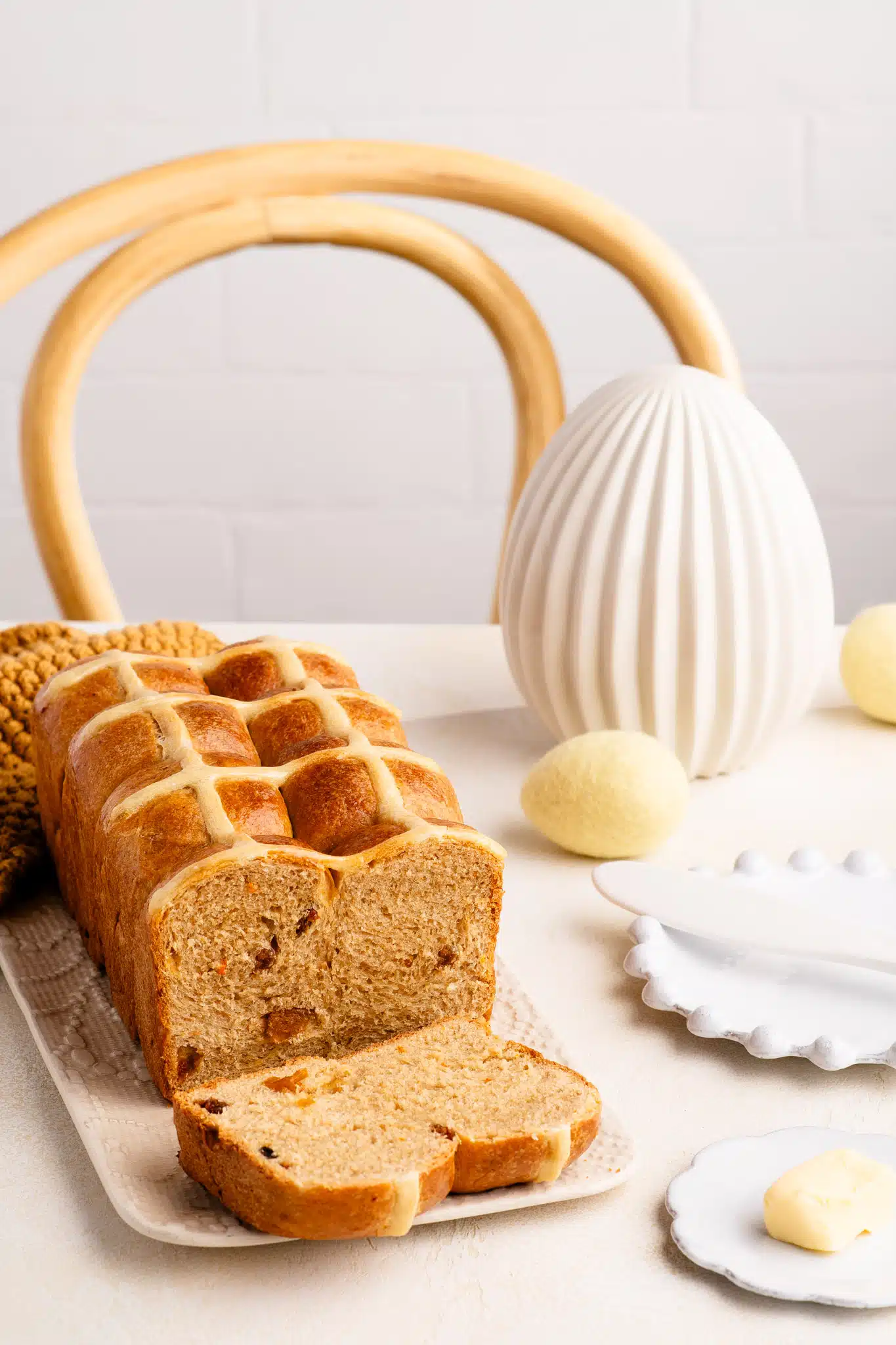
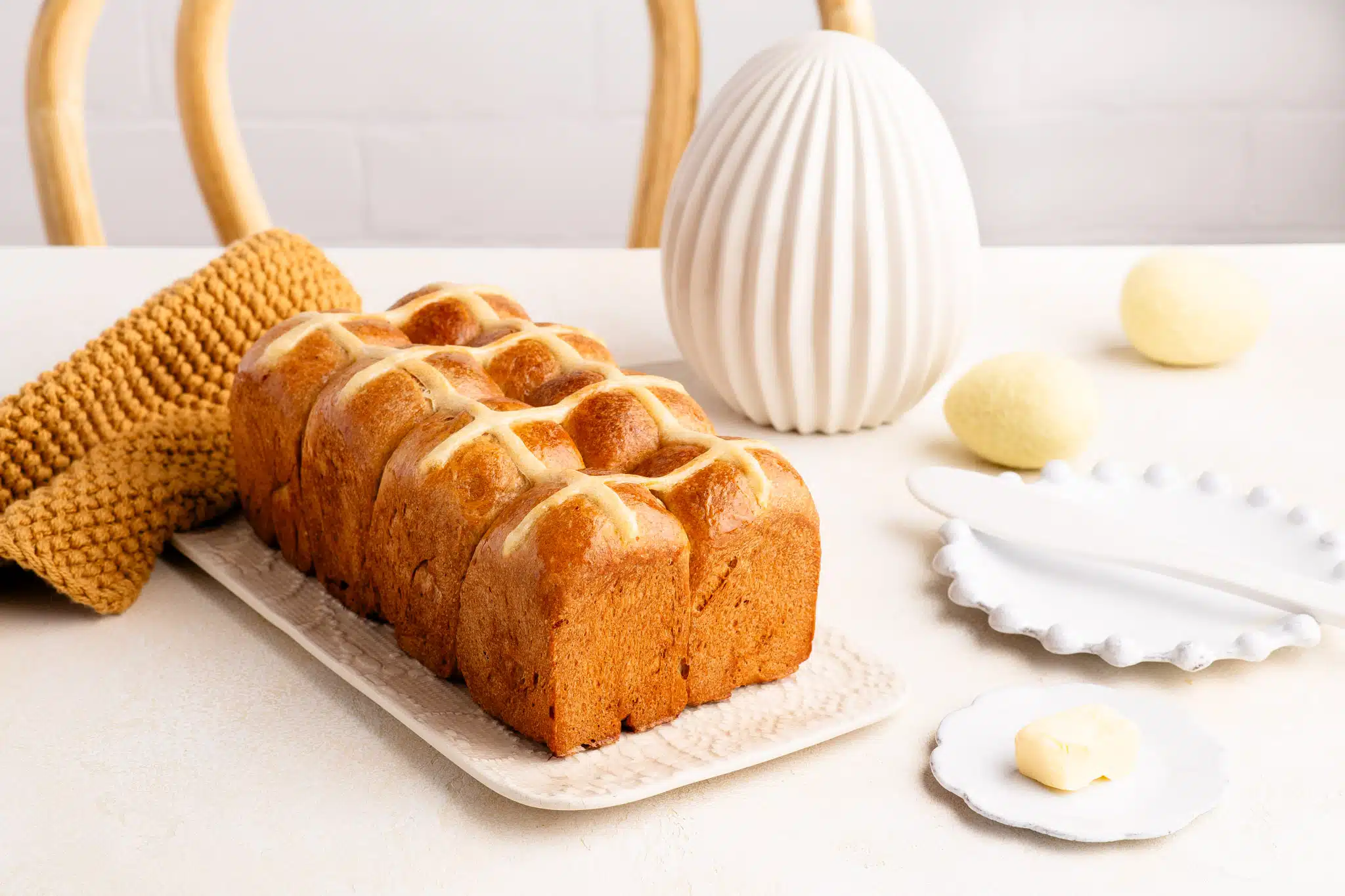
What is great about baking Hot Cross Buns in a loaf shape is that you can cut thick slices (like a regular fruit loaf), toast it until golden and then slather with some good salted butter. It is, essentially, a more spiced up Fruit Loaf, but with some little changes to make it special at Easter time.
What makes a Hot Cross Bun Loaf even more appealing in my neck of the woods is that, aside from the absence of regular Hot Cross Buns at Easter, fruit bread – as it is known in the UK and Australia – also does not exist in Switzerland. You might find some dense, dark, tooth-buckling bread which contains dried fruit, but none of the faintly-scented pillowy-soft loaves that are used to make what is called “raisin toast” in Australia.
I have to confess to bringing back a loaf of raisin toast bread in my carry-on when coming back from Australia last year. I carried it like a baby so that it wouldn’t get squashed on the plane, and I could barely contain my joy at being able to eat raisin toast in Zurich. Some months later, a friend came to visit and he had a frozen loaf of raisin toast tucked away in his suitcase, together with an assortment of Tim-Tams. I was in heaven!
Hot Cross Bun Loaf Recipe
For this Hot Cross Bun Loaf recipe, I have merely halved my recipe for classic Hot Cross Buns, so that you have just enough dough to fill a regular loaf pan. Here, I have used a pan which measures 23 x 13 cm/9 x 5 inches. I have used a high-sided loaf pan (11 cm/4.5 inches) so that the buns do not rise and spill over the sides; they will instead rise within the loaf pan to produce a nice, tall loaf.
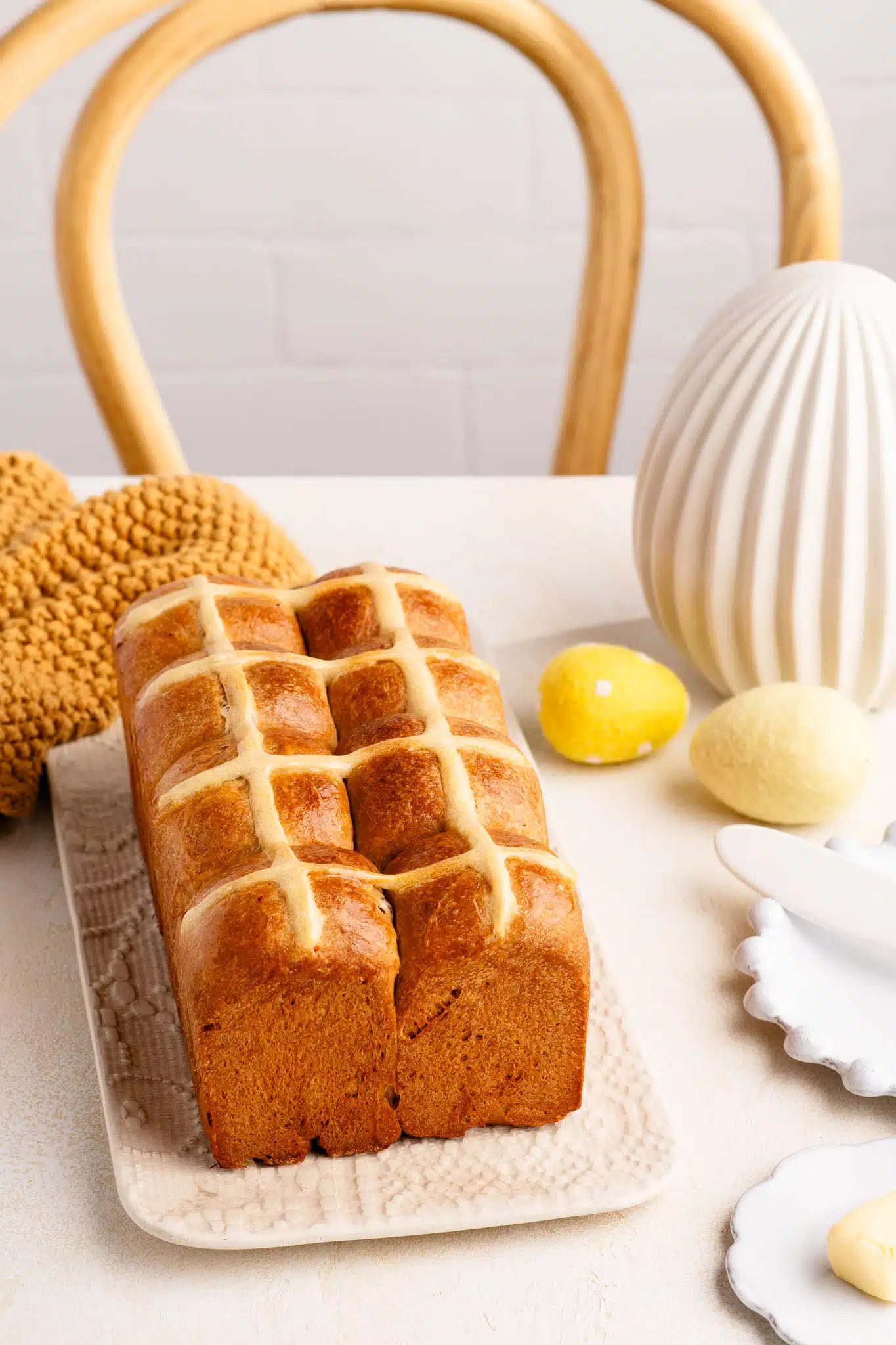
In the same style as a French Brioche Loaf, I then divided the dough into 8 portions to produce 8 small pull-apart buns, but you can also slice and serve the loaf as a regular loaf bread.
If you are entertaining, or you have the freezer space, it might even make sense to make the full recipe to produce two loaves – these disappear very fast!
How to Make Hot Cross Bun Loaf
Step 1
Heat the milk, butter, cloves, brown sugar and raisins in a small saucepan. When the butter has melted and the sugar has dissolved, set the saucepan aside for the mixture to cool to about 37°C/98°F. Discard the cloves.
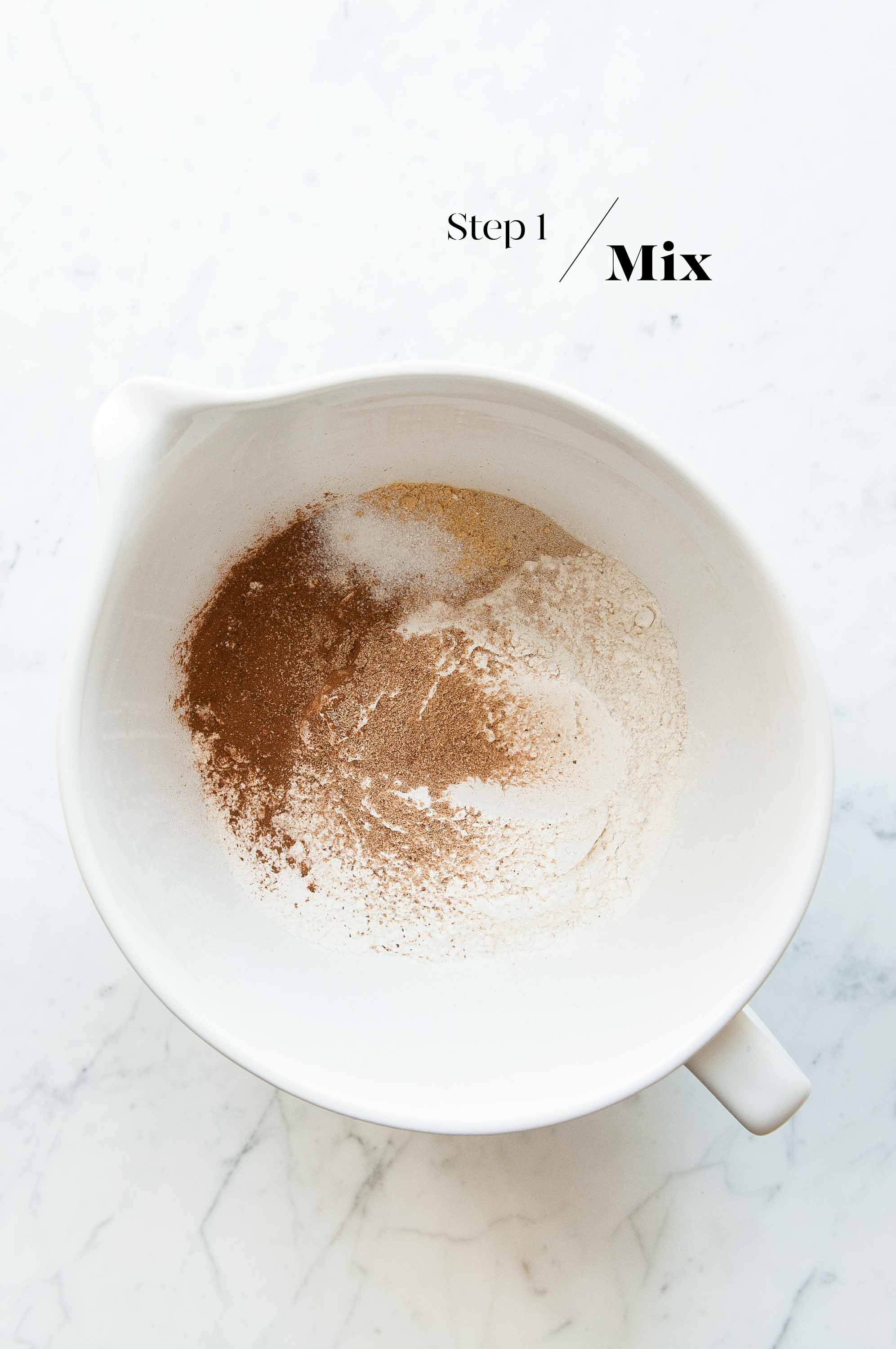
Place all of the dry ingredients into a large mixing bowl, or the bowl of an electric stand mixer.
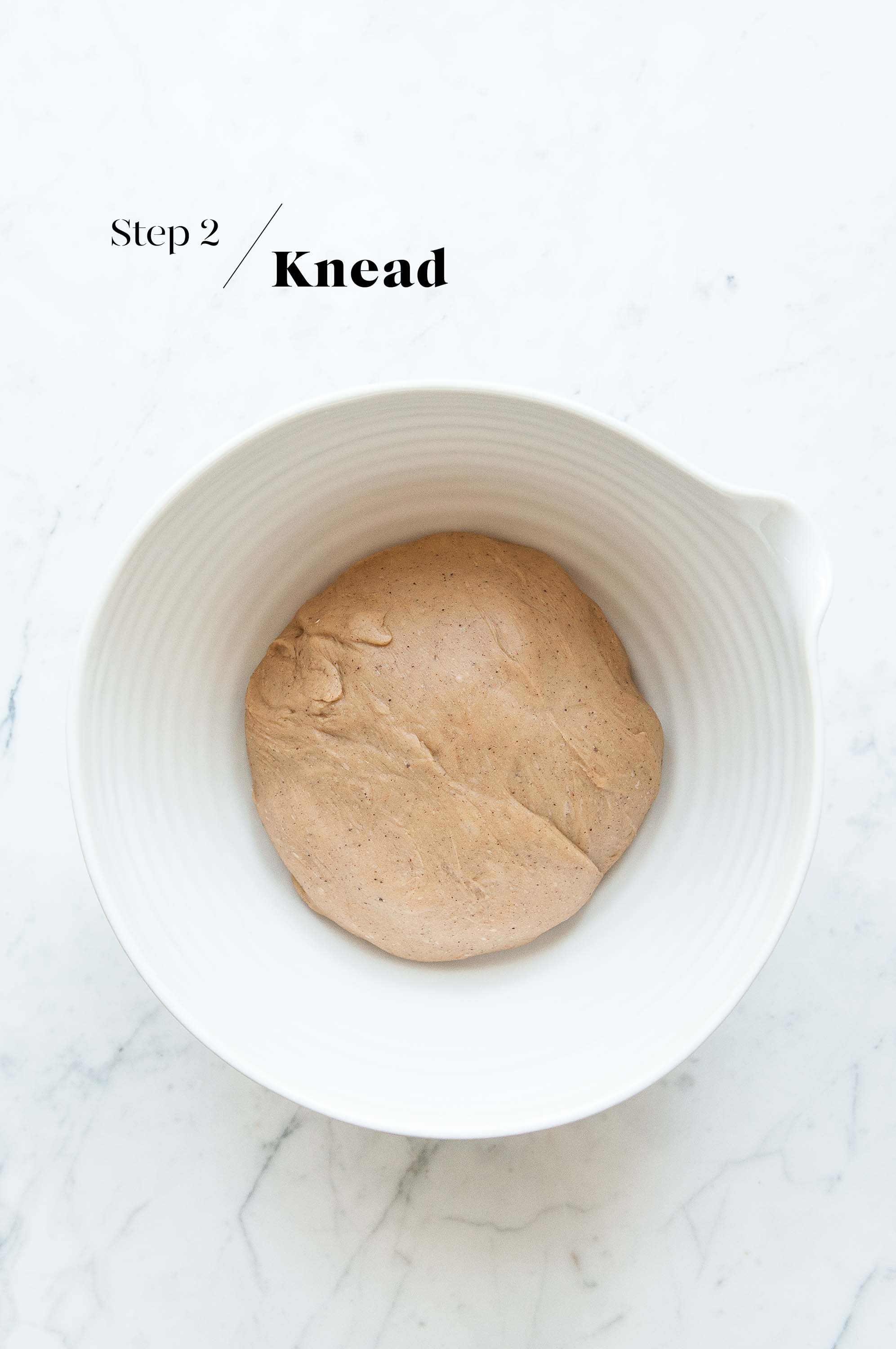
Step 2
Slowly add the milk mixture to the dry ingredients. Then add the egg.
Mix until everything is combined, and continue kneading the dough until it is smooth and elastic in texture. If you are using a stand mixer, this step will take about 10-12 minutes on the lowest speed.
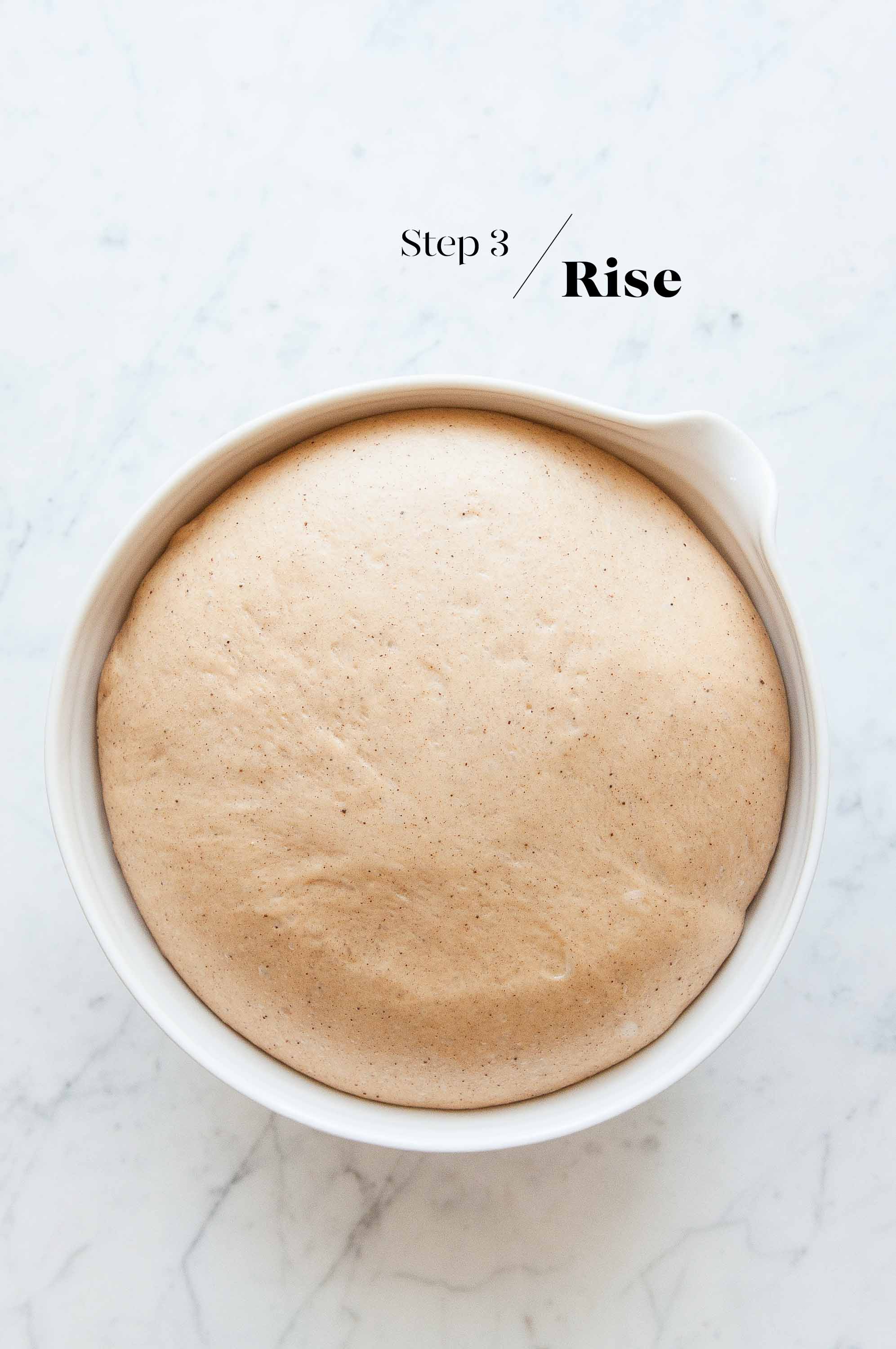
Step 3
Lightly oil a large mixing bowl, and place the dough into the bowl. Cover with a clean tea towel, and place the bowl somewhere warm for the dough to prove for about 1 hour, or until the dough has doubled in size.
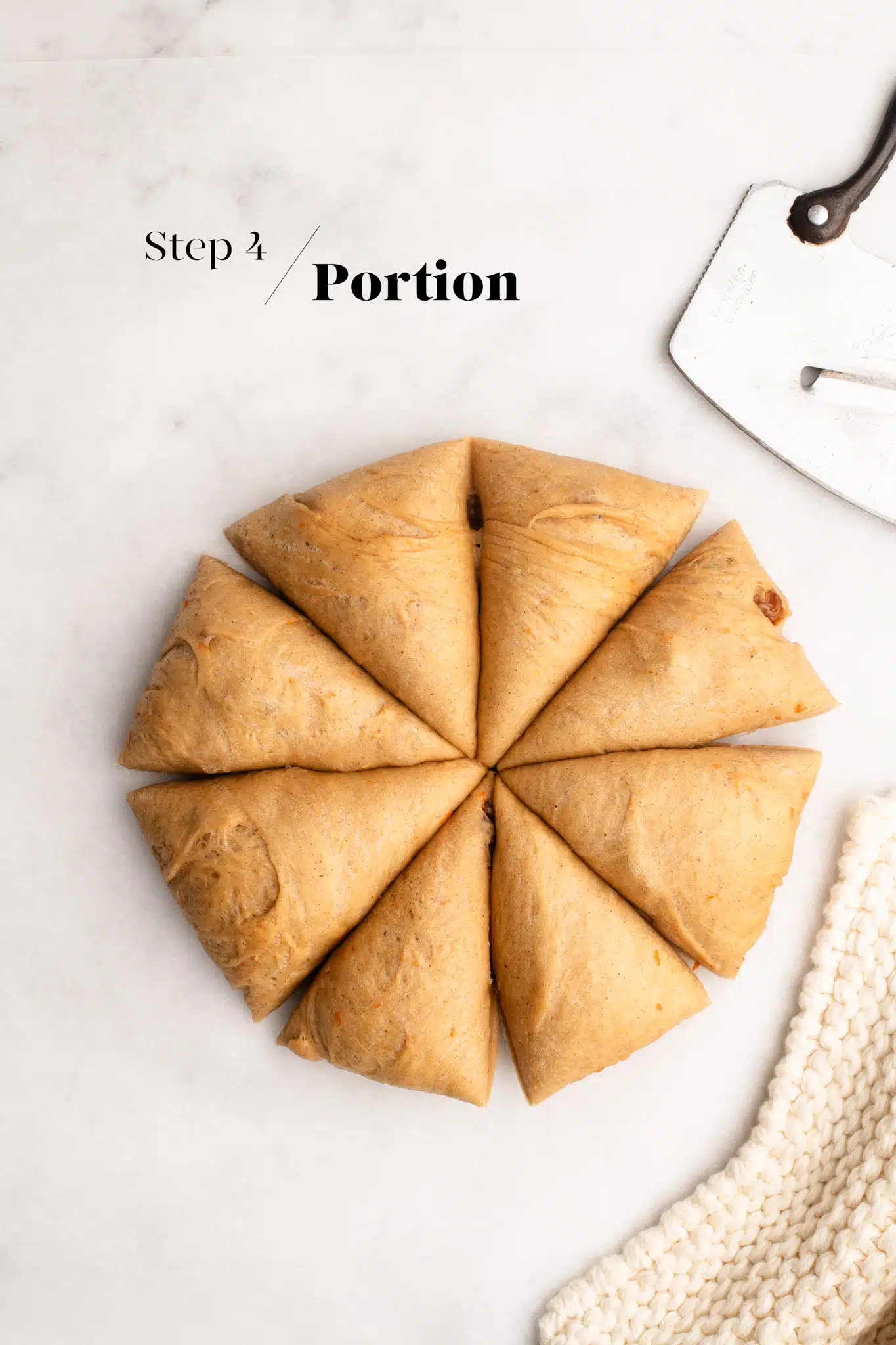
Step 4
Gently remove the dough from the mixing bowl and place it on the kitchen bench (I like to use a silicone mat). Portion the dough into 8 equal pieces.
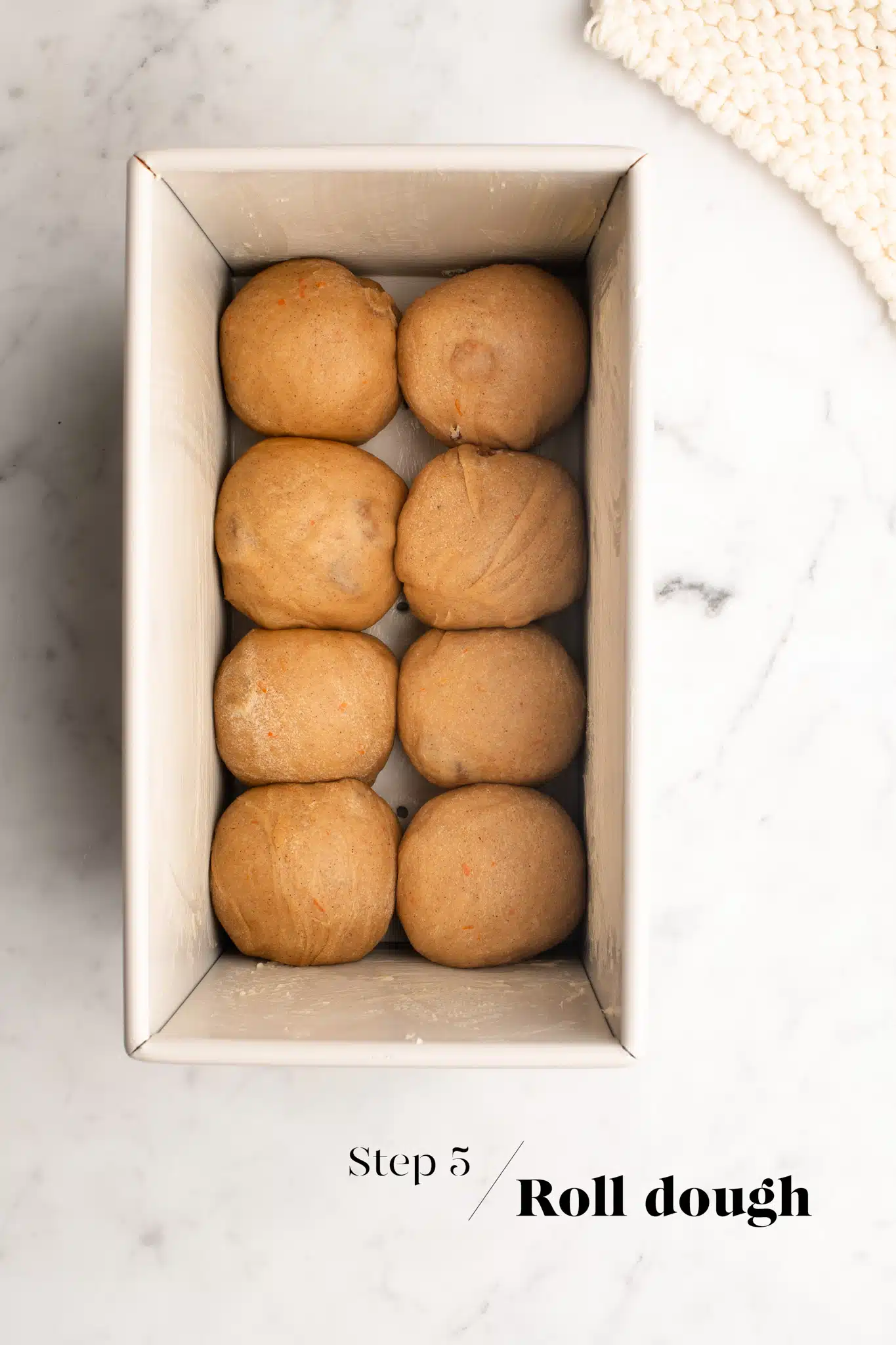
Step 5
Generously butter a loaf pan. I used one measuring 23 x 13 cm/9 x 5 inches. Roll each piece of dough into a small ball, and place them into the loaf pan.
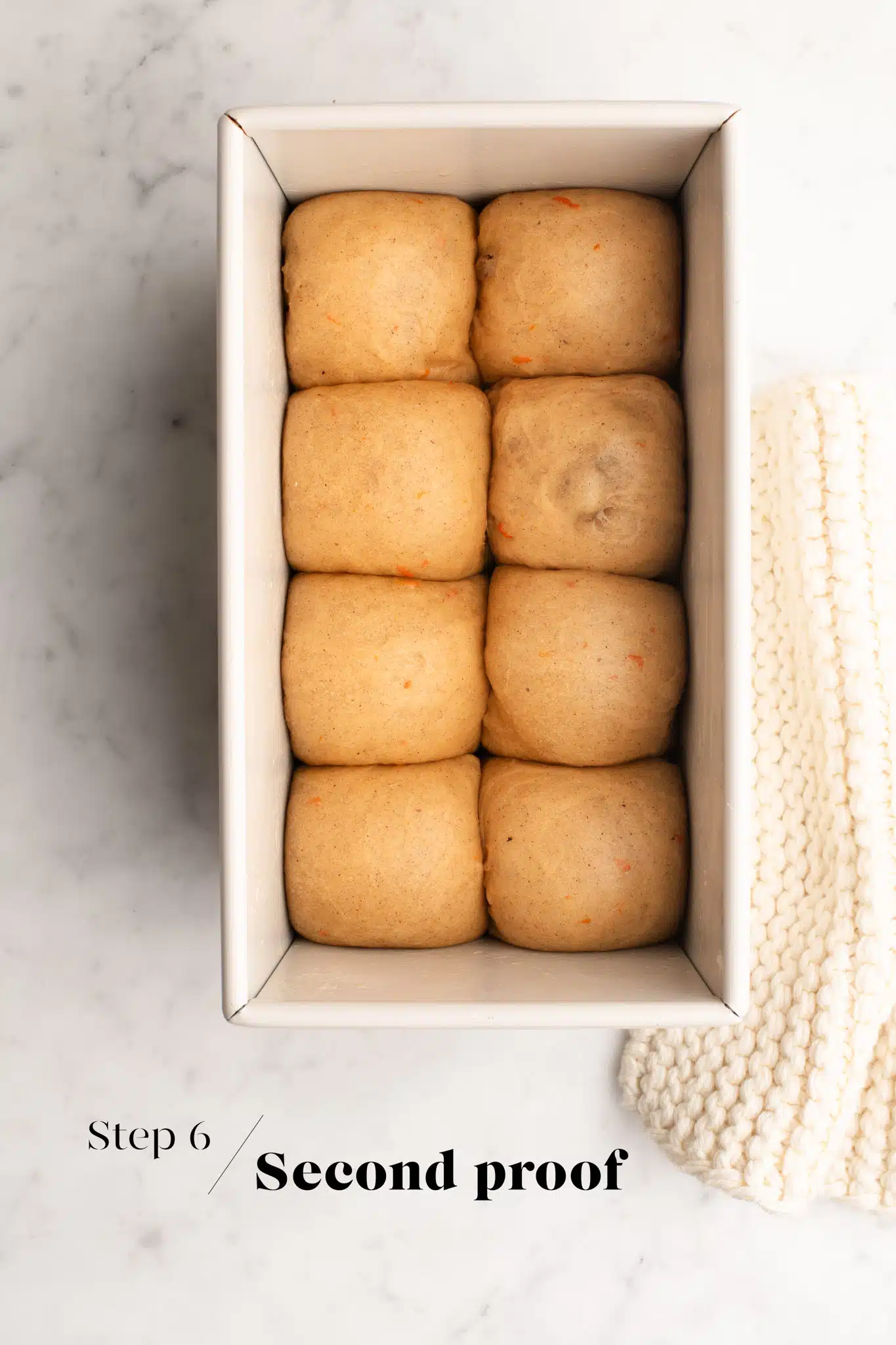
Step 6
Place the pan somewhere warm for about 30 minutes, or until the buns have puffed up, about double in size.
Step 7
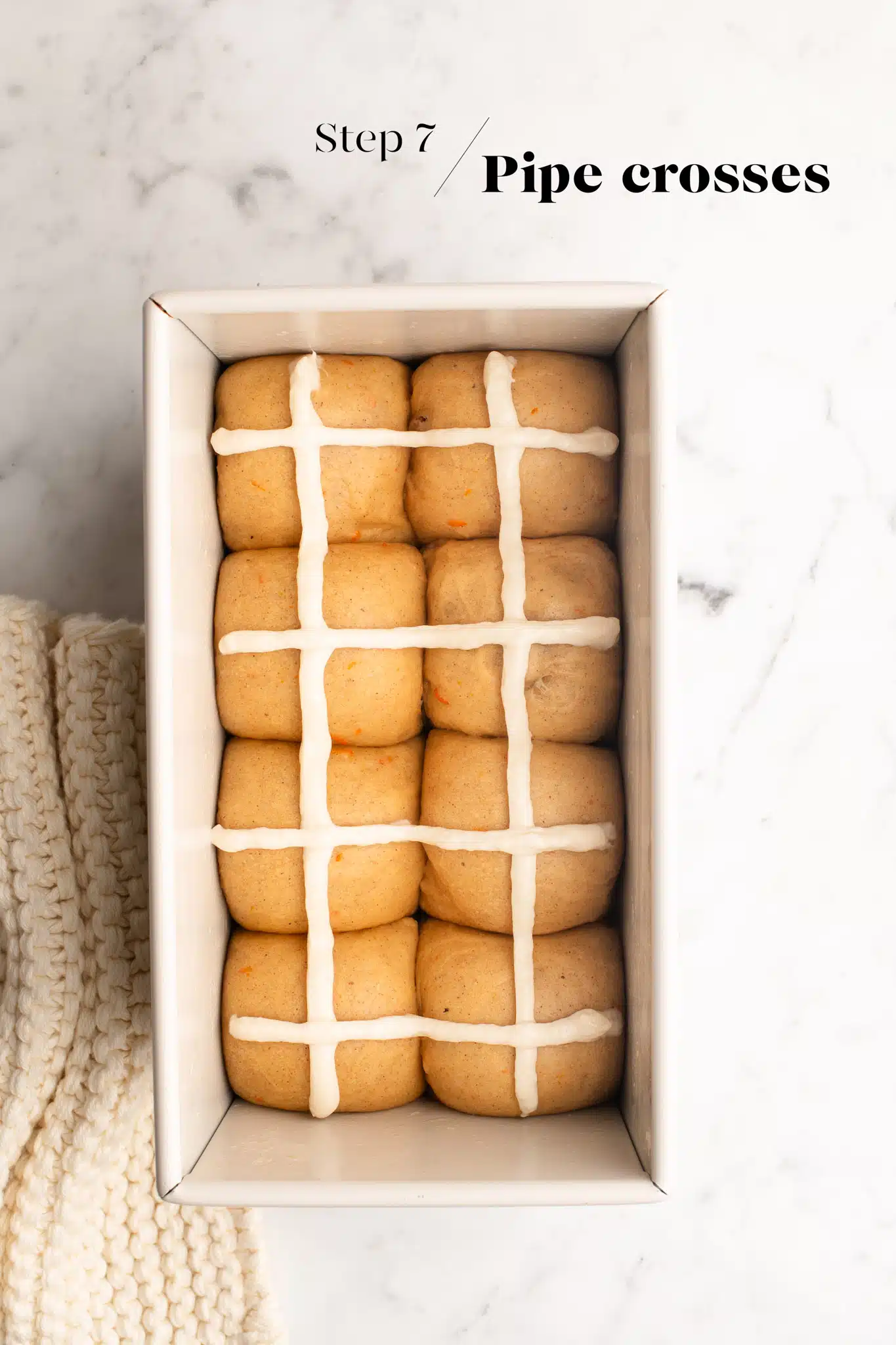
To make the crosses, mix together the flour and enough water in a small mixing bowl until you have a thick paste, but which is still runny enough to push through a piping bag. Fill a small piping bag with the paste. Pipe a cross onto each bun. I do this by piping a line horizontally across all of the buns, and then vertically.
Step 8
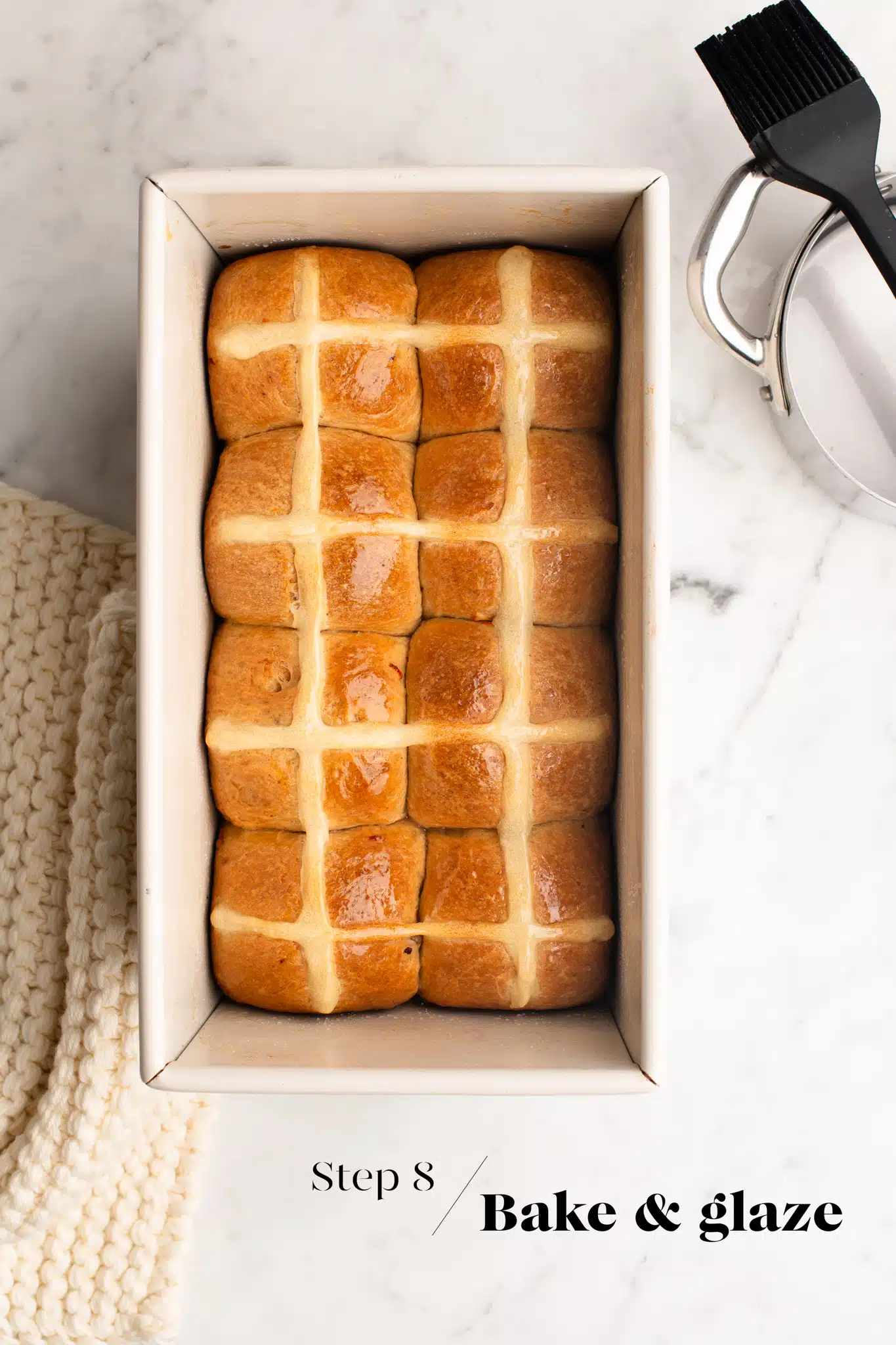
Preheat the oven to 180°C/356°F. Place a metal tray on the middle shelf to preheat.
Place the loaf pan onto the preheated metal tray. Bake for 25-30 minutes, or until the loaf is nice and golden.
During this time, make the glaze. Brush the glaze over the Hot Cross Bun Loaf while it is still hot from the oven.
Tips For Making Hot Cross Bun Loaf
- Make a regular loaf. You can skip portioning the dough and make a regular bread loaf instead. In which case, flatten the dough into a large rectangle, and then roll up the dough into a log which will fit your loaf pan.
- Make a double batch. The recipe below produces a small loaf. I think it is worth doubling the recipe to make two loaves – one to eat right away, and the other to store in the freezer.
- Freeze leftovers. Hot Cross Buns can be frozen in pairs or individually for quick defrosting. If you plan to toast the buns later, it is also worth slicing them in half before freezing. You can also cut thick slices from the loaf and freeze them in a single layer. I simply freeze Hot Cross Buns in ziplock freezer bags, knowing that they will be eaten soon. If you plan to freeze them for longer, you should carefully wrap them first in plastic wrap, before sealing them in the freezer bags.
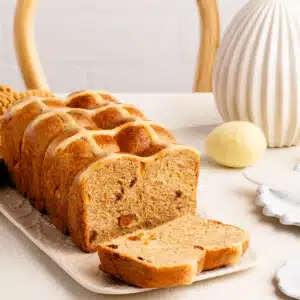
Hot Cross Bun Loaf

Ingredients
For the Hot Cross Buns
- 90 ml (⅓ cup milk) milk
- 60 g (4 tablespoons) unsalted butter
- 1 clementine, or mandarin, zested
- 2 cloves
- 40 g (¼ cup) light muscovado sugar, or light brown sugar
- 60 g (⅓ cup) raisins
- 300 g (2 cups) white bread flour
- 3 ½ g (1 teaspoon) instant dried yeast, see Kitchen Notes
- ½ teaspoon fine salt
- 1 teaspoon ground cinnamon
- ½ teaspoon nutmeg, freshly grated
- ½ teaspoon ground ginger
- ½ teaspoon cardamom seeds, freshly ground, optional
- 1 egg
For the crosses
- 60 g (⅓ cup plus 1 tablespoon) plain flour, (all-purpose flour)
- 125 ml (½ cup) water
For the glaze
- 1 tablespoon boiling water
- 1 tablespoon caster sugar, (superfine sugar)
Instructions
Making the Dough
- Combine the milk, butter, clementine zest, cloves, brown sugar and raisins in a small saucepan.
- Gently heat until the butter has melted and the sugar has dissolved.
- Leave the mixture to cool until it is lukewarm (about 37°C or 98°F).
- Remove and discard the cloves.
- In a large bowl, mix together the flour, yeast, salt, ground cinnamon, ground nutmeg, ground ginger, and ground cardamom (if using).
- Slowly mix the milk mixture into the flour mixture.
- Add the egg.
- Knead the dough on a lightly floured surface until it is soft and elastic in texture. If you have an electric stand mixer, you can knead the dough using the dough hook for about 10-12 minutes on the lowest speed.
- If the dough is too wet, add some flour (about a tablespoon at a time) until the dough looks the right texture.
- Lightly oil a large bowl.
- Place the dough into the bowl, cover with a teatowel, and leave it to prove in a warm place for about 1 hour or until it has doubled in size.
Shaping the Dough
- Generously grease a loaf pan with butter. I have used one which measures 23 x 13 cm/9 x 5 inches.
- Once the dough has doubled in size, gently remove it from the bowl.
- Divide the dough into 8 equal portions.
- Roll each portion of dough into a ball.
- Place the balls of dough into the loaf pan.
- Place the loaf pan in a warm place to prove for 30 minutes or until the balls of dough have almost doubled in size.
- Meanwhile, preheat the oven to 180°C/356°F (without fan).
Decorating the Loaf
- To make the crosses, mix together the flour and enough water in a small mixing bowl until you have a thick paste, but which is still runny enough to push through a piping bag.
- Fill a small piping bag with the paste.
- Pipe a cross onto each bun. I do this by piping a line horizontally across all of the buns, and then vertically.
Baking the Loaf
- Bake the loaf for 25-30 minutes, or until it is nicely golden on top.
- Meanwhile, make the glaze by heating the water and sugar together in a small saucepan until it comes to a boil and the sugar has dissolved.
- Brush the glaze over the loaf as soon as you take it out of the oven.
Kitchen Notes
- MAKE AHEAD TIPS
To start the dough the night before, make the dough as per the recipe. Place the bowl of dough (covered) in the fridge to proof overnight, or for at least 8 to 10 hours. During this time, it should have at least doubled in size. The next day, proceed with the rest of the recipe. As the dough will be cold, it may require a bit more time for the second proofing period. - DIFFERENT TYPES OF YEAST
* Please note that there is a difference between instant yeast (also called instant dried yeast or fast-action dried yeast) and dried yeast (also called active dry yeast). If you are not sure what type of yeast you have, please check the packaging for instructions on how to use the yeast.
* With instant yeast, you can add it directly to the flour mixture without having to activate it first.
* With dried yeast, you will need to activate it first (usually in some warm liquid). - DIFFERENT TYPES OF FLOUR
* Bread flour contains 11-13% protein content, which is required to develop more gluten in the dough, which in turn gives yeasted bread a nice, chewy texture.
* For Swiss readers, I use Zopfmehl (or farine pour tresse) when making bread and enriched dough. - PROOFING THE DOUGH
Dough needs a warm environment for the yeast to activate and cause the dough to rise. If you don’t have a warm place in your home, try one of the following ideas:
* In the oven with the oven light switched on (works only for some ovens).
* In the oven with a tray of boiling water on the bottom shelf.
* In the oven at a low temperature of about 25-40°C (77-104°F). - DRIED FRUIT
You can also play around with the dried fruit content, or omit it completely for just a plain spiced bun. - STORAGE
Hot Cross Buns are best eaten the day they are made. Any leftover hot cross buns can be stored in the freezer and toasted before serving. - OVEN TEMPERATURES
All recipes on this website state temperatures for a regular oven (i.e. a conventional oven without fan). If you have a convection oven with a fan, please consult the manufacturer’s handbook on how to adjust the temperature and baking time accordingly. - CONVERSIONS
To convert from cups to grams, and vice-versa, please see this handy Conversion Chart for Basic Ingredients.



I have made bread of all kinds for many years but I think there is something wrong with this recipe. My yeast was fresh and I got literally no rise. Very dense though it smells great! Not sure what happened.
Hi Carrie,
Perhaps the milk was too warm when you added it, which could kill the yeast? Generally, if the dough does not rise after proofing, it means that the yeast was either not fresh or that it died when something warm was added. Sorry this happened to you.