

 by
by 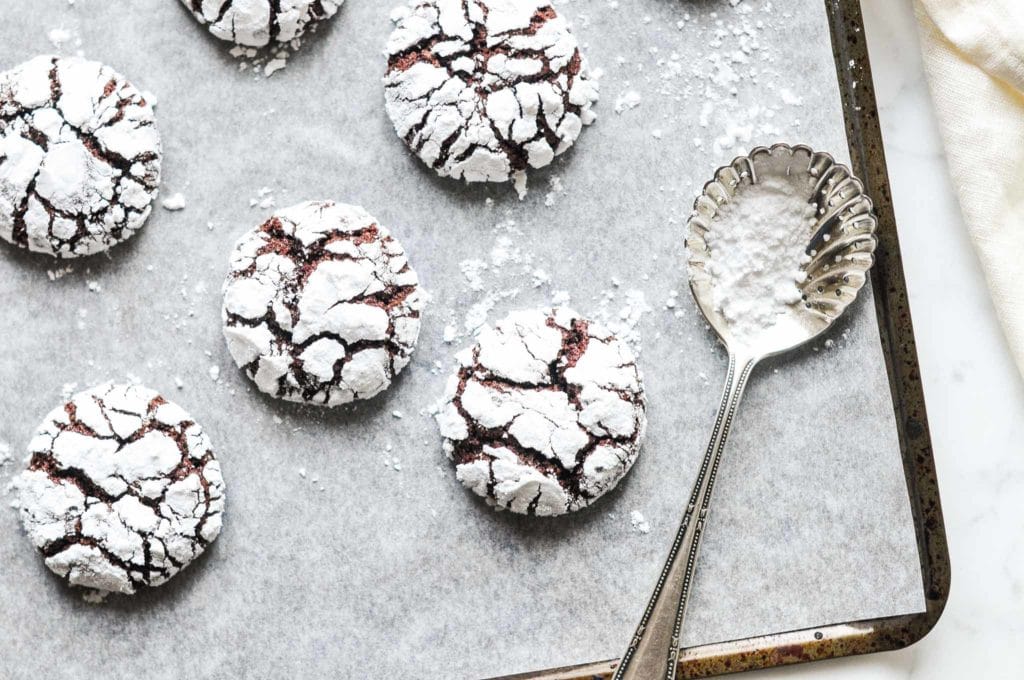
Christmas Cookies
We bake a lot of cookies in the lead up to Christmas, and whilst we tend to recreate old favourites like Gingerbread Sablé or Swiss Walnut Christmas Cookies for the sake of tradition, I always try to sneak in a few new recipes to keep things fresh and exciting.
My Reindeer Cookies have proven to be quite popular already, but I always think there is room for another chocolate cookie 🙂
Chocolate Crinkle Cookies
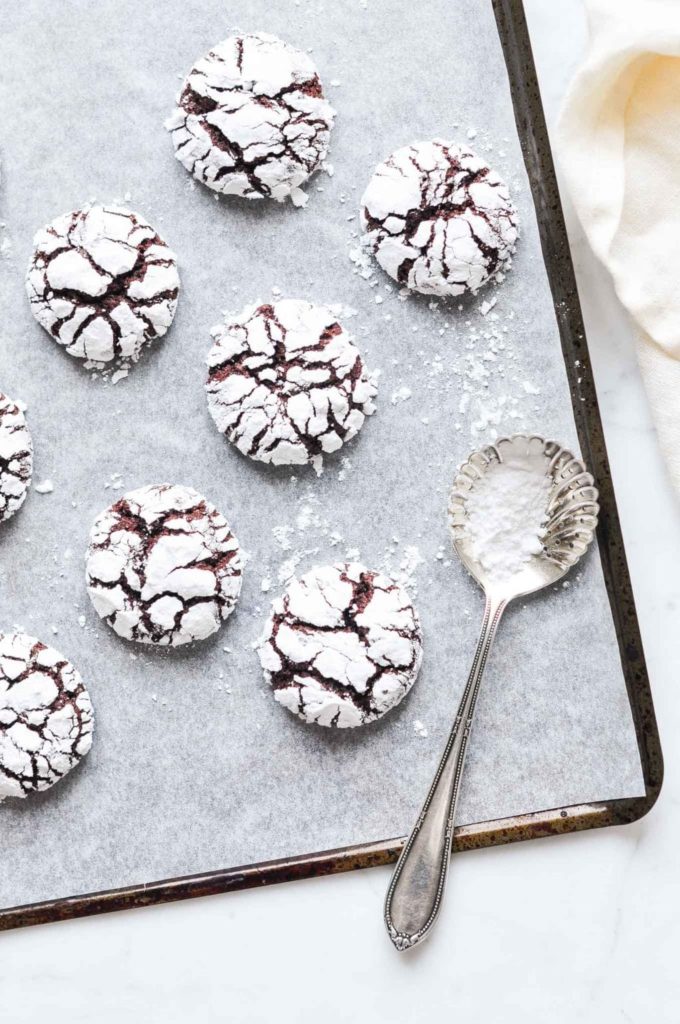
When I was flicking through my small collection of Christmas cookbooks, I came across several recipes for these Chocolate Crinkle Cookies and I was instantly intrigued by how beautiful they looked, by how they resembled snow-capped mountains (which we can already see in the distance from our home).
Snowcap Cookies
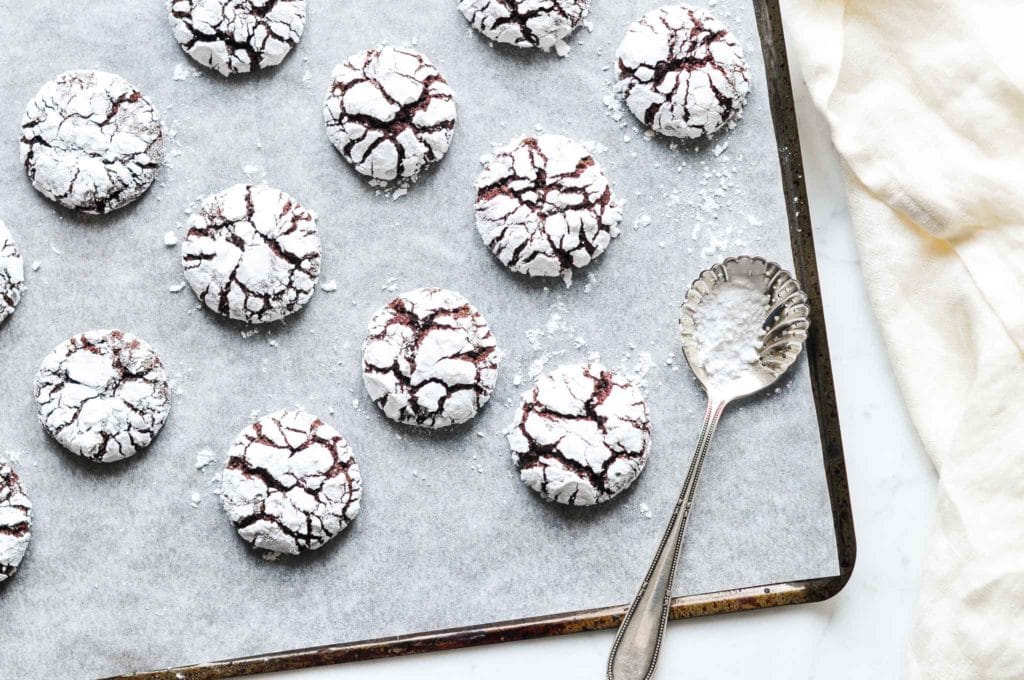
In fact, the British call them Snowcap Cookies, whilst the Americans more commonly refer to them by the more descriptive Chocolate Crinkle Cookies.
Tips for Making Chocolate Crinkle Cookies
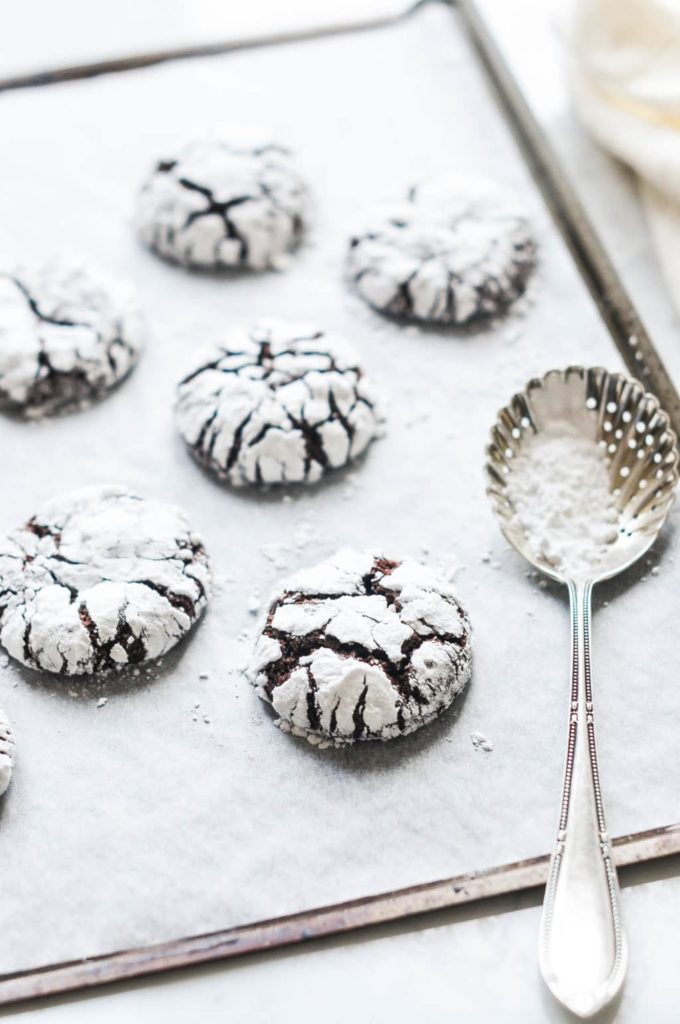
My first attempt didn’t turn out so well – the cookies failed to crinkle. MAJOR fail!!
My second attempt (from a different cookbook) rose and crinkled beautifully, but the icing sugar coating looked yellow and cakey.
At this point, any normal person would have thrown in the towel. But given the simple pantry ingredients required for these cookies (especially the use of oil instead of butter!), I was determined to do some further midnight experimenting. There is something oddly relaxing about baking in the middle of the night when everyone else is asleep.
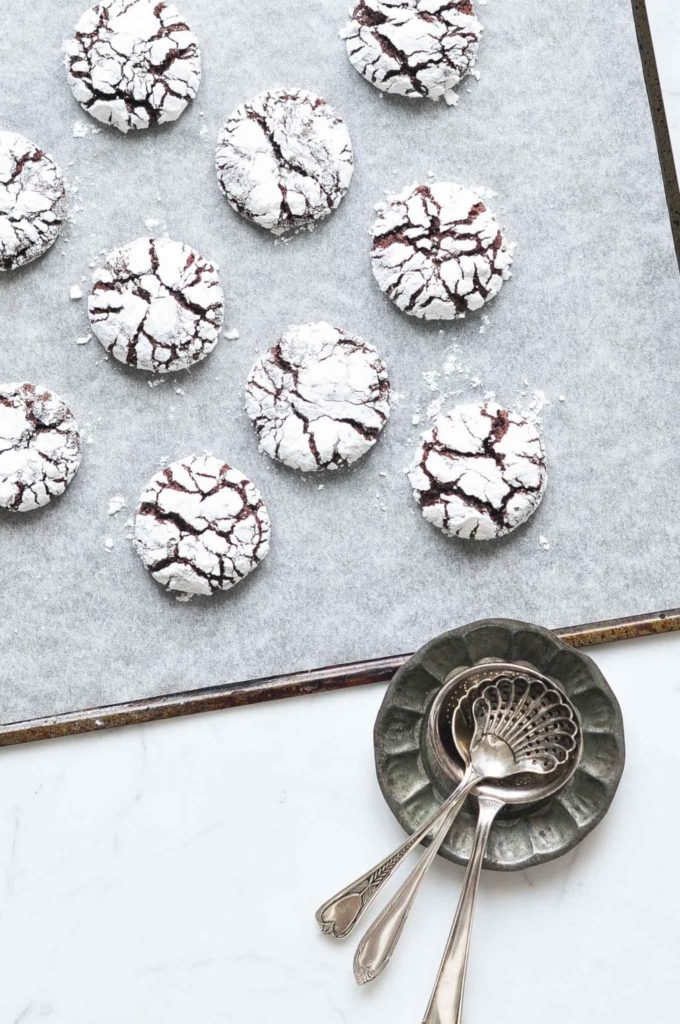
Chocolate Crinkle Cookie Recipe
And so it turns out – I think – that the type of icing sugar (powdered sugar) used in this chocolate crinkle cookie recipe is quite crucial.
I typically use a soft icing sugar which contains cornflour (US: cornstarch) to make it soft and less lumpy, which means there is never a need to sift it. But my batches of cookies with this type of icing sugar yielded unattractive results; my guess is that the icing sugar started to melt into the cookie dough and the chocolate dough, in turn, stained the icing sugar a pale yellow.
But my batches using pure icing sugar gave perfect results. I’m not a culinary scientist, but I would recommend that, for this chocolate crinkle cookie recipe, you use pure icing sugar (i.e. icing sugar with no added cornflour (US: cornstarch) for best results.
It is also important to chill the cookie dough for long enough so that it is thoroughly cold when you start to roll them into little balls.
Edible Christmas Gifts
And the verdict? My family loved them. These Chocolate Crinkle Cookies are more like little fudgy brownie bites than a traditional crunchy chocolate cookie. But I think that is what makes them perfect at this time of the year alongside the more traditional Christmas cookies.
If you know someone who doesn’t like the spices normally present at this time of the year, and especially someone who doesn’t like gingerbread, then you need to make them these Chocolate Crinkle Cookies.
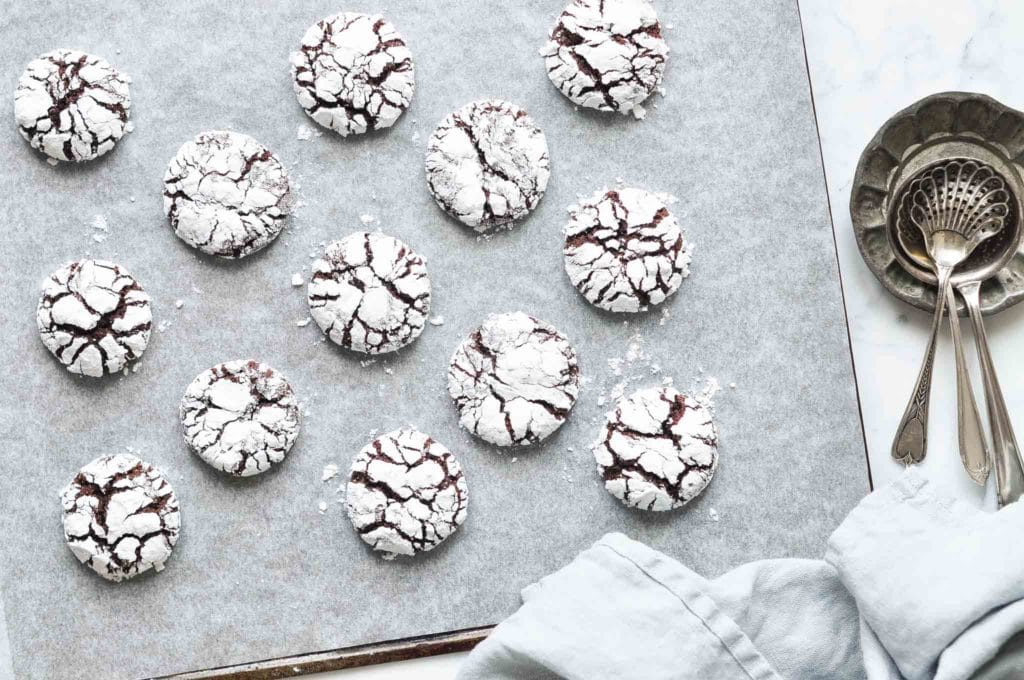
Chocolate Crinkle Cookies

Ingredients
- 170 g (¾ cup) granulated sugar
- 60 ml (¼ cup) vegetable oil
- 1 teaspoon vanilla extract
- 2 eggs
- 150 g (1 cup) plain flour, (all-purpose flour)
- 60 g (½ cup) cocoa powder, sifted
- 1 teaspoon instant espresso powder, optional
- 5 g (1 teaspoon) baking powder
- ¼ teaspoon fine salt
- 90 g (½ cup) pure icing sugar, (powdered sugar) see Kitchen Notes
Instructions
To Make the Cookie Dough
- In the bowl of stand mixer, and using the flat paddle attachment, beat together the sugar, oil, and vanilla extract until just combined. The mixture should be thick and gritty.
- Add the eggs, one at a time. Beat for 1-2 minutes until the mixture looks pale and thick.
- Slowly beat in the flour, cocoa powder, espresso powder (if using), baking powder, and salt.
- Mix until the ingredients are well-combined. The mixture should be somewhat wet, more like a very thick cake batter than a normal cookie dough.
- Scoop the mixture onto a large sheet of plastic wrap and wrap it up firmly into a ball of dough.
- Place the cookie dough in the fridge for at least 2 hours to firm up, but overnight is best.
To Bake the Cookies
- Preheat the oven to 180°C/350°F (without fan).
- Line a baking tray with baking paper.
- Place the icing sugar (powdered sugar) into a small bowl.
- Remove the cookie dough from the fridge.
- Pinch off small pieces of dough and roll them into small balls the size of a walnut.
- Place the balls of dough onto the baking tray, and space them apart by about 4 cm or 2 inches.
- Roll each ball of dough in the icing sugar (powdered sugar) until they are thoroughly coated. It is important that there is plenty of icing sugar (powdered sugar) as some will melt into the cookie dough, but the excess icing sugar (powdered sugar) will form the nice powdered effect on the cookies.
- Bake the cookies for 10-12 minutes, or until the cookies have risen and crinkled like in the photos.
- Remove the tray from the oven and leave the cookies on the tray for about 5 minutes to firm up before transferring them to a wire rack to cool completely.
Kitchen Notes
- WHAT TYPE OF ICING SUGAR OR POWDERED SUGAR TO USE
It is important to use pure icing sugar (powdered sugar) in this recipe, so make sure you check the ingredients on the packaging. Some types of icing sugar contain starch or other ingredients to make it softer or less lumpy. If your icing sugar is very fine and doesn’t need to be sifted, chances are that it is not pure icing sugar. If you use anything other than pure icing sugar for coating these cookies, you might find that the cookies will not turn out the same – the icing sugar may turn a pale yellow instead of remaining white. - STORAGE TIPS
The cookies will keep well for about 5 days in a covered container. - OVEN TEMPERATURES
All recipes on this website state temperatures for a regular oven (i.e. a conventional oven without fan). If you have a convection oven with a fan, please consult the manufacturer’s handbook on how to adjust the temperature and baking time accordingly. - CONVERSIONS
To convert from cups to grams, and vice-versa, please see this handy Conversion Chart for Basic Ingredients.
Did you make this recipe?
Please leave a comment below and share your photos by tagging @eatlittlebird on social media and using #eatlittlebirdUpdate
This recipe was first published on 23 November 2017. It has been updated with new photos and more comprehensive recipe notes.


These look so Christmasy and beautiful! I don’t feel in the Christmas spirit just yet… it doesn’t feel like it will actually be December next week. hmmm maybe when our little tree up it will. Or maybe I need to start some christmas baking projects like these… might rustle up the festive-ness in me? Thanks for sharing x
Thanks, Dani! It’s been relatively warm where we are, so it doesn’t quite feel like Christmas is around the corner. There’s a chance it might snow next week, so I have my fingers crossed!
Crinkle cookies are so beautiful to look at and remind me of a dusting of snow at Christmastime. I’ve been wanting to expand my cookie repertoire, so I look forward to trying your recipe. Thank you.
Thanks, Lisa! Hope you will enjoy this recipe 🙂
I have yet to make crinkle cookies but they’re definitely on my to-do list, specially seeing how pretty yours are!
Thanks, Patty!
These cookies look so perfect, and I’ve had trouble before getting my crinkle cookies to ‘crinkle’, so thanks for the tips!
Thanks, Sue! My first batch was a major disappointment, but I’m glad I finally got it right 🙂
I was just on the hunt for a perfect Christmas cookie, but my previous cookies didn’t crinkle, thanks for sharing a tip about the icing sugar! ????
You’re welcome! I hope you will have better luck next time 🙂
These look so yummy! I have never made chocolate crinkle cookies! I’m glad you did all of that trial and error! Saves me a bunch of mistakes!
Ha ha, indeed! I always knew there were different types of icing sugar, but this was the first time it had an impact on my baking.
These are so perfect. I haven’t tried these cookies. Surely I’ll, Thanks for sharing the post 🙂
Thank you! Hope you will enjoy the recipe!
This is by far my favourite cookie recipe! So easy and delicious! And thank for the note about the icing sugar, my icing sugar also had cornstarch in it – something I never realized prior to making this recipe. After an internet research, I found out that we can easily make our own icing sugar by putting normal sugar through the blender, skeptical at first, it actually works perfectly and I didn’t need to go look for pure icing sugar, in fact, I don’t see myself ever buying icing sugar again =)
Sophie
Hi Sophie,
Thanks for your lovely words here! I had no idea you could make icing sugar this way – I must absolutely try it too! I love small discoveries like these in the kitchen 🙂
Oh my goodness this look absolutely amazing! It truly looks delicious!