

 by
by Sablé Cookies
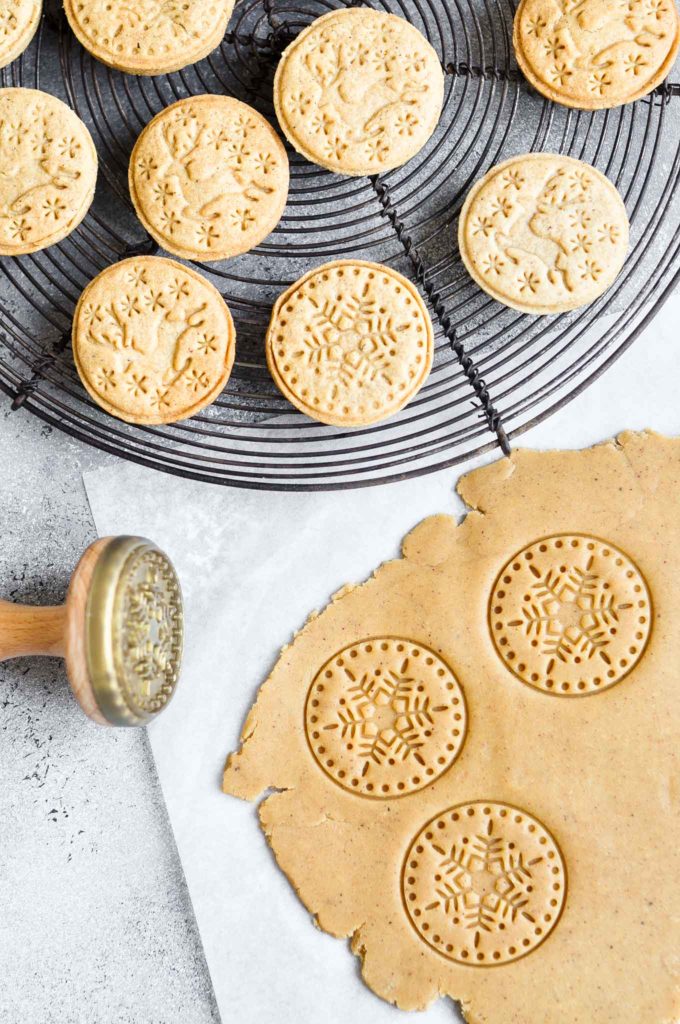
It’s that time of the year again to get out the Christmas cookie cutters and, this year, I’m having much fun with my newfound cookie stamps and cookie moulds.
I love the old-fashioned Swiss-style Christmas cookies, and I thought it would be fun to replicate them using a favourite family recipe.
French Butter Cookies
When it’s time for a bit of fun in the kitchen with the children, we often resort to making cookies; the kids have hours of fun rolling out the dough and stamping out various shapes, and the cookies happen to be quite delicious to eat!
This recipe is based on one used by my husband’s great-aunt, who loves to make a big batch of sablé (French butter biscuits) whenever we visit her in France.
Why This Recipe Works
- The dough is very easy to work with.
- If you are baking with children, the children can roll it and re-roll it as many times as they like, yet the dough will remain soft and pliable, but still firm enough to cut out shapes.
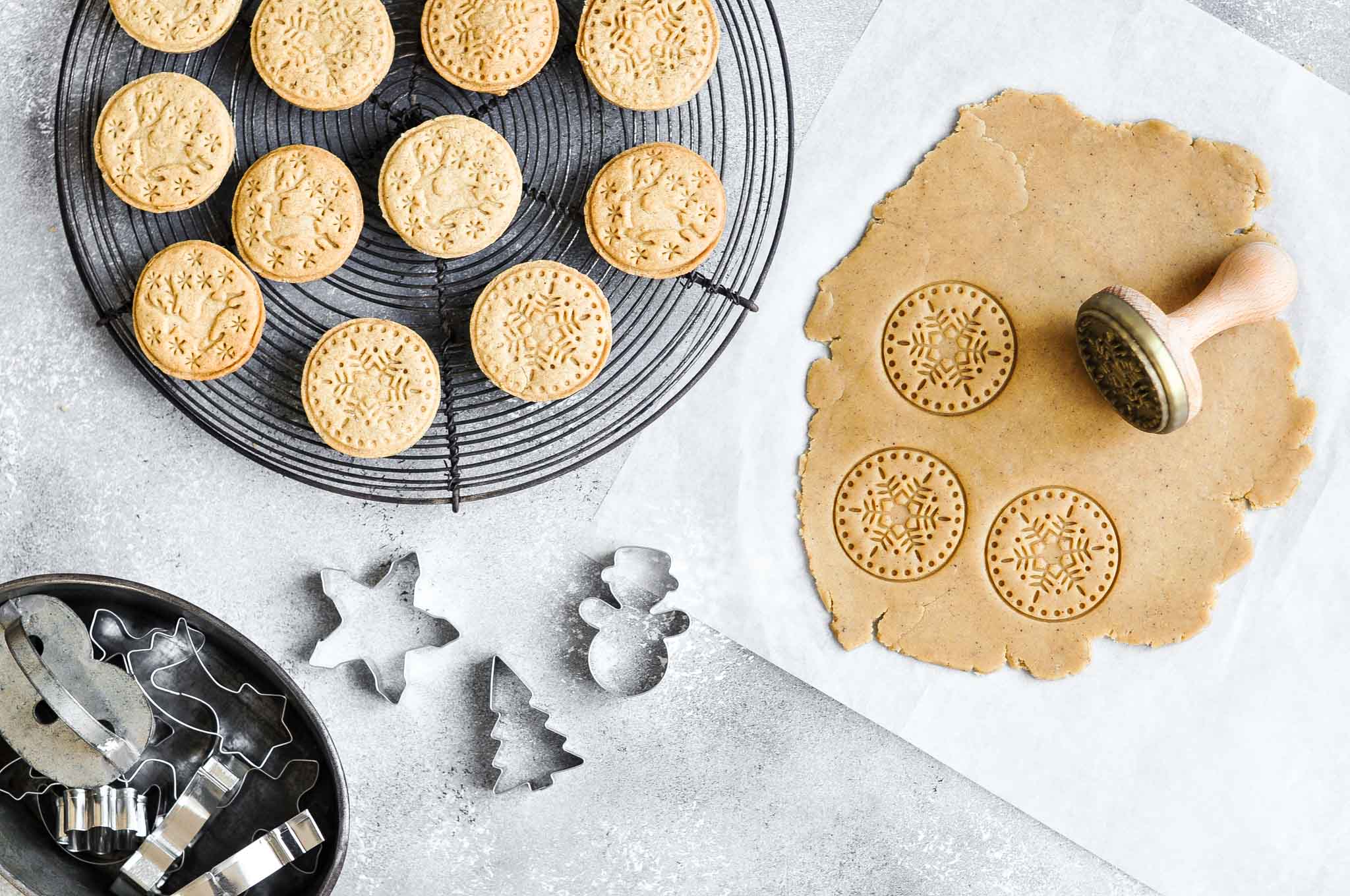
- This recipe is perfect if you are using a cookie stamp like those featured in the photos, or even an embossed rolling pinbecause the dough will not stick to either. When using a cookie stamp or embossed rolling pin, you need to work with a dough which is NOT moist and sticky, otherwise the dough will simply stick to whatever it touches.
Baking with Children
If I am baking with the children, I always double the recipe so they each have a bit of dough to play with while I get on with the real business of getting some cookies in the oven.
Afterwards, I try to salvage whatever dough I can from the children (i.e. the bits which they have not tried to eat raw!) to make some more cookies, although they usually surprise me with some of their own successfully cut-out shapes (dinosaurs are popular in our home, even at Christmas).
Gingerbread Cookies
To make our usual cookie dough a bit more festive, I added some spices to give it a subtle hint of gingerbread.
You could, of course, play with the ingredients to make it spicier, but we tend to receive a lot of traditional spicy gingerbread from friends and neighbours at this time of the year, and I wanted to make something more mild and child-friendly.
Our children absolutely love these cookies and devour a whole batch within the space of just a few days. So my recommendation is to hide a small plate of cookies somewhere for you to enjoy on your lonesome with a cup of tea.
And don’t forget to save some for Santa too!
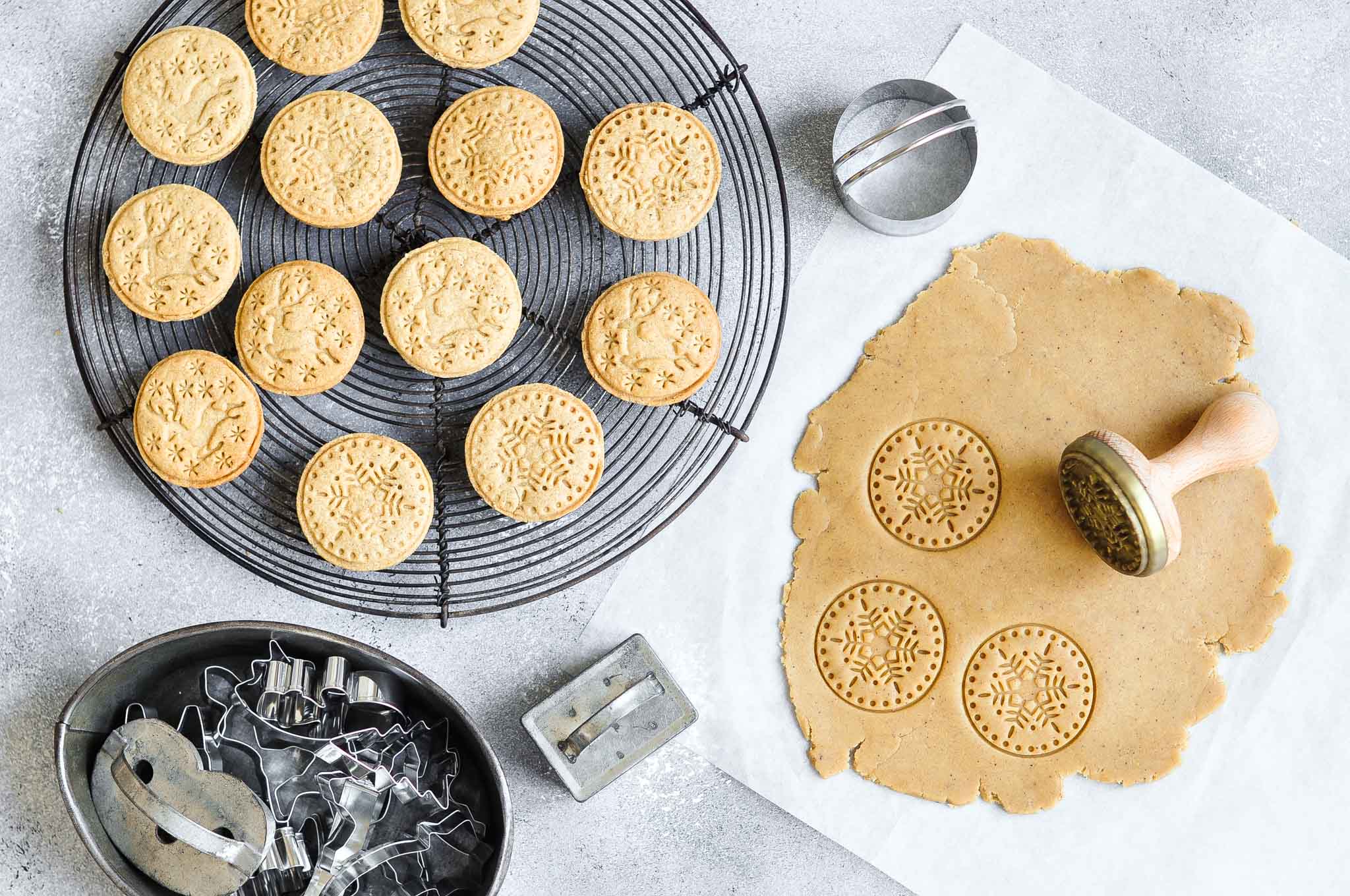
Tips For Using Cookie Stamps
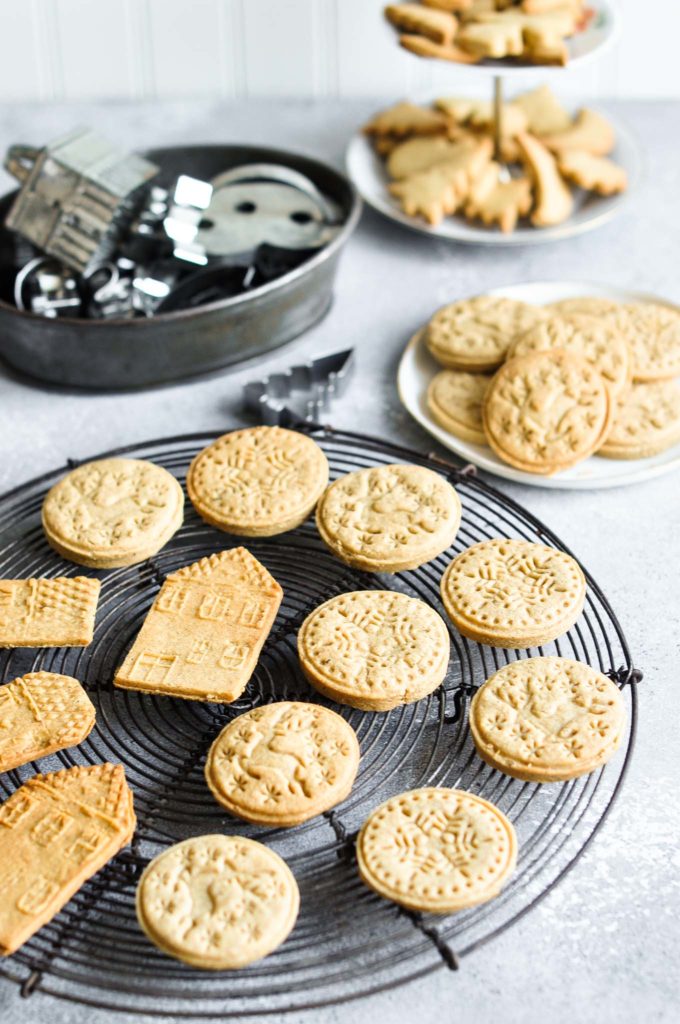
- Cookie stamps are available in different materials – wood, silicon, and metal or aluminium.
- When using wooden cookie stamps, I find it helpful sometimes to dip the wooden cookie stamp in flour before stamping to prevent it from sticking to the dough.
- Silicon and metal cookie stamps are generally less prone to sticking to the dough than wooden stamps. They are also easier to clean.
- I find it best to use cookie stamps when the dough is relatively cold and firm.
- To use the cookie stamp, slowly press it down into the dough and carefully remove it by tilting the stamp sideways and lifting it up as you do so (as opposed to an “up and down” stamping motion).
- Once you have tried using cookie stamps once or twice, you will get a feel for how they work, depending on the softness of your dough.
Tips For Using Embossed Rolling Pins
- I find it easiest to using embossed rolling pins when the cookie dough is cold and firm. If the cooke dough is too warm and/or soft, it may stick to the embossed rolling pin (and which is an annoying task to clean!).
- If the cookie dough is too cold, the embossed rolling pin may slip and slide across the dough.
- Start by placing the rolling pin close to you and roll away forwards, i.e. away from you.
- Depending on the cookie dough and the type of pattern on your embossed rolling pin, you might want to roll and re-roll a few times to make a deeper impression in the cookie dough. Do this by rolling forwards and backwards a few times as you move the rolling pin forwards, but making sure that you do not lift the rolling pin at any time.
- Most embossed rolling pins produce a uniform pattern across the dough. I like to use a plain round cookie cutter to cut out shapes from the dough.
- Re-roll any leftover dough between two sheets of baking paper, and chill for about 15 minutes in the fridge before using the embossed rolling pin again.
Gingerbread Sablé Cookies

Ingredients
- 175 g (1 ½ stick) unsalted butter, softened
- 4 to 8 tablespoons light muscovado sugar, or light brown sugar, depending on how sweet you like the cookies
- 2 egg yolks
- 300 g (2 cups) plain flour, (all-purpose flour)
- 2 teaspoons ground ginger
- ½ teaspoon ground cinnamon
- ¼ teaspoon nutmeg, freshly grated
- ¼ teaspoon ground allspice
- 2 tablespoons cold water
Instructions
To Make the Cookie Dough
- Place the butter and sugar into the bowl of a stand mixer.
- Using the flat paddle attachment, cream the butter and sugar until light and fluffy.
- Add the egg yolks.
- Measure the flour and spices into a bowl.
- Add a few tablespoons of the flour mixture at a time to the butter and sugar, and incorporate on slow speed.
- Once all of the dry ingredients have been added, add a bit of the cold water (you may not need all of it) and mix until everything comes together into a soft ball.
- Place the dough between two sheets of baking paper and roll until the mixture is about 5mm thick.
- Place the rolled out dough in the fridge to chill for at least 30 minutes.
To Make the Cookies
- Preheat the oven to 180°C (350°F) (without fan).
- Cut out shapes from the dough and transfer them to a baking sheet lined with baking paper.
- Bake the cookies for about 12 minutes, or until they are lightly golden.
- Let the cookies rest on the baking sheet for a few minutes before transferring them to a wire rack to cool completely.
Kitchen Notes
- MAKE-AHEAD TIPS
The dough keeps well in the fridge for several days. - STORAGE TIPS
The cookies keep well in an airtight container. - OVEN TEMPERATURES
All recipes on this website state temperatures for a regular oven (i.e. a conventional oven without fan). If you have a convection oven with a fan, please consult the manufacturer’s handbook on how to adjust the temperature and baking time accordingly. - CONVERSIONS
To convert from cups to grams, and vice-versa, please see this handy Conversion Chart for Basic Ingredients.
Did you make this recipe?
Please leave a comment below and share your photos by tagging @eatlittlebird on social media and using #eatlittlebirdUpdate
This recipe was first published on 19 December 2016. It has been updated with new photos and more comprehensive recipe notes.


Can’t wait to try the recipe. I adore the star and reindeer stamps in your photo. May I ask where they might be available?
Thanks, Ann! I bought the cookie stamps from a store in Zurich called Tchibo. They also have an online-shop, but I think they only deliver to select countries in Europe. I’ve just checked their website and it looks like the cookie stamps are sold out, but you might find something else that catches your eye 🙂 Here is the link: https://www.tchibo.ch
Good morning Thanh, and thanks for the recipe???I’m already done with my annual Christmas cookie baking, but …???I’ll give this recipe a try very soon?
Do you ever tried to use French salted butter and to replace the cold water with milk? Just my Tuesday morning thoughts??
Hi Patrizia,
I hope you will enjoy this recipe! You’ve asked some very good questions … I do sometimes use salted butter for these cookies, in which case I would omit the salt from the recipe. This happens only when I have run out of unsalted butter (very rare, but it does sometimes occur!). However, as I sometimes worry about the salt in my childrens’ diet, I try to use unsalted butter instead when I’m baking. But I do love my salted butter, which I have on hand to spread on my bread at mealtimes 🙂
I think you could certainly use milk in place of water. My husband’s great-aunt’s recipe uses water, so I do as I’m told 😉 I think her recipe is very close to a French shortcrust pastry (pâte brisée), and these recipes traditionally use water to bind the pastry. I’ll try this recipe with milk next time 🙂
I absolutely adore sablés! They’re so buttery and perfect <3 Every time I visit Paris, I stop by La Grande Epicerie and pick up a box of those La Mere Poulard sablés..so yummy!
Ooh we love those biscuits too!! And I totally love La Grande Épicerie ❤️ I always want to buy so much whenever we go there. For a while, whenever we travelled to Paris, we stayed at a hotel just around the corner from La Grand Épicerie (I also love shopping at Le Bon Marché 🙂 ), so we got to buy food there quite often. Makes me miss Paris just writing this!
These are beautiful Thanh! Such gorgeous cutters too! Have a very Merry Christmas! Xx
Thanks, Angela! Merry Christmas & Happy Holidays to you and your family also! xx
Can you tell me where you got your canal house stamps from?
Hi Libby,
I purchased the cookie stamps and moulds used in these photos from the following store: https://www.tchibo.ch
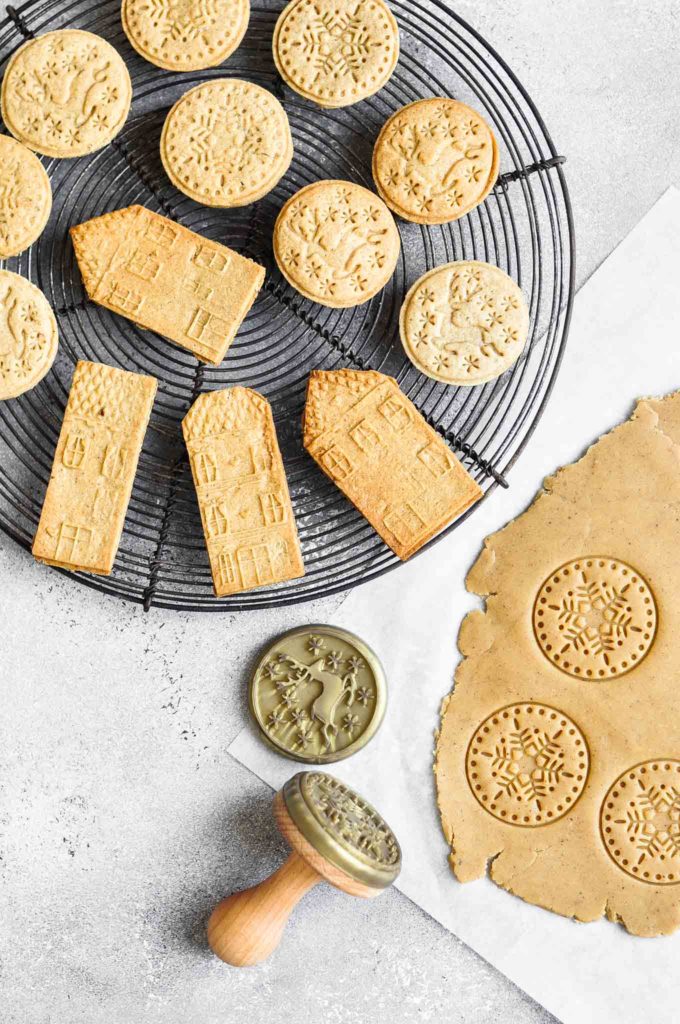
However, I think they only deliver to selected countries in Europe. The houses are made by pressing the dough into a silicon mould. I’m looking forward to giving it another try for Christmas this year 🙂
Did I read correctly that the recipe only makes 12 cookies? I do not have a stamp and is the stamp that you use so large that there are only 12 cookies? Thanks-
Hi Kate,
This recipe produces a small batch of cookies. If you are making cookies of this size, then yes, the recipe makes approximately 12 cookies. However, I usually double the recipe and make cookies of various shapes and sizes from the dough. The recipe is fairly easy to scale up or down 🙂
Love this recipe! Our children don’t normally like the spiciness of traditional gingerbread cookies but they really enjoyed these ones!
Oh my goodness this look absolutely amazing! It truly looks delicious!
Ola sou Claudia sou brasileira sei que pode ser bem dificil eu encontrar os selos mas caso for possivel voce pode me indicar onde eu posso encontrar muito obrigada pelas tuas receitas são divinas
Absolutely delicious. Not too sweet, not too spicy, not too crunchy.
This is a really lovely variation of a traditional sable recipe. The spices are very gentle and I love the crumbly shortbread texture. I used an embossed rolling pin to cut out the biscuits. It took a bit of trial and error to reach the right temperature, but in the end it worked out beautifully.
These are like shortbread cookies with a bit of spice. My family loved them! I used regular Christmas cookie cutters but I would love to find similar stamps which you used.
Very nice recipe and a good excuse to use the embossed rolling pin which does nothing the rest of the year!
Lovely recipe, very gentle gingerbread flavors. I love all types of gingerbread at this time of the year, and this is a different but nice recipe to add to the mix.