

 by
by 
Coconut Chicken Noodle Stir Fry
This is one of my go-to recipes for when I need to get dinner on the table quickly. Any by quick, we’re talking less than 30 minutes!
In fact, if you skip the chicken altogether to make this a vegetarian dish, dinner could be ready in less than 20 minutes!
This Coconut Chicken Noodle Stir Fry is perfect for a weeknight meal when time is short but you still want something substantial and full of flavour.
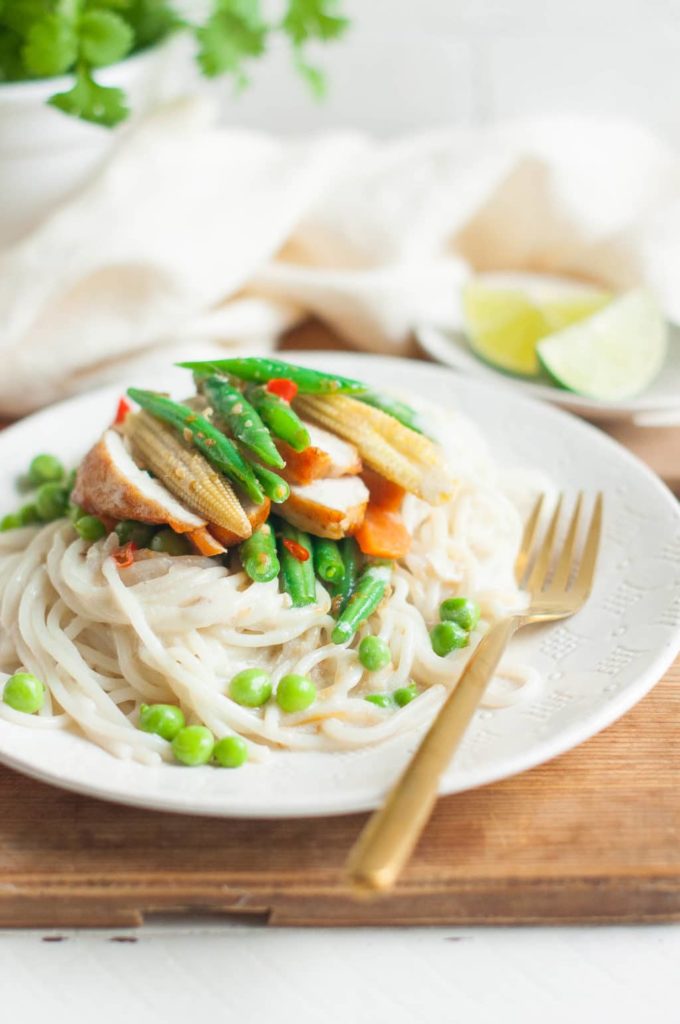
Simple Chicken Stir Fry
What makes this recipe for Coconut Chicken Noodle Stir Fry special is the use of coconut milk to add a creamy richness to the sauce.
And with the addition of classic Asian flavourings such as garlic, ginger, coriander (cilantro), chillies and fish sauce, you are moments away from a delicious home-cooked simple chicken noodle stir-fry.
Interestingly, I found that this recipe vaguely reminded me of a Vietnamese dish called Banh Tam Bi but which is served cold.
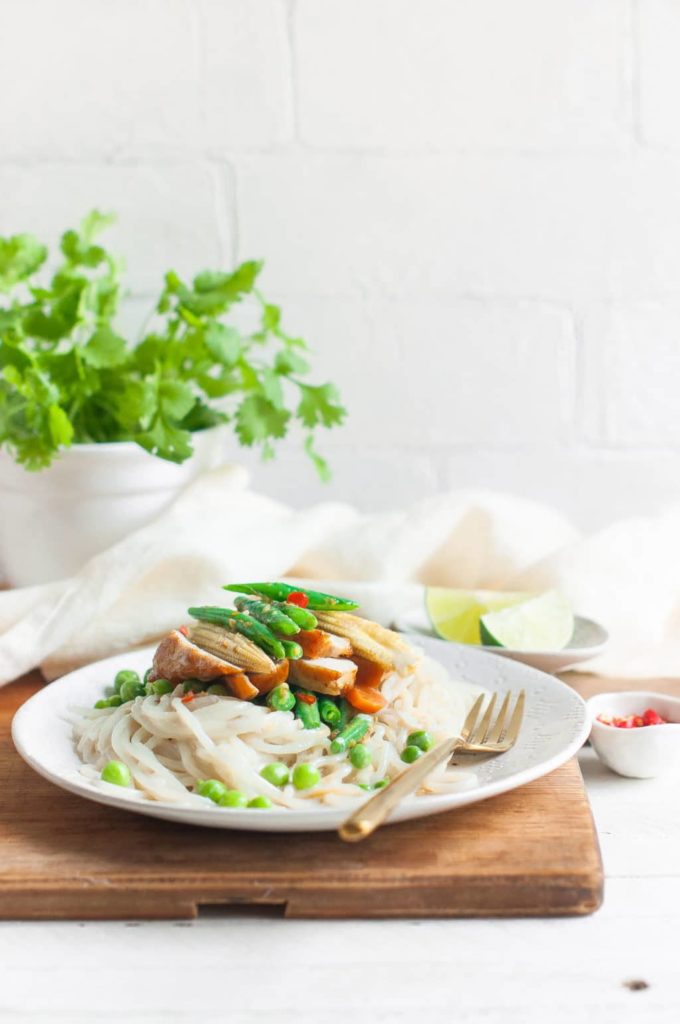
What Vegetables to Use in a Stir-Fry?
Generally speaking, crunchy vegetables work best in stir-fries to provide some contrast in texture against the soft noodles, but there are no hard and fast rules.
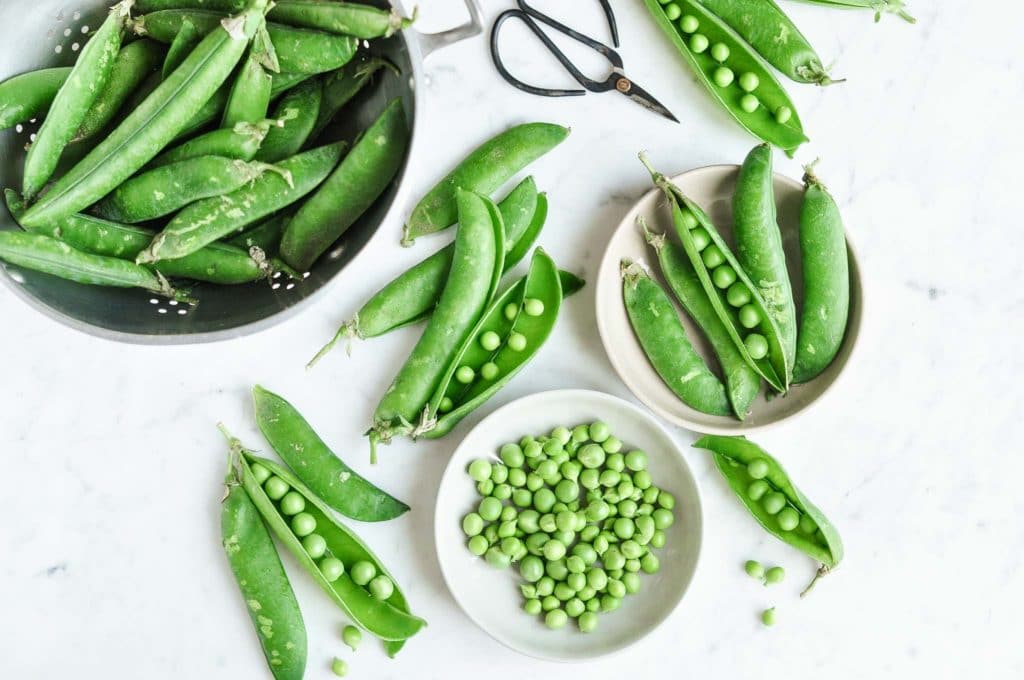
I shop at the farmers’ market at least twice a week for our fruit and vegetables, and this allows me to buy what is seasonal and local. Currently, fresh peas are still on offer, although they are coming to the end of their season. I love adding them to soups and pasta dishes, and they also work beautifully in stir-fries like this one.
But most of the time, stir-fries give me an opportunity to do a fridge raid to see what vegetables need to be used right away.
Other vegetables which I recommend in stir-fries include:
- Carrots, thinly sliced
- Green beans, trimmed and sliced
- Courgettes (zucchini), thickly sliced
- Baby corn, thickly sliced or halved
- Shitake mushrooms (or other mushrooms), thickly sliced
- Capsicums (peppers), sliced or diced
- Bok choy, the stems cooked first and the leaves added towards the end
- Bean sprouts
What Kind of Noodles to Use in a Stir-Fry?
For this chicken noodle stir-fry recipe, I like to use thick vermicelli noodles which have a similar thickness to regular spaghetti.
However, if you can only find thin vermicelli noodles, or even flat rice noodles (the type used for Pad Thai), they would also work well in this recipe.
This recipe is also delicious with udon noodles.
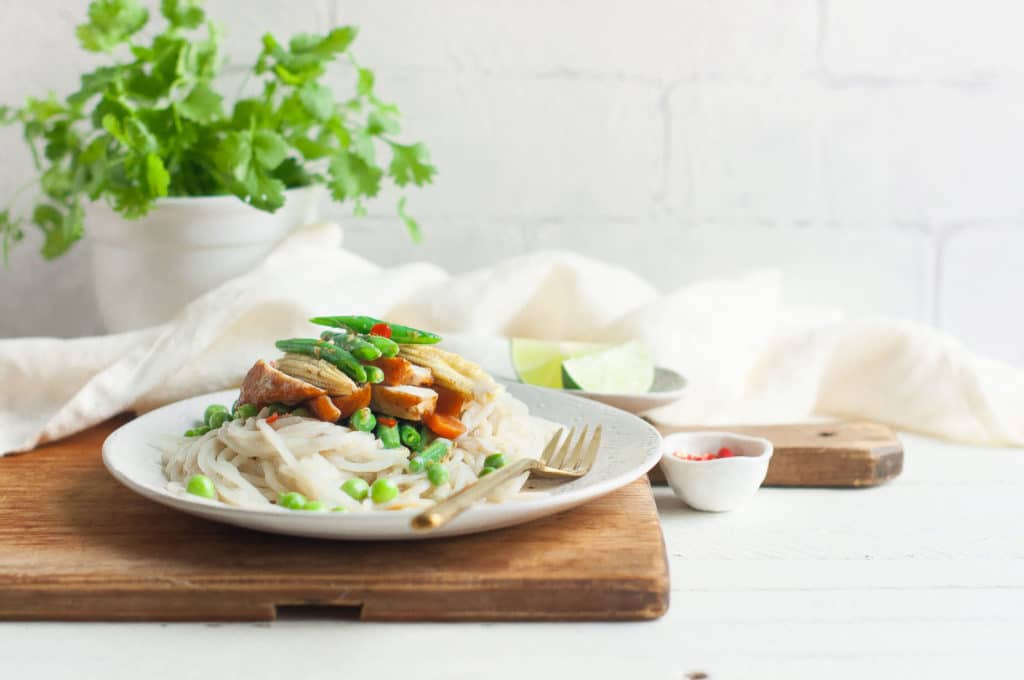
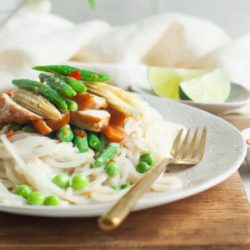
Coconut Chicken Noodle Stir-Fry

Ingredients
For the Stir-Fry
- 200 g (7 oz) medium or thick rice noodles
- 300 g (11 oz) chicken breast fillets
- 3 garlic cloves, finely chopped
- 3 cm (1 inch) ginger, coarsely grated
- 1 red chilli, finely chopped
- 2-3 coriander roots and stems, finely chopped
- 1 small carrot, sliced at an angle
- 5 pieces baby corn, cut into short lengths
- 1 handful green beans, trimmed and sliced
- 1 handful fresh or frozen peas
- 400 ml (1 ½ cups plus 2 tablespoons) coconut milk
- 1 tablespoon fish sauce
- ½ lime, juiced
To Serve
- coriander, (cilantro)finely chopped
- 1 lime, cut into wedges
Instructions
- Cook the noodles according to packet instructions until they are cooked but still have a bit of bite. They shouldn’t be cooked completely as you will be cooking them again later.
- Drain the noodles and rinse under cold water.
- Meanwhile, proceed with the rest of the recipe.
- Add a few tablespoons of oil into a large wok or frying pan and place on high heat.
- Cook the chicken until it is cooked through and golden in colour on both sides.
- Remove the chicken to a chopping board and let it rest while you proceed with the rest of the recipe.
- Add the garlic, ginger, chilli, and coriander (cilantro) stems to the hot pan.
- Stir until everything is fragrant.
- Add the vegetables and cook for a few minutes.
- Pour the coconut milk and fish sauce into the pan.
- Turn the heat down to medium and allow everything to simmer gently for about 5 minutes until the vegetables have softened a bit.
- Add the lime juice.
- Taste for seasoning as you might want to add a splash more fish sauce.
- Stir in the noodles until it is coated in the coconut sauce.
- Cook for a few minutes for the noodles to absorb some of the coconut sauce.
- If you find that the noodles have absorbed too much liquid, simply add some boiling water to the pan.
- Remove the pan from the heat.
- Slice the chicken breast fillets into thick medallions.
- Serve with noodles with the sliced chicken.
- Garnish with the remaining coriander (cilantro) and a squeeze of lime juice.
Kitchen Notes
- COOKING FOR CHILDREN
If you are cooking for young children, I recommend omitting the chillies from the recipe. You can instead serve chopped chillies or Pickled Chillies on the side. - VARIATIONS
Other types of noodles which work well in this recipe include regular vermicelli noodles, flat rice noodles, and udon noodles. - OVEN & STOVE TEMPERATURES
All recipes on this website have been tested on an induction stove and/or with a conventional oven (i.e. an oven without fan). All recipes on this website use temperatures for a conventional oven, unless otherwise mentioned. Convection ovens (i.e. fan-forced ovens) are typically 20°C/70°F hotter than conventional ovens, but please check your manufacturer’s handbook. - CONVERSIONS
To convert from cups to grams, and vice-versa, please see this handy Conversion Chart for Basic Ingredients.
Did you make this recipe?
Please leave a comment below and share your photos by tagging @eatlittlebird on social media and using #eatlittlebirdUpdate
This recipe was first published on 19 September 2011. It has been updated with new photos and more comprehensive recipe notes.

I love RA and it’s lovely to read a post championing one of her recipes. It’s often a meal or recipe is so smart and so simple we can often over look the idea in favour of always trying to conjure up magic in the kitchen. It’s these books that often guide us back. Lovely dinner, great photos.
Thanks again, Julia! This recipe uses ingredients that I always have at home and yet I never thought of combining them in this way. I know a lot of people are heavy on criticism about Rachel Allen, and of course a few of her recipes have failed on me, but so have other people’s recipes!
great insight…..i so agree with you on the blurring of borders and not only in cooking! The dish looks fresh tangy and delightful to eat.
Hi Terry! This is a really lovely dish and I’m happy to add it to my weeknight repertoire 🙂
Your oriental dishes always look so “clean” and appetising: I love the freshness and definition of the colours. And they’re really not diffcult to make – I should try this sort of thing more often.
Liz – This dish is super easy to make and, what’s more, the chillies are optional 😉
I love, love, love, your writing on this one Thanh. Wonderfully written, witty and engaging! And the pictures are always top notch! I can never make a plate of noodles look as beautiful as you do, but then I have said, that everything you do and produce in the kitchen, seems to resonate with the care taken to achieve something beautiful and delicious!
PS: Am the same with you on the noodles and pasta! ahah!
Aww thanks, Carrie! The plate didn’t look too pretty once I tucked in 😉 I’m glad to hear I’m not the only one who cooks too much noodles and pasta – I seem to have this inability to remember that they swell upon cooking!
That looks so good I’m wondering if I need the book lol.
My Bill Granger Asian book arrived today and the recipes in it look fabulous!
Yes, you do, ha ha! 😉 I saw that you just got acquired two Bill Granger books! Lucky you! I was about to order Everyday Asian the other day and just moments before clicking on the “checkout” button, I could hear hubby groaning from the other side of the Atlantic, telling me to put away my credit card, LOL! Hopefully soon 🙂
My first time here, loving your blog, it is really cute!! The recipes are great! I will try this one soon, thanks!
This looks so beautiful and delicious…
I love how your food looks so fresh and clean, plus flavorful.
Beautiful picture.
Great recipe! It’s amazing how some are just so simple, but my problem is I always forget the idea! LOL. Loving how you are generous with your noodle and pasta preparation. I typically do the same. There’s something comforting about left overs for me. 🙂
That sounds so flavorful! Beautiful presentation! You make it sound so easy! Can’t wait to try this one! This sounds fantastic! YUM!