

 by
by I know I’ve mentioned it before, but my blog seems to feature very few Vietnamese recipes, despite the fact that I cook Vietnamese at home every second day or so. So in an attempt to rectify the situation and to bring some more balance to this blog, I hope to feature more Vietnamese recipes which are quick, easy and delicious to make at home.
Thankfully, most Vietnamese home-cooking is, in fact, quick, easy and delicious. One dish which my mother used to make frequently on weeknights was pork ribs braised in young coconut juice with freshly ground black pepper. The pork ribs would be chopped into small lengths which could be handled easily with chopsticks, and the salty and peppery sauce was perfect for drizzling over plain, steamed Jasmine rice. When pork ribs were not available, my mother would simply use sliced pork fillet or pork loin, which would require an even shorter cooking time. It was a cheap and cheerful meal and I loved it.

This is a dish which you are unlikely to find on restaurant menus – it is simple, Vietnamese home-cooking, best eaten in the company of those who share the same appreciation for eating messy ribs and licking the sweet and salty sauce from their fingers.
The recipe below comes from The Food of Vietnam, the latest cookbook by Luke Nguyen. What is interesting about his recipe is that the pork ribs are first marinated for a brief period before being deep-fried to give them a lovely, golden colour and to also start the caramelisation process. Once deep-fried, the pork ribs are then braised in some young coconut juice to tenderise the meat and to add sweetness.
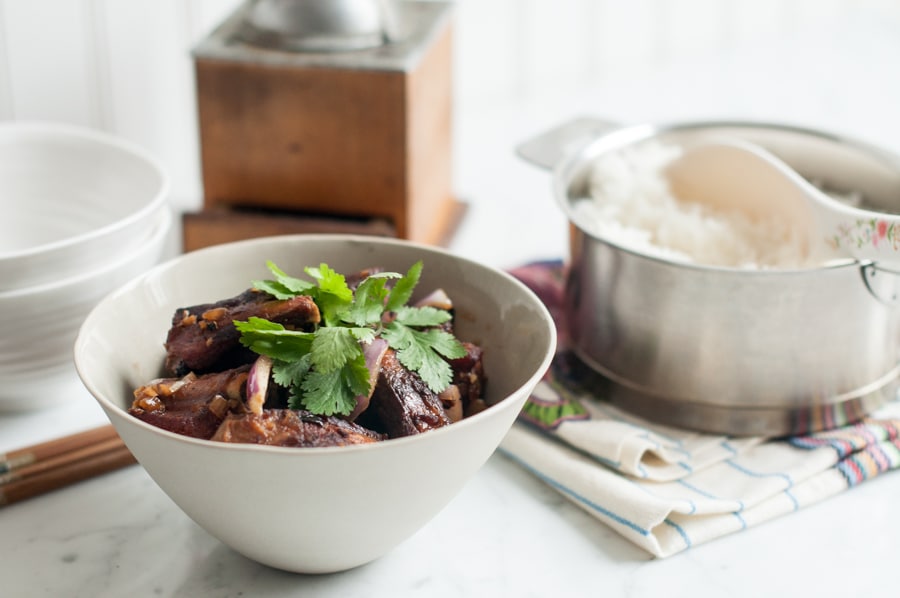
Cooking with young coconut juice is common in Vietnamese cooking; it is often used in place of broth or water for a subtle, sweet flavour. Young coconut juice is readily available in most places, but be sure to buy the unsweetened variety for cooking. Alternatively, coconut water is now readily available in most supermarkets and it works perfectly in this recipe too.
I often double the recipe below for just my husband and I, and team it with a generous serve of steamed greens on the side and plain rice. The lovely savoury sauce is perfect for drizzling over your vegetables and rice. Make sure you have plenty of paper napkins handy.
Vietnamese Pork Ribs

Ingredients
- 1 shallot, or small red onion, finely chopped
- 4 garlic cloves, finely chopped
- 2 tablespoons fish sauce
- 1 teaspoon oyster sauce
- 2 tablespoons sugar
- ½ teaspoon sea salt
- ½ teaspoon black peppercorns
- 300 g (10 ½ oz) pork spare ribs, cut in short lengths
- vegetable oil, for deep-frying
- 250 ml (1 cup) coconut water, unsweetened
- 1 red onion, or brown onion, sliced thickly
- coriander, (cilantro) to garnish
Instructions
- Prepare the marinade by mixing together the shallot, half the garlic, fish sauce, oyster sauce, sugar, salt and pepper.
- Separate the pork ribs and marinate them in the mixture for at least 20 minutes.
- Heat the oil in a saucepan until 180°C/350°F.
- Using chopsticks or tongs, remove the pork ribs from the marinade, shaking off any excess (but keep the marinade), and deep-fry the pork ribs in small batches until golden brown. Skim off any bits of caramelised shallots and garlic (which are not burnt) and save these to add colour to the sauce later.
- In a separate saucepan or wok, bring the coconut juice with the reserved marinade to the boil.
- Add the pork ribs and any caramelised bits, reduce the heat and simmer for 15-20 minutes until the liquid has reduced.
- There should be enough sauce for the meat to sit in, but they should not be completely submerged.
- Taste for seasoning (you may wish to add some water or more black pepper).
- Add the onion and remaining garlic, and cook for a further 5 minutes.
- Garnish with coriander and serve with Steamed Jasmine Rice.
Kitchen Notes
- The pork ribs will need to be chopped into short lengths to make them quicker to cook and easier to eat, especially if you are eating them Vietnamese-style with chopsticks. Unless you are handy with a meat cleaver, it is best to ask your butcher to do this for you. For pork baby back ribs, I often just ask the butcher to cut a rack of ribs down the middle. For a rack of larger sized pork spare ribs, ask your butcher to cut them into 2 cm to 4 cm lengths (1 inch to 1.5 inches).
- OVEN & STOVE TEMPERATURES
All recipes on this website have been tested on an induction stove and/or with a conventional oven (i.e. an oven without fan). All recipes on this website use temperatures for a conventional oven, unless otherwise mentioned. Convection ovens (i.e. fan-forced ovens) are typically 20°C/70°F hotter than conventional ovens, but please check your manufacturer’s handbook. - CONVERSIONS
To convert from cups to grams, and vice-versa, please see this handy Conversion Chart for Basic Ingredients.

Yum, bookmarked! This looks absolutely delicious. I just wish I was not so scared and hesitant about deep-frying food..I am quite clumsy so I am thinking about buying a deep-frying machine not make it a bit safer and less messy. Vietnamese cuisine is really my favorite.. I hope I can go to Vietnam again to try more of the fantastic food!
I’m not such a fan of deep-frying food either – what do you do with all of that oil afterwards? But the deep-frying for this recipe can be done in small batches, which makes it much more manageable and less scary. I simply use a small saucepan and fill to about 4cm depth with oil. If you liked any of the caramelised dishes when you were travelling through Vietnam, I think you would like this dish 🙂
I had the most wonderful pork ribs with plum sauce last week and can’t stop thinking about them. These ribs seem like a great variation, since I love coconut juice. Thanks for this idea!
I love the sound of pork ribs with plum sauce! That reminds me of Rachel Khoo’s pork ribs which are cooked in crème de cassis … I will have that recipe posted shortly 🙂
I think he had this recipe in one of his other books. Either that or I’ve seen it somewhere. Now you know how I LOVE all things coconut and adore it in savoury form. For the coconuts in Kerala, we don’t seem to use the water for cooking. It’s drunk as a refreshing and nutritious treat but not cooked with as such. The only time I use it that way is to soak beaten rice, which is then mixed with fresh coconut, cardamon and sugar for breakfast or a mid-day snack..delicious! I get baby back ribs here will definitely give this a go 😀
Yes, you’re right. He has a very similar recipe in The Songs of Sapa, but that particular recipe uses chilli sauce. I think what is quite distinct about the Vietnamese caramelised dishes is the use of freshly ground black pepper, which is why I tried this recipe instead. Although, I bought some more pork ribs yesterday and might give the other recipe a try to see how it compares! I remember fondly drinking fresh young coconut juice in Vietnam – it’s so refreshing and addictive. Growing up, my mother used to buy the frozen sort in packets which you would then defrost at home, but it was never the same!
Yesterday, I saved a recipe for ribs cooked in coconut milk. It seem original to me, because I’m used to combine coconut with chicken, not pig!! 😛
Alghough the other recipe looked good, I’m going to keep yours, as you are ‘of the family’ I’m sure it’s foolproof to me 😛 And, for weeks, my boyf see the can of coconut juice and ask to try it, but we know we won’t like as a beverage, and I didn’t know that we could cook with it. I think he’s in love with that can.
I like the process of preparing these ribs, I’ll tell you when we try!!
Have a nice week, Thanh!
Just to be sure, make sure you use coconut juice in this recipe, not coconut milk 🙂 The flavour of the coconut juice is not very obvious in this dish – it is mostly there to give sweetness to the sauce. Some Vietnamese dishes have a very distinct but delicious salty, savoury and sweet flavour, and this is one of them 🙂
Another dish that’s bound to make my hubby smile 🙂 He loves pork ribs. When you say young coconut water is it the orange King coconut? We drink that juice back home but like Carrie we rarely use the coconut water for cooking. I think I used it once to make a Thai chicken dish and the flavour was very very subtle.
xx
I’m not sure … young coconut juice used in Vietnamese cooking is typically from young green coconuts. It’s more commonly used to drink, but it is also used in quite a few Vietnamese dishes. The flavour is indeed very subtle – it does not taste obviously of coconut like coconut milk or coconut cream. I actually just found unsweetened coconut juice in Zurich which are sold in little containers which look like green coconuts. I’m looking forward to using them in some upcoming blog posts 🙂
Hi! I really really love your blog! Posts are well done and the photos are something special! I put ELB un my fab 15, here is the link! The post is in italian but I can provide you a traslation in english if you like! Have a nice day!! Francesca
http://www.involtinidipeperone.it/2014/04/premio-food-blog-grazie.html?m=1
Thank you so much! I am so honoured 🙂 Grazie mille!
That’s such a good idea to ask the butcher to cut the ribs. I never actually thought of that. The Chinese way of eating ribs is a little goes a long way when you eat them with rice and vegetables, but the Western way of eating ribs seems that everyone gets about a kilo of ribs to eat and they don’t eat much else!
Ha ha!! Quite true 😉 My first real introduction to Western ribs was when we lived in Chicago and our colleagues suggested that we have dinner at Sweet Baby Ray’s one night. We made the mistake of ordering a plate of ribs each – one plate of ribs would have been enough to feed a family of 6! But oh my gosh, the ribs were soooo good. We had coleslaw and baked beans on the side, although I don’t remember touching it. I still crave their sticky and spicy ribs every once in a while and am still trying to find the right recipe to recreate them at home. It’s not very common in Vietnamese cooking to serve ribs in similar large portions, but I often do, although the ribs will be marinated in lemongrass, chilli and the like. But, as you’ve mentioned, we would always serve ribs with rice and vegetables. It’s all about balance 🙂
This is such a delicious recipe! I don’t usually deep fry my food but it was so worth it here. Thank you!
You make it sound so easy! This is really very tasty. Can’t wait to try this one! Yum!