

 by
by 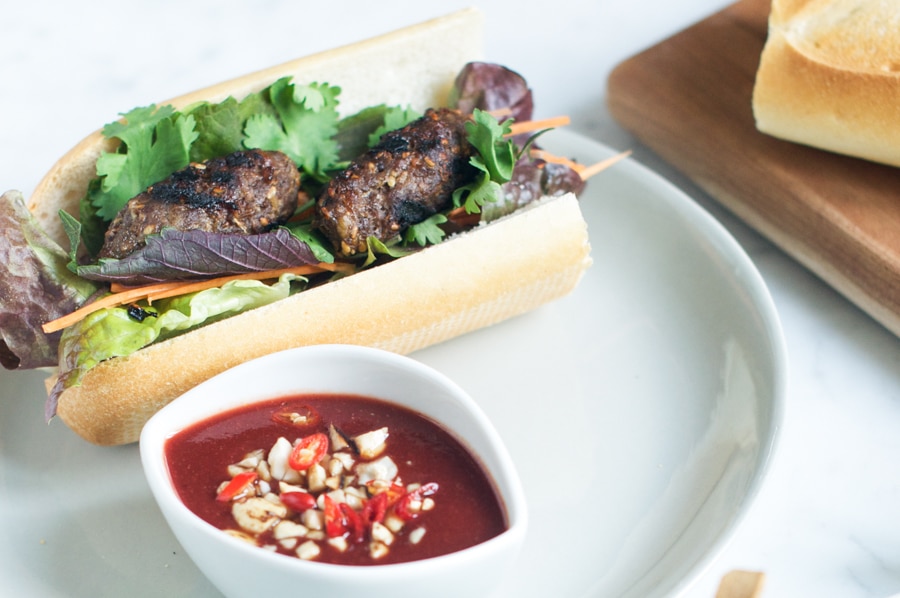
From looking at the recent entries on my blog, you wouldn’t think that I cook a lot of Vietnamese food at home. The fact is, I probably cook Vietnamese food about 4 to 5 times a week! Of course, the frequency varies, but hardly a week goes by when I haven’t made something at least Vietnamese-inspired.
After my mother, Luke Nguyen would have to be my greatest source of inspiration when it comes to authentic Vietnamese cuisine. His recipes appear in Secrets of the Red Lantern, an autobiography of sorts written by his sister, Pauline Nguyen, detailing the plight of their family from when they emigrated from Vietnam to Australia, as well as an account of her growing pains as a Vietnamese immigrant in an Australian society. Her story is an inspiring one, though perhaps not too different from many Vietnamese immigrants who struggled to come to terms with their Vietnamese heritage whilst wanting to embrace their newfound Australian identity at the same time. And whilst her bravery in sharing her story ought to be commended, I think the book is made more heartfelt by its recipes.
I have a soft spot for any book which is smartly dotted with recipes throughout. As with many foodies out there, I have a curious obsession with reading cookbooks, and so reading an autobiography is made much easier when there are mouthwatering recipes and tantalising food photography to break the story a little.
The recipes in Secrets of the Red Lantern are quite faithful to what is cooked in many Vietnamese homes. The recipes in The Songs of Sapa (renamed as My Vietnam in the US and My Vieatnam in German), on the other hand, take into account more regional variations and personal adaptations. The Songs of Sapa is a beautiful book which follows Luke Nguyen on his journey through the main regions of Vietnam, providing traditional and new recipes which he encounters along the way. Whenever I want to cook something Vietnamese, I always turn to these two books for guidance, and The Songs of Sapa has been a book which has been in my kitchen quite frequently as of late.
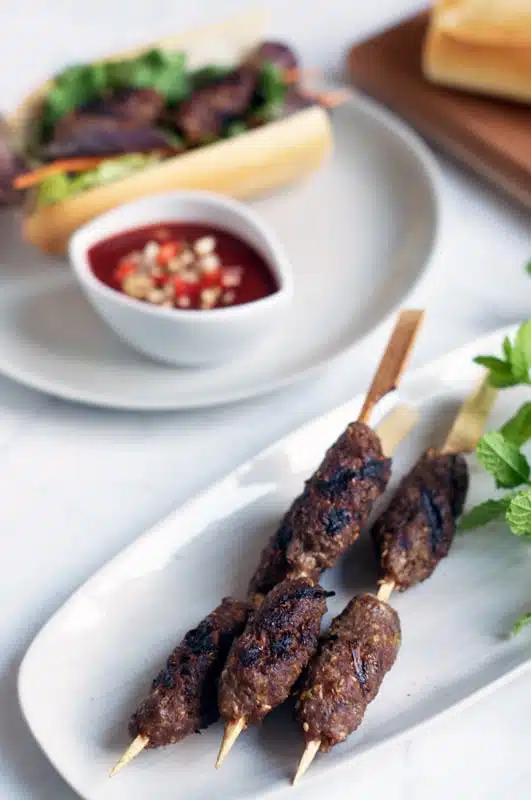
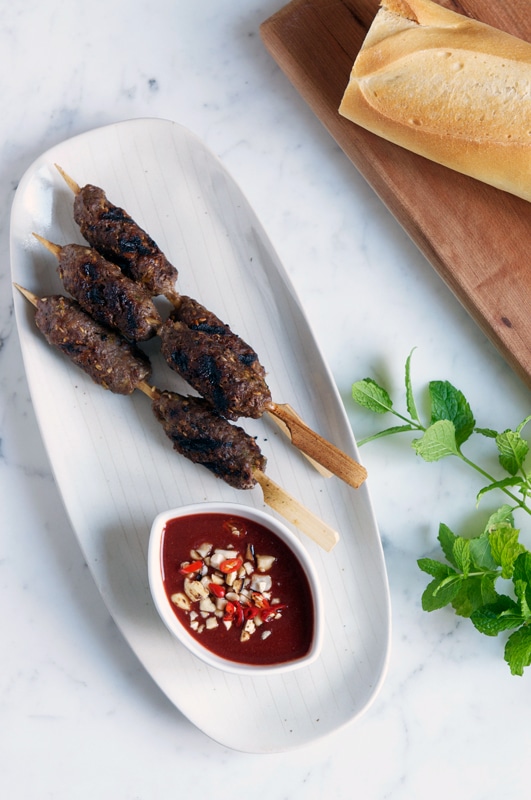
These beef skewers are quite popular in Vietnamese households, particularly as a light snack to serve with some cold beers. Many variations of this recipe exist and Luke Nguyen’s version is quite a tasty and easy one to prepare. My only deviation from his recipe was to leave out the shrimp paste (the recipe calls for a mere, but punchy, 1 teaspoon). Shrimp paste is something you either love or hate, and as it is not an ingredient which I regularly use, I felt justified in leaving it out.
You don’t have to shape the meat filling onto skewers – you could just as easily shape them into sausages or meatballs, or even hamburger patties, and cook them on a grill accordingly.
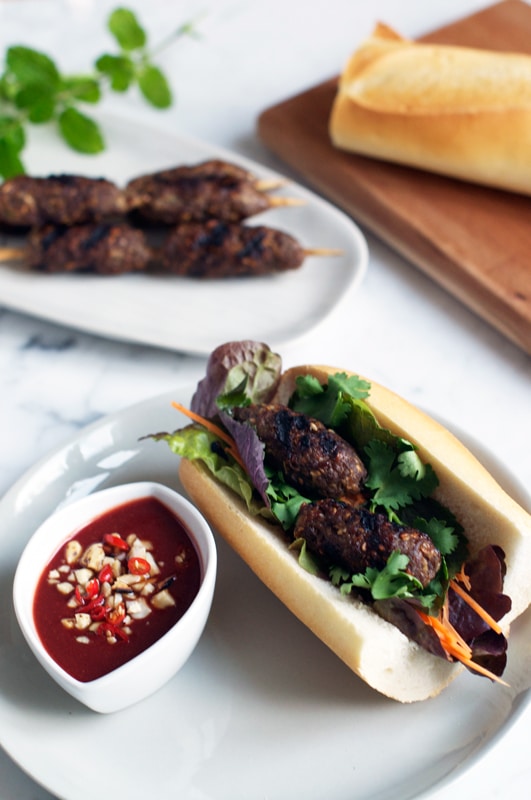
I like to serve these beef skewers as a filling for rice paper rolls, which we call cold rolls in Australia and which go by the name of spring rolls in other parts of the world. They also work well served with a salad comprised of cooked vermicelli noodles, lettuce, shredded carrots, a myriad of fresh herbs (such as coriander/cilantro, mint, perilla leaves) and drizzled with a Vietnamese dipping sauce. A more modern twist is to serve the beef skewers in a baguette filled with lettuce, pickled shredded carrots and fresh herbs as take on the more traditional banh mi. For an even faster route to nourishment, I would simply wrap the grilled beef in some lettuce with some fresh herbs and serve the Hoisin Dipping Sauce alongside (recipe below).
All in all, some more inspiring recipes from Luke Nguyen. If you love Vietnamese food, I highly recommend The Songs of Sapa for no-fuss and great-tasting recipes. His accompanying TV series, Luke Nguyen’s Vietnam, is also great to watch and provides beautiful footage of his gourmet travels through this exotic country. Luke has a very casual, yet charming, presence in front of the camera and makes you want to hop on the next plane bound for Vietnam for a full-on foodie feast.


Luke Nguyen’s recipe for Hoisin Dipping Sauce also happens to be one of very many versions found in Vietnamese restaurants and households. I make mine by simply mixing together hoisin sauce and coconut cream to taste, some use a mixture of hoisin sauce and crunchy peanut butter. But, for a change, I tried Luke Nguyen’s recipe and found it to be quite pleasant, and perhaps a good recipe to have on hand if you don’t have any coconut cream in the pantry.


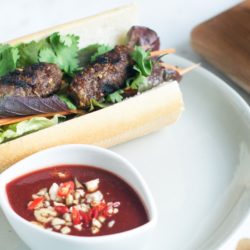
Chargrilled Lemongrass Beef with Hoisin Dipping Sauce

Ingredients
For the Lemongrass Beef
- 2 tablespoons sesame seeds
- 10 spring onions, (scallions)
- 2 lemongrass stalks
- 2 garlic cloves
- 1 pinch fine salt
- black pepper, freshly cracked
- 500 g (1 lb) minced beef, (ground beef)
- 1 tablespoon fish sauce
- 1 tablespoon soy sauce
- 1 teaspoon sesame oil
- 1 tablespoon light muscovado sugar, or light brown sugar
- vegetable oil
For the Hoisin Dipping Sauce
- 125 ml (½ cup) hoisin sauce
- 1 ½ tablespoons white vinegar
- 125 ml (½ cup) milk
- 3 teaspoons unsalted peanuts, toasted and crushed
- red chillies, finely chopped
Instructions
To make the Lemongrass Beef
- Toast the sesame seeds in a hot, oil-less pan, until they are lightly golden.
- Remove the green parts of the spring onions (and set aside to use another time).
- Trim the lemongrass stalks so that you only have the white parts, and roughly chop them.
- Place the white parts of the spring onions, lemongrass and garlic cloves, together with a pinch of salt and pepper, in the bowl of a food processor. Blitz until you have a fine paste, adding some oil to help it along (about 1/2 to 1 tablespoon), if needed.
- In a medium mixing bowl, combine the minced beef with the fish sauce, soy sauce, sesame oil, light brown sugar, toasted sesame seeds and the lemongrass paste.
- Use your hands to mix everything together.
- Cover the bowl with clingfilm and put the bowl in the fridge for about 1 hour for the flavours to develop.
- Meanwhile, soak some bamboo or wooden skewers in some cold water for at least 30 minutes. This will stop the skewers from burning when you grill them later.
- Shape the beef mixture into long or short sausages and thread them onto the skewers. I used 18cm long bamboo skewers and needed 16 for this amount of beef mixture.
- Heat a grill pan or barbecue on medium-high heat and cook the skewers for about 6 minutes, turning them frequently so that they colour and caramelise on all sides.
- Serve the lemongrass beef skewers with a baguette filled with some lettuce, pickled shredded carrots and herbs such as mint, coriander (cilantro) and perilla leaves, drizzeld with some Hoisin Dipping Sauce.
- Alternatively, serve the lemongrass beef skewers with a vermicelli noodle salad or in rice paper rolls.
To make the Hoisin Dipping Sauce
- In a small saucepan, whisk together the hoisin sauce, white vinegar and milk.
- Bring the mixture to a gentle simmer over medium heat until it has thickened slightly, stirring frequently.
- Remove the pan from the heat and allow to cool. The sauce will thicken as it cools. To serve, sprinkle with the crushed roasted peanuts and some finely chopped red chilli.
Kitchen Notes
- COOKING FOR CHILDREN
These beef skewers are quite child-friendly as there is not much spice in the meat mixture. - VARIATIONS
You could easily add a red chilli or two to the lemongrass mixture for a bit of heat. If you don’t have any spring onions to hand, I have also used a small red onion or a few shallots as a good substitute. - STORAGE TIPS
Any uncooked beef skewers can be kept in the fridge, covered in clingfilm, for a few days. The Hoisin Dipping Sauce can also be kept in the fridge for up to 1 week. - RECIPE CREDIT
Recipe adapted from The Songs of Sapa by Luke Nguyen. - CONVERSIONS
To convert from cups to grams, and vice-versa, please see this handy Conversion Chart for Basic Ingredients.

Oh my god, how lush do those look!!! I absolutely love this post. I think the Vietnamese inspired posts of yours are my favourite. You showed me the path to Songs of Sapa and it’s a book that I love. Like you said, it’s authentic but accessible for the most part. I still cook out of it, think of you every time I do, wondering if it would match up haha! Another beautiful post Thanh. You so NAIL the process shots!
Thanks, Carrie! I ought to post more Vietnamese recipes but somehow I get side-tracked by other recipes. In fact, I have a back-log of recipes to post! I still make the tofu dish from this book often which you pointed out to me – that’s one of my favourite recipes 🙂
Oh that’s a star recipe, very comforting somehow 🙂
As usual it’s a treat..And what a heartfelt read.This time talking about Vietnamese food made me kind of emotional.Where ever we are,there is that ‘root’ factor lay inside.As much as I ventured Vietnamese food (most of which are restaurant encounters),I have found serious similarities between Kerala food (my native in India).In fact I have done a guest post on this at one of my friend’s blog.It’s a sweet once I happened to have from Vietnamese Restaurant ,Che chuoi…Brought back one of my fav childhood dessert from my own place.What a co-incidence !
I love this exotic recipe of yours..I think the usage of sesame seeds is almost common with Vietnamese food. Isn’t it ? Requests you to blog more of Vietnam..Cheers !
Oh I love Chè chuối! I haven’t had it in such a long time (nowhere to be sold in Zurich, unfortunately), but I ought to make it at home. There is a recipe for Tapioca Pudding with Banana and Cassava in Secrets of the Red Lantern which I have always wanted to try. I’m not sure if my husband would like it but I guess that would mean more for me 🙂
Thanks also for the link to the recipe on your blog – it looks very similar to Luke Nguyen’s recipe, although I don’t think cardamom is widely used in Vietnamese cooking. It’s interesting to know that there is a similar dessert in Kerala! I guess there’s a reason why I love Keralan food.
Btw,this is what pal vazhakka,a childhood dessert from our place quiet similar to Che Chuoi -http://www.desimelange.com/2012/06/paal-vaazhakka-banana-in-coconut-milk.html
Wow, this is not one of my favourite ways to eat meat, but I was searching something like that for my boyfriend. He loves lemongrass beef, but at restaurants, is not always very good, and he likes as well eating skewers like these, so perhaps I have to give a try to this recipe 😉
Thanks for the idea, Than!!
These beef skewers are great for barbeques, picnics, apéros … essentially any casual or informal setting, which is when Vietnamese food taste its best. They are essentially Vietnamese meatballs on a stick! I hope you will like them too 🙂
Such great photos.. my son would die if I made these for him!!
Another great post, Thanh! Thanks for introducing me to the food from the Vietnamese household. I must say it seems to be one of the healthiest (and flavorful) cuisines. Loved your meat pies, Vietnamese rolls and now this!
Your pepper grinder is so cute:). Is it vintage?
Thanks, Shalini! You are right that Vietnamese cuisine is quite healthy and full of flavour, and that’s why I love it so much 🙂 Whenever we have moments where we feel we have indulged too much – too much meat, too much pasta, too much cream – and I feel I need to restore balance by cooking something healthy, I will inevitably make something Vietnamese and the body feels better again.
The pepper grinder is not quite vintage … they are quite similar to the old-fashioned coffee grinders and are used throughout Vietnam for coarsely grinding peppercorns. My mum visited her family in Vietnam in the 1980s and brought this pepper grinder back. I have fond memories as a child of grinding pepper for my mum whilst her hands were busy kneading or mixing something, so when it was time for me to move out of home, I took the pepper grinder with me 🙂 And it has travelled with me everywhere ever since. I just love it!
Oh what a timing! I just bought the Songs of Sapa and Secrets of the Red Lantern last week! I thought about buying either one of these but I absolutely love Vietnamese food so I told myself ‘heck, we only live once..let’s go crazy and buy both books!’ Yes, I live dangerously like that 🙂
Anyway they are on my bedside table and though I haven’t cooked anything from the books yet, they make me happy by just being there, they are so pretty 🙂 I really want to see Luke’s TV shows but they are not showing on TV here as far as I know and I wasn’t able to find out where to order the DVDs. So I have been looking at some episodes on youtube for now but hopefully i will get the whole series one day.
The restaurant we most often visit in Zürich (by far!) is actually Asiaway in Oerlikon when I crave Vietnamese food but don’t have time to cook it myself. There are some dishes from the restaurant Saigon that we enjoy very much too (the bun cha gio for instance). Do you know any other Vietnamese restaurant in the region by any chance?
Anyway sorry for the rambling and thanks for these amazing pictures that make me want to cook this dish right away!
Oh how exciting!! I do things like that too 🙂 With these two books, you will have all of the Vietnamese recipes at your fingertips. They are both fantastic books, in my opinion. I hope they will be as helpful to you as they have been for me!
I buy most of my cooking DVDs online from Australia. There are probably some cheaper options (such as iTunes but not in Switzerland) but I’m a creature of habit! You will have to factor in the shipping fees and any potential Swiss VAT (which Swiss customs are very quick to charge). You can find Luke’s TV shows (and others) from:
http://shop.abc.net.au/
http://www.jbhifi.com.au/
For the longest time, there existed no Vietnamese restaurants in Zurich, and that was what prompted me to learn how to cook Vietnamese dishes at home. In the past few years, a few restaurants have popped up here and there and I think Asiaway and Saigon happen to be the best of those which I have tried. We have friends who used to live in Oerlikon and who would always rave about Asiaway, and I agree that their food is very good. We first went to Saigon a few years ago and found the service to be amazingly slow. We would wait for about an hour, only to be served the wrong dish! But just the other week, we went there spontaneously for dinner and were pleasantly surprised to find that the food arrived promptly and that it was really delicious. I absolutely love their spring rolls (nems)! So now that we know that their service has improved, I think we will be visiting again more often 🙂 We don’t eat out very often in Zurich but it’s nice to know that there are some Vietnamese options now.
I think there is a Vietnamese restaurant near Bahnhof Binz but I have never tried it; I’ve only looked at their menu from outside and it seems to be a mix of Chinese and Vietnamese cuisine?
If you ever have any questions about certain ingredients and where to find them, just let me know!
Great recipe indeed! With this cold weather and bad road conditions last week-end, we decided to stay home and do some cleaning/organizing.
Which means that I also had time to read the Songs of Sapa (Great book. I loved his stories! really didn’t want it to end!) and try some of those recipes. I made the chargrilled lemongrass beef since it looks so delicious in your pictures (and delicious it was indeed!). I also made the stir-fried ginger chicken that I served with his wok-tossed asparagus in garlic (both recipes fantastic!). The last one I cooked was the Hanoi chicken and vermicelli noodle soup which was really good too. I did use a bit of the shrimp paste in there since he highly recommended that and I had some in my fridge but I am not sure I would add it next time..it adds quite the fishy punch!
Anyway I am really glad that I have such a beautiful and useful cookbook in my collection.
Thank you for your recommendations for the TV series and the restaurants! I am glad too that we now have a few Vietnamese restaurants in the area. Doing a search online, I found one I haven’t tried (Vietnam) and plan to go one of these days.
Wow, you’ve been busy in the kitchen! I’m so glad you enjoyed the Chargrilled Lemongrass Beef, as well as his other dishes.
I’ve also made the Stir-Fried Ginger Chicken quite a few times – it’s a classic Vietnamese home dish, one which my mum made very frequently when I was growing up. She often made it with chicken wings which she would chop in half with a meat cleaver. It makes for messy eating but, as a kid, I loved it! I don’t know about you, but I rarely find chicken thigh fillets in Zurich. I’ve seen it a few times at my local Migros, but it’s hit and miss. So I often make it with diced chicken breasts or chicken drummettes if I can find them.
The Hanoi Chicken and Vermicelli Noodle Soup is also another popular favourite in Vietnamese homes, though I often skip the shrimp paste. It’s worth trying to see if you like it but, as you suggest, the flavour can be full-on!
I’m really happy to hear that you’ve enjoyed cooking from The Songs of Sapa so far. I would love to hear about any other dishes you try 🙂
I love this little insight into your everyday life. I also have a huge number of recipes and inspirations that never get close to appearing on the blog but am so glad you shared this. I think my fiance would absolutely adore it, especially if I ramped up the chilli factor!
It seems there could never be enough time for us to share all the recipes that we would want to on our blogs! Definitely add some chillies if you like your food spicy. In fact, it’s quite a versatile recipe that you could tweak it a bit here and there. Enjoy!
These tasty little numbers have just hot-footed it right to the front of the shopping list for the weekend! I, too, love Pauline’s book and Luke’s recipes. I’ve made these before, but not for some time. And i’ve also moved house since then. Pauline’s book and Luke’s later book are still packed in a box – which box, i’m not quite sure. So i am most happy that you posted this recipe. Lovely post. Thanks for sharing.
Oh it’s great to know of someone else who has tried this recipe 🙂 Hope the house move went well. My least favourite task is unpacking but, somehow, unpacking cookbooks feels like a reunion with old friends which I would gladly look forward to.
This is exactly the sort of thing my husband would devour, and probably eat far more than he needs 🙂 I love your suggestion of serving them in cold rolls. What a great idea! I just adore cold rolls. And I’m glad to know that I’m not the only one with a huge back log of recipes who gets distracted by new recipes 😀 I think if I cooked every day for the rest of my life I still wouldn’t get through the list.
We love making cold rolls at home, especially since they are so fresh and healthy. The other thing is that cold rolls are perhaps better eaten at home because it can be a bit messy in public! But I’m constantly making different fillings for cold rolls and these beef skewers are great, especially for meat eaters. For vegetarians, I often make a tofu filling or grill some prawns if they are ok with seafood.
I think I’ve accepted that not all of my favourite recipes will ever make it to my blog, not with the amount of time it takes to photograph and generally prepare a blog post, as you would know 🙂
Wow this looks great – I am making it for dinner tonight!
Question though, between Songs of Sapa or Secrets of the Red Lantern, which one would you recommend based on the recipes? I would love to buy both, but cannot justify it right now…. thanks! 🙂
Ooh … tough question!
I enjoyed reading the Songs of Sapa more, but if I had to make a recommendation based on the recipes, Secrets of the Red Lantern has more traditional and everyday Vietnamese recipes, such as those commonly found in Vietnamese restaurants. It has recipes for Pho and other noodle soups, spring rolls, noodle salads, dipping sauces, etc.
The Songs of Sapa has similar, and perhaps more, recipes but some with a modern twist, such as Beef with Kohlrabi (not a common vegetable used in Vietnamese cooking but the dish still tasted delicious and very Vietnamese). I would also describe the recipes in The Songs of Sapa as variations of the more traditional Vietnamese recipes which are covered in Secrets of the Red Lantern. For example, there are recipes for Pho and other noodle soups, but they are regional variations which are explained in the corresponding chapter as part of Luke’s travels through the country.
As another example, Secrets of the Red Lantern has the traditional recipe for Tamarind and Pineapple Broth with Silver Perch (Canh Chua Cá), whilst The Songs of Sapa gives a recipe for Tamarind Broth with Beef and Water Spinach (Canh Chua Rau Muống Thịt Bò), a delicious and less common variation but one which I have made much more frequently since coming across this recipe.
You won’t go wrong with either book, but I think Secrets of the Red Lantern would be a good place to start 🙂
Thank you so much for the detailed reply! I think then I will go for the Red Lantern.. for now (heh heh). I do love Vietnamese food so much and really would like to have a solid cookbook for the recipes, so it will be best for me. Tschuss!
You’ve made this recipe look so easy with your detailed instructions – I can’t wait to try this at home!!!
I love this! and I love Luke Nguyen. He also has a tv show on the cooking channel right?
Hi Alice,
I’m not sure which channel his show is on in the US, but I’m glad to hear that it’s on air over there. I loved watching Luke Nguyen’s Vietnam and have seen snippets of his new show, Luke Nguyen’s Greater Mekong, which coincides with the release of his new book soon. I can’t wait!
the photography is so superior to most instructional recipes, I’m very impressed. Reason enough to try the recipe. And since I live in Vietnam part of the year, I crave those flavors. Off to the store right now to get some lemongrass. Thank you.
Thank you, Jane! How lucky you are to live in Vietnam for part of the year. That must make for an interesting experience! I envy all of the meals you would be eating each time you visit.
Vietnamese food is above all my favourite cuisine! I love how everything just tastes so fresh and light – but keeping with a spicy element. I was lucky enough to visit Hanoi this year and had such a fabulous time. This recipe for chargrilled beef looks very good – never tried it with hoisin sauce before. Thanks for the Songs of Sapa recommendation
I’m glad to hear that you enjoyed your time in Hanoi. It’s been a while since I have visited Vietnam and hope we will be able to squeeze in a trip sometime soon.
Some restaurants serve these chargrilled beef skewers with a simple Vietnamese dipping sauce (made with fish sauce, lemon juice or vinegar, sugar and some chillies), and an alternative is this hoisin dipping sauce which is much more heavily flavoured. I always have a jar of Vietnamese dipping sauce in the fridge but a hoisin dipping sauce is a nice change sometimes.
Vietnamese sandwiches and burritos would be a part of my daily diet if I had easier access.
This is a beautiful pictorial and it looks like you put a good amount of work into it. It is difficult sometimes for me to make a raw meat photo look appealing, but I particularly like your intro ingredients photo. Cheers!
Thank you! As a fellow blogger, you would probably understand how much work might go into each post and, yes, these recipe photos do take a bit of time but I quite enjoy the process 🙂
I could also live on Banh Mi everyday if they were sold where I live. Once in a while, I will go to the effort of making pâté, garlic mayonnaise, pickled carrots and Vietnamese pork terrine just so I can have a Banh Mi. I might have to repeat the effort again soon!
These are so delicious, I didnt make the sauce but the beef skewers are so so good, they remind me of the beef in grape leaves that I have tried at Vietnamese restaurants in the past. I actually swapped half the beef for ground dark meat chicken as I had some on hand and they were still divine. What a great recipe! I am certainly going to follow your blog!
I need to try this! I’ve never had anything like this. Looks good!