

 by
by 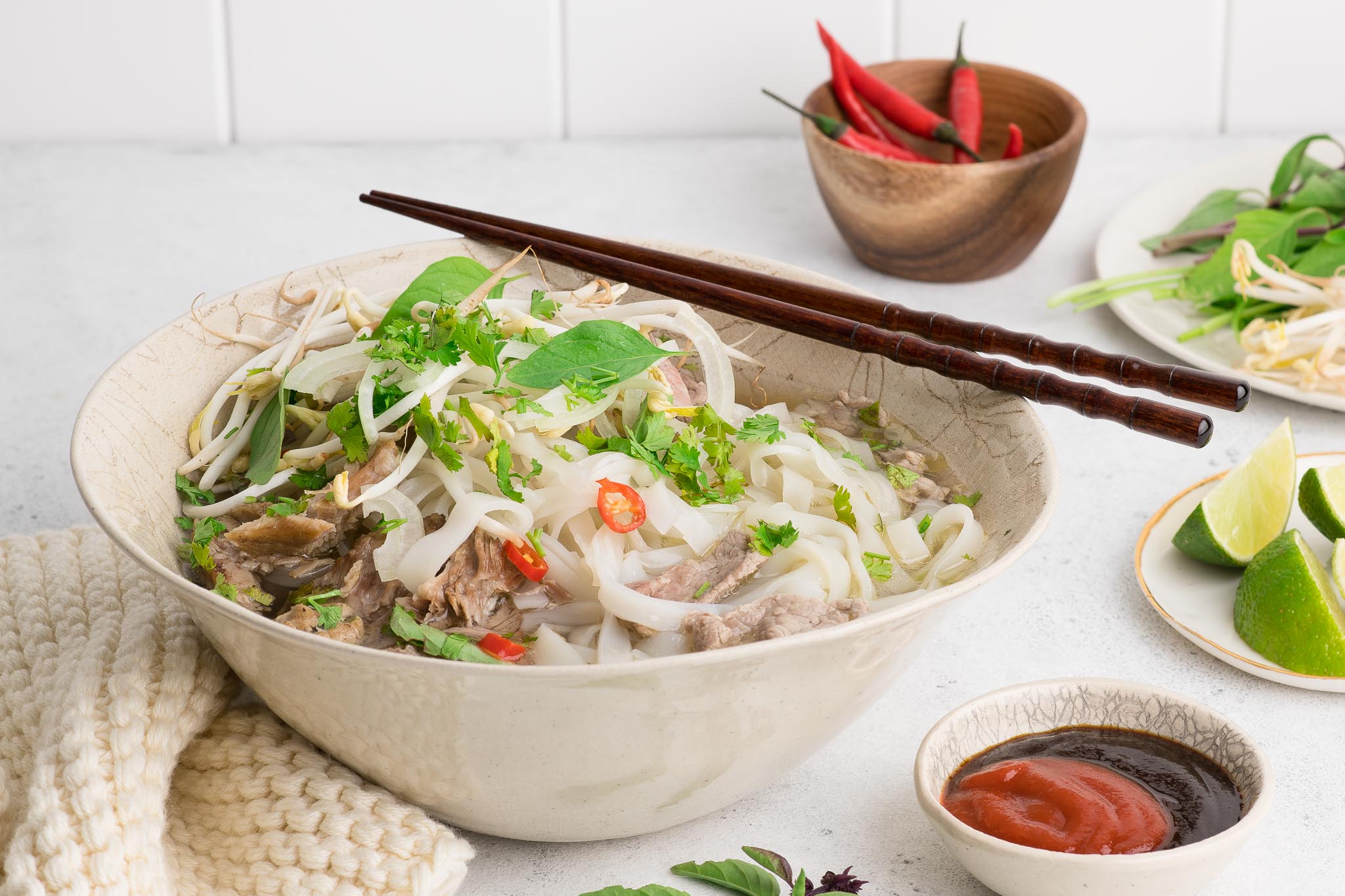
Vietnamese Pho
Pho could perhaps be described as the national dish of Vietnam. But what many people don’t know is that Pho is predominantly a breakfast dish in Vietnam.
In some parts of the world, breakfast might be a bowl of cold cereal to some. In Vietnam, however, they like to kick-start their day with an aromatic noodle broth, full of flavour and texture to awaken the senses.
Making your own Vietnamese pho at home might sound complicated, especially if you have a cheap and cheerful Vietnamese joint in your neighbourhood.
But this is the sort of dish to make on a rainy day when you can potter about in the kitchen, resulting in a nourishing and healthy meal which you can enjoy over several days.
How to Pronounce Pho
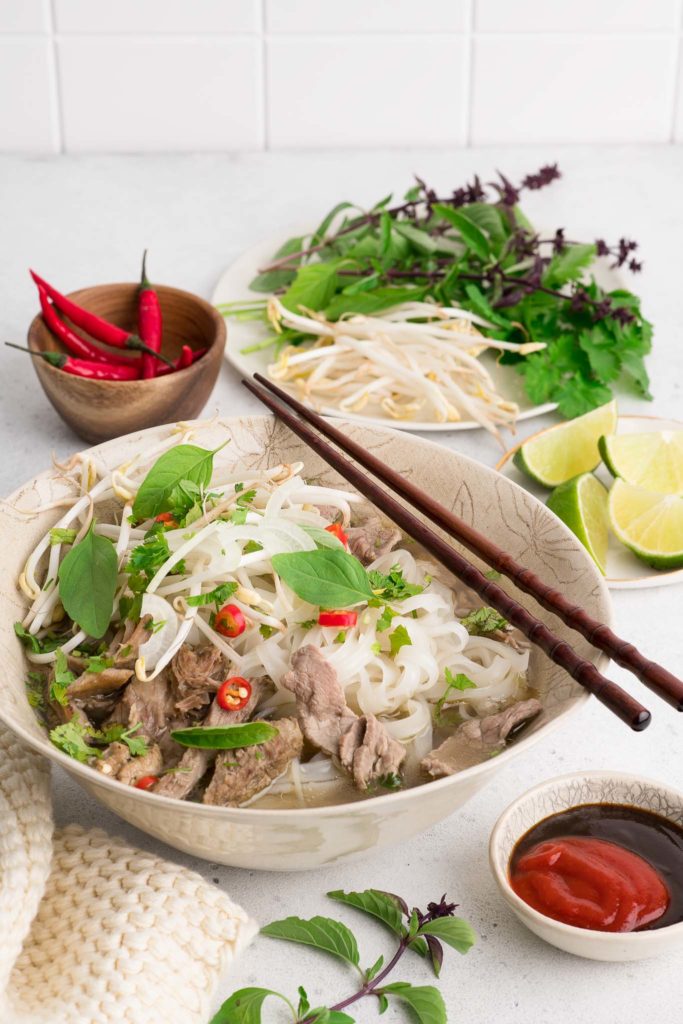
Pho is pronounced “fuh” or “fur” (not “foe”). The name and inspiration for this dish is thought to have its origins from the French pot-au-feu.
Beef Pho
On one of my trips to Vietnam as a small child to visit my maternal grandmother, I would go into town with my uncle in the early hours of the morning to seek out a little pho stand where we would grab some takeaway for breakfast.
Perched on the back of my uncle’s motorcycle, I would watch the pho lady quickly assemble our order, placing steaming hot noodles with meat into one plastic bag, and sealing the pho broth in another plastic bag (much like transporting a newly-acquired goldfish).
Once home, we would quickly empty the contents of the plastic bags into waiting bowls before grabbing our chopsticks and diving in. It was perhaps the only time I ever ate Vietnamese Pho for breakfast, and my mother says it was the only time I ever enjoyed breakfast as a child.
Origins of Pho
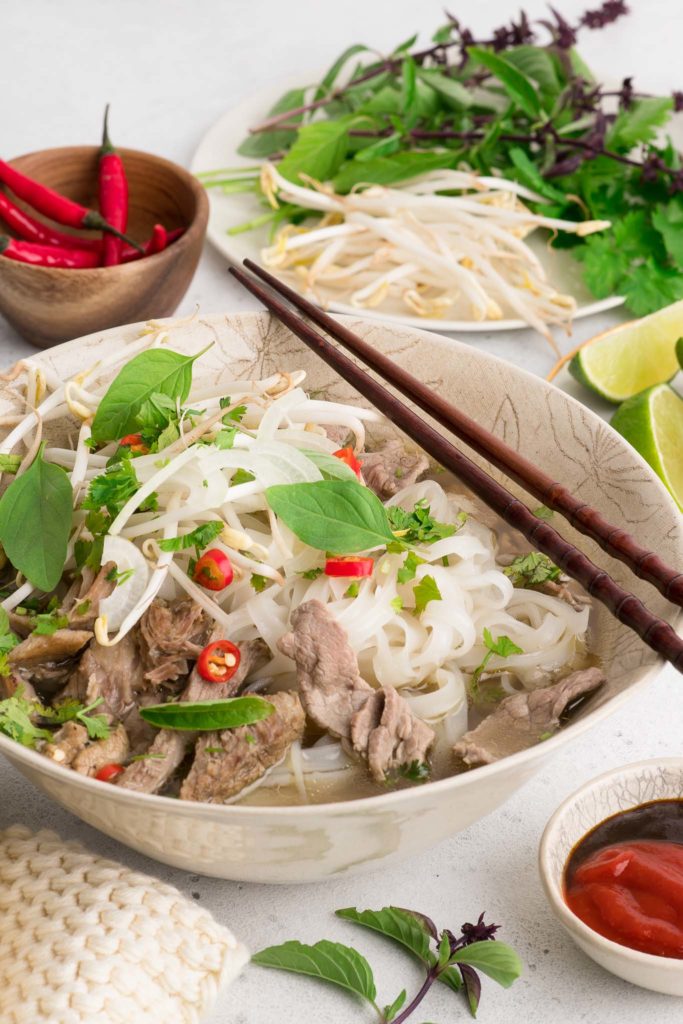
It is believed that, during the French occupation of Vietnam, the French consumed large quantities of beef in their diet and the resourceful Vietnamese cooks used the scraps and bones from the slaughtered cattle to create a local version of the French meaty stew.
Pho Recipe
The recipe for Pho is believed to have originated in the north of Vietnam where, like many dishes from the north, it is simple and uncomplicated; a pho bac is often simply noodles, broth, slices of beef and minimal garnish.
In the south of Vietnam, however, their pho broth is more like their people – a bit fancier and more show-offy. They like their bowls to be more generously sized with more texture added to the dish, such as with the inclusion of beef meatballs and tripe, and pimped with bold flavours courtesy of a selection of fresh herbs and chillies.
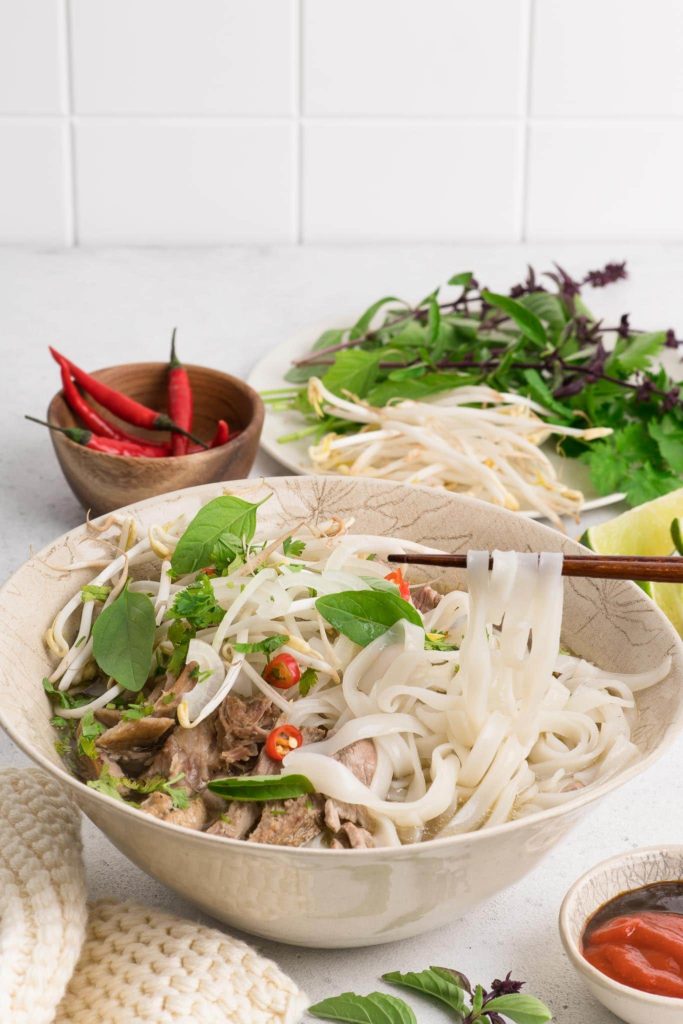
How to Make Pho
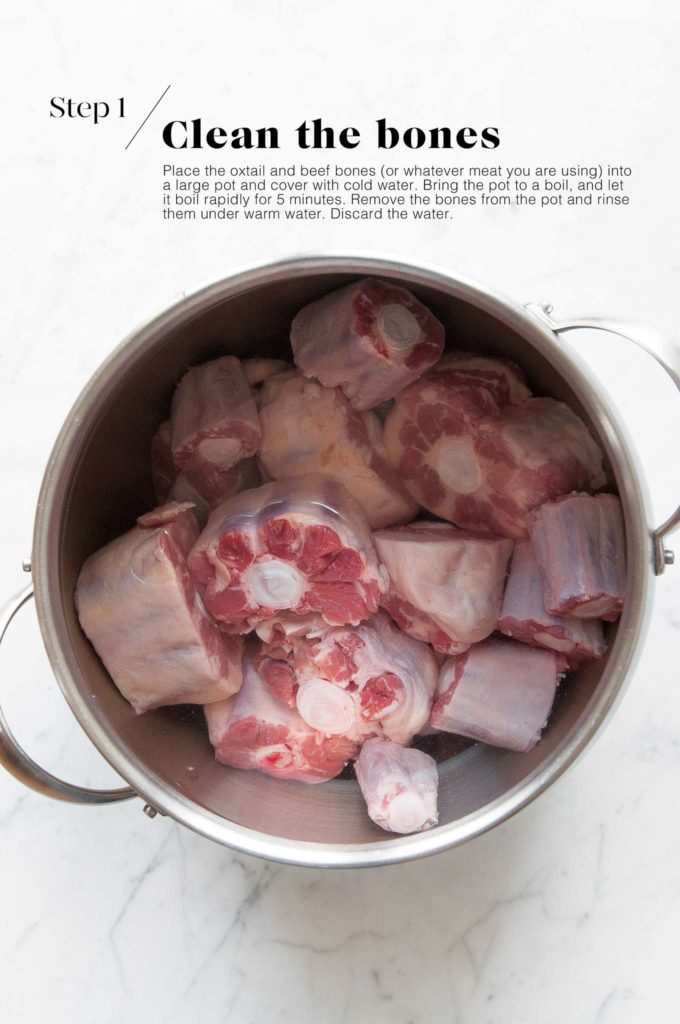
Step 1
Place the oxtail and beef brisket (or beef short ribs) into a large pot, and cover with cold water.
Bring the pot to a boil, and let it boil rapidly for 5 minutes.
By this stage, a lot of the gunk and impurities from the meat will have risen to the surface. This is actually why this first step is important – you don’t want these impurities in your soup broth.
Remove the meat and bones to a large colander, and discard the water from the pot.
Step 2
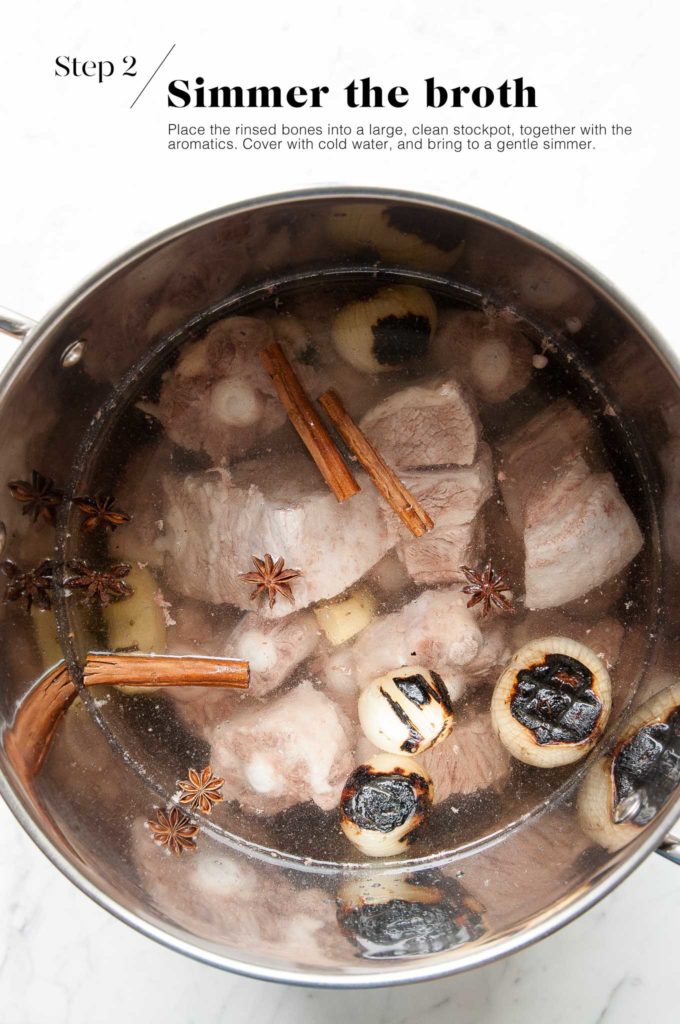
Rinse the meat and bones, and place them into a large, clean stockpot which you will use to make the pho broth. For the recipe below, I use a stockpot with a 15 litre (16 quart) capacity, but you can use one slightly smaller.
Cover the meat and bones with cold water, and bring the pot to a gentle boil, before reducing to low-medium heat.
The broth should not be rapidly boiling, otherwise the broth will go cloudy – you want just a gentle simmer to achieve a nice, clear broth.
Add the cloves, star anise and cinnamon sticks to the broth, as well as the chargrilled onions and ginger (see Step 3 below).
Simmer gently for about 2 hours, before seasoning the broth.
Simmer for a further 1 hour, or until the meat is very tender.
Check the broth regularly to skim off any impurities from the surface, and to top up the water, if necessary. I like to ensure that the water level remains consistent throughout cooking.
Step 3
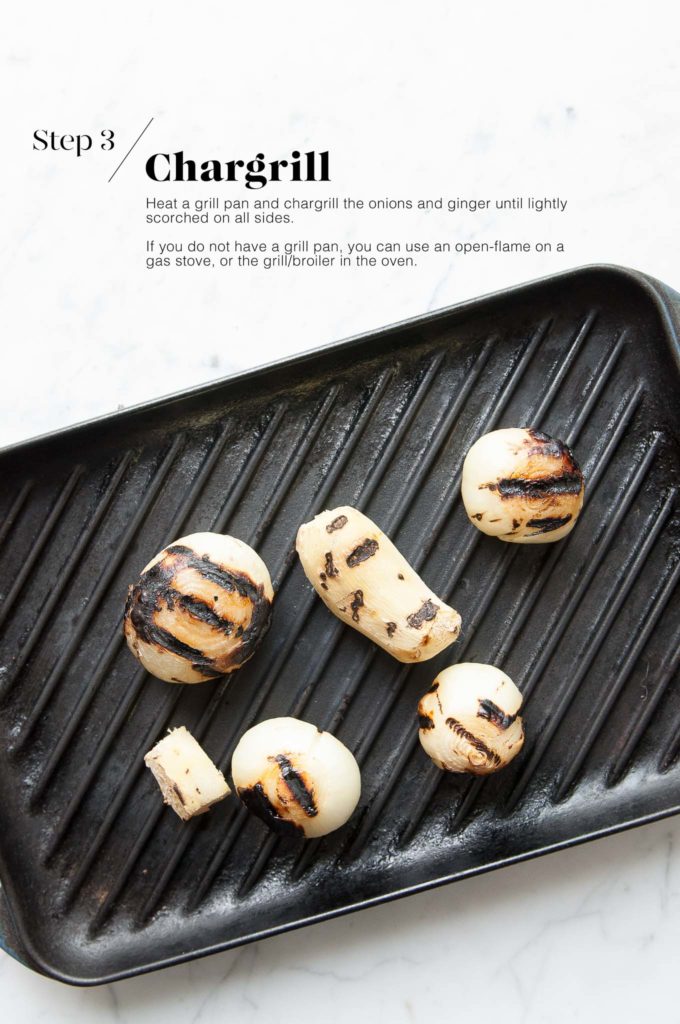
While you are waiting for the broth to come to a simmer in Step 2, chargrill the onions and ginger until lightly scorched.
I use a grill pan on the stove, but you can also use an open flame if you have a gas stove, or you can grill (broil) the onions and ginger in the oven.
The char on the onions and ginger will not only flavour the pho broth, but also give the broth a golden colour. For this reason, try not to over-scorch (or even burn!) the onions and ginger, otherwise your broth will be very dark.
Tips for Making Pho
- Use a mix of oxtail and beef bones: I like to use a mix of oxtail and beef short ribs for maximum flavour, but I quite often use just oxtail and beef brisket, or even just oxtail. I think oxtail is important in pho because it gives a distinct sweetness and flavour to the broth, plus it has a gelatinous quality which gives your broth extra richness.
- Make a double batch: Given the time required to make a pot of pho broth, I highly recommend making a double batch, either to freeze some broth for a rainy day when you know only a bowl of noodle soup will do, or to invite your friends over for a fabulous pho feast. Trust me – your friends will love you for it.
- Use a very large stockpot: Perhaps the only barrier to making a double batch (or even one batch, for some people) is finding a stockpot large enough to hold everything comfortably. While the recipe below requires about 6 litres (24 cups) of water, you will need a stockpot with a larger capacity as the beef and bones will need some room. I use a massive 15 litre (16 quart) stockpot.

How to Eat Pho
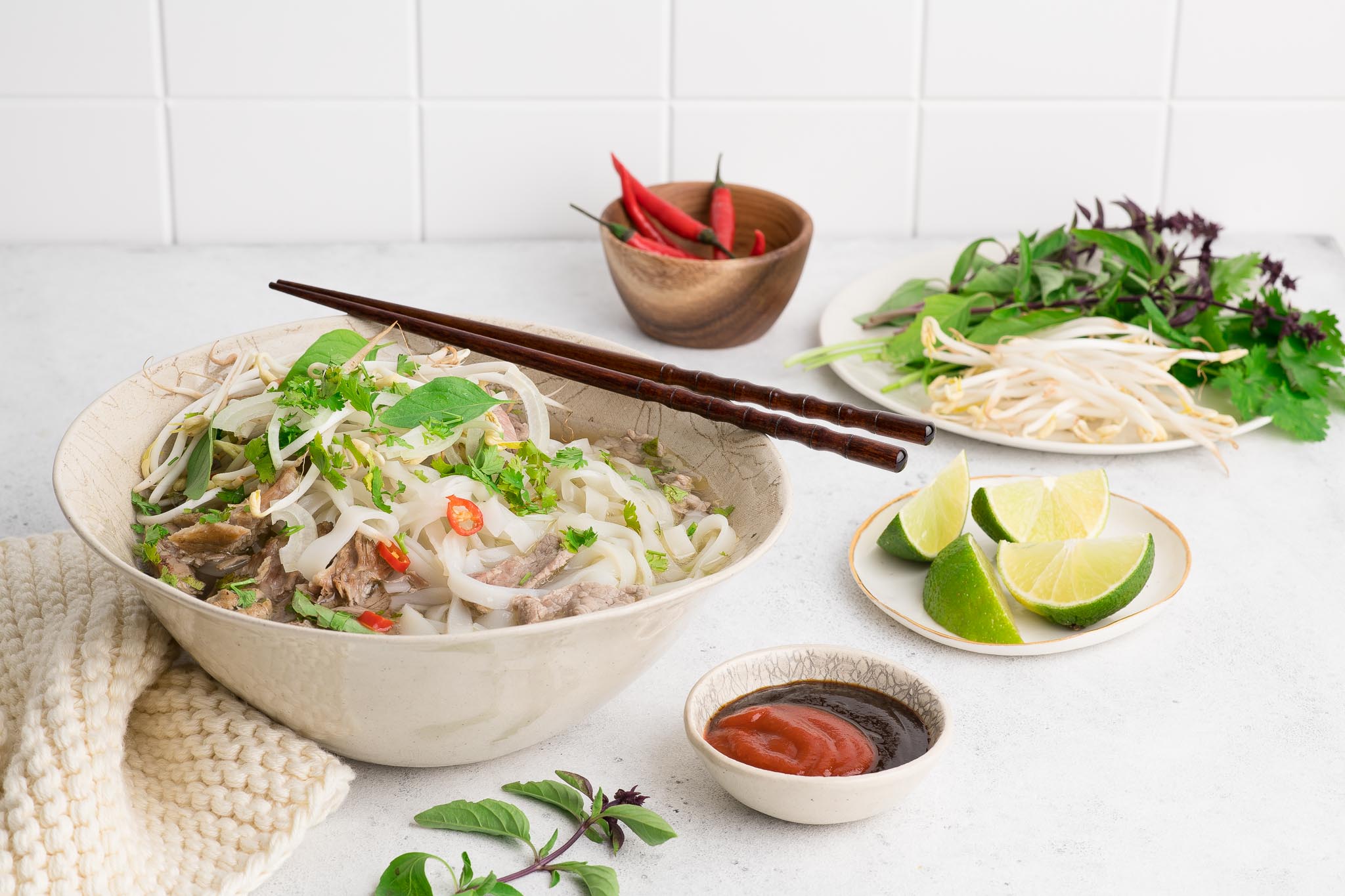
Like many noodle soup dishes in Vietnam, the final flavouring of the pho broth is always up to the eater. Any serious establishment serving Beef Pho will always offer a plate of garnish alongside, generously piled with fresh coriander (cilantro), spring onions (scallions), Thai basil, bean sprouts, chillies and lemon or lime wedges.
Sauce accompaniments typically include hoisin sauce and Sriracha sauce for dipping your meat into, although I know many who also add these sauces to their broth, along with fish sauce to taste and sometimes even freshly ground black pepper.
Personally, I wouldn’t add any sauces to the pho broth directly because, after the many hours of simmering on the stove, the broth should already be rich and full of flavour.
But at the end of the day, how much or how little you want in your bowl of pho is up to you.
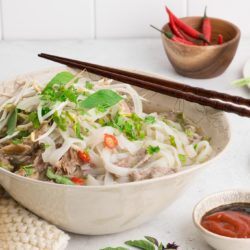
Vietnamese Pho Noodle Soup

Ingredients
For the broth
- 2 kg (4 lb) oxtail, see Kitchen Notes
- 1 kg (2 lb) beef brisket, or beef short ribs
- 10 cm (4 inches) ginger, peeled
- 4 brown onion, peeled
- 8 cloves
- 5 star anise
- 2 cinnamon stick
- 60 ml (¼ cup) fish sauce
- 1 tablespoon sugar
- 1 tablespoon sea salt
- ½ to 1 tablespoon MSG, or 1 beef stock cube, optional, see Kitchen Notes
To serve
- 200 g (7 oz) flat rice noodles, per person
- brown onion, halved and sliced thinly
- spring onions, (scallions) thinly sliced
- coriander, (cilantro) finely chopped
- Thai basil, roughly torn
- red chillies, finely chopped
- lime, cut into wedges
- Hoisin sauce
- Sriracha
Instructions
To make the broth
- Place the oxtail and brisket (or short ribs) in a large pot and cover with cold water.
- Bring the water to the boil and let it bubble away on high heat for about 5 minutes. During this time, a lot of the impurities from the meat and bones will come to the surface.
- Use large tongs to remove the oxtail and brisket to a large colander.
- Discard the water from the pot.
- Rinse the oxtail and brisket under cold water to remove any impurities that might be attached.
- Place the oxtail and brisket in a clean stockpot and cover with cold water. For this quantity of meat, you will need about 6 litres (24 cups) of water, or enough to just cover the meat.
- Bring the pot to a gentle simmer.
- Meanwhile, add the cloves, star anise and cinnamon sticks. You can place these spices into a spice pouch or add them directly to the broth (you will be straining the broth later anyway).
- Heat a cast-iron grill over medium-high heat and chargrill the onions and ginger until they are lightly scorched on all sides. This will take about 10-15 minutes. You can also char the onions and ginger over an open flame if you have a gas stove, or under a hot grill in the oven.
- Add the chargrilled onions and ginger to the broth.
- Simmer the broth over low-medium heat for about 3 hours. During this time, keep skimming the surface of the broth to remove any impurities to ensure a clean and clear broth, otherwise the broth will turn cloudy. If a lot of the broth has evaporated, top up with some boiling water so that the water remains constantly at the same level (i.e. just covering the meat).
- After 2 hours, add the fish sauce, sugar and salt.
- After 3 hours, or when the meat falls off the bones easily and the beef brisket is very tender, remove all of the meat and bones to a large bowl.
- Remove the spices and discard.
- Strain the broth through a fine sieve or a muslin cloth, and into a clean stockpot.
- Heat the broth over medium heat.
- Taste the broth for seasoning – you might want to add some more water if the broth is too concentrated, or perhaps some more salt or fish sauce if the flavour needs adjusting. If your broth is still lacking some depth or feels like it is missing something (which can happen if you made the broth with too much water), add some MSG or beef stock cubes to taste.
- Reserve the oxtail for serving.
- Once the beef brisket has cooled, slice it into thick slices. If you have used short ribs, remove the meat from the bones and cut into large slices or chunks.
To serve
- Cook the rice noodles according to the packet instructions. If you are using dried rice noodles, this usually requires an initial soak in cold water for about 30 minutes, and then about 1 minute in boiling water until they have softened. If you are using fresh rice noodles, you should blanch them first in some boiling water for just a few seconds. A Chinese noodle strainer is helpful for this task. For both types of noodles, keep in mind that they will continue to soften when you add hot broth to them.
- Place the softened noodles into large bowls.
- Top the noodles with some onion slices, some slices of beef brisket, and a few pieces of oxtail (optional). Please see more serving ideas below in Kitchen Notes.
- Ladle hot broth into each bowl.
- Depending on how steaming hot you like your bowl of noodles to be, you can repeat this step by using a large slotted spoon to hold back the contents of the bowl, and return the broth to the stockpot. Wait for the broth to come back to the boil and pour some hot broth back into each bowl.
- Garnish with coriander (cilantro) and spring onions (scallions).
- Allow each person to season their bowl to taste with some Thai basil, red chillies and a squeeze of lime.
- For a dipping sauce for the meat, the Vietnamese typically mix together Hoisin sauce and Sriracha hot sauce in a little sauce bowl.
Kitchen Notes
- PHO NOODLES
Pho is traditionally served with flat rice noodles. They come in various widths, and the size used depends on personal preference. Thin flat rice noodles are perhaps more common in restaurants, but I personally prefer the wider noodles (about 1 cm width) because they have a softer, silkier texture when cooked. - HOW TO COOK RICE NOODLES
The instructions will vary from brand to brand, but I generally soak my dried rice noodles first in a large bowl of cold water for about 30 minutes. Bring a large pot of water to the boil. Using a noodle strainer or large slotted spoon, cook one portion of noodles at a time in the boiling water. The timing will vary depending on the type of noodles that you have used, but anywhere between 30 to 60 seconds should be sufficient. The noodles should be soft but still have a bit of bite. Strain the noodles and place them in the serving bowl. The noodles will continue to cook once you pour over the soup broth. - HOW MUCH BROTH PER PERSON
For a generous serving, I like to give each person approximately 600 ml (about 2½ cups or 3 large ladles) of broth. This should give the cook an idea of how many noodles per serving, keeping in mind that the noodles will absorb some of the broth once added, and you want enough broth in the bowl for some slurping action. - HOW MUCH MEAT PER PERSON
How much meat you add is also a personal choice. I often find that the oxtail and beef brisket used to create the broth is more than we would eat over 6 to 8 servings. In fact, a lot of recipes for pho often don’t tell you what to do with the oxtail; it is a lovely and flavourful piece of meat which should be enjoyed after you have tended to it for so many hours. The oxtail happens to be my daughter’s favourite part of this recipe! You can serve the oxtail as is alongside or in the soup bowls, or – for a more elegant option – you can remove the meat from the oxtail and discard the bones before serving. - HOW TO MAKE PHO TAI
Vietnamese Pho is commonly served with slices of thinly sliced fresh beef. You will need about 400 g (14 oz) beef filet or eye filet (for 6 to 8 servings). To help you achieve paper-thin slices, place the piece of meat in the freezer for about 30 minutes before slicing. Slice the beef very thinly and place 4-5 slices on top of the noodles. As you pour the hot broth over the beef, the meat will start cook. The slices of beef will continue to cook in the hot broth in the bowl. - MAKE IT WITH BEEF BONES
My mother always made pho with oxtail, which I think gives the broth a unique sweetness and flavour which you can’t achieve with regular beef bones. However, you could still substitute the oxtail for the same quantity of beef bones, or use a mixture of both oxtail and beef bones. I like to use to mixture of oxtail and beef short ribs; the bones in the short ribs add additional flavour to the broth, and if you choose meaty short ribs, you can serve the meat with the soup later. When choosing oxtail, I prefer to use small to medium pieces, especially if you plan to serve them as part of the meal. - MAKE IT WITH MORE VEGETABLES
For a non-traditional, yet a frequent variation of this recipe in my home, I like to add vegetables to the finished broth, such as:
* carrots, thinly sliced
* bok choy or pak choy, sliced if large
* broccoli, cut into small florets
* baby corn, sliced - SEASONING THE BROTH
This is perhaps the trickiest part of the recipe if you are a novice cook. Knowing how to balance the flavours in a recipe takes practice, and how you like your broth will be different to how others like it. If you cooked your broth at a slightly higher temperature than I did for 3 hours, more water would evaporate during cooking, and your broth might turn out more concentrated, thus requiring some diluting with water at the end. Similarly, different brands of fish sauce vary in saltiness. But if you have followed the above recipe to the letter and you think the broth is still missing something, don’t be afraid to add a dash of MSG or crumble in a beef stock cube. Vietnamese home cooks do this all of the time! - HOW TO STORE THE PHO BROTH
The broth keeps well in the fridge for several days and will turn jelly-like once cold. If you have made a large batch, you can freeze the broth in freezer bags. - FOOD STORAGE
All of the components of this dish should be kept separately in the fridge. - OVEN & STOVE TEMPERATURES
All recipes on this website have been tested on an induction stove and/or with a conventional oven (i.e. an oven without fan). All recipes on this website use temperatures for a conventional oven, unless otherwise mentioned. Convection ovens (i.e. fan-forced ovens) are typically 20°C/70°F hotter than conventional ovens, but please check your manufacturer’s handbook. - CONVERSIONS
To convert from cups to grams, and vice-versa, please see this handy Conversion Chart for Basic Ingredients.
Did you make this recipe?
Please leave a comment below and share your photos by tagging @eatlittlebird on social media and using #eatlittlebirdUpdate
This recipe was originally published on 27 February 2014. It has been updated with new photos and more comprehensive recipe notes.
More Vietnamese Recipes

I wanted to say thank you to you even before I finish reading your very informative post on the much loved Pho! It was one of my close friend from Vietnam, Huong (herself also married to an Aussie and currently living in Borneo) who first introduced to me a real, home-made Pho… And also how to correctly pronouce her name and the dish. We all just loved the simplicity of this one-bowl meal, and how it was so delicious, healthy and filling. In her version of the Pho, she had used this incredibly fragrant spice which she called black cardamom but it was much bigger than the cardamoms I’ve been used to. Another friend of mine who visited India was lovely enough to bring me back some from there. I now live in Lille, France and I’m not sure if I can buy it here…:(. Anyway! I’m just so happy that you took time to blog about the Pho and am now excited to finish up reading it :).
You’re very welcome! I hope you will enjoy this post and be able to take something from it. I’ve included a video of Luke Nguyen making a version of Pho in Hanoi, and there he uses black cardamom in the spice pouch. I also can’t find it where I live in Zurich so I sometimes use the more commonly available green cardamom which, in itself, is also quite fragrant.
I’m not sure how readily available Asian food products are in Lille, but I hope you will get a chance to make this at home. For me, it normally requires a trip to 2 different supermarkets and 2 different Asian grocers. Even then, sometimes what I’m after is sold out so I have to make another trip a day or two later!
In Zurich, instead of using beef brisket, I often use the cut of beef sold for pot-au-feu (Bouilli Maigre). I think it’s from the same part of the animal but just cut differently.
Beautiful Thanh. A labour of love! I love the new style of recipe photo you did – shot from the side instead of above. The bowl is beautiful too which you serve the soup in, but I am a freak for a beautiful bowl 😉
Thanks, Jo! I knew this post would be quite long so I decided not to do any step-by-step photos for this recipe. I also love these soup bowls – they’re so pretty to look at while you are eating 🙂
What a lovely presentation! I really enjoy Pho and now I have the perfect recipe with which to try it here at home. Thank you for the inspiration.
You’re welcome, Donna! I hope you will get a chance to try this recipe at home. I promise you that it will be worth it!
Oh, if there can only be one thing I could thank you for, it’s for introducing me to Luke Nguyen and Pho! I tried this version recently and instantly fell in love with the beautiful, complex, layered flavours. And it’s SO comforting in the eating. I love eating this alone. One, you don’t have to worry about offending anyone with appreciative slurping noises and two, no one can see just how many bowlfuls I eat!
I liked the Pho Tai version in SoS – fine fresh hit of silky, barely cooked meat, against the deeper flavour and texture of the long cooked brisket and the gamey flavour of the oxtail – which all played together nicely with the clean, unfussy broth.
The spices in this version make it a bit more special, more interesting, a little louder. I’d take it any which way it was given! Thanks Thanh. Fabulous post 🙂
PS: Think I’ll try your mum’s method for the oxtail next time, just to see the difference.
It’s great to know that you’re also a fan of pho 🙂 Whenever we travel and I see a Vietnamese restaurant, I always order pho because it is something I only get to eat once in a while. But either I am getting too used to my own cooking or I am starting to find that there is something special about a homemade version. I like to make a big batch of pho because I love looking forward to a bowl in the coming days. If my freezer was bigger, I would make so much more!
And as I know you’re also a fan of Luke Nguyen, I have a few more of his recipes lined up to publish soon 🙂
Well, I’ve already said this before, but this is no he kind of dishes that I include in my favorite foods. Anyway, I love the mix of ingredients and flavours, and the photos, as usual, are beautiful!!
I don’t know, I’m more used to eat noodles without broth, and soup whit short pasta, not noodles. Habits, I think…
Mom has a spice ball like that, never use it, I’m going to tell her what she can do with it!!! Or keep the secret and take it home with me 😛
This summer we return to Schweitz!!! I’m looking forward to go to one of these pastries you give envy with on Facebook 😛 We’ll be there during 7-10 days, we’ve to decide.
I have to go over allll the post you have make about special places!!! 😛
Asian food culture is a lot about big bowls of noodle soups, so I totally understand if this is very foreign to you 🙂 I love noodles of all kind – in soups, in stir-fries, pasta, etc. In fact, I didn’t like rice as a child so my mother had to cook noodles most of the time for me.
That’s so exciting that you will be visiting Switzerland again soon! I’ll send you an email with some tips on where to go 😉
I have to introduce a little more on Asian food. Beyond fried rice and Pekin duck 😛 Cos the truth is that I like the mix of flavors they use, but the format is new for me 😛
I wouldn’t dare to ask you for help (well, perhaps I was going to abuse a little and ask for some little information that you don’t find in guides or web), but if I receive that mail, you don’t know how much I’d appreciate it!! But I know you’ll be busy too, so no problem if you don’t find an opening 😉
We’re really happy with this travel, we have the flight, so from now till july we only will think on vacations, jajaja Every year happens the same. We’ll fly to Zurich and come back from Geneve, so we can give a good trip, I think. We were going to use our car, but it was a little exhausting, even if you can put all the things you want in the boot 😛
Call me silly, but I’ve a terrible desire to ‘step on’ Gruyères!! And fondue, and raclette!! 😛
I learnt so much from your post. I’m a novice when it comes to Pho, I’ve only read about it and seen pictures of the beautiful steaming dish. I loved this post, it’s felt like a big hug on a warm rainy day. I think I had a similar soup in Thailand but that was ages ago and can’t seem to remember much of it. Thanks for introducing me t yet another awe inspiring dish from Vietnam 😀
xxx
Thanks, Rushi 🙂
Next time you are in Paris, you should head to the 13th arrondissement for a bowl of pho! It’s always hard to imagine or recreate a dish which you have never tried before, but pho is a defining dish of Vietnamese cuisine. It’s warm and comforting, fragrant and heady, much like a lot of Vietnamese food. Hope you are doing well 🙂
This looks spectacular and your pictures are fabulous! Pho is one of my favorite dishes ever and in Saigon, we had a big bowl of the best pho ever every morning to start the day properly..my favorite breakfast ever! Perfect comfort food for me- and I am not even Asian 🙂
We also try to visit Vietnamese restaurants whenever we travel somewhere and did find some good pho soups in Paris. Here in Zürich, we often visit Asiaway (I believe we talked about this place long ago) but I always order their bun bo hue which I crave all the time. The bun bo hues I tried in Vietnam need some getting used to (lots of types of meats I was not familiar with) but the one at Asiaway packs lots of bold flavors and has lean tender meat. Hm just thinking about it makes me hungry!
I heard about a new Vietnamese restaurant in Zürich called Hoi An..have you tried it? We always mean to go but haven’t found the right time until now.
Anyway I am the biggest fan of Luke Nguyen too and really need to try this recipe. The problem is indeed that I don’t have a pot that’s big enough but I think it will be my next investment and I am sure it will be worth is since I love making different types of stock. I will try to see what I can find in France one of these days since these types of things are so overpriced here in Switzerland.
Thanks for this great post!
Hi Carole! Lovely to hear from you 🙂
I remember us discussing some of Luke Nguyen’s cookbooks a while back. I hope your trip to Vietnam has inspired you to make a few Vietnamese dishes at home. I find the Asian grocers in Zürich to be better stocked these days compared to, say, 5 years ago, but sometimes it is hit and miss as to whether they will have what I need. Quite often, I have to trek to at least two Asian grocers before I have everything on my shopping list.
I haven’t heard of Hoi An … I will have to look it up. I saw a Vietnamese-Thai takeaway shop open recently in Wollishofen, so I suppose Vietnamese restaurants are slowly taking off around here.
I’m also a big fan of Bun Bo Hue 🙂 Actually, if I go to a Vietnamese restaurant, I am perhaps more likely to order this dish than Pho; I make Pho quite frequently at home, whereas I am still yet to find “the” Bun Bo Hue recipe. So that’s great to know that Asiaway makes good Bun Bo Hue! We might go there this week to check it out 🙂
As for the stockpot, I didn’t bother looking for one in Zürich as I knew it would cost a fortune. But then, you can sometimes find good bargains at Manor or Co-op. The one I ended up buying in the US cost only about CHF 50, although it seems to be of good quality with a good, heavy base.
We are cooking this tomorrow for our Charity dinner. Never made or even had pho before so I can’t wait to see how this goes!
I’ll make sure I share your recipe on my page 🙂
If you want to taste real broth, skip the sugar and use white daikon and one white or yellow onion. Grill the onion over fire and then put it in the soup stock.
Hi Luke.
Thanks you for a very good recipe video ‘ how to cook PHO ”
I just have 2 question for you:
1- What was it in the white bow with rock sugar ?
2- What was it in another white bow that look like seeds that you dry fired ?
Many thanks.
Steve
Lovely recipe – definitely gonna try this soon. Just one question – isn’t the oxtail a bit fatty? I have nothing against fat, by the way (it’s where the flavour is) but all the pho recipes I’ve looked at talk about the broth being crystal-clear.
I don’t think oxtail is overly fatty as it is mostly meat and bone. It is definitely important that the broth is clear, so it helps to continually skim the broth during cooking to remove impurities which are released from the oxtail and brisket. In doing so, you are also likely to remove some fat when skimming the broth, which is a good thing because too much fat in the broth can make it taste too rich. Otherwise, I’ve never found that cooking with oxtail made the pho broth particularly fatty, but that might be because the oxtail I buy has been well-trimmed of the fat?
Excellent recipe! I followed it closely and even found fresh pho noodles at the Asian supermarket. It needed a bit more salt or fish sauce, but I liked that we could each season our soups to taste just before eating. Will definitely be making this again!
I’ve been wanting to try and make pho for ages but it looked so complicated. But I gave your recipe a go and it was much easier than I expected. The broth tasted great, even nicer than the restaurant where I normally eat pho! But your recipe takes a long time. Can I use your recipe for the Instant Pot or pressure cooker? What settings should I use?
That’s great to hear that you enjoyed this recipe 🙂 I haven’t tried making beef pho in the Instant Pot or pressure cooker yet, mostly because I prefer to slow-cook meat on the bone. But if I get around to experimenting, I will let you know 🙂
Do you have to use beef brisket for the broth? Is it possible to substitute it for something else or not include it at all?
Hi Jesse,
You could leave out the beef brisket from this recipe, and the broth should still taste the same. I’ve done that quite a few times because I feel that the dish is already quite meat-heavy, especially since I like to serve the oxtail as part of the soup. Or if I am making Pho Tai (with slices of beef fillet), I tend to omit the beef brisket as well. Hope you will enjoy this recipe! I just made a double batch yesterday and I’m looking forward to eating it everyday for a few days!
Very tasty and authentic recipe. I think it tastes even better than my mum’s ha ha! I grew up mixing hoisin and sriracha in my pho, but this broth was so delicious that it didn’t need any extra seasoning. I will definitely make this again.
Yep, I can confirm that this recipe is very authentic. I doubled the recipe and cooked for 6 hours as my mom always cooked her pho broth for ages, sometimes 12 hours. Very delicious.
This recipe is South pho, North one need much more time to prepare and you won’t regret.
I think your family from the south? You use a lot of herbs like the Vietnamese people in the south. I try your recipe today and it very good. I also use black cardamom for more flavour. I recommend you try next time. Thank you for sharing your Vietnamese recipes. It means you very proud of your heritage. Thuy
Excellent recipe! This was my first time making pho and it tasted amazing. Thanks for your easy to follow recipe.
Hi Thanh, I moved to Germany from the US in 2020 and have been craving good Vietnamese food. Your pho recipe was spot on! It was my first time making pho and I can’t wait to make it again. Looking forward to trying your other Vietnamese recipes soon!
Hi, where do you buy oxtail in Zurich?
Hi James,
I regularly buy oxtail from the butcher’s counter at Coop, but you should also be able to find it at the butcher’s counter at Migros, Globus and Jemoli. It’s called “Ochsenschwanz” in German. Hope this helps!
Thanks for your recipe! I made the pho broth yesterday to serve for lunch with my family today. The broth tastes great! What do you do with all of the oxtail. You say in your recipe that you serve the oxtail with the soup but there is so much? My family like to have Pho Tai so I bought some beef fillet to thinly slice. But I can see why you prefer to just use the oxtail because there is a lot of meat in this recipe. Do you have recipes to use the leftover oxtail meat?
Very authentic recipe, almost as good as my mom’s but definitely better than the local restaurant 😉 Jokes aside this was a seriously great pho recipe. The flavors were spot on. Thanks for your recipe!
The best pho I’ve ever tasted! Can’t wait to try more of your Vietnamese recipes. I’m also Vietnamese and trying to cook more from my heritage. I’m so happy to have found your website!
This is the perfect pho recipe and very authentic. I used a mix of oxtail and short ribs and the broth tasted incredible. Do you think I could make this recipe with an Instant Pot?
Fantastic recipe! The broth was very full-bodied and flavourful. I toasted the spices first to make the broth more fragrant. Great instructions.
Wow this was the best pho I have ever tasted!! 10/10! All of the meat and ingredients were not cheap but this recipe makes a lot of broth and the taste is definitely amazing, so worth every cent. I will be trying more of your recipes. Thank you!
This recipe was so delish! I used brisket and it was so tender and flavorful from the broth. Just yum!
Thank you for this recipe! I never leave comments but this soup was honestly so delicious and exactly what I had hoped for. I will definitely be making this again.
I’ve made this recipe twice now! My family just love it! The broth is amazing and so flavorsome. The soup goes a long way with lots leftover for seconds. Definitely a favorite.
Thank you for this recipe. The taste is very authentic and actually better than what you can get at most Vietnamese restaurants. We loved it.
Best pho I have ever tasted – and I made it myself! Great tips, everything worked out perfectly. I also appreciated the tips on how to soak and cook the dried noodles. Up until now, I was obviously doing it wrong but soaking the dried noodles first was key here.
I made this again for a second time this past weekend. This recipe is spot on. I can’t believe how authentic this soup tastes. Thank you for all of your great recipes and step by step photos. I think your blog is amazing. All of your recipes are fantastic!
We moved to a remote part of Germany last year and there is not an Asian restaurant in sight, let alone a Vietnamese restaurant. I was craving pho the other day and decided to try your recipe. I couldn’t find Thai basil but managed to get coriander and even Sriracha at the supermarket! My first sip of the broth was just heaven – I can’t thank you enough for this fantastic recipe!
Wow! That is so great to hear! So glad you could make this pho and enjoy it. I can understand how hard it might be to find the right ingredients if you live somewhere remote, but thankfully most butchers sell oxtail and short ribs. The other ingredients you can find online, but I agree that fresh herbs can be hit and miss. Guten Appetit!
Such a good recipe! I used only oxtail for the broth and it still tasted amazing.
Made this yesterday and it was so good! I started cooking after lunch and the broth was ready by dinner time. It tasted better than any pho I had eaten in a restaurant. My family slurped up everything in their bowls!
Really delicious. This recipe takes a bit of time, as well as a lot of shopping, but the cooking part is actually quite easy. Authentic yummy flavors!
I cooked this recipe for my family on the weekend – 26 people! I multiplied your recipe 5x and used a mix of oxtail and short ribs. Everyone loved the broth and my mom and aunt were very impressed. My mom had a back injury a few months ago and hasn’t been able to cook since, but she watched me very proudly as I served the pho to everyone. It was a lot of work but it was worth every second just watching my family enjoy this meal together. I look forward to trying more of your Vietnamese recipes 🙂
I made this for my family and it was so good! Thanks for the easy and delicious recipe.
Thanks for the great recipe! I used exactly your recipe, found some fresh pho noodles at the Vietnamese supermarket, and I also used sirloin to make Pho Tai. It was an amazing meal.
I made a big batch of this pho recipe on the weekend – I tripled the recipe. The taste of the broth was spot on – very authentic. We just had some of the leftovers for dinner tonight and it tastes even better! I can highly recommend this recipe.
Great flavor in this pho broth! I would make it again 10/10.
We really like this recipe. The taste is very authentic and the broth is nourishing and flavorful.
Beautiful flavors!
I tried this recipe for the first time and the flavors were just wow. I’m definitely making this again.
This is one of the best pho broths I have ever tasted. This recipe is definitely a keeper.
We really enjoyed this recipe. Very nice tasting soup broth
I’ve been meaning to try and make pho for a long time but never got around to it. Finally found the time yesterday and I can’t believe how easy it is. Followed your recipe and used oxtail and short ribs. The flavor was excellent and tasted better than any pho I have ever ordered in a restaurant!
This pho broth is incredibly delicious! What a great recipe.
I don’t think it is traditional to serve the pho with oxtail? In my family, we only serve it with thinly sliced beef fillet.
Hi Frances,
In restaurants, you won’t normally find the pho served with oxtail. At home, I find that it feels wasteful to discard the oxtail after making the broth, so I serve the oxtail meat with my pho. My kids actually love to eat the oxtail dipped into hoisin sauce!
So delicious and very authentic taste
Very delicious recipe! I’m looking forward to the leftovers!
Tastes just like my mum’s recipe! So yum!
This pho recipe was so so delicious! I wish I followed your advice and doubled the recipe so I could have more leftovers. The flavors were spot on. I can’t wait to make this again soon.
I made this recipe last weekend and it was such a hit that my family has asked me to make it again soon. Do you have any tips for making pho with the Instant Pot?
Hi Jamie,
I’m not a big fan of making beef pho in the Instant Pot because the broth will go cloudy. Also, cooking the bones under pressure in an Instant Pot will make the broth taste different to a traditional pho broth. I have tried making beef pho in the Instant Pot twice and, both times, I felt that the broth made using the traditional method tasted far superior.
I have never made pho from scratch before but your recipe was so easy to follow. The flavors were excellent!
Very delicious recipe. It actually tastes better than the pho I’ve eaten in Vietnam! Definitely making this again.
Hello! I’ve made your pho recipe twice now and each time was absolutely amazing! The broth needs a long time to simmer, but the recipe is actually very easy to make, now that I know how. Thanks for your great recipe!
This is a great recipe. I’ve never cooked with oxtail before but the broth was so delicious. I couldn’t find brisket or short ribs, so I added thinly sliced sirloin before serving. I am salivating as I write this!
One of my favourite soups! Do you also have a recipe for Bun Bo Hue?
Hi Nigel,
I do have a recipe for Bun Bo Hue! I hope to publish it very soon. But I will send you an email with my recipe – I just don’t have any photos yet 🙂
Amazing recipe. I could eat this pho every day!
Can I make this recipe with a slow cooker?
Hi Marion,
You could make this in the slow cooker, provided that it is big enough to fit all of the bones, meat and other ingredients. I would follow the recipe as though you were making it on the stove, but you could slow cook the broth for up to 12 hours, or until the meat is tender.
Excellent recipe and very clear instructions. The broth is sooo delicious!
I followed your recipe but also added some beef bones which I had in the freezer. Amazing broth!