

 by
by 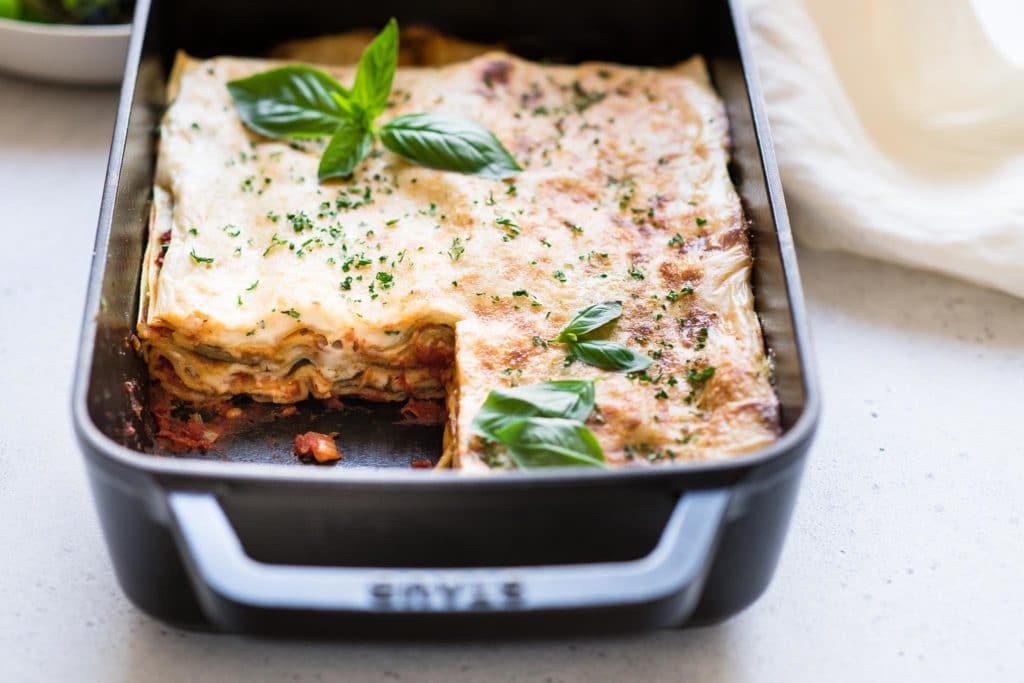
Spinach Lasagna
I love a good lasagna and it’s a satisfying dish to make when you have time to potter about in the kitchen. With spring having finally arrived in Zurich and warmer weather slowly creeping into the forecast, I wanted to make a baked pasta dish, but nothing too rich and heavy.
Why This Recipe Works
- This Spinach Lasagna takes less time to make than a traditional lasagna.
- All you need is a simple Tomato Pasta Sauce and a Béchamel Sauce, plus a scattering of spinach between the layers.
- Change the recipe to your liking by using different vegetables.
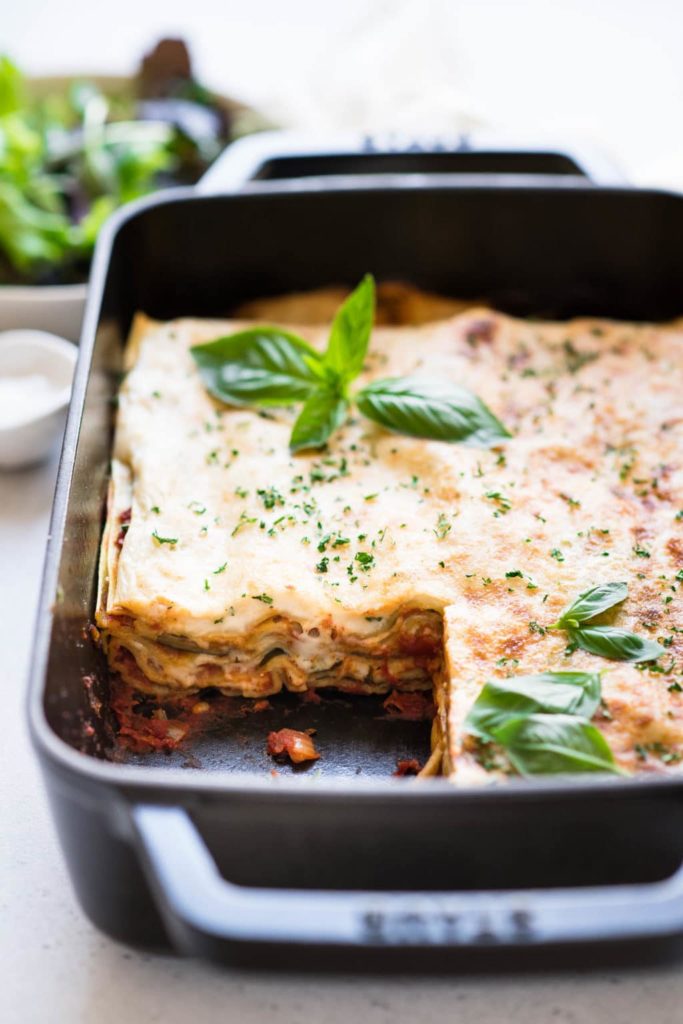
Spinach Lasagna Recipe
This recipe for Spinach Lasagna is simple with clean, fresh flavours.
Whilst I wouldn’t attempt to make a traditional meat lasagna during the week, I quite often make this Spinach Lasagna (or variations of it – see below) on a busy weeknight.
I find this Spinach Lasagna recipe to be a great way of combining pasta and vegetables, and there is something special about bringing a bubbling lasagna to the table after a long day at work.
Although this lasagna has a few components and requires an assembly job, I make Tomato Pasta Sauce and Béchamel Sauce so often that I can have both sauces ready to go in about 20 minutes.
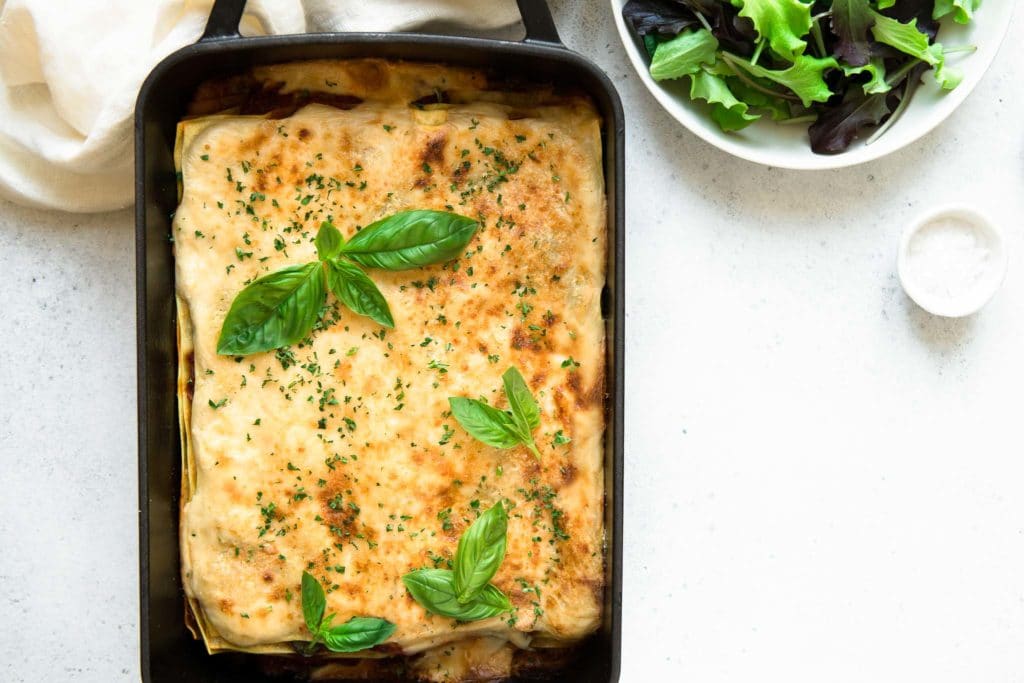
Tips for Making Lasagna
When making a lasagna of any sort, my tips are as follows:
- Start by making the Tomato Pasta Sauce. My recipe for Tomato Pasta Sauce takes about 5 minutes to prepare, and while it is simmering away and reducing, you can get started on the Béchamel Sauce.
- The Béchamel Sauce should take about 10 to 15 minutes to make, so it should be ready at about the same time as the Tomato Pasta Sauce.
- Once both sauces are ready to go, you can get started on assembling the lasagna.
- I like to pre-cook my fresh lasagna sheets in boiling water for about 2 minutes each. This is enough time for me to quickly assemble a layer while I have a sheet of lasagna cooking.
- If you prefer to use dried lasagna sheets, I recommend soaking them in hot tap water while you are making the sauces. Some brands even require you to cook them first, so check the packet instructions.
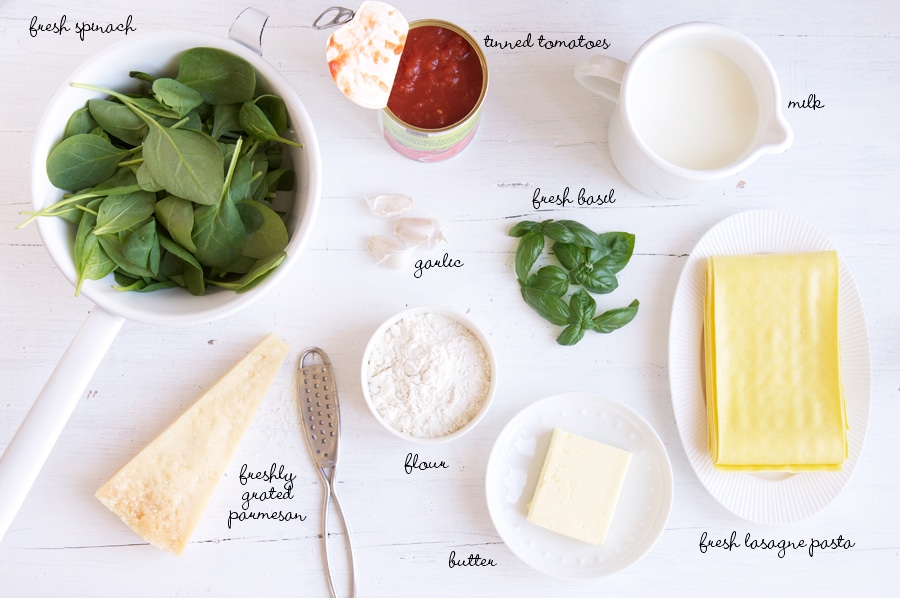
How to Make Spinach Lasagna
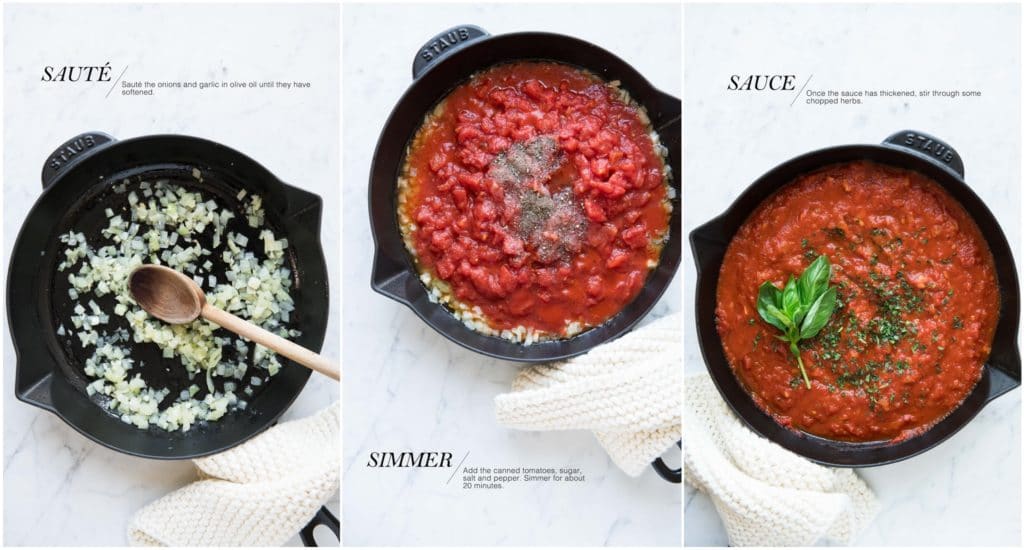
Make the Tomato Pasta Sauce
This Tomato Pasta Sauce is one which I make at least once a week to serve with pasta, polenta or even alongside some grilled steak.
Please see my recipe for Tomato Pasta Sauce for step-by-step photos.
Make the Béchamel Sauce
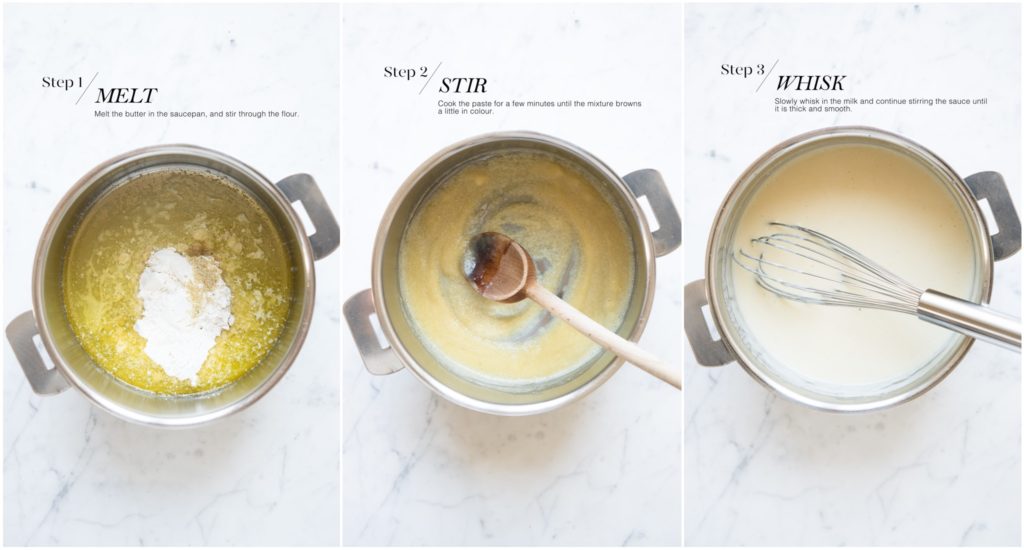
And the Béchamel Sauce (white sauce) is a staple in my cooking, often used to generously coat some vegetables (like par-boiled cauliflower or boiled potatoes) and transform them into a cheesy gratin dish.
Please see my recipe for Béchamel Sauce for step-by-step photos. For this lasagna recipe, I have doubled the quantity of Béchamel sauce.
Assemble the Lasagna
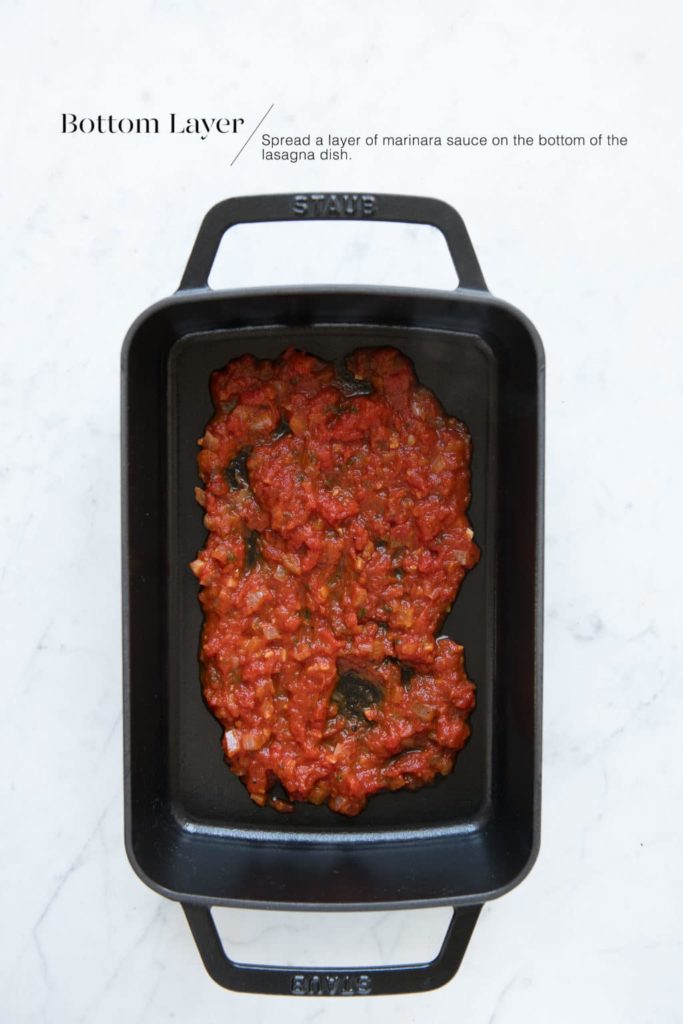
To assemble the lasagna, start by spreading a layer of tomato sauce on the bottom of the lasagna dish. This will prevent the pasta from sticking to the bottom of the dish.
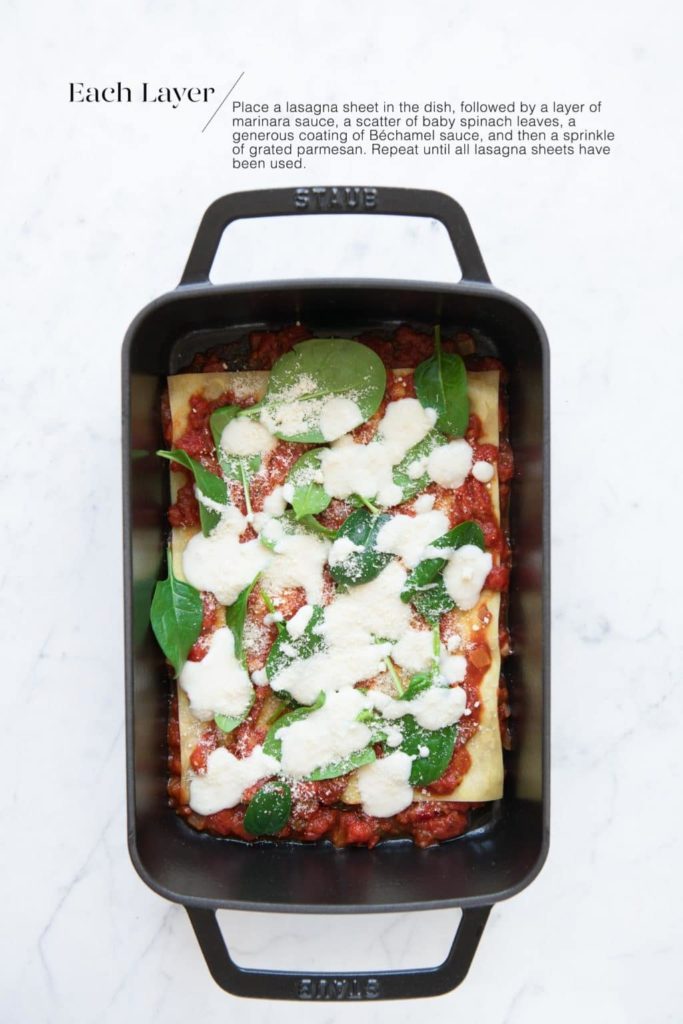
Place a lasagna sheet in the dish and start layering on the ingredients as follows:
- a layer of tomato sauce
- a good scattering of baby spinach leaves
- a generous coating of Béchamel sauce
- a sprinkle of grated parmesan
Repeat the above steps until all lasagna sheets have been used.
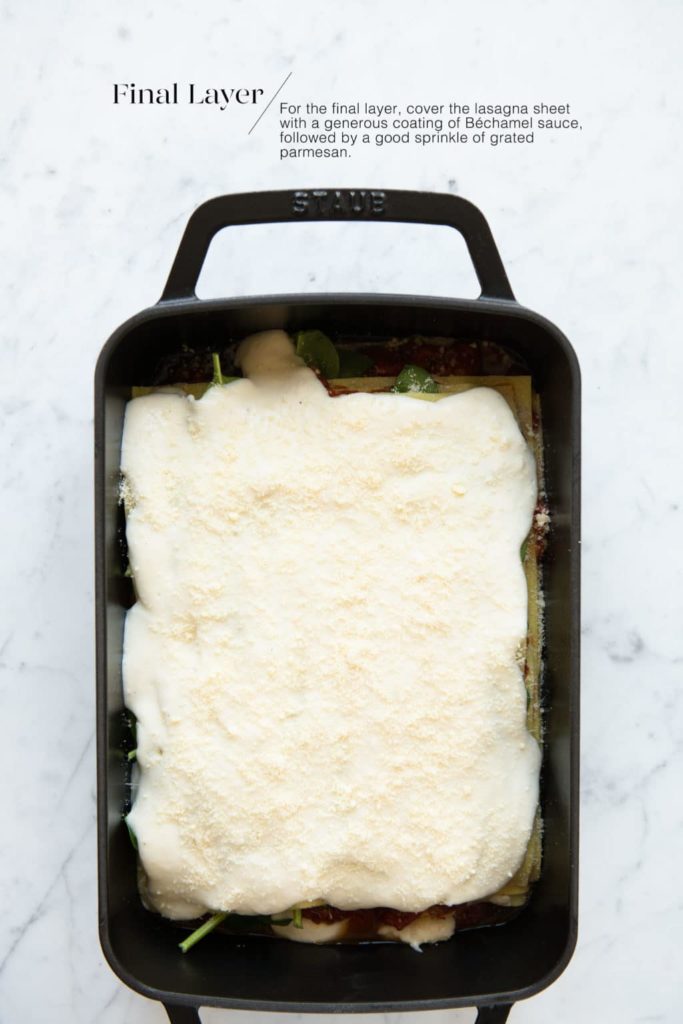
For the final layer, I like to have a generous coating of Béchamel sauce. I try to reserve about double the quantity of Béchamel sauce for the top layer as for the other layers, just to make the lasagna extra unctuous.
A generous sprinkle of grated parmesan helps the top layer to brown nicely.
Fresh vs Dried Lasagna Pasta Sheets
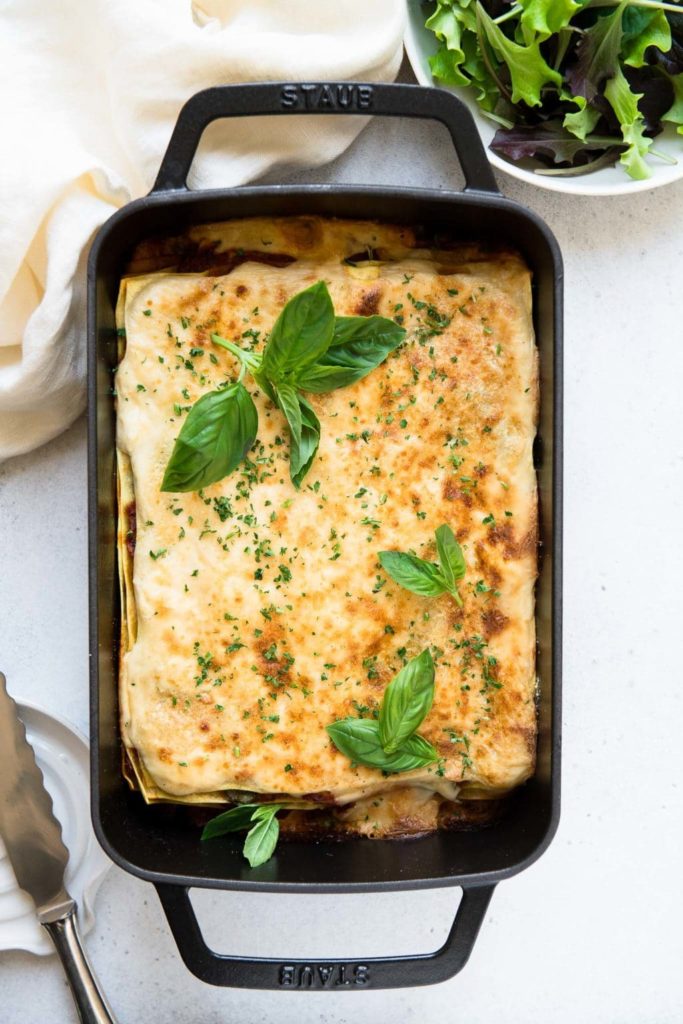
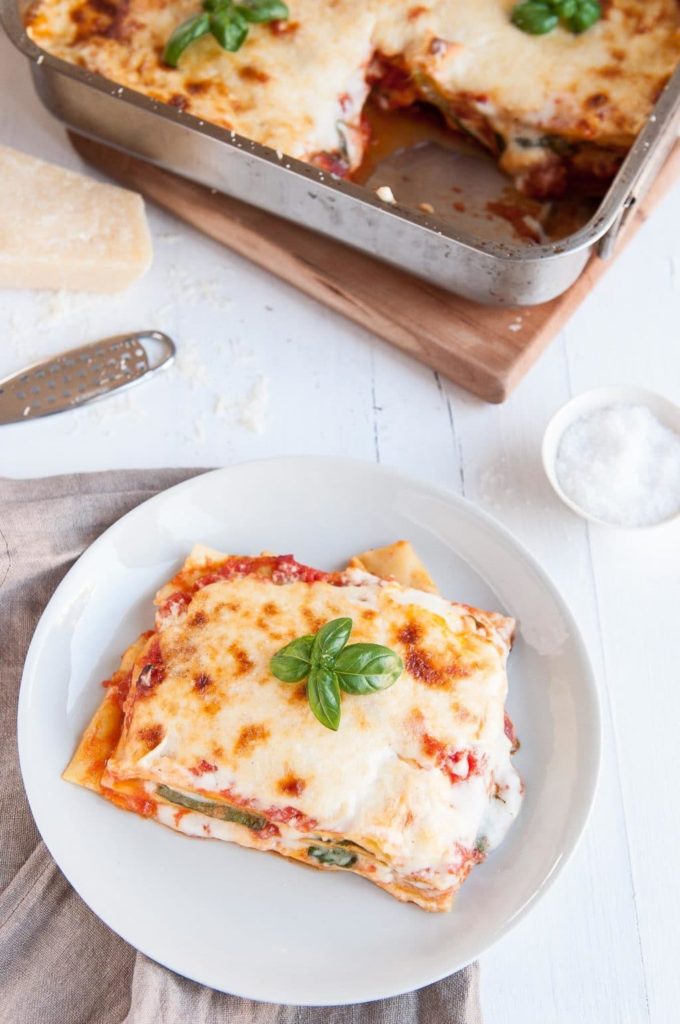
I prefer to use fresh lasagna sheets where possible, mainly because I like my pasta to be on the soft side (see photo below from 2012!) and I find that dried pasta sheets are always too firm after baking, even if I have taken steps to ensure that the sauce is as runny as possible.
To that end, I also pre-cook my fresh lasagna sheets in boiling water to get the cooking process started, thereby ensuring that the pasta will be to my liking come time to serve.
But if you prefer a more firm lasagna which can hold its shape upon serving, then I would recommend using dried lasagna sheets.
Although, when using dried lasagna sheets, I still recommend soaking them in hot water (from the tap) to help them to cook and soften. Some brands even require you to cook the dried lasagna sheets first, so check the packet instructions.
Variations
I quite like this Spinach Lasagna with just the Tomato Pasta Sauce and Béchamel Sauce, but you can sneak in a few more veges to make it more substantial.
- I love to add thickly sliced courgettes (zucchini) with the spinach.
- Thinly sliced aubergines (eggplants) also work well.
- When pumpkins are in season, layer thin slices of pumpkin (about 2 mm thick) with the spinach.
- If you have leftover ham at Christmas, Iayer thin slices of ham with or without the spinach.
Spinach Lasagna

Ingredients
For the Tomato Pasta Sauce
- 1 tablespoon olive oil
- 1 small onion, finely chopped
- 2 garlic cloves, finely chopped
- 800 g (28 oz) canned diced tomatoes
- 1-2 teaspoons sugar
- 1 teaspoon sea salt, plus more to taste
- black pepper, freshly cracked
- parsley, finely chopped
- basil, finely chopped
For the Béchamel Sauce (white sauce)
- 120 g (1 stick plus 1 tablespoon) unsalted butter
- 80 g (½ cup) plain flour, (all-purpose flour)
- 1 chicken stock cube, or vegetable stock cube, optional
- 1 litres (4 cups) milk
- 1 bay leaf
- nutmeg, freshly grated
To Assemble the Spinach Lasagna
- 250 g (9 oz) fresh lasagna sheets, see Kitchen Notes
- 80 g (3 oz) parmesan, freshly grated
- 100 g (3 ½ oz) baby spinach leaves, washed and drained
Instructions
For the Tomato Pasta Sauce (For step-by-step photos, please see my recipe for Tomato Pasta Sauce)
- Pour the oil into a medium-sized skillet or saucepan.
- Add the onion and garlic to the cold oil, together with a sprinkle of sea salt.
- Sauté over medium-high heat until the onion and garlic have softened.
- Add the canned tomatoes, together with the sugar, salt and some pepper to taste.
- Simmer the mixture over low-medium heat for about 20 minutes.
- Stir the mixture frequently, and use a wooden spoon to help break down the tomatoes.
- If the mixture has thickened too much, thin it with some boiling water. The tomato sauce needs to be slightly runny as the lasagna sheets will soak up some of the liquid during the baking time.
- Taste for seasoning. Depending on the acidity of your canned tomatoes, you might need to add some more sugar.
- Stir through the chopped herbs, and reserve some herbs for garnishing.
For the Béchamel Sauce (white sauce) (For step-by-step photos, please see my recipe for Béchamel Sauce)
- Melt the butter in a medium-sized saucepan.
- Sprinkle in the flour and stock cube (if using).
- Stir the mixture with a wooden spoon and cook for 1-2 minutes until it browns a little in colour.
- Slowly whisk in the milk and keep whisking until there are no lumps.
- Add the bay leaf.
- Use a wooden spoon to stir the sauce frequently over medium-high heat until the sauce is thick and smooth.
- Take the sauce of the heat and generously grate in some fresh nutmeg.
- Taste for seasoning.
- The sauce will continue to thicken as it cools.
- If you need to thin the Béchamel sauce, simply whisk in some milk until you have the right consistency.
To Assemble the Spinach Lasagna
- Preheat the oven to 180°C (350°F) (without fan).
- Bring a large pan of water to the boil and then add about 1 tablespoon of sea salt.
- Cook the lasagna sheets according to the packet instructions (about 2 minutes per sheet). I tend to cook enough lasagna sheets to form one layer at a time, and while I am assembling the dish, I cook the next batch of lasagna sheets.
- In a baking dish approximately 18 cm x 25 cm (7 inch x 9 inch), spoon a thin layer of tomato sauce on the bottom of the dish.
- Place the lasagna sheet on top.
- Spread another thin layer of tomato sauce on top of the lasagna sheet.
- Scatter over a layer of fresh baby spinach leaves.
- Drizzle over some Béchamel sauce. The Béchamel sauce does not need to completely cover the layer.
- Sprinkle over some grated parmesan.
- Repeat Steps 5 to 9 until all lasagna sheets have been used. For the lasagna dish in the photos above, I used 6 sheets of lasagna.
- I reserve most of the Béchamel sauce for the top layer so that the dish is generously coated in the white sauce.
- Sprinkle the final layer of Béchamel sauce generously with grated parmesan.
- Bake for about 40-45 minutes until the cheese is golden brown and the sauce is bubbling.
Kitchen Notes
- SOFT VS FIRM LASAGNA
If you like a soft lasagna like that pictured in the photos above, I recommend using fresh lasagna sheets as per the recipe. But if you prefer a firm lasagna which can hold its shape upon serving, I would recommend using dried lasagna sheets. I recommend soaking them in hot water (from the tap) for about 20 minutes, but some brands require you to cook them before using, so please check the packet instructions. - MAKE IT VEGETARIAN
Omit the chicken stock cube from the béchamel sauce and use either vegetable stock instead, or leave out the stock cube completely. I add it for a small punch of flavour to the dish, but you could instead sneak in more flavour by adding more parmesan cheese between the layers. - VARIATIONS
This is a very versatile recipe where you can use other vegetables in addition to, or instead of, the spinach. I often make this lasagna with thinly sliced courgettes (zucchini) and/or aubergine (eggplant). This lasagna is also delicious with slices of ham in between the layers. - OVEN & STOVE TEMPERATURES
All recipes on this website have been tested on an induction stove and/or with a conventional oven (i.e. an oven without fan). All recipes on this website use temperatures for a conventional oven, unless otherwise mentioned. Convection ovens (i.e. fan-forced ovens) are typically 20°C/70°F hotter than conventional ovens, but please check your manufacturer’s handbook. - CONVERSIONS
To convert from cups to grams, and vice-versa, please see this handy Conversion Chart for Basic Ingredients.
Did you make this recipe?
Please leave a comment below and share your photos by tagging @eatlittlebird on social media and using #eatlittlebirdUpdate
This recipe was first published on 27 May 2012. It has been updated with more comprehensive recipe notes.


That looks so delicious! When I make lasagne it never looks as pretty at this 🙂 I have to admit I usually go for the classic minced beef, but there is a recipe with little herby meatballs I want to try 🙂
I also love lasagne with a meat sauce, but little meatballs sound delicious!! I might give that a go next time 🙂 Thanks for the idea!
How do you do it? You even make the messiest of dishes, i.e: LASAGNA!!! look neat!?! Love the look and sound of this. Love the post and gorgeous photos as always! S x
LOL!! Oh gosh, I don’t want to come across as a neat freak but is it that obvious, LOL?! 😉 Let’s just say that the plate doesn’t look so neat once you tuck in 🙂 Am having leftovers right now – yum!!
perfect dish!! lovely photos too, the white background is stunning.
Thank you! 🙂
Love this! It sounds soooo delicious!
Thanks, Katrina!
That’s perfect lasagne according to me..Will be real pleasure to have with the subtle spices..Classic clicks.
Thanks, Melange! This lasagne is indeed a simple one with subtle, but good, flavours.
I am yet to make a lasagne from scratch and this is where I think I will start. It is so lovely and light and I love your step by step photos. Beautiful!
Making a lasagne from scratch can seem daunting, but it’s actually not complicated; it just requires a bit of time to prepare the different sauces and then assemble everything together. This lasagne is fairly quick because the tomato sauce is quite simple and doesn’t need as much time to cook as a meat sauce. I hope you will give it a try!
These lasagne seems to be so italia, I love the colours!!!
Have a nice week
Ah yes! I didn’t think about the colours at first, but now that you mention it, it is very Italia 🙂 Something only an Italian would notice 😉
Cute photos!! I love so much light and color!! I mean, I’m green with envy!! 😛
It’s so nice to see a simple dish like a lasagna with a presence so appealing! And now, some months ago I discovered that I love changing lasagna filling (or is it stuffing??). For the moment Portobello mushrooms and pumpkin is my favorite, but I must try this!! One of my favourite pizzas in a lasagna!! Including garlic and basil, it must be perfect!!
Wow, I’m going to look like a groupie, but even if just recently met your blog, I’m in love with all the food!! You know what to eat!! 😛
Oh, you are so sweet, Paula! 🙂 A filling with Portobello mushrooms and pumpkin sounds delicious! I particularly love pumpkin lasagnas but, strangely enough, have never made one at home. Must rectify that soon!
This looks light and sensational. I used to make a wicked, chunky vegetable lasagne when i was vegetarian – usually concocted from whatever veggies were in the fridge. I loved the bite of cauliflower florets in there, sliced leeks, and wedges of potato. These days i stick to the traditional minced beef filling. I make a huge lasagne, cook it, and portion it out into containers that go in the freezer. There’s nothing better than coming home from work and just having to heat one of those little babies up!
I know how productive you have been in organising your freezer so I can only imagine the wonderful treats you have stored away! I also love the idea of squirrelling some lasagna portions away in the freezer but, unfortunately, we have a teeny, tiny icebox for a freezer. I do love a traditional minced beef filling as well which makes for a very substantial meal. But I love your idea of adding cauliflower florets – I think that could work really well with this vegetarian version 🙂
What a beautiful lasagna Thanh, and I agree with Sam-I-Am, how do you make something as messy as lasagna so neat!! You are amazing!
My favourite lasagna filling is mushroom. I love its earthy flavour.
LOL!! I think I have only become neater with my food presentation since I started taking photos for this blog. I was conscious of how sloppy the lasagna might be because I like my lasagna pasta to be on the soft side. I know many like a more firm-standing lasagna so I was lucky that mine didn’t run everywhere and look like a flat pancake!
I also love mushrooms in my lasagnas, both meat and vegetarian versions. In fact, I’m known to overload my pasta dishses with mushrooms to the point that hubby one day commented that it must be my favourite vegetable – and he was right 🙂
I love those stage-by-stage photos, Thanh ! I must admit I’ve more or less given up on making lasagna because of the pre-cooking of pasta. Do you pre-cook your pasta sheets one at a time ? I’ve never managed to find a way to stop them sticking together if I do more. Like you, I tried the “no pre-cook” method but never found it entirely satisfactory.
Thanks, Liz! I admit that pre-cooking the lasagna sheets do add a bit of time to the whole process – it’s not complicated, just fiddly. I only cook enough lasagna sheets for one layer at a time, so as soon as I have put the lasagna sheets in the baking dish, I put the next batch of lasagna sheets in the boiling water to cook while I am arranging the layer with the sauces. The fresh lasagna sheets I use require about 3 minutes of pre-cooking, which is just enough time for me to tend to the sauces. But sometimes, because 3 minutes is not a lot of time, I just cook the lasagna sheets once I am done with a layer. Hopefully you will give lasagna another try one day 🙂
Nigella has a great recipe in Feast for Rigatoni al forno, where you essentially prepare a meat sauce and béchamel sauce, but instead of making a lasagne, she uses rigatoni and mixes the two sauces together before popping everything in the oven. The end dish tastes very much like a lasagna but without all of the fuss. I’ve made it a few times and absolutely love it 🙂
Almost summer here…But I believe lasagne is great whatever season, right? I love the spinach in this recipe and since it is covered with yummy tomato sauce and cheese and creamy sauce, I am sure my little girl wont be frowning at her veggies. Thanks a lot!
Absolutely – lasagne is great in any season 🙂 I think this dish is very kid-friendly as the flavours are quite simple and not too overpowering. Lasagnas are also great for sneaking in veges between the layers, for both kids and adults alike!
Oh my word I am so glad to have stumbled upon your delicious & dreamy blog. Love all your recipes & amazing photography.
xo
Thanks, Ally! That means a lot to me 🙂 Hope to see you here more often!
What a beautiful tray bake! Every frame in this post calls out to me. I think this has to be tried out. I am bookmarking this.
I’m glad you enjoyed this post 🙂 *And* it’s vegetarian! I do hope you will try it.
This is my first visit to your blog Thanh, truthfully I am hooked, your photos are truly amazing.
Thank you for the the visit and commenting to my blog, I will surely would love to come back here very often and check out whats your new recipe.
Have a nice day and Happy cooking Thanh
Ira, lovely to see you here! And what a wonderful compliment from a talented blogger as yourself! I look forward to “seeing” you more often 🙂
Ohh this looks fantastic! 😀 I’ve always been a fan of spinach and it’s such a great idea to incorporate it into lasagne.
I’m so happy that I stumbled onto your blog! I’ve only just started getting into cooking/baking so I’m trawling the internet for great sites on cooking. XD Will definitely be back!
It’s pretty easy to sneak vegetables into lasagnes and spinach would have to be one of my favourites. Someone recently adapted my recipe and used roasted pumpkin which I would love to try next. Enjoy your forays into cooking and baking and I hope you will find some more inspiration here.
oh Droooooooool!!!! Lasagne has to rate as one of my all time favourite comfort eats, even if I suck at making them! I like a fairly ‘firm’ lasagne, not swimming and sliding around in tomato sauce or worse, cheese. This looks so light and delicious. Fabulous photos and my favourite is the tri-collage construction of the lasagne.
Ah, I like my lasagne to be on the sloppy side 😉 This is mostly because I like my lasagne sheets to be soft and I like there to be a decent amount of sauce, especially white sauce. Having said that, I have eaten some really good firm lasagnes and that is usually on the rare occasion when the meat sauce has been really flavoursome and not too meaty. You know my thing with minced meat 😉
LOL indeed I do! We tend to be more opposites don’t we? Makes things interesting 🙂
Is that just fresh parmesan cheese on top or did you top it off with some mozzarella?
Looks amazing and am trying to make it. Thank you.
Hi Kelly,
Yes, it’s just parmesan cheese which I grated on top of the lasagne. The béchamel sauce makes everything a bit creamy so you don’t really need the mozzarella. But you could, of course, replace the béchamel sauce with some thick slices of mozzarella or a generous sprinkle of grated mozzarella – this is what I do sometimes for a really quick lasagne. Good luck!
I just pinned this. Hmm on my list of things to cook.
I would love to know what you think once you get around to making this recipe! It’s a very simple lasagne and you could very easily add other ingredients to it. Enjoy!
I just came across your blog, and I would love to try this recipe! Yum! 🙂 I’m looking forward to browsing through your blog.
Have a good Sunday!
Enjoy and I hope you will find some more recipes to try 🙂
I scoured the internet searching for a good-looking, easy fresh baby spinach lasagna, and voila! I’m making this tonight, thank you so much.
I hope you will enjoy this recipe!
What could be better? It looks incredible! I like this! So yummy! I definitely want to try! Thank you!
Absolutely delish!
I blended the tomato sauce (teenager!) and chucked more spinach in because I bought a bigger bag. Simple and flavourful. A big hit.