by
by 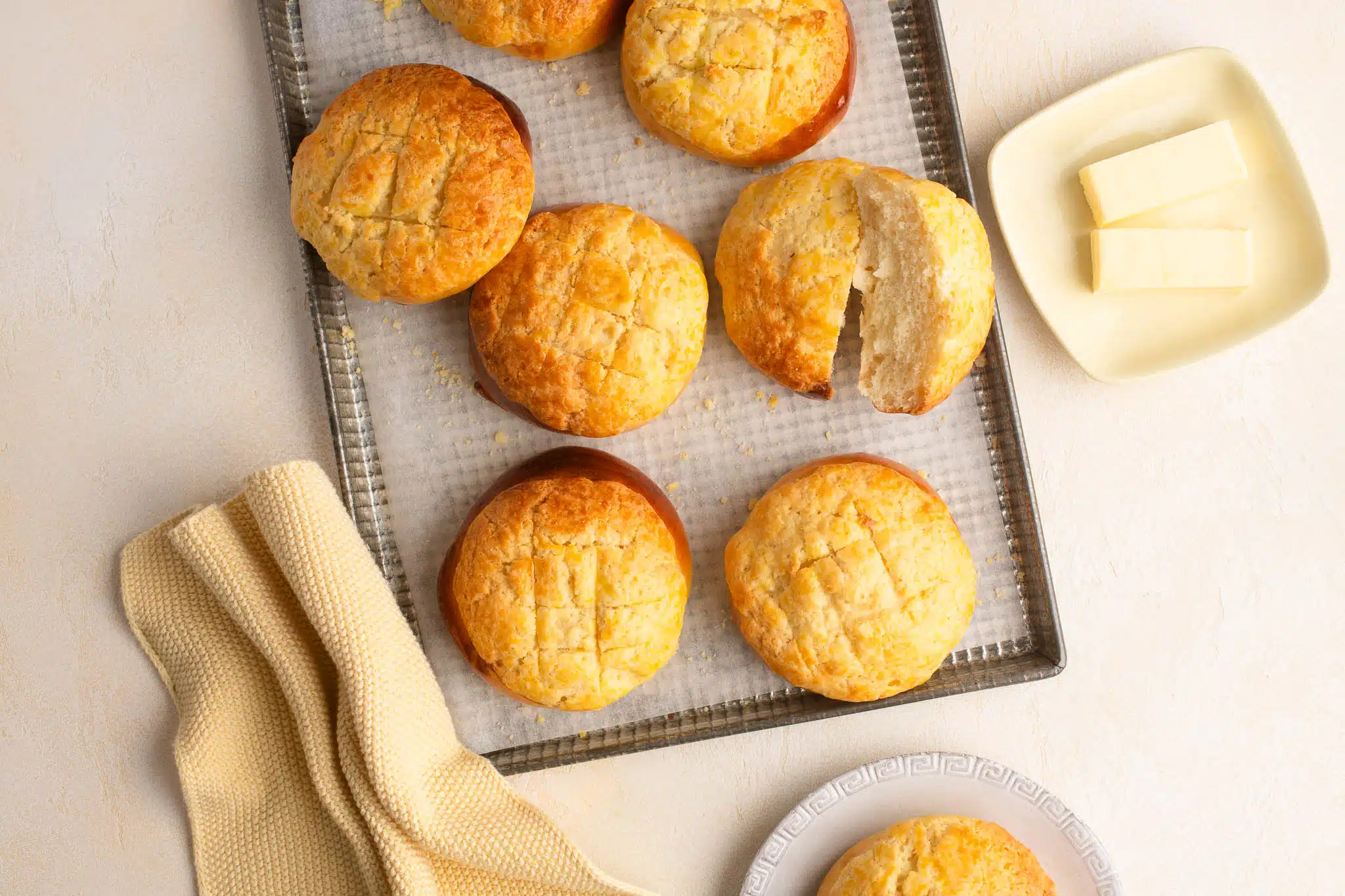
Pineapple Buns
A delicious treat which I discovered many years ago in a Hong Kong bakery were Pineapple Buns. At the time, I had no idea what they were called (the bakery only had signs in Chinese), and whether they were meant to be sweet or savoury. I settled on them being a sweet bun. But a few days later, a friend took me to lunch at Cheung Hing Coffee Shop where I ordered a fried egg and spam roll and which, to my surprise, was served in a Pineapple Bun. I was in heaven!
Like many Chinese bakery treats, Pineapple Buns are delicious alongside a milky coffee at breakfast, or as part of a light meal throughout the day. They taste best when they are fresh from the oven, and even better when they are homemade ????
What are Pineapple Buns?
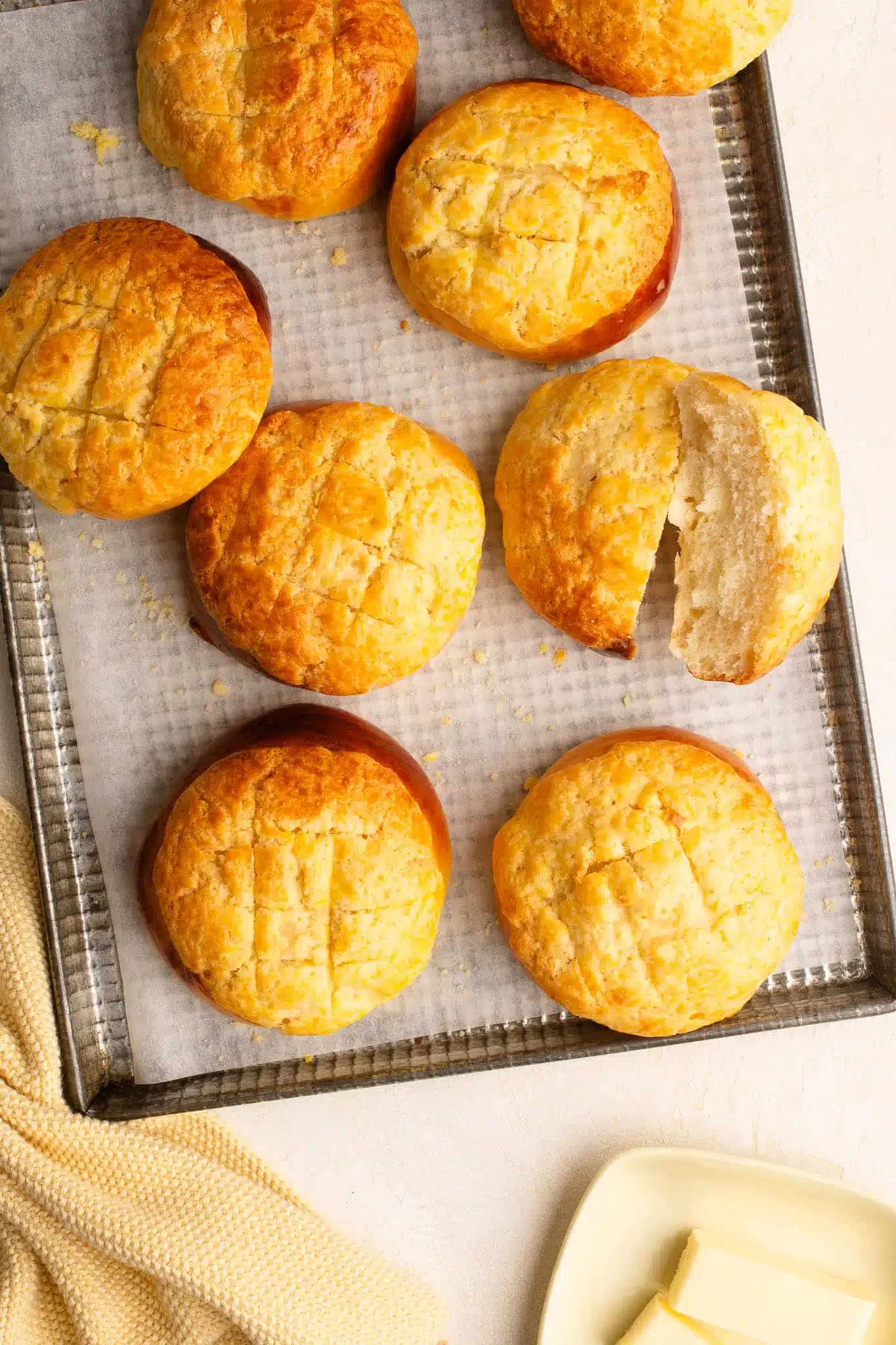
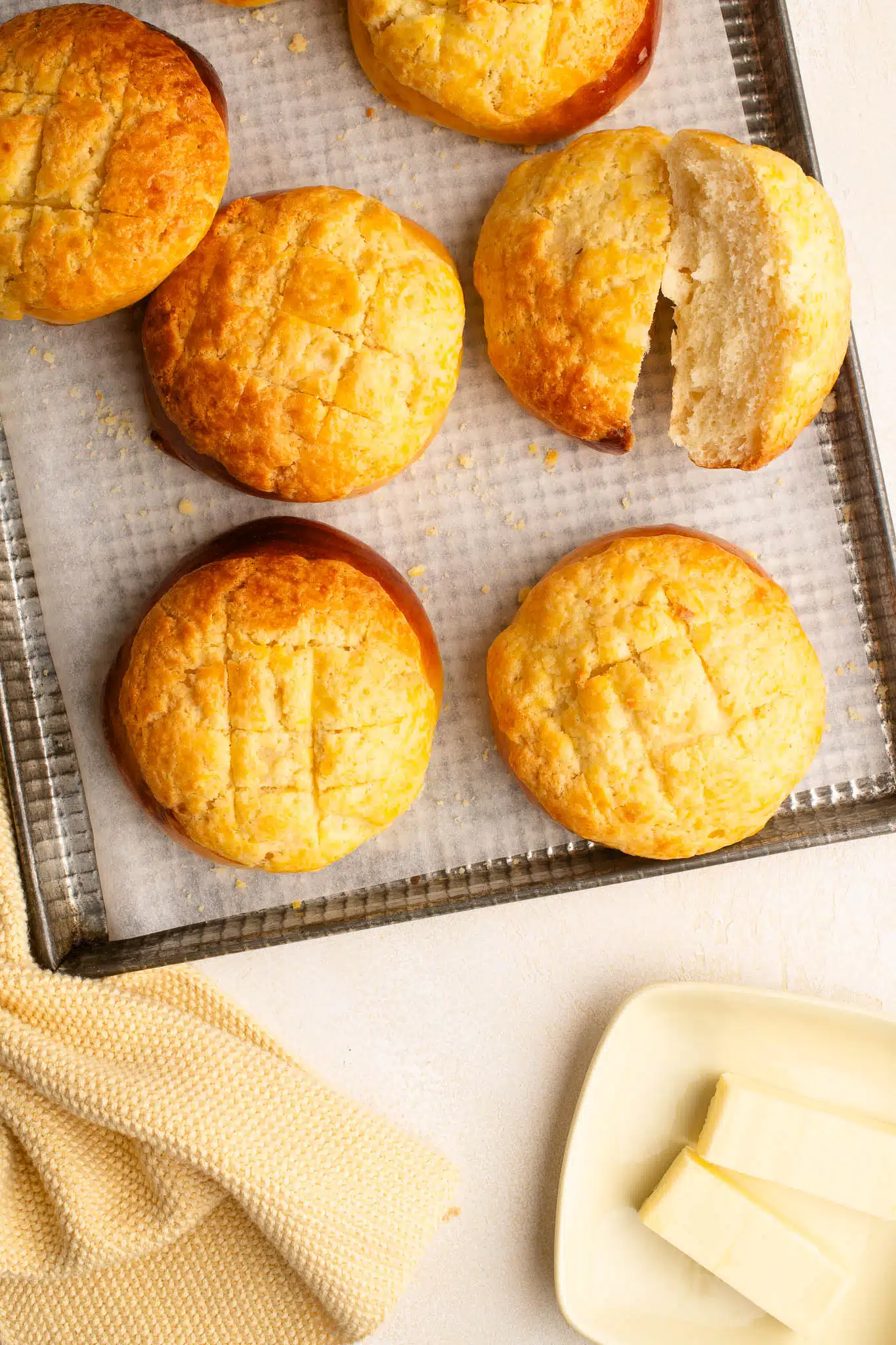
Pineapple Buns are Chinese-style milk buns with a sweet and crispy cookie topping which “cracks” upon baking to give the buns the appearance of pineapples (if you use your imagination ????). Contrary to its name, they don’t contain any pineapple at all.
What is unique about a Pineapple Bun is the textural combination of a soft chewy bun with a crispy cookie layer.
The Japanese have a similar version called Melon Pan, which they also make in varying flavours, such as matcha, chocolate, or even filled with a vanilla custard.

Where to Buy Pineapple Buns
If you are lucky enough to have a Chinese bakery in your neighbourhood, try to buy your Pineapple Buns on the day they are baked, which is when the cookie topping is really crispy. As Pineapple Buns can keep for several days, many bakeries package them individually in plastic bags to help keep them fresher for longer.
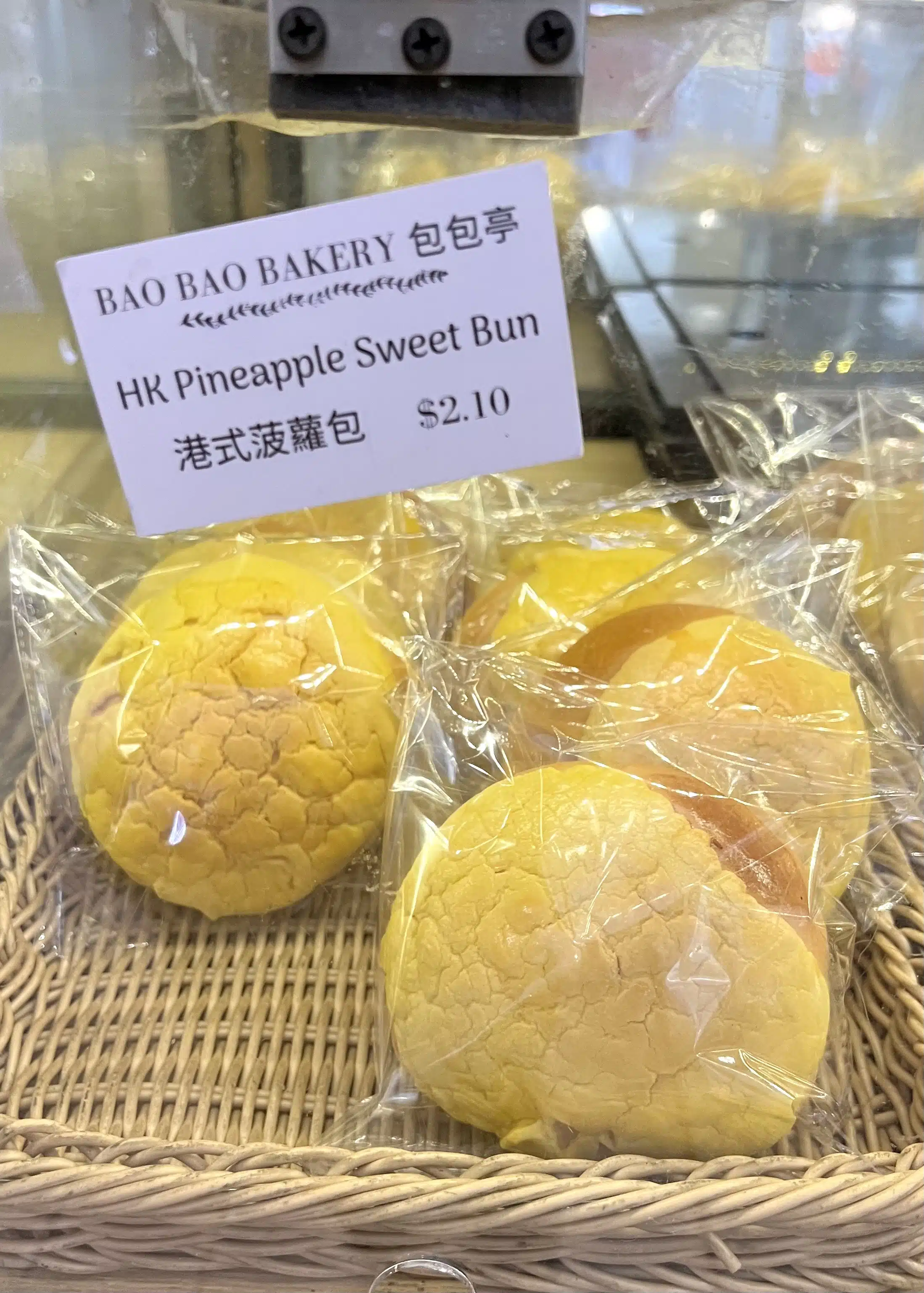
On a recent trip to Boston, we came across Bao Bao Bakery & Cafe and I couldn’t resist popping in to see what delicious treats I could buy for afternoon tea. I was happy to grab some of the Pineapple Buns, as well as their very delicious Egg Custard Tarts.
Sadly, there is no Chinese bakery in Zurich, but we are very lucky to have a few local Japanese bakeries, and Hiro Takahashi make delicious Melon Pan in different flavours.
Recipe for Pineapple Buns
My recipe for Pineapple Buns uses my recipe for Japanese Milk Buns, which I portion into 12 buns.
For the cookie topping, I find it easiest to make the cookie topping far in advance and to keep it chilled in the freezer. The cookie itself is a soft and buttery dough which spreads and cracks upon baking. Once the cookie dough is frozen, it is easier to slice and also easier to place on the buns just before baking.
To help the buns achieve the pineapple look, you can score a crosshatch pattern onto each cookie slice before placing them onto the buns. I happen to not mind the “natural” look and usually leave the cookie slices as they are. Even when you score them in advance, sometimes the lines don’t really show after baking.
How to Make Pineapple Buns
Make the Cookie Topping
Start by making the cookie topping, as it needs time to firm up in the fridge or freezer. If you follow my steps below to make the bread dough the night before, I would also recommend making the cookie dough the night before.
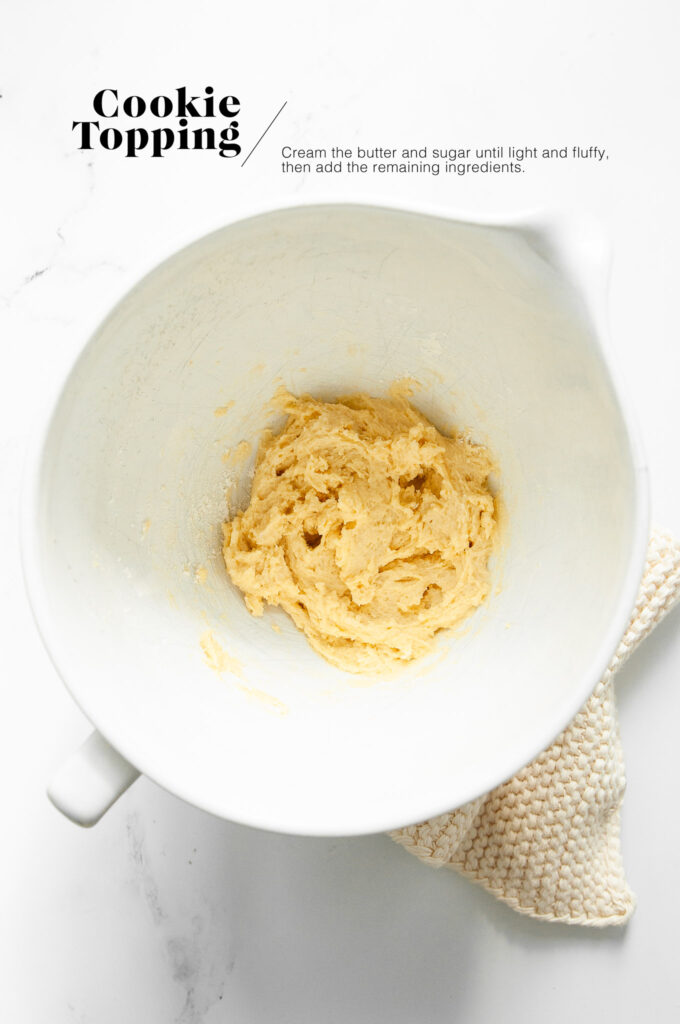
Cream the butter and sugar together until it is light and fluffy. I use an electric stand mixer for this task. Then add the remaining ingredients and beat until you have a soft and smooth dough.
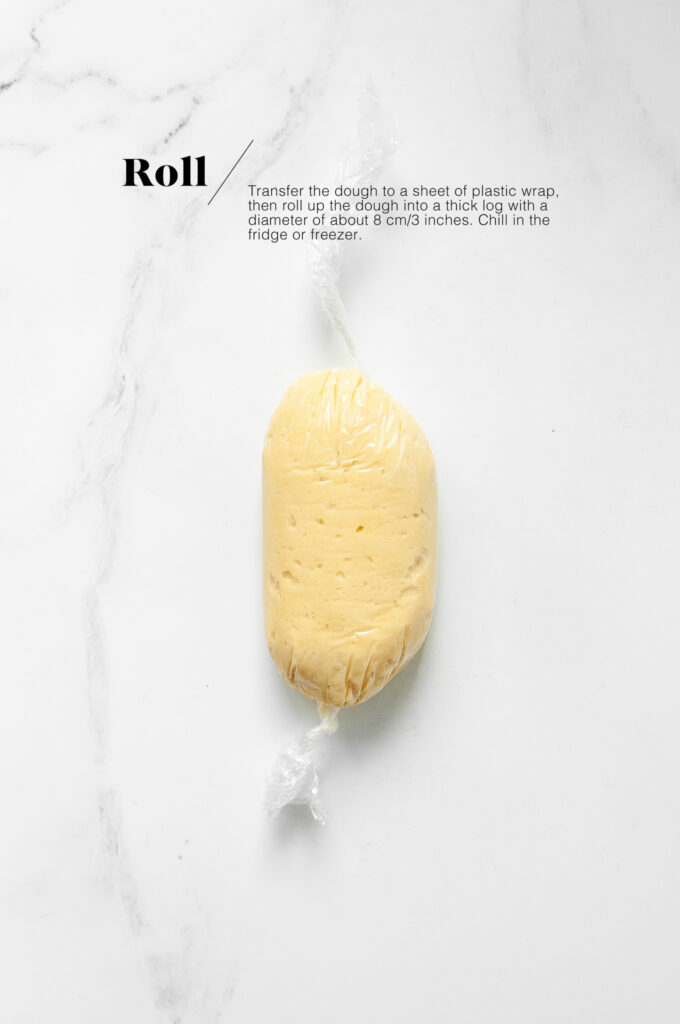
Transfer the dough to a sheet of plastic wrap, roll up the dough and secure both ends. Tighten the roll as you do so to create a fat log of dough about 8 cm/3 inches in diameter.
Place the log of dough into the fridge or freezer to firm completely.
Make the Milk Buns
Step 1
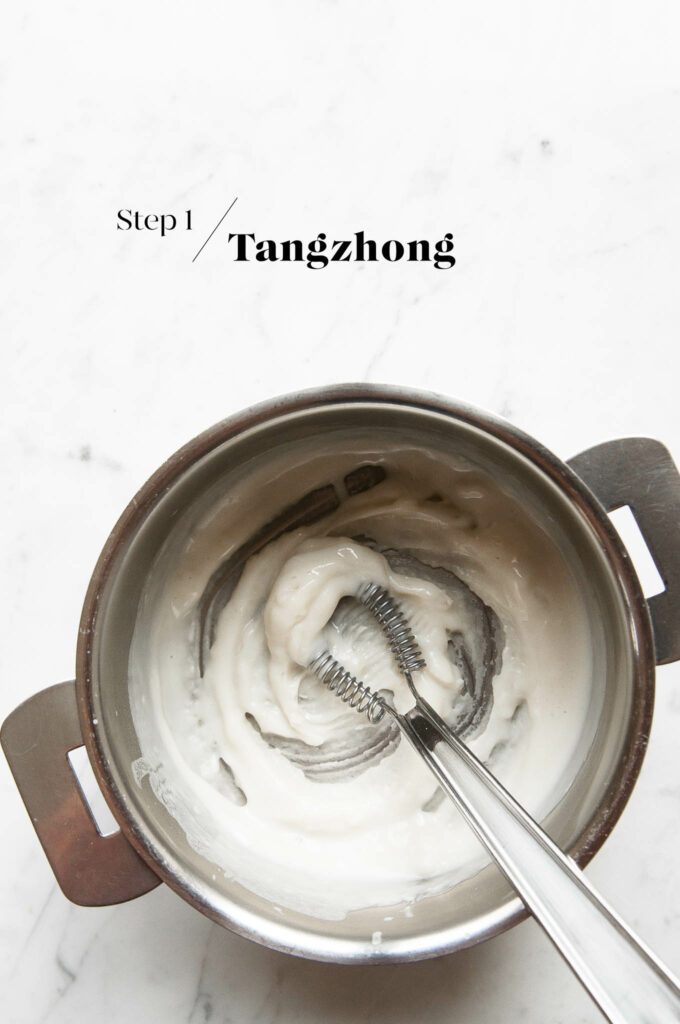
Make the Tangzhong by whisking together the ingredients in a small saucepan. Place the saucepan over low heat, and continue whisking until the mixture forms a thick paste. You want a thick enough consistency so that, as you whisk the mixture, the whisk leaves lines which do not move.
Scrape the Tangzhong into a small bowl and set it aside to cool. Once cooled, cover the bowl with clingfilm and place it in the fridge overnight.
If you are in a hurry, you can use the Tangzhong as soon as it has cooled to room temperature. But leaving the Tangzhong overnight allows it to develop more flavour.
Step 2
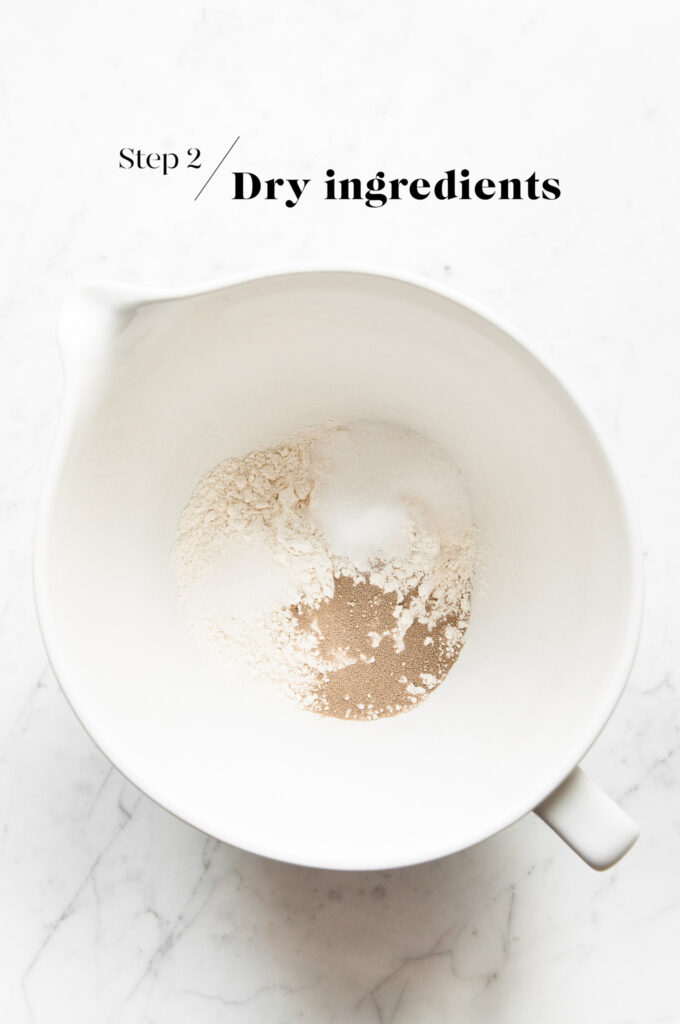
Measure the flour, yeast, salt and sugar into the bowl of an electric stand mixer. Lightly mix the ingredients together.
Step 3
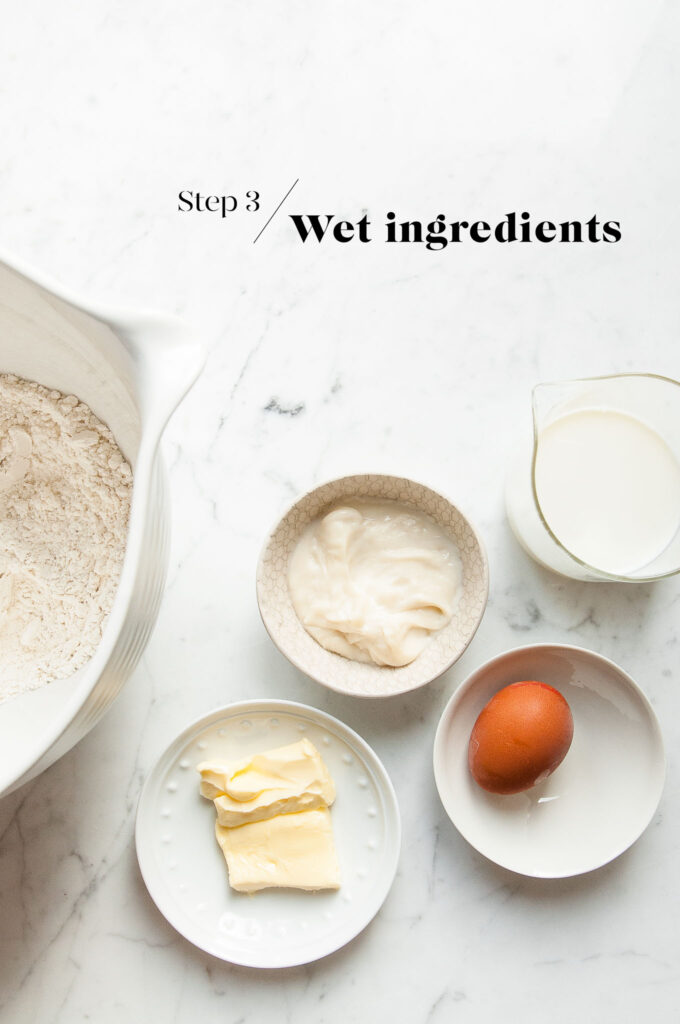
Add the Tangzhong. Use the dough hook to start to incorporate everything together. Slowly add the milk until a sticky dough starts to form. Then add the butter, one tablespoon at a time.
Step 4
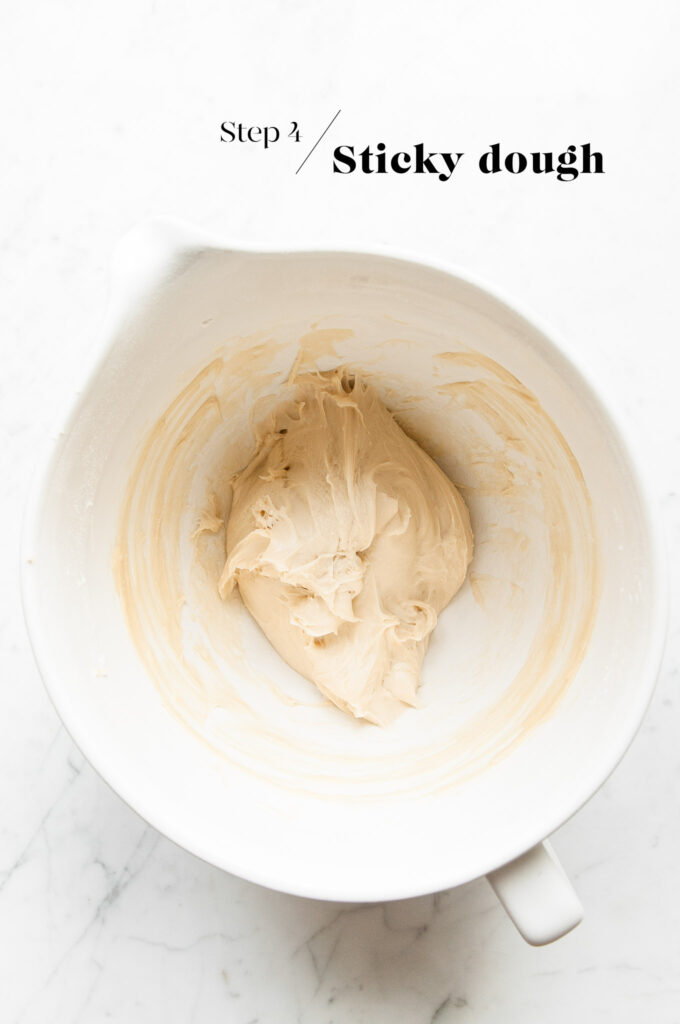
Knead the dough on medium speed for 10-15 minutes until you have a dough which passes the windowpane test.
To perform the “windowpane test”, pinch off a small piece of dough, roll it into a ball and use your hands to gently stretch the dough. If the dough can stretch to form a thin sheet and be almost translucent so that you can see the light through it, your dough has passed the “windowpane test”. This means that you have kneaded the dough sufficiently and that the dough is ready to be proofed.
At this stage, the dough will be somewhat sticky and tacky, mostly because of the butter and high liquid content. But the dough should be coming away from the sides of the bowl during the mixing. Once the dough has had its first proofing, it will be less sticky to the touch and easier to handle. If the dough is too sticky and impossible to handle, knead in a tablespoon of flour at a time until the dough is easier to handle.

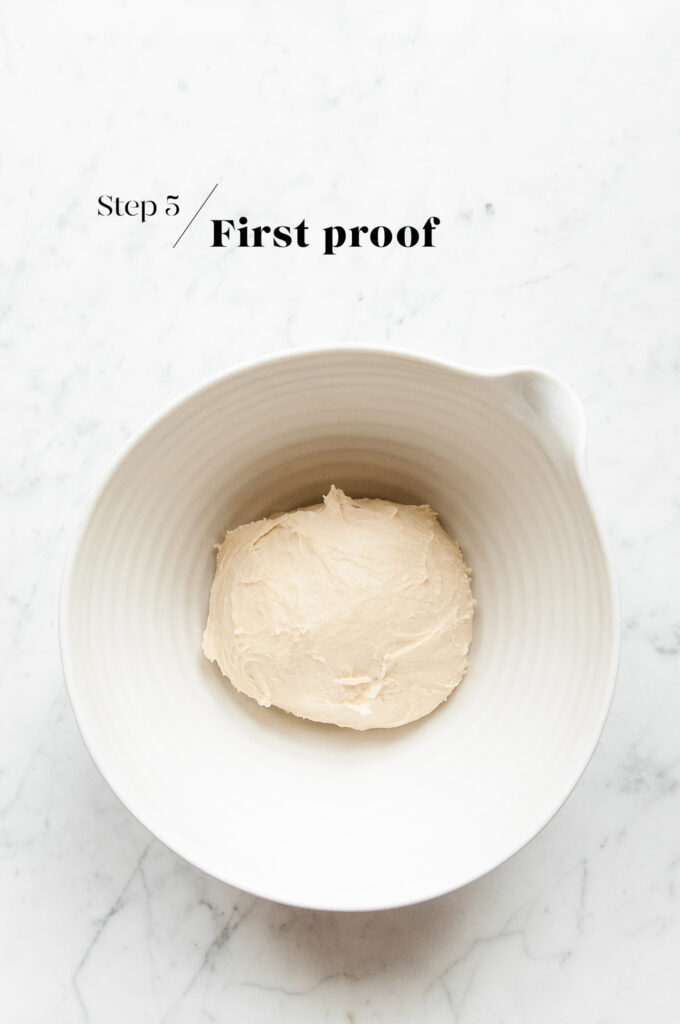
Lightly oil a large mixing bowl. Roll the dough into a smooth-ish ball and place it inside the bowl.
Cover with a clean tea towel, and set it aside somewhere warm for about 1 to 1.5 hours, or until it has doubled in size.
Step 6
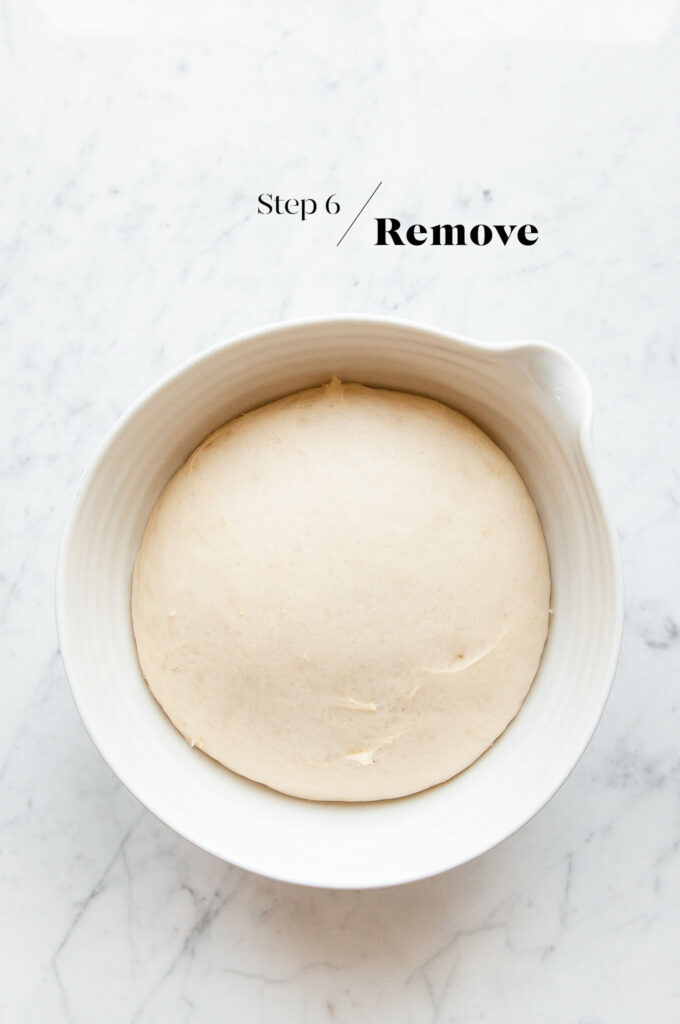
Once the dough has doubled in size, gently remove the dough from the bowl. The dough will deflate as you handle it.
Step 7
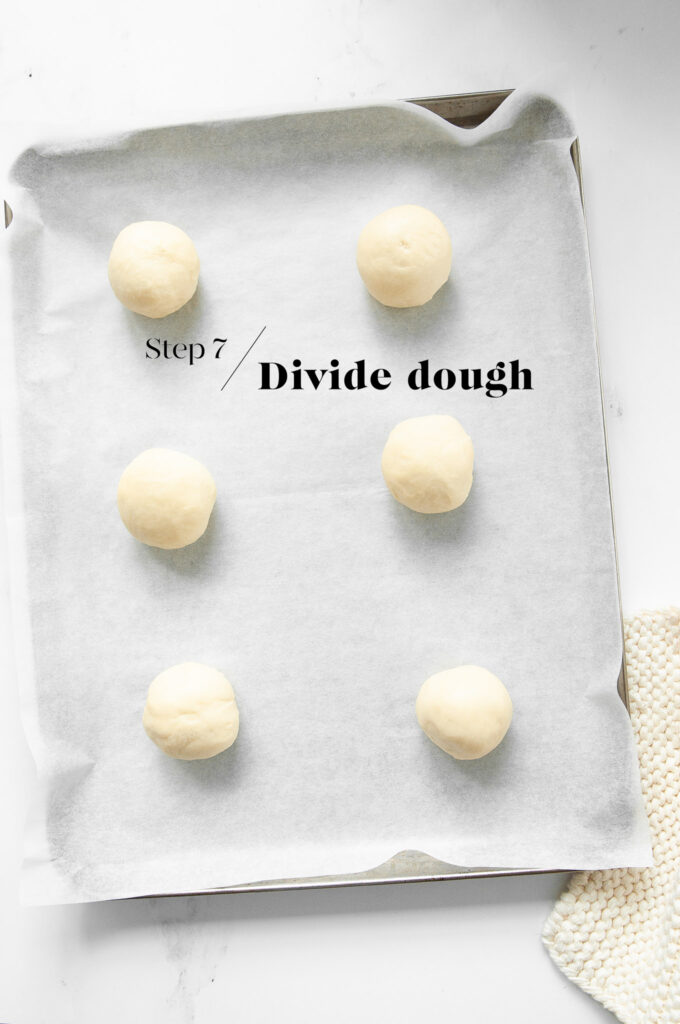
Divide the dough into 12 equal portions (I recommend using a digital kitchen scale). Roll each portion into a smooth ball. You can do this by pinching the seams together to form a ball, and then roll the ball on the kitchen counter while cupping it with your hands to ensure smooth sides all over.
Place the balls of dough onto 2 large baking trays lined with baking paper, spaced well apart.
Place the pan somewhere warm for about 20 minutes, or until the buns have puffed up slightly.
Step 8
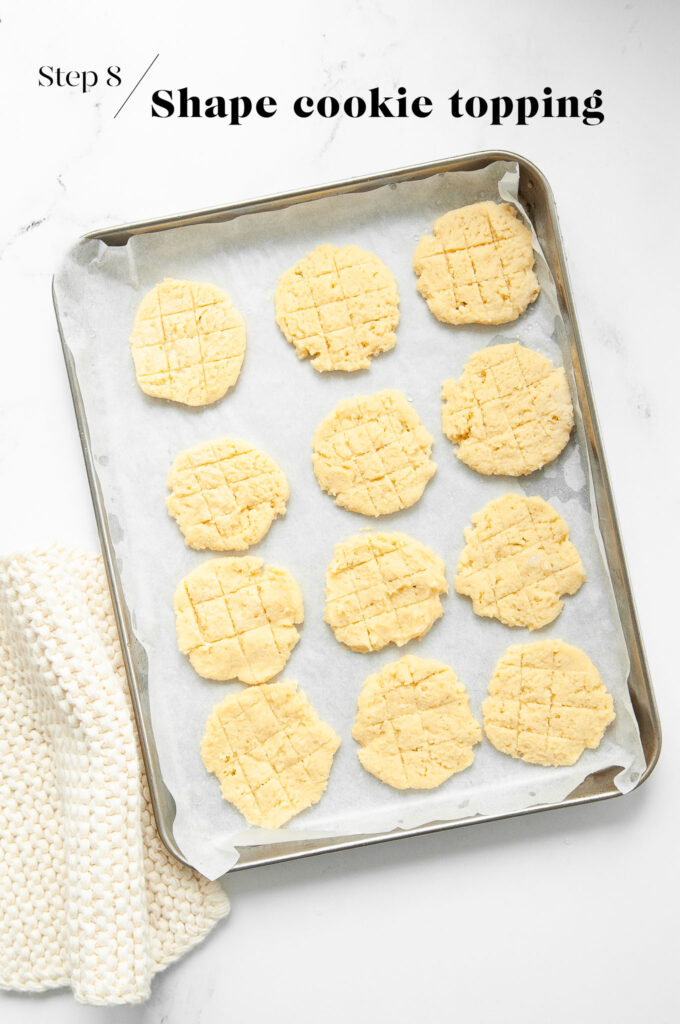
While the buns are proofing the second time, prepare the cookie slices. Remove the log of cookie dough from the fridge or freezer, and cut 12 slices about 0.5 cm thick.
Place each cookie slice on a tray lined with baking paper.
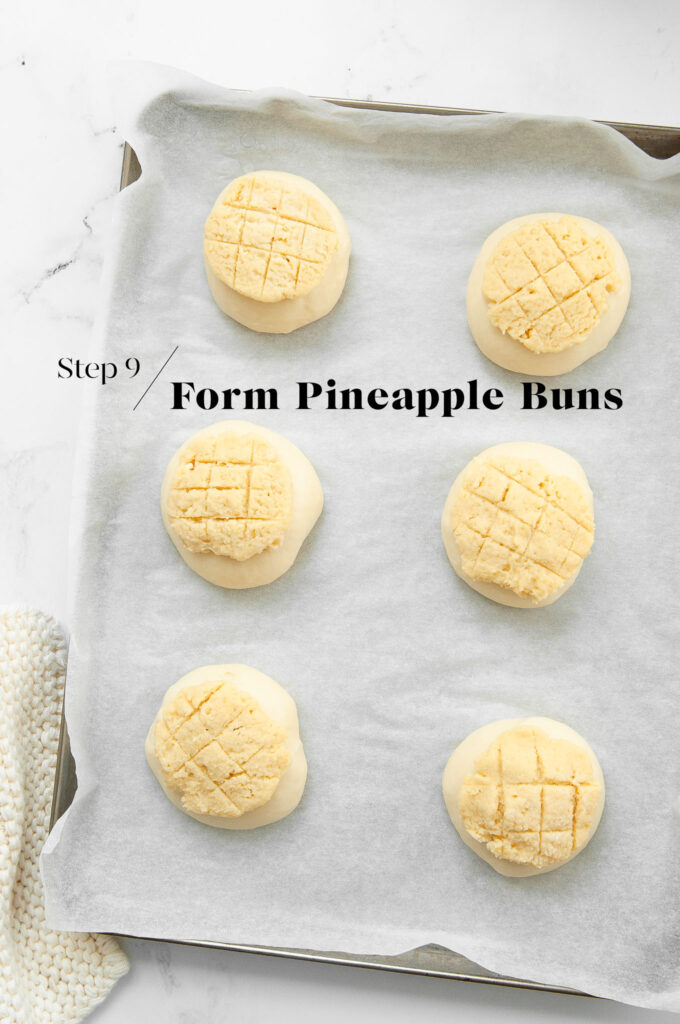
If you want to create the pineapple look on the buns, use the back of a knife or similar to make a crosshatch pattern on each cookie slice.
Ideally, the cookie slices should be cold and firm when you place them onto the buns later, so if they feel a little soft, place the tray back into the fridge or freezer.
Step 9
Once the buns have puffed up nicely, gently place a cookie slice on top of each bun, taking care not to deflate the buns.
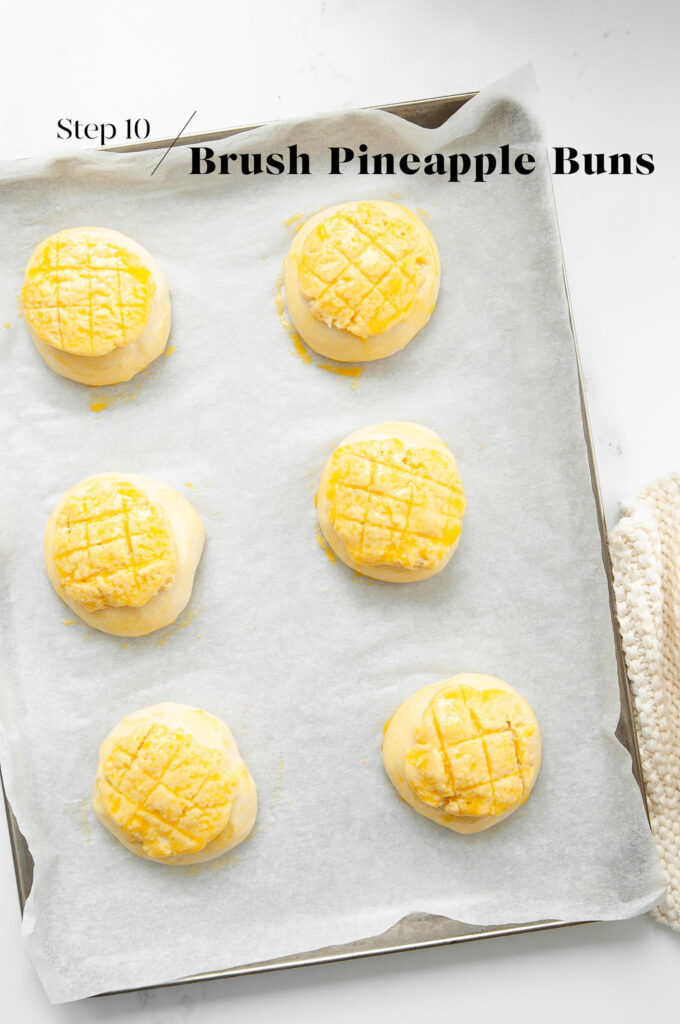
Step 10
Brush the cookie slice, as well as the sides of the buns, with the beaten egg yolk.
Place the tray of buns into an oven preheated to 180°C/356°F (without fan). Bake for about 20 minutes, or until the buns are nicely golden. Start checking the buns at about 10-12 minutes and, if they are browning too quickly, place a sheet of foil over the buns for the remainder of the baking time. The buns are cooked if an internal thermometer reads 85°C/185°F.
How to Eat Pineapple Buns
You can eat Pineapple Buns just as they are, which work great at breakfast or as a snack in the morning or afternoon.
In Hong Kong, it is popular to serve Pineapple Buns with a thick slice of cold butter in the centre which melds into the soft dough. A cup of milky hot tea on the side is also a good idea.
And as I also discovered in Hong Kong, you can serve the Pineapple Buns like you would ordinary buns with a range of savoury fillings. My family enjoy eating these buns with a generous slather of salted butter and some slices of ham or mortadella. However, you would need to be aware that the buns are somewhat sweet, so you would be working with a unique sweet-salty combination.
I think the Pineapple Buns taste the best when they are still warm from the oven, and the cookie topping is nice and crunchy. The topping will stay crunchy on the first day, but it will soften once you start to store the buns, which keep for several days in a ziplock bag.

Tips for Making Bread Dough Ahead of Time
I love baking bread, but I don’t love getting up extra early to get started on the dough. So I typically make the dough the night before and allow it to rise slowly in the fridge overnight. The longer proofing time has the added benefit of allowing the dough to develop more flavour and a better texture. Come the morning, the dough will have at least doubled in size, and it will be ready for shaping as per the recipe.
To make the dough the night before:
- Make the dough as per the recipe.
- Place the dough into a large oiled bowl.
- Cover the bowl with plastic wrap or a reusable bowl cover.
- Place the bowl into the fridge.
- Let the dough rise overnight, or for at least 8-10 hours.
- The next morning, the dough should have at least doubled in size.
- Gently remove the dough from the bowl.
- The dough is ready for shaping and the second proof as per the recipe.
- As the dough will be cold from the fridge, the second proof may take slightly longer.
Tips for Making Pineapple Buns
- Start the night before. When it comes to making bread, I like to start the day or night before, which feels more efficient because the dough can rise while you are sleeping, and the longer rising time also contributes to a better flavour and texture.
- Freeze the cookie dough. In addition to making the dough the night before, I also recommend making the cookie dough in advance, and keeping it in the freezer so that it will be easier to slice and handle.
- Embrace the cracks. Making this type of bread already involves a lot of steps, so eliminate steps which are not necessary, such as creating the crosshatch pattern to achieve a more Instagram-worthy pineapple look. More often than not, I skip this step and nobody notices anyway!
Pineapple Buns

Ingredients
For the Cookie Topping
- 50 g (½ stick) unsalted butter, softened
- 50 g (¼ cup) caster sugar, (superfine sugar)
- 1 egg
- 1 teaspoon vanilla extract
- 100 g (⅔ cups) plain flour, (all-purpose flour)
- ½ teaspoon baking powder
- ¼ teaspoon fine salt
For the Tangzhong
- 14 g (2 tablespoons) white bread flour
- 100 ml (⅓ cup plus 1 tablespoon) milk
For the Japanese Milk Bread Dough
- 350 g (2 ⅓ cups) white bread flour
- 3 g (1 teaspoon) instant dried yeast
- 6 g (1 teaspoon) fine salt
- 55 g (¼ cup) caster sugar, (superfine sugar)
- 1 egg
- 125 ml (½ cup) milk, warmed to 37°C/98°F
- 50 g (½ stick) unsalted butter, softened
For the Eggwash
- 1 egg yolk
- 1 dash water
Instructions
For the Cookie Topping
- Place the butter and sugar in an electric stand mixer with the flat paddle attachment.
- Cream the butter and sugar until it is light and fluffy.
- Add the egg and vanilla.
- Slowly add the dry ingredients.
- Keep beating until all of the ingredients are fully incorporated and you have a soft and smooth dough.
- Transfer the dough to a large sheet of plastic wrap.
- Roll up the dough in the plastic and tighten the ends to produce a fat log of dough about 8 cm in diameter.
- Place the dough to chill in the fridge for 1-2 hours, or until it is completely firm.
For the Tangzhong
- Whisk the ingredients together in a small saucepan.
- Place the saucepan over low heat.
- Keep whisking until the ingredients form a thick paste. The consistency should be thick enough so that as you whisk the mixture, the whisk leaves lines in the mixture which remains.
- Remove the paste to a small bowl, and set it aside to cool down.
To Make the Dough
- Measure the flour, yeast, salt and sugar into the bowl of an electric stand mixer.
- Mix the dry ingredients together using a dough hook.
- Add the egg and the cooled Tangzhong.
- Slowly add the milk until the mixture comes together into a sticky dough.
- Add the butter, one tablespoon at a time. Wait for each tablespoon of butter to be fully incorporated into the dough before adding the next.
- Continue kneading the dough on medium speed for about 10-15 minutes, or until the dough passes the windowpane test. (See Kitchen Notes below). By this stage, the dough should also be coming away from the sides of the bowl.
- Lightly oil a large, clean mixing bowl.
- Roll the dough into a smooth ball and place it into the mixing bowl.
- Cover the dough with a clean tea towel or bowl cover, and place it somewhere warm for about 1.5 hours, or until it has doubled in size.
To Portion the Dough
- Gently remove the dough from the bowl. The dough will deflate as you handle it.
- Divide the dough into 12 equal portions. Use a digital scale for even-sized buns.
- Roll each piece of dough into a smooth ball. I do this by pulling the edges of the dough into the centre, and then pinching those edges together while shaping the dough into a smooth ball as you do so. The pinched edges form the bottom of the buns.
- Line 2 large baking trays with baking paper.
- Place the shaped buns into the lined baking pan, spaced well apart.
Proving the Shaped Dough
- Place the pan somewhere warm, covered with a clean tea towel, for about 30 minutes, or until the buns have almost doubled in size.
To Shape the Cookie Topping
- Remove the cookie dough from the fridge.
- Cut the dough into 12 equal slices, about 0.5 cm thick.
- Place the cookie slices onto a baking tray lined with baking paper.
- You can leave the cookie slices as they are, or you can use the back of a knife or similar to create a crosshatch pattern on each cookie slice. The cookie will crack during baking, but creating a crosshatch pattern in the dough will help to create the pineapple look.
- If the cookie slices feel very soft, you can place the tray back in the fridge or freezer to firm up again.
To Form the Pineapple Buns
- Once the buns have finished proofing, carefully place a cookie slice on top of each bun. Take care not to deflate the buns as you do so.
- Brush the buns all over, including the cookie slices, with the egg wash.
Baking the Pineapple Buns
- Preheat the oven to 180°C/356°F (without fan).
- Place a metal baking tray on the middle shelf.
- Bake the buns for about 20 minutes, or until they are lightly golden. Check the buns at about 10-12 minutes and, if they are browning too quickly, cover the buns with a loose sheet of foil for the remaining baking time.
- The buns are cooked if an internal thermometer reads 85°C/185°F.
- Leave the buns on the pan for about 5 minutes to firm up, before carefully removing the buns to a wire rack to cool completely.
- Serve warm or at room temperature.
Kitchen Notes
- WINDOWPANE TEST
Pinch off a small piece of dough, roll it into a ball and use your hands to gently stretch the dough. If the dough can stretch to form a thin sheet and be almost translucent so that you can see the light through it, your dough has passed the “windowpane test”. This means that you have kneaded the dough sufficiently and that the dough is ready to be proofed. - MAKE AHEAD TIPS
To start the Milk Bread dough the night before:
* Make the dough as per the recipe.
* Place the bowl of dough (covered) in the fridge to proof overnight, or for at least 8 to 10 hours. During this time, it should have at least doubled in size.
* The next day, proceed with the rest of the recipe. As the dough will be cold, it may require a bit more time for the second proofing period. - DIFFERENT TYPES OF FLOUR
For Swiss readers: I use Zopfmehl (or farine pour tresse) when making bread and enriched dough. - DIFFERENT TYPES OF YEAST
* Please note that there is a difference between instant yeast (also called instant dried yeast or fast-action dried yeast) and dried yeast (also called active dry yeast). If you are not sure what type of yeast you have, please check the packaging for instructions on how to use the yeast.
* With instant yeast, you can add it directly to the flour mixture without having to activate it first.
* With dried yeast, you will need to activate it first (usually in some warm liquid). - PROOFING THE DOUGH
Dough needs a warm environment for the yeast to activate and cause the dough to rise. If you don’t have a warm place in your home, try one of the following ideas:
* In the oven with the oven light switched on (works only for some ovens).
* In the oven with a tray of boiling water on the bottom shelf.
* In the oven at a low temperature of about 25-30°C (77-86°F). - OVEN & STOVE TEMPERATURES
All recipes on this website have been tested on an induction stove and/or with a conventional oven (i.e. an oven without fan). All recipes on this website use temperatures for a conventional oven, unless otherwise mentioned. Convection ovens (i.e. fan-forced ovens) are typically 20°C/70°F hotter than conventional ovens, but please check your manufacturer’s handbook. - CONVERSIONS
To convert from cups to grams, and vice-versa, please see this handy Conversion Chart for Basic Ingredients.