

More from The Little Paris Kitchen
 posted by Thanh | Eat, Little Bird on January 16, 2013 (last updated Dec 22, 2016)
Regular readers of my blog will know that I had a love affair with The Little Paris Kitchen in 2012. I loved the TV show, the recipes, Rachel Khoo. Despite having been a consumer of French food since I was a child, I was never as inspired to cook it until Rachel Khoo hit our screens with her fresh take on the old French classics.
Though, that’s not to say that every recipe I have tried has been a success … I had set out to blog about quite a few recipes from her book, only to find that some of them did not turn out so well. But in the hope that my findings might help others, here are a few reviews (please excuse the photos … most were taken just seconds before eating!).
Bacon and Egg Tart (Quiche Lorraine)
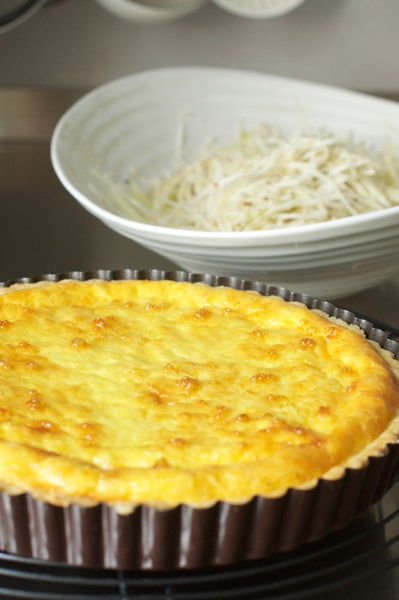
Merely looking at the simple list of ingredients for this recipe would have one guessing that this quiche is quite simple in flavour.
Rachel Khoo is quite strict in her introduction to this recipe, stating that, “Quiche Lorraine should only be pastry, cream, eggs and bacon. No cheese, no onions, nor any extra flavours … A quiche is basically a savoury custard tart. Add bacon and you have quiche Lorraine; add some Gruyère cheese and you have quiche Vosgienne.”
All quiches I have made have always had bacon, cheese, mustard, chives and/or a myriad of other ingredients added. So when attempting Rachel Khoo’s pared down and authentic version of Quiche Lorraine, I expected the end result to not be packed with flavour as my usual recipe.
The pastry was somewhat on the sweet side for me, which is not surprising given that it contains a teaspoon of sugar. But it was, nevertheless, a nice pastry which held up well upon baking.
The quiche itself was enjoyable, but hubby and I both agreed that we have perhaps been corrupted by more flavourful and exotic quiches, even if they were wrongly labelled as Quiche Lorraine. This particular recipe is perhaps a good basic recipe for a quiche from which you can add other ingredients and flavourings, if you wish.
Celeriac and Apple Salad
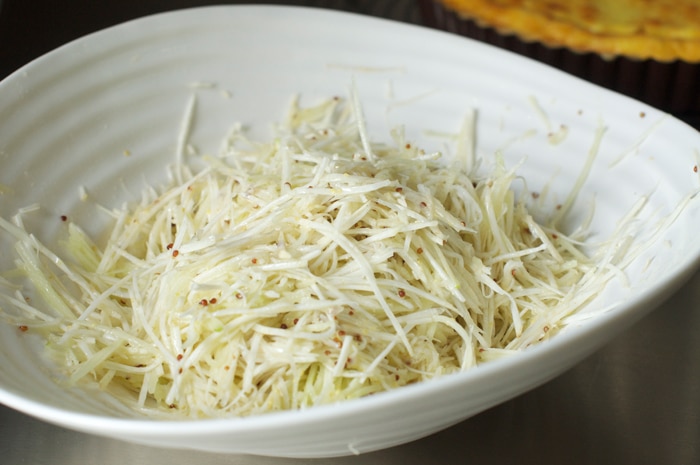
This is a gorgeous salad, and one which I made over and over throughout the summer. I love apples in salad and this one did not disappoint. The tartness of the apple went really well with the earthy flavours of the celeriac, spruced up with a punchy mustard vinaigrette.
This salad lends itself well to picnics as the apples and celeriac can be dressed in advance and will not go soggy like lettuce would.
This recipe is definitely a keeper.
Chocolate Lava Cake with Salted Caramel Filling
Chocolate lava cake, gooey chocolate puddings, chocolate fondants, moelleux au chocolat … whatever you call them, they are a frequent feature in our home.
Salted caramel seems to be all the rage lately and I must confess to being a real salted caramel junkie. And when I discovered that salted caramel was thought to originate from Brittany in France, I was even more excited that I could show an interest in something from the area where my in-laws live.
Alas, none of them had ever tried salted caramel sweets, nor ever made salted caramel at home. In fact, it bemused them to read in my Australian foodie magazines that Brittany was famous for its salted caramel, especially since it is rather hard to come across in the region. Sure, some Breton crêperies serve their dessert crêpes with salted caramel sauce, but such a sauce is not exactly a house specialty (it comes out of a squeeze bottle) and is often listed somewhere at the bottom of the menu.
My mother-in-law made crêpes for dessert one evening and I generously offered to make a salted caramel sauce to serve alongside (using the tin of Lyle’s golden syrup which I had tactfully gifted to her that trip), only to discover that the jar of strawberry jam, and even the bowl of sugar, were more popular accompaniments than my homemade effort. Oh well.
Anyway, I digress … I’m happy to believe that salted caramel originates from somewhere in France, just perhaps not from the area (or street) where my in-laws live (that or they need to get out more ;-)).
So combining my love for salted caramel with chocolate pudding sounded like heaven to me. I was tempted to make my usual gooey chocolate puddings (using a faithful recipe from Nigella) and fill it with my usual salted caramel sauce (another Nigella recipe), but Rachel Khoo made her recipe look simple enough that I was willing to give it a try.
And what a disaster!
The chocolate puddings themselves were straightforward to make. Her salted caramel filling left me cursing.
The recipe instructs one to make a caramel by sprinkling a thin layer of sugar on the bottom of a saucepan, letting it melt before adding more sugar and repeating the process. The goal is to make a caramel until it is “almost a Coca-Cola colour”. I don’t know about the Coca-Cola in your part of the world, but I know Coca-Cola to be dark-brown, verging on black. My instinct told me that a caramel that colour would taste very bitter and, well, burnt. And I was right. It tasted terrible. But maybe once the cream and salt was added, everything would taste better? Not really.
The recipe then instructs one to pour the caramel into a dish and “leave to cool a little”. In the show, Rachel Khoo actually puts the caramel into the fridge, but because I was in recipe-reading-mode, I left it to “cool a little” before proceeding with the rest of the recipe, namely to fill the piping bag with the sauce and to then squirt the sauce into the chocolate puddings.
And against my better judgment, I discovered that filling a piping bag with warm/hot caramel sauce was frightfully messy, if not totally unmanageable. Moreover, as the sauce was still quite warm, it had no intention of being piped into the centre of a cold chocolate pudding; it preferred to swim on top. Not quite the effect I was hoping for. After all of that pfaff in the kitchen, the salted caramel topped chocolate puddings were expectedly quite bitter from the burnt caramel sauce and were not at all what I was wanting to sit down to at dessert.
I am usually a more instinctive cook but was hoping that following Rachel Khoo’s recipe in this instance would teach me some new or different skills in the kitchen. It could totally be a case of me stuffing up this recipe, but I think her recipe could be improved with clearer instructions. First, her method of making caramel from melting just sugar in a hot pan (no water added) is not the easiest way to make caramel and lends itself to a higher risk of being burnt. Second, cooking the caramel until it is “Coca-Cola colour” is perhaps too long a time-frame; I think one should aim for something 10 shades lighter than Coca-Cola, or Nigella’s description of “gold to dark amber”. And third, the caramel should be left to cool completely (possibly in the fridge) before one attempts to pipe it into the chocolate puddings.
Thankfully, I only attempted to fill two puddings with the salted caramel sauce and was still able to bake the remaining puddings (just as they were) the following evening. I can’t quite recall how they tasted – I think I was still a bit traumatised from the salted caramel disaster.
Vanilla Cream with Caramel Sauce (Crème Caramel)
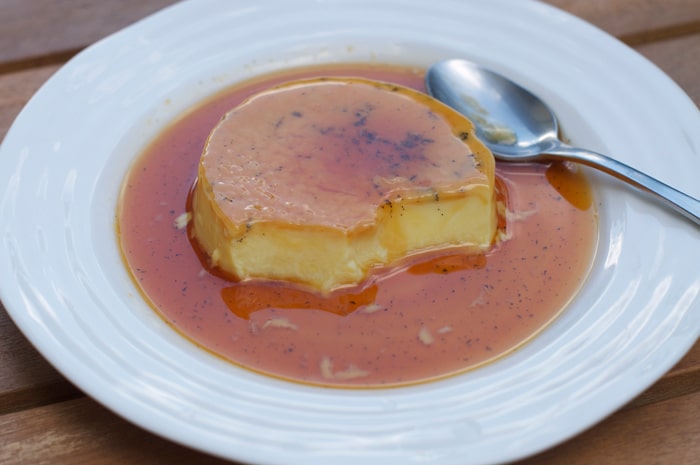
One of my guilty pleasures is shop-bought crème caramel. As far back as I can remember, my mum used to always keep some crème caramel in the fridge for a quick dessert after dinner. Growing up, I’m sure she counted it as part of my daily dairy intake.
For so long, crème caramel was never a dessert which I ever contemplated making at home. I always felt it was a dessert that one ordered in a posh, French restaurant or plucked off the refrigerated shelf at the supermarket.
But one day, in an attempt to impress a work colleague which my husband had invited over for dinner, I set about making crème caramel, figuring that, if it didn’t work out, I would still have time to pop down to the local pâtisserie to pick up a back-up dessert. Besides, the French frequently serve shop-bought cakes for dessert and make no apology for it.
The recipe for the crème caramels start off with a caramel, similar to the Salted Caramel Filling for the Chocolate Lava Cakes above. Having learnt my lesson from that experience, I still proceeded to make a caramel by melting sugar in a hot pan, but I aimed to cook it only until it was golden amber in colour, taking it off the heat long before it reached a “Coca-Cola colour”. Nevertheless, each addition of sugar to the pan meant that the already melted sugar continued to darken in colour, and the end result was still a bit darker than what I would have liked.
The rest of the recipe was, thankfully, rather straightforward, requiring one to make a custard, fill the ramekins (lined with some caramel), and then bake in the oven in a roasting tin filled with water.
The recipe states to bake the custards at 110°C for 30-40 minutes “or until the cream is set around the edges but still slightly wobbly in the middle”. It took a good 1 hour and 40 minutes of baking before I decided to increase the temperature to 150°C for about 10 minutes until the custards were set and had achieved the right state of wobbliness. I was somewhat nervous that the extra baking time was going to affect the taste of the crème caramels, but a quick taste test about an hour before our guest arrived calmed any nerves. They were absolutely delicious! The caramel was perhaps a bit on the bitter side, but not overly so. Our guest was suitably impressed to be served with a homemade crème caramel and I was able to tick off another recipe from my extensive to-cook list.
Now that I have attempted to make crème caramel at home, I would definitely make it more often from hereon and perhaps by-pass the shop-bought variety. Whilst the cooking time which I encountered could be due to various factors such as my oven, the size of my ramekins, the thickness of my ramekins, etc., I think I will experiment with a few other recipes.
Pistou Soup
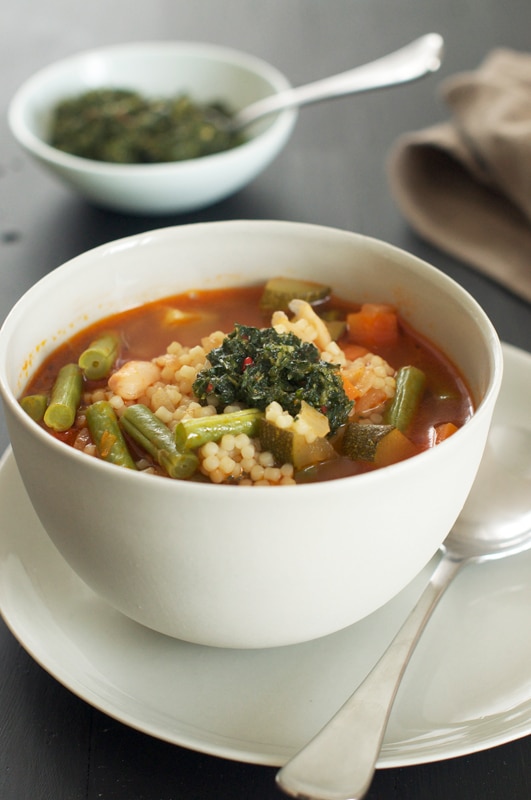
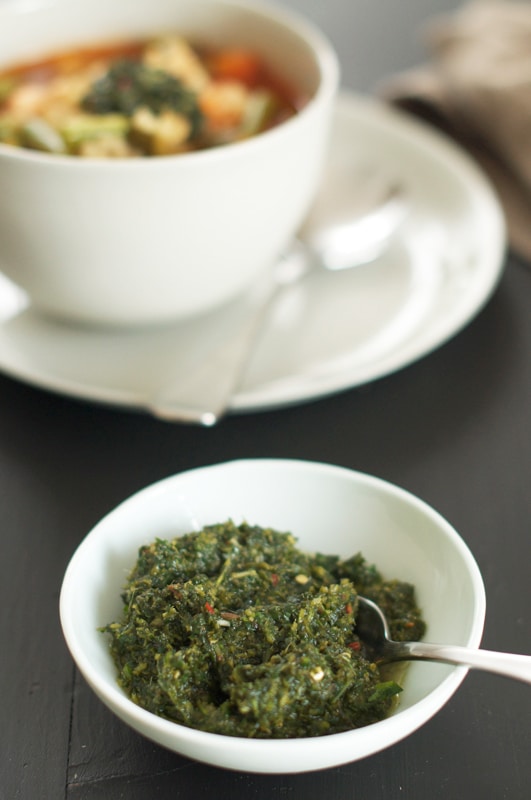
A pistou is a French version of the more commonly-known Italian pesto, except that it does not contain pine nuts nor parmesan cheese. I was attracted to this particular recipe because Rachel Khoo makes a Vietnamese pistou to serve with this chunky vegetable soup. Her Vietnamese pistou is made using Vietnamese basil, lemongrass, chilli and oil.
Some Asian herbs have the misfortune of having multiple names (e.g. coriander vs cilantro) or are simple incorrectly labelled most of the time, with Vietnamese basil falling into this latter category. In the TV episode, it looked like Rachel Khoo was using Thai basil, but it could have perhaps been Vietnamese mint (which is not Vietnamese basil …). Anyway, I settled on using Thai basil as it is one of my favourite herbs and I had a hunch that it would taste great in this Vietnamese pistou. And I was right. This Vietnamese pistou is packed with flavour and brings instant zing to whatever you are serving it with.
Sadly, the vegetable soup itself was terribly bland. I guess you can call this soup a French version of the Italian minestrone, and whilst I wouldn’t normally need a recipe to make such a soup, I did follow Rachel’s recipe closely for the sake of trying something new. Perhaps the vegetables I was using were not at their peak, or perhaps it was due to the absence of stock in the soup (Rachel’s recipe uses only water), but the soup did not wow me at all. And unfortunately, even the Vietnamese pistou could not rescue this soup.
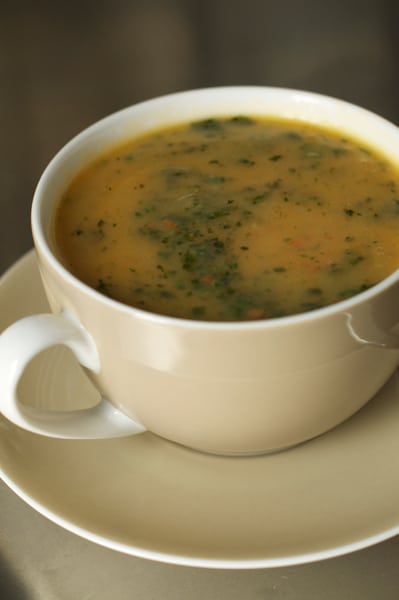
So whilst Rachel’s soup was quickly pushed aside, I did find that the Vietnamese pistou was delicious stirred into some Cream of Tomato & Potato Soup. This Vietnamese pistou is definitely an exciting way to introduce Vietnamese flavours to other dishes.
In the book, Rachel writes that this Vietnamese pistou is a homage to her favourite Vietnamese restaurant in Paris, Le Grain du Riz. When hubby and I were in Paris over the summer, we made our way across the city to try out this particular restaurant instead of heading to the 13th arrondissement as we often do for our fix on Vietnamese cuisine. Sadly, on a bustling Friday evening when activity could be seen on every corner of Paris, Le Grain du Riz was closed. We weren’t sure if they were simply on summer vacation or if they were no longer in business. I was disappointed and hungry, from both arriving at a closed restaurant and from reminders of the unsuccessful recipe in homage to this closed restaurant. Oh well.
Looking for my other review of recipes from The Little Paris Kitchen? You can find them here:
Bouef Bourguignon with Baguette Dumplings
Chicken Dumpling Soup
Coq au Vin Skewers
Croque Madame Muffins
Meatballs in Red Wine Sauce
Pot-au-feu

Thanh, well done for documenting the things that didn’t go well and not only the things that did. Some food bloggers *apparently* turn out an endless stream of intimidatingly perfact creations !
I have fond memories of basic Quiche Lorraine. When I was a student in France (1968 – 69) before quiches were common currency in the UK, I used to aim to be at the little local supermarket at the moment they lifted the quiches from the oven at the in-store bakery, and sold them by the slice to the eagerly waiting customers. A slice of that, accompanied by a small glass of (as I remember it) rather sweetish cheap white wine, seemed a very exotic meal to a teenager from industrial south east Lancashire ! I agree though that people’s eating experiences have moved on since those days and that now, most people come to quiche with expectations of a more extensive range of flavours.
I love food memories like yours, Liz 🙂 Sometimes food doesn’t have to be complex and fancy for it to be delicious. Some of my favourite meals have also been on the cheap in my student days. I do love a good quiche, though not with too many exotic ingredients but definitely with some strong seasoning.
First of all, I absolutely love your photos, even the fast one! You know, there are things you need to eat them hot!!
I haven’t tried Rachel’s quiche lorraine, when I make quiche, I always add food out of the ‘orthodox’ quiche lorraine. Someday I’ll make the genuine one!! 🙂
And that salad, being sooooooo simple, my mom and I, we love it!! We serve as a side dish with pork, cos it makes a good balance between something light and something more heave as pork meat. Believe me!!
And what a surprise about the lava cake!! All desserts Rachel cooks are irresistible, especially when there is chocolate!! What a pity that the recipe didn’t work, it sounded so good, chocolate and salted caramel, wow!!
These things happen sometimes, how irritating! 🙁
And, forgive me, I don’t want to be evil, but I’ve laughed (a little!!) picturing you in front of a pan, thinking if you’re goigin to wait for Coca Cola color, or let yourself be guided for your instints and common sense. And wondering what color have Coca Cola in other parts of the globe, jajaja
And, you know, is funny, the caramel, I prepare best if only use sugar, when I use also water, it looks lumpy, never works, or perhaps I stop before it works, don’t know.
Nice to see you again, and sorry, I have comment too much today (with this rude english, I’m sorry!).
LOL!! I think it takes skill to make a caramel using only sugar (and no water), so perhaps you will have better luck with this recipe than I did. I honestly think cooking the caramel until it is the colour of Coca-Cola is too long – the colour should be much lighter. I have made a similar dessert using another recipe (before Rachel Khoo came on the scene), and that was much more successful for me.
As for the salad, I agree that it would taste great alongside pork – pork and apples is always a classic combination. I made this salad quite often during the summer, especially when we went on picnics, and it was always very popular. Thinking of this salad makes me long for summer again!
What a shame about the chocolate puddings…they do sound amazing! But caramel can be so tricky. Everything else looks gorgeous – maybe I need to invest in this book!
Despite some of the recipes not working out for me, I would still highly recommend the book 🙂 The recipes that have worked have definitely made the book worth it’s purchase.
I think that caramel is easier to be made on gaz (ie proper flame) ;-), I saw my mother do it easily many times when I was young 🙂
You might be right – there might be a difference in using gas versus electric stove. My mum also regularly makes caramel using just sugar and she has a gas stove … When I have my dream kitchen, I will definitely ne installing a gas stove!
A really fascinating and revealing review. I have not seen the tv series but have been recommended the book many times. How incredibly frustrating about the Vietnamese restaurant – I think I would have stomped my feet loud and hard.
Congratulations on your new arrival how extremely exciting and joyous. I rather wondered where you had gone at the end of last year, we certainly missed your posts, so fantastic to have you back again. Happy 2013 and enjoy the wee one.
Thanks Joanna! I slowed down a bit last year with the pregnancy, and now that our little boy is here, sleep is a precious thing! But I always feel better when I can get some “me” time and am hoping to be posting more regularly soon. Good thing I was a bit organised during my pregnancy so I should have some new posts up very soon 🙂
As for the restaurant, I sent a tweet to Rachel asking if the restaurant was still open, but she didn’t really respond except to ask which night we went. Nevermind – we still had a good meal later that night 🙂
This was a very interesting post Thanh. Pity that restaurant was closed – it would have been good to hear what you made of it. Is there a specific restaurant in Paris that you would recommend for Vietnamese food?
I don’t have a specific Vietnamese restaurant in Paris that I could recommend. There are quite many to choose from in the 13th arrondissement and we seem to eat at a different one each time we are there. My tip is to simply choose a restaurant which is busy and has a lot of Asian customers! I’ll try to find s name of a few and jot those down for you later (I have the business cards stashed somewhere).
Thank you, that would be amazing – i would love to try some of them next time i am there.
I like your point about perhaps having been corrupted by more flavourful and exotic quiches. I suspect that happens a lot to our taste buds. I’m a big fan of making paella – and i know i have been making quite a bastardised version of it for some time. But boy, it’s tasty. I’ve recently come across what appears to be quite a traditional recipe – i’m tempted to give it a try, it does sound lovely. But just looking at the ingredient list tells me i’m in for something quite different – perhaps not as bold – as i’m used to. Do i give it a try and risk being disappointed? Or stick with my old tried and tested bastardised version? What to do …
I’d go with the tried and tested bastardised version 😉 Whilst there is a time and place for sticking to the original and authentic recipe, so much of cooking and eating comes down to personal taste. After all, if we weren’t to improvise a bit here and there, recipes wouldn’t evolve and every dish would taste the same! I’d be tempted to hear more about your paella and what “extra” ingredients you add to make it so tasty … I’m a big fan of paella 🙂
I will try that salad sometime soon when it’s not too cold 🙂 What a shame that the Chocolate lava cake with the salted caramel didn’t turn out well. To be honest I’m a huge fan of Nigella’s gooey choc puddings and might try to incorporate the caramel. I remember trying to make the caramel for a flan (again a Nigella recipe) and she used sugar without any water but I got scared and used a tiny bit of water to make my caramel and haven’t looked back since. I did use my mom’s gas stove though.
I love Quiche Lorraine, wasn’t too fond of it as a child but now I’ve grown to love it. I’m sure my hubby (who’s tastebuds are less corrupted than mine) would love the basic version but I know I’d go heavy on the seasoning 😀
Oh I also love Nigella’s Gooey Chocolate Puddings – they are one of my go-to desserts whenever we have last minute guests or when I’m simply craving something quick and simple, but also decadent, for dessert.
I’m glad to hear that you’ve come to enjoy eating quiche. Growing up, I ate many not-so-good versions but I’m glad they didn’t put me off! I think a quiche was also one of the first things I made in home economics classes at school. I remember clearly cutting some herbs from my mum’s herb garden to take to my class, thinking they were parsley, only to find out later that they were celery leaves! Long story but it made my teacher laugh 😉
Fabulous review Thanh…of the good and the bad! Caramel is the minx of the kitchen, temperamental! I’ve done the sugar only and the added water types and it’s worked but that’s after I’ve burnt at least one batch of each!
thanks for posting your experiences with Rachel Khoo’s recipes – I thought I was the only one who had trouble with the recipes. I made the creme caramel as well – the first time around exactly according to the recipe which so did not work at all (never before had I heard baine marie starting out with cold water in a roasting tin but I thought to myself hey she trained at le cordon bleu – she probably knows better). When thinking back to watching the series her oven was really small so probably the cooking time and oven temperature need to be adjusted to a regular sized oven in a, well, regular kitchen for the recipes to work properly. Why any cookbook author would publish recipes that are not adjusted to regular kitchen equipment I don’t know but I think that’s the case here.
All in all, I like the cookbook a lot but I wish I wouldn’t have to start calculating everytime I try out one of that baking recipes for fear it might work otherwise….
Hi Anna,
Thanks also for sharing your experiences with Rachel Khoo’s recipes. I know Rachel worked with a tiny toaster oven on her show but I would have thought that, in order to publish a cookbook for mainstream use, she would have been required to test her recipes using a normal home oven. Or at least I trusted that she did! So I agree that cookbook authors should indeed test their recipes using regular kitchen equipment – I’m not sure if this explains some of the problems which we have encountered or if such problems can be attributed to something else.
Having tried a lot of recipes now, I have found that the instructions are not always very clear, despite the fact that some recipes are quite lengthy and wordy. So I have also been hesitant to try many more recipes from the book because, quite frankly, I no longer have the luxury of time for trial and error!
I, too, like the book very much and am now just more careful about which recipes I choose to make. Usually, I can get a sense of whether a recipe will work from looking at the ingredients and skimming through the instructions. I feel I have already given a few of Rachel’s recipes the benefit of the doubt and, unfortunately, it didn’t always work out for me.
But having said that, there have been a few recipes from this book which I have made over and over and which have definitely made the book more than worthwhile for me. The Croque Madame Muffins and the Bouef Bourguignon with Baguette Dumplings are regular dishes for me now 🙂