

 by
by 
Pikelets
Growing up in Australia, I loved eating pikelets for afternoon tea. My earliest memory of pikelets was when I was in primary school, perhaps about 8 years old, when our teacher made pikelets one afternoon and cooked them on an electric frying pan, with eager little bodies “helping” her with various tasks like measuring, stirring, flipping.
Being young children, we were often always quite hungry and cooking classes like these were always met with much enthusiasm. As soon as the pikelets were cooked, we would spread them with butter and jam and eat them more quickly than they could be made.
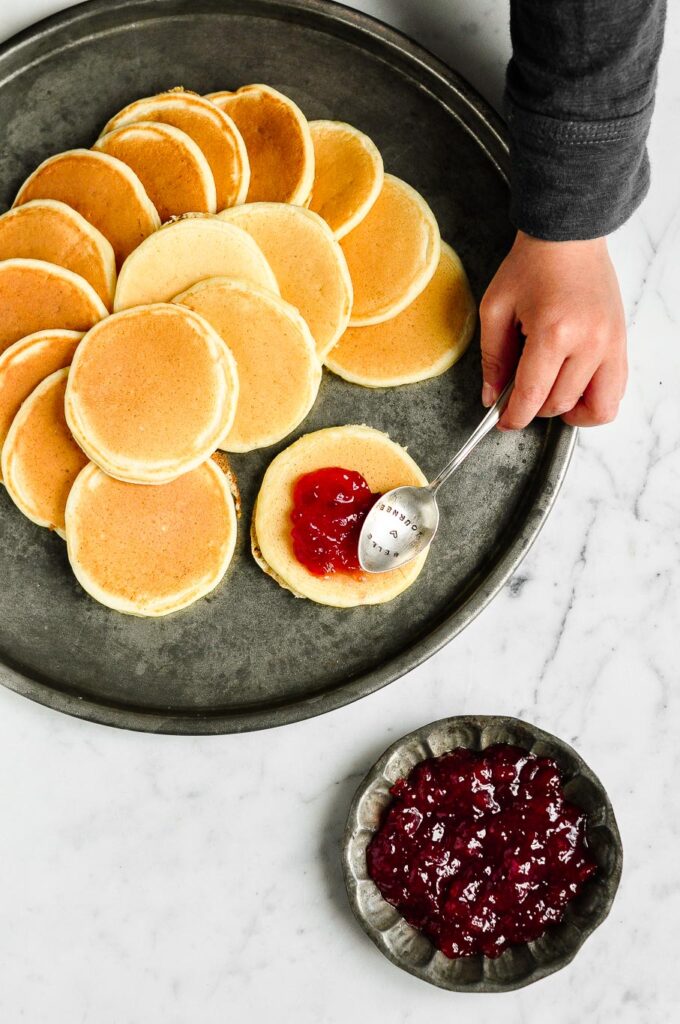
What Are Pikelets?
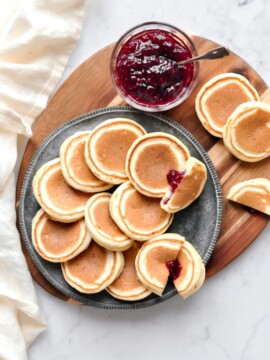
Pikelets are mini pancakes which are popular served as a snack in Australia. In some other parts of the world, they are known as drop scones.
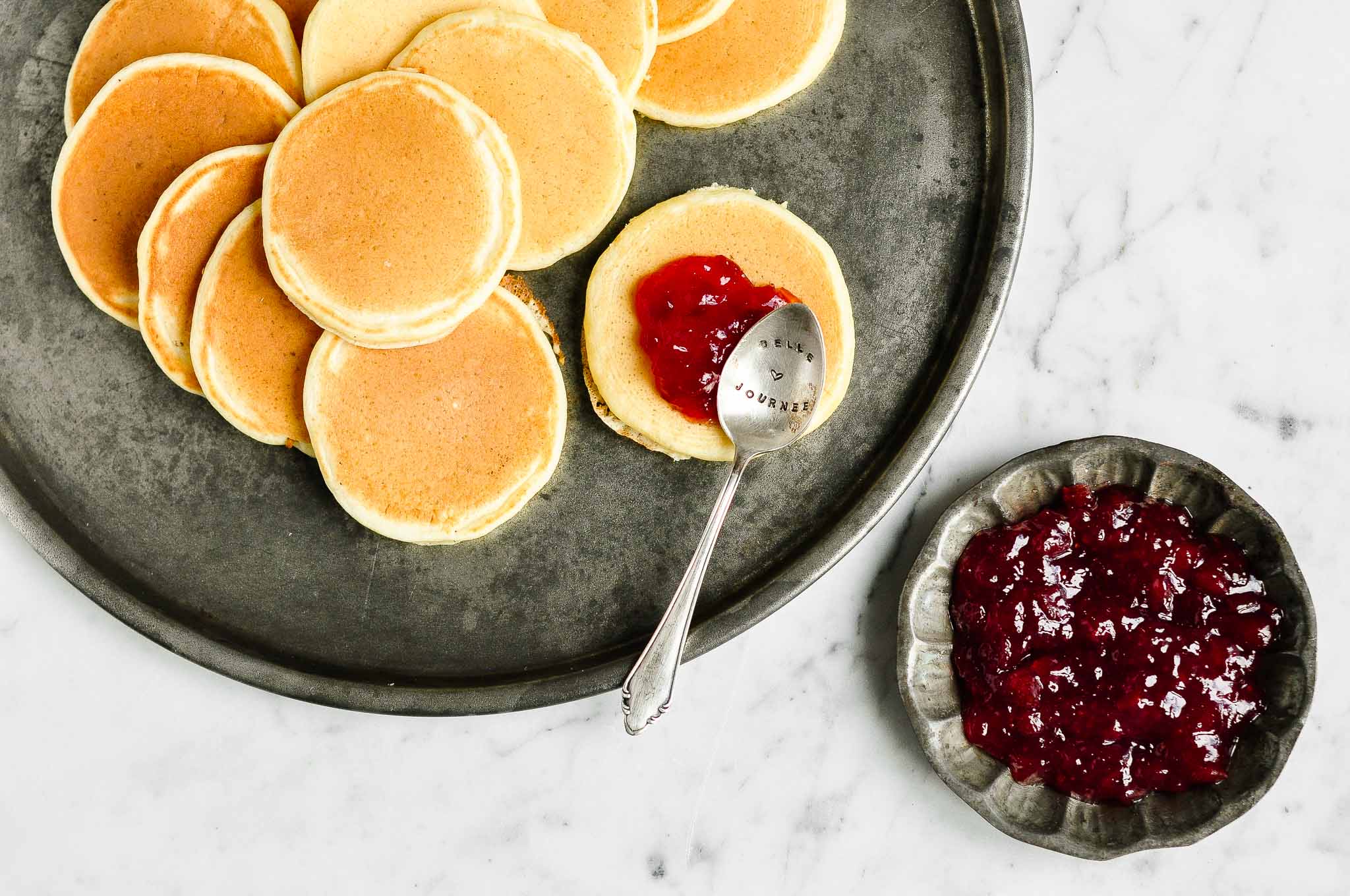
Pikelet Recipe
When I recently wanted to recreate this tea-time treat from my childhood, I turned to the only person who I thought could be an authority on this point – Stephanie Alexander.
The Cook’s Companion by Stephanie Alexander is a wealth of information on not just traditional and modern Australian recipes, but it is a comprehensive compilation of information on ingredients and basic recipes which any home-cook would find an invaluable resource.
And Stephanie Alexander’s pikelet recipe is my go-to recipe whenever I want to treat the children (and myself!) to something warm for afternoon tea.

How to Make Pikelets
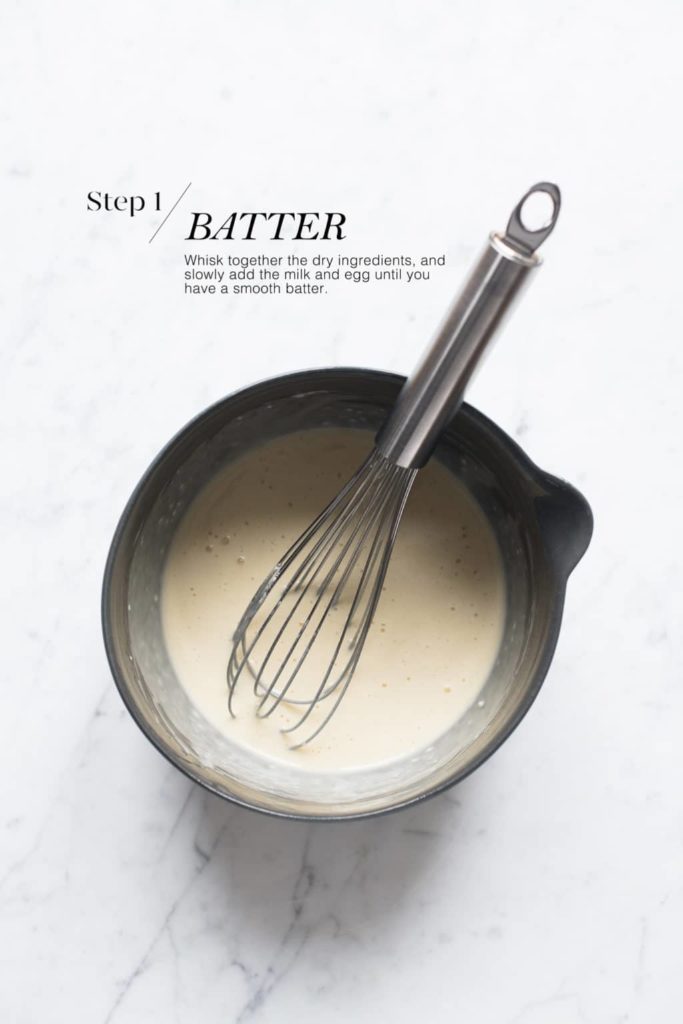
Prepare the batter in a medium-sized mixing bowl. I do this by whisking together the dry ingredients (I don’t like sifting and the whisk does a perfect job of aerating the flour!).
Next, measure the milk into a small measuring jug, add the egg, and whisk together.
Then slowly add the wet ingredients into the dry ingredients, whisking as you do so to remove any lumps.
The pikelet batter should be thick and smooth.
Making pikelets is much like making pancakes, except pikelets are meant to be much smaller – think canapé size. I use a tablespoon measure for making pikelets and to ensure that they are all similar in size.
I also use a non-stick crêpe pan for making pikelets and pancakes, but any non-stick pan will do.
Start by melting about 1/2 teaspoon of butter in the pan. Then use a paper towel to spread the butter all over the pan, but to also wipe off all of the butter. This ensures that the pan is only very lightly greased with butter. I do this process only once, and only before the first batch of pikelets. After you have cooked the first batch of pikelets, the pan is well greased for the subsequent batches.
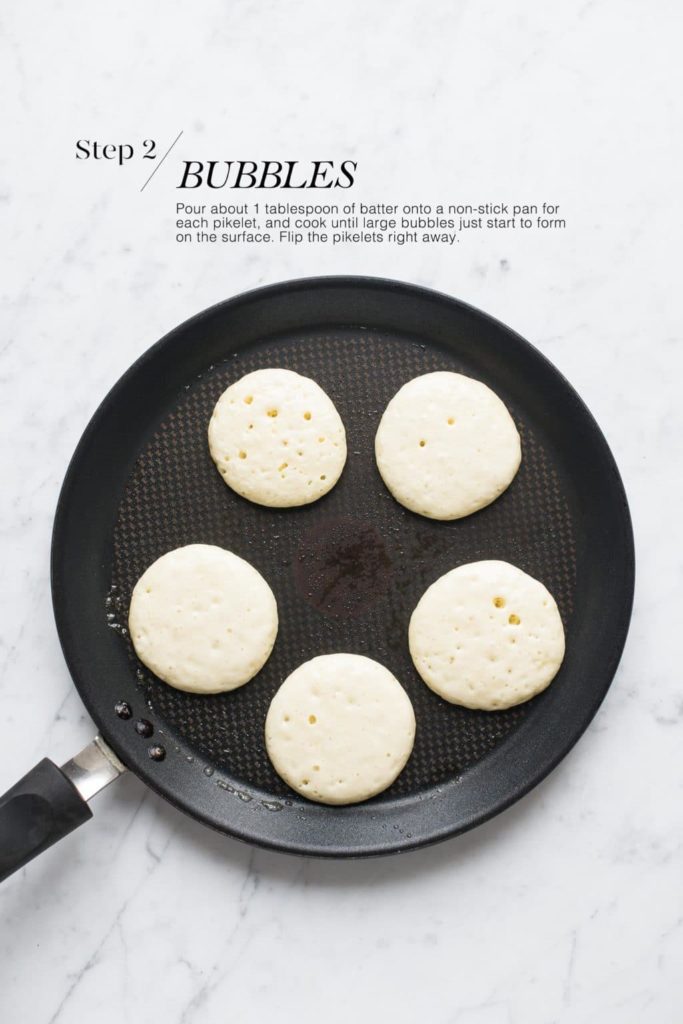
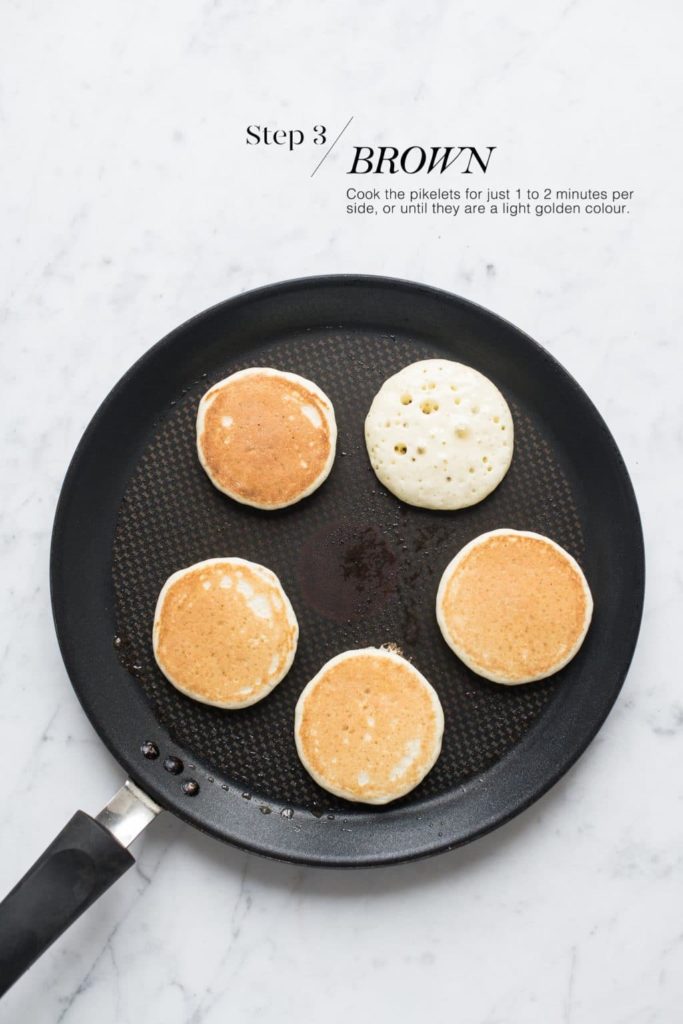
As soon as bubbles start to appear on the surface, immediately flip the pikelets over.
Cook the pikelets for about 1 to 2 minutes on each side until they are lightly golden in colour.
Variations
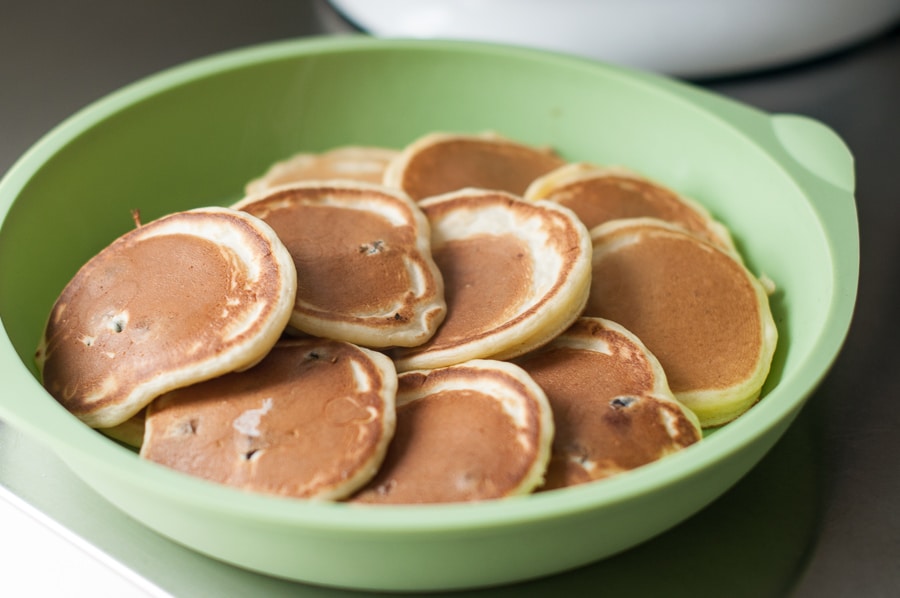
Stephanie Alexander’s pikelet recipe is quite straightforward and she also offers some variations to the recipe, such as adding sour cherries or raisins to the mixture before frying.
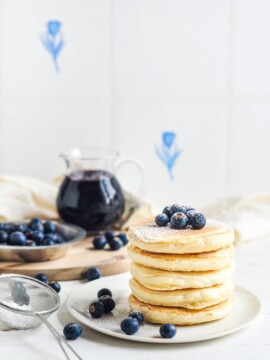
My son LOVES blueberries, so I sometimes add a few handfuls of fresh blueberries to the batter, just for something a bit different.
What to Serve with Pikelets
These pikelets are wonderful served warm but they also taste great cold.
I like to make enough for leftovers for my childrens’ lunch boxes the next day. There is very low sugar content in these pikelets, plus they happen to love eating them plain!
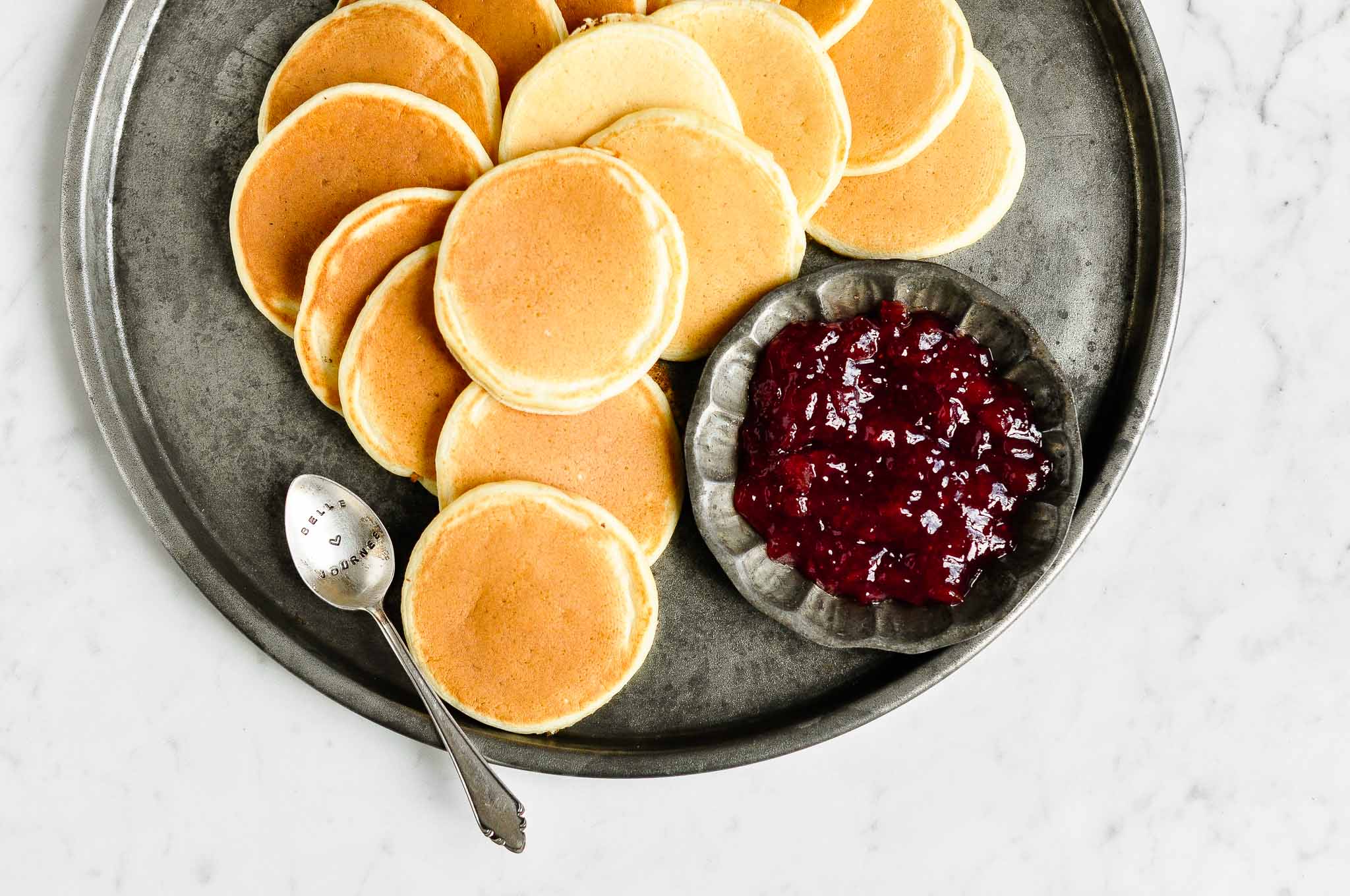
If you like to make your own jam, may I suggest one of the following as a delicious accompaniment to these pikelets?
Pikelets

Ingredients
- 100 g (¾ cup) plain flour, (all-purpose flour)
- 1 teaspoon baking powder
- ¼ teaspoon fine salt
- 1 teaspoon caster sugar, (superfine sugar)
- 1 egg
- 150 ml (½ cup plus 2 tablespoons) milk
- unsalted butter, for frying
- Strawberry Jam, to serve
Instructions
- Measure the flour, baking soda, cream of tartar, salt and sugar into a medium-sized mixing bowl.
- Whisk the egg and milk together in a measuring jug.
- Pour the wet ingredients into the dry ingredients and whisk until the mixture is thick and smooth.
- Heat a non-stick frying pan or crêpe pan over medium heat.
- Drop about 1/2 teaspoon of butter into the pan and wipe it around the pan with a paper towel. The surface of the pan should be only very lightly greased. I only do this once, and only before the first batch of pikelets. After you cook the first batch of pikelets, the pan is well greased for the subsequent batches. But this might vary depending on the pan that you use.
- Using a 1 tablespoon measuring spoon (15-20 ml) or large spoon, pour small drops of batter into the pan.
- As soon as small bubbles start to appear on the surface, flip the pikelets over and cook for a further minute or so. The pikelets should be evenly coloured on both sides.
- Remove the pikelets to a silicon tortilla or pancake warmer.
- Repeat until all of the batter has been used.
- Serve each pikelet with a dollop of jam.
Kitchen Notes
- BAKING POWDER SUBSTITUTE
In place of baking powder, you can use ¼ teaspoon bicarbonate of soda and ½ teaspoon cream of tartar in this recipe. - STORAGE
Any leftover pikelets can be covered with plastic wrap and kept in a cool place for 1 day. - RECIPE CREDIT
This recipe is adapted from The Cook’s Companion by Stephanie Alexander. - OVEN & STOVE TEMPERATURES
All recipes on this website have been tested on an induction stove and/or with a conventional oven (i.e. an oven without fan). All recipes on this website state temperatures for a conventional oven, unless otherwise mentioned. If you have a convection oven (i.e. an oven with a fan), please consult the manufacturer’s handbook on how to adjust the temperature and baking time accordingly. - CONVERSIONS
To convert from cups to grams, and vice-versa, please see this handy Conversion Chart for Basic Ingredients.
Did you make this recipe?
Please leave a comment below and share your photos by tagging @eatlittlebird on social media and using #eatlittlebirdUpdate
This recipe was first published on 6 September 2011. It has been updated with new photos and more comprehensive recipe notes.

Those pikelets look so good. You’ve reminded me I’ve not made pancakes for the longest time!
Oh! great breakfast;)
The pikelets are my favourite food for breakfast. But I’m always lazy to make it myself that I always buy the ready made ones and heat it.
This recipe looks pretty straightforward! Time to try it 🙂
Oh once you’ve made these pikelets from scratch, I’m sure you won’t be buying them anymore 😉
I love these pickelets! We make pancakes most weekends for breakfast, my boys never get tired of them 🙂
Your lucky boys! We also often make pikelets or pancakes on the weekend when we have more time to linger, though if my hubby decided to make pancakes for breakfast during the week, I’m sure that would help me to get out of bed a bit earlier 😉
Never heard pikelets before, I can give it a go!! have a nice day!
Manu
Oh my, how did i miss and ELB posting. Fabulous. They remind me of pancakes too.
Lovely.
Never heard of these before. Sound and look a lot like tiny cute pancakes. the pictures are lovely
I have made these again this morning and the recipe has not lost any of its charm. I do not call them pancakes anymore but I am having a time re-educating the children!
Be that as it way, out of several recipes I have tried, these are, by far, the best I have produced. Fluffy, with structure, holds up to plenty of syrup slathering; it’s perfectly delicious. My go to pancake…errrrr…pikelet recipe from now on.. 😀
Oh how wonderful to hear!! I’m so glad that you and your family like these pikelets. They’re a classic in Australia and Stephanie Alexander’s recipe produces pikelets which taste exactly as I remember from my childhood. I think what’s really great about this recipe is that the pikelets still taste great when cold, which is not something you can say for most other pancakes. So for me, there is less stress when making these pikelets because you don’t have to worry about making sure they are all hot when served.
I guess I should start calling your fish cakes fish “cutlets”? 😉
Haha! Well, if ever amongst Indian’s it would earn you brownie points! :-). I love the fact that its still fluffy even when cold, which is always the worry isn’t it, with pancakes. I warmed the extras ( I managed to make a huge amount!) the next day and it was still pretty darn good to eat!
I love pikelets and use a Bill Granger recipe from a book my brother sent me from Australia. I haven’t heard of Stephanie Alexander before (maybe I should ask my brother!) but that book sounds good.
Oh I wonder which Bill Granger book it is? I make pikelets so frequently now that I have the recipe memorised, just like I had when I was younger 🙂 I find these pikelets to be so much lighter and easier to eat than pancakes, plus they taste great cold and can be kept for the next day, which is not always the case for pancakes.
Stephanie Alexander is the authority on Australian cooking. Her book, The Cook’s Companion, is a cooking bible found in most Australian homes. It’s a very big and heavy book but I would definitely put it on your Christmas wish list 🙂
I gave this recipe a try today… i love the fluffy siftvtexture of these oancakes.. Never made pancakes before..but this recipe seems straightforward and easy… A definite keeper. Thanks for sharing and keep up the good work 🙂
Thanks, Amanda! I’m glad you enjoyed this recipe. I make these pikelets all the time and love them hot or cold – definitely a keeper!
Love love this recipe! It’s so easy to make and the kids just love it. Definitely a keeper!
WOW…how deliciously does this look!!! Beautiful presentation. You make it sound so easy! Can’t wait to try this one!
is caster sugar the same a granulated or powdered sugar in USA?
Hi Leslee,
I believe caster sugar is called “superfine sugar” in the US? I would describe it as being in between normal granulated sugar and powdered sugar. Caster sugar is often used in baking because it dissolves very quickly, but if you can’t find caster sugar, normal granulated sugar works fine too, especially in this pikelets recipe 🙂 Hope this helps!
Great recipe. Not sure what I did but I had to double the recipe to make 20 pikelets!
Glad you enjoyed the recipe! Perhaps you made your pikelets a bit bigger than mine? But a double batch is never a bad idea anyway 😉
I am going to make this for my son’s lunch today. Thanks
I hope you will enjoy this recipe for pikelets!
Thanks so much for this recipe! I have celiac so I swapped in rice flour in place of the plain flour. I also added a pinch of ground vanilla beans. They came out beautifully and so delicious! My fiancé and I had them with lingonberry jam and homemade whipped cream. I made them again today with wild blueberries in the batter and topped with maple syrup. I will definitely be using this recipe often. Thanks again!
Hi Carly,
Thanks so much for your feedback! I also have a friend with celiac, so I’m very thankful for your notes. I will try it the next time he visits!
Great recipe to make with the kids! Made half a batch with blueberries like in your photo, the kids loved it. They want to make them again tomorrow!!
Easy and delicious!
this is very nice and easy to use