

 by
by 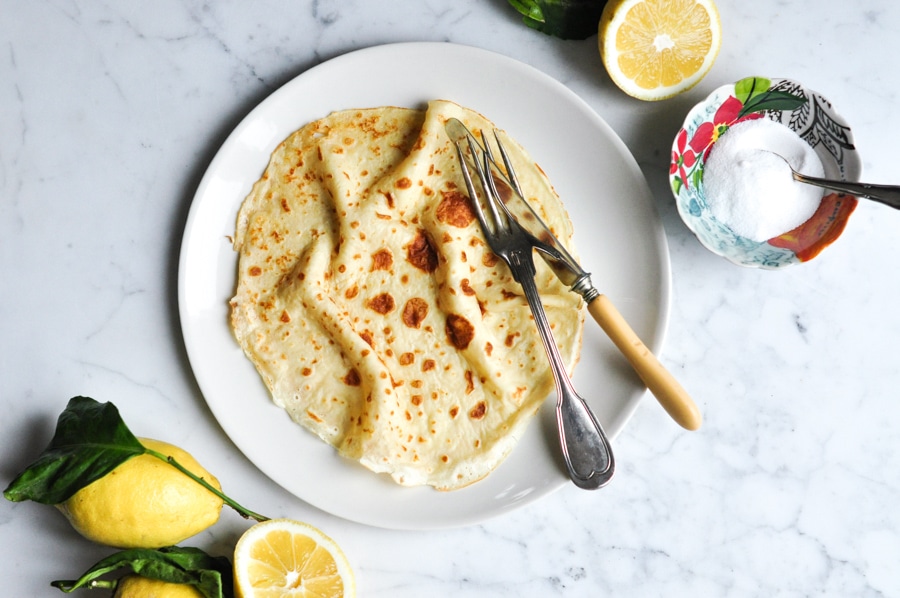
French Crêpes Recipe
My husband hails from the French region of Brittany where crêpes are thought to have originated. And so it goes without saying that, in this part of the world, it is completely acceptable to have pancakes at breakfast every morning, or even as a goûter, the French equivalent of afternoon tea.
I unashamedly take advantage of this opportunity whenever we are in Brittany, and as do my nieces who manage to get away with eating crêpes not just at breakfast, but also for dinner!
At home, when pancakes are in demand, I tend to make my childrens’ favourite pikelets. These were the pancakes that I grew up eating in Australia, and it warms my heart to see that my children adore them as much as I do.
But once in a while, I like to make French crêpes for something a bit more substantial.
What Are French Crêpes?
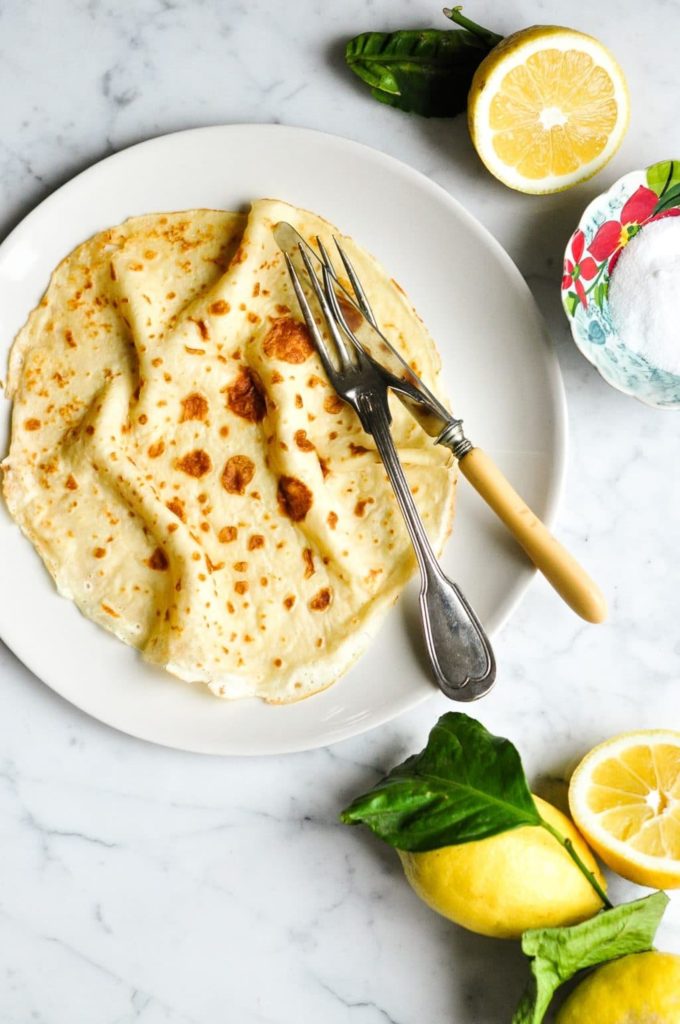
French crêpes are very thin and delicate pancakes which are typically eaten as a snack in France. By comparison, American pancakes are much smaller, and are usually thick and fluffy due to the baking powder in the batter.
Easy Crêpe Recipe
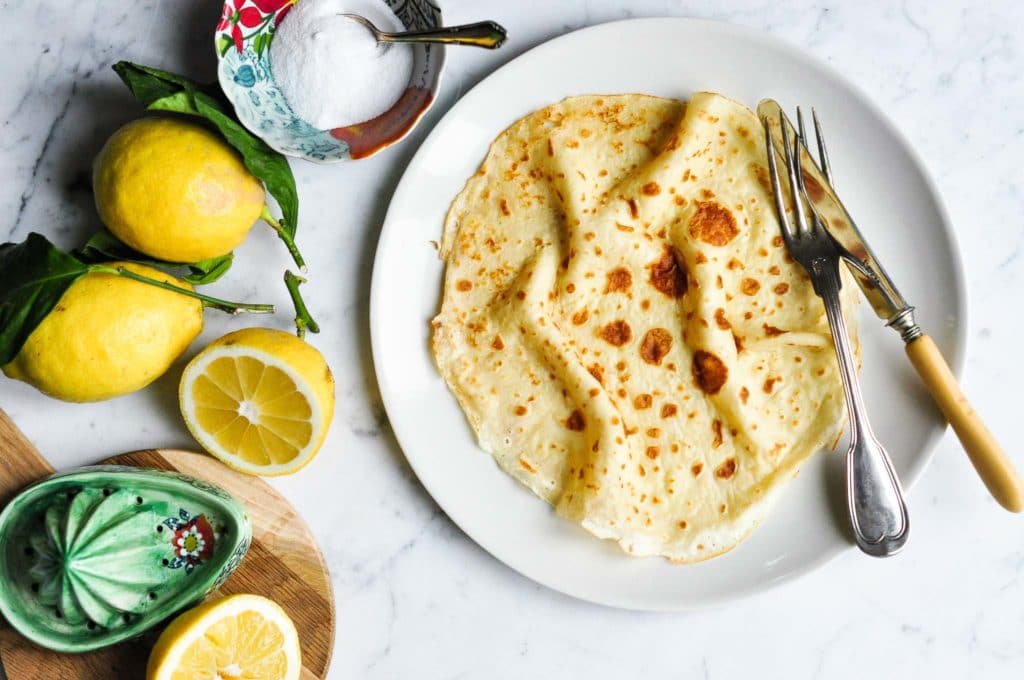
Traditionally, the basic crêee recipe below is used for sweet or dessert crêpes; savoury crêpes follow the same recipe but have buckwheat flour in place of the plain flour (all-purpose flour), and use water instead of milk.
However, I rather like using this basic crêpe recipe also for savoury crêpe – there is very little sugar in the recipe so they are quite bland on their own (it is the toppings which add the sweetness), and they work really well with creamy sauces like this one from my recipe for Zurich-Style Veal with Mushroom & Cream Sauce.
How to Make Crêpes
Step 1
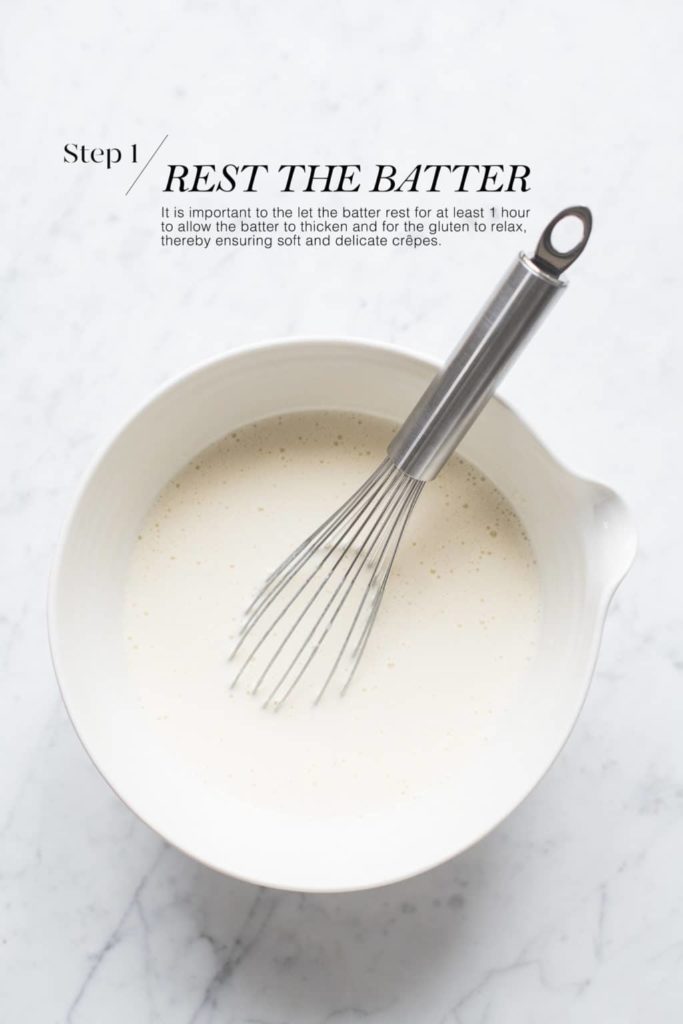
Whether you are making sweet or savoury crêpes, what is crucial is that you rest the batter for at least 1 hour to allow it to thicken and for the gluten to relax. This will, in turn, produce soft and paper-thin crêpes.
If you make the crêpes right away, they will still taste good, but they might be a bit chewier.
Step 2
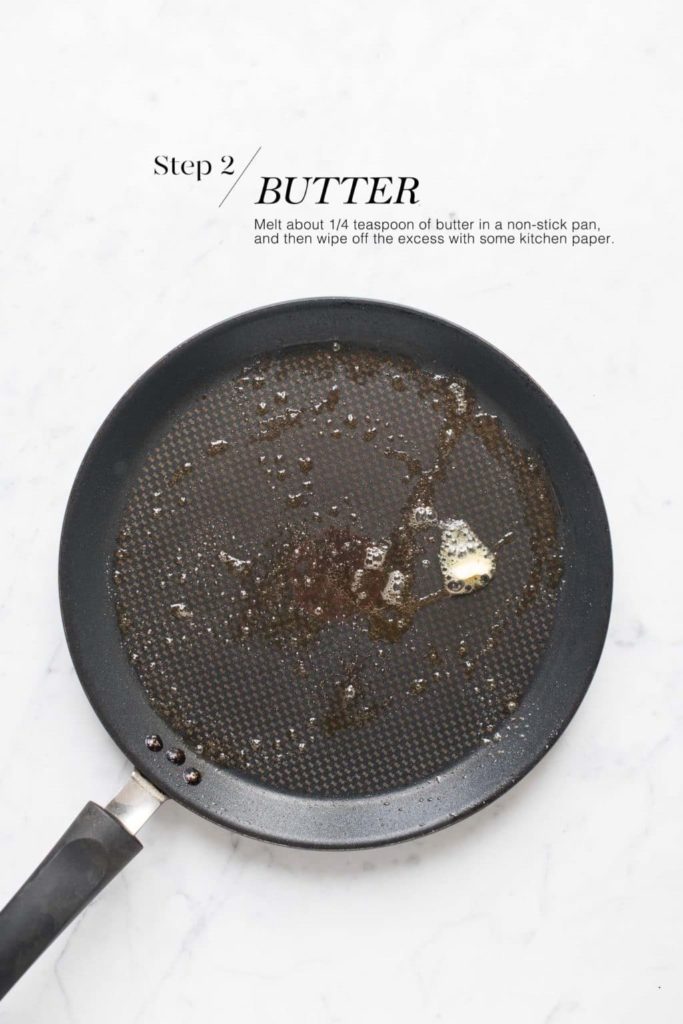
Heat a large non-stick frying pan with about 1/4 teaspoon butter. Use some kitchen paper to evenly coat the pan with butter, and to also absorb any excess butter.
But it is important that you grease the pan with butter because it is the butter which helps to cook the crêpes and to make them crispy.
Step 3
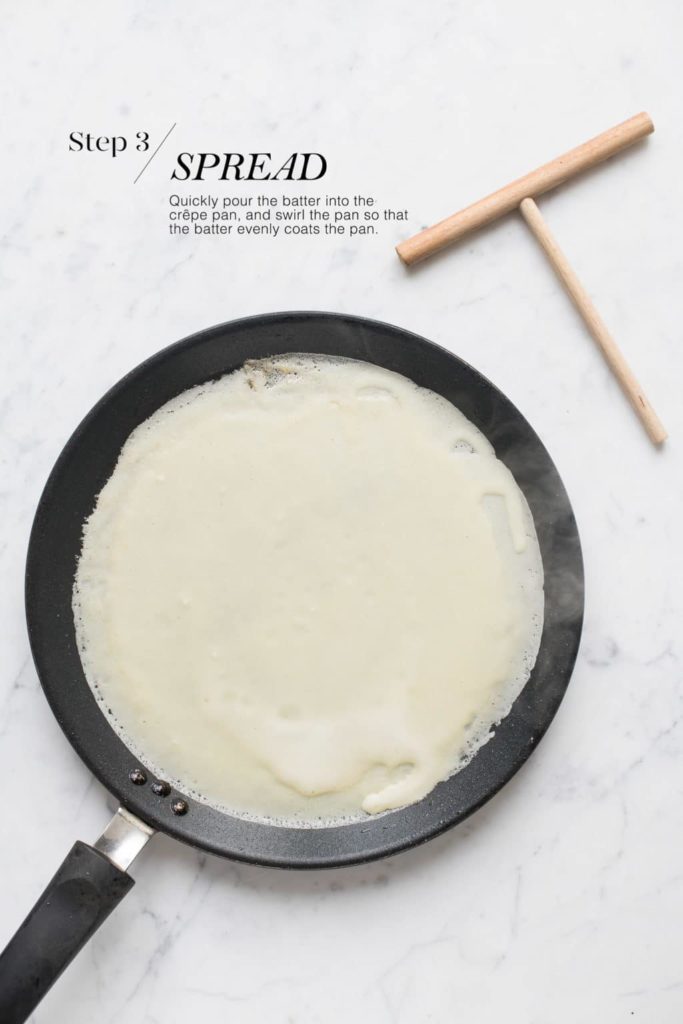
Pour some batter into the pan and quickly give the pan a swirl so that the batter can coat the pan in an even layer.
A crêpe batter is very similar to a normal pancake batter, but you will have to experiment with the first few crepes to get the right consistency.
The crêpe batter should be thin enough to spread evenly across the surface of the pan, but it should also be thick enough to give the pancake some body.
Step 4
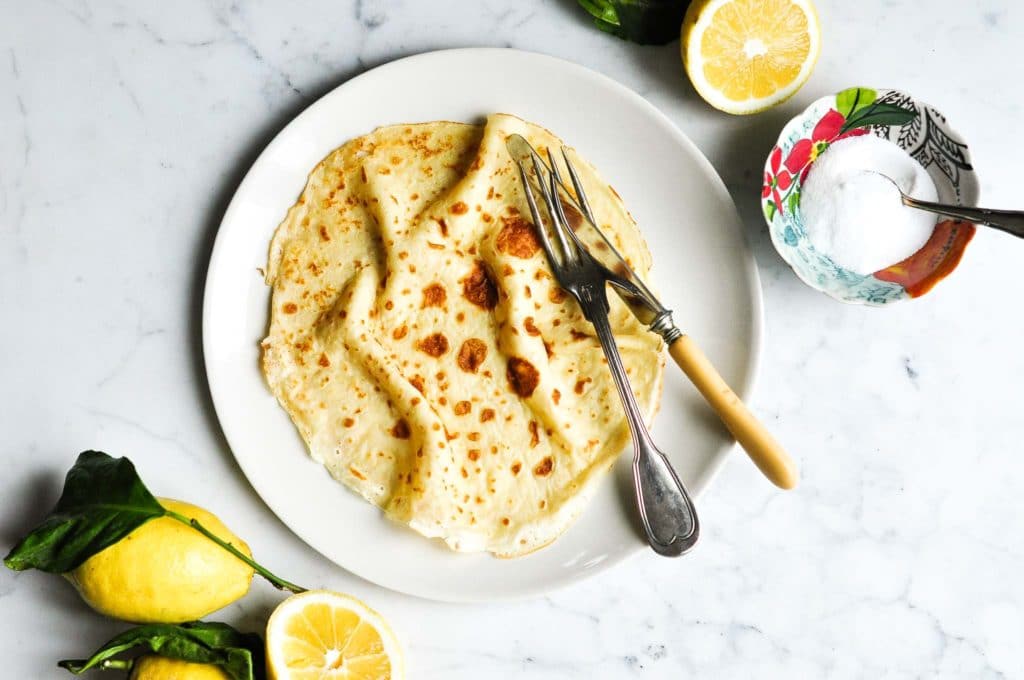
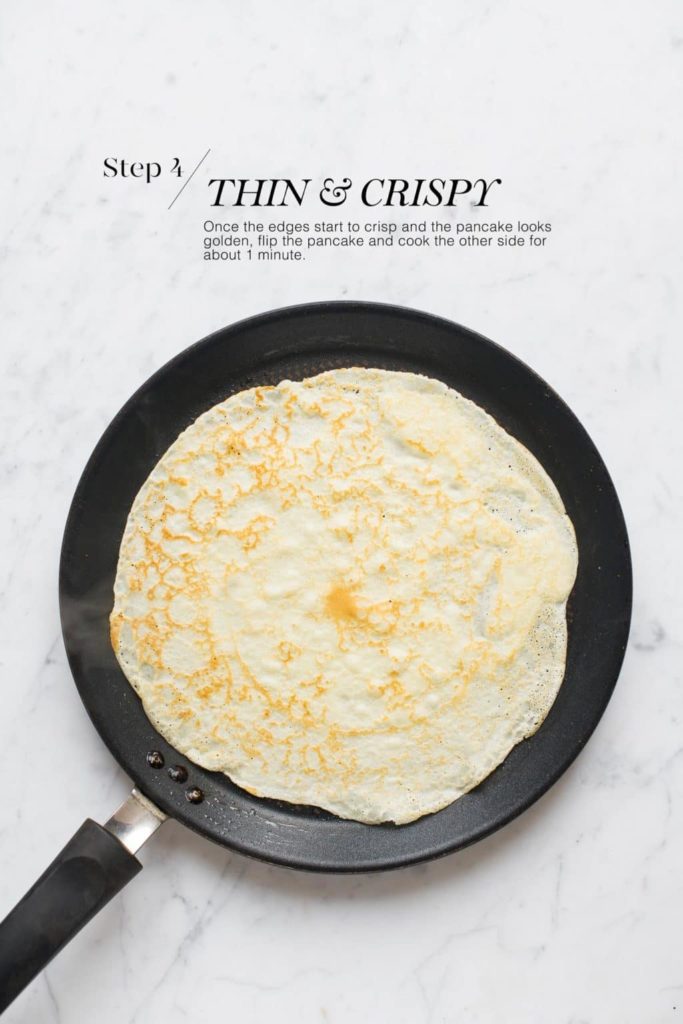
Once the edges start to crisp up and the pancake looks nice and golden, quickly flip the pancake to cook the other side for 1 to 2 minutes.
The resulting crêpe should be very thin (almost see-through) with crisp edges.
Filling for Crêpes
According to my Swedish sister-in-law, it is completely normal in Sweden to eat pancakes for dinner. And so I like to exploit this concept once in a while by making a large batch of French crêpes for dinner, keeping them warm in a low oven as I make them.
Dinner is then all-you-can-eat-crêpes with an assortment of fillings, such as:
- a thin layer of strawberry jam
- a drizzle of homemade salted caramel sauce
- a good spread of Nutella
- a generous sprinkle of cinnamon sugar
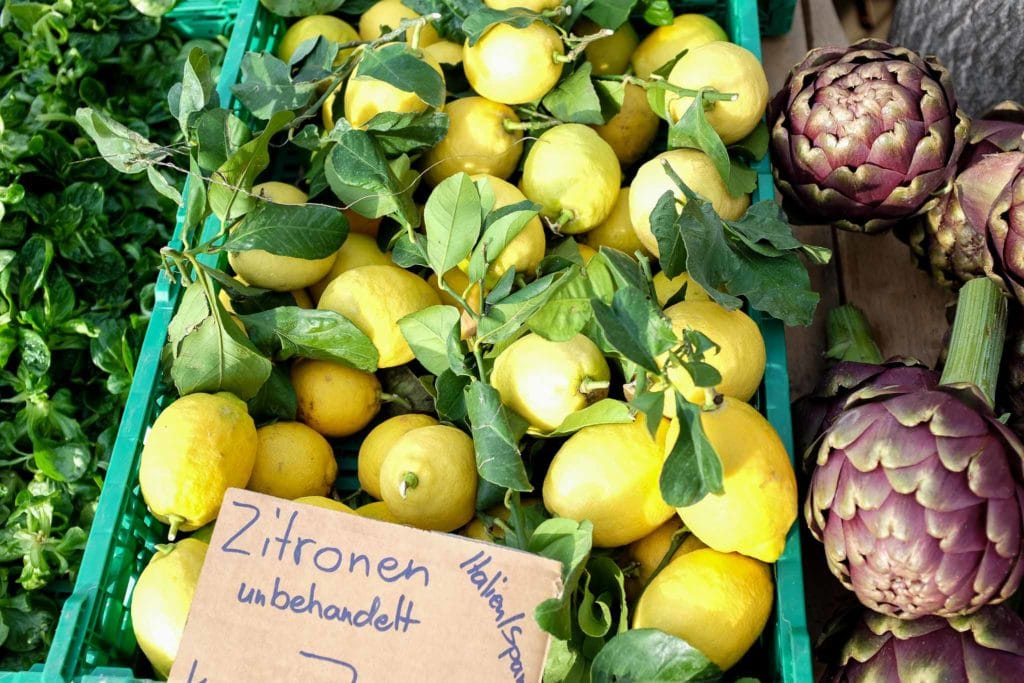
- a sprinkle of granulated sugar with a squeeze of lemon juice (my favourite)

French Crêpes

Ingredients
For the Crêpes
- 200 g (1 ⅓ cup) plain flour, (all-purpose flour)
- 1/2 teaspoon caster sugar, (superfine sugar)
- 1 pinch fine salt
- 600 ml (2 ⅓ cup) milk
- 2 eggs
- unsalted butter, for frying
To Serve
- granulated sugar
- cinnamon sugar
- lemon wedges
- Raspberry Jam, or other jam
- Nutella
- Salted Caramel Sauce
Instructions
To Make the Crêpe Batter
- Measure the flour, sugar and salt into a large bowl.
- Pour the milk into a large measuring jug.
- Add the eggs to the milk.
- Whisk the milk and eggs together lightly to break up the eggs.
- Slowly pour the wet ingredients into the dry ingredients and gently whisk until everything is incorporated and there are no lumps. Be careful not to over-whisk the mixture.
- Cover the bowl with plastic wrap.
- Leave the batter to rest at room temperature for at least 1 hour, or overnight in the fridge.
To Cook the Crêpes
- Heat a large non-stick frying pan over medium heat.
- Add about 1/4 teaspoon butter to the pan.
- Swirl the pan so that the butter melts and coats the surface of the pan.
- Pour about 60 ml (1/4 cup) of batter into the pan and quickly swirl the pan so that the batter covers the whole surface of the pan.
- Cook the crêpe for a few minutes on one side until it is lightly golden and the edges look firm, before flipping it over to cook the other side for a further 1-2 minutes.
- Remove the cooked crêpe to a plate in a warm oven and continue with the remaining batter.
- Remember to melt some butter each time before adding the batter to the pan – it is the butter which helps the crêpes to cook and brown.
- Serve the crêpes warm with a generous sprinkle of granulated sugar and a squeeze of lemon juice, or with whatever topping you prefer.
- You can either roll up the crêpe like a log, or fold the crêpe in half, and then in half again.
Kitchen Notes
- USING A CREPE PAN OR PANCAKE PAN
You can make crêpes or pancakes in any non-stick pan, but a special crêpe pan has very low sides which makes sliding the crêpe out of the pan easier. I have an old and trusty T-Fal crêpe pan. - USING A PANCAKE SPATULA
Unless you are skilled in flipping pancakes, I recommend using a wide pancake spatula which makes flipping crêpes and pancakes a breeze. - THE FIRST PANCAKE
As with any pancake recipe, the first pancake usually doesn’t always turn out or look right, often because the pan hasn’t come to the right temperature and/or because there is too much butter in the pan. In my husband’s family, they actually fight over the first pancake because they claim it to be the tastiest from all of the butter it has absorbed! - CONSISTENCY OF BATTER
Depending on the dimensions of your pan, you will have to play around with quantities of butter and batter to find the right balance for the perfect crepes. You might also have to thin the batter with some milk if the batter is too thick. - MAKE-AHEAD TIPS
It is important to let the batter rest so that the gluten in the flour has time to rest, leading to softer and less chewy crêpes. If you have left the batter to rest overnight, you might need to thin the batter a little with a dash of milk. - STORAGE TIPS
Any leftover crêpes can be kept in the fridge, covered in clingfilm, and gently reheated in a non-stick pan before serving. - FREEZER TIPS
My sister-in-law freezes her crêpes and thaws them in the microwave for a quick snack or meal for her kids. - MAKE IT GLUTEN-FREE & DAIRY-FREE
To make gluten-free crêpes which are also dairy-free, substitute the flour in this recipe for buckwheat flour and replace the milk with water. This will produce what the French call “galette de sarassin“, which are typically served with a savoury filling. - OVEN & STOVE TEMPERATURES
All recipes on this website have been tested on an induction stove and/or with a conventional oven (i.e. an oven without fan). All recipes on this website state temperatures for a conventional oven, unless otherwise mentioned. If you have a convection oven (i.e. an oven with a fan), please consult the manufacturer’s handbook on how to adjust the temperature and baking time accordingly. - CONVERSIONS
To convert from cups to grams, and vice-versa, please see this handy Conversion Chart for Basic Ingredients.
Did you make this recipe?
Please leave a comment below and share your photos by tagging @eatlittlebird on social media and using #eatlittlebirdUpdate
This recipe was first published on 9 February 2016. It has been updated with more comprehensive recipe notes.

These crepes sound wonderful! Love the simple lemon flavour!
Thanks, Katrina! I like to keep it simple and sometimes have just sugar. My son keeps it simplest of all by eating them plain!
We have crepes for dinner sometimes (they are know as ‘flat pancakes’ in our house) & we have anything from lemon, sugar & cinnamon, to jam, stewed fruit (especially apples), maple syrup & even nutella occasionally on them.
Also, crepe pans are the best!
Oh I love crêpes with Nutella too! Whenever we are in Paris and pass a crêpe stand, I often order one with Nutella 🙂 And my crêpe pan has been a better investment than I initially anticipated. When I bought it about 8 years ago, I thought it was a terribly expensive non-stick pan. But it turns out that I use it almost daily to make not just pancakes but also flatbreads, naan bread, etc. I love it!
Beautiful photos! I love your ceramic juicer. Are Vietnamese sizzling crepes the same as banh xeo? If so, any possibility for a recipe for those also?
Thank you! Yes, Vietnamese sizzling crêpes are called “banh xeo”. They take a bit more work than French crêpes but it’s one of our favourite dishes. I’ll try to post a recipe for them soon!
sugar and lemon with my pancakes and that is all. I also mean English pancakes that are like crepes, nothing like the American style fluffy ones.
These look so delicious!
So we have similar taste in toppings 😉 I love all pancakes – crêpes and the thick, fluffy American ones. My favourites are the Australian pikelets, though 🙂
Thanh, I’ve been meaning pop by but time seems to be a scarce commodity these days especially when you have a 1 year old who demands your full attention.
I love pancakes, especially with lemon & sugar but another favourite of mine is my mom’s savoury version which is then stuffed with tuna and potatoes…
xx
Oh I know how it is! I’ve been meaning to write to you for a long time … You have me curious about these savoury pancakes – they sound so delicious!!
Your crepes are beautiful, Thanh! I love the combination of lemon juice and sugar with these. And while I knew crepes can be savory, I never knew that there was a Brittany tradition of enjoying them as a sort of “bun” or envelope for sausage as well, which is something I learned on my last trip to France. It was good, but I prefer crepes done simply as you’ve so beautifully presented here! 🙂
Thanks, Beeta! Are you referring to a savoury galette with Andouille? That’s a very classic dish in Brittany. I tend to prefer sweet crêpes … I could eat them all day 🙂
My husband is from Brittany, too (via his mother)! I love crepes, but I prefer the British way of making them, slightly thicker, less dry. I have to hide this fact from my mother-in-law! They sometimes also make crepes with a heavier, darker flour which are then filled with savoury fillings – I can’t remember the name of the flour though. I love your site! Your photos are lovely!
Ha ha!! My mother-in-law makes really nice crêpes. She once made them for dinner when we were visiting with some other family members, and the poor lady was stuck in the kitchen the whole evening, making crêpes one at a time for everyone! The savoury crêpes you are referring to are called galettes, which are made with buckwheat flour. I grew up eating savoury crêpes made with the same recipe used for sweet crêpes, so I actually prefer them to the traditional buckwheat galettes. Although I always look forward to lunch or dinner at the local crêperie when we are in Brittany, and will feast on both savoury and sweet crêpes 🙂
I received a crêpe pan for Christmas!! It’s sooooo great having this, instead of using a pan.
Our biggest problem is to flip the crêpes, what a stupid, we have a spatula just like yours (but in blue!), we use for flipping eggs, why don’t we use it for this!!! I can’t believe it!! We use two normal spatulas, because I have a bigger flexible flex turner, but as it is metalic, I don’t want to damage my lovely crêpe pan. It’s so frustrating!!
I’ll try next time with this.
Crêpes with lemon and sugar reminds me of France, because there, we always have in the afternoon one of this, so simple and so delicious.
Have a nice weekend!!
Lucky you! I love my crêpe pan 🙂 I use it for crêpes, pancakes, tortillas, flatbreads … you will find lots of use for it, I’m sure! I found my pancake spatula in the US – before then, I didn’t know such things existed! But it’s a great tool to have, and you can imagine how useful they are 🙂
These crepes look so delicious! I love their simplicity. And I do believe your sister-in-law may be right – in Ukraine, where I’m from, it is also acceptable to have crepes as a meal, both with sweet and savory toppings.
How wonderful to come from a culture where it is acceptable to eat crêpes as a meal! The children absolutely love it when I make crêpes for dinner (it doesn’t happen very often), and I must admit that I’m quite happy to have something sweet for dinner sometimes 🙂
I love this recipe! Our family love pancakes on weekends and I made these crepes for a little change. Everyone loved them!
This is a great breakfast for me and my family! Looks very tasty and gentle! Thank you!
Great recipe! Made the batter the night before and thinned out in the morning with some milk. The crepes were soft and chewy, great texture.
My husband is French too 🙂 His mother never lets the crepe batter rest but I got distracted and ended up leaving the batter to rest as per your recipe. Either it’s your recipe or the resting time, or both!, but these were delicious crepes!!
Easy delicious recipe!
Weĺ well, I printed the recipe to use on St-Valentine, but I lost it, that said a wish for you on this day sending you a storm of roses n petals, no thorns, you’re truly wonderful in sharing ❤ a great recipe I thought was lost
Wonderful crepe recipe. My family loved them.
Thank you for this recipe! French crepes have a long history of celebration. February 2nd was the day when every home in France would make twelve crepes to eat together. Apart from the February 2nd candlemass celebration, there was a belief that crepes are related to wealth.
Excellent recipe – we enjoyed these crepes very much!
I have made this recipe many times and the crepes are just beautiful to eat.