

 by
by Pork Potstickers
I never understand those restaurants which offer potstickers as an appetiser or starter, maybe four dumplings per serve. When I want to eat potstickers, I want to eat a whole plate!
This would look greedy and, perhaps, gluttonous in a public setting, which is why I prefer to make dumplings at home, to serve as a meal in itself, and to eat to my heart’s content!
What are Potstickers?
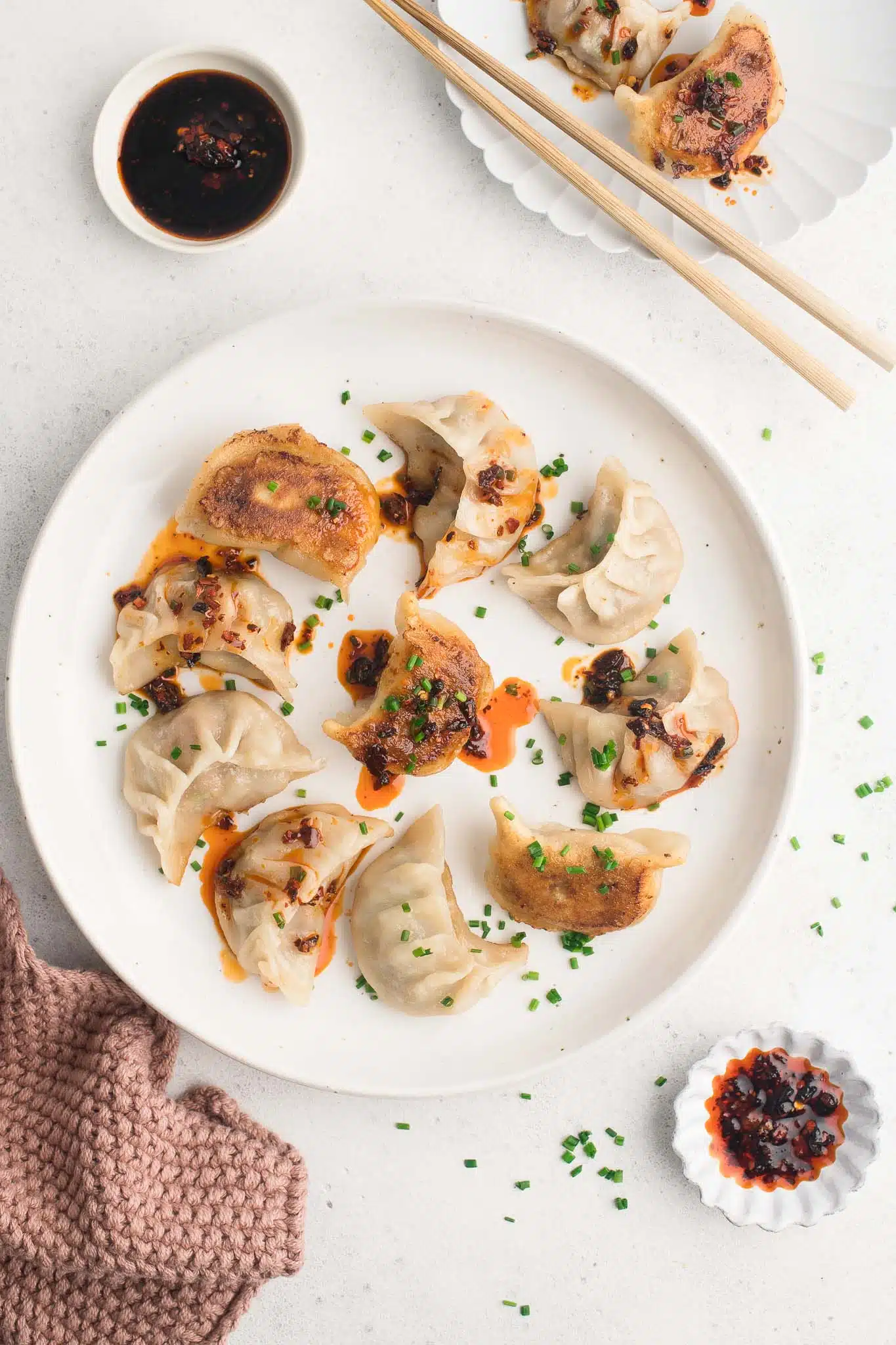
Potstickers are Chinese-style dumplings which have been pan-fried to give a crispy bottom, and then steamed to finish the cooking process.
The result is the best of both worlds – tender and juicy dumplings with a crispy bottom for maximum flavour.
What is the Difference Between Gyozas and Potstickers?
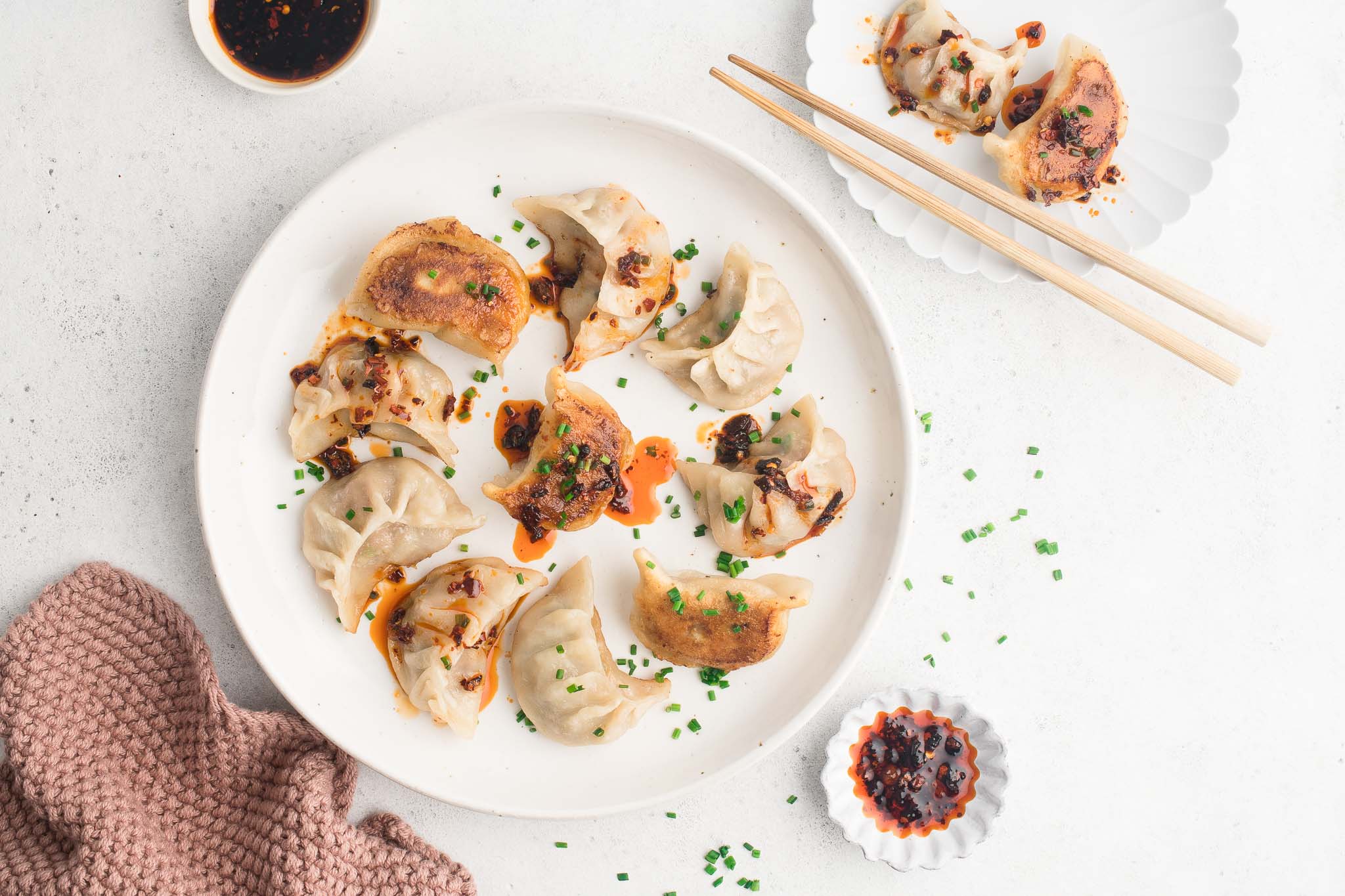
The Japanese have Gyozas, whilst the Chinese have their own variation called Potstickers, or jiaozi. Chinese-style potstickers tend to be larger with a more hearty filling, and a thicker wrapper.
Gyozas, on the other hand, tend to be smaller and daintier, and made with very thin dough.
But both are essentially the same thing (apparently the Japanese borrowed the idea from the Chinese), and some restaurants use the terms interchangeably.
My gyozas/potstickers happen to be generously-sized because I have a habit of over-filling my dumplings!
Why This Recipe Works
- Making the dumpling wrapper from scratch ensures a soft and chewy texture which you cannot get with ready-made wrappers.
- The filling is made with pork and lots of vegetables, so you can eat these dumplings as a complete meal!
Pork Dumplings
My Taiwanese neighbour once invited me over to make dumplings for lunch. As someone who lives for dumplings and would travel far and wide in search of the perfect plate of dumplings, I needed no persuasion in simply walking down the street to be served the most perfectly homemade dumplings.
Prior to that auspicious lunch invitation, I had never entertained the idea of making my own dumplings at home. But seeing how she easily, and lovingly, kneaded a piece of dough made simply from flour and water, and even prepared three different fillings to offer everyone a little variety, she inspired me to have a go at making my own dumplings at home.
And once you have tasted dumplings made with homemade wrappers, it is hard to go back to the shop-bought variety.
Potsticker Recipe
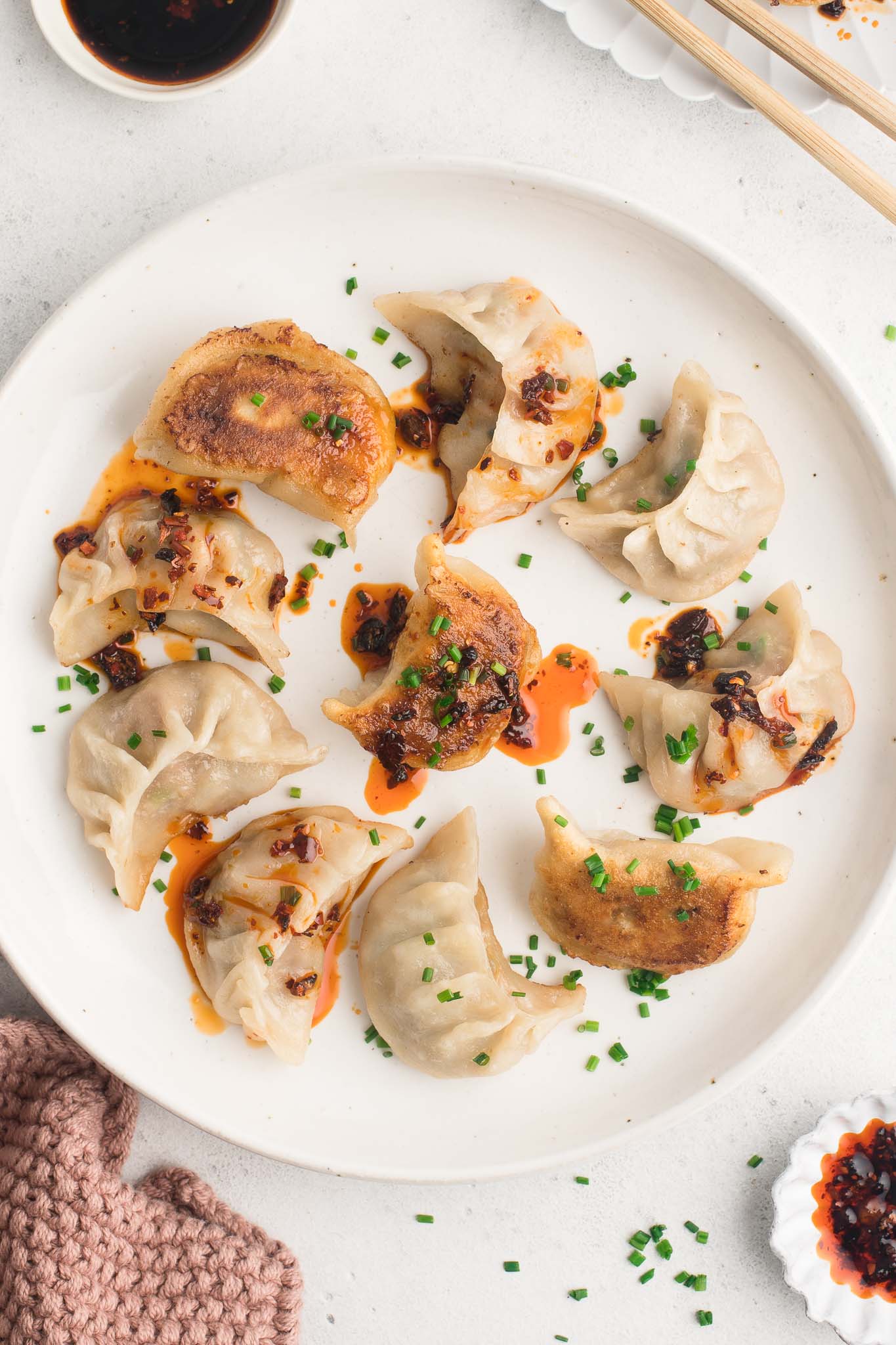
This potsticker recipe is adapted from the wonderful Dumpling Sisters, Amy and Julie Zhang.
When I first set about making my own dumplings, I followed their recipe with no deviation, and the result was everything I wanted in a dumpling.
I’ve tinkered with this potsticker recipe a tiny bit, and I have even substituted the pork and bok choy for chicken and cabbage – both versions are equally tasty.

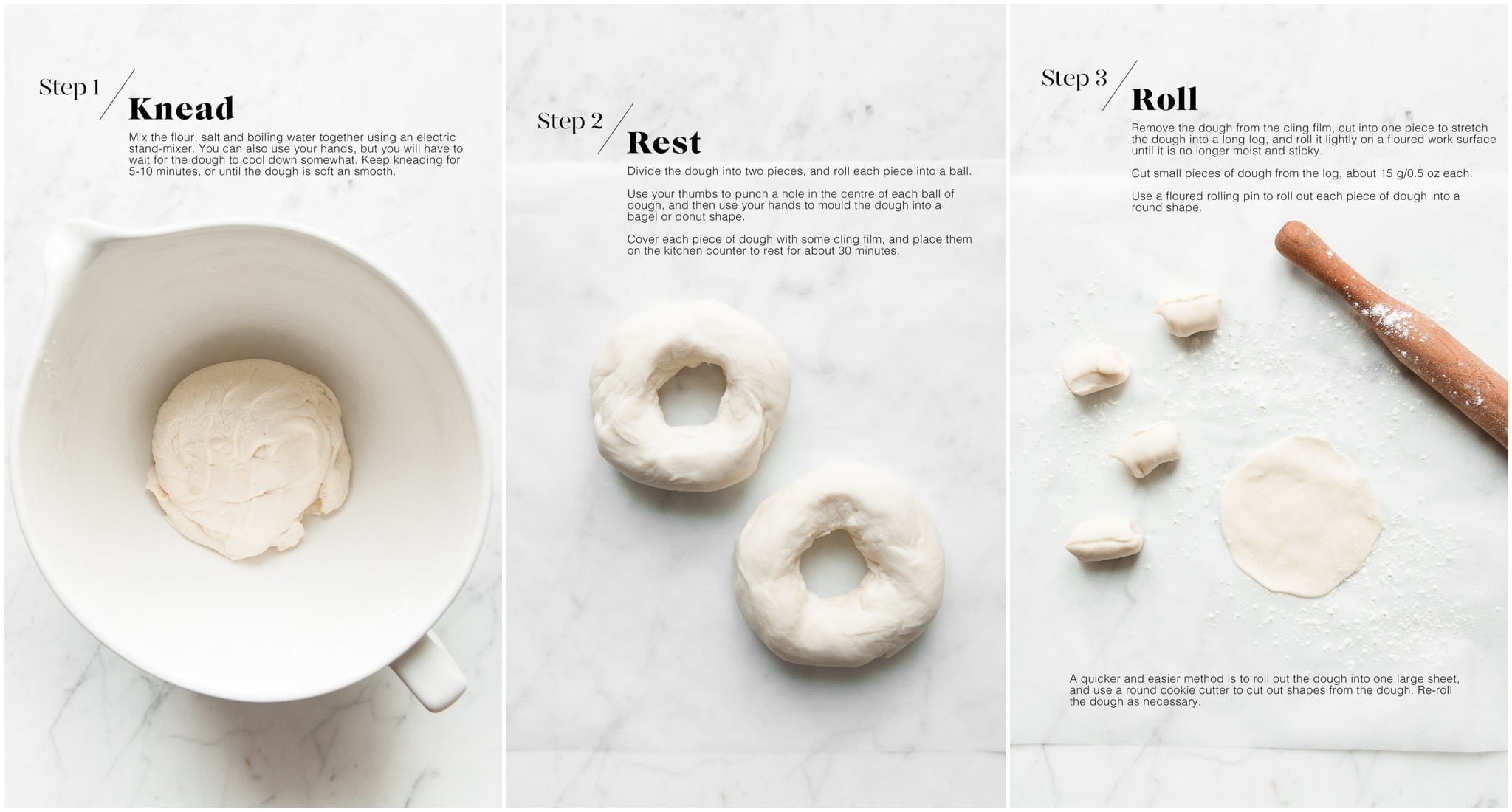
How to Make Homemade Dumpling Wrappers
When time is tight but you still want dumplings for dinner, ready-made dumpling wrappers can be a godsend.
But if you can, I recommend making the dumpling wrappers from scratch. Homemade dumpling wrappers have a thicker and chewier texture than the store-bought variety, which means they are more interesting to eat. And as the homemade wrappers are more robust in texture, this means they are also more substantial and filling.
But you can make the wrappers as thin as you like (without them breaking), if you want a more delicate-tasting dumpling.
Please see my recipe for Homemade Dumpling Wrappers with step-by-step photos.
How to Make Potstickers
Step 1
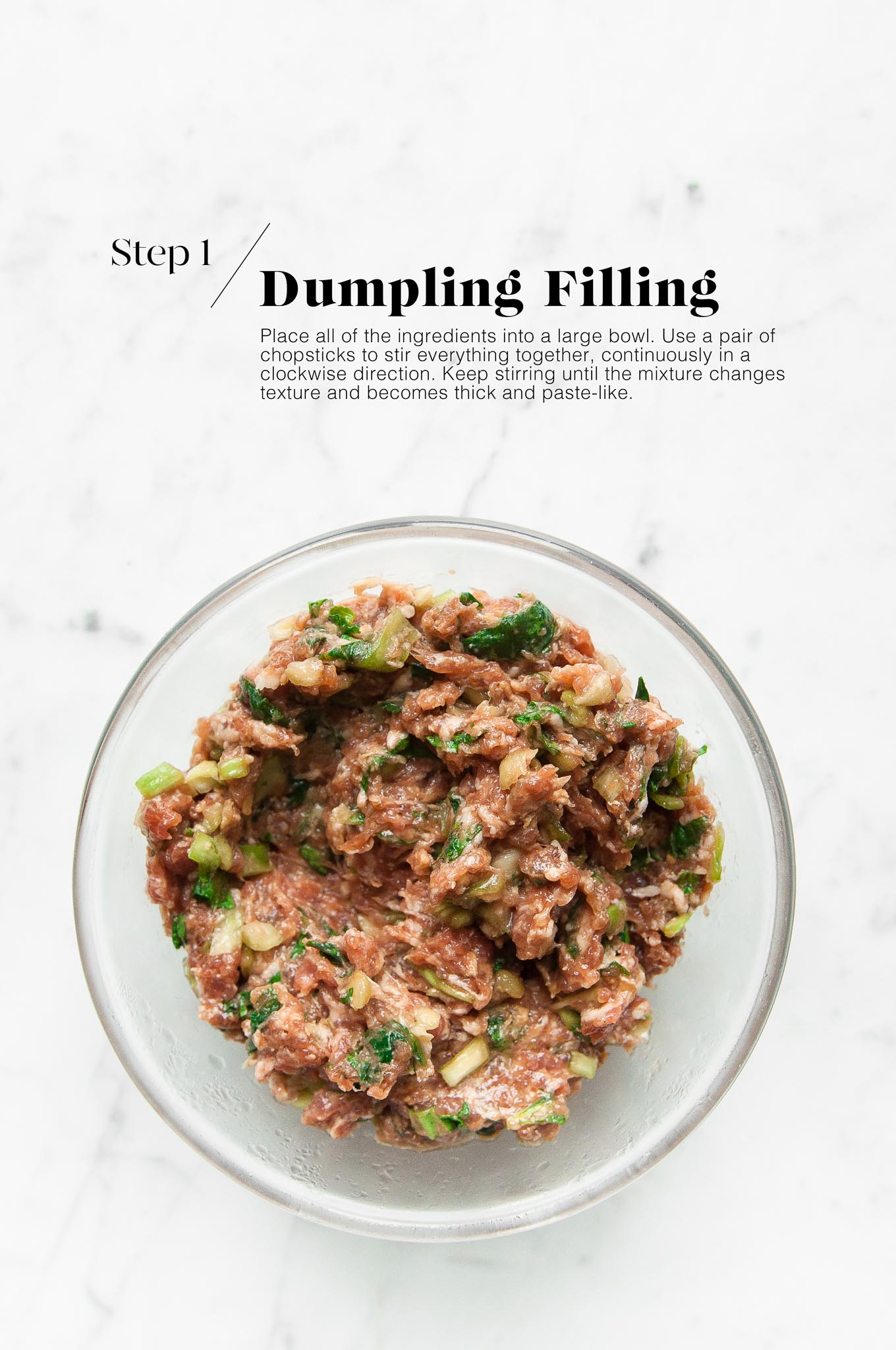
Place all of the ingredients for the dumpling filling into a large bowl.
Use a pair of chopsticks to mix the ingredients together by moving the chopsticks continuously in a clockwise direction. The mixture will start to change texture and become more paste-like as you keep mixing.
Continue mixing in a clockwise direction until everything comes together like a thick, sticky paste.
Step 2
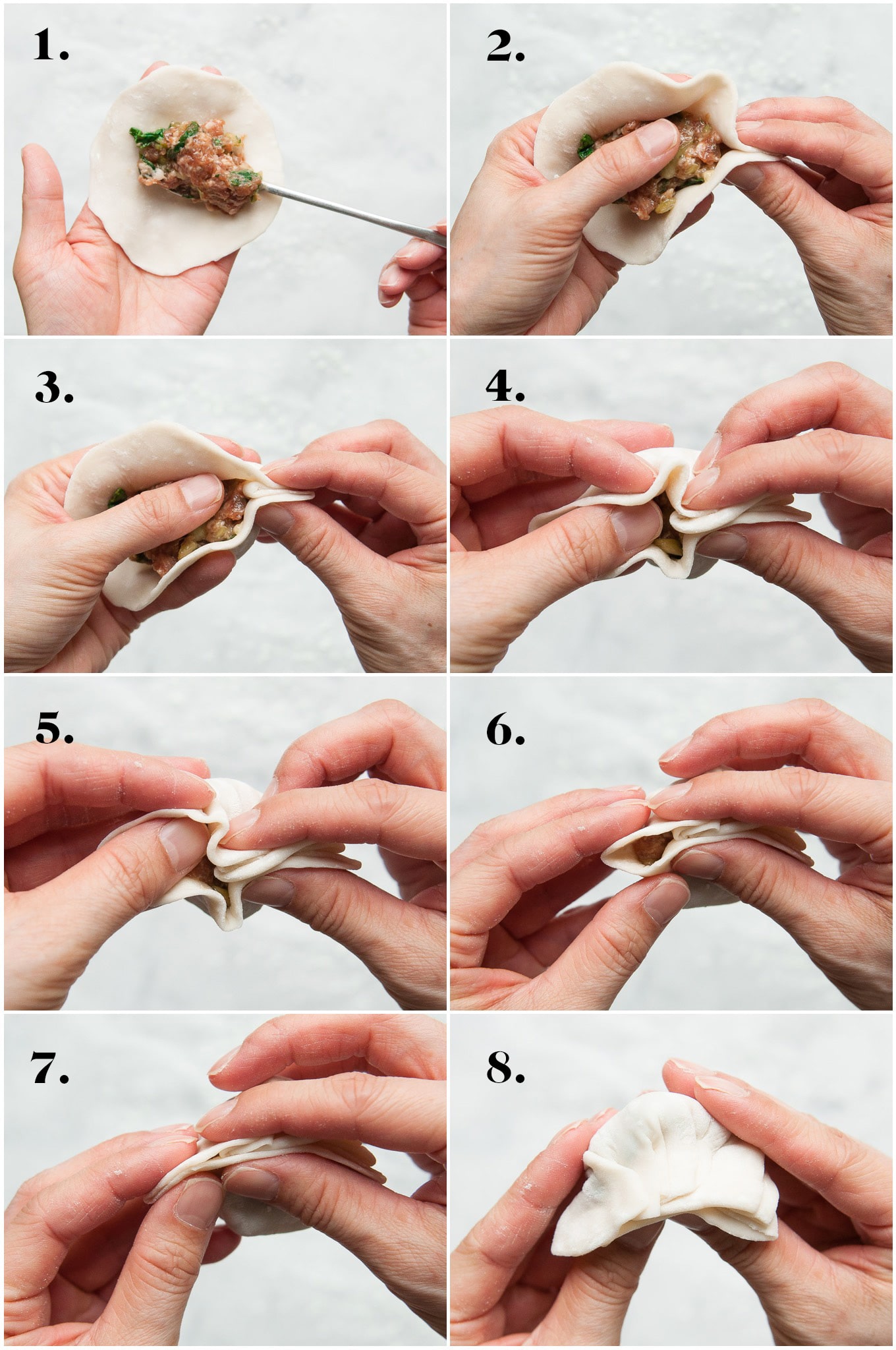
Place a good tablespoon of filling into the centre of the dumpling wrapper.
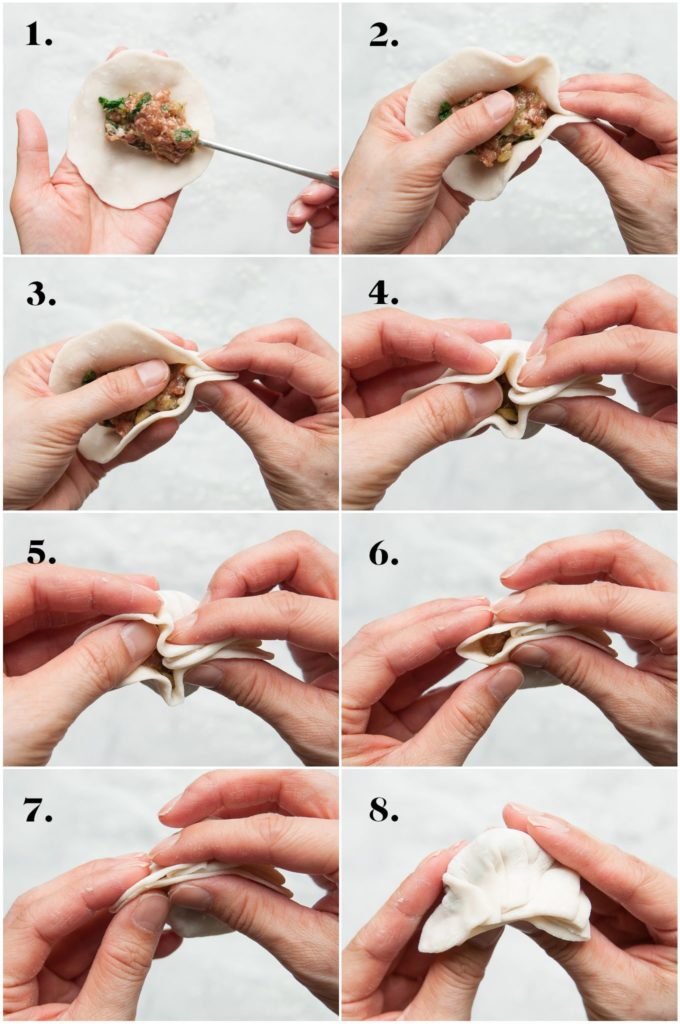
There are various ways to pleat or shape a dumpling. The following method is what my Taiwanese neighbour taught me and I find it quickest and easiest.
If you are right-handed, start pleating by using your right thumb and forefinger to fold over the edge which is facing away from you into small pleats from right to left.
Meanwhile, the thumb on your left hand is used to keep the filling inside the wrapper.
When you reach the end, press the pleats tightly to ensure that everything is sealed. As you do this, try to shape the dumpling lightly into a nice crescent-shape.
Repeat with the remaining dough and filling.
Step 3
To cook the dumplings, I recommend using a non-stick pan. Otherwise, as the name suggests, these dumplings will stick to your pot!
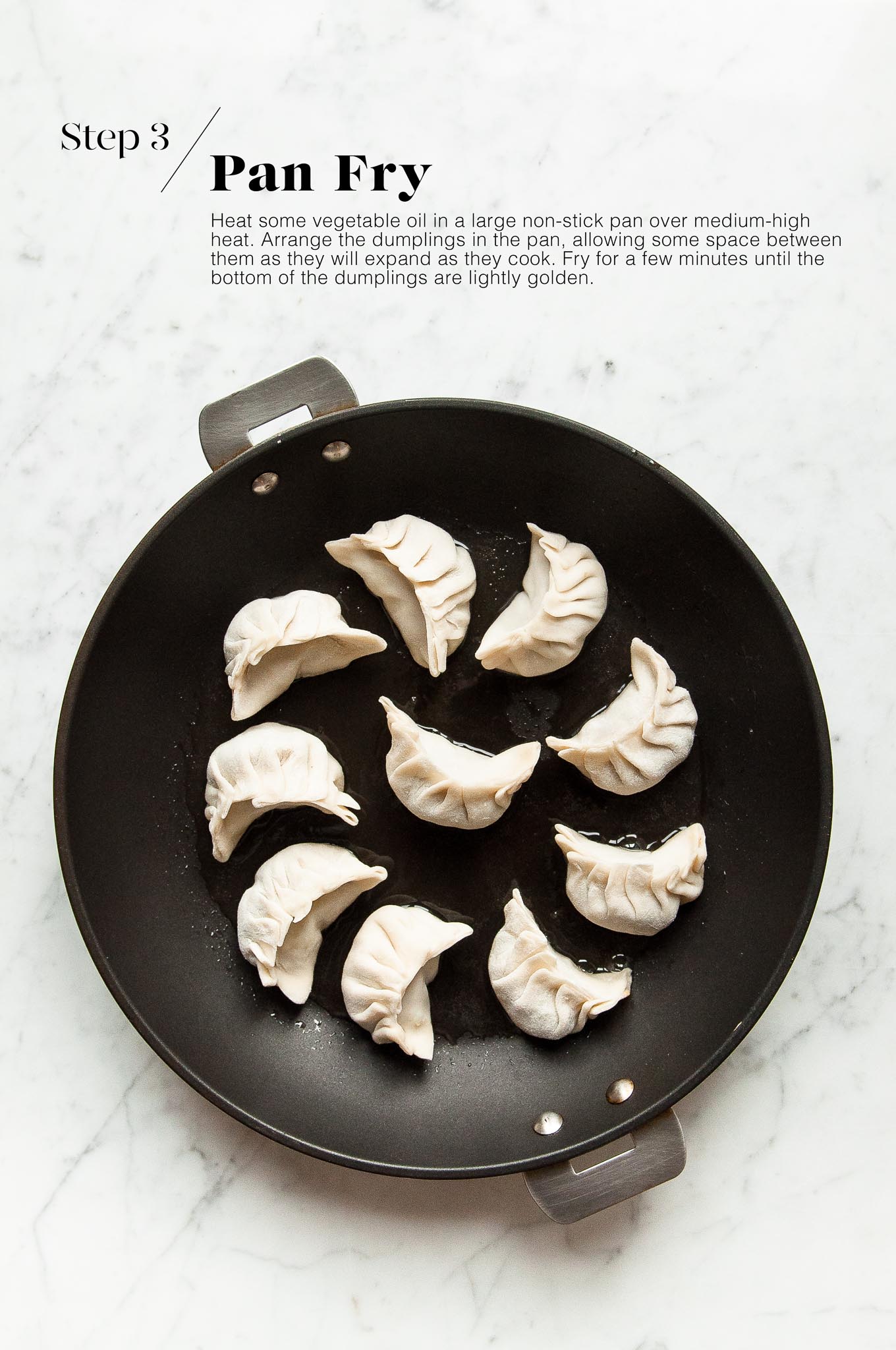
Heat some vegetable oil in a large non-stick pan over medium-high heat.
Arrange the dumplings in the pan, allowing some space in between as these dumplings will expand a little upon cooking.
Step 4
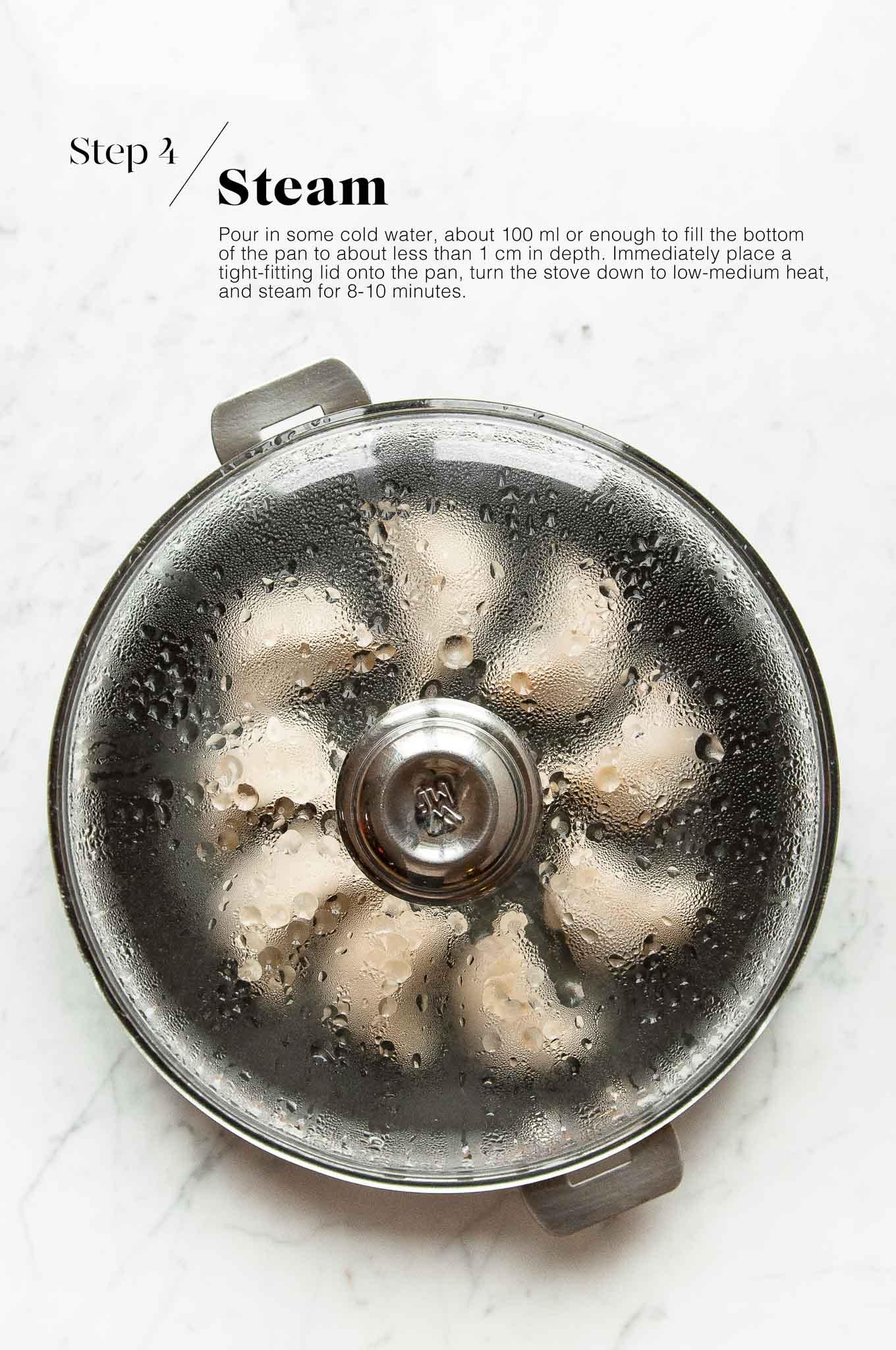
Once the dumplings are lightly golden on the bottom, pour in about 100 ml cold water, or enough to fill the sides of the pan to less than 1 cm in height.
Immediately place a tight-fitting lid on the pan, turn the stove down to low-medium heat. I like to use a glass lid so that I can see what is happening in the pan.
Let the dumplings steam for about 8 to 10 minutes, depending on the size of your dumplings. At the end of this time, most – if not all – of the liquid will have evaporated.
Step 5
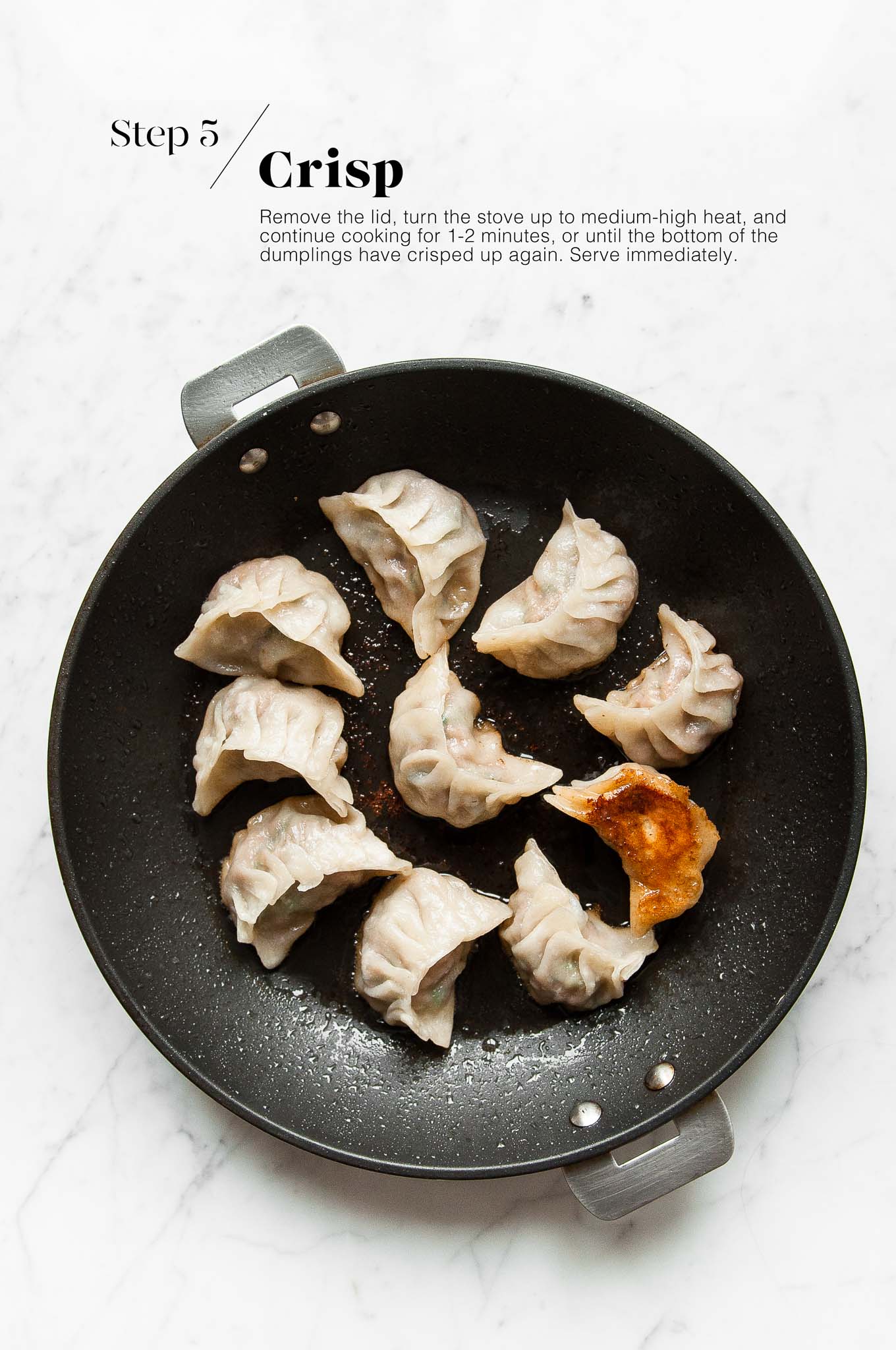
Remove the lid, turn the stove up to medium-high heat, and continue cooking the dumplings for a further 1-2 minutes until the bottoms have crisped up again.
Serve immediately.
What to Serve with Potstickers
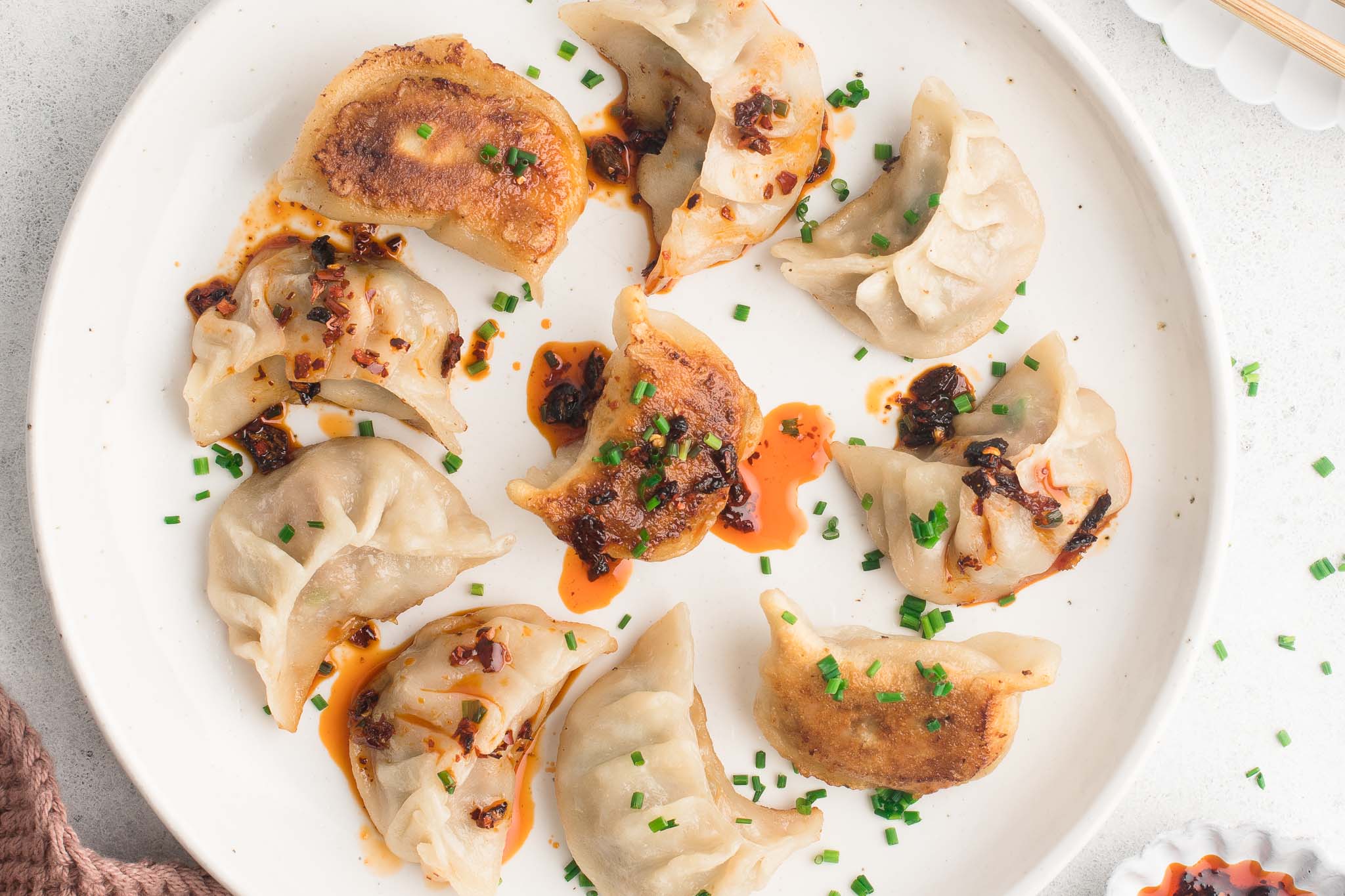
If I am serving these dumplings as a meal, I am usually happy to eat a plate of them just as they are. At other times, I will make some plain steamed Jasmine rice for the kids, as well as some steamed greens on the side – broccoli, more bok choy or pak choi – or perhaps a fresh cucumber salad.
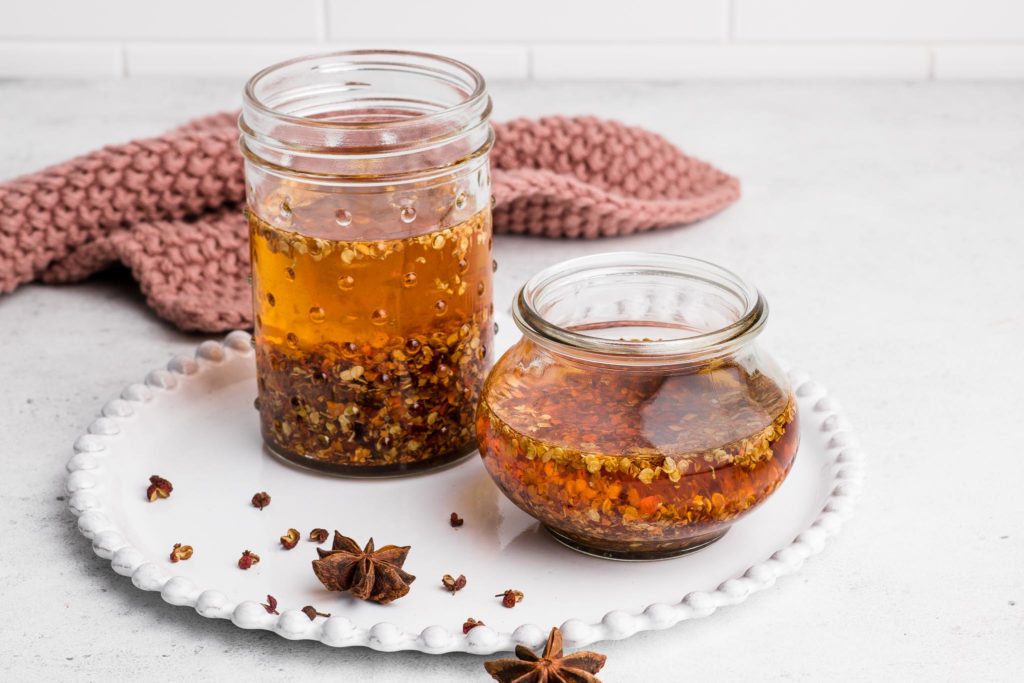
Some Homemade Chilli Oil is obligatory in my book, mixed with some soy sauce and a dash of Chinese black vinegar.
But my kids simply love to dip these dumplings in a little bowl of (low sodium) soy sauce.
Pork and Vegetable Potstickers

Ingredients
For the Homemade Dumpling Wrappers
- 300 g (2 cups) plain flour, (all-purpose flour)
- pinch fine salt
- 200 ml (¾ cup plus 2 teaspoons) boiling water
For the Dumpling Filling
- 300 g (11 oz) minced pork, (ground pork)
- ½ teaspoon baking soda
- 1 teaspoon cornflour
- 1 ½ teaspoon fine salt
- 1 teaspoon sugar
- 1 teaspoon freshly cracked pepper
- 1 tablespoon Shaoxing cooking wine
- 1 teaspoon dark soy sauce
- 1 teaspoon soy sauce
- 2 tablespoons sesame oil
- 1 tablespoon fresh ginger, coarsely grated
- 1 garlic clove, finely grated
- 2 tablespoons coriander, (cilantro) finely chopped
- 1 tablespoon spring onions, (scallions) finely chopped
- 200 g (7 oz) bok choy or pak choi, finely chopped
To Cook
- 2-4 tablespoons vegetable oil
- cold water
For the Dumpling Dipping Sauce
Instructions
For the Homemade Dumpling Wrappers
- Please see my recipe for Homemade Dumpling Wrappers with step-by-step photos.
To Make the Dumpling Filling
- Place all of the ingredients into a large mixing bowl.
- Use a pair of chopsticks to mix everything together by continuously stirring clockwise.
- Keep stirring until the texture of the filling changes to become almost paste-like and thick.
To Shape the Dumplings
- Place 1 tablespoon of filling the centre of the dumpling wrapper.
- If you are right handed, use your right thumb and forefinger to pleat the edge facing outwards, from right to left. Meanwhile, your left thumb is used to keep the filling inside the dumpling. Press the pleats tightly to ensure that everything is well-sealed.
- Place the dumplings onto a large tray or plate which has been lightly dusted with flour.
- Repeat the above steps with the remaining dumpling wrappers and filling.

To Cook the Potstickers
- Heat a few teaspoons of vegetable oil in a large non-stick pan which has a tight-fitting lid over medium-high heat.
- Arrange the dumplings in the pan, allowing some room between each dumpling as they will expand upon cooking.
- Cook for a few minutes until the bottom of the dumplings are lightly golden.
- Pour about 100 ml (⅓ cup) of cold water into the pan, or enough water to cover the bottom of the pan to just less than 1 cm in height.
- Quickly place the lid on the pan.
- Turn the stove down to low-medium heat.
- Steam the dumplings for 8-10 minutes (the timing will vary depending on the size of your dumplings). Towards the end of the steaming time, most – if not all – of the water will have evaporated.
- Remove the lid.
- Increase the stove to medium-high heat.
- Continue cooking the dumplings for 1-2 minutes or until the bottom of the dumplings have crisped up again.
- Serve immediately.
To Serve
- For each person, make a dipping sauce of soy sauce mixed with Chinkiang vinegar to taste, plus some Homemade Chilli Oil for those who like things spicy.
- Garnish the potstickers with coriander (cilantro) or chives.
To Make the Dumpling Dipping Sauce
- In a small sauce bowl for each person, pour 1-2 tablespoons of soy sauce, and then add enough Chinese black vinegar and/or chilli oil to taste.
Kitchen Notes
- VARIATIONS
* Substitute the bok choy for Chinese cabbage (Napa cabbage) or green beans.
* Substitute the pork for minced chicken (ground chicken). - USING READY-MADE DUMPLING WRAPPERS
If time is tight, you can use shop-bought, ready-made dumpling wrappers which are typically found in the fridge or freezer section of your supermarket or Asian grocer. Look for those which are suitable for potstickers or gyozas. - FREEZING DUMPLINGS
Uncooked dumplings can be frozen. Place them on a tray lined with baking paper, and place the tray into the freezer. Once the dumplings are frozen, place them into a zip-lock freezer bag in the freezer. To cook them as per the recipe above, simply cook them from frozen, but steam them for an extra 2-3 minutes. - RECIPE CREDIT
This recipe is adapted from the Dumpling Sisters. - OVEN & STOVE TEMPERATURES
All recipes on this website have been tested on an induction stove and/or with a conventional oven (i.e. an oven without fan). All recipes on this website use temperatures for a conventional oven, unless otherwise mentioned. Convection ovens (i.e. fan-forced ovens) are typically 20°C/70°F hotter than conventional ovens, but please check your manufacturer’s handbook. - CONVERSIONS
To convert from cups to grams, and vice-versa, please see this handy Conversion Chart for Basic Ingredients.
Did you make this recipe?
Please leave a comment below and share your photos by tagging @eatlittlebird on social media and using #eatlittlebirdUpdate
This recipe was first published on 15 December 2020. It has been updated with more comprehensive recipe notes.

I made these potstickers on the weekend with your dumpling wrapper recipe. Omg best potstickers ever!! I still need to work on my pleating but I definitely improved by the end of the batch. My mom (she’s Chinese) was so impressed. I’m going to try your bao buns next.
Delicious recipe! I used store bought gow gee wrappers but the filling was so delicious. I’m going to try your homemade dumpling wrappers next time. I’m so happy to find your blog!
Delicious dumpling recipe! I don’t normally use so much vegetables or even herbs in my filling, but you have now converted me. The taste was so fresh and light.
Fantastic recipe! I was also doubtful about the amount of bok choy in this recipe but it totally works. The filling had a good balance of meat and vegetables and was very tasty. Definitely making these again.
Beautiful recipe. Definitely a labor of love but the potstickers were worth it. The homemade wrappers were nice and chewy – I definitely prefer it to the store bought wrappers. Can’t wait to play around with the fillings next time.
I made your Potstickers for Lunar New Year and they were amazing! I even made the dumpling wrappers from scratch and couldn’t believe how easy it was. Thank you for your recipes!
My family loved these potstickers. I even made the dumpling wrappers from scratch. Very delicious!
I’ve tried several potsticker recipes and this one was absolutely delicious. The filling was really lovely and moist, and I liked that there was a lot of bok choy in the filling. I also made the dumpling wrappers from scratch, which was definitely worth it. Next time, I need to make the chilli oil too!
Definitely a labour of love but these potstickers are worth the time! The homemade wrappers were a wonderful texture and the filling was so juicy and tasty. Absolutely delicious!
I highly recommend this recipe! The potstickers AND the dumpling wrappers were so tasty. I can’t wait to make them again!
This is such a delicious recipe! The pork filling was nice and juicy, and I loved all the greens in the filling.
Fantastic recipe! My kids helped me to shape the dumplings, so some of them looked better than others. But they all tasted delicious!
Excellent recipe! I highly recommend it. Nothing beats homemade dumplings.