

 by
by 
Pastry Cream Recipe
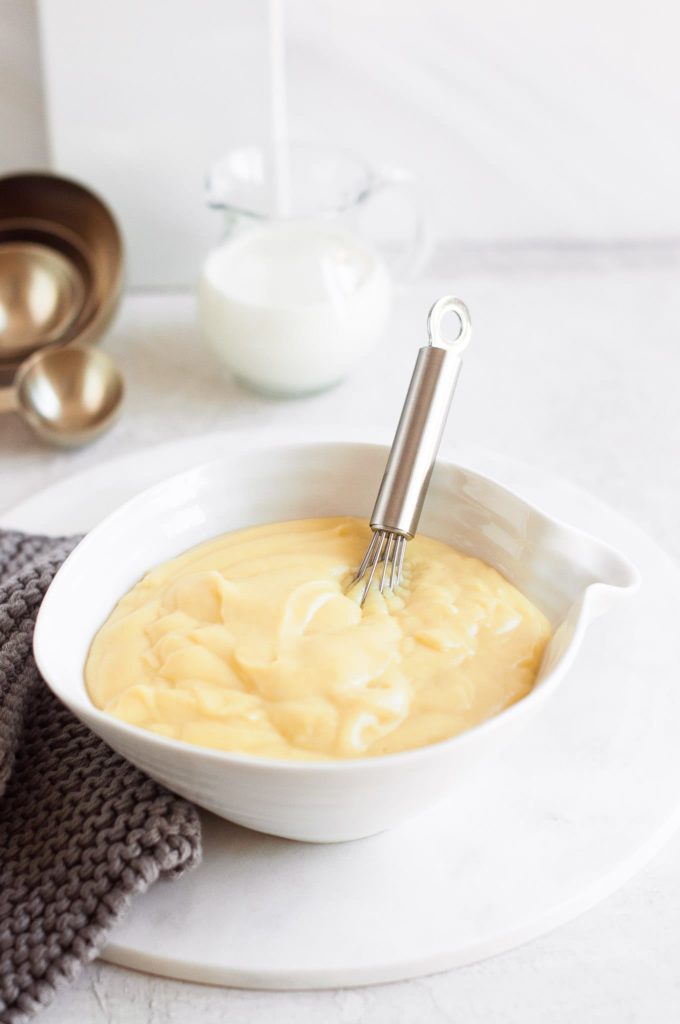
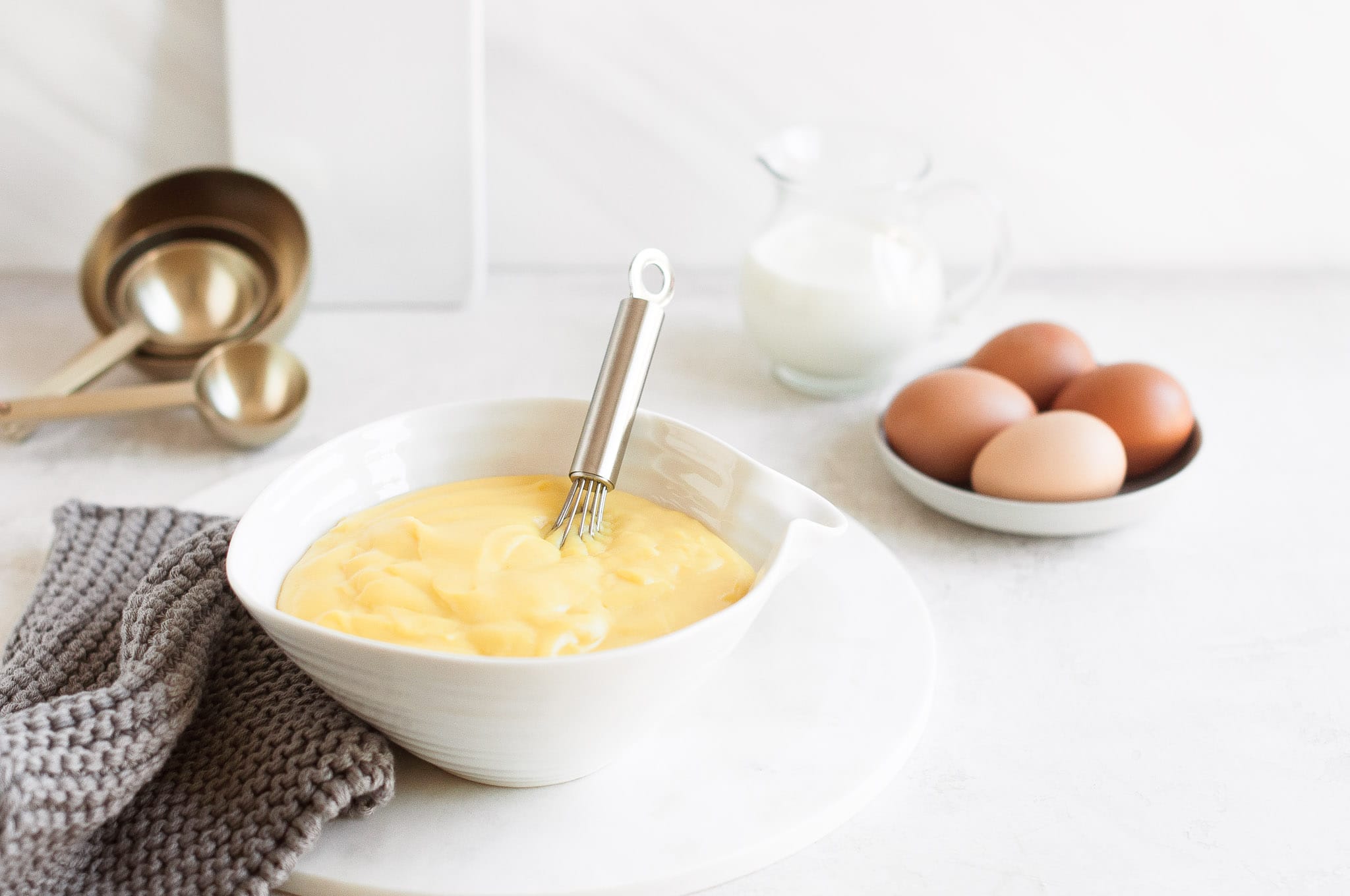
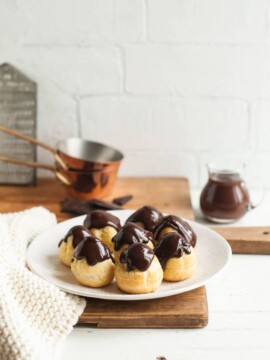
Pastry cream is a popular component of many French desserts. It is a thick, vanilla custard which you will often find inside Profiteroles or Éclairs, spread between the layers of a Millefeuilles, or used as the filling for fruit tarts.
In France, it is called crème pâtissière.
In the US, crème pâtissière is called pastry cream.
In Australia, the UK and many other countries, crème pâtissière is sometimes known as vanilla custard. However, there are different types of custard – pouring custard or thickened custard – which can make the term “custard” a bit confusing to use sometimes.
What is Crème Anglaise?
Crème anglaise is the French term for what the non-French would call a thin pouring custard, typically served alongside desserts and puddings common in British cooking (hence the name).
A crème anglaise uses the same ingredients as that for a crème pâtissiere, except for the addition of a stabilising agent like cornflour (cornstarch) or flour.
Hence, making crème anglaise requires a bit more technical skill, especially since the custard is at risk of splitting or curdling if it becomes too hot.
What is Crème Pâtissière?
Crème pâtissière is a thickened vanilla custard. It is a custard made using cornflour (US: cornstarch) or flour to thicken the mixture, giving it stability for uses in desserts like profiteroles or éclairs.
Crème pâtissière is much easier to make than crème anglaise as there is little to no risk of the mixture splitting or curdling.
How to Make Crème Pâtissière
Making crème pâtissière is relatively quick and easy because the flour in the mixture helps to bind and thicken the ingredients without any risk of splitting or curdling.
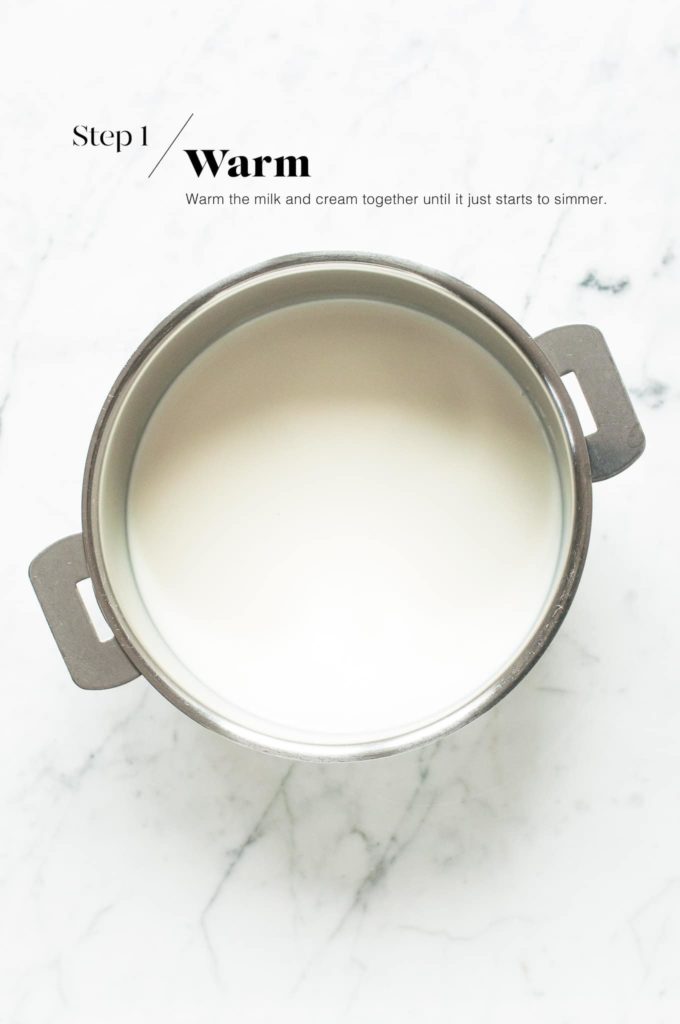
Step 1
Start by warming the milk and cream together in a medium-sized saucepan. I also like to add a splash of vanilla extract at this stage to intensify the vanilla flavour.
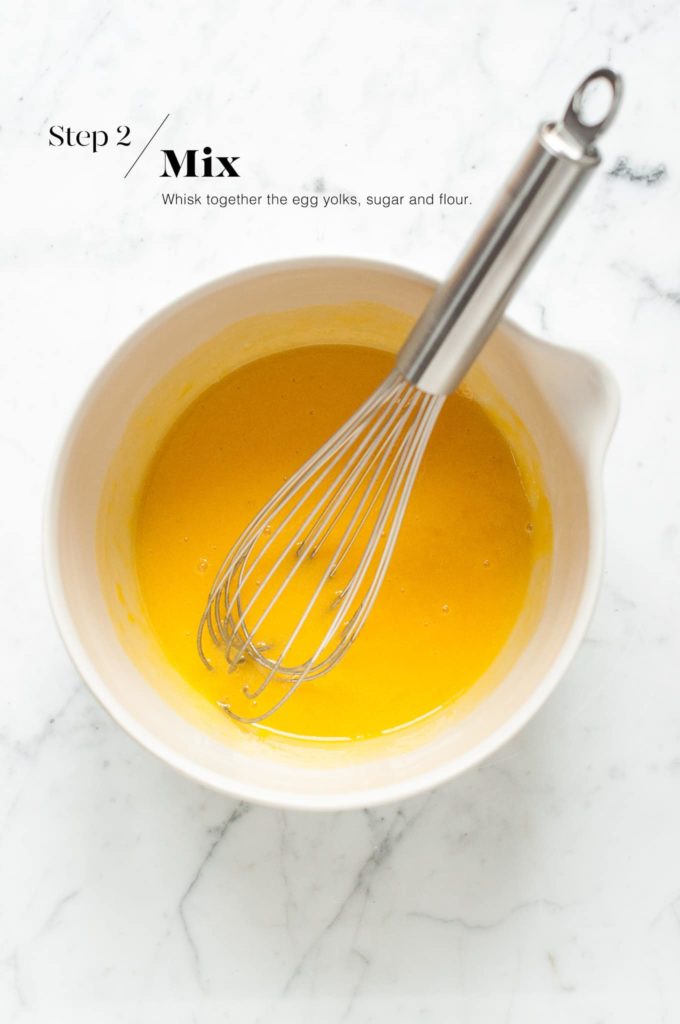
Step 2
Meanwhile, whisk together the egg yolks, sugar, and flour in a large bowl, preferably with a pouring lip.
Step 3
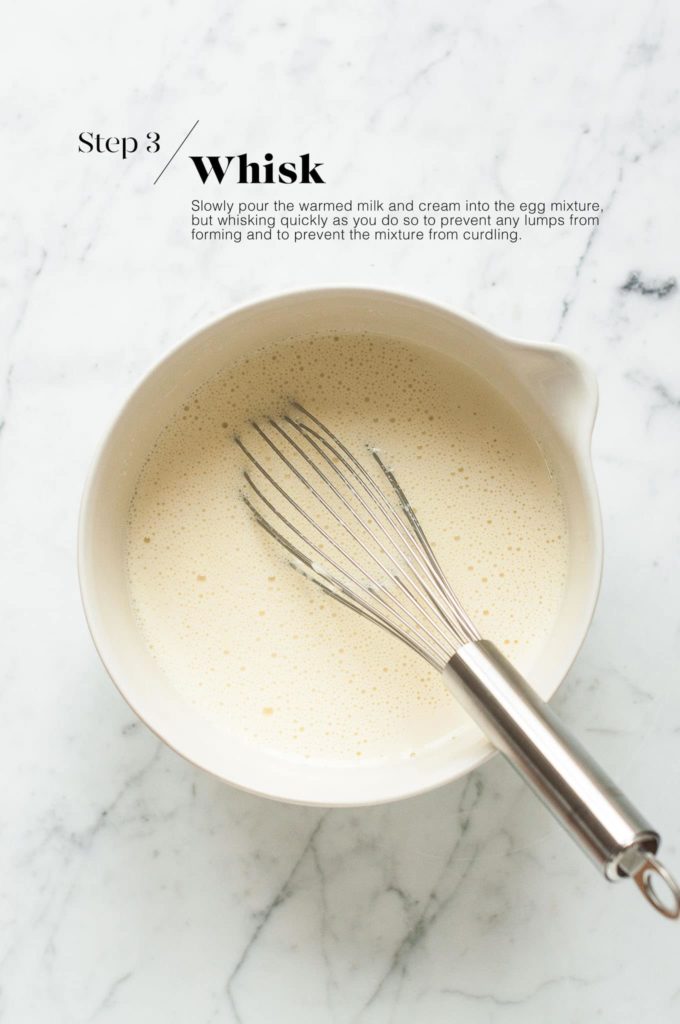
Once the milk and cream is just about to simmer, slowly pour it into the egg mixture, whisking quickly as you do so to prevent any lumps from forming, and to stop the egg mixture from scrambling.
It is a good idea to place a wet cloth under the bowl to stop it from moving while you are whisking.
Step 4
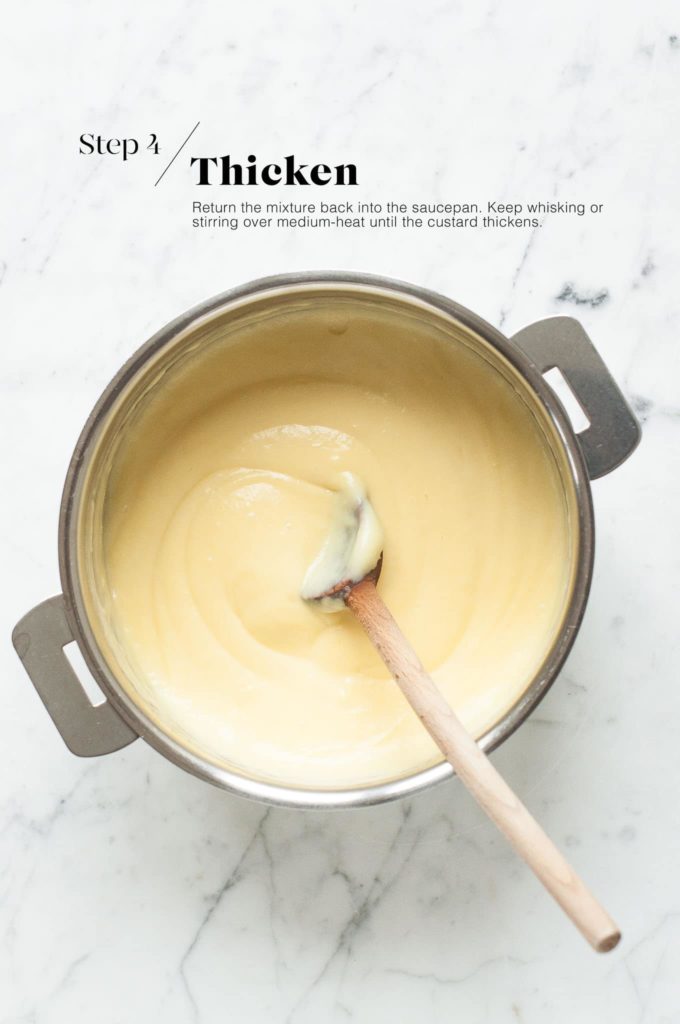
Pour this mixture back into the saucepan, and return the saucepan to the stove.
Continue to whisk over medium heat until the custard thickens considerably. This should only take a few minutes. The custard should be thick and smooth, and free from any lumps.
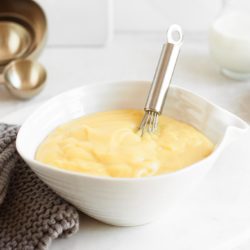
Pour the custard into a large bowl. Cover the bowl with a sheet of clingfilm pressed against the custard to prevent a skin from forming.
Crème Pâtissière (Pastry Cream or Vanilla Custard)

Ingredients
- 250 ml (1 cup) milk, (whole milk), 4% fat
- 250 ml (1 cup) double cream, (heavy cream), 35% fat
- 1 teaspoon vanilla extract
- 6 large egg yolks
- 100 g (½ cup) caster sugar, (superfine sugar)
- 30 g (4 tablespoons) plain flour, (all-purpose flour)
Instructions
- Pour the milk and cream into a medium-sized saucepan.
- Add the vanilla extract.
- Warm the mixture until it just starts to simmer.
- In a large bowl or jug, beat together the egg yolks and sugar, and then whisk in the flour.
- Slowly pour the warm milk and cream mixture into the egg mixture (not the other way around or else you will have scrambled eggs), whisking as you do so until the custard is smooth.
- Pour this mixture into a clean saucepan and whisk gently over medium heat until the custard thickens. This should take only a few minutes.
- Continue whisking for another 1-2 minutes to allow the mixture to release a few bubbles.
- Pour the custard into a bowl and set aside to cool.
- I recommend covering the bowl with a layer of clingfilm pressed against the custard to stop a skin from forming.
Kitchen Notes
- OVEN & STOVE TEMPERATURES
All recipes on this website have been tested on an induction stove and/or with a conventional oven (i.e. an oven without fan). All recipes on this website use temperatures for a conventional oven, unless otherwise mentioned. Convection ovens (i.e. fan-forced ovens) are typically 20°C/70°F hotter than conventional ovens, but please check your manufacturer’s handbook. - CONVERSIONS
To convert from cups to grams, and vice-versa, please see this handy Conversion Chart for Basic Ingredients.
Did you make this recipe?
Please leave a comment below and share your photos by tagging @eatlittlebird on social media and using #eatlittlebirdUpdate
This recipe was first published 5 October 2018. It has been updated with new photos.


Great recipe! Thanks for the step by step photos – very helpful!
Glad you enjoyed the recipe!
Creme patissiere is not as complicated as it sounds. Thanks a bunch, Thanh! ?
I’ve made pastry cream several times now but I’ve always used cornstarch to thicken it. A few weeks ago I came across a few recipes that used flour only and the creator said it was safe for us to freeze any leftovers. Can I do the same with yours? One last question. How much does this make? To be honest yours is the first recipe I’ve come across that seems so easy to make even though we have to temper the mixture….
Hi Tammie,
Sorry for my late reply. I have never tried to freeze pastry cream, but I think it would be fine to freeze this recipe. This recipe makes about 3 cups of pastry cream. Hope this helps.
STEP 3 – One moment, you say to ‘whisk the mixture together quickly’, but in the image which follows this, you contradict yourself and state to ‘whisk slowly’.
??????
Hi Phil,
Sorry for the confusion! I have corrected the image above. You should pour the warmed milk and cream slowly into the egg mixture, but whisk quickly as you do so. Thanks for pointing this out to me.
Very good, and not that difficult to make. I did get a few lumps but that was my fault–I stopped whisking a little too soon. Nothing a good sieve cant fix!
Very good recipe!
Great, easy to follow recipe.
I have never made one before but this was easy to follow and comes out well.
Hi Jon,
Glad this recipe worked out well for you!
I am going to try this recipe to make little tarts with fruits on top.
Question, can i make the crème pâtissière the day before I use it
This was so easy! I have avoided making cremr patisserie because I thought it was complicated and scary. This recipe is super simple and easy to follow! Thanks!
Happy to report, I halved the recipe for use for donuts and used bob’s red mill 1:1 gluten free baking flour and this recipe worked perfectly! Thanks!
Hi Steph,
So glad this recipe worked out great for you!
Wonderfully simple recipe! I added 3 tablespoons of cubed butter after removing it from the heat. Came out perfect
Hi Michelle,
Glad you enjoyed this recipe!