

 by
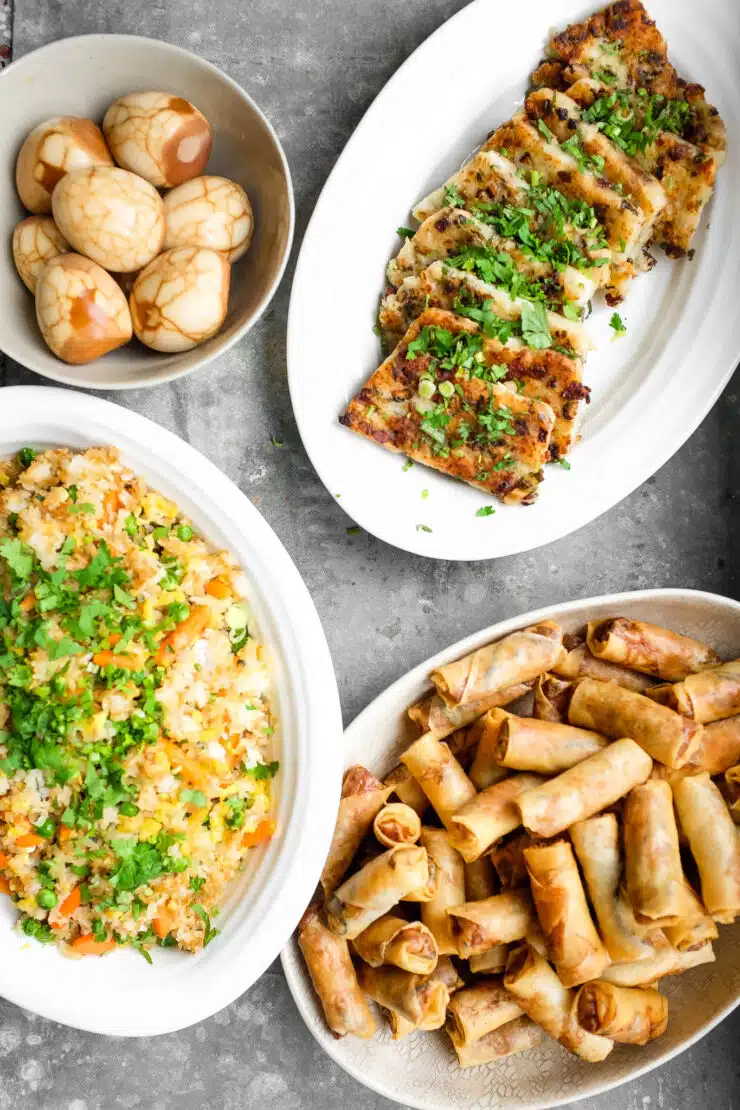
by Lunar New Year Menu
Following on from my previous post where I shared my recipe for Chinese Turnip Cake, it seemed only fitting to also include my recipe for Chinese Tea Eggs.
If you are planning a Lunar New Year lunch or dinner, or any Chinese-inspired feast, these Chinese Tea Eggs are great to include in the menu, not least because they can be made well ahead of time.
Chinese Tea Eggs
My initial motivation for making Chinese Tea Eggs was to get our children to eat boiled eggs. Our picky four-year-old has never liked eating plain boiled eggs, which therefore often rules out many quick and easy-to-make lunch or snack ideas which are meant to work for children his age.
Then he went through a stage where he would only eat the eggwhites, or only the yolks, but never the two combined.
So one day, I thought of making these Chinese Tea Eggs as a way of flavouring the eggs, and now he happily eats 2 to 3 whole eggs with his rice and vegetables!
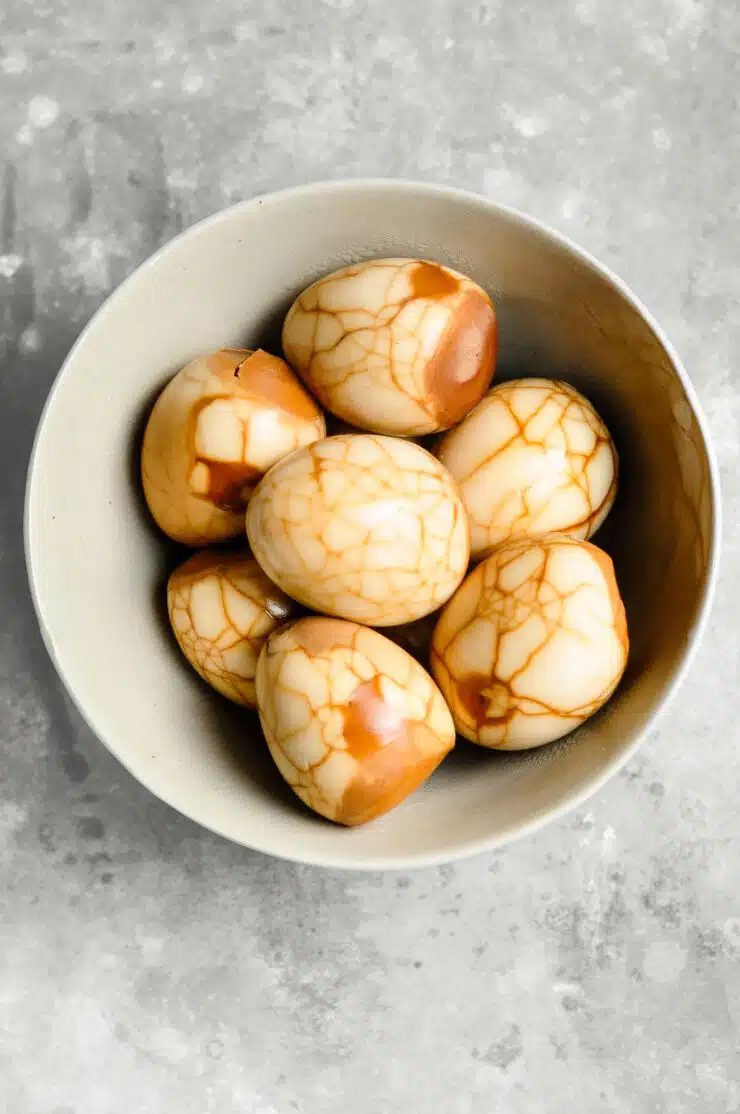
Chinese Tea Eggs Recipe
Admittedly, Chinese Tea Eggs involve a bit of preparation and planning, but there is very little cooking itself to be done; you just need to be patient to let the eggs cook and steep in the tea mixture for a few hours.
The tea mixture itself is comprised of a few ingredients plus, of course, some tea leaves for both colour and flavour. As this is a Chinese dish, I like to use Jasmine tea leaves in this recipe, but the orange flavours in Lady Grey also works really well.
Most of the flavour of these tea eggs comes from soy sauce, which is why they are sometimes also called “Soy Sauce Eggs“, although recipes for the latter don’t always include tea leaves.
The eggs, once cooked in the tea mixture, keep well in the fridge for several days, and need only be reheated in the tea mixture for an instant snack or quick meal.
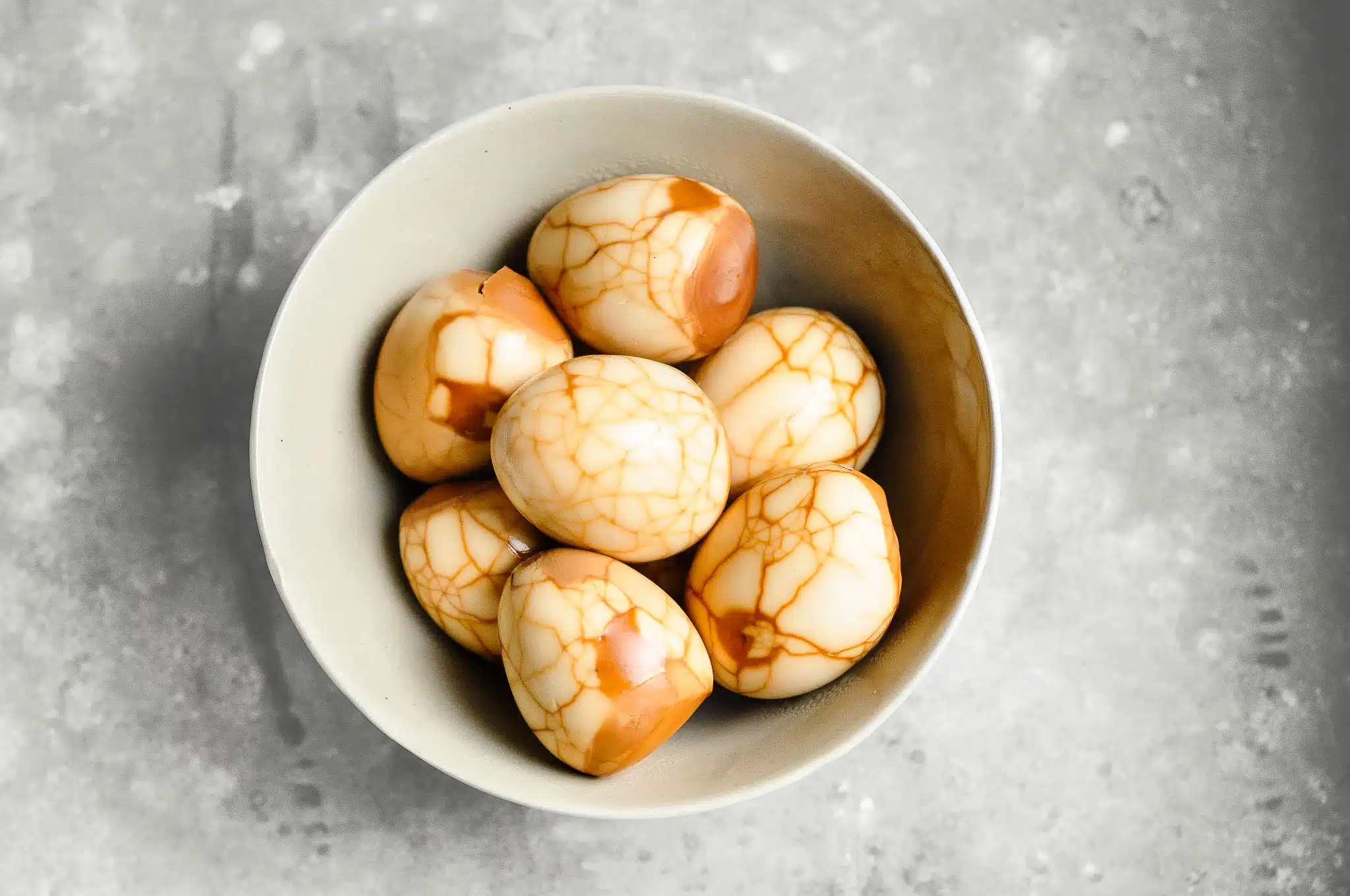
And whilst the marbled eggs themselves look very impressive at the table, I happen to think there is much comfort in serving boiled eggs as part of a meal. These Chinese Tea Eggs just take it up a notch.
Chinese Tea Eggs

Ingredients
- 12 eggs
For the Braising Liquid
- 1 litres (4 cups) water
- 2 tablespoons Lady Grey or Jasmine tea leaves
- 125 ml (½ cup) soy sauce
- 2 star anise
- 1 cinnamon stick
- 1 tablespoon light brown sugar, or dark brown sugar
Instructions
To Prepare the Eggs
- Use a needle or similar instrument to pierce a small hole in the base of each egg. This will help you to peel the eggs easily later.
- Place the eggs in a large pot filled with cold water.
- Bring to a boil and cook over medium-high heat for 10-12 minutes.
- Drain the eggs.
- Place the eggs in a large bowl of cold water in the sink.
- When the eggs are cool enough to handle, use a teaspoon to gently tap the eggs all over until they are lightly cracked but the shell still remains intact around the egg. The cracks will allow the tea mixture to seep through the shell and marble the eggs and to add flavour.
To Braise the Eggs on the Stove
- Put all of ingredients for the braising liquid into a large saucepan.
- Bring the mixture to a boil, and then turn it down to a low simmer.
- Gently place all of the cracked eggs into the saucepan.
- Simmer over very low heat for about 3 hours.
- You can serve the eggs right away, or leave the eggs to cool completely in the saucepan in the tea mixture and place it in the fridge overnight. If the latter, the eggs will take on more flavour from the tea mixture. To serve, gently heat the eggs in the tea mixture over medium-high heat until they are completely warm through.
- You can serve the warm eggs as they are and allow your guests to peel the eggs at the table, but I usually peel them first so that everyone can admire the marbled texture on the eggs.
To Steep the Eggs in the Fridge
- Put all of ingredients for the braising liquid into a large saucepan.
- Bring the mixture to a boil.
- Set the liquid aside to cool to room temperature.
- Place all of the cracked eggs into a glass container or bowl where they will fit snugly. Alternatively, a large ziplock freezer bag also works well.
- Poor the cooled braising liquid over the eggs.
- Cover the container (or seal the bag).
- Place the eggs in the fridge to steep for 12 to 24 hours.
Kitchen Notes
- STORAGE
Once the eggs are removed from the marinade, they can keep in the fridge for 2-3 days. - OVEN & STOVE TEMPERATURES
All recipes on this website have been tested on an induction stove and/or with a conventional oven (i.e. an oven without fan). All recipes on this website use temperatures for a conventional oven, unless otherwise mentioned. Convection ovens (i.e. fan-forced ovens) are typically 20°C/70°F hotter than conventional ovens, but please check your manufacturer’s handbook. - CONVERSIONS
To convert from cups to grams, and vice-versa, please see this handy Conversion Chart for Basic Ingredients.

I’m literally obsessed with boiled eggs haha!! I just love them and these look absolutely delicious; what a great way to switch up a plain egg!
Then we have something in common! Thanks for popping by 🙂
Wow I’ve never heard of Chinese tea eggs before! But this looks very interesting
They can look a bit strange to the unaquainted, but I can assure you that they are delicious 🙂 They are essentially hard-boiled eggs cooked in a soy sauce mixture.
I’ve never heard of these! But they look yummy and I’m sure my husband (who is a huge egg fan) would love them!
I hope you will enjoy the recipe!
Very pretty way to make a boiled egg attractive. My kids will love this. Nice idea for a brunch, too.
Indeed, it’s an unusual way of cooking eggs, but they taste and look delicious 🙂
I have always been intrigued by these eggs. I think they are so pretty. I have yet to try them.
I didn’t make these for a long time because I thought they were tricky to make, but it turns out that they are incredibly easy to make. It just takes time for the eggs to cook, that’s all.
I made these for Chinese New Year this year and they were so delicious! Goes so well with rice.
I am going to make this! Perfect! Looks tasty and healthy! Yum!