

 by
by 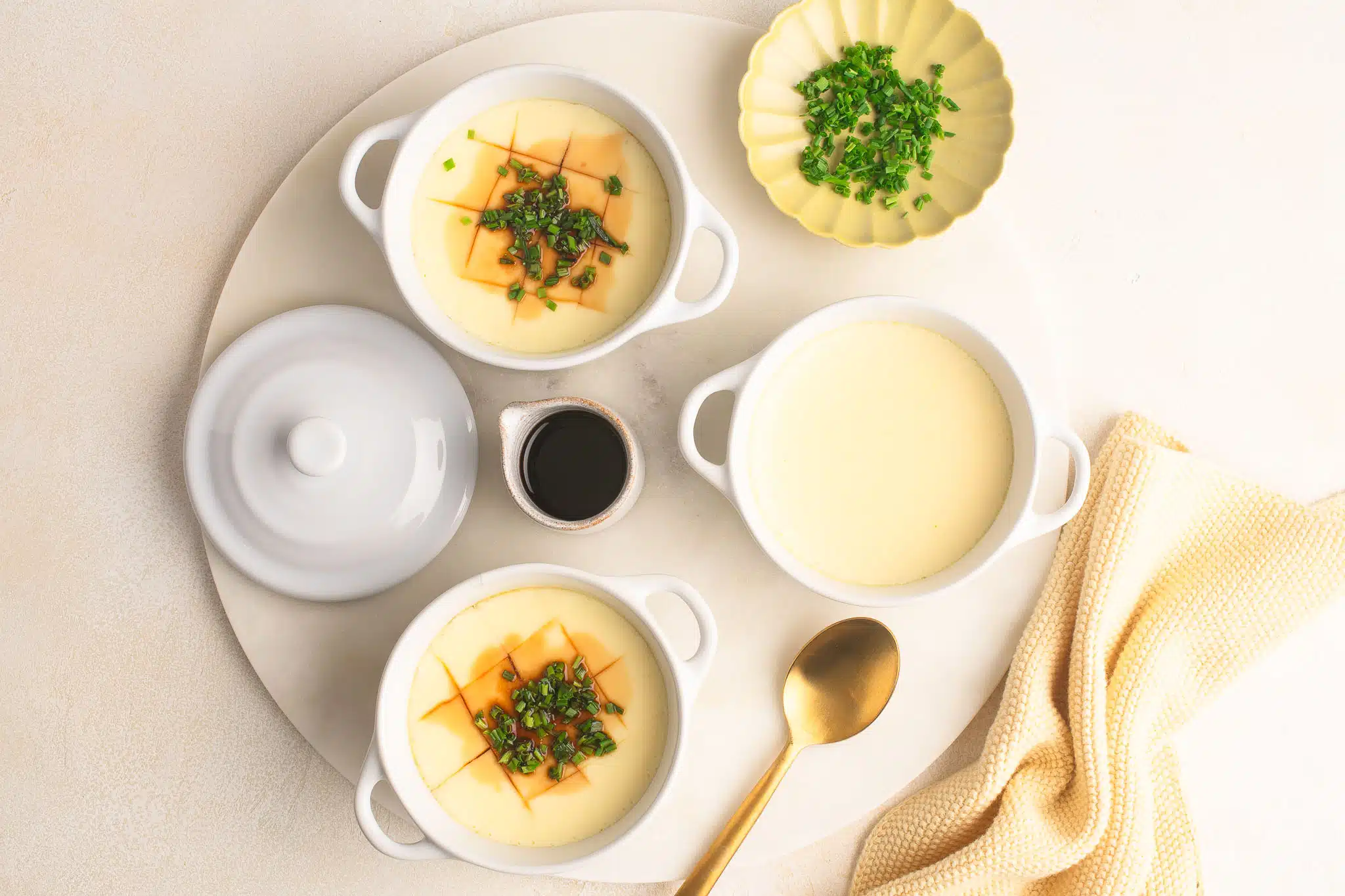
Chinese Steamed Eggs
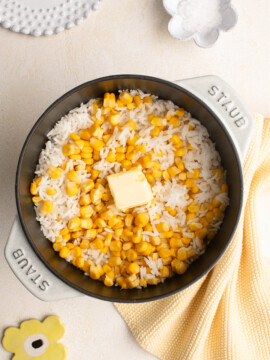
One of the easiest, tastiest and healthiest dishes you can make is Chinese Steamed Eggs. In fact, often on those nights when I am too tired to cook and I am lucky to find eggs in the fridge, I can whip up this dish to serve with some steamed rice (whether freshly cooked or defrosted from the freezer), and call it a meal. In fact, you could serve it with Steamed Rice with Corn and that’s your vegetable component also sorted!
Steaming is also a very healthy way to cook eggs, so you can make this dish and feel virtuous while eating it!
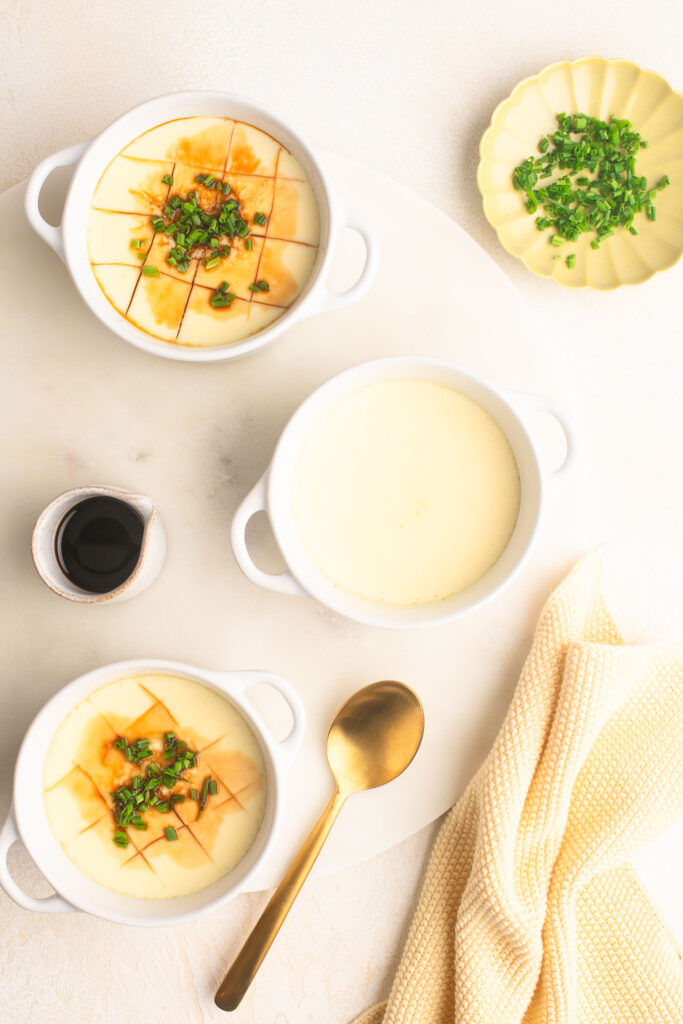
What are Chinese Steamed Eggs?
Chinese Steamed Eggs is a savoury dish where eggs are steamed to form a very soft-set and silky smooth custard. The texture is very similar to silken tofu. I would say that, if you are a fan of silken tofu, you will love Chinese Steamed Eggs.
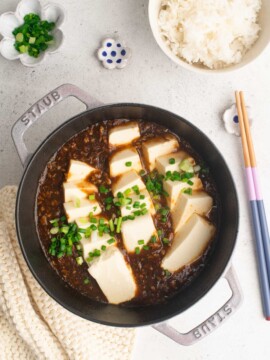
The easiest version of this dish is served simply with a drizzle of soy sauce, but it can also form the base of other Chinese-style dishes, e.g. served underneath spicy, stir-fried minced meat.
Recipe for Chinese Steamed Eggs
The simplest version of this dish is just eggs whisked with water and steamed until it is softly set. But for a more savoury version, you can substitute the water with vegetable stock or chicken stock.
My recipe for Chinese Steamed Eggs is simply: 1 egg per person, plus 100 ml of water or diluted stock.
I use medium-sized eggs which, in Europe, weigh approximately 53 g each.
You could be more scientific about this recipe and measure out the eggs by volume or weight, and add twice the amount of water, i.e. use a ratio of 1:2 of eggs to water. So if your eggs are larger than what I use, you might want to follow this formula.

How to Serve Chinese Steamed Eggs
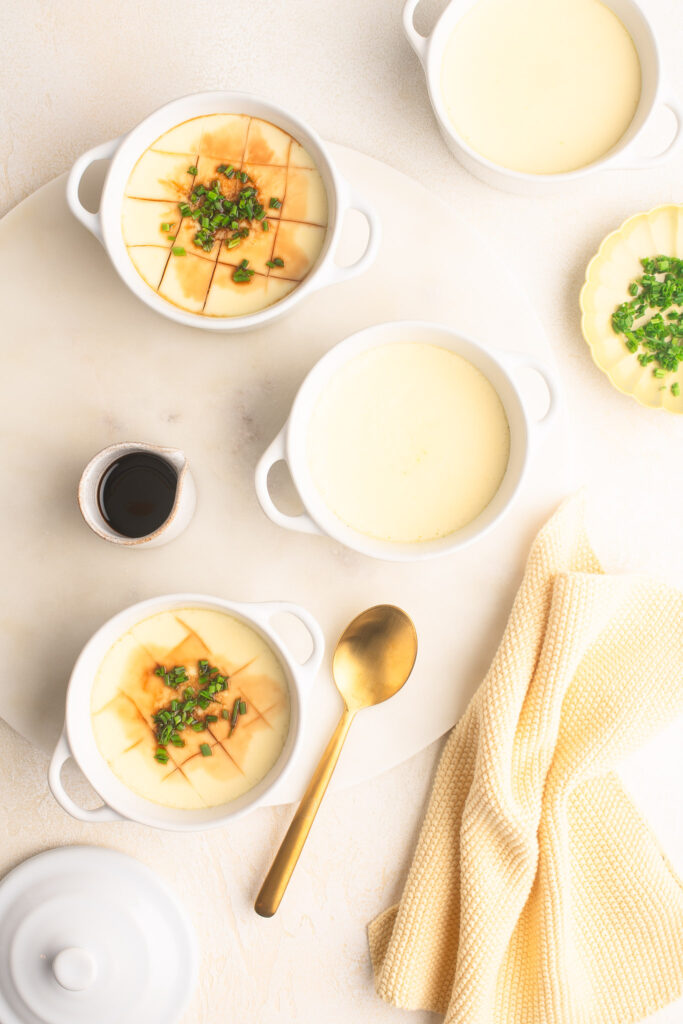
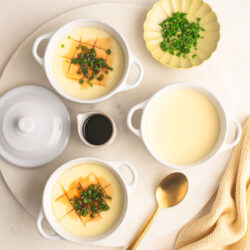
I like to make and serve Chinese Steamed Eggs in individual ramekins, similar to how the Japanese serve Chawanmushi. As the custard is very soft in texture, I find it easier to serve this dish in individual portions, plus my family like their eggs served with different types of sauces and toppings which they can customise to their liking.
I make Chinese Steamed Eggs in ceramic ramekins with lids, which I also happen to use for other egg dishes such as Steamed Whole Eggs (crack an egg into a ramekin, cover with a lid, and steam until the yolk is cooked to your liking) or Oeufs Cocotte (crack an egg into a ramekin with a tablespoon of crème fraîche and bake until the yolk is cooked to your liking).
If you don’t have ramekins with lids, you can also use regular ramekins or small heat-proof bowls and cover them either with a silicone lid, a small plate, or plastic wrap.
For one serving per person, a ramekin with 250 ml/1 cup capacity is sufficient, especially if you are also serving other side dishes.
You can also serve Chinese Steamed Eggs family-style by cooking it in a larger bowl, and increasing the cooking time. I recommend choosing a shallow bowl where the custard can be filled to about 2-3 cm high.
Ceramic ramekins like those shown in the photos work best for this recipe. Cast-iron ramekins would be too thick and require a longer time to heat up, plus a longer cooking time.
How to Make Chinese Steamed Eggs
Step 1
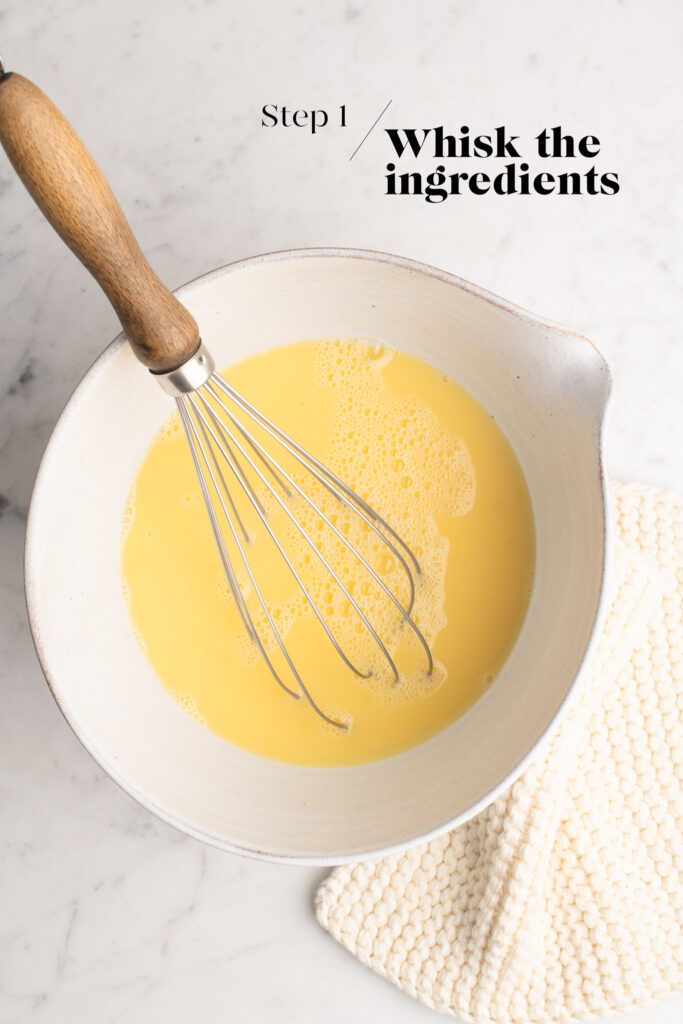
Whisk together the eggs, warm water, stock powder (if using) and salt in a large jug or bowl with a spout.
Bring a large saucepan half-filled with water to the boil. The saucepan should be large enough to fit the steamer you are using, and the steamer should be large enough to fit all 4 ramekins.
Alternatively, if you are using a steam oven, preheat the oven to 70°C/158°F.
Step 2
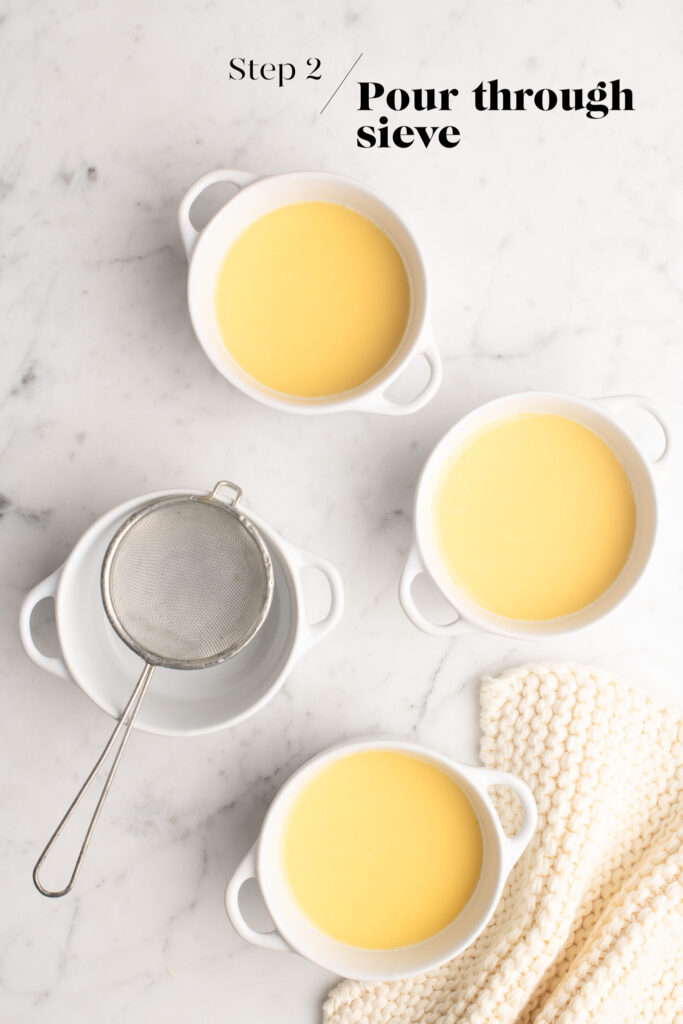
Carefully pour the mixture through a fine sieve into each ramekin. The sieve should capture any froth, bubbles, egg whites that had not dissolved, and any pieces of egg which had cooked if your water was too warm.
Use a teaspoon to remove any bubbles from the custard in the ramekins. Otherwise, any bubbles on the surface on the custard will remain during the cooking process.
Step 3
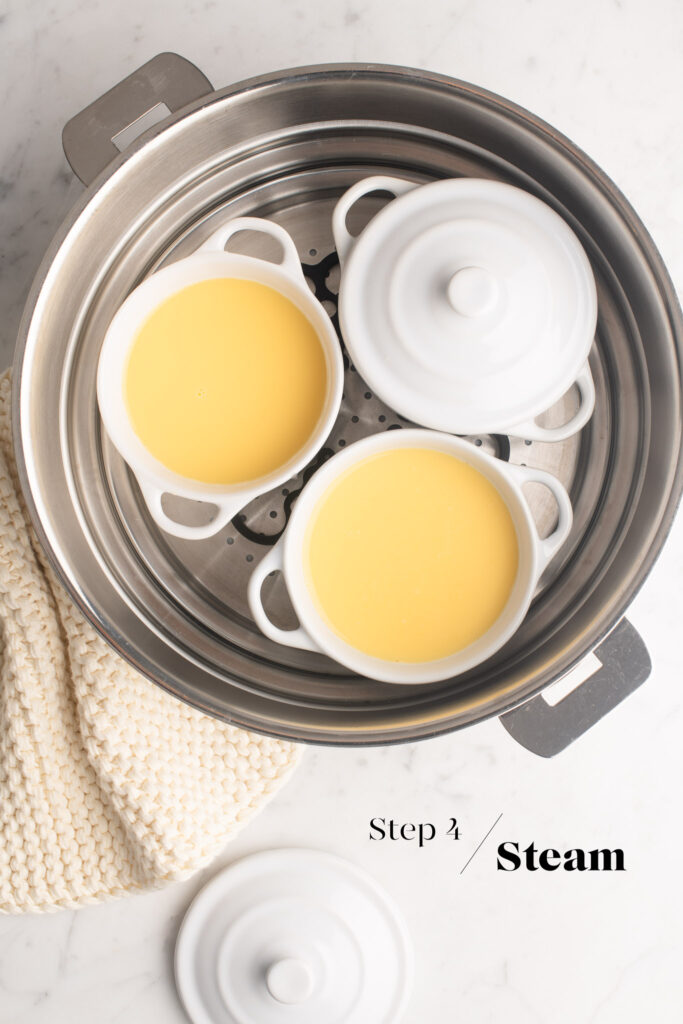
Carefully transfer the ramekins to a steamer which is large enough to fit all of them. Otherwise, steam them in batches.
To steam on the stove top, I use a stainless steel steamer (and ramekins without handles so there is more space), but a bamboo steamer would work equally well.
More often than not, I use my steam oven which can accommodate large serving bowls, as well as many ramekins with handles.
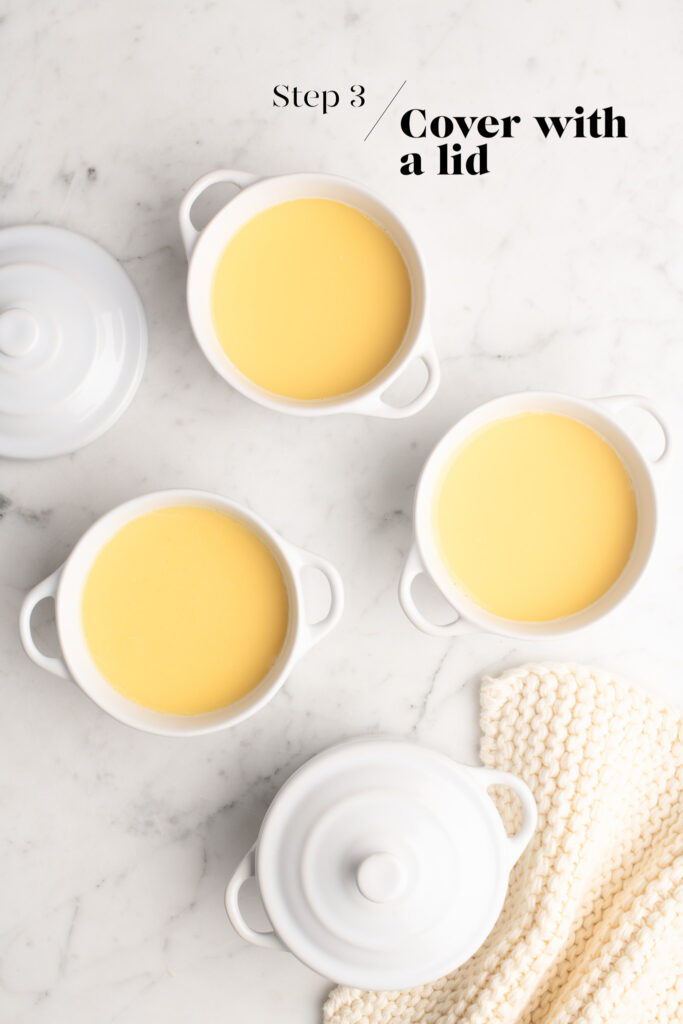
Cover each ramekin with a tight-fitting lid, a silicone lid, a small up-turned plate, or plastic wrap. If you don’t cover the ramekins, the custard will cook at a higher heat, which may scramble the eggs. Furthermore, condensation will fall from the lid onto the custard and pock-mark the surface. I find that the lids need to be tight-fitting, otherwise any steam that makes direct contact with the custard will result in a scrambled texture.
Step 4
Place a lid on the steamer, and cook at medium heat for about 12 minutes.
If you are using a steam oven, cook at 70°C/158°F for about 12 minutes.
Ideally, the custard should cook at a gentle heat to achieve a silky smooth texture. If the heat is too high, you risk scrambling or curdling the eggs.
The custard is cooked if, when you jiggle the ramekins slightly, the custard has a firm wobble.
Step 5
Carefully remove the ramekins from the steamer or steam oven, and remove the lids.
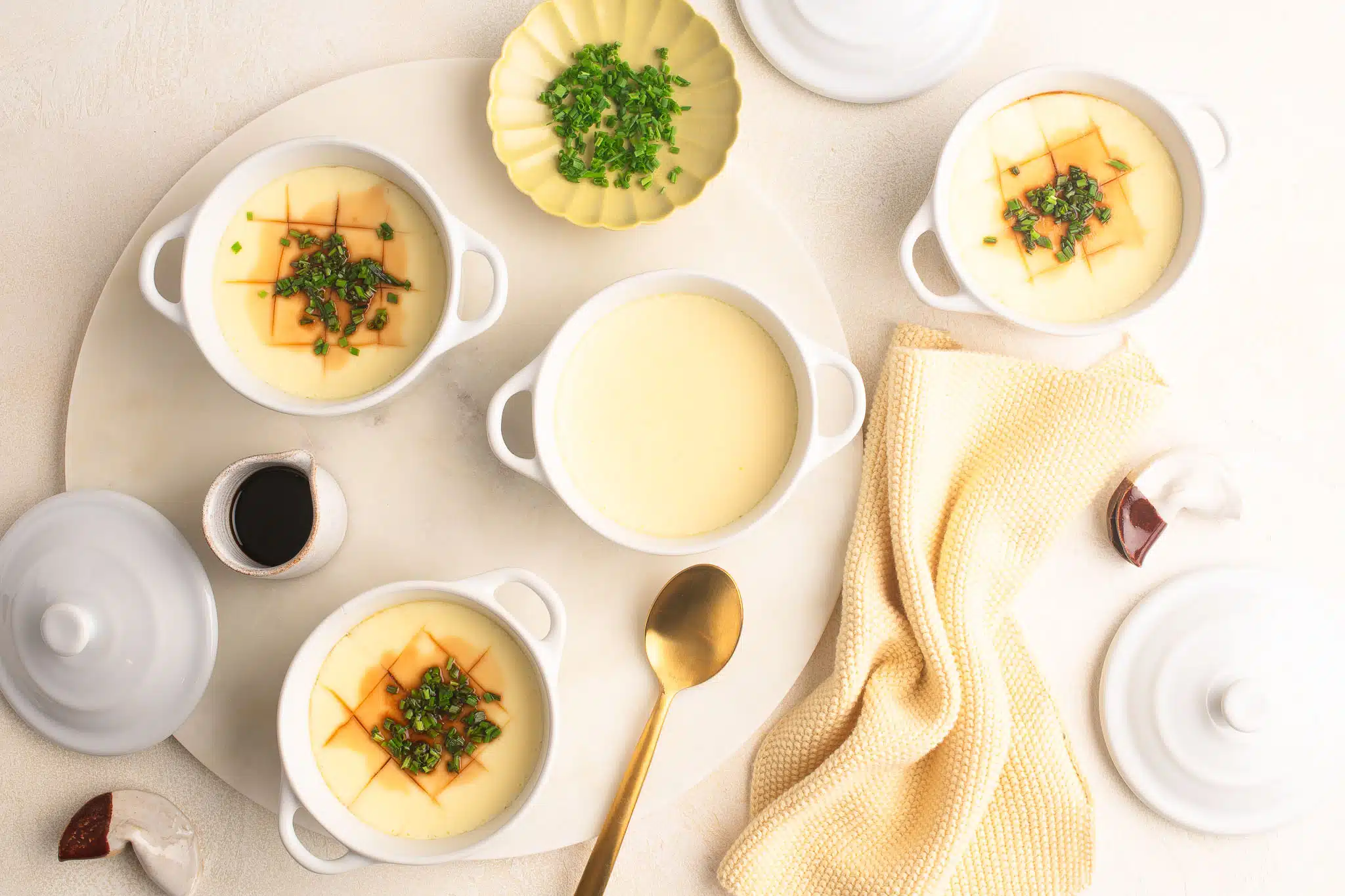
Use a sharp knife to score the custard (optional), drizzle with soy sauce and serve with any other toppings of your choice.
My kids like to have only soy sauce on their steamed eggs, whilst my husband and I enjoy it also with a dash of sesame oil. Occasionally, I will also drizzle my portion with some Homemade Chilli Oil and, whilst coriander (cilantro) is not traditionally used as a garnish, I love the freshness that it gives to any dish.
Tips for Making Chinese Steamed Eggs
- Ratio of 1:2. For each egg, you should use about twice as much liquid, give or take.
- Use warm water. If the custards are at room temperature when you start cooking them, this will help them to cook evenly and gently. The water should be at body temperature, either from the tap or from a mix of tap water and recently boiled water.
- Use a fine sieve. The sieve needs to be fine enough to strain the egg mixture to give it a silky smooth texture.
- Use a medium heat. The custard needs to cook on a gentle heat. Otherwise, if the heat is too high, the eggs will scramble or curdle.
Chinese Steamed Eggs

Ingredients
For the Chinese Steamed Eggs
- 4 eggs, approx. 53 g each (see Kitchen Notes)
- 400 ml (1 ⅔ cups) warm water
- ½ teaspoon chicken stock powder, or ½ chicken stock cube, optional
- 1 pinch sea salt
To Serve
- soy sauce, to taste
- sesame oil, to taste (optional)
- spring onions, (scallions) or chives, thinly sliced
- coriander, (cilantro) finely chopped (optional)
- Homemade Chilli Oil, to taste (optional)
- Steamed Jasmine Rice, or Steamed Rice with Corn
Instructions
For the Chinese Steamed Eggs
- If you are using a stove-top steamer, half-fill a saucepan with water and bring it to the boil.
- If you are using a steam oven, preheat it to 70°C/158°F.
- Whisk the eggs in a large jug or a bowl with a spout.
- Slowly whisk in the warm water and remaining ingredients.
- Pour the mixture through a fine sieve into 4 ceramic ramekins with a capacity of about 250 ml/1 cup. The sieve should be fine enough to strain any froth, bubbles, egg whites that had not dissolved, and any egg pieces which had cooked if your water was too warm.
- Use a teaspoon to remove any bubbles or froth from the surface of the custard. Any bubbles which are on the custard will remain there during cooking.
- Carefully transfer the ramekins to the steamer basket. If you are using a steam oven, you can place the ramekins on a large tray.
- Cover each ramekin with a tight-fitting lid. If your ramekins do not have lids, you can use silicone lids, small up-turned plates, or plastic wrap.
- Place the lid on the steamer basket, or close the door to the steam oven.
- Steam the custard on medium heat for about 12 minutes. If you are using a steam oven, the temperature should be set to 70°C/158°F.
- The custard is cooked if, when you jiggle the ramekins slightly, the custard has a firm wobble.
- Remove the lids from the ramekins.
- Use a sharp knife to score the custard, but this step is optional.
- Drizzle with some soy sauce and any additional flavourings.
- Serve hot.
Kitchen Notes
- USING LARGER EGGS
This recipe uses a ratio of 1:2 eggs to water. If you are using larger eggs, simply crack them into a large measuring jug and whisk them well. Measure the volume of eggs and simply add twice as much warm water or stock. - COOK IT IN A LARGER BOWL
To serve this dish family-style, pour the mixture into a large shallow bowl, so that the mixture is about 2-3 cm high. The cooking time will vary according to the size of the bowl, but start checking around 20 minutes. - OVEN & STOVE TEMPERATURES
All recipes on this website have been tested on an induction stove and/or with a conventional oven (i.e. an oven without fan). All recipes on this website use temperatures for a conventional oven, unless otherwise mentioned. Convection ovens (i.e. fan-forced ovens) are typically 20°C/70°F hotter than conventional ovens, but please check your manufacturer’s handbook. - CONVERSIONS
To convert from cups to grams, and vice-versa, please see this handy Conversion Chart for Basic Ingredients.

This was my first time making Chinese steamed eggs in small bowls and its an excellent idea! The steamed eggs turned out very smooth and the taste was perfect. I will make this recipe again and again. Thank you!