

 by
by I think Rachel Khoo has a thing for prunes, and I’m not complaining. As someone who has a general aversion to dried fruit in baking, I make an exception for prunes. Some recipes which I have recently attempted with much success from her latest cookbook, My Little French Kitchen, include the Kugelhopf with Prunes & Armagnac and Custard Tarts with Prunes.
And now I have these Semolina Burnt Creams with Prunes to add to the list.

I have yet to meet someone who shares my soft spot for rice pudding or semolina pudding. It seems that most people’s reaction to either is in part due to some childhood trauma when they were served a cold and gluggy rendition of this dessert.
My husband shudders at the mere sight of rice pudding as it reminds him of a too-frequently appearing dessert in his childhood, an economical dish which my mother-in-law made almost weekly as a way of using up milk which was about to go off in the grocery store where she worked. In fact, when she wasn’t making rice pudding, she was making rice pudding cake.
I tried the latter on our last visit to Brittany and absolutely loved it, although my husband has forbidden me from ever making it.
I, too, was a victim of mass-produced and flavourless rice pudding as a child, but boarding school food was never that great anyway. But where my schoolmates would go pale at the sight of rice pudding in their dessert bowl, I strangely enjoyed it.
There is something comforting about a bowl of sweetened and creamy rice, especially when it is served warm. I don’t think semolina pudding is as well-known in Australia, but it is made using a similar method for rice pudding and the bonus is that it is much quicker to cook.
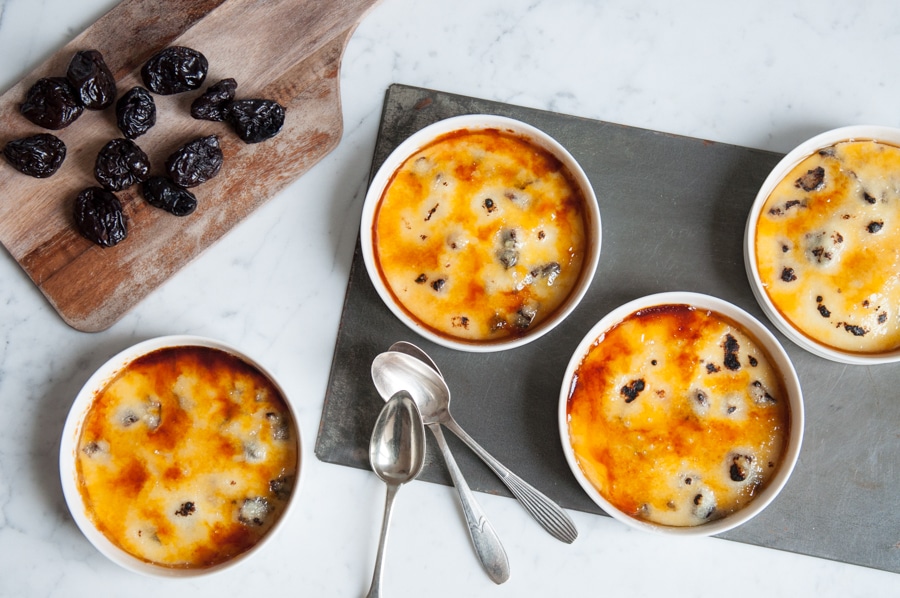
I absolutely love Rachel Khoo’s French makeover for semolina pudding. Here, she has added plump sweet prunes to the mixture with a crisp and caramelised golden topping to give you a reminder of crème brûlée. Her recipe converted my husband at the first mouthful, and I’m sure a brûlée topping could do the same for many other desserts.
This is an instant comfort dessert, one which I could sit down to any night. Thankfully, with only 4 ingredients, most of which you would already have in your fridge and pantry, you can make this pudding at a mere moment’s notice.
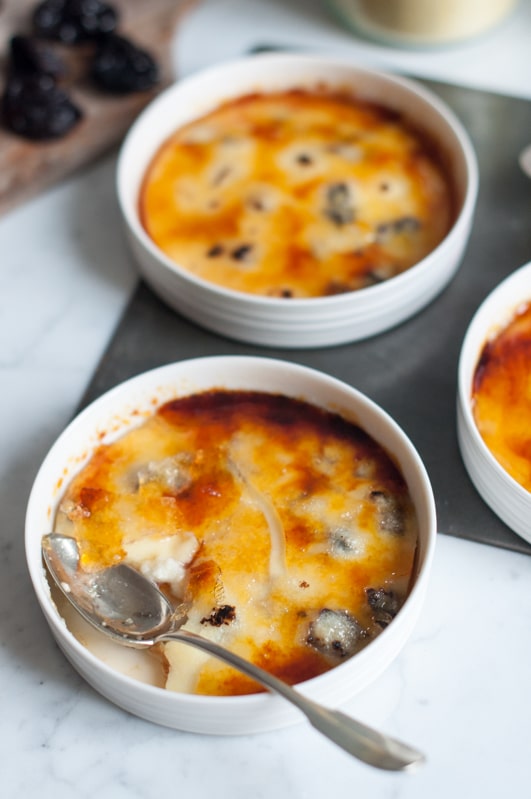
When it comes to caramelising the sugar, a blowtorch is best for this job. And the bigger the blowtorch, the better.
I find the little blowtorches sold in kitchenware stores to be too small – it takes far too long to caramelise the sugar and, by which time, you will have warmed (or even cooked) the pudding underneath.
Larger blowtorches will scorch the sugar more quickly and more evenly, so try to find a professional-sized blowtorch or even have a look at your local hardware store.
But always place the ramekins on a metal tray before torching them, otherwise you may burn your kitchen bench top! If in doubt, use your blowtorch outside on the footpath.

Burnt Cream with Prunes

Ingredients
- 500 ml (2 cups) milk
- 35 g (1 ½ oz) semolina
- 4-6 dried prunes, roughly chopped
- 8 tablespoons granulated sugar
Instructions
- Heat the milk in a saucepan and bring it to the boil
- Add the semolina and whisk continuously for 5 minutes until the mixture thickens nicely.
- Remove the pan from the heat and stir through the prunes.
- Pour the mixture evenly between 4 ramekins.
- Chill in the fridge for about 30 minutes.
- When you are ready to serve, sprinkle about 1-2 tablespoons of sugar over each ramekin, making sure you have an even layer of sugar.
- Use a handheld blowtorch to lightly scorch and caramelise the sugar.
- Serve immediately.
Kitchen Notes
- OVEN & STOVE TEMPERATURES
All recipes on this website have been tested on an induction stove and/or with a conventional oven (i.e. an oven without fan). All recipes on this website use temperatures for a conventional oven, unless otherwise mentioned. Convection ovens (i.e. fan-forced ovens) are typically 20°C/70°F hotter than conventional ovens, but please check your manufacturer’s handbook. - CONVERSIONS
To convert from cups to grams, and vice-versa, please see this handy Conversion Chart for Basic Ingredients.

I love dishes like this! And the prunes in this sound so good!
The prunes add a lovely sweetness to this pudding, especially since there is no sugar in the pudding itself. Although, there is the lovely golden topping to make up for it 🙂
Well I love rice pud no matter how it comes, always have :). But what interests me is as a small child I was given semolina “pudding” as baby food (the brand was Milupa). I remember having it instead of cereal when I was probably a bit too old for it lol! But the taste and smell if it has stayed with me all these years, to the extent I’m scared to try it in case it doesn’t measure up to my memory. I don’t fancy prunes but I’m sure I could find an alternative ingredient. And now you mention that small blow torches melt or cook your custard I know where I went wrong that time I tried Creme brûlée myself ha!
I also had semolina pudding as a child, but I recall that none of my friends knew what it was. They were more familiar with rice pudding. I think an Italian neighbour introduced semolina pudding to my mum and she, in turn, made it for me as a quick and cheap snack.
And yes, those little blowtorches are not so great for crème brûlée as they often heat the custard underneath and can even curdle them!
I love rice pudding – the home made version at least 🙂
the semolina puddings look gorgeous
I also love homemade rice pudding, although I sort of have a soft spot for the shop-bought kind as well 🙂 But not the flavoured ones with fruit – just plain vanilla for me.
I introduce myself: I’m Paula, your friend with soft spot for rice and semolina pudding. You’ve found it!! Not so much for the rice pudding. You have to continue searching, Thanh! 😛
I love desserts with semolina. My fist and usual is Griess-Pudding that I met in Germany, not so common here in Spain. But I also like many Arabs desserts which also use semolina or grits.
My boyf is not so funny with it, it’s all about the texture, but he’s a rice dessert lover 😛
Even if it sounds good with prunes, I think I’ll copy you and Rachel but with dried apricots. I love them more…
A few months ago my boyf gave me a blowtorch, a couple of weeks ago we loaded it, now, the premiere!! Want to see the results?? Just kidding, but I’m sure I’ll star burning some semolina creams, you can be sure too!! 😛
Have a nice week, Thanh!!
Yay! Glad to know of another rice pudding and semolina pudding lover 🙂
I think dried apricots would be delicious in this recipe. For some reason, I really love dried prunes. I can eat them as they are but I also love them in desserts. So these recipes from Rachel Khoo using prunes have been really fun for me!
I look forward to seeing what you make using your blowtorch … I would suggest trying crème brûlée but this semolina pudding is much quicker and easier 😉
P.S. I still need to send you an email re Swiss eating tips … please remind me if I forget!
Yes, my boyf and me would be good guests at your table 😛
The other day, we use for the first time our blowtorch… to gratin mashed potato!! 😛 We had to begint for something 😛
We love crème brûlée, and would be the firms time we can broil with direct flame, but I also love so much this semolina pudding that I’ll have to try both.
I don’t want to disturb you about the mail, but of course, if you find the time, I’ll be very grateful 😛 I know my first destination, I have that: Sprüngli!!! 😛
Yes! Rice pudding lover here (and having the same problem with all those rice pudding traumas around me)! I loved this recipe from Rachel’s book and it’s so good to see it here as well (lovely pictures!). Have you tried the cheese shortbreads with tomato? One of my favorites from this book!
Glad to hear that you also enjoyed this recipe. Those biscuits are on my to-do list. In fact, there are still so many recipes I want to try from My Little French Kitchen … it’s proving to be such a wonderful book 🙂
Hi Thanh, hope things are well on your end. My aunt introduced me to a stovetop semolina pudding but she uses coconut milk instead of regular milk and I loved it. I think I need to get a blowtorch soon, been eyeing one for years but never invested in one… I happen to enjoy semolina based desserts so I’ll be giving Rachel’s version a go.
xx
Ooh a version with coconut milk sounds lovely! In fact, I’m pretty sure my mum made a version with coconut milk too, which is quite popular with Vietnamese desserts. As you live in France, you will have no problem tracking down a good blowtorch – a very worthwhile investment if you like desserts such as crème brûlée 🙂
Gorgeous recipe and perfect kitchenware…Sophie Conran’s always on top!! 🙂
Thank you! Yes, I love these dishes from Sophie Conran. I normally use them for crème brûlée (which is rather often), but it has been nice to finally use them for a different recipe.
Super! I will try it for sure!
This is such a quick and easy dessert! I left out the prunes for the children but I really enjoyed the prunes here.
Wow this looks insanely good! YUM! Thank you for sharing this great recipe!