

 by
by Traditional Spaghetti Bolognese
Growing up, my mother never really cooked Italian food. I think our closest encounter with Italian cuisine was Pizza Hut, and I loved it! When she did attempt any Italian food, it was likely to have been tainted with some coriander (cilantro) and eaten with chopsticks.
This might go some length in explaining why, for many years, I failed miserably in attempting to recreate a decent Bolognese Sauce at home.
No matter how many different recipes I tried, how expensive the red wine or for how long I simmered the sauce, a bottle of ready-made bolognese sauce from the supermarket always tasted better.
And I accepted this defeat on the grounds that, well, I wasn’t Italian; that certain dishes were out of my realm because of my gene pool. Until I tried the following recipe.
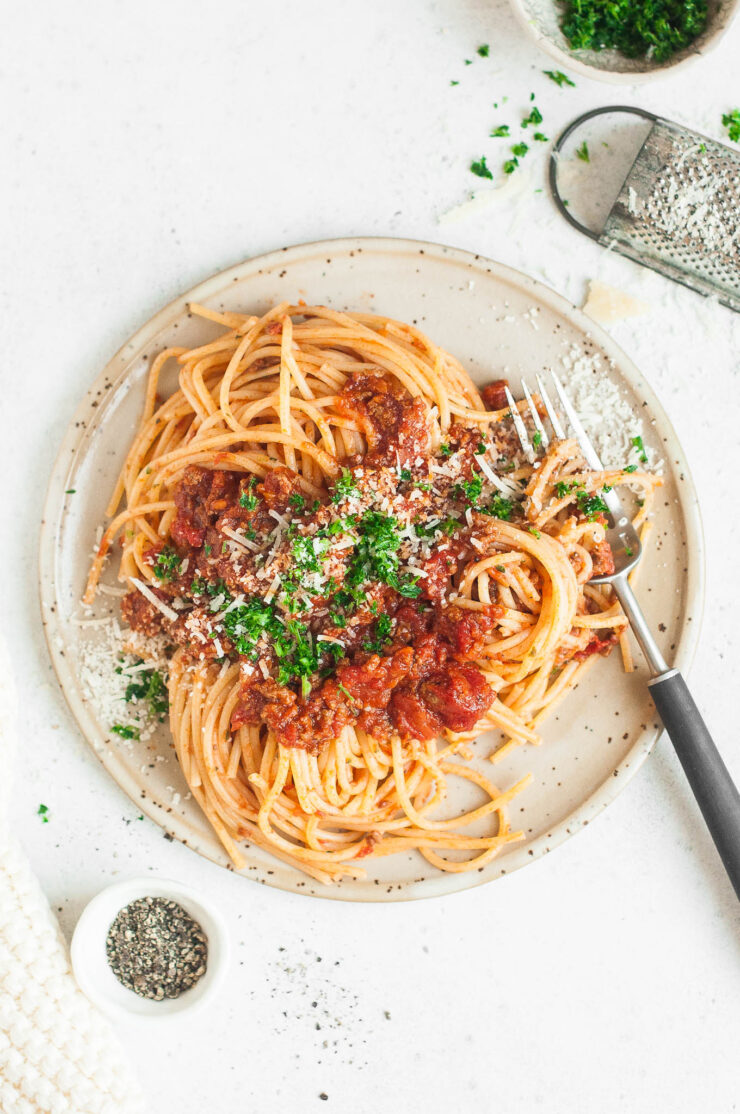
Spaghetti Bolognese Recipe
This particular recipe for a traditional Spaghetti Bolognese caught my eye because it contains neither red wine, stock nor bacon, ingredients which are so commonly found in a traditional beef ragu.
I attempted this Spaghetti Bolognese recipe out of curiosity because the list of ingredients looked quite minimal compared to many popular recipes, and I have never looked back since.
For me, this is the Bolognese Sauce which I have been trying to recreate at home for so many years.

Why This Recipe Works
We all know that the secret to a great tasting dish is to use the best quality ingredients. I think this is the best Bolognese Sauce recipe because:
- It uses good quality, freshly ground beef to give a rich flavour to the sauce.
- The Bolognese Sauce is slow-cooked on the stove for 2 to 3 hours to allow the flavours to intensify and the sauce to thicken.
- Fresh herbs add a brightness to the Bolognese Sauce.
What Type of Meat to Use for a Bolognese Sauce
Whenever a recipe calls for minced meat (ground meat), I always go out of my way to make my own, and I have been doing this for as long as I can remember.
In fact, my mother never bought minced meat either. I have vivid recollections of her mincing her own meat with a menacing Chinese meat cleaver in both hands, rapidly hacking away with such aggression that you wouldn’t want to disturb her on such occasions.
I used to mince meat in my food processor; it does a decent job but the meat is likely to be very finely chopped in this method, almost paste-like if you process it for too long.
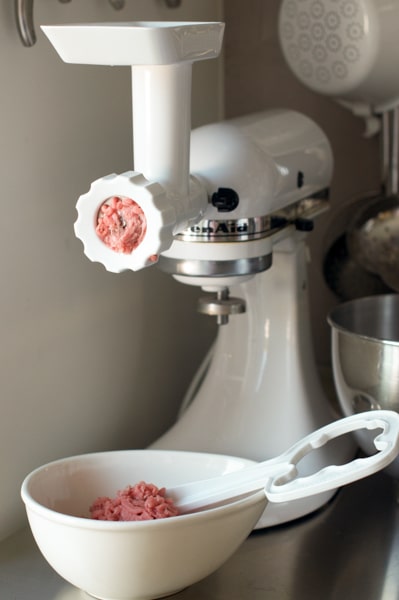
The better approach is to use a proper meat grinder, and KitchenAid owners will rejoice in knowing that the meat grinder attachment does a fabulous job in grinding meat in coarse or fine textures.
The simplest approach, of course, is to ask your butcher to grind the meat for you. This is what I do when I plan to make a double or triple batch of this Bolognese Sauce.
And the reason why I think freshly-ground mince tastes best is because you can choose the cut of meat yourself; selecting a good-quality cut of meat means that you can control both the flavour (some cuts of meat taste better than others) and know exactly what it is that you are eating.
For this Spaghetti Bolognese recipe, I like to use a cut of beef which the French and Swiss call entrecôte, which is termed as rib-eye or sirloin in other parts of the world, or even beef brisket or a similar stewing beef. These are all flavourful cuts of beef with a good amount of fat or marbling, making it a good choice for a bolognese sauce which needs a robust, meaty base.
How to Make Spaghetti Bolognese
A Bolognese Sauce is based on an Italian ragu, which is a slow-cooked meat sauce made with tomatoes.
Slow-cooking allows the ingredients in the sauce to meld and intensify, as well as giving the meat a chance to become incredibly tender and almost dissolve into the sauce.
Of course, it is possible to make a Bolognese Sauce in 30 minutes or less, but it won’t be as rich, and the meat will still have a bit of bite.
So where possible, I recommend cooking the Bolognese Sauce for at least 2 hours for maximum flavour, and I also recommend doubling or tripling the recipe because it is that good!
Step 1
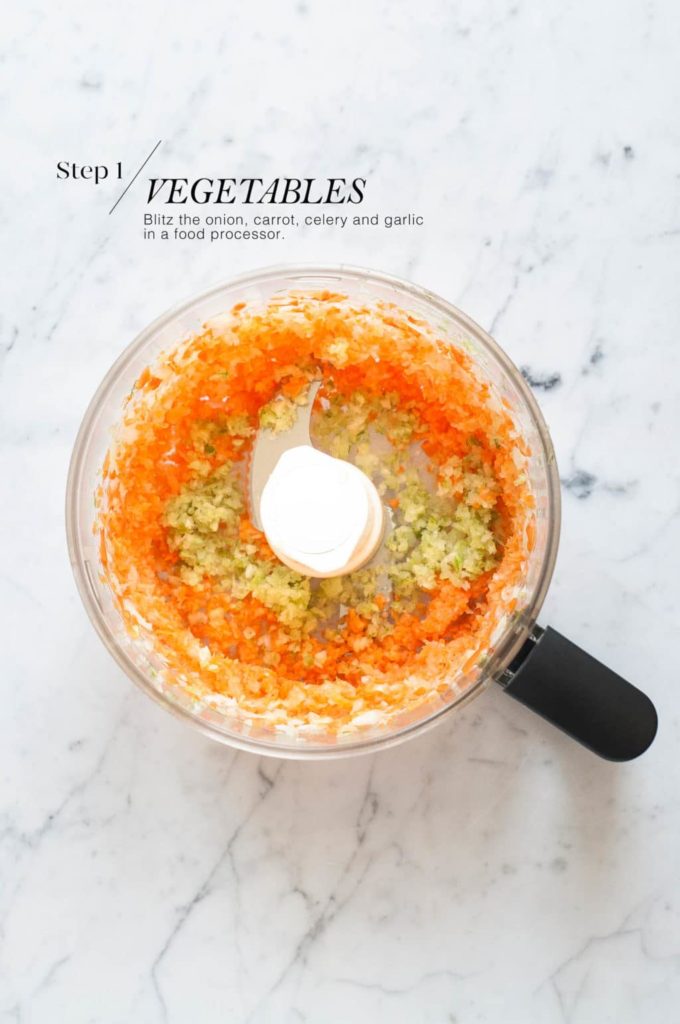
Start by blitzing the vegetables in a food processor. Finely chopping the vegetables this way allows them to literally melt into the sauce later (and your kids won’t notice that you snuck healthy stuff into this dish).
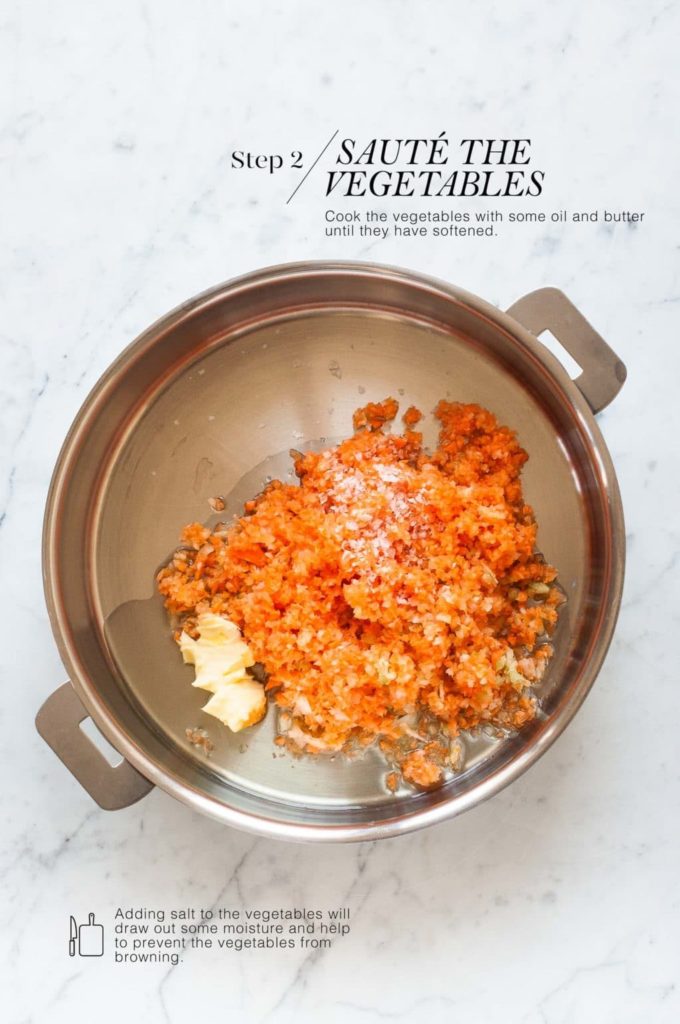
Step 2
Cook the vegetables over a medium heat until they have softened. You don’t want the vegetables to brown or caramelise, so adding a good pinch of salt will draw out some moisture and help the vegetables to cook gently.
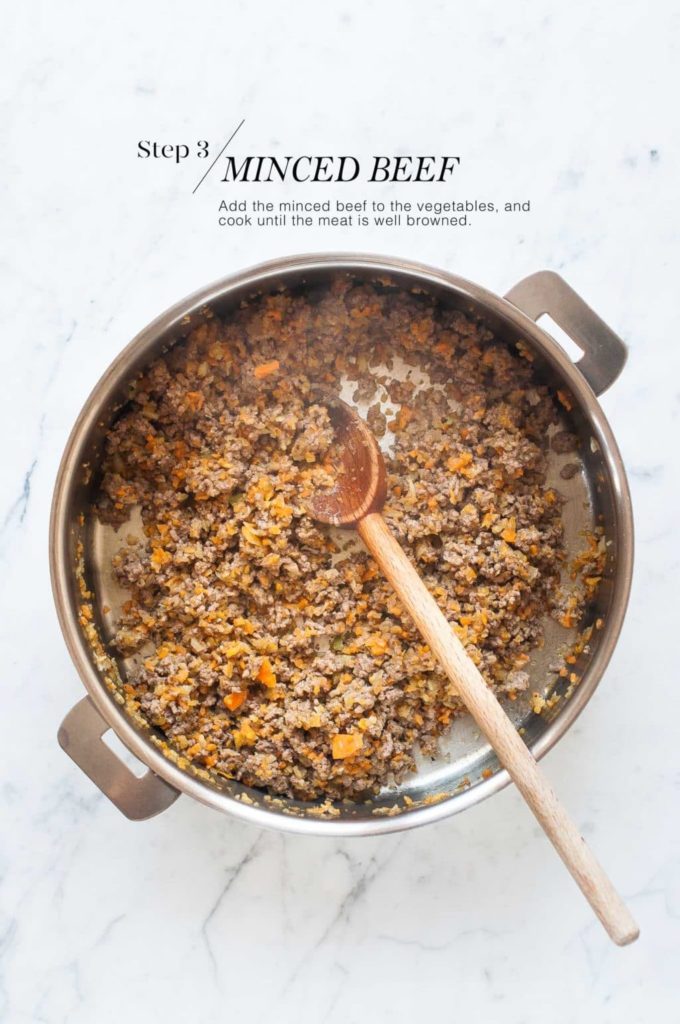
Step 3
Next, add the minced beef and cook until there is no trace of pink left. If you have a small pan, you might want to do this in batches, otherwise the meat will steam instead of fry and become golden brown. And you want the meat to brown properly because this caramelisation adds flavour to the sauce.
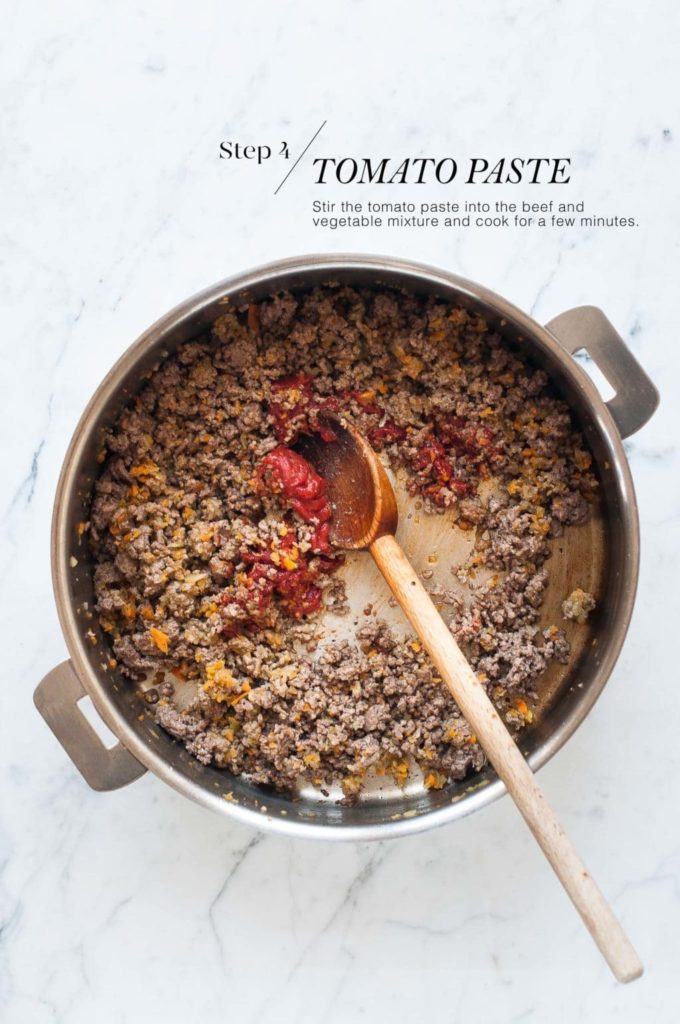
Step 4
Stir in the tomato paste until all of the meat is coated. As tomato paste is highly concentrated, you need to cook off the raw flavour for a few minutes.
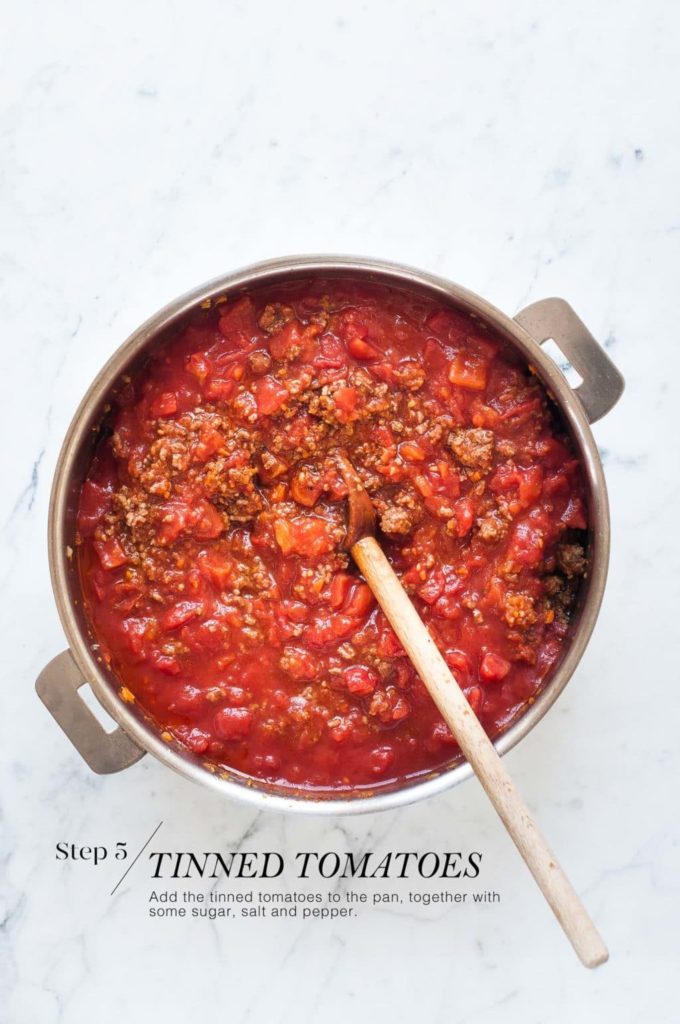
Step 5
Then add the canned tomatoes, together with some sugar, salt and pepper. It might look like a lot of tomatoes, but as you will be slow-cooking this bolognese sauce for about 2 hours, some of the liquid will evaporate during this time and the sauce will thicken considerably.
Also, the generous amount of tomatoes will cook down to produce a really flavoursome tomato sauce.
Step 6
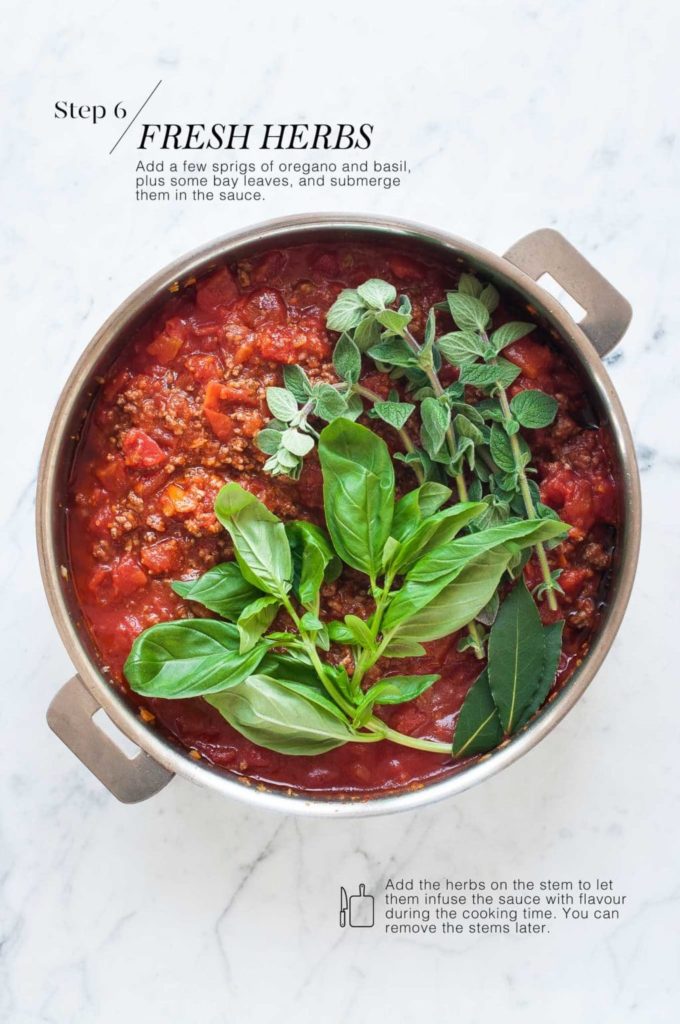
Many bolognese sauce recipes call for dried herbs, but I like to use fresh herbs. Plus, they seem to grow wild on my balcony and I need every excuse to use them where possible.
I don’t bother to chop the herbs ; I simply place large twigs – stems and leaves – directly into the sauce for maximum infusion of flavour. After 2 hours, I try to fish out the stems, although most of the oregano leaves will have fallen off, and this is totally fine.
Step 7
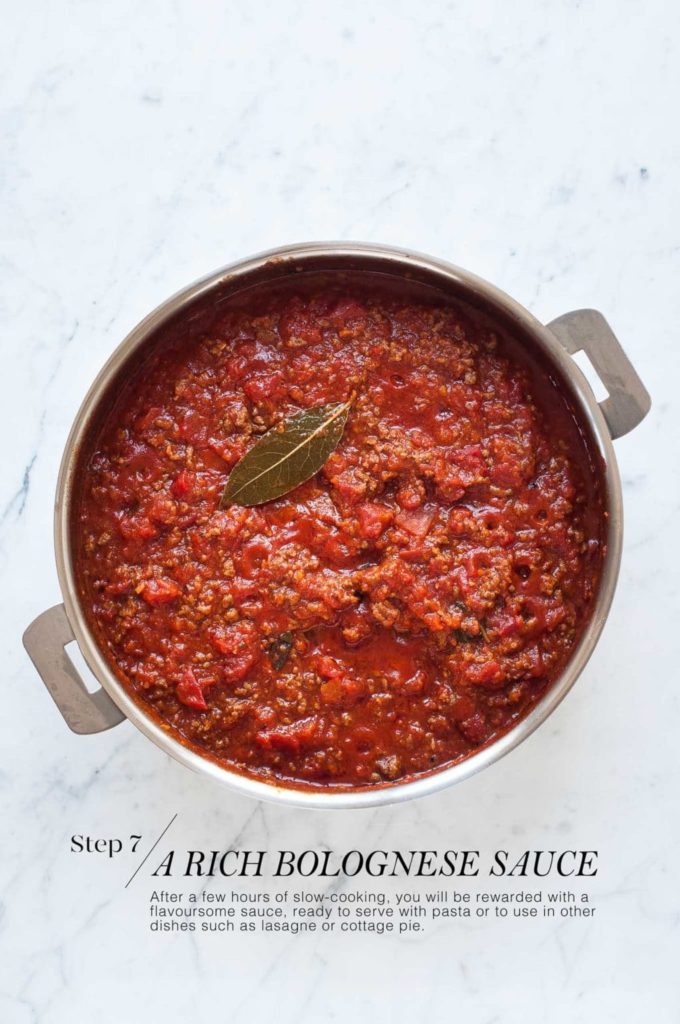
During the cooking time, make sure you give the bolognese sauce a good stir now and then to make sure nothing is sticking to the pan. If the sauce is thickening too much, you should also add some boiling water to thin the sauce to your liking.
How to Serve Spaghetti Bolognese
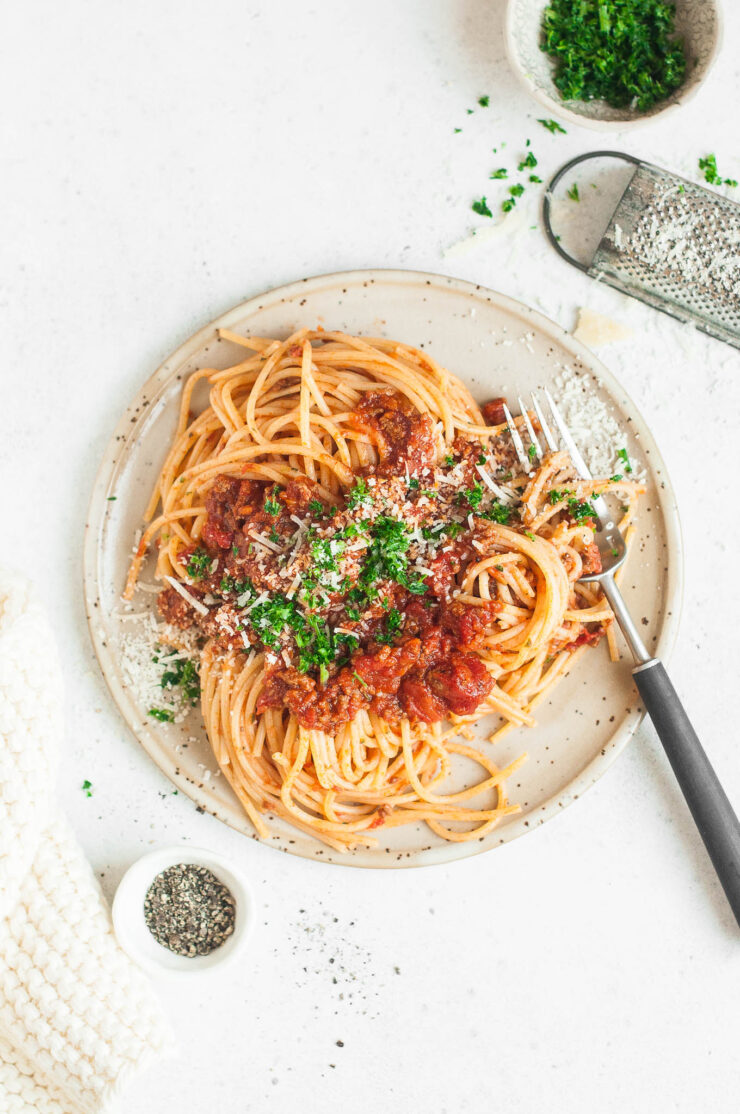
I always recommend cooking the pasta in the Bolognese Sauce for a few minutes before serving, thereby allowing the pasta to absorb some of the flavours from the sauce.
This means that you will have to carefully estimate how much pasta and how much sauce you will need as any leftover pasta cooked with the sauce will become thick and gluggy when reheated.
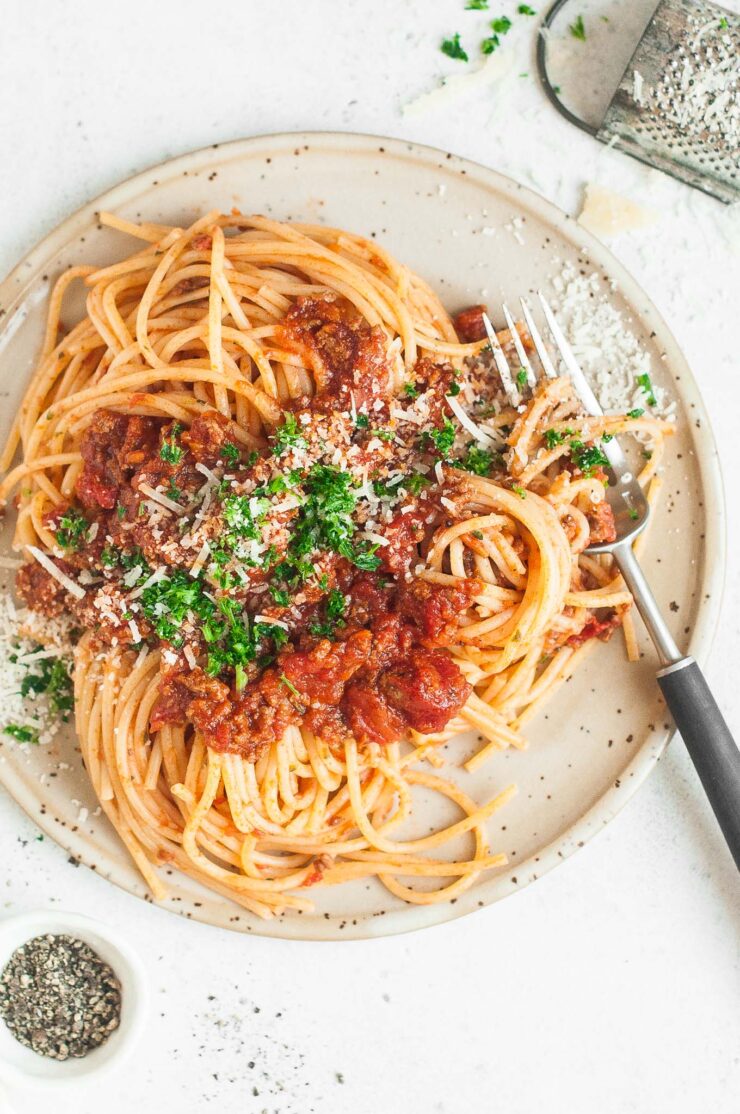
For extra savouriness, I recommend grating fresh parmesan over the dish just before serving, as well as a good sprinkle of fresh herbs to liven up the dish.
Freezer Tips
As mentioned above, whenever I cook this Bolognese Sauce, I always make a double or triple batch.
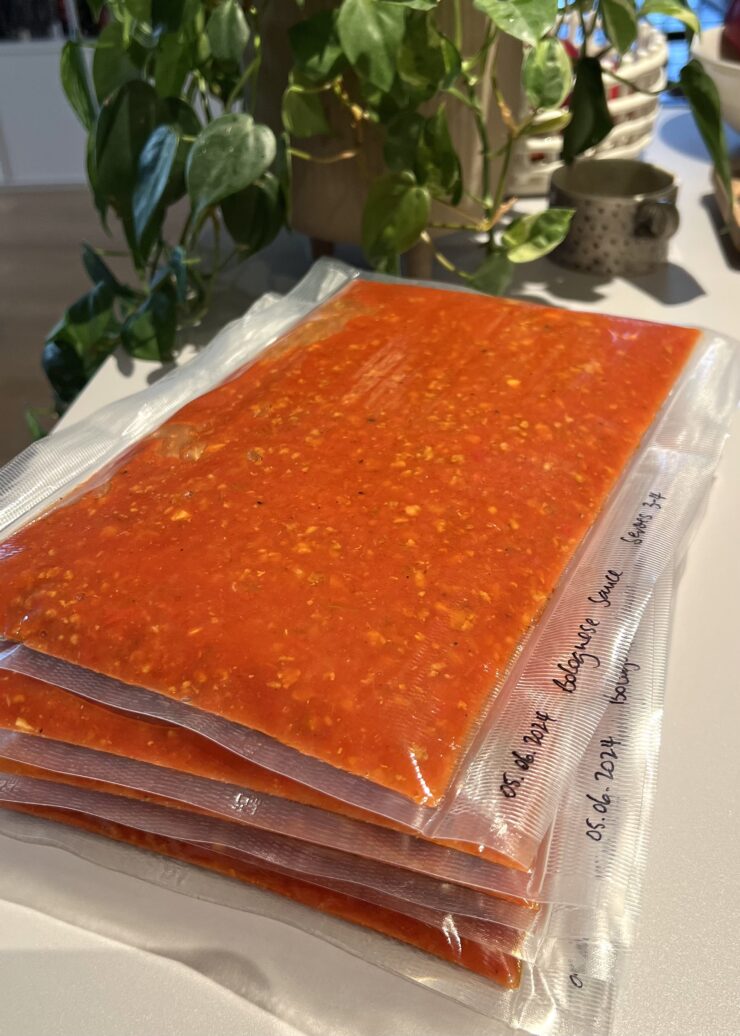
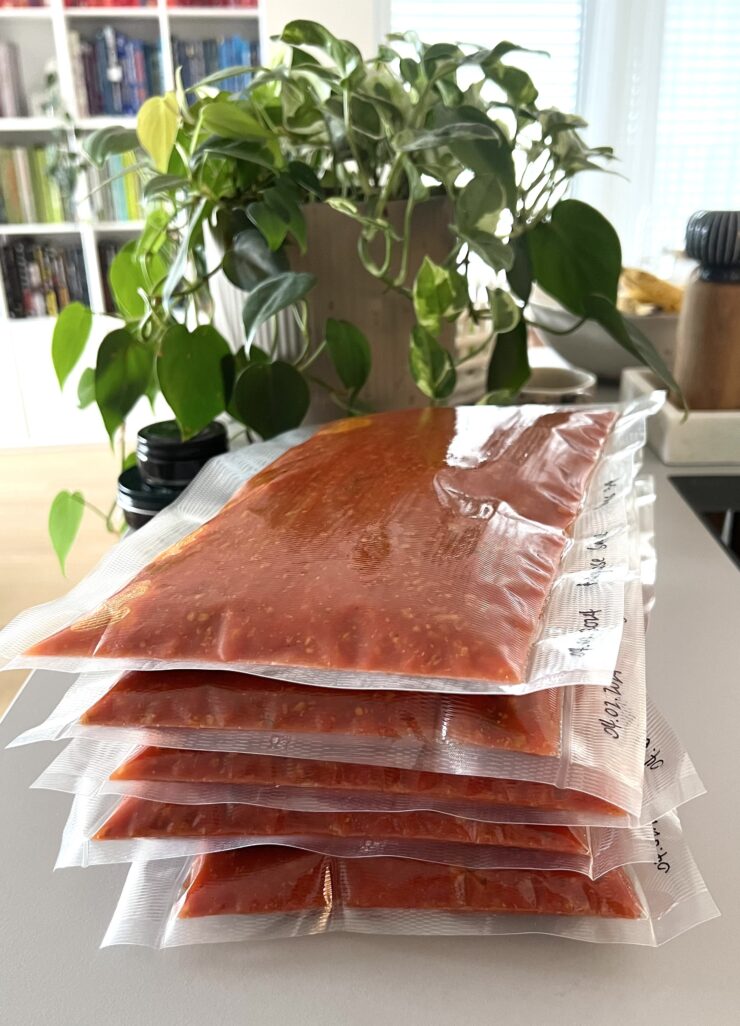
Once cooled, I portion the sauce into serves of 3 to 4 (about 3 large ladles), and freeze the sauce in vacuum-sealed bags, but ziplock freezer bags would work just as well.
I like to freeze the sauce in flat bags for easy storage in the freezer, and also for quicker defrosting.
The Bolognese Sauce can keep in the freezer for 3 to 6 months (longer if vacuum-sealed).
FAQs
- How long should I cook Bolognese Sauce? A Bolognese Sauce generally requires at least 2 hours of slow simmering to allow the flavours to develop and for the meat to tenderise. You can, of course, cook a bolognese sauce in less time, but the flavours will not be as rich. That is why Bolognese Sauces tend to taste so much better the next day!
- How long does Bolognese Sauce last in the fridge? Bolognese Sauce can be kept in a covered container in the fridge for up to 3 to 4 days.
- How long does Bolognese Sauce last in the freezer? Bolognese sauce can be stored in air-tight containers or freezer bags in the freezer for up to 3 months. Food frozen in vacuum-sealed bags can keep for much longer.
- How much Bolognese Sauce per person? This, of course, varies from person to person! But I estimate roughly 1 cup (250 ml or 1 large ladle) per adult.
- How to thicken Bolognese Sauce? A bolognese sauce will thicken as it cooks, and the longer it cooks, the thicker the sauce will become. You should cook a bolognese sauce by allowing it to simmer on low to medium heat, but if you are in a hurry and are trying to make a “quick” bolognese sauce, you can thicken the sauce by simmering it on a higher heat.
- How to make Bolognese Sauce with passata? I recommend making bolognese sauce with canned diced tomatoes because the tomatoes add some texture to the sauce. However, you can also use tomato passata – bottled tomatoes which have been smoothly blended – for a smoother sauce.
- How to make Bolognese Sauce without wine? My recipe below does not contain any wine. Some recipes for Bolognese Sauce include wine which acts as a sweetener, but I prefer to use sugar because I find it to be an easier way to control the sweetness of the sauce, and also to control the flavour of the sauce; different wines can vary in taste and which affect the final taste of the sauce.
- What if my Bolognese Sauce is too sweet? Canned tomatoes vary in sweetness, so you should try to taste the sauce before adding any sugar. But if your Bolognese Sauce is too sweet, try to balance it out with a dash of red wine vinegar.
- Which pasta to serve with Bolognese Sauce? The choice is endless! You can’t go wrong with spaghetti or fettucine, but short and ribbed pastas (such as penne rigata or rigatoni) also work well with a meaty Bolognese Sauce.
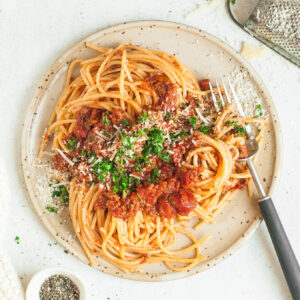
Spaghetti Bolognese

Ingredients
For the Bolognese Sauce
- 1-2 tablespoons olive oil
- 500 g (1 lb) minced beef, (ground beef)
- 1 tablespoon unsalted butter
- 1 large carrot, peeled
- 1 celery stick
- 1 brown onion
- 2 garlic cloves
- 4 tablespoons tomato paste
- 1.6 kg (3 ½ lb) canned diced tomatoes
- 4-5 sprigs fresh oregano, or marjoram
- 2 sprigs basil
- 2 bay leaves
- 1-2 teaspoons sugar, or to taste
- sea salt, to taste
- black pepper, freshly cracked
To Serve
- dried spaghetti, about 100 g (3.5 oz) per person
- fresh parsley, finely chopped
- fresh oregano, or marjoram, finely chopped
- basil, finely chopped
- parmesan, finely grated
Instructions
To Make the Bolognese Sauce
- Heat the oil in a large cast-iron pan or saucepan over medium-high heat.
- Add the beef and cook until well-browned. If you are using a small pan, or you are doubling or tripling the recipe, you will need to cook the beef in batches.
- I recommend spreading the meat to cover the bottom of the pan (like a large hamburger patty), and leaving it to cook for a few minutes until it is golden and caramelised on the bottom. Once the meat is nicely browned, use a wooden spoon to turn the meat over and break it up into finely ground meat.
- Use a slotted spoon to transfer the cooked beef to a large bowl.
- Finely chop the carrot, celery stick, brown onion and garlic cloves in a food processor.
- Turn the stove down to medium heat.
- Add the butter, and some more olive oil if needed.
- Cook the vegetable mixture with about 1 teaspoon of sea salt for about 10 minutes, or until the vegetables have softened.
- Add the tomato paste and cook for a few minutes.
- Add the canned diced tomatoes, herbs and sugar. I add the sprigs of herbs whole and allow it to cook down in the sauce, and remove the stems at the end of the cooking time. During the cooking time, the leaves will have fallen off the oregano or marjoram sprigs, but the basil sprigs should be mostly intact.
- Add the browned meat to the sauce.
- Give the sauce a good mix.
- Season with salt and pepper.
- Cook over very low heat with the lid on for about 1 ½ hours, stirring occasionally. The sauce should just be gently bubbling.
- Remove the lid and cook the sauce over medium heat for about 30 minutes to allow the sauce to evaporate and thicken.
- Taste for seasoning.
- Just before serving, stir through the chopped parsley.
To Cook the Pasta
- Bring a large pot of water to the boil.
- Add 1 teaspoon of fine salt.
- Cook the spaghetti for 2 minutes less than the packet instructions.
- Do NOT drain the pasta.
- Reserve the pasta cooking water for the next step.
To Serve
- Heat the Bolognese Sauce in a large saucepan. You will need approximately 250 ml/1 cup of sauce per person.
- Use a pair of tongs to transfer the spaghetti directly from the pot of boiling water to the pan with the Bolognese Sauce.
- Stir the mixture so that the pasta is evenly coated.
- If the pasta sauce is too thick, add enough pasta boiling water to the sauce to get a nice consistency.
- Serve with freshly grated parmesan cheese and a sprinkle of fresh herbs.
Kitchen Notes
- INSTRUCTIONS FOR SLOW COOKER
* Follow the same instructions as for the stove top.
* Cook on low (95°C/203°F) for 4-5 hours or high (105°C/221°F) for 3-4 hours. - INSTRUCTIONS FOR THE OVEN
* Follow the same instructions as for the stove top, but make sure you use an oven-proof pan and lid, such as a cast-iron pan.
* Place the pan with the lid in the oven at 160°C/320°F, and cook for 2 hours.
* After this time, finish cooking the sauce on the stove for about 15-20 minutes on medium heat, without the lid so that the sauce can thicken. - RECIPES USING BOLOGNESE SAUCE
* Cottage Pie: add some peas to the sauce, and top with mashed potatoes before baking.
* Meat Lasagne: use this Bolognese Sauce in place of a simple Tomato Sauce. - OVEN & STOVE TEMPERATURES
All recipes on this website have been tested on an induction stove and/or with a conventional oven (i.e. an oven without fan). All recipes on this website use temperatures for a conventional oven, unless otherwise mentioned. Convection ovens (i.e. fan-forced ovens) are typically 20°C/70°F hotter than conventional ovens, but please check your manufacturer’s handbook. - CONVERSIONS
To convert from cups to grams, and vice-versa, please see this handy Conversion Chart for Basic Ingredients.
Did you make this recipe?
Please leave a comment below and share your photos by tagging @eatlittlebird on social media and using #eatlittlebirdUpdate
This recipe was first published on 9 December 2013. It has been updated with new photos and more comprehensive recipe notes.
More Italian Recipes

This looks fabulous Thanh. Definitely something my husband would eagerly gobble up. I’ve made him a few bolognese recipes over the years, none overly amazing, but I think your trick of using freshly ground beef is definitely a winner instead of the supermarket stuff. I’ll be making this next week 🙂
Thanks, Jennifer! Hope your husband will enjoy this recipe. That’s so sweet of you to cook meat dishes for him 🙂 When I first tried this recipe, I was pleasantly surprised by how much I enjoyed it, and I have made it 5 or 6 times again since just to be sure that the first time wasn’t a fluke! It’s a recipe that has worked for me so I hope others will enjoy it too 🙂
This gigantic plate of hearty pasta is exactly what I want when it gets chilly out! So warm and substantial and satisfying. 🙂
I totally agree! There’s nothing more welcoming than a big plate of spaghetti when the weather is cold outside 🙂
The things I would give to have that plate in front of me right now…it’s so cold out, and a giant bowl of this is exactly what I need to warm me up! Pinned, and most definitely making before winter is up 🙂
Hope you will enjoy this recipe! I’m looking forward to making it again later this week – I don’t think I could ever tire of this dish!
Bolognese is one of our ultimate comfort dishes. If you want a really unctuous version, have you ever tried using white wine and a little milk? Sounds a bit mad but it’s actually a very classic italian method!
Yes, I’ve tried recipes using white wine and milk, though not together. I do like the addition of milk but then I’m always tempted to go all out and make a béchamel sauce … I love anything that is covered with béchamel sauce and then baked in the oven.
Looks lovely! The pictures are fabulous
This looks delicious, and your description of your pasta enthusiast coworkers made me giggle.
Yum, that looks delicious. I’d love a big bowl of warm steaming spaghetti right now, think I might make a variation of this for dinner tonight.
xx
Hello, I have been reading your blog for sometime and have successfully cooked many of the recipes, so thanks to you! It was so funny to read that you ate spaghetti bolognese with chop sticks. Our family did as well, why, I don’t know, we are not Asian. All rice meals and spaghetti bolognese were eaten with chop sticks. I do enjoy your blog and I shall try your recipe as my children have not liked any of my previous attempts. Thanks again and happy holidays!
Thank you for your lovely feedback! That’s so funny that your family ate spaghetti bolognese with chopsticks – I thought only Asian families did that 😉 But then, spaghetti is very much like Chinese noodles, and apparently the Italians got the idea for making spaghetti from the Chinese, so maybe it makes sense to eat spaghetti with chopsticks after all??
I’m so happy to hear that you have enjoyed many recipes from my blog. I love sharing my favourite recipes and so it’s nice to hear from readers when a recipe has worked well for them. I hope your kids will like this bolognese recipe!
Thanks for the recipe , we went to Bill and Tonys last night so now ill try to replicate.
Now I want the schnitzel recipe as well.
I would be curious to know how this recipe compares to the actual dish at Bill and Tonys. Thanks for popping by!
Instead of sugar I add a bit of red wine 😉
I think red wine would give a different taste, no? I always add sugar when using tinned tomatoes as they always seem to be need a bit of sweetness. But you are right that there are many red sauces out there that use red wine and for good reason 🙂
Thanks for sharing this recipe! Just a quick question before trying 🙂 So, the minced beef is cooked in more than 2 hours, isn’t it? Can we reduce the time to prevent overcooking?
Hello, the mince is being slow-cooked over low heat in this recipe, so I don’t think you will be over-cooking the meat. In any event, you could cook the mince for less time and taste to see if the flavours have developed enough to your liking.
Dear Thanh,
living in Switzerland I am sure you would understand my German as well – but as your blog language is English I’ll give it a try:
I love Spaghetti Bolognese and I love your recipe above. It’s so well done with this veggi part and the extra long cooking time, which is essential to a Bolognese to mho… 🙂
I made them yesterday, ate the second part today – oh, it was even better today. I only used one can of tomatoes, added a little bit of red wine (not for children of course) and a bit cayenne pepper to my taste of being hot. It came out delicious.
I wanted to pass your recipe to a friend who does not understand English, that’s why I translated it for her. But. There’s one question coming up:
Is the given amount of tinned tomatoes right? Really right? – I doubt a bit, because 1,6 Kilo tomatoes to 400 g meat sound a bit too much for me. It is four times the amount of meat. Isn’t it getting a bit “soupy” or “tomatoey” then? To my opinion 1 can = 400 g should be enough. – What do you think about it? Maybe there’s a little mistake in the recipe? Thanks for your advice.
Your site is great, it shows so much love.
Many Regards
Irmi from Munich
Hello,
I’m so glad to hear that you enjoyed this recipe 🙂
The recipe amount for tinned tomatoes is correct – there is 1.6 kg, or 4 tins of tomatoes (usually about 400 g per tin), in this recipe. It sounds like a lot of tomatoes, but a lot of it breaks down and evaporates during the long cooking process. So the end result is not too “soupy”, although the sauce is quite “tomatoey” as you would describe it. For me, I like my bolognese sauce to have more tomatoes than meat, which is why I like this recipe.
But cooking is all about personal taste, so if you have tried this recipe using less tomatoes and it worked out well, then I would recommend that to your friend 🙂 It’s interesting to read that you used only one can of tomatoes in this recipe, but it sounds like you like your sauce to be more meat-heavy. Did you also cook the sauce for 2 hours? I understand that you added some wine to the sauce, so that would help with the liquid content for this sauce.
I’m glad you enjoyed this recipe and made it with your own changes. I love the sound of adding cayenne pepper – I will try that next time too!
Thank you very much, Thanh, for your quick response. –
Yes, I did cook it for 2 hours, even more, it were two and a half. – I have to admit that there might have been my memory in that game and it seems that I did not read your recipe very carefully in making the dish: I added a couple of spoonfuls of tomato paste – that is what I am used to do – and I also use to add water (not broth) to my cooking. That might be the reason why I just needed one can of tomatoes. – So this might be equivalent to the amount of tomatoes given in your recipe. – I just got it right at my translation work…. that there are some differences to my way of having done it.
Thank you again for this very good recipe – I still got some sauce left and I am sure I will be hungry later on this evening…
Have a nice Holiday,
Irmi
This is a fantastic recipe! I love how rich and tomatoey it is. The whole family loved it and I also used leftovers in your Cottage Pie recipe. This will now be my go to recipe for pasta sauce!
mmm…this looks delicious! This looks heaven! I want some!
Hi Thanh, I was searching Bolognaise recipes and yours came up. I am hoping you can help me please? Bill and Toni’s recipe calls for 900g minced beef to the exact same ratio of the other ingredients in your recipe. Did you reduce the amount of beef ie 400g of minced beef because the ratio to tomatoes etc results in a better sauce? Also do you simmer the sauce with the lid on or off the saucepan? Thanking you.
Hi Eloise,
Many thanks for your query. I just looked up the original recipe and you are right – the original recipe calls for 900g of minced beef. I can’t remember why I halved the amount of beef (more or less), but it is probably because I don’t really like my Bolognese sauce to be too “meaty”. I also always end up diluting the sauce with water as it cooks so that I have the right consistency.
Although I posted this recipe in 2013, this is still the only Bolognese recipe I use and it is exactly how I like it 🙂 So yes, I think the ratio of ingredients I have listed in the recipe here produces a really nice sauce, but I have never made it as per the original recipe (i.e. with twice as much meat to my recipe), so I can’t compare.
If you like a rich, meaty sauce, definitely use 900g of beef, but know that you can still adjust the thickness/consistency of the sauce with water anyway.
What I always do is make a double batch, which means I use about 1kg of minced beef and then double the rest of the ingredients in my recipe.
And I generally simmer with the lid off so that the sauce can thicken nicely as it cooks.
I hope this helps! I can’t attach a photo here, but I will send you a separate email with a copy of the original recipe from the magazine 🙂
Thank you so much for your reply, I really appreciate it.
I’ve made this recipe twice and it’s just perfect. I used to make a much quicker version of the sauce but now I totally get how cooking it for 2 hours makes the sauce so much more delicious. I was also skeptical about how many cans of tomatoes this recipe uses but it gives the perfect taste and consistency. Thanks so much for sharing this recipe.
Made this for family today ,I added a little Worcester sauce and was delicious even hubby who dosnt like bolognese said we should now have it once a week
Hi Jenn,
Thanks for your feedback! I like the idea of adding some Worcestershire sauce – yum! Glad your husband enjoyed this recipe too.
Wonderful recipe! I never really liked the taste of wine in my meat sauces and this tasted absolutely delicious. I will be making this regularly!
Beautiful recipe. Makes a very nice, thick, rich sauce. I will definitely make this again.
Absolutely delicious! Next time, I will make a double batch to freeze.
Delighted with this recipe!
Wonderful recipe. Blitzing the veg makes it resteraunt quality.
Hi Oliver,
That’s great that you enjoyed this recipe! Yes, the food processor is great for chopping the veges quickly and finely, especially if you make a large batch of this bolognese sauce. Thanks for popping by!
Simple and delicious recipe.
So easy to follow and I love your choice of herbs, to avoid over-seasoning.
Hi Anne,
I’m so glad you enjoyed this recipe!