

 by
by 
Vietnamese Beef Stew (Bo Kho)
There are many who claim that Vietnamese Beef Stew, known as Bò Kho in Vietnamese, is derived from the French Boeuf aux Carottes. But upon closer inspection of both recipes, beef and carrots is pretty much all they have in common.
This classic Vietnamese dish takes the humble beef and carrot stew up a few notches with its generous use of fresh herbs and spices.
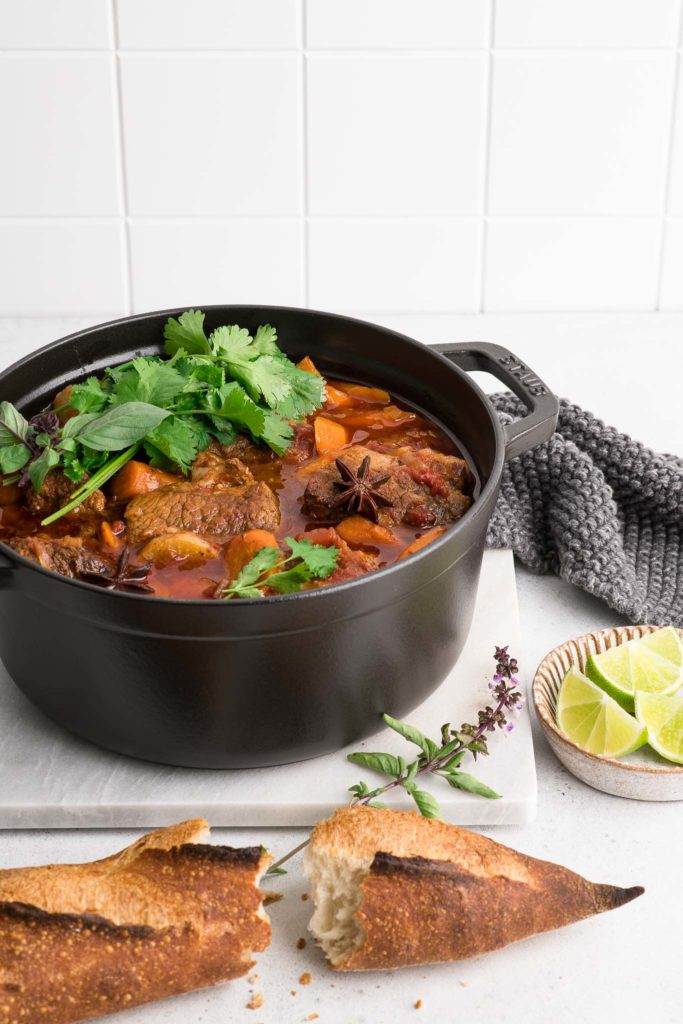
Bo Kho
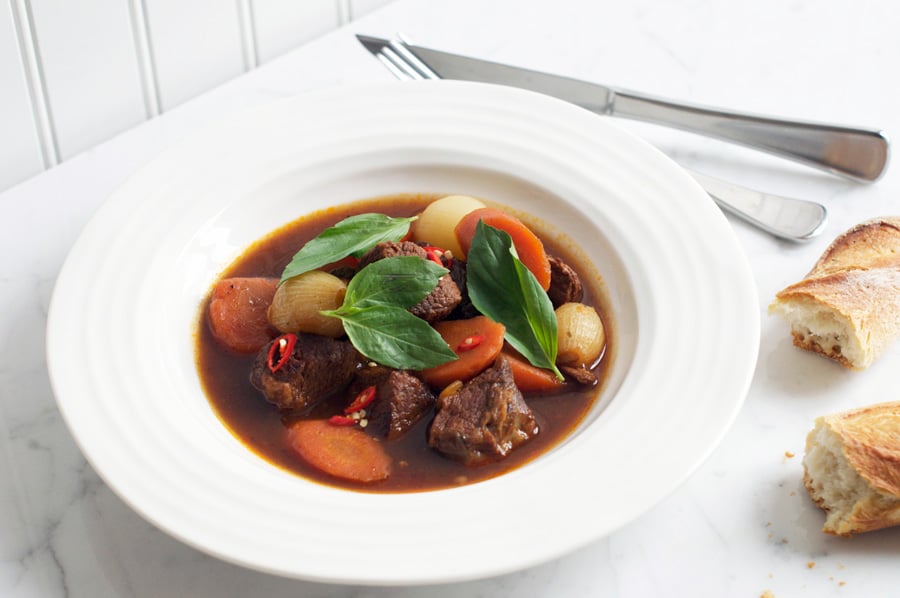
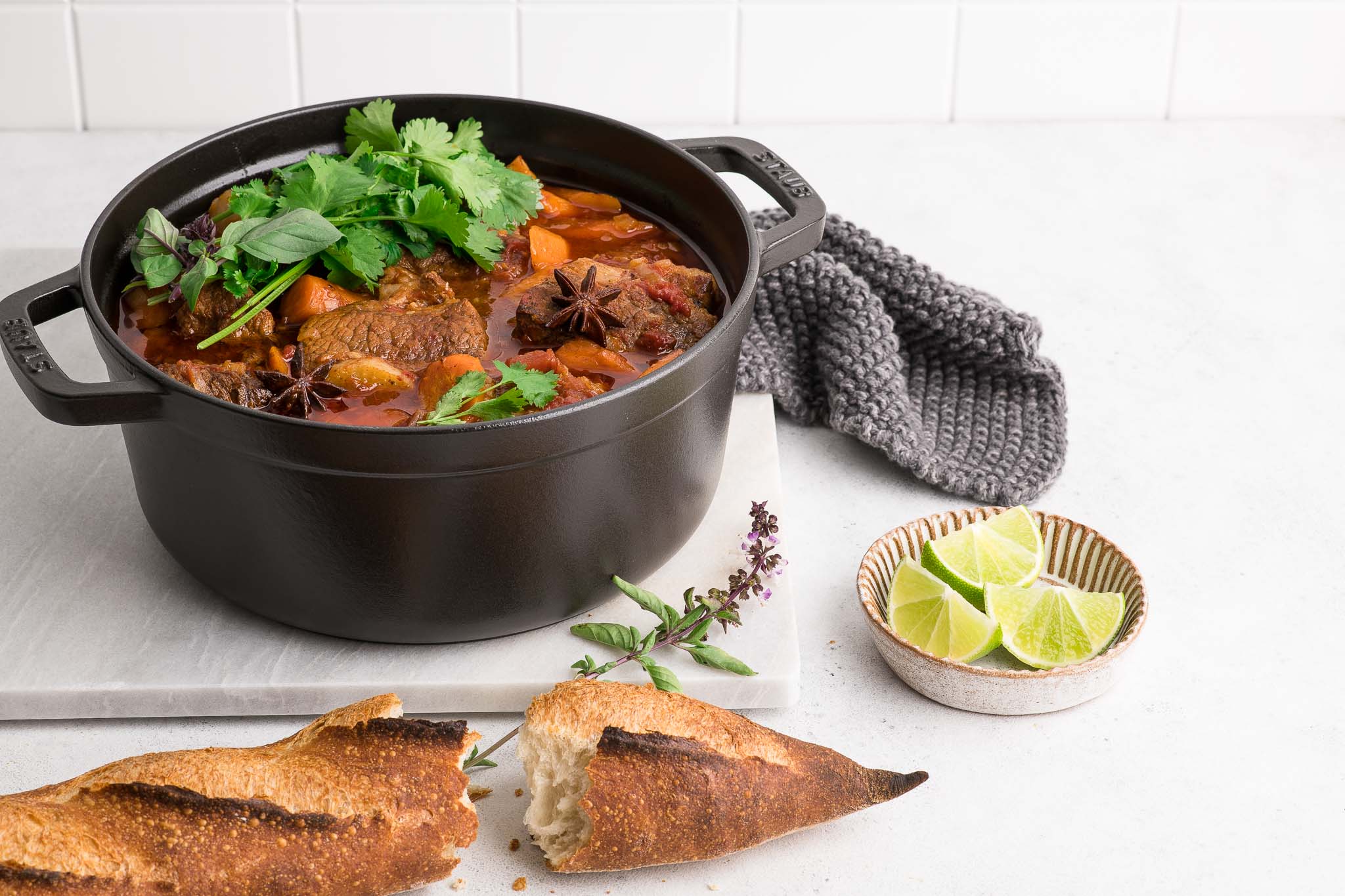
Where the French version is simple and comforting as a mere braise of beef and carrots with perhaps some tomatoes and thyme for additional flavour, the Vietnamese counterpart is fragrant with lemongrass, cloves, star anise and Chinese five-spice powder, and has a spicy kick when served with Thai basil and red chillies.
The only thing both dishes have in common is the crusty baguette served alongside, an idea which the Vietnamese undoubtedly borrowed from the French.
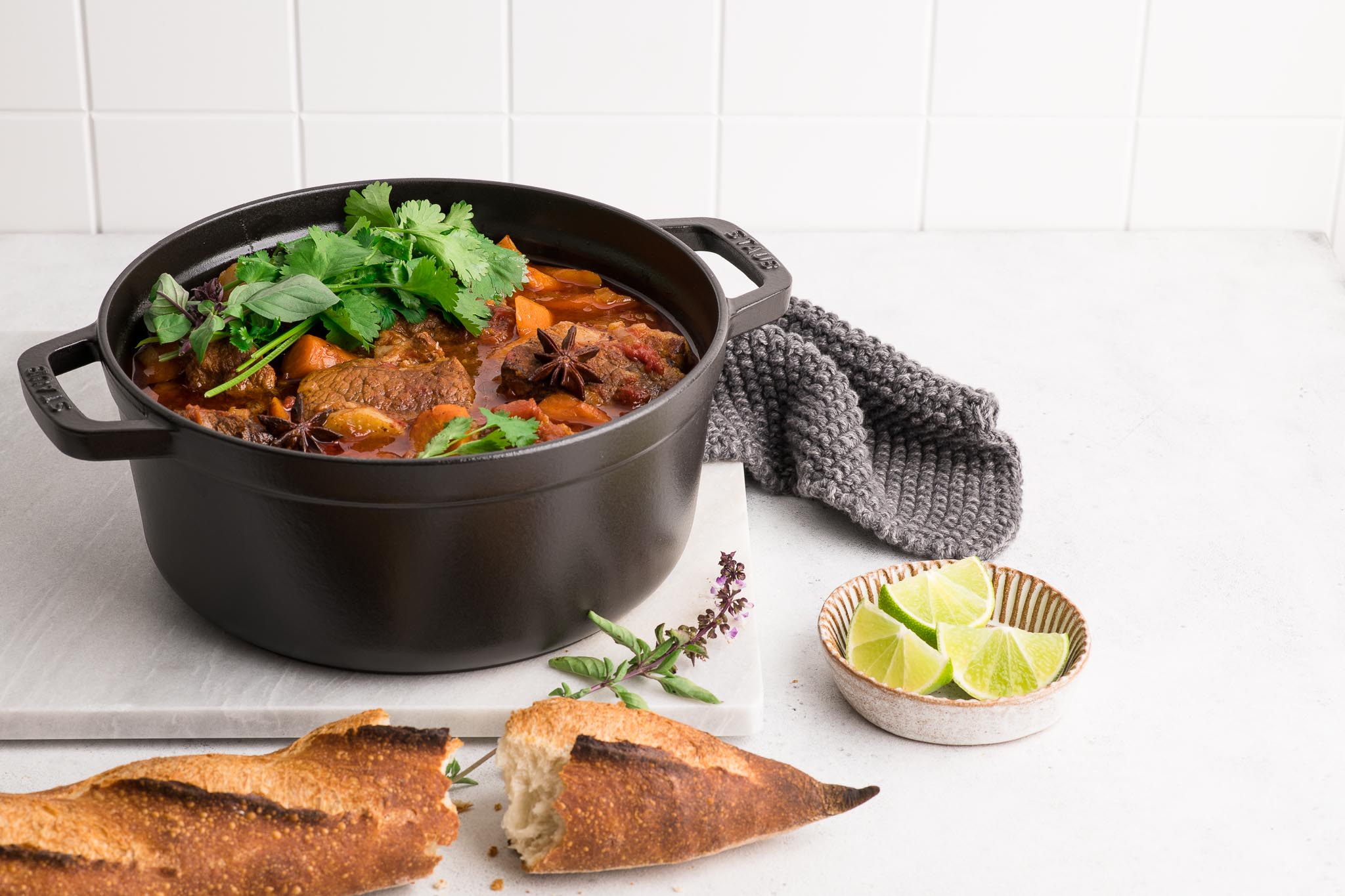
Bo Kho Recipe
My mother first taught me to make Bo Kho using a packet of pre-mixed spices from the Vietnamese grocery store which was employed in the marinade for the meat.
There’s nothing wrong at all in using these pre-mixed spices; I probably would have continued to do so but for the fact that I moved to Switzerland and the variety of Asian food products here is rather limited (although continually improving).
I had experimented with several recipes for this dish over the years with vague success until, one day, a good friend of mine revealed that her secret ingredient was … Coca-Cola.
And this instantly reminded me that my mother used Sarsparilla in her own version of this dish. (She used to teasingly offer me the leftover Sarsparilla to drink, but the mere smell would make me run in the other direction!)
Coca-Cola sounds to be an unusual ingredient but the bubbles have a marvellous way of tenderising the meat, and the sugar content of this fizzy drink means that you can dispense with any sugar in the dish. If you’re a bit apprehensive about using Coca-Cola, don’t be; you need barely a glassful for this recipe.
You can also omit to the Coca-Cola, if you wish. Simply add 1-2 tablespoons of vegetable oil instead to help the marinade coat the meat.
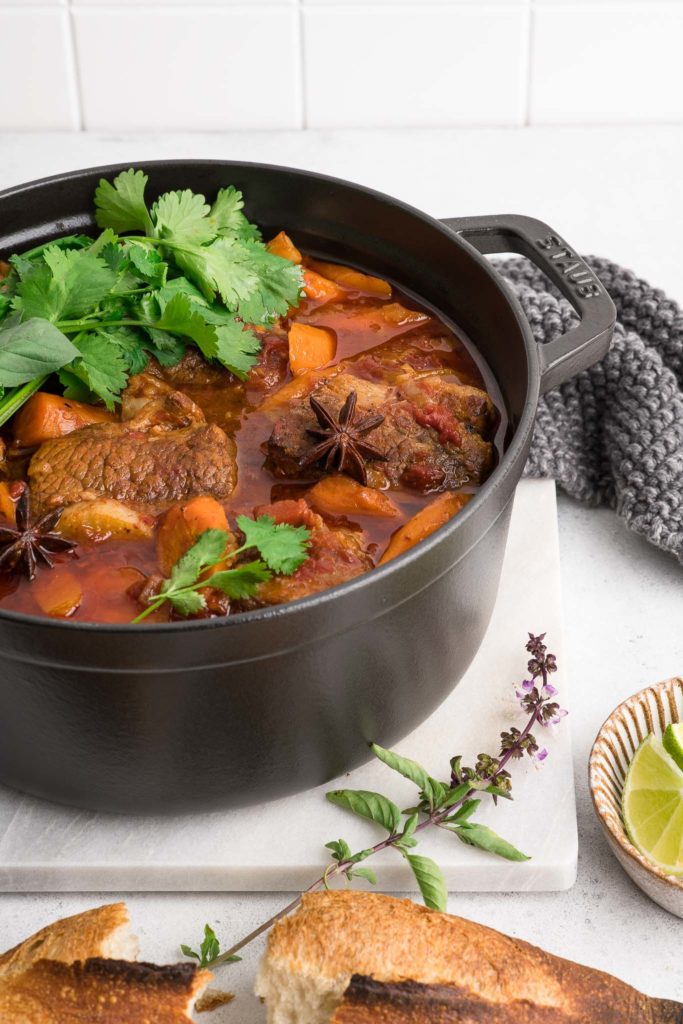
How to Make Vietnamese Beef Stew (Bo Kho)
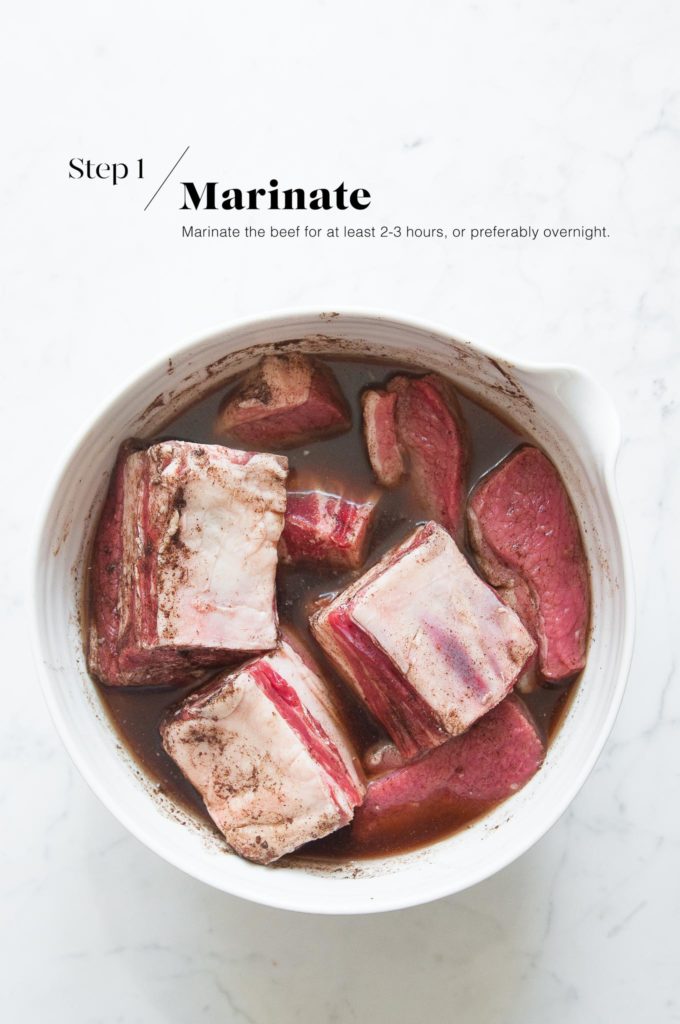
Step 1
Whisk the ingredients for the marinade in a large bowl. Add the beef and make sure all of the pieces are coated in the marinade. Cover with cling film and leave to marinate for at least 2-3 hours, or preferably overnight.
Step 2
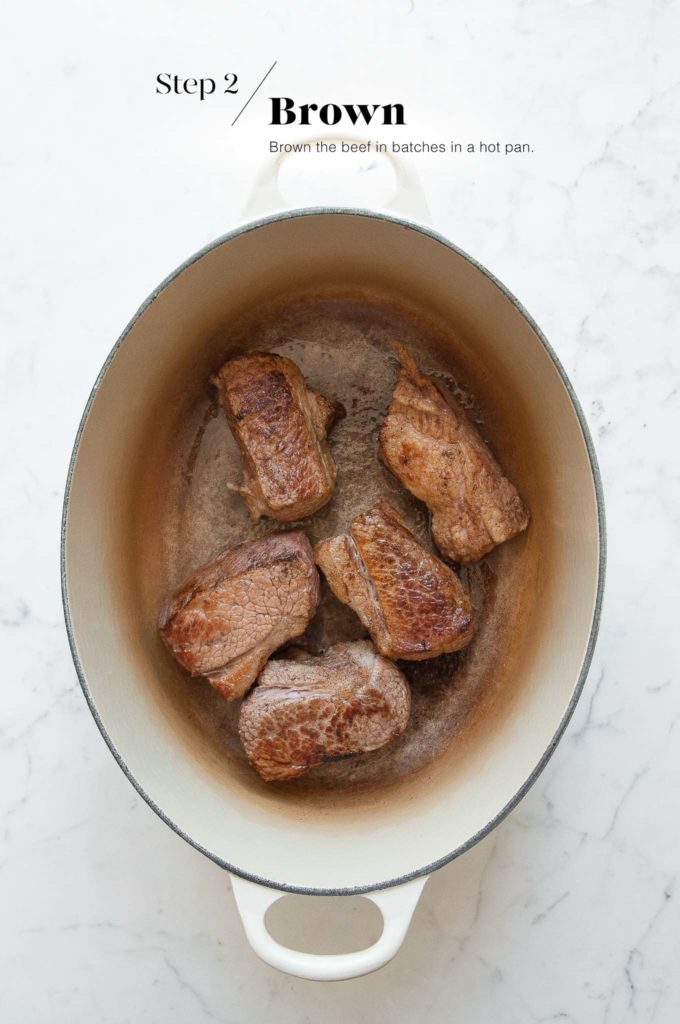
Heat some oil over medium-high heat in a large pot which will take all of the ingredients later.
Remove the beef from the marinade and pat dry with some kitchen paper.
Brown the beef in batches until they are nicely golden on all sides. Due to the sugar content in the marinade, take care not to burn the meat.
Remove the browned meat to a large plate.
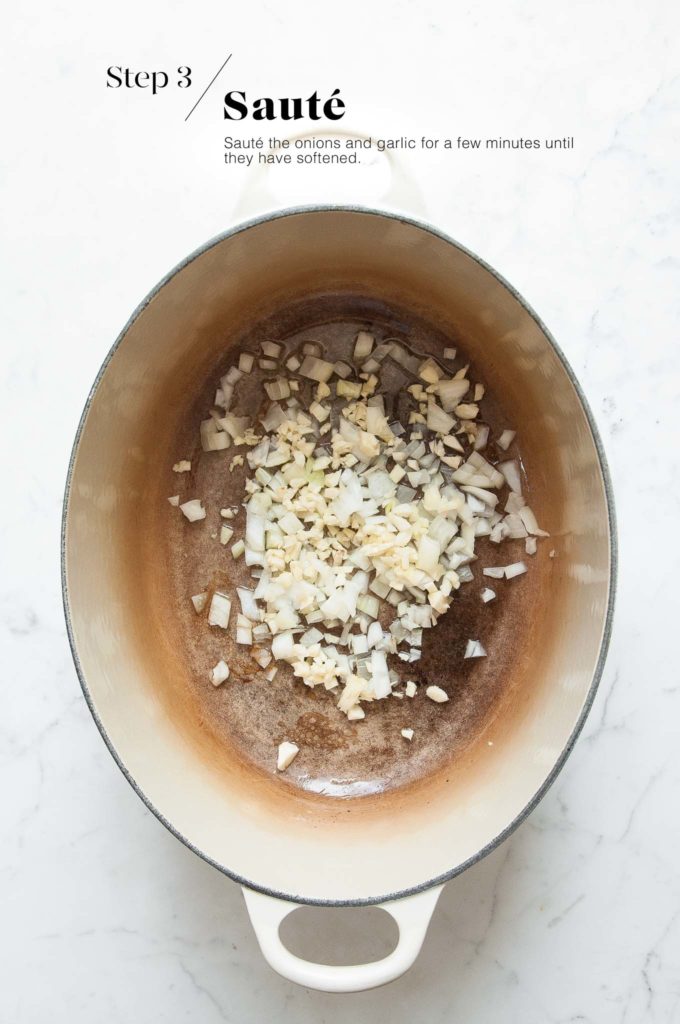
Step 3
Sauté the onions and garlic in the same pan until they have softened.
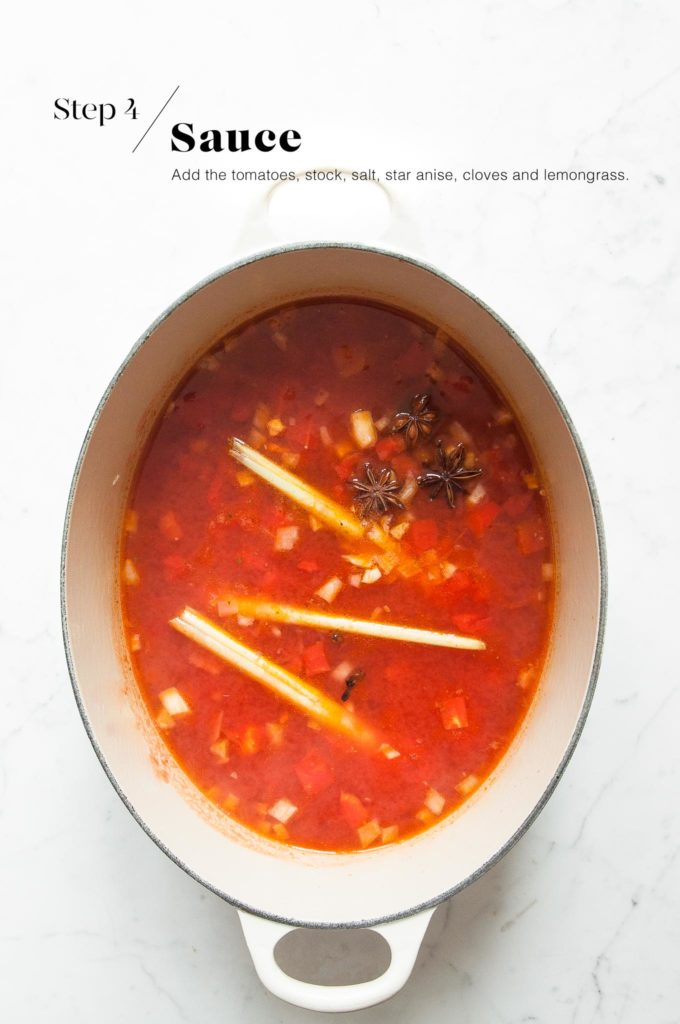
Step 4
Add the tomato paste or canned tomatoes, together with the stock, salt, star anise, cloves, and lemongrass.
Tomato paste is more traditional, but I once ran out of tomato paste and found that canned tomatoes was a great substitute.
Bring the mixture to a gentle simmer.
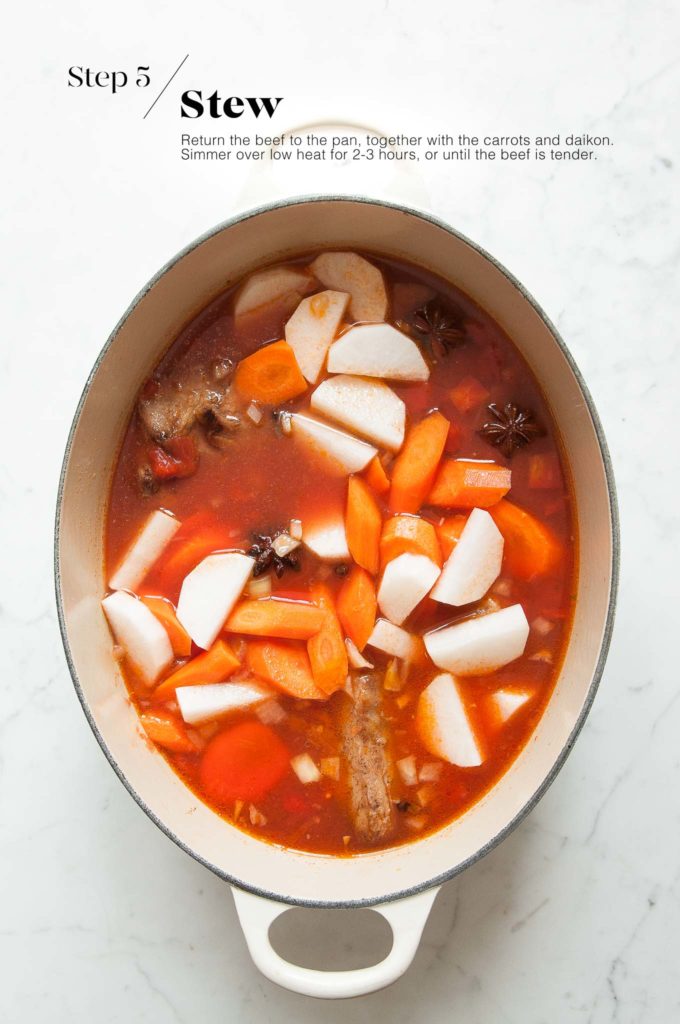
Step 5
Return the beef to the pot, and add the carrots and daikon. You should have enough liquid to just cover the meat and vegetables.
Turn the heat down to low, and simmer gently with the lid half on for about 2-3 hours, or until the meat is tender. The cooking time will depend on how big your pieces of meat are.
Remove the lid and continue to simmer for another 10 minutes or so, or until the sauce has thickened slightly.
How to Serve Vietnamese Beef Stew
This particular stew typically has bite-sized pieces of beef and carrots which are eaten with chopsticks, and the liquid broth is intended to be sipped with a spoon.
French inspiration can certainly be found in how the dish is served; the Vietnamese usually eat Bo Kho with some crusty baguette (preferably from a Vietnamese bakery) to soak up the aromatic broth, but it can also be served with some flat rice noodles for a more Asian affair.
When serving Vietnamese Beef Stew, the bread is actually a significant component – think half a baguette per person.
Tips For Making Vietnamese Beef Stew
To make this dish knife and fork friendly and a bit more elegant, I prefer to use large pieces of braising meat (about 1 to 2 per person) rather than small, diced up pieces. The large pieces take a little longer to cook, but I find the texture to be much nicer and more tender. But feel free to use smaller pieces as this is more traditional.
I also love carrots in my stew and tend to go rather overboard with them, so use as little or as much as you like, noting that the carrots will add a subtle sweetness to your stew.
Vietnamese Beef Stew (Bo Kho)

Ingredients
For the Marinade
- 1 teaspoon Chinese five-spive powder
- 1 tablespoon hoisin sauce
- 1 tablespoon sea salt
- 1 tablespoon black pepper, freshly cracked
- 250 ml (1 cup) Coca-Cola, optional, see Kitchen Notes
- 1 ½ kg (3 lb) beef brisket, chuck steak or stewing steak
For the Beef & Carrot Stew
- vegetable oil
- 1 brown onion, finely chopped
- 3 garlic cloves, finely chopped
- 400 g (14 oz) canned diced tomatoes
- 2 litres (8 cups) beef stock
- 1 teaspoon fine salt, or to taste
- 3 star anise
- 3 cloves
- 3 lemongrass stalks, bruised
- 5 large carrots, or more, peeled and sliced thickly (about 1 cm thick) on the diagonal
- 1 large daikon, peeled and sliced thickly (about 1 cm thick)
To Serve
- Thai basil, torn
- coriander, (cilantro) roughly chopped
- red chillies, finely chopped
- crusty bread
Instructions
To Prepare the Vietnamese Beef Stew
- In a large bowl, mix together the ingredients for the marinade.
- Cut the beef brisket or chuck steak into large pieces, about 5 x 10 cm / 2 x 4 inches.
- Place the beef into the marinade and make sure all of the pieces are coated.
- Cover the bowl with some cling film.
- Place the bowl in the fridge for the meat to marinate for at least 2-3 hours, but preferably overnight.
- Remove the meat from the marinade and pat dry with some kitchen paper.
- Let the meat come to room temperature before cooking.
- In a large saucepan, heat some oil and brown the beef in batches. Due to the sugar content in the Coca-Cola, the meat will brown quickly and will burn easily if you do not keep a close eye.
- Set the browned beef aside on a plate.
- In the same pan, cook the onions and garlic until they have softened.
- Add the tomato paste or canned tomatoes and cook for a few minutes.
- Add the stock, salt, star anise, cloves and lemongrass.
- Bring to the pan to the boil and return the meat to the pan, together with the carrots and daikon.
To Cook
- Simmer gently on low heat with the lid half on, for 2-3 hours, or until the meat is tender.
- Remove the lid and skim off any excess fat.
- Continue simmering for about 10 minutes without the lid, or until the sauce has thickened slightly.
- Taste for seasoning.
Kitchen Notes
- INSTRUCTIONS FOR PRESSURE COOKER OR INSTANT POT
* Follow the same instructions as for the stove top.
* Use about 1.5 litres (6 cups) of stock. The liquid should not completely cover the meat and vegetables.
* Cook using the manufacturer’s instructions on high pressure for 30 to 40 minutes with a slow release. - INSTRUCTIONS FOR SLOW COOKER
* Follow the same instructions as for the stove top.
* Cook on low (95°C/203°F) for 5-6 hours or high (105°C/221°F) for 4-5 hours. The timing may vary depending on the size of the pieces of meat. - VARIATIONS
* Use beef short ribs. The bones will add lots of flavour to the sauce. Use about 2 kg (4.4 lb) for the above recipe and ask your butcher to cut them into short lengths.
* Use whole baby carrots in place of normal carrots. Take care not to overcook them as they can break and disintegrate.
* Add whole, peeled baby onions. Take care not to overcook them as they can break and disintegrate.
* Add whole, peeled baby potatoes. The starch from the potatoes will help to thicken the sauce as well.
* Omit the Coca-Cola. This is used to tenderise the meat during the marinating time but you can omit it without too much effect on the final result. I would suggest adding instead 1-2 tablespoons of vegetable oil to the marinade to help everything coat the meat.
* Use smaller pieces of meat. If you prefer to use smaller pieces of meat (about 4 cm / 2 inch cubes) you will need to reduce the cooking time accordingly. - SERVE WITH BREAD
This dish is traditionally served with loaves of crusty baguette which are used to dunk into the sauce. - SERVE WITH NOODLES
For a gluten-free meal, it is also common to serve this dish with flat rice noodles. Cook the noodles according to the packet instructions until they have softened. Drain and lightly rinse the noodles. Place a serve of noodles into a large bowl, and ladle just enough broth to cover the noodles and top with the meat, vegetables and garnish. - OVEN & STOVE TEMPERATURES
All recipes on this website have been tested on an induction stove and/or with a conventional oven (i.e. an oven without fan). All recipes on this website use temperatures for a conventional oven, unless otherwise mentioned. Convection ovens (i.e. fan-forced ovens) are typically 20°C/70°F hotter than conventional ovens, but please check your manufacturer’s handbook. - CONVERSIONS
To convert from cups to grams, and vice-versa, please see this handy Conversion Chart for Basic Ingredients.
Did you make this recipe?
Please leave a comment below and share your photos by tagging @eatlittlebird on social media and using #eatlittlebirdUpdate
This recipe was first published on 6 February 2014. It has been updated with more comprehensive recipe notes.


Oh lovely! It’s kinda like the Chinese one on the good food site, but sounds much better! Coca-Cola makes sense for the reasons you have mentioned. Looks totally delicious Thanh 🙂
The flavours are quite different to the Chinese Braised Beef, but both are very delicious. Actually, I make the Chinese Braised Beef quite often but haven’t yet done so for guests. I’m more likely to make this Vietnamese stew when we have friends over because it’s a bit different. But both are definitely winter favourites in our home 🙂
So well written and presented Thanh! It sure isn’t winter here but I’d love a serve please 😉
Oh I couldn’t imagine eating this dish in the heatwave you’re experiencing at the moment in Australia! Can you guess who it was that revealed her secret ingredient to me?? 😉 I’m already putting in my request for her to make this dish and many others when we are next in Brisbane (hopefully soon!).
I’ve only ever cooked this once – used my aunt’s recipe and it was seriously an intense labour of love. I think I’ll wait for your return for our friend to cook it 😉 We went to visit her new eatery today and it was unsurprisingly super busy and delicious!! When are you coming home??
Hopefully sometime this year … but I think we say that every year?? You’ll be among the first to know 🙂 And our first food stop will be T’s new eatery!
This looks absolutely delicious! I love braised dishes at this time of year so I will be giving this one a try. Thank you for sharing.
Thanks, Donna! Hope you will enjoy this recipe. It’s a bit different to your usual beef stew but I think it’s worth trying 🙂
My mom loves making this alongside big, fluffy vietnamese baguettes 🙂 She said that it makes a good breakfast!
Absolutely! The Vietnamese love their hot breakfasts and I would be happy to sit down to a bowl of this in the morning with a hot baguette loaf, fresh from the oven. Mmmm 🙂
I’m not much of stew, but your photos are soooo beautiful, that even makes me want to eat it!! Well, OK, that’s nos so true!!!
However, I wouldn’t say no to this, I love that combination of five spices, lemongrass and all that…
And it’s funny the idea of using Coca-Cola. I’ve also seen some recipes for meat using it, and I have to try sometime!! But I’m somewhat reluctant, I don’t even like Coke as a drink!!
Cute cute photos, love it!!
Have a nice weekend, Thanh!!!!
Hi Paula,
I’m not a big fan of Coca-Cola either. I used to drink it a lot when I was younger, but then I stopped and now it tastes a bit funny when I drink it. Although, I do like to have a glass of Coca-Cola when I eat pizza … 😉
I’ve tried Nigella Lawson’s Ham in Coca-Cola which was really delicious. Although, that recipe uses A LOT of Coca-Cola, like a whole 2 lt bottle! This stew only needs about 3/4 cup so it’s not so bad.
Wishing you a great weekend also!
I used cold coca-cola only in case our (then small) daughter had a stomach problems. Few spoons of cold coca-cola and few sticks of salted pretzels were good to calm the stomach down as our doctor said. It always helped.
My mum used to prescribe lemonade or Sprite whenever I had stomach problems as a child! I suppose there is something in the fizzy bubbles which helps. My son had a bout of bronchitis a few months ago and was generally feeling quite poorly. The paediatrician recommended that I give him salty food, such as pretzels, as the body apparently loses some salt when sick and this needs to be replenished. So Coca-Cola and pretzels are not so bad after all 😉
Beautiful pics Thanh. I’ve only used coca cola once in cooking, well rather baking thanks to Nigella. I made her coca cola cake a while back. My hubby would be the happiest if I made him this stew, I tend to avoid beef so to hubby this would be one of those rare treats 🙂
Ooh I haven’t tried Nigella’s Coca-Cola cake yet … that would be an interesting one! I guess one shouldn’t be too surprised about cooking with Coca-Cola; wine, beer and other beverages are commonly used in cooking too.
This looks like such a beautiful clean dish – can’t wait to try it. Excellent food styling, too. Great work.
Thanks, Rachel!
I made this recipe today using the pressure cooker and it was absolutely delicious! Can’t believe dinner was on the table so soon! The carrots had softened a lot but they were still intact – the kids absolutely loved it. Thank you for this recipe!
I will try to cook it.I really liked your recipe. Thank you
Used candied ginger instead of garlic & lemon zest in place of lemon grass. Didnt bother with the meat “browning” – a total waste of time for two reasons: 1. splatters everywhere ruining cooker, walls, floors etc. 2. meat doesnt brown just boils because of liquid content from marinade (I have a gas stove so regulating heat to high is not a problem). I also coated the meat in flour to aid in thickening the sauce speeding overall cooking time. Added potatoes to replace baguette or noodles. Used a good dash of soy sauce in the marinade so didnt need much salt, also takes the edge off coca-cola, carrot, candied ginger sweetness
I’m Vietnamese and I’ve never seen anyone use coke in their beef stew marinade.
Unbelievably delicious. Was termed “the best soup I’ve ever had” by one eater. I have made this 3 times. Once with coca cola, once without in a slow cooker and once with ginger ale as had no cola. All three were amazing. Smashed and very thin sliced lemon grass was more flavorful than smashed and floating the stalk. Wading through the ads was worth it for this recipe. Thank you!
Hi Anne,
Thank you for your feedback! I’m so glad you have enjoyed it many times now. Great to know that ginger ale also works!
I made this for dinner last night and it was just like how my mum made it! Such a great recipe!
Such a delicious recipe! I’ve been wanting to try this beef stew for a long time but wasn’t sure about the Coca Cola in the recipe. But we had a party and someone left a bottle of Coke at our place and I thought I would give your recipe a try. It totally works! I used the Instant Pot and the meat was so tender and delicious. Now I regret waiting so long ha ha! I also make your chicken pho frequently.
We once had this dish in a Vietnamese restaurant in Hong Kong and I’ve been to trying to recreate it ever since. I tried a recipe which used Coca Cola in the broth but it was too sweet. Then I tried your recipe on the weekend and it was exactly how I remembered this dish tasting! We just had leftovers and it tastes even more amazing the next day! Definitely need to serve with warm baguette. Thanks so much for your recipe.
Really nice recipe. I might add more spices next time like more star anise and five spice, but overall very delicious.
Hi there! I found your recipe on Pinterest and spent the whole day making it. The taste is delicious!
Great recipe! Tastes almost like how my mom makes her Bo Kho, except she uses Sarsparilla in her marinade. I’ve never had this dish with daikon but tried it as per your recipe and loved it.
Very delicious and flavourful beef stew, perfect for the cooler weather we’ve been having lately in Melbourne. I made it with the Instant Pot so it was pretty quick and easy.
Wow, so delicious! I had this dish once in a Vietnamese restaurant and decided to make it at home. The Coca-Cola was an interesting ingredient, I guess to add sweetness to the marinade? Next time, I’m going to make a bigger batch so that I can have more leftovers. Everyone loved it!
Really nice recipe. We don’t normally make bo kho with daikon but it was delicious. My mom usually makes it with carrots and potatoes, and probably also with the same store bought seasoning you mentioned above! She said she liked your recipe too 🙂
Lovely recipe! Will make again but double the recipe next time 🙂
Absolutely delicious recipe. It tasted amazing with the fresh herbs and chillies.
Amazing recipe! I made this with the Instant Pot and the flavors were so delicious. My mother (she’s Vietnamese) likes to eat this with rice noodles, but I prefer baguette. Either way, everyone loved it.
Wow! Amazing flavours. I made this dish for friends last night and everyone loved it. The beef was very tender and the sauce was absolutely delicious. I cooked it on the hob but now considering if I should buy an Instant Pot.
Really nice flavors. I will definitely make this again.
Beautiful flavors! I made this in the Instant Pot and the meat was incredibly tender. I’ll definitely make this again.
Beautiful recipe! Can I say that it tasted better than my mom’s??! Can’t wait to try more of your recipes.
Amazing! This Vietnamese beef stew was more delicious than the one we usually order when we go out, and so much cheaper to make at home! Looking forward to leftovers.
Delicious meal for the family!
This Bo Kho was amazing. The beef was so tender and flavorful. I also added potatoes which went really well.
This beef stew has been perfect for the cold (and wet) weather we have been having lately in Melbourne. Beautiful flavors. I even bought Vietnamese baguette from a Vietnamese bakery, ha ha!
Absolutely great recipe. Really delicious flavors and the kids loved it too!
Wow! Such an amazing recipe. My boyfriend likes to order this dish when we go to a Vietnamese restaurant, so we thought we would try to make it at home. Incredible flavors!
Wow, flavor was amazing. Very delicious!
Thank you for this recipe. My mom used to make this for special occasions and it was a favorite of mine when I was a kid. Now I can make it for my kids.
This was pretty amazing. I didn’t realize it was so easy to make this dish. The flavors were 10/10!
Yummy! Easy to make and tastes very good!
The taste was excellent, very authentic.
My family loved this dish! I cut the carrots larger and also added potatoes and broccoli. I need to sneak in the veges when I can! Great recipe, will make again 🙂
We make this about once a month as a treat. It’s absolutely delicious exactly as written.
Thank you!
Hi Anne,
Thanks so much for your comment! I’m so glad to hear that you love this recipe. This is one of my favourite stews too, and I can’t wait to make it again this weekend 🙂