

 by
by 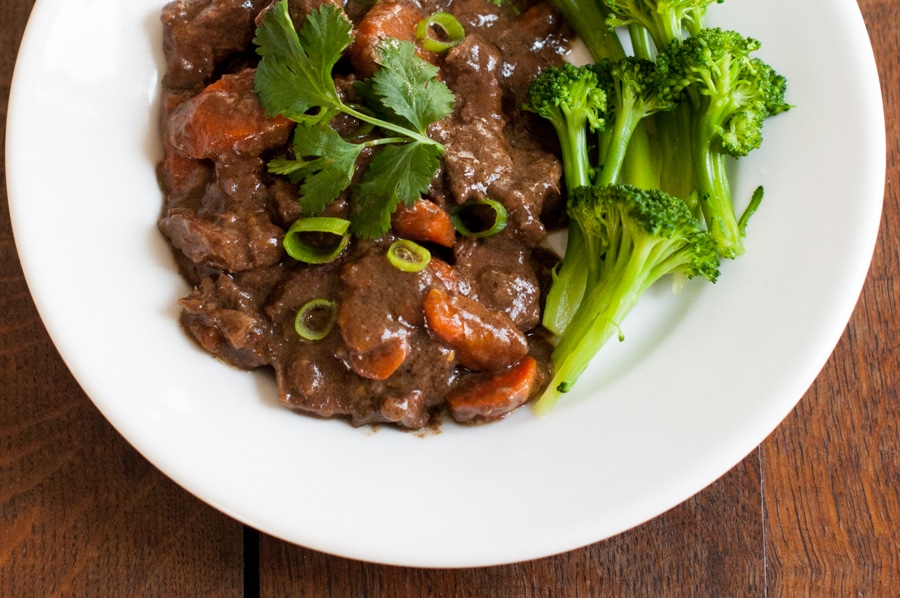
I always look forward to Autumn, that time of the year when the trees change their colours and their golden leaves line the streets with their warm tones in contrast to the biting chill that is beginning to pervade the air. I also love Autumn because I can start to pull out my favourite trench coats, turtleneck jumpers and knee-high boots, a welcome change in wardrobe when I can start to cosy up with layers.
With the looming grey skies that threaten to hang around for a good 5-6 months, my thoughts often turn to stews and braises. I particularly love beef stews and make several versions of this dish through the cooler months.
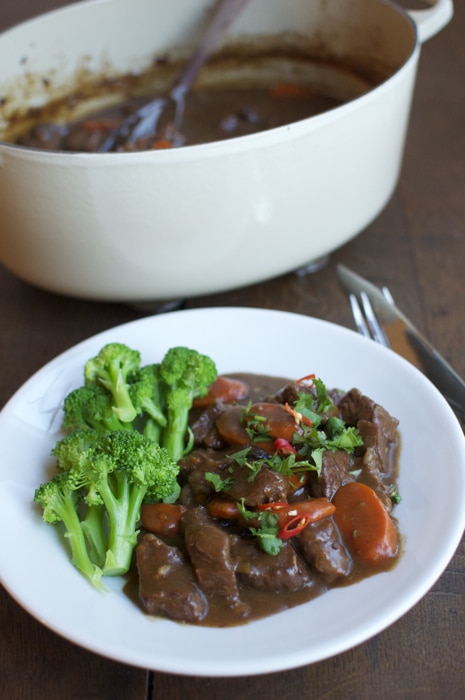
Not long ago, an online foodie friend from the Netherlands, Joost, talked about his favourite beef stew for which he would travel to the other side of the city just to buy the right cut of meat. Such dedication resonated with me and suggested that there was something special about this recipe. This dish has now become a regular in our home, particularly as an alternative to the more usual beef in red wine stews.
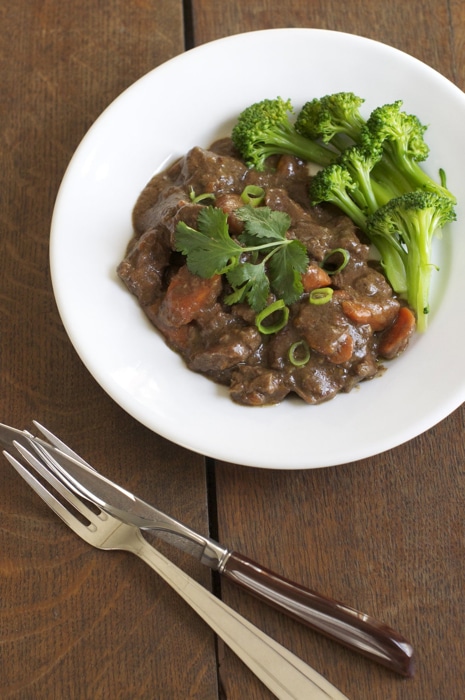
The recipe comes from Good Food magazine and is essentially a beef stew with a few key Asian spices and ingredients to lift this dish from being just any ordinary beef stew to something quite wonderful. I’m not sure if it is an authentic Chinese dish, per se, thus explaining why it is called Chinese-style, but the Chinese flavours are really welcoming. The Chinese five-spice powder, ginger and chillies lend a gentle heat to this stew which is perfect if you are looking for a dish with a bit of kick. You might even want to bump up the chillies and Chinese five-spice powder, though I would suggest following the recipe first as much depends on the brand of Chinese five-spice powder that you are using; the brands that you can buy from an Asian grocer are usually stronger in taste than those from Western supermarkets. And please do not confuse Chinese five-spice powder for the French quatre épices – the latter is a completely different spice mix used in French cooking and is not a substitute for Chinese five-spice powder. As for chilli heat, you can always add more chillies upon serving.
I love to add carrots in my stews – lots of them! – so that is one main addition of mine to the Good Food recipe. Otherwise, I have altered the method a little to suit my (lazy) style in the kitchen.

Chinese Braised Beef with Carrots

Ingredients
- 1 kg (2 lb) chuck steak, beef brisket or other stewing beef, cut into large cubes
- 1 tablespoon vegetable oil
- 6 garlic cloves, finely chopped
- 5-6 spring onions, (scallions) thinly sliced and separated into white and green parts
- 1 red chilli, finely chopped
- 4 cm (2 inches) ginger, coarsely grated
- 1 teaspoon Chinese five-spice powder, or more, to taste
- 3 tablespoons Shaoxing cooking wine, or dry sherry
- 2 tablespoons plain flour, (all-purpose flour)
- 500 ml (2 cups) beef stock, or chicken stock
- 3 tablespoons soy sauce, plus more to taste
- 2 teaspoons light brown sugar, or sugar
- 2 star anise
- 3 large carrots, thickly sliced
- coriander, (cilantro) finely chopped
Instructions
- Preheat the oven to 150°C/302°F (without fan).
- Heat a few tablespoons of olive oil in a large, oven-proof pan (such as a Le Creuset pot) over medium-high heat. Brown the meat in batches and remove with a slotted spoon to a bowl. Add more oil between batches if necessary.
- Once you have finished browning all of the meat, add to the pan the garlic, white part of the spring onions, chilli, ginger and Chinese five-spice powder. Cook for a few minutes until fragrant. Pour in the Shaoxing rice wine and let it bubble away for about a minute, scraping the pan with a wooden spoon to make sure that any bits which have stuck to the pan are dissolved in the wine.
- Return the meat to the pan, together with any juices which have collected while it has been resting. Sprinkle over the flour and stir everything together until the flour is dissolved and the liquid in the pan starts to thicken.
- Pour in the beef stock and soy sauce. Add the sugar, star anise and carrots. Mix everything together well. Place the lid on the pan and put the pan into the oven for about 1.5 to 2 hours, stirring every 30 minutes or so. Alternatively, you can cook this on the stove-top over low heat, making sure that you stir regularly.
- The beef is done when it is soft and easily falls apart when pierced with a fork. Taste the sauce for seasoning and see if you want to add more soy sauce. If you would like to have more sauce, you can add some boiling water to the stew, though you might have to thicken it with some cornflour if the sauce is too thin.
- I like to serve this stew with a good sprinkle of freshly chopped coriander (cilantro), green spring onions (scallions) and some finely sliced red chillies for more kick. Serve with steamed Jasmine rice and some steamed green veges, such as broccoli, on the side.
Kitchen Notes
- OVEN TEMPERATURES
All recipes on this website state temperatures for a regular oven (i.e. a conventional oven without fan). If you have a convection oven with a fan, please consult the manufacturer’s handbook on how to adjust the temperature and baking time accordingly. - CONVERSIONS
To convert from cups to grams, and vice-versa, please see this handy Conversion Chart for Basic Ingredients.
Did you make this recipe?
Please leave a comment below and share your photos by tagging @eatlittlebird on social media and using #eatlittlebird

I adore this recipe and I remember a few of us made it around the same time! I, like you, love carrots in my stews…probably my favourite way of having them. Thanks for reminding me of this..its turned cold here in Doha, and stews are starting to sound extremely appetizing!
Made this for tea tonight Thanh! As luck would have it, I had everything I needed and had taken out beef to defrost. My son absolutely LOVES it! I haven’t dampened down the flavours at all, if anything I bumped up the Chinese spice powder. He is tucking away nicely (had no patience, had to feed him now, well before the rest of us sit down for dinner!). Thanks for the recipe 🙂
PS : Love Mandy’s noodle idea… if there are any left, I shall try that!
Oh yes, I remember you trying this dish earlier now! It’s a wonderful recipe, isn’t it? And great to hear that your little boy can tuck into a dish like this which is packed with flavours! I usually also add an extra teaspoon of Chinese five-spice powder, though I didn’t this time and it was still quite flavourful for us. But for me, the carrots are a must; like you, I absolutely adore carrots in beef stews 🙂
One of my favourites too, and I love your addition of carrots. I also found that if you shred the leftover meat it makes a great sauce for a noodle stir-fry.
Ooh that sounds delicious!! I will have to try this dish with noodles next time!
Beef stews in all the guises are a favourite with us too although we use the leaner richer buffalo. I love it gamey with elderberry jelly, and sprightly with marmalade and orange zest. I’ve yet to try a chinese style one and as luck would have it I have cubed buffalo in my freezer and carrots in my fridge….
For jo tho, there may need to be a little rice or more english mashed potatos on the side!
I’ve never tried buffalo. I guess it would taste more gamey? Though, I imagine that it would work well in this recipe with the Chinese flavours. Please let me know if you try it! And don’t worry – we often have plenty of rice with this dish 🙂 For some reason, on both occasions when I’ve gone to take photos of this dish, the rice was still cooking!
This sounds very tempting: it’s ages since I’ve cooked with Chinese flavours, though I did poach some plums with star anise recently which reminded me how delicious that particular spice is. My “best ever” beef stew is one with a little chocolate in… and I CAN’T FIND THE RECIPE !!
Poached plums with star anise sounds delicious! I remember you talking about this beef stew with chocolate before. Is it anything similar to Nigella’s chilli recipe where she adds cocoa? That’s such a shame that you can’t find this recipe anymore! Was it from a magazine, online or from any popular chef?
Your blog is lovely! I started reading at work and didn’t finish until I got to the end. 🙂
I’m going to try the braised chicken legs w/ mushrooms this week… it looks phenomenal!
Hi Sydney,
You’ve just made my day 🙂 Thank you for taking the time to read my blog. I hope it made your work day go faster 😉 Please let me know if you do try the Braised Chicken with Mushrooms. With the weather cooling down a lot here, I might make it myself again soon.
its so delicious
I had this recommended to me when looking for different recipes other than beef in red wine (a familiar problem! lol) and Im so glad I tried it! I use pretty much the same ingredients but use mince instead to make san choi bow, and we love it wrapped up in crunchy lettuce leaves during summer with a spicy dipping sauce (http://wherethewindblowsher.blogspot.com.au/2011/07/san-choi-bow.html). This recipe is a fabulous way to use these flavours that I already love, but transferred to a winter dish! So glad this recipe came to my door!
Your san choi bow sounds interesting and really delicious!! I think the ingredients in this stew are very familiar to Chinese cooking and these same ingredients can create delicious flavours in other dishes too. I love a good san choi bow, and with the weather warming up, I might take a tip from your blog 🙂
This was a wonderful dish, with exquisitely flavorful sauce. I didn’t use the carrots, but instead stir-fried some bok choy and added a ladleful of the sauce to that.
I’m so happy to hear that you enjoyed this recipe. Some bok choy would be lovely alongside this stew. I also love the sauce in this recipe as it is lovely drizzled over some steamed rice.
YUM! This looks so delicious! I can’t WAIT to try this! Thank you for this great recipe!