

 by
by 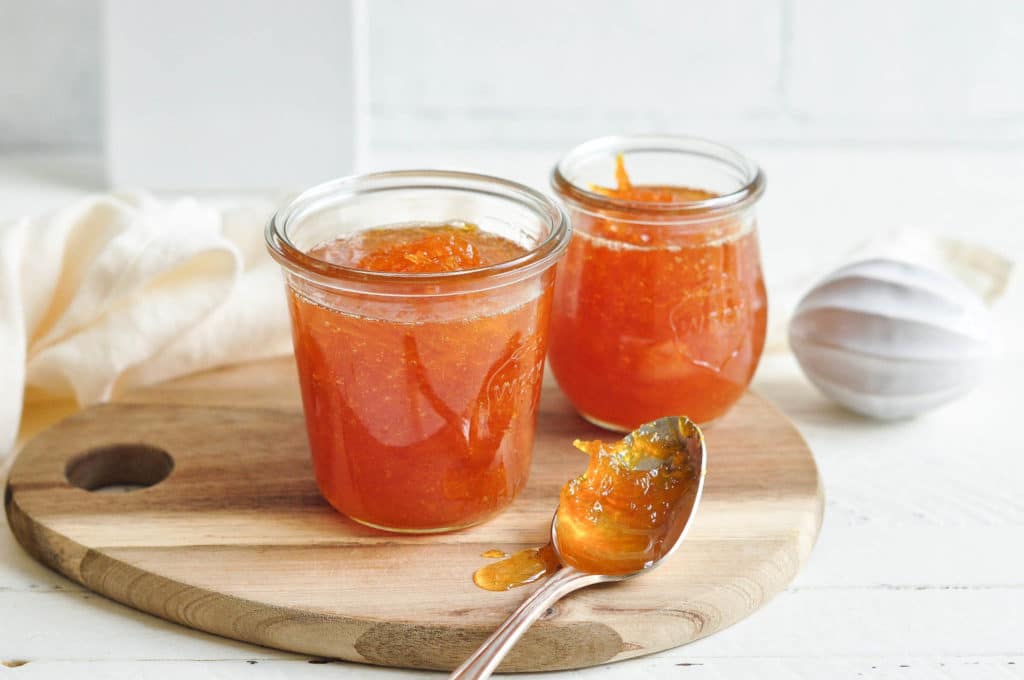
Preserving
One thing I love about summer is the abundance of fruit and trying to preserve as much of summer as I can into little glass jars.
I have made several batches of Peach & Raspberry Jam, as well as a simple Apricot Jam, not to mention the Strawberry Jam which has been disappearing as fast as I make it.
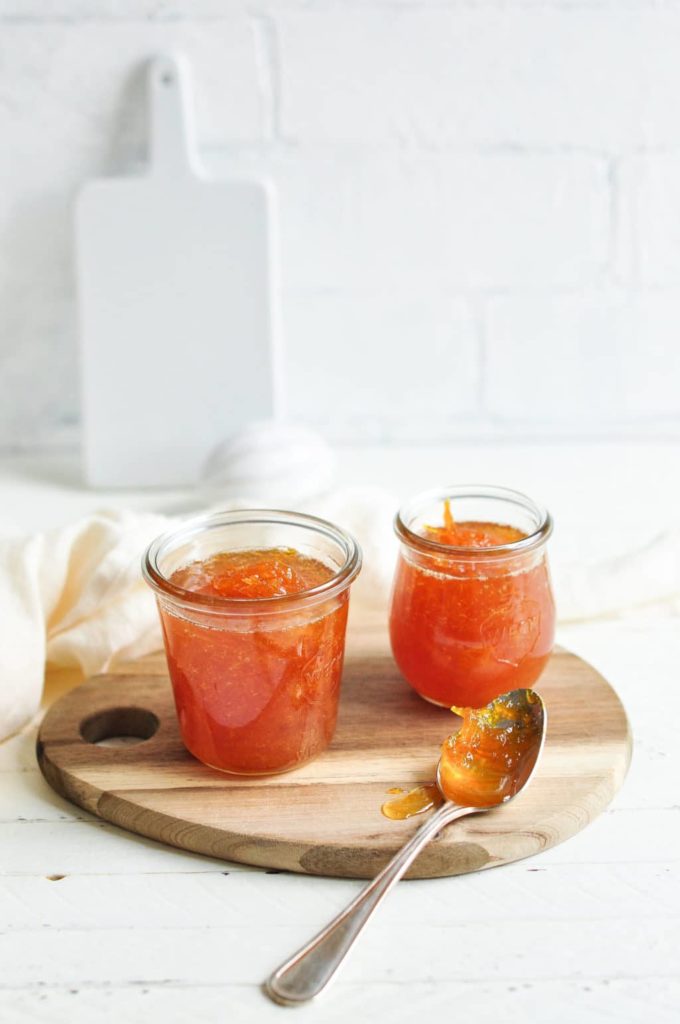
We always have a constant supply of oranges at home, either to eat as is or to freshly squeeze at breakfast.
But I never really contemplated the idea of making orange marmalade at home until I was one day treating myself to some homemade fruit bread and realised that only orange marmalade would be the perfect accompaniment.
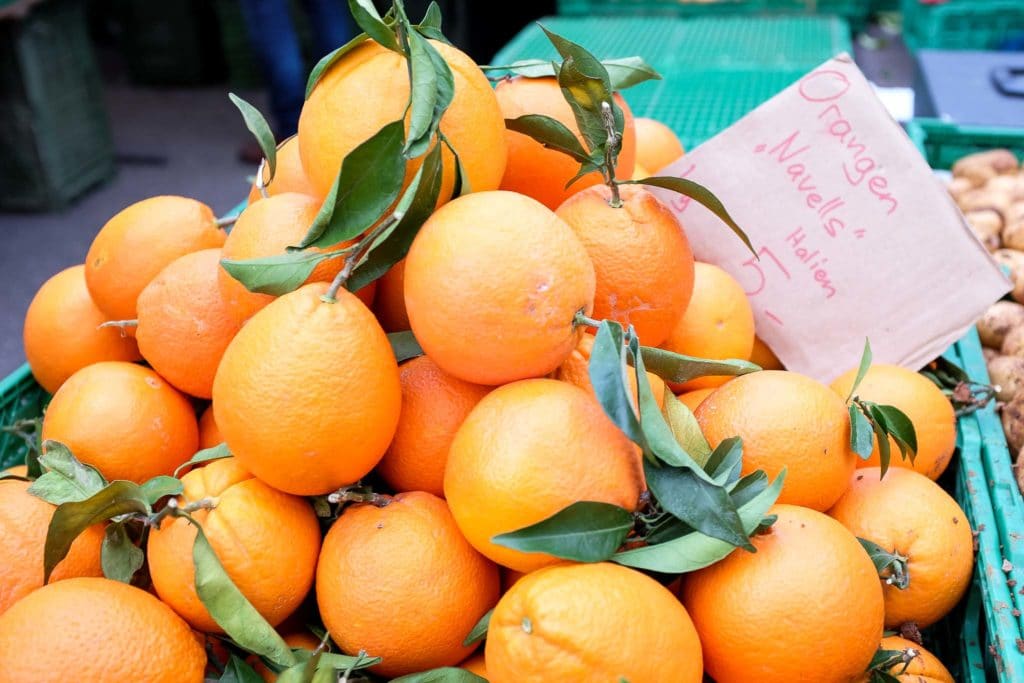
Orange Marmalade Recipe
I gathered all of my books on making jam and was somewhat surprised to find that there were so many varied recipes for orange marmalade.
Some marmalade recipes required the orange rind to be soaked in water for 3 hours. Some required straining the fruit mixture through a piece of muslin overnight.
I ultimately settled on a marmalade recipe from one of my many French cookbooks which perhaps wasn’t the quickest recipe but it didn’t require any overnight preparation.
It was also a recipe which used the least amount of sugar; jam recipes often call for 1:1 ratio of fruit to sugar and which makes sense if you are preserving for the long haul (i.e. if you are making jam which might be eaten 2 or more years later), but which isn’t necessary if you know you will consume the jam over the coming weeks.
This particular orange marmalade is quite sweet, primarily because it uses sweet, blonde oranges and not the bitter Seville oranges.
Also, this marmalade recipe is quite persistent in trying to remove as much pith as possible, and blanching the peel beforehand helps to soften it so that you are not confronted with a chunk of bitter peel later.
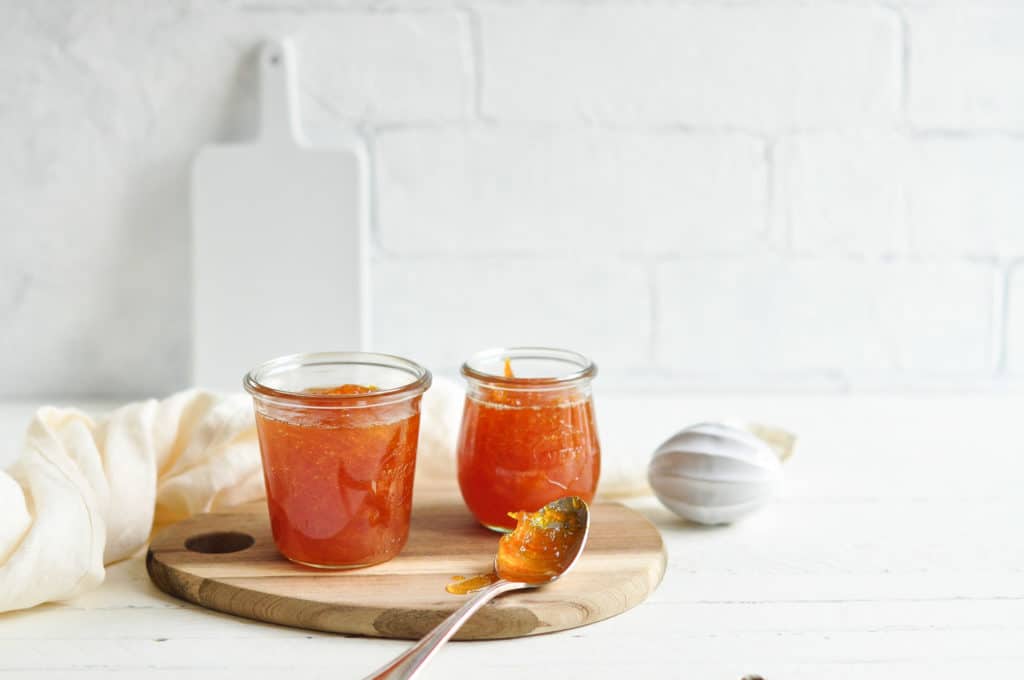
Ginger Marmalade
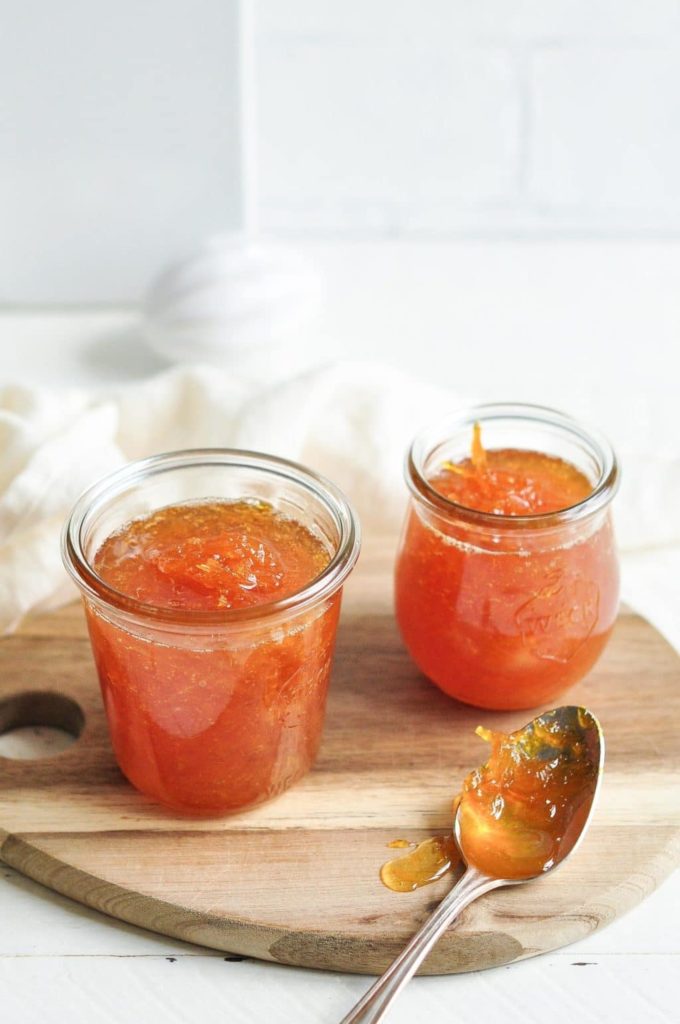
I happen to love, love ginger jam and so I grated fresh ginger into half of the orange marmalade just before bottling them to make a small batch of ginger marmalade. It was also a quick way to add more variety to my current jam collection.
I quite like this marmalade recipe and would be curious to try it with grapefruit!
How Long to Boil Jam
Making jam involves boiling the fruit with sugar in a large saucepan over high heat until it has thickened nicely.
How long you need to boil the jam depends on how much liquid there is to start with, as you essentially want most of the liquid to evaporate so that the mixture can thicken.
Obviously, some fruits contain more water than others, so some jams are relatively quick to make, whilst others require a bit more time.
Oranges, for example, contain a lot of water, so making marmalade generally takes a bit longer than other jams.
For the recipe below, I estimate that you need to boil the mixture on high heat for almost 30 minutes until you reach setting point.
Setting Point for Jam
Most recipes for jam suggest a setting point of 105°C (220°F).
The best way to test if a jam has reached setting point is to use a digital thermometer, sugar thermometer or jam thermometer.
However, I find that, even when using a thermometer, sometimes the jam is ready before or after reaching the desired temperatures.
So in addition to using a thermometer, I also use the jam plate test.
The Jam Plate Test
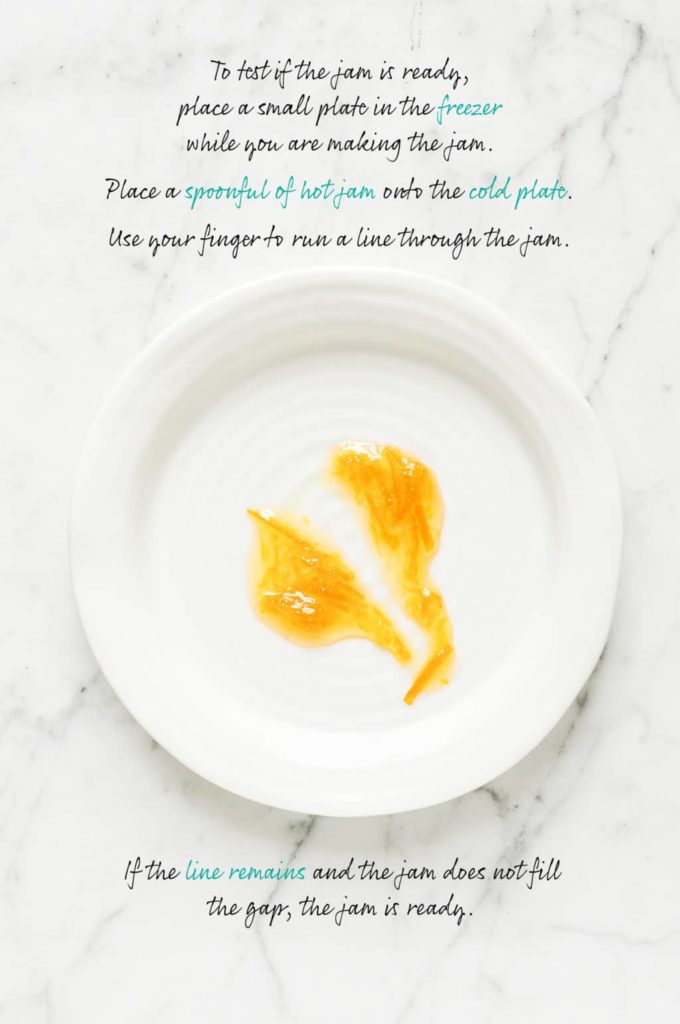
The jam plate test, also called the cold plate test or wrinkle test, is an effective way to test if your jam has reached setting point.
While you are making the jam, simply place 3 or 4 small plates in the freezer.
To test if your jam is ready:
- Place a spoonful of hot jam onto the cold plate, and use your finger (or a teaspoon) to run a line through the blob of jam.
- If the jam starts to fill the line, this means that the jam is still too liquid and runny, and that it is not yet ready.
- If the line remains and the jam does not fill the gap, then the jam has reached setting point and is ready.
How to Make Marmalade
For a printable recipe, please scroll down.
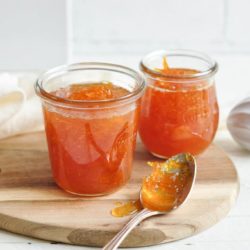
Orange Marmalade

Ingredients
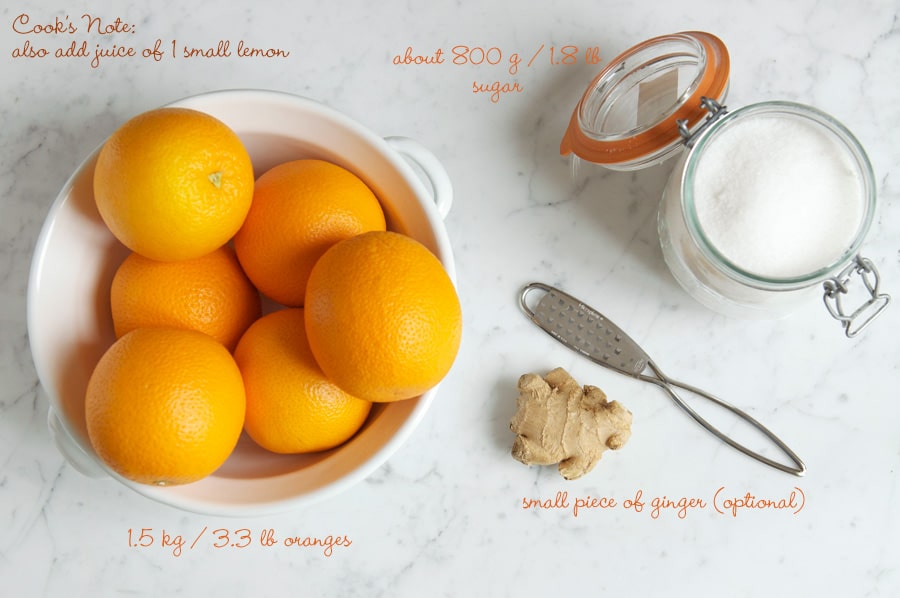
- 1.5 kg (3 ⅓ lb) blonde oranges
- 800 g (3 ⅔ cups) caster sugar, (superfine sugar)
- 1 small lemon, juiced
Instructions
To prepare for the Jam Plate Test
- Place 3 or 4 small plates into the freezer.
To prepare the orange peel
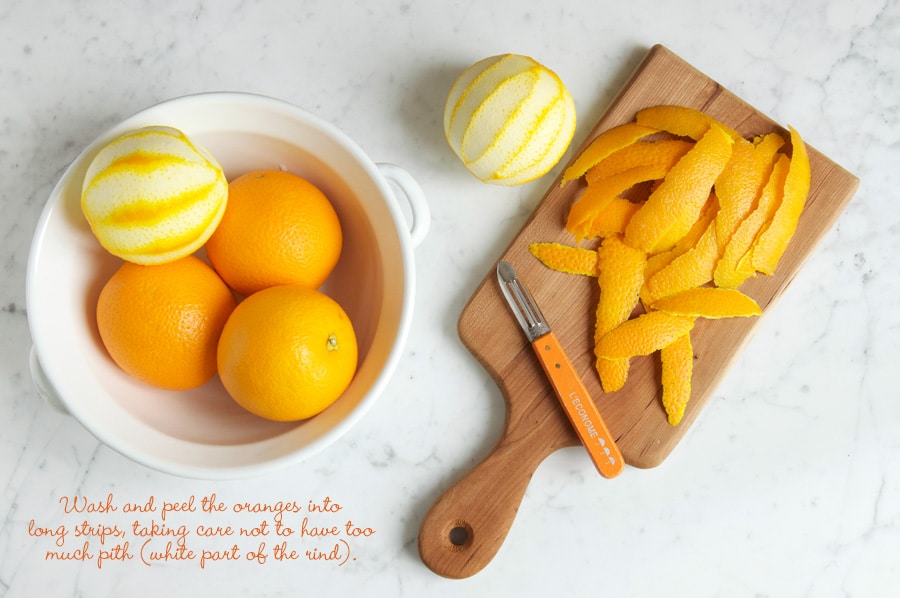
- Wash and pat dry the oranges.
- Use a vegetable peeler to carefully peel the oranges into long strips, taking care not to have too much pith (white part of the rind) on the rind.
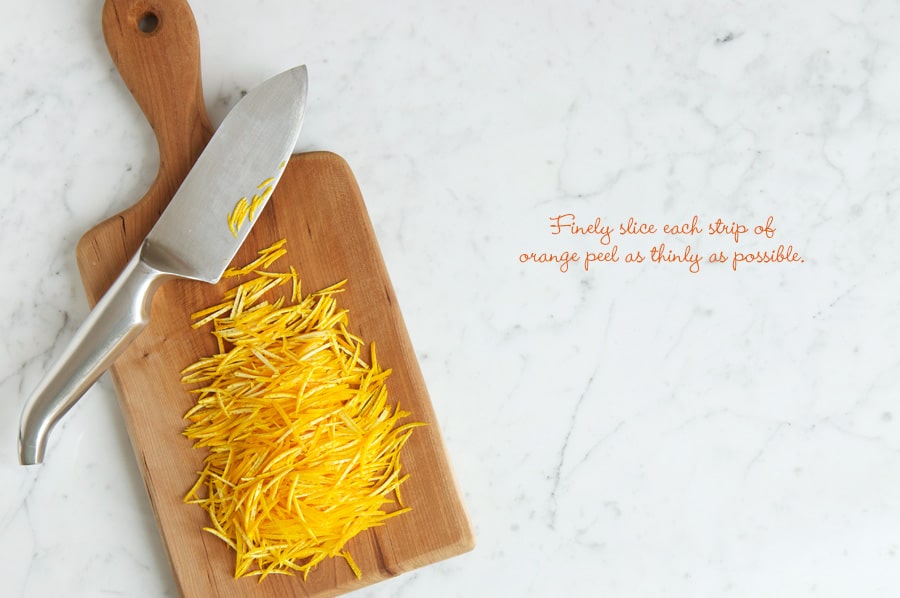
- Finely slice each strip of orange peel as thinly as possible.
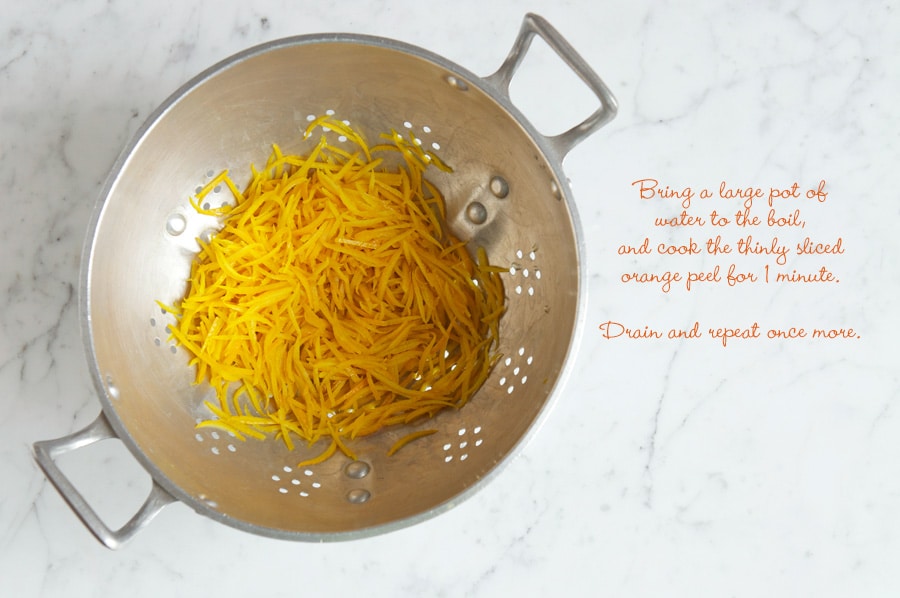
- Bring a large pot of water to the boil.
- Cook the thinly sliced orange peel for 1 minute.
- Drain and repeat once more.
- Set the cooked orange peel aside.
To prepare the orange flesh and juice
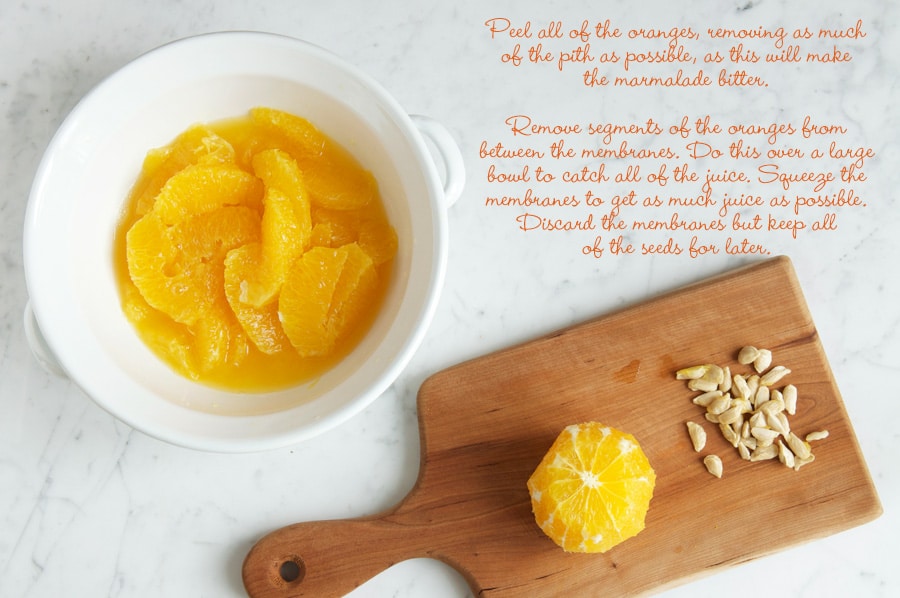
- Use a sharp knife to remove as much pith as possible from the oranges, as the pith will make the marmalade bitter.
- Remove segments of the oranges between the membranes. Do this over a large bowl to catch all of the juice.
- Squeeze the membranes to get as much juice as possible.
- Discard the membranes but keep all of the seeds for later.
To calculate how much sugar to add
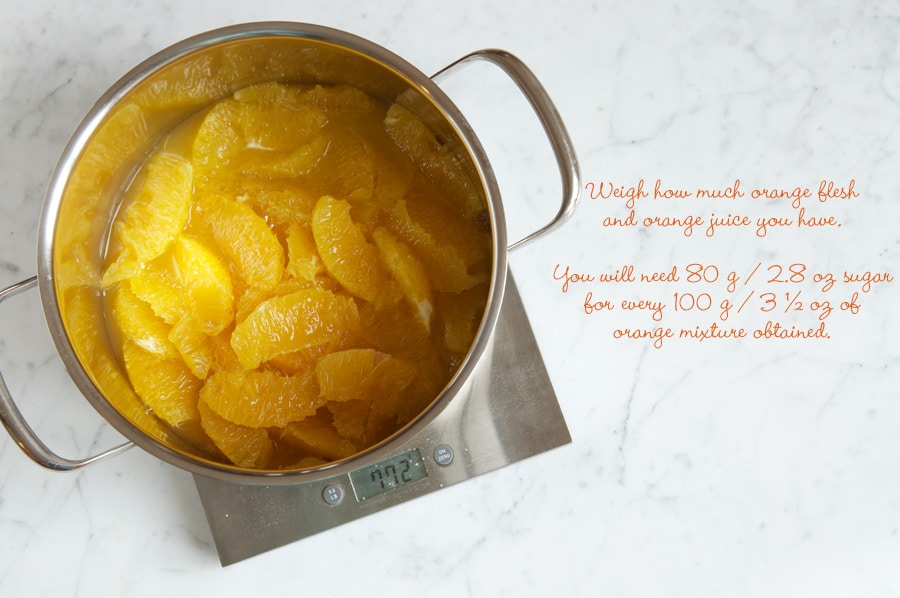
- Weigh how much orange flesh and orange juice you have. I do this by measuring the orange flesh and juice directly in a saucepan on a set of digital scales.
- Calculate how much sugar you need. You will need 80 g (1/3 cup) sugar for every 100 g (3.5 oz) of orange flesh and juice.
- Add the sugar to the orange mixture.
To cook the orange marmalade
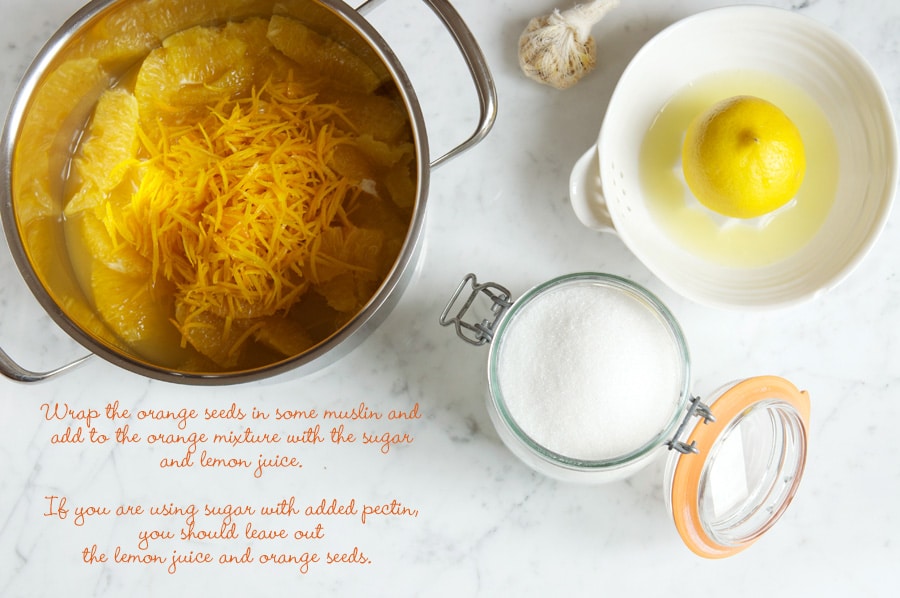
- Wrap the orange seeds in some muslin.
- Add the wrapped orange seeds to the orange mixture.
- Add the lemon juice.
- Add the cooked thinly sliced peel.
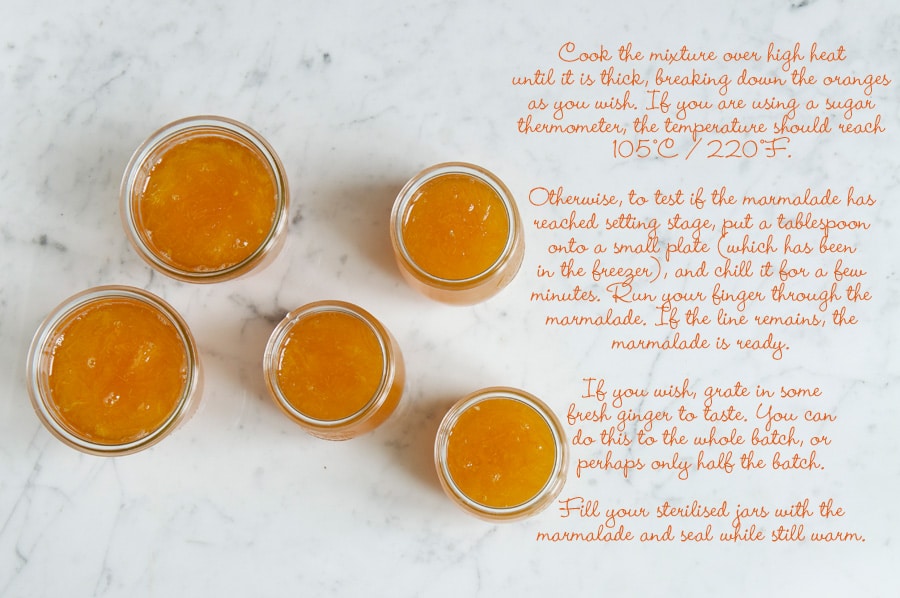
- Cook the mixture over high heat until it has thickened.
- Stir the mixture frequently so that it doesn’t stick to the bottom of the pan.
- If you are using a sugar thermometer, the temperature should reach 105°C (220°F).
- Once the marmalade is ready, fill your sterilised jars with the marmalade and seal while still warm.
The Jam Plate Test
- If you are not using a sugar thermometer (or even if you are), to test if the marmalade has reached setting point, put a tablespoon of marmalade onto the chilled plate.
- Run your finger through the marmalade.
- If the line remains, the marmalade is ready. If the marmalade fills the line, it is still too liquid and has not yet reached setting point.
- If the marmalade is not ready, continue boiling the mixture and testing the setting point every 5 minutes or so.
Kitchen Notes
- SETTING POINT TEMPERATURE
When making this orange marmalade, I frequently find that the mixture reaches setting point at about 110°C (230°F). But I would advise to start checking for the setting point once the temperature reaches 105°C (220°F). - IF YOUR JAM OR MARMALADE HAS NOT SET PROPERLY
If you end up bottling jam or marmalade which has not set – and you can tell if you tip the jar and the mixture sloshes around inside – simply empty the jars back into a large saucepan and reheat them until they have reached the desired thickness. You can try this a few hours after bottling when the jam has had time to cool, or even the next day. The jam should not suffer for this second cooking attempt, although you will have to rewash and sterilise all the jars again. - USING JAM SUGAR
If you are using jam sugar (sugar with added pectin), you should leave out the lemon juice and orange seeds. - HOW TO MAKE GINGER MARMALADE
To make ginger marmalade, grate in some fresh ginger to the finished marmalade while it is still hot. Add as much or as little ginger as you like. You can do this to the whole batch, or only some of the batch. - OVEN & STOVE TEMPERATURES
All recipes on this website have been tested on an induction stove and/or with a conventional oven (i.e. an oven without fan). All recipes on this website use temperatures for a conventional oven, unless otherwise mentioned. Convection ovens (i.e. fan-forced ovens) are typically 20°C/70°F hotter than conventional ovens, but please check your manufacturer’s handbook. - CONVERSIONS
To convert from cups to grams, and vice-versa, please see this handy Conversion Chart for Basic Ingredients.
Did you make this recipe?
Please leave a comment below and share your photos by tagging @eatlittlebird on social media and using #eatlittlebirdUpdate
This recipe was first published on 7 October 2012. It has been updated with new photos and more comprehensive recipe notes.

Thanh, what gorgeous photos! And you have some serious chopping skills, look at those perfectly uniform strips of peel! Impressive!
I love making jam, though we are still getting through the strawberry and rhubarb jam I made early summer. I haven’t tackled marmalades though and am hoping to do so soon when such citrus fruits come into season. It’s confusing the amount of information out there and the differing methods. I like quite a dark, tawny marmalade, to which I think your addition of ginger would be just perfect.
Hoorah for championing smaller portions and a lower temperature. I think so many people are put off jam making due to the devotion to getting the setting point on target, which inevitably result in tar! So what if it’s a bit soft? Lower sugar ratio jams will tend to be softer anyways.
Is that the Krentenwegge the jam is smeared onto?
Yes, I had made the marmalade in advance of making the Fruit Loaf – the perfect combination for me 🙂
I think once you’ve made jam once or twice, you sort of get an idea of how thick the consistency of the mixture should be before bottling it. And then, if it doesn’t set, there’s no harm in re-cooking it until you get it right.
This year, I’ve been reducing the sugar somewhat in my jams, which makes the jam taste more fruity and vibrant. But we go through a jar of jam in less than a week here, hence my continually dwindling supply! I wish I had made some rhubarb jam when it was in season but I was just simply addicted to rhubarb crumble!
If you can get frozen rhubarb, that works a treat 🙂
These days I reduce sugar by half! Especially for soft fruit jams. Like the one I mentioned…for 400g of fruit I must have used no more than 250 and it’s still keeping well. I myself was dubious but am darn pleased its worked out so far.
I love that fruit loaf smeared with marmalade too! Though I would have hated peel in it! You’d think it’s the same difference but really, it’s not!
I looked at the frozen section of the supermarket the other day and their frozen fruits here are mostly limited to raspberries, blueberries and mixed berries. I was hoping to find frozen strawberries but no luck …
Using a 2:1 fruit to sugar ratio will definitely give you a softer set jam, although I’m sure you could still boil the mixture until you have the desired consistency. I also think you would have enough sugar for preserving the fruit for the short-term, so a good option if you are going to eat the jam soon.
You know I love your marmalade (and if you didn’t know, now you do it!!), but this is so special!! Because I’m in love with citrus marmaladed!! This one I make it with a touch of whiskey of, as you, ginger, both go really well, believe me about the whiskey one!! But I also enjoy the christmas citrus marmalade, or one with blood oranges!
Yesterday I bought more gelifiant sugar (call me lazy!!), so these weeks I’ll still making jam!! It’s something I love doing at this time of the year 🙂
I have never prepare the peel like you have do it in this. That was the problem of my orange marmalade versus the shop bought, but now I think I can solve it, thank you for the step by step. You make it sound easy and not boring!! 😛
Talking about the boring, I think I’m boring you, so sorry, and, the last thing, your Confitures book seems nice!!!
Now that you mention it, I have tried orange marmalade with whisky and it’s delicious! Thanks for reminding me! I will definitely add some whisky next time … it sounds like something to make around Christmas time 🙂
I think a lot of people don’t like marmalade because it frequently contains bitter peel, and I happen to not like bitter peel either. So I was drawn to this particular recipe because it tries to soften the peel first, making it less noticeable when eating later.
The recipe comes from a really cute French book, which is part of a large collection of French cookbooks which are sold nearly everywhere in France. I love them because they always have great recipes and great ideas 🙂
I look forward to hearing about what jams you will be making with your gelifiant sugar!
Wow! the pictures are too good. They are ready to adorn any classy food magazine/book . From these pictures, the Seville oranges can also be named “beauties”.
Loving the color of the marmalade too. The jars filled with marmalade up to the brim are too tempting,Thanh. I want to pick one up right from the screen itself. Don’t look for it if one goes missing 🙂
Can’t get over the finely sliced (extra thin!!) strips of orange peel 🙂 how skillful you are? You have made the whole process of making jams/jelly look so simple & easy (I find it too cumbersome…).
Oh thank you!! I think making jam is relatively easy, but making marmalade is a bit more fiddly because you don’t want the end product to be too bitter. So I hope these photos are helpful in terms of illustrating this recipe, making the process seem more manageable 🙂
Slicing the orange peel into those thin strips took a bit of time but didn’t require too much skill, thankfully! I kept reminding myself that I didn’t want big chunks of peel when eating the marmalade later and that gave me motivation to keep the slices really thing.
This is such a fabulous recipe! I love the colour!
I absolutely love your illustrations. This is like a very well laid out cook book. I usually buy the orange-ginger marmalade but have never thought about making my own. I love the taste on bread as well as on pork and chicken dishes.
I made some rose petal jelly way back in July. I have enough to remember the sweet smell of a summer garden when the snow is heavy on the ground. I also made a very little bit of kumquat marmalade, which I need to make again with a better recipe.
Thank you! I’m glad that you enjoy my step-by-step photos 🙂
Rose petal jelly sounds so fragrant and lovely! I used to make kumquat marmalade when I lived in Australia as I had a little kumquat plant on my balcony. I was tempted to buy a kumquat plant this year but wanted to see how I would fare with a kaffir lime tree. So far, so good! Perhaps next year I can add a kumquat tree to my balcony garden?? I can’t remember which recipe I used for my kumquat marmalade but I will try and find out.
God ! I haven’t seen such a perfect peeling with oranges .. Touch wood !
Bold to go with this recipe..I admit the fact that this sugar ratio always had pulled me behind from making my own jam..And your addition of ginger,what a flavor that can come up with…Makes me hungry..The second photograph,it’s torturing me ..hehe.
Ah yes, once you see how much sugar goes into making jams and marmalades, it’s often enough to make you think of the dentist! But you can always reduce the sugar, bearing in mind that you are also reducing the preservation time. So unless you are making a HUGE batch of jam to eat over 3 years’ time, I think you can safely reduce the amount of sugar 🙂
That’s indeed something valuable to share.I would love to try soon.
One word – YUM
Thanh you really do take gorgeous pics. I’ve never tried making marmalade or jam. One of my aunt’s make this gorgeous passionfruit jam and she’s never never shared the recipe despite my constant pestering. I used to hate marmalade until I tried some in France and I’ve been hooked ever since. Now that I have a sugar thermometer I must start making jam, if it’s anything like making chutney then I’d be happy to potter about in the kitchen 😀
Passionfruit jam sounds divine! I think I might have a recipe … will email you if I find it 🙂
A sugar thermometer will open up a whole new world of cooking to you, so enjoy! Not that you really need a sugar thermometer when making jam, but it certainly takes out some of the guess work. I upgraded to a digital thermometer not long ago and that has been a great investment for me.
Oh thanks Thanh, I sure hope you’ll find that recipe 🙂
I love my sugar thermometer, been making a whole heap of fudge and will move on to jam. A digital one will be more fun I guess, must keep an eye out for one.
The French marmalade is much sweeter than the ones in UK, I used a pot of marmalade (which was on the bitter side) in one of Nigella’s chocolate cakes, I think it was a storecupboard chocolate cake or something of that sort.
What gorgeous photos Thanh! I have to admit I haven’t tried marmalade since childhood which I absolutely hated due to the orange rind. I really should change that because your marmalade looks divine.
As for jam making tips, my Nanna made a lot of jam while I was growing up, and she always told me to place a small plate in the refrigerator at the start of the process and to remove it each time you want to test the jam to see if it’s set. Leave the jam for 30 seconds and if it sets on the cold plate then you’re good to go.
Ah yes, putting a plate in the fridge before you start is a good idea. I often forget and end up popping one in the freezer while the mixture is boiling away! Even when I am using a sugar thermometer, I still like to test the jam the old-fashioned way as well.
I think some people like bitter marmalade with lots of peel, which was certainly the only type I ate when I was growing up and which I wasn’t very fond of. But when I discovered that marmalade comes in varying degrees of sweetness, I suddenly found that there were marmalades that I enjoyed. I should mention that this occurred in France and Switzerland where marmalade tends to be sweet like jam, rather than bitter like what you would find normally in the UK and Australia. I don’t mind the bitter marmalades but I always avoid the peel when I can!
What beautiful pics Thanh!!
Love the flavour combinations and the whole thought about preserving the fading summer into jars. How romantic!!
Thanks, Anita! But if only I could have been more productive … we’re down to only a few jars now!
Wow. I especially love your photos on this post. The orange pops so magically. My grandfather is such a big fan of orange marmalade. I know have a great Christmas idea. Thanks.
I dont know where to put this comment but i just wanted to let you know that i just discovered your website (was looking for a rachel khoo recipe – i dont have her book, yet :D). Browsing through your recipes gives me a lot of inspiration and motivation to cook delicious things so thank you and keep sharing your passion for food!
Thank you for your lovely comment! I’m happy to hear that you’ve enjoyed browing the recipes here on my blog 🙂
I wished read your instructions about boiling the rind first before I made my marmalade. I added a tat too much rind into the marmalade (unboiled) and now it’s too citrussy. (It has a very strong orange oil taste that leaves a stingy aftertaste)
Does anybody have any idea how to neutralise the taste in the marmalade? I really don’t want all my efforts to go down the drain…. 🙁
Unfortunately, I think that once you add too much rind, the marmalade will taste quite bitter, unless you treat the rind beforehand. I’m not aware of anything you can do to save your marmalade but one thought is to use the marmalade in a cake or a marinade? If the marmalade is really bitter, I guess you could offset the bitterness with some extra sugar in the cake batter or marinade.
This is a recipe for Marmalade Pudding Cake which I have been wanting to try for some time: http://www.nigella.com/recipes/view/marmalade-pudding-cake-5159
I hope you will still be able to put the marmalade to some good use!
Thank you very much for the recipe.
Rather than using Oranges I uses Tangerines. I cut down in preparation time and pressed the Tangerines through a course sieve to get rid of the membranes. Although I didn’t end up with your wonderful segments it worked very well! I ended up with only 500 grams of juice/pulp and added 440 grams of sugar which translated into 2 glasses (?) (approx. 550ml each) of marmalade. Further the marmalade didn’t set. I guess that might be because I didn’t boil it for long enough. There was not much in the pot and I was worried that the mixture might burn in the pot!
A lot of work for 2 glasses! Where did I go wrong?
How much marmalade you ultimately make will depend on how much fruit and juice you have to start with. Some citrus fruits might have thick peels which add to their overall weight but, once stripped of this peel, will have less fruit than others. And, of course, some fruits have less juice than others. But this recipe does produce about 700 ml to 1 litre of marmalade (or 3-4 pots of 375 g each as stated at the top of the recipe).
And if your marmalade didn’t set, it is most likely because you didn’t boil it for long enough. The mixture should thicken on the stove, as well as reach 105°C.
If you’re worried that there is too little mixture in the pot, you might be using a pot which is too big. Although, you don’t want to use one that is too small either because the mixture needs room to bubble away viciously without burning your hands as you stir to avoid it catching at the bottom of the pan!
Making jam and marmalade takes a little getting used to but once you get an idea of the ratio of fruit to sugar, as well as the consistency as it starts to set, the process is quite easy. Good luck next time!
I made this yesterday and usually I am lazy at leaving feedbacks on websites and recipes etc. But I HAVE to tell you this is the most awesome, classy, delicious marmalade I have ever tasted. And it was the first time I have ever tried making one ( I make a lot of jams though) ! My husband loved it and I also made some homemade yeast-free bread to go with it. Thank you for sharing. Your beautiful pictures illustrated the instructions so well that I could not possibly go wrong.
One thing I have noticed is that though I cooked it until it was jelly-like and flowing consistency, it solidified quite a bit after cooling it ( specially since I keep opened jams in the refrigerator. I guess next time, I am going to cook it a little lesser)
Thank you for your lovely feedback! I’m so happy to hear that you and your husband enjoyed this recipe. This particular is one of my favourites and which I make quite often, especially since orange & ginger marmalade is not available where I live.
I’ve also made jam a few times where it has thickened considerably upon cooling and, as you have also guessed, I think I had cooked it for a bit too long. Even when working with digital thermometers, I find that the mixture can boil at 105°C for quite some time without any change in temperature. Perhaps some domestic thermometers are not sensitive enough but, I think once you get into the habit of making jams and marmalades, you start to get an idea of what consistency the mixture should be before you take it off the heat, whether you use a thermometer or not.
Enjoy the rest of the holiday season!
Hi 🙂 I was looking for a recipe for jam or marmelade with the orange peel, cause next wekend I intend to do some orange cupcakes, and would like to use it on top, instead of frosting. However, although the taste is good – I added the ginger, and it smells marvellous – when I took from the pan, it was OK. However, after 24hs in the fridge, it is really stick, hard-like. I kept an eye on my candy thermometer, and as soon as it moved from 105C to above I removed the pan from the oven. I guess in my case, I should have let it go as it reached 105C. Is there any way to salvage this batch? Thanks for the wonderful recipe!
Oh dear! It sounds like you may have boiled your marmalade for too long. Generally, once your thermometer reads 105°C, you should take the pan off the heat. Although, sometimes, you will see from the consistency of the jam if you will need to take it off sooner or even continue cooking it for longer. Once your jam or marmalade reaches setting point, it will continue to thicken as it cools in the sealed jars.
Also, I’m not sure if putting the marmalade into the fridge may also be a factor. I don’t normally put my homemade jam or marmalade in the fridge unless I have opened a sealed jar to use. The jars of warm, sealed jam or marmalade should be fine kept at room temperature in a cool, dark place.
I’m not sure if it is possible to salvage this batch, especially if you were planning on using it to decorate some cupcakes. If you are able to spoon the marmalade out of the jars, you might be able to soften them by heating them again gently in a pan with perhaps some water. Please let me know what you end up doing!
FYI : Since I made 1/3 the recipe (500g orange), and divided it between 2 jars, I tested with one of them. I let it come to room temperature, and then put it in a small pan filled with some water (room temp,) letting it on the lowest heat possible on my oven. In another one pan, I put some water to heat it just a little bit. Once the marmalade started ‘melting’, I stirred it with a porcelain spoon (I was not sure if metal would affect it), to dissolve all, then added a trickle of water, mixed, and waited; repeated the add water a couple of times, until I thought the marmalade was OK – It has been some 12 hours past since, and the taste is good – also the texture. Guess it will be OK by tomorrow, to use on top of the cupcakes. The fix was very simple, BUT I decided to do it very slowly to keep a good track of what was going on.Tomorrow I will be repeating the same process with the other jar.Thanks for the attention !
Oh that’s good to know that you were able to save the marmalade! Thanks for writing back to let me know 🙂 I hope the cupcakes worked out the way you had hoped.
Sometimes you can follow a recipe to a T and it will work perfectly. At other times, unfortunately, a recipe might need a bit of tweaking depending on everything from ingredients to room temperature. As you had made only 1/3 of the recipe, I wonder if this played a role as it would have taken much quicker to get the marmalade to setting point. When making jam, sometimes the size/width of the pan also makes a difference. I find that the more often you make something, you start to get a feel for when it is going right or wrong and what you can do to help the recipe along.
I’m glad to hear that, overall, things worked out in the end and you enjoyed the taste of this marmalade 🙂
Though not the cook of the household, I’ve made the marmalade over the last 3 years & found it delicious each time, but didn’t make enough to last a year’s consumption (is a new family favourite!). So this year I made a larger batch (12 jars) & had to use a much larger saucepan than usual.
I’d like to know how to prevent the peel from floating to the top of the jars.
Previously, making & drinking a cup of tea once the marmalade had cooked, worked fine as a way of waiting to jar the marmalade. This year (because I made a much larger batch?), all the peel floated to the top 1/2 of each jar. The marmalade must still have been too hot….
Is there an ideal temperature for the mixture when jarring-up? (in the same way that temperature is a good way to judge when the marmalade has reached setting point).
I’d really like to know!
Hi Dee,
I wonder if the peel is floating to the top because the marmalade has not reached the right temperature or consistency yet? I typically double or triple this recipe and haven’t had a problem so far with the peel floating to the top. But as I’ve mentioned in a comment above, I don’t always rely on my thermometer to tell me when I have reached setting point; I also go by eye and watch the consistency of the marmalade before taking it off the heat. I like my marmalade to be slightly soft-set so I always take care not to overcook it as the mixture tends to always thicken upon cooling.
I’m not too sure myself if there is an ideal temperature for sealing the jars. Some recipes say to do so right away (probably to avoid contamination), although I sometimes wait a bit before doing so. I’ve looked up my jam books but couldn’t find any further information. If I find out more, I’ll definitely let you know.
I can’t wait to try it out! This looks sooooo good! YUM!
This looks so amazing!! Thank you for sharing!! I’m considering making this for a cheese plate; do you have any suggestions on what cheese to pair this with? Thank you!
Thanks, Miranda! I think a semi-hard cheese, like a Tomme de Savoie, would work well with the marmalade. Otherwise, something like a cheddar or Comté would also be delicious 🙂
Hi from Australia Dee, I have just discovered this recipe on Pinterest, and I was wondering if you could Zest the oranges instead of peeling them, then continue as instructed, also I check my jam for “doneness” by the eye and fridge-set method. Another tip I have discovered when bottling said preserves is to bottle when hot and immediately invert the jar after wiping down as this also helps to seal jars when they cool. You hear the lid ‘pop’
Hello,
Finely chopped orange zest is what gives marmalade that slight bitterness and texture. If you don’t like having bits of orange peel in your marmalade, you could certainly zest the oranges instead and add it directly to the cooked orange flesh. Hope this helps!
Love the step by step photos. I made this recipe for my husband. He likes it with thin peel and not too thick so this method works. It’s a bit tricky to obtain the perfect consistency for him. I slightly overboiled it at 55 minutes as it didn’t look set when I used the plate testing method. I also added 6 cups of water and sugar – concerned it would be too rich. Will use this technique again and reduce the sugar as per the recipe.
Hi Sharon,
So glad you liked this recipe!
First ever attempt at marmalade and it turned out perfectly, not bitter and so delicious, thanks for the recipe!
I have to say I totally lost interest after peeling and finely slicing up the rind which took FOREVER, so that when it came time to segment the oranges between the membranes, I just gave up and put in membranes and all. I just cut the oranges in half and picked off the pithy centre bit then cut the oranges up and threw them in as is. I don’t think it affected the final product, it all seemed to break up satisfactorily during the cooking process. I’m all for shortcuts!
I also used some pectin sugar which i added half way through the cook, and it set well
Now I can’t wait for breakfast and a good piece of sourdough toast.
Hi Jen,
So glad you enjoyed this marmalade recipe! I like your shortcut as well 🙂 I’m hoping to make a new batch next week and maybe add some whiskey or Cointreau for something a bit different. Thanks for popping by!
Why is there no water in this receipe
Hi Jean,
There is no water in this recipe because it uses orange juice 😉
Do you need to add water to boil with orange mixture
Do you need to add water to orange mixture to boil.
Thanks for this recipe. Can I use the same recipe but substitute oranges with cumquats? If so, do I still have to remove the membranes?
What do you do with the orange peels after boiling them? There is no mention of what to do once you have boiled them twice. Could you please advise?
Hi Angela,
Sorry that it is not so clear. Once you have added the sugar to the mixture containing the orange flesh and orange juice, add the orange seeds (wrapped in muslin) together with some lemon juice. At this stage, also add the thinly sliced peel which you have cooked twice. Then you can cook everything together until you have reached the right temperature/consistency. I hope this helps.
Beautiful recipe! I made a batch yesterday and just opened the first jar for breakfast this morning. The marmalade is absolutely delicious! I was going to gift the remaining jars but I might hold onto them instead!
Beautiful recipe, worked wonderfully.
I can highly recommend this recipe. I’ve made it several times and the marmalade makes a great gift too.