

 by
by My husband and I recently welcomed our baby daughter into the world, a beautiful bundle of joy who loves to sleep but who is still mastering the art of how to do it well. Some days are better than others, and some nights are better than others.
Despite the sleep deprivation that comes with a newborn, and not to mention the pre-existing sleep deprivation that comes with a sleep-walking toddler, my heart feels full and I am slowly adjusting to the chaos that is a family of four.

There is something about little babies and cute nicknames. Perhaps it is because it feels odd to ascribe an adult name to a new being who has not yet had time to grow into his or her moniker. Or perhaps it is because some babies are better suited to being called sugar plum than, say, Arnold.
My mother-in-law calls our son “petit crab” (little crab), to which he reciprocates by calling her simply “crab”. It may not impart the same level of affection but it nonetheless demonstrates that our son has a good grasp of adjectives.
A good friend of mine used to call her lovely and rounded son “sausages” until he started to only respond to “sausages” and never his real name, which can be rather embarrassing when you live in a country where sausages are the main form of protein.
As for me, I tend to use nicknames absentmindedly. If our baby girl is refusing to sleep unless we are holding her and gently lulling her to sleep while standing (not sitting), I find myself calling her “madame”. I’m not sure why, but it seems to suit a baby who is bossing me around.
At other times, especially right after a feed when she is giving sweet, contented smiles in her milk-induced coma, I like to call her “honey pie”.
I’m sure I use this term of endearment with my son as well, but it’s a nickname which I have used for years without much thought until recently when Nigella Lawson posted a photo of a honey pie on her Instagram account. An actual honey pie. It never occurred to me that such a thing really existed. And the honey pie that Nigella was referring to was, in fact, a salty honey pie. Could anything sound more heavenly?
Soon after Nigella’s post, the salty honey pie was trending on Instagram and, before I knew it, I had purchased The Four & Twenty Blackbirds Pie Book from which the recipe for this addictive pie originates.
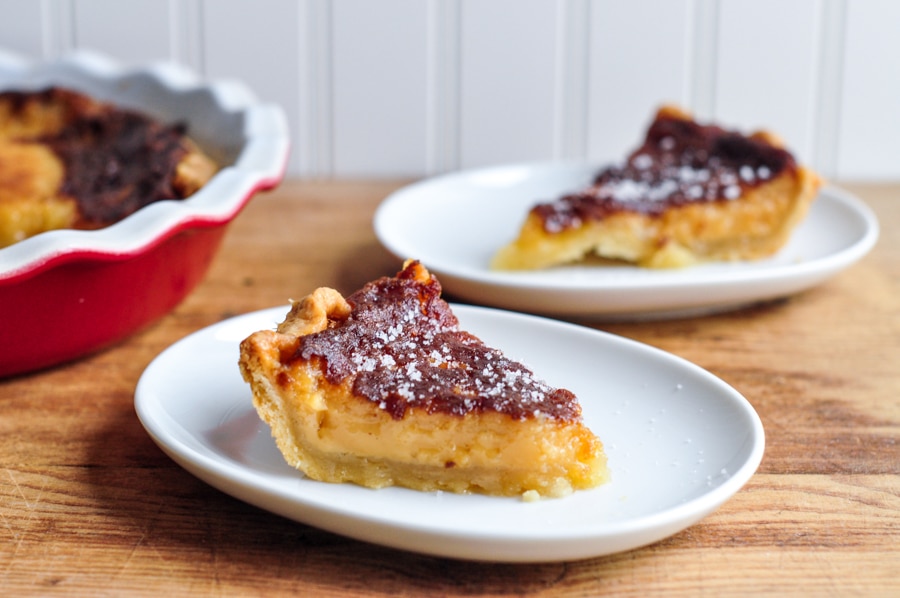
A honey pie is essentially a tart filled with a custard sweetened with honey, and baked until it is set with the merest hint of a wobble. What makes this honey pie simply divine is the generous sprinkling of sea salt upon serving, perfectly offsetting the honeyed sweetness of the custard. Move over salted caramel … salted honey is the flavour du jour.
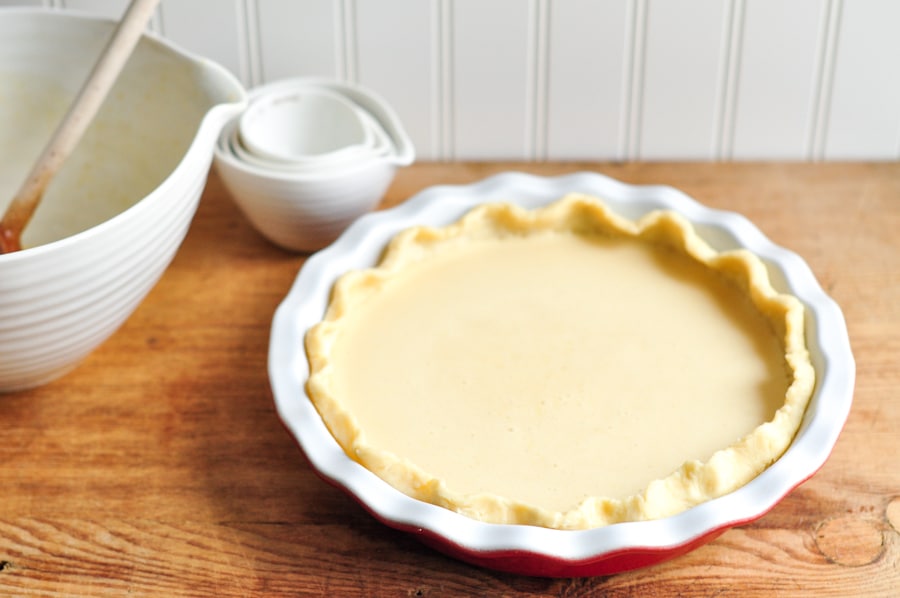
My only disappointment with this recipe is that my attempts so far have yielded less than professional-looking results. On my first try, my pastry didn’t keep its shape upon baking and even shrunk a little in the pan. Admittedly, I didn’t quite understand the recipe for making the pastry, which instructs you to add half a cup of ice to the pastry. Ice? Is that meant to be crushed ice or cubes of ice? Is the ice meant to be mixed into the pastry mixture, or is it to simply help keep the water cold? I was a bit confused about the role of the ice, so I left it out completely, which might explain why my pastry looked a bit shabby after baking.
On my second attempt, I froze the pastry-lined pie dish to compensate for the absence of ice, but this produced an even more rustic-looking pie that my husband tucked into it without even asking if I would be bothering to photograph it.
By my third attempt where I decided to blind-bake the pastry first, our arteries were starting to work overtime and I still could not produce a photogenic pie. My guess is that this is one of those recipes which works great in a commercial kitchen and when made by a professional pastry cook, or, in my case, it could be due to baby brain.
I daresay one might get better results by using a metal pie dish to achieve a crisper pie crust, so that will be my next avenue of experimenting. However, I have since discovered that it is recommend to use glass pie dishes so that you can see if the pastry is cooked through ot not.
The recipe for the custard filling is also a bit odd in that it calls for granulated sugar (not caster or superfine sugar) and cornmeal, but then goes on to instruct the cook to strain the custard through a fine sieve before filling the pastry shell. Needless to say, most of the cornmeal is unable to pass through the sieve because it is not an ingredient which dissolves in the uncooked custard, and the same can be said for the granulated sugar.
Has anyone else tried this recipe? Any tips or tricks?
Despite the hiccups in getting this pie to look like the photo in the cookbook, it tastes absolutely delicious. Knowing now how a honey pie actually tastes, I think it is the perfect term of endearment; in my case, it’s perfect even for someone a bit rough around the edges.
Salty Honey Pie

Ingredients
For the All-Butter Crust
- 190 g (1 ¼ cup) plain flour, (all-purpose flour)
- ½ teaspoon fine salt
- 1 ½ teaspoons granulated sugar
- 110 g (1 stick) unsalted butter, cold and cubed
- 125 ml (½ cup) cold water
- 2 tablespoons apple cider vinegar
- ½ cup ice
For the filling
- 110 g (1 stick) unsalted butter, melted
- 165 g (¾ cup) caster sugar, (superfine sugar)
- 1 tablespoon cornmeal
- ½ teaspoon fine salt
- 1 teaspoon vanilla extract
- ¾ cup runny honey
- 3 eggs
- 125 ml (½ cup) double cream, (heavy cream)
- 2 teaspoons white vinegar
- 1-2 teaspoons sea salt
Instructions
For the All- Butter Crust
- Measure the flour, salt and sugar into the bowl of a stand mixer.
- Use the flat paddle attachment to slowly mix the ingredients together.
- Add the cubes of butter and beat on low speed until the mixture resembles crumbly, wet sand.
- Measure the water, vinegar and ice into a small measuring jug. The ice is to keep the liquid ingredients very cold and is not to be added to the pastry.
- Very slowly pour the liquid ingredients into the flour mixture (but keep the ice out of the mixture), and beat slowly until the mixture comes together into a ball of dough. You may not need all of the liquid (I usually only need about half, but much depends on the type of flour you use).
- Shape the dough into a flat disc.
- Roll out the dough between two sheets of baking paper, into a large round which will fit your pie dish with some overhang.
- Using a rolling pin, transer the pastry to the pie dish, and press the pastry into the pie dish. At this stage, do not remove any excess pastry.
- Place the pie dish into the fridge for at least 1 hour.
- Remove the pie dish from the fridge and crimp the edges to your liking. Remove any excess pastry.
- Place the pie dish into the freezer for at least a few hours, or up to 1 month.
For the Salty Honey Pie
- Preheat the oven to 190°C/375°F (without fan).
- Place a metal baking tray in the middle shelf of the oven.
- In a medium bowl, whisk together all of the ingredients for the filling, except for the Maldon sea salt flakes.
- Carefully transfer the pie dish to the metal tray in the oven, and bake for 40-50 minutes, or until the filling is set and edges of the pastry are lovely and golden. To test if the filling has set, I give the pie dish a bit of jiggle to see if the filling in centre wobbles at all.
- Allow the pie to cool completely on a wire rack.
- Sprinkle with Maldon sea salt flakes just before serving.
- I think this pie is best served warm or at room temperature. It keeps well on a cake stand covered with a glass lid for a few days.
Kitchen Notes
- OVEN TEMPERATURES
All recipes on this website state temperatures for a regular oven (i.e. a conventional oven without fan). If you have a convection oven with a fan, please consult the manufacturer’s handbook on how to adjust the temperature and baking time accordingly. - CONVERSIONS
To convert from cups to grams, and vice-versa, please see this handy Conversion Chart for Basic Ingredients.

First of all congratulations on your baby girl, I had been wondering why you hadn’t posted in a while. This pie is something I came across but it sounded a bit too sweet for me, when I find out where I saw it, I’ll look at their method and see if it is as complex as this one. Nice to have you posting again : )
Looking at this recipe, I think the ice is just there to keep the water cold, I can’t see adding fine or large chunks of the ice to the dough to make a difference to the doughs outcome. This is just my opinion, if anyone knows this to be different, I will stand corrected.
Hi again, I just found where I saw another ‘salty honey pie’ recipe and this one is just a basic pie dough (very easy, my go- to pie dough) and the filling has cornmeal in it but the recipe does not indicate to sieve the filling before adding to pie shell. The pie shell is blind- baked in this recipe.
Hope this helps, it’s from ‘Annie’s Eats’ http://www.annies-eats.com/2014/11/21/salty-honey-pie/
Hi Faye,
Thanks for the link to Annie’s Eats. I think I may have seen this particular post as I recall reading about how another blogger blind-baked the pastry first, and that’s probably where I got the idea to try and blind-bake the pastry. It didn’t work for me, so I suppose the recipe from Four & Twenty Blackbirds is not intended for blind-baking. The pastry started to collapse and probably needed a filling to hold it up.
I also think the ice is meant to keep the water cold so that the pastry dough remains as cold as possible, but the recipe doesn’t make this clear, especially for those of us who don’t work with pastry everyday. It is still fairly cold where we live so I don’t think the temperature of my kitchen is a factor.
I will keep trying though. Perhaps I need to leave the pastry to rest for longer and freeze it for longer too. It really is a such a delicious pie that I don’t mind experimenting 🙂 I can see how a “honey pie” might sound really sweet, but it is not sickly sweet at all. It tastes almost like a normal custard pie which has been fragranced with honey. I hope you will try it one day 🙂
Whata funny post! Congratulations! Little girls are so fun to dress! Beautiful pie, I think.
Hi, Thanh!!!!
I hadn’t seen that you had posted this pie!! I saw it on Facebook, but I thought it wasn’t yet on the blog!!
Well, I repeat, but congrats for the baby!!!!!!! And of course, for the new state of chaos at home! 😛 What a joy, Thanh!!!! 😀 😀
Petit crab sounds greaet, but honey pie, I find it delicious 😛
I’ll try the recipe, I don’t think someone like me can give tips or advice to someone as you, but I’ll tell you.
Well, one tip, I know I’ll serve this with some lavender whipped cream… 😛
PD: And i have to think if I add to this cream some vanilla seeds or not 😛
Hi Paula,
Thank you 🙂 I hope you will enjoy this recipe. My husband and I are dangerously quick in finishing this pie between ourselves. But I recently bought a metal pie dish so hopefully this will produce a more good-looking pie 🙂
Hi, =)
Hopefully the following tips will help:
1- Regardless of how cold your enviroment is, you want to make sure that the water is icy-cold and not just cold. So do add the ice.
2- After you melt the butter, directly add the granulated sugar, along with the cornmeal and the other ingredients as described right away while the butter melted still got some heat in it. That’s when the sugar and cornmeal will probably supposed to melt.
Congratulations on the baby! ^.^
Hi Nora,
Thanks for your tips! I will add the ice next time to keep the liquid extra cold. And now that you’ve mentioned the second tip, I probably didn’t add the ingredients to the melted butter right away; this might explain why the cornmeal and sugar didn’t fully dissolve. I can’t wait to try this recipe again very soon 🙂
I’m glad I helped! Btw, if you don’t have a background in baking, you can try and watch a youtube video of a person making a pie crust from scratch. The method used to make sure you have the flaky crust and not an overworked one, is by using the ‘pulse’ method through a food processor.
Other than the youtube video option, you could google ‘pulse method in making dough’ .
Thanks, Nora! I’m not an expert in making pastry but I’ve been able to make pastry successfully in the past. I found this particular recipe to be quite complicated in comparison to other recipes I have tried, but I am guessing that the recipe from Four & Twenty Blackbirds is meant to produce a pastry which is the hero of the dish. I hope to try again soon.
I made this recipe using your pie crust from your cherry pie recipe and it was absolutely perfect! I’ve made your cherry pie a few times and the pastry is always a dream to work with. It goes great with this salty honey filling.
What a fantastic idea! I like this! Thank you for a great recipe!
Hello! I noticed in the directions that it said to use the ice to keep the water and vinegar very cold and not to add it to the mixer when making the crust. I’m not sure if that’s the original recipe or your own notes….I just wanted to point that out. 🙂
Hi Colleen,
They are my own notes as the original recipe does not say what to do with the ice. But from my knowledge of pastry-making, all of the ingredients should be super-cold to help prevent shrinkage upon baking, and to also make the pastry easier to work with.
Oops…I forgot to add that while I was still working in the industry we froze all of our pie crusts prior to baking and I still do that with my business I run out of my home. That allows the heat to seize the outside of the pie crust first before it finishes cooking on the inside and enables it to hold it’s shape. Room temp or slightly cold crust will just droop! LOL The oven heat melts it.
I agree – it is best to bake pie crusts or pastry shells from frozen to prevent shrinkage. Although, much also depends on the butter to flour ratio as I have made some pastry shells which only required a bit of refrigeration, and they baked perfectly. I will update this recipe shortly 🙂
Hi Nora
I made this recipe and it was delicious!
But I have some spare filling.. can I freeze it?
Hi Nora,
I’m glad you enjoyed this recipe! I have never tried to freeze the uncooked filling, so I can’t answer your question, sorry.