

 by
by Roast Rack of Lamb
As an Australian, lamb features a lot on our menu at home and I particularly love cooking with lamb racks. You don’t have to do too much to them, but they will always look impressive!
I have a habit of always marinating meat, something which I am sure I picked up from my mother. The advantages of marinating is that you can add flavour to the meat while also tenderising it at the same time.
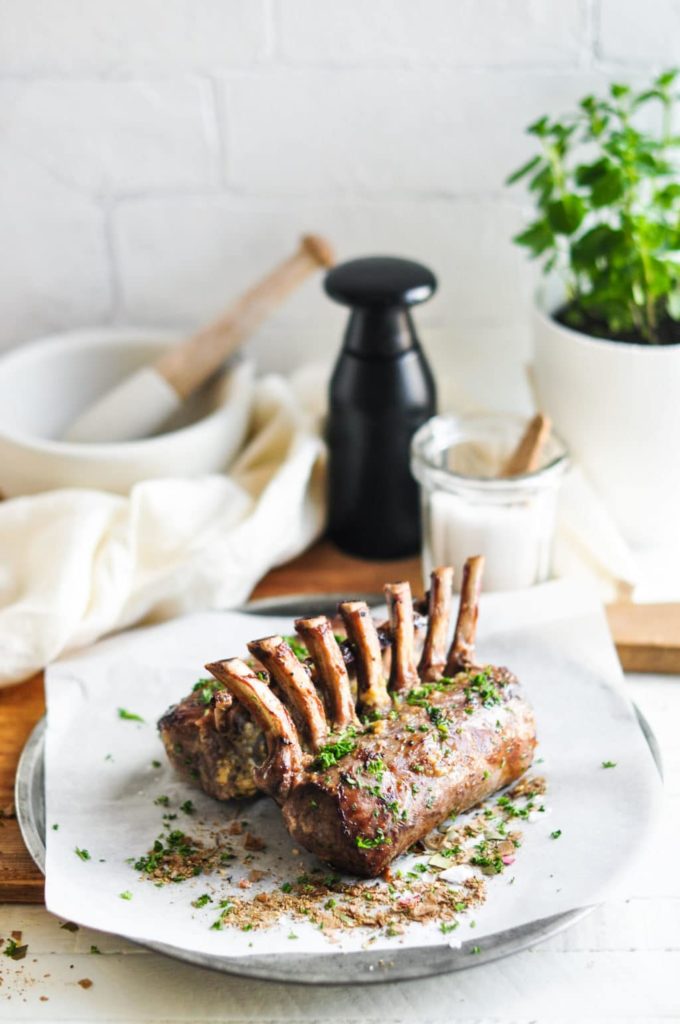
Rack of Lamb Recipe
My basic marinade for lamb racks (and also cutlets, fillets, or even a leg), is comprised simply of olive oil, lemon, garlic, salt and pepper. Always. This means that, when I don’t have the time or energy to think about complicated flavours, I just make my basic marinade and I know that dinner will still be delicious.
But depending on my mood or what I might be serving with the lamb, I might add some other spices to my basic marinade. Sometimes it is dried mint or dried chilli flakes, and at other times I might go down the middle eastern route and add cumin and ground coriander. If I want to go all out, I tend to make a herb-crusted rack of lamb.
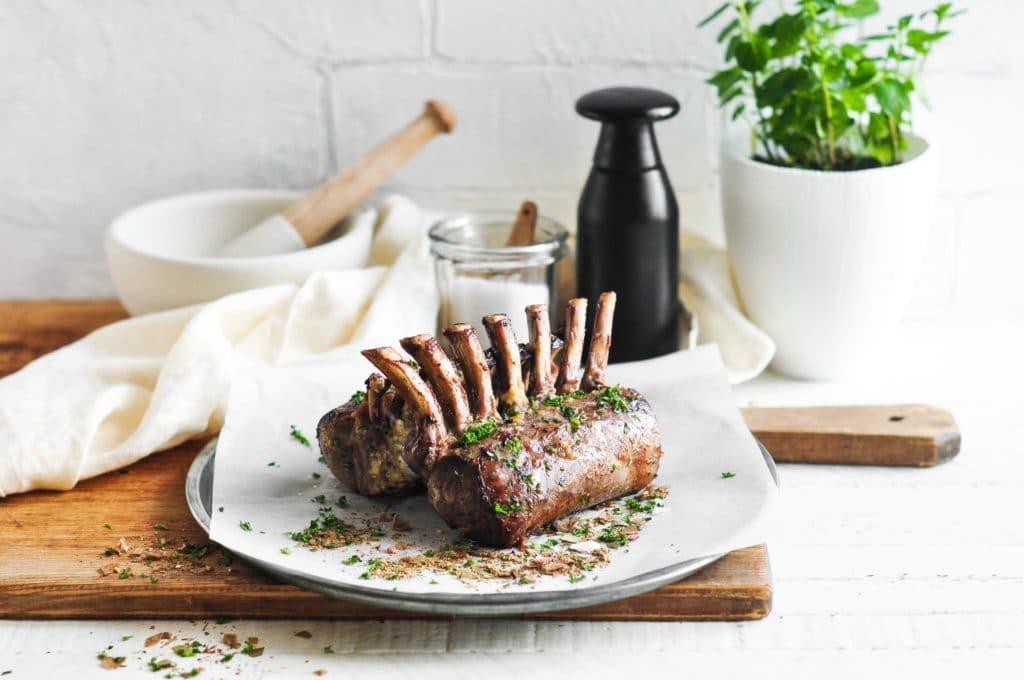
How to Cook a Rack of Lamb
You might not believe it, but I frequently make a roast lamb racks like those pictured in these photos on a casual weeknight.
- Marinate the meat first – The marinade takes about 5 minutes to prepare, and I try to marinate the lamb racks for at least 30 minutes, but overnight is always better.
- Cook the lamb first on the stove for colour – To get that lovely and golden crust on the lamb, I always sear the lamb first in a hot pan. Once the lamb racks have a good colour on them, I will then transfer the lamb racks to a hot oven to continue cooking. For this reason, it is a good idea to use a saucepan which can go into the oven later.
- Finish cooking the lamb in the oven – The lamb racks will need to roast for about 15-20 minutes in the oven, depending on how well cooked you like your lamb. For more information on timing and temperatures, please see my recipe below.
- Use a thermometer to check for doneness – The best and most accurate way to test if the lamb is cooked to your liking, is to use a digital thermometer. The digital thermometer should be inserted into the thickest part of the meat when you take a reading.
- Let the meat rest before carving – Note that the meat will continue to cook as it rests, something you should always do after cooking meat so that the juices can flow from the surface of the meat back to the centre, thereby keeping your meat nice and tender.
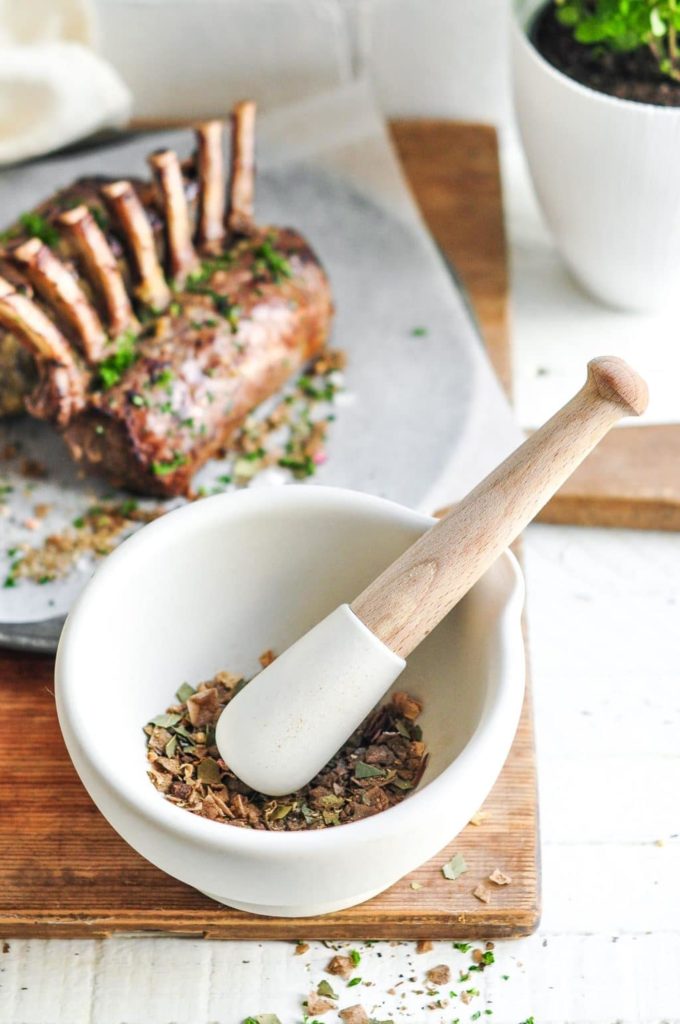
What to Serve with Lamb
Paired with a simple couscous salad and maybe a homemade hummus, roast lamb racks makes for the perfect, but special, weeknight dinner.
But my main question to everyone is: who else – like me – also loves mint sauce with their lamb??!
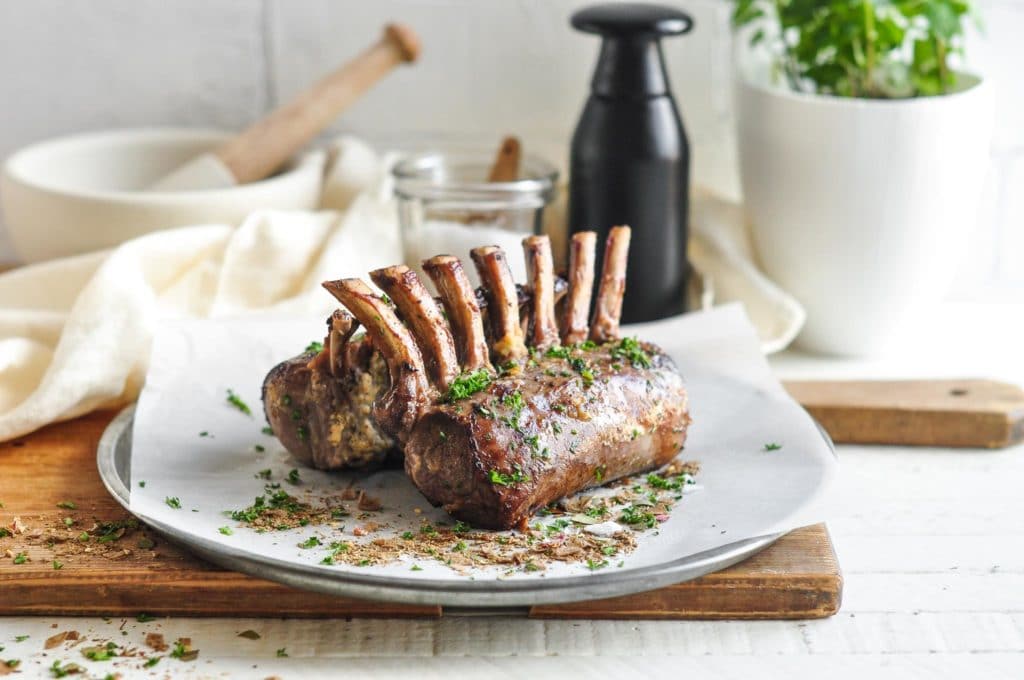
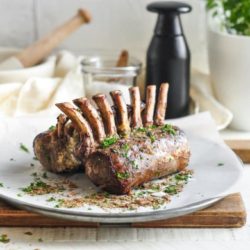
Roast Lamb Racks with Lemon and Garlic

Ingredients
- 3 tablespoons olive oil
- 2 teaspoons sea salt
- black pepper, freshly cracked
- 1 lemon, zested and juiced
- 2-3 garlic cloves, finely minced
- 2 small lamb racks, approx 350g/12 oz each
- 1-2 tablespoons olive oil, extra
Instructions
- In a small bowl, mix together the oil, salt, pepper, lemon and garlic.
- Place the racks of lamb into a large ziplock freezer bag.
- Pour the marinade into the bag, seal the bag, and make sure that the racks of lamb are well coated in the marinade.
- Leave to marinate for at least 30 minutes, but overnight in the fridge is best. If your kitchen is quite cool, I would simply leave the bag on the kitchen counter to marinate. Otherwise, place it in the fridge.
- Preheat the oven to 200°C/390°F (without fan).
- Let the meat come to room temperature before cooking.
- Heat the extra oil in a large oven-proof saucepan which will fit both racks of lamb comfortably.
- On a medium-high heat, sear the racks of lamb on each side until they are nicely browned.
- Once both sides of the racks of lamb have been seared, quickly position them on the saucepan so that the bones are standing upwards.
- Place the saucepan into the oven and roast for 15-20 minutes, depending on how well-cooked you like your meat. I test for doneness by prodding the meat gently, but a more accurate way of testing is to use a meat thermometer. Please see Notes below for temperatures.
- Allow the lamb to rest for about 10 minutes before carving.
Kitchen Notes
- MEAT TEMPERATURE
If you are testing with a digital meat thermometer, the reading should be as follows:
Rare 46°C/115°F
Medium-Rare 48°C/120°F
Medium 54°C/130°F
Medium-Well 60°C/140°F
Well-done 65°C/150°F - VARIATIONS
To add additional spices to this basic marinade, some suggestions are as follows:
* 1 teaspoon dried mint
* 1/2 to 1 teaspoon dried chilli flakes
* for a Moroccan-inspired marinade: 1/2 teaspoon each ground cumin, ground coriander, and ground cardamom - MAKE-AHEAD TIPS
* The lamb can be marinated the night before and kept in the fridge. Bring to room temperature before cooking.
* The lamb can be browned on the stove 1-2 hours before serving, and kept at room temperature until ready to roast. The meat may need some extra time in the oven to warm up. - OVEN & STOVE TEMPERATURES
All recipes on this website have been tested on an induction stove and/or with a conventional oven (i.e. an oven without fan). All recipes on this website use temperatures for a conventional oven, unless otherwise mentioned. Convection ovens (i.e. fan-forced ovens) are typically 20°C/70°F hotter than conventional ovens, but please check your manufacturer’s handbook. - CONVERSIONS
To convert from cups to grams, and vice-versa, please see this handy Conversion Chart for Basic Ingredients.
Did you make this recipe?
Please leave a comment below and share your photos by tagging @eatlittlebird on social media and using #eatlittlebirdUpdate
This recipe was first published on 14 November 2017. It has been updated with new photos and more comprehensive recipe notes.

Oh, I remember that ad! So cute. Love your marinating tip for the lamb. I also like to shortcut by sprinkling some Moroccan spice mix onto lamb fillet.
This ad still makes me laugh 😉 Great idea to sprinkle Moroccan spice mix on the lamb – they seem to work so well together.
What an elegant looking meal! I’ve never had lamb, but definitely agree with the marinating theory here. There’s nothing like a good marinade to add flavor and tenderness … I’m usually putting mine in the fridge overnight for great meats!
Thanks, Noel! Yes, I tend to marinate most things overnight too – it somehow makes dinner the following night seem much less stressful!
I have always been intimidated by a rack of lamb. I love your easy step by step directions.
Oh no, lamb racks are so easy to cook! Hope you will try it one day!
This looks delicious and do-able … I will have to try it!
Lamb racks are definitely do-able! They are so easy to cook with 🙂
PS I give this recipe 5 stars.
Oh thank you 🙂 🙂
That is my favorite marinade also! I haven’t tried it with lamb but I will now:)
I often use this marinade with chicken too 🙂
I’ve never attempted rack of lamb, but your pictures and recipe make me want to give it a try. Thanks for sharing!
Lamb racks are really easy to cook with. Hope you will try it soon!
I LOOOOOOOOOOOOOOOOOOOVE lamb! 😀 I don’t know why I never think to make it, but you make this look so simple that I think I am going to start enjoying this again! yay! 🙂 Oh, and there’s something about being here it just makes me feel so cozy ^_^
Aww thanks, Joyce! 🙂 I didn’t eat a lot of lamb growing up, but it was something I slowly started to embrace once I moved out of home. Now we eat it every week! Thanks for popping by xx
So YUMMY!!! Sounds totally delicious!!! I can’t WAIT to try this! Thank you for this great recipe!
I’m pinning and making!Love this recipe.easy and simple .i will definitely try it. One of our families favorite dinners! So easy and it tastes delicious! Thanks for a great recipe!
Thank you! I make this lamb rack recipe very often for my family – lamb racks are a favourite with our kids 🙂
Simple and delicious marinade!! I marinated it overnight and then grilled it on a propane grill. It came out amazing!!
Hi Deb,
So glad you enjoyed this recipe!
Great easy recipe! I cooked everything on the bbq and it turned out spectacular. Cheers!
We loved this recipe! So easy to make. So tasty!
Hi Julie,
So glad you enjoyed this lamb recipe! 🙂
Absolutely perfect! I decided to make a mint pistachio pesto & excited to serve with hummus, hadn’t thought about that, thank you.
Sounds delicious!