

 by
by Duck Confit (Confit de Canard)
Confit de Canard is a classic dish found in many Parisian bistros, and it is a dish which my mother-in-law likes to serve whenever we visit. After one of our trips to France late last year, I felt compelled to recreate this dish at home, primarily because I didn’t want to wait so long before eating it again.
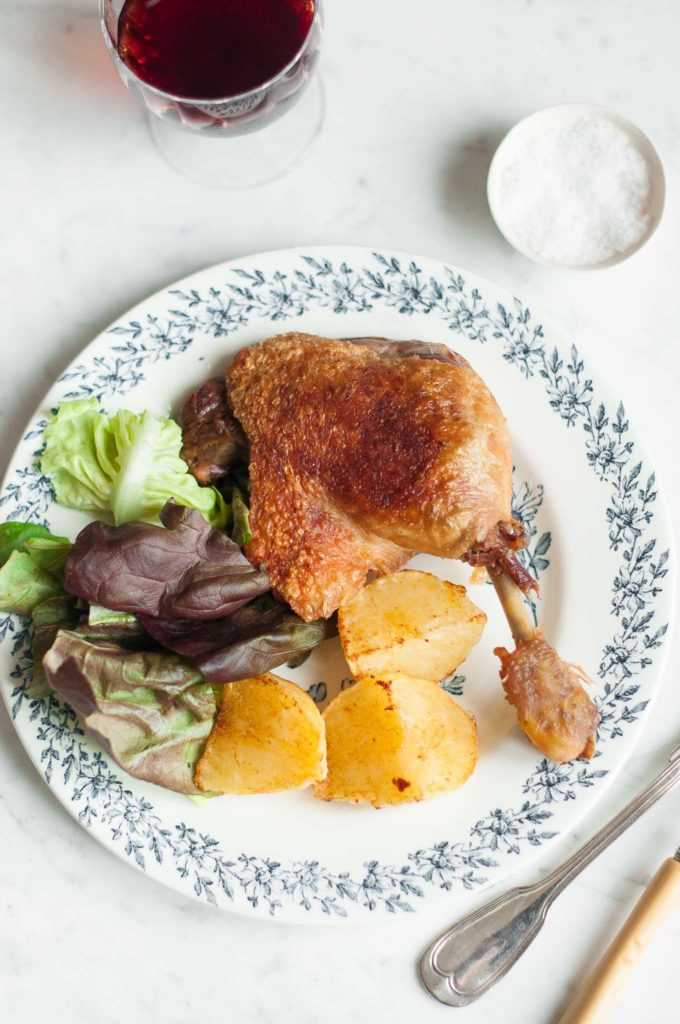
What is Duck Confit?
Duck Confit is essentially duck slow-cooked in its own fat until it is meltingly tender, and then seared in a pan until the skin is golden and crispy just before serving.
Duck Confit could perhaps be described as the up-market, heart-stopping version of fried chicken, only so much more grown-up and more revered.
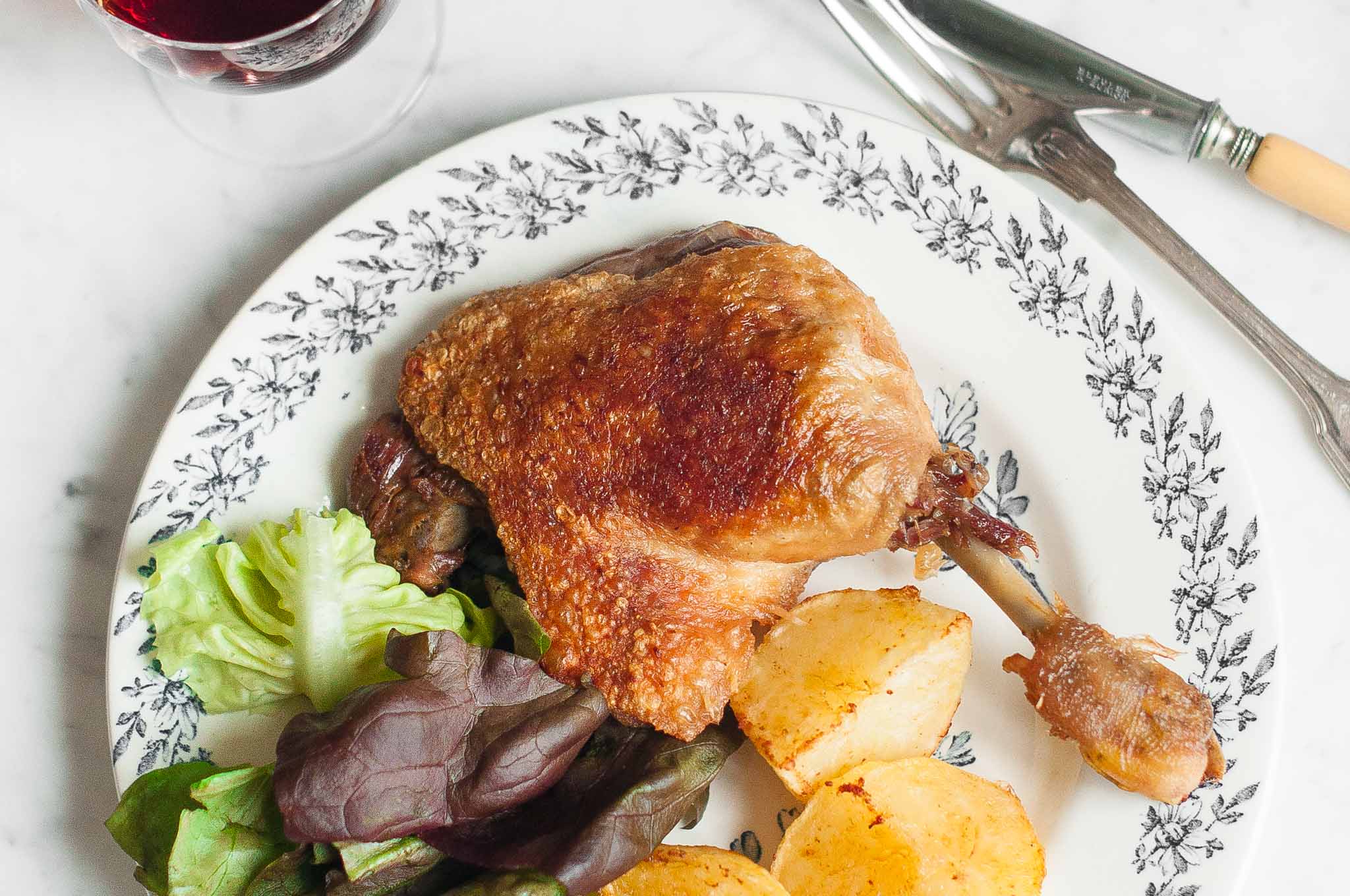
How to Make Duck Confit
Duck legs (typically the drumstick with the thigh attached and sometimes called marylands) are normally used to make Duck Confit, but duck breasts also work quite well.
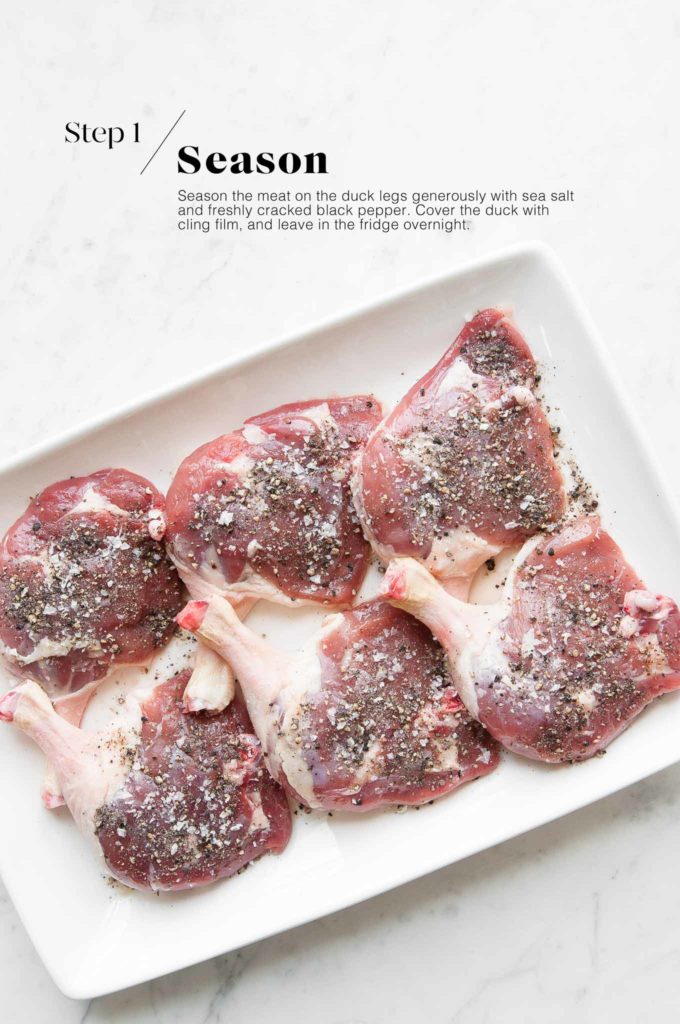
Step 1
The duck legs are often salted and seasoned generously for 1-2 days to draw out the moisture, as well as to add flavour to the meat.
Simply season the meat of the duck legs generously with sea salt and freshly cracked black pepper. Cover the duck legs with cling film, and place in the fridge overnight.
Step 2
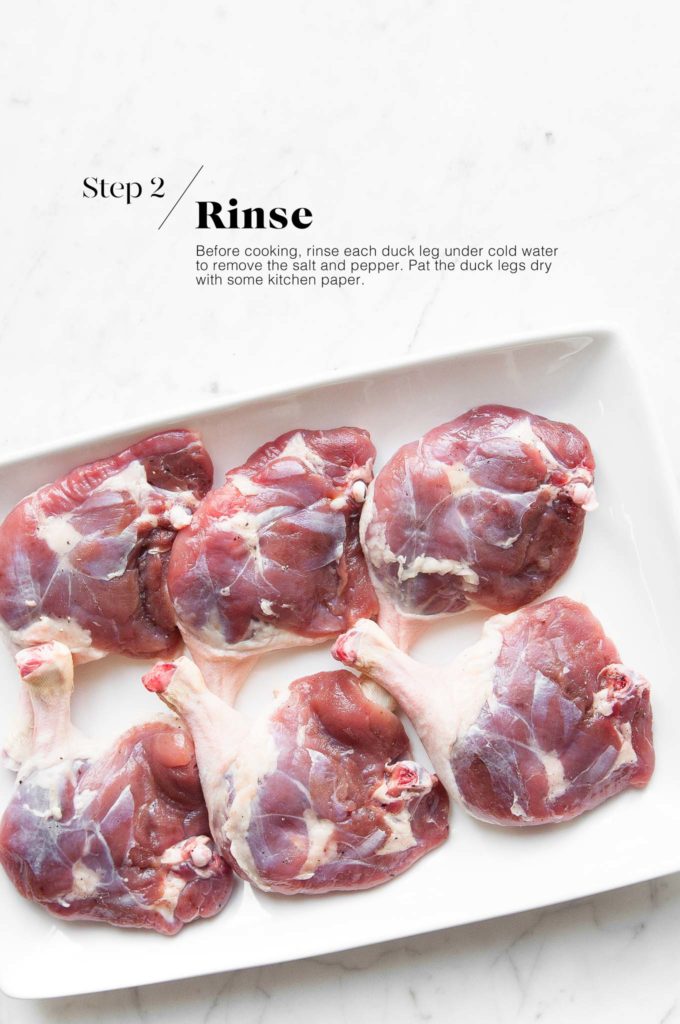
The next day, rinse the duck legs under cold water to remove the salt and pepper.
Pat the duck legs dry with some kitchen paper.
Step 3
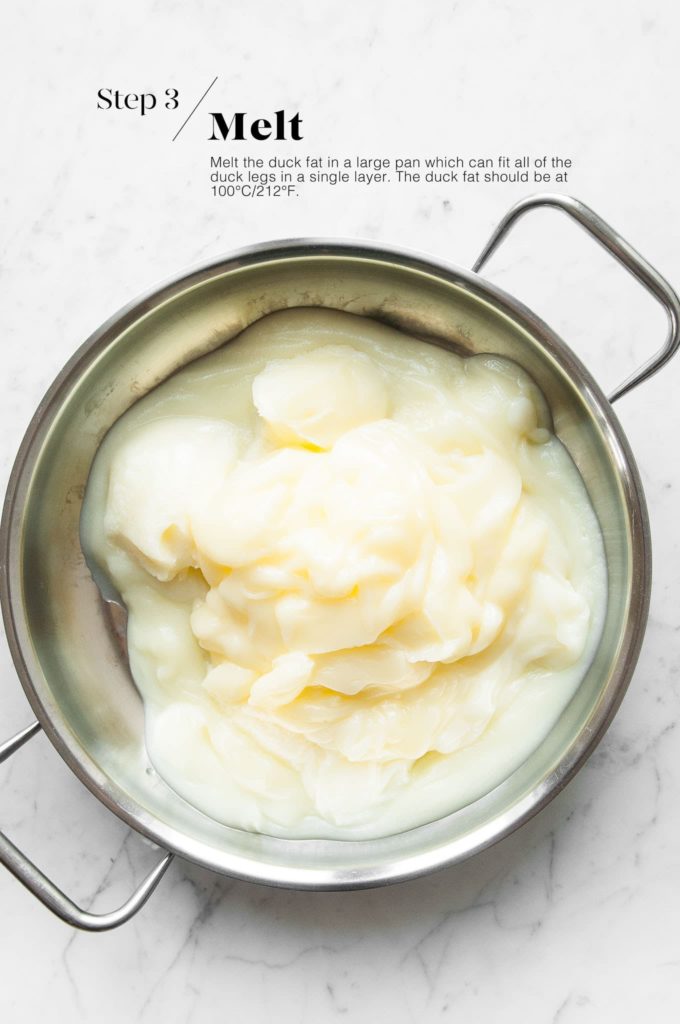
Melt the duck fat in a large pan which can fit all of the duck legs in a single layer.
The duck fat should be at a temperature of 100°C/212°F.
Step 4
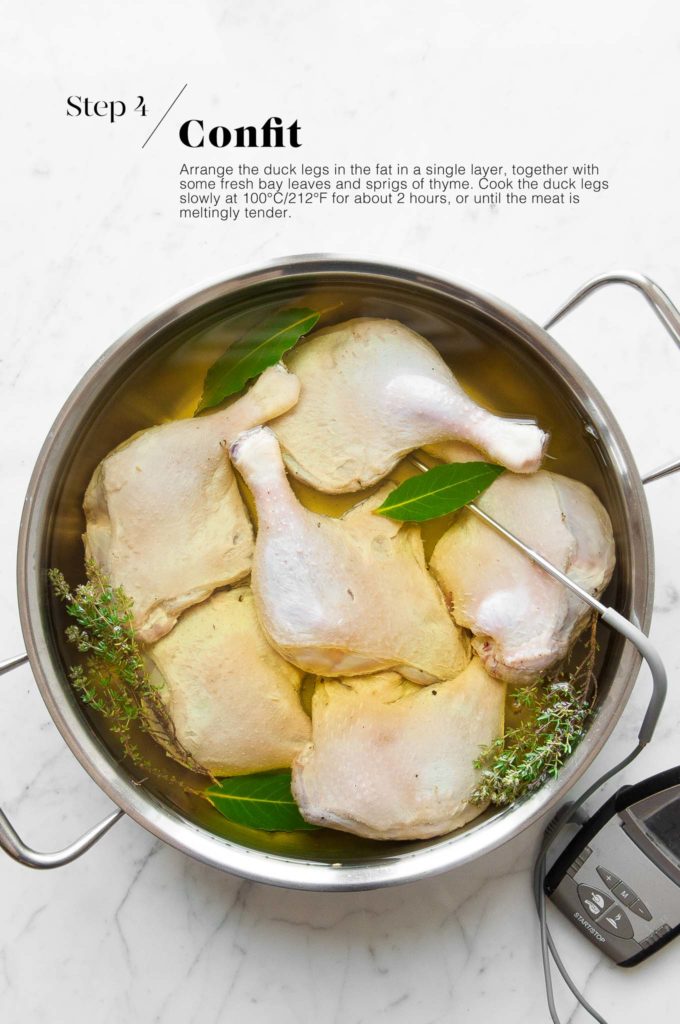
Arrange the duck legs in the duck fat in a single layer, together with some bay leaves and sprigs of thyme.
The duck legs should be just submerged in the fat.
Also keep in mind that, as the duck legs are cooking, it will render some fat. So make sure that your pan is high enough to contain all of the fat.
Cook the duck legs at 100°C/212°F for about 2 hours, or until the meat is meltingly tender.
The duck fat should be barely simmering, or else you run the risk of deep-frying your duck. I like to use a digital thermometer to make sure the oil is constantly at the right temperature.
If you find it difficult to regulate the temperature of the oil in the stove, I find it easiest to do this in the oven at 100°C/212°F.
Step 5
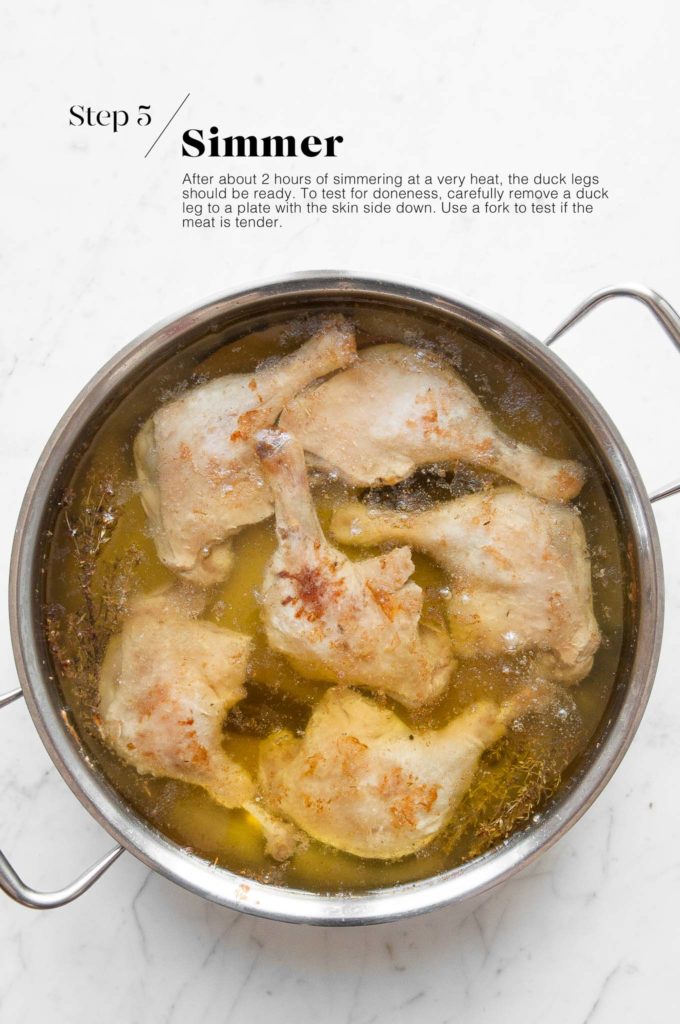
To test if the duck legs are cooked, carefully remove one duck leg to a plate with the skin-side down. Gently pull at the meat with a fork to test if it is cooked to your liking.
For me, if the meat flakes away very easy, I know it is ready. If there is some resistance in flaking the meat, then cook the duck legs for a bit longer.
Once cooked, the duck can be stored in a clean container, completely covered with more duck fat, and kept in the fridge for about a month. In fact, the recipe for Duck Confit originated from south-western France and came about as a method of preserving duck for long periods of time.
Duck Fat
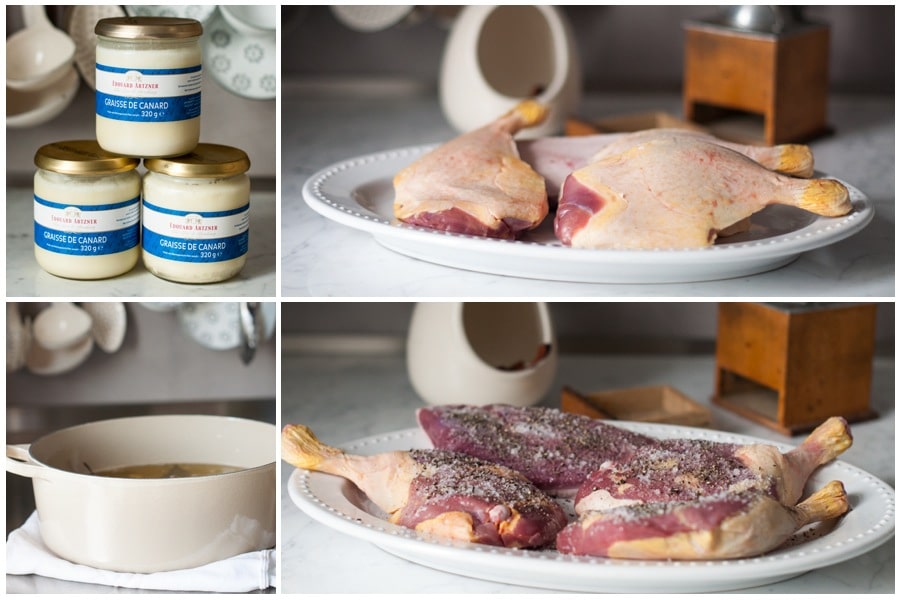
Unless you live on a farm and are in the habit of rendering down whole ducks for their fat, you will have to buy duck fat which either come in cans or glass jars sold in the refrigerated section.
During the cooking process, the duck will render some of its own fat, as well as flavour, into the cooking fat. For this reason, it’s a good idea to keep the leftover duck fat to add extra depth of flavour in a later batch of Duck Confit, or to simply use for the best roast potatoes you will ever taste.
Duck Confit Recipes
As with most classic French dishes, there exists a wealth of recipes for Duck Confit.
In French Food Safari, Michael Smith shares a recipe which doesn’t require overnight salting and can be prepared all in the same day. The duck, however, does require up to 1.5 hours of salting with an aromatic rub of peppercorns, juniper berries, garlic, bay leaf, thyme and lemon zest.
Thomas Keller also employs a dry marinade of salt and fresh herbs (including parsley), but cooks the duck at a much lower temperature of 88°C (190°F) for 10-12 hours. In Bouchon, Keller’s recipe for Duck Confit with Brussel Sprouts and Mustard Sauce is one of my favourite ways of serving Duck Confit.
I was surprised to find that the “Chef of the Century”, Joël Robuchon, had a fairly simple recipe for Duck Confit in his compendium, The Complete Robuchon. His salt rub is flavoured with garlic, fresh thyme, cloves and cracked pepper, but, unusually, he adds water to the duck fat to prevent the meat from colouring too much.
Perhaps the simplest Duck Confit recipe I have tried, and which reminds me most of Duck Confit I have eaten in restaurants, is one by Stéphane Renaud in Ripailles, or French Feasts as it is called in the US. The recipe below is an adaptation of Renaud’s recipe, although his book also gives an illustrated description of how to preserve Duck Confit in sealed glass jars for up to 6 months – a handy recipe if you find yourself with a lot of duck to use up.
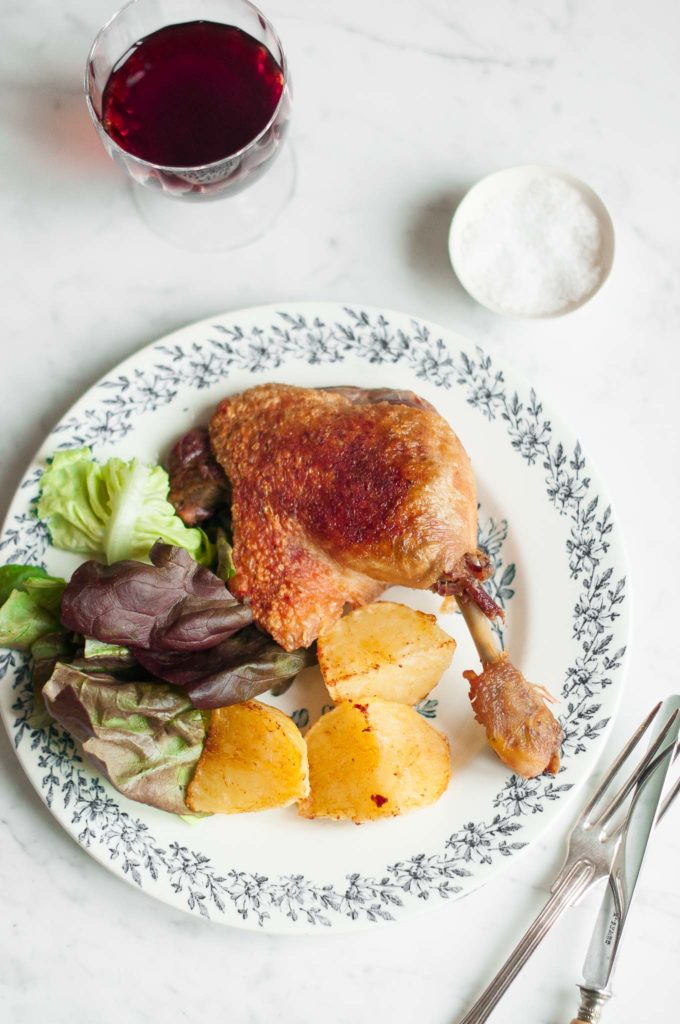
What To Serve With Duck Confit
To serve the duck, either straight from slow-cooking or after it has been preserved in the fridge, simply heat a large frying pan and cook the duck legs (or breasts) until the skin is nice and crispy, a benchmark of a good Duck Confit. You shouldn’t need to add oil to the pan as there should be plenty from the duck.
If you thought Duck Confit on its own would already exceed your week’s intake of calories, the dish is traditionally served with pommes de terre à la Sarladaise, which are slices of potatoes cooked in duck fat (thick coin-sized French fries). If you are going to indulge, you may as well do it properly.
Perhaps a more restrained way of eating Duck Confit is with a simple green salad dressed with a spikey vinaigrette to offset the richness of the duck. My mother-in-law simply serves boiled potatoes alongside.
But potatoes roasted in duck fat are my favourite accompaniment to Duck Confit. See here for my recipe for Crispy Roast Potatoes with step-by-step photos.

My favourite sauce to serve alongside Duck Confit is a homemade plum sauce, which I suppose is heavily influenced by my Asian upbringing. But it is also delicious with a homemade lingonberry jam.
Go for a brisk walk or a long jog the next day to offset the calories. Bon appétit!
Duck Confit (Confit de Canard)

Ingredients
- sea salt
- black pepper, freshly cracked
- 4 duck legs, thigh and drumstick attached, see Kitchen Notes
- 1 kg (2 lb) duck fat, see Kitchen Notes
- 2 bay leaves
- 4-6 sprigs thyme
Instructions
To prepare the duck legs
- Generously rub sea salt onto the flesh side of the duck legs, and season with cracked pepper.
- Cover with cling film and leave the duck in the fridge overnight.
To make the Duck Confit
- Rinse the duck legs under running water and pat dry with kitchen paper.
- Melt the duck fat in a large saucepan that will hold the duck legs in a single layer. The duck fat should be at a temperature of 100°C/212°F.
- Immerse the duck in the fat, add a few bay leaves and some sprigs of thyme.
- You should have enough duck fat to just cover all of the duck legs. Keep in mind that, as the duck legs are cooking, they will render fat as well.
- Cook the duck on a very low heat for about 2 hours until the meat falls off the bone easily. There should be barely a bubble seen in the oil during this time. An easier way to maintain a constant temperature is to place the saucepan into the oven (without fan) at 100°C/212°F.
- Check regularly to make sure that the oil is not bubbling, otherwise you will end up deep-frying and drying out the duck legs.
- To test if the duck is cooked to the right texture, carefully remove one duck leg to a plate with the skin side facing down. Test with a fork to see if the meat falls away from the bone easily.
To serve the Duck Confit
- To serve the duck right away, heat a large frying pan over medium-high heat (with no oil as there is enough oil from the duck legs) and sear the duck legs skin-side down until golden and crispy.
- Turn the duck legs over and brown the other side.
- Serve with a green salad and roast potatoes.
Kitchen Notes
- DUCK LEGS VS DUCK BREASTS
Duck legs work best in this recipe and I prefer to buy small duck legs which are easier to serve than large ones; large duck legs tend to be too big for one person. Duck breasts can also be used in this recipe, but they are not as commonly used. - HOW TO REHEAT DUCK CONFIT
To prepare Duck Confit after it has been preserved, let the container come to room temperature or until the duck can be easily removed from the duck fat in one piece. You could also gently warm the container in a very low oven which will melt the duck fat, allowing you to easily remove the duck. - WHERE TO BUY DUCK FAT
Duck fat can be purchased from specialty stores or butchers. I buy them sold in glass jars in the refrigerated section. - HOW TO STORE DUCK FAT
Any leftover duck fat should be strained of any brown meat juices and kept in a sterilised glass jar in the fridge. - RE-USING DUCK FAT
You can reuse leftover duck fat to make Duck Confit again, and it will be even more delicious because the duck fat will already have a lot of flavour from the previous batch of duck confit. I love to use leftover duck fat to make the best roast potatoes. - STORAGE TIPS
If you are not serving the Duck Confit right away, place the duck into a clean container, preferably made from glass or ceramic. Strain the leftover duck fat into a large bowl or jug, taking care not to catch any of the brown meat juices which should be discarded. Completely cover the duck with the strained duck fat, and leave to cool to room temperature. Cover the container and keep in the fridge for up to 1 month. Joël Robuchon gives further instructions to heat enough lard to cover the (set) duck fat by 1 to 2 cm as a method of keeping the confit for longer. Once the lard has set, press a piece of parchment paper onto the lard, completely cover the container and store in the fridge for 5-6 months. - OVEN TEMPERATURES
All recipes on this website state temperatures for a regular oven (i.e. a conventional oven without fan). If you have a convection oven with a fan, please consult the manufacturer’s handbook on how to adjust the temperature and baking time accordingly. - CONVERSIONS
To convert from cups to grams, and vice-versa, please see this handy Conversion Chart for Basic Ingredients.
Did you make this recipe?
Please leave a comment below and share your photos by tagging @eatlittlebird on social media and using #eatlittlebirdUpdate
This recipe was first published on 29 January 2014. It has been updated with new photos and more comprehensive recipe notes.



Oh, I haven’t had duck confit in ages! You’ve inspired me….just the thing for a freezing cold weekend.
Thanks.
Nan
Enjoy! It’s a definitely a dish to make when you have time to potter about at home.
Great to see this recipe here!! 🙂 And the instagram photo is great too, your mother in law knows what she does!!
Althought duck leg is my favorite part to confit, confit magret makes a sensational salad. And don’t tell me about potatos roasted in duck fat, the best for me!!
I always think about buying a Stéphane Renaud book, are they a must-have?? 😛
Congratulations for your mention in Rachel Khoo’s blog. I almost get excited when I saw it!! Silly me!! 😛
Hi Paula,
I also love confit magret. When I was experimenting with recipes, I also used duck breasts and found that they were just delicious shredded in salads. We even ate it Chinese-style with spring onion pancakes and plum sauce!
We received all of the cookbooks by Stéphane Renaud as a gift. They are quite wonderful to have, especially for reading if you are into French food. However, I must admit that I don’t cook from them so often. I seem to use them more as a reference or for comparison.
P.S. I was also very excited to be mentioned on Rachel Khoo’s website! It’s such an honour considering how much I enjoy her recipes 🙂
Duck confit is one of my favorite foods in the whole world! I am now inspired to make a batch (which I haven’t done in a very long time) Absolutely lovely!
Great to know of another fan! And that you have also cooked this before yourself. Winter always seems to be a good time for this sort of cooking 🙂
I agree with the sentiment that if you are going to indulge you may as well do it properly. 🙂 I know my hubby would love this as he just adores duck!
One of the first meals I seek out when we are in Paris is duck confit with fried potatoes. It feels rather sinful, but then I’ve been denied fried chicken ever since moving to Switzerland (it’s practically non-existent here), and so it’s a rather rare indulgence, I think 🙂
10/10 and a gold star for doing your homework and comparing recipes … and top marks for sharing your own adaptation because i absolutely love duck confit. I’ll be giving it a try … but doubt i’d ever have the willpower to store this gorgeous meat for 6 months! Thanks so much for this.
For some reason, I always thought making duck confit would be really complicated, but it’s rather easy – it just requires time and preparation. So I had a lot of fun comparing recipes for duck confit 🙂 We’ve probably eaten more duck confit in the last few months than would be recommended, but it’s addictive!
Fantastic! I love Duck Confit but never attempted it at home. I indulged in it completely when I visited France a few years ago. And yes, with potatoes roasted in duck fat please, might as well enjoy it to the max! This is taking your homework seriously Thanh, though I doubt your husband would be complaining with such a delicious meal made so regularly!
Brilliant post Thanh, this is something that I must try sooner rather than later. Mmmmm potatoes in duck fat 😀
This looks so delicious- love duck confit and the potatoes look so amazingly crisp too! 🙂
Excellent recipe! I’ve made duck confit twice using this recipe and it worked out perfectly each time. I could only find large duck legs which needed a slightly longer cooking time. Definitely making this recipe again!
Looks so warm and comforting! I can’t WAIT to try this! Thank you for this great recipe!
I take the left over duck fat and put it in a pan with a few inches of water. I boil it gently for ten minutes or so and let it cool. I take the duck fat off the top and put in the freezer for next time. This removes the salt and other cooking materials from the duck fat so it keeps very well in the freezer for months. Each time I use the fat I find I have more because the fat from the legs renders.
Delicious! I didn’t realise Duck Confit would be so easy to make at home. Everyone loved it. I served it with your roast potatoes in duck fat and a green salad. Can’t wait to try more of your French recipes!
Delicious! The recipe takes a bit of planning but otherwise very easy to make. The duck was so tender the meat just fell apart with the fork. Loved it!
Brilliant recipe. Even though the recipe takes a bit of time to make, it is so simple and so delicious.