

 by
by There’s Chinese food, and there’s American-Chinese food. I wasn’t even aware of the latter until we were posted in Chicago for a few years where lunch with colleagues was often at P.F. Chang’s or Big Bowl, two popular Chinese restaurant chains in the US. There, the menu often featured the likes of Sweet & Sour Chicken, Honey-Glazed Chicken, and Mongolian Beef; Chinese food which is rarely eaten by the Chinese themselves but which are very popular with westerners.
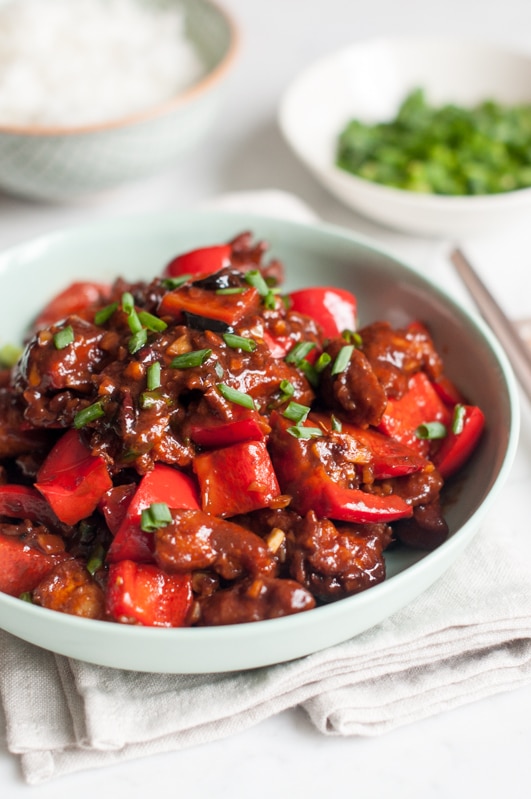
In fact, in some traditional Chinese restaurants, they will often have two entirely different menus – a menu for westerners, and a different menu for those who are suspected to be of Chinese or other Asian origin, i.e. the menu without Sweet & Sour Chicken. I stumbled across this finding when I had recommended a Chinese restaurant in Zurich to an American colleague, a place which was well-known locally for specialising in dishes from the Szechuan region. When I bumped into him the following day, he proclaimed their Sweet & Sour Chicken to be the best he had ever eaten. I wasn’t even aware that they offered this dish on the menu! It transpired that my colleague was never even given the menu with the fiery and tongue-numbing Szechuan specialties; he was simply handed a shorter menu (in English) with his American-Chinese favourites listed inside. With this new knowledge, I began to notice the same amusing trend in other Chinese restaurants.
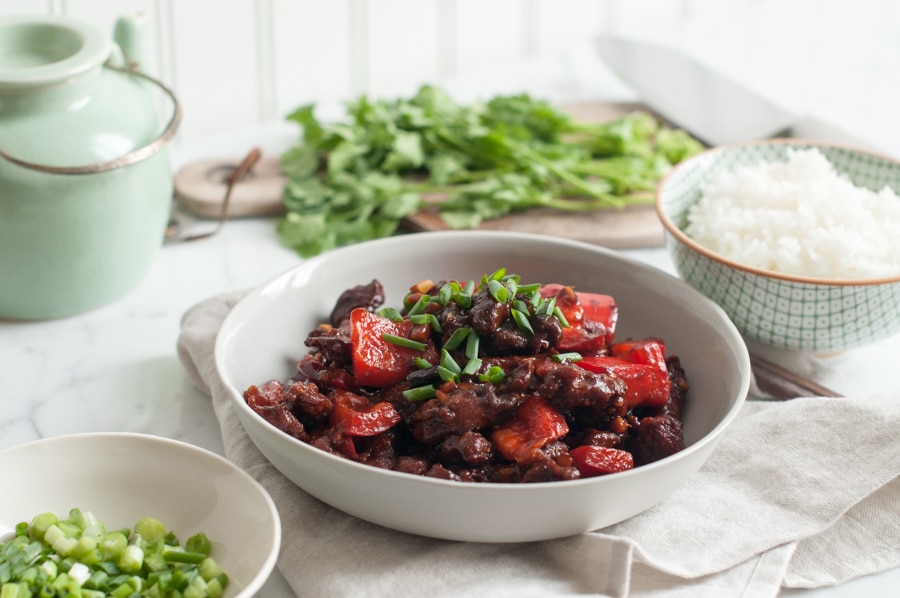
One particular Chinese dish which doesn’t even originate from China is the vastly popular General Tso’s Chicken. According to Fuchsia Dunlop, this dish was created by a Chinese chef when he was working in New York. And while it is now a dish which many Americans know and love, it is virtually unknown in China. Not that I am an expert on Chinese food, nor an expert Chinese-food eater, but I have never come across this dish outside of the US and Canada.
So upon moving back to Zurich, I was missing my hit of American-Chinese food and set about finding the perfect recipe to recreate General Tso’s Chicken at home.

The recipe below for General Tso’s Chicken comes from Every Grain of Rice by Fuchsia Dunlop, a rather wonderful collection of authentic Chinese recipes. The recipe is based on the original version which she learnt from the actual creator of the dish, Peng Chang-Kuei. I mention this fact because this recipe tastes somewhat different to the versions you might find at your local Chinese restaurant in America, an indication of how recipes can change and adapt greatly over time.
My experience of General Tso’s Chicken is usually crisp, deep-fried pieces of chicken in a heavy batter, coated in a dark, sweet and sticky sauce which is spiked with hot chillies. This version below has a very light batter, just enough to give the chicken a light coating. And the sauce is absent of any sugar, meaning that it is not sweet at all, but rather savoury and tangy with the requisite amount of heat from the dried chillies. Whilst there is a time and place for the take-away version (I have a weakness for anything deep-fried in batter), one could describe the original recipe for General Tso’s Chicken as a healthier version of what is commonly found in most Chinese restaurants today.
So that the dish can be eaten on its own with some steamed rice, I like to bulk up the dish with some vegetables, usually chopped red or green capsicums, sliced celery or even large diced onions. I know – it’s not very authentic but it saves me from having to make a separate vege dish. Plus, I can then serve everything in one bowl and curl up on the sofa for an evening in front of the telly. Right now, I’m addicted to Damages.
General Tso’s Chicken

Ingredients
For the marinade
- 2 teaspoons soy sauce
- ½ teaspoon dark soy sauce
- 1 egg yolk
- 2 tablespoons potato flour
- 2 teaspoons vegetable oil
For the sauce
- 1 tablespoon tomato paste
- 1 tablespoon water
- ½ teaspoon potato flour
- ½ teaspoon dark soy sauce
- 1 ½ teaspoon soy sauce
- 1 tablespoon rice vinegar
- 3 tablespoons water
For the stir-fry
- 350 g (12 oz) chicken breasts, or chicken thighs, diced
- 6-10 dried red chillies
- 2 teaspoons ginger, finely chopped
- 2 teaspoons garlic, finely chopped
- 1 red capisicum, (bell pepper) diced
- 2 teaspoons sesame oil
- vegetable oil, for deep-frying
- spring onions, (scallions) sliced
Instructions
- To make the marinade, mix together the light and dark soy sauces with the egg yolk.
- Add the chicken pieces and mix well.
- Stir through the potato flour and then the oil.
- Make the sauce by mixing all the ingredients together in a small bowl or jug.
- Heat the cooking oil in a large saucepan until about 180°C/350°F and deep-fry the chicken in batches until crisp and golden. Set the chicken aside.
- Heat another saucepan with some of the used cooking oil and stir-fry the dried chillies for a few seconds.
- Add the ginger, garlic and capsicum and cook for a few minutes until fragrant.
- Add the sauce and stir until it thickens.
- Add the cooked chicken to the sauce and give everything a good mix.
- Stir in the sesame oil and garnish with spring onions.
Kitchen Notes
- The heat intensity of dried chillies can vary so go easy with them. If you’re a bit timid, I would start by halving the amount of dried chillies in this recipe.
- If you can’t find potato flour, you can substitute with half the quantity of cornflour (cornstarch).
- OVEN & STOVE TEMPERATURES
All recipes on this website have been tested on an induction stove and/or with a conventional oven (i.e. an oven without fan). All recipes on this website use temperatures for a conventional oven, unless otherwise mentioned. Convection ovens (i.e. fan-forced ovens) are typically 20°C/70°F hotter than conventional ovens, but please check your manufacturer’s handbook. - CONVERSIONS
To convert from cups to grams, and vice-versa, please see this handy Conversion Chart for Basic Ingredients.

Your post reminds me how much we Indians adore Indian Chinese food – a concoction of sweet, tangy and spicy, Mostly sold as street food, it holds a special place in the hearts of all the college goers. Sometimes I desperately crave for that taste and always make it a point to have my share of sweet and spicy cripsy chilly potaotes ( Indian style ofcourse) and veg Hakka noddles
The american chinese version seems just as delightful. We go to PF Changs here in Bahrain to have a taste of the Americanized chinese food and we love it!
I didn’t know that PF Chang’s was international! Lucky you! We have a Chinese restaurant down the road which makes really nice sweet and sour chicken, and I’m sure they must think it is strange that I should always order it. But as you say, I love that mix of sweet and sour and with a bit of spice.
I have seen many blogs with this recipe, but never find it in oriental restaurants, here in Spain. Funny to read you, cos I always think that it looks like Chinese food from America 😛 You have revealed the mystery 😛
But even more, now I imagine clandestine menus in Chinese restaurants, jajaja
It seems a little “heavy” dish, but even with that I like how it looks, and I have all the ingredients, I like Chinese (or not so Chinese) food, and we always buy some ingredients and sauces we like. One of the last was the rice vinegar, and haven’t used yet!!
Have a nice day, Thanh!!
If you like spicy Chinese food, you might like this dish. The restaurant version is much sweeter, but I like the tang in this version. I’ve also never seen General Tso’s Chicken on the menu in Switzerland … I guess it hasn’t made it this far yet! And rice vinegar will come in handy for a lot of Asian recipes, even Vietnamese cooking 🙂
I’ve made this one only once before Thanh, I’m not sure why as it was very good. Not life changing but certainly worth doing again. I’ve never heard of this or fish tiles but Fuschia makes reference to them being take away/restaurant classics which surprised me! If only I looked Chinese so I got offered the more trad recipes ;). Maybe I need to take my Chinese-English friend Teresa out for dinner soon 😉
Ha ha! I’ll be curious to know if the Chinese restaurants in the UK do something similar with the menus – I wouldn’t be surprised if some did. The sweet & sour fish tiles have a familiar Chinese flavour to them and I believe the sauce from that recipe is used commonly in Chinese cooking. But General Tso’s Chicken seems to be mostly popular in North America. I’m not sure why because it’s quite delicious and I’m sure it would be just as successful in other countries.
Oh my oh my, I wish I had a bowl of this right now……I remember making a similar dish minus a few ingredients some time back. I love spicy food! 😀 Come to think of it the Chinese food you have back where I come from is very very spicy, I’m beginning to think that they reinvented some dishes to suit the South Asian palatte because I haven’t come across such sipcy dishes in the Chinese restaurants here in Europe. I’ve always woI think I’ll have to get Fuschia Dunlop’s book soon, it seems to be a keeper. For the meantime I’m going to make myself this dish for lunch to get that chilli fix for the day :p
xxx
Oh the Chinese food in Switzerland is what the locals describe as “Swiss spicy”, i.e. not even registering on the spice scale! Very few dishes are served spicy and chillies are usually offered on the side. In fact, this is how I also cook at home in case the dish is too spicy for my husband. But, over time, I think my palate has changed and I can no longer tolerate the same level of heat as I used to years before. But the restaurant mentioned in my post which specialises in Szechuan cooking is the only place I know which isn’t shy about using chillies. We’ve ordered some dishes there which were so incredibly spicy, but addictively so, that you almost break into sweat from the chilli heat!
The TSO Chicken is so irresistible!! The Americanized version of Chinese food differs per restaurants I guess. We have a Chinese take out place next to our house owned by a family and their TSO chicken looks similar to this. I have to give this recipe a try for sure!!!
Hi Shibi,
Lucky you to have a Chinese take-away so close to home! I would be tempted to do very little cooking during the week 😉 I hope you will enjoy this recipe.
I’ve never made this before Thanh and I’m not even sure I’ve seen it on a menu.
I have heard of it before, in cookbooks, and it always seems to look delicious as does yours. In fact yours looks even better!
I really should be more adventurous with Chinese food 🙂
Hi Anna,
Yeah, I figured that this dish hasn’t yet made it across the big pond to Europe! I’m not sure why because it’s really delicious – much more addictive than the more commonly known sweet & sour chicken. I guess it’s hard sometimes to be adventurous with a cuisine you are not really familiar with. I used to be that way with Greek food, until our Greek friends showed us the way 🙂
This looks like such a lovely, vibrant dish – a real heart-warmer! Well captured by photograph. Can’t wait to give it a try. Thanks for sharing.
Thanks, Rachel! Hope you will enjoy this recipe 🙂
What a delicious recipe! This is one of my favourite dishes in the US – shame that it is now made anywhere else. But so happy to be able to make it at home now!
Sounds worth a try! this looks SO good. Thank you for sharing this great recipe!