

 by
by Thai Green Curry
There comes a time during the week when I find myself with lots of bits of vegetables in the fridge, none which can be used on their own to make any meaningful meal, but it would be a shame and a waste to otherwise throw them away. Oddly enough, this fridge raid often occurs on a Monday evening, the night when I try to empty the fridge in readiness for my weekly trip to the farmers’ markets on Tuesdays.
Faced with an odd assortment of vegetables, I often resort to making a sweet and sour sauce which beautifully brings everything together, or a spicy curry which can perk up any vegetable a bit past their prime.
Ready-Made Curry Pastes
The fastest route to a curry in a hurry is with a ready-made curry paste, something which I only tried for the first time when we were in the Swiss alps a few weeks ago. After having spent a week in a holiday apartment and trying my best (but failing) to cook simple meals each night with minimal ingredients, I found myself with an assortment of lone vegetables and a craving for something Asian (this is always bound to happen when we have eaten cheese and potatoes too many days in a row).
I was pleasantly surprised to find that the two supermarkets in Grindelwald were well-stocked with Asian pantry ingredients, and that they even sold coriander (cilantro) at this altitude!
Moreover, pre-prepared packs of fresh vegetables and spices for curries were available; these packs included Thai eggplants, snake beans, baby corn, Kaffir lime leaves, fresh green peppercorns, red chillies, lemongrass and galangal. I couldn’t believe my luck!
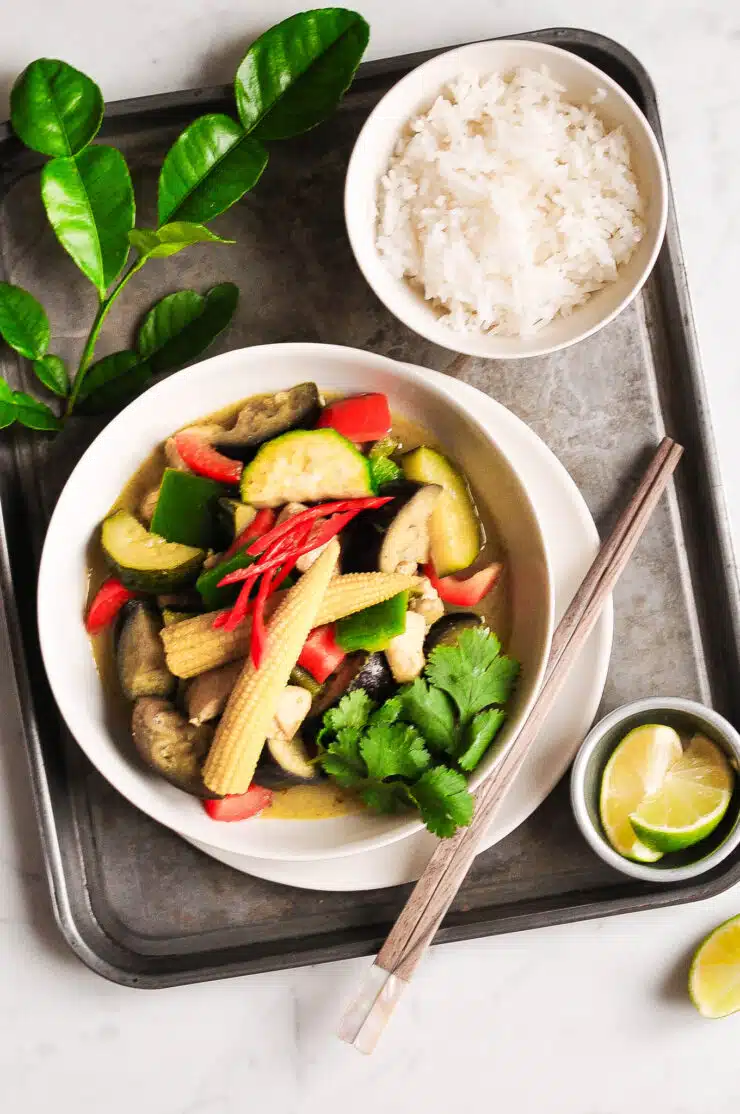
Later that night, in our cozy apartment in the mountains with the fireplace crackling softly in the background, I managed to surprise our friends and family with a Thai green curry. Not a typical meal after a day on the slopes, but a delicious and hearty meal nonetheless.
Homemade Thai Green Curry Paste
Whilst store-bought curry pastes can mean dinner on the table in less than half an hour, I usually always make a homemade curry paste, mostly so I can control the chilli heat so that our young children can also enjoy the meal (i.e. I tend to omit the chillies if our children will be eating with us).
The following recipe for Thai Green Curry Paste is one which I have been using ever since I first started cooking. You should treat the recipe as a blueprint and tweak the ingredients to your liking.
It is not a “traditional” Thai curry paste in the sense that I have omitted various ingredients, such as shrimp paste, which was hard to find when I first moved to Zurich. So I substitute with fish sauce, and I have made it this way ever since. Even though shrimp paste is now readily available where I live, as I don’t use this ingredient very often, I am happy to continue substituting with fish sauce. If you prefer, you could use 1/2 teaspoon of shrimp paste in place of the fish sauce.
All of the ingredients for my Thai green curry can normally be found at your local supermarket, although I highly recommend shopping at an Asian grocer for more authentic brands and cheaper prices.
Proteins to Use for a Thai Curry
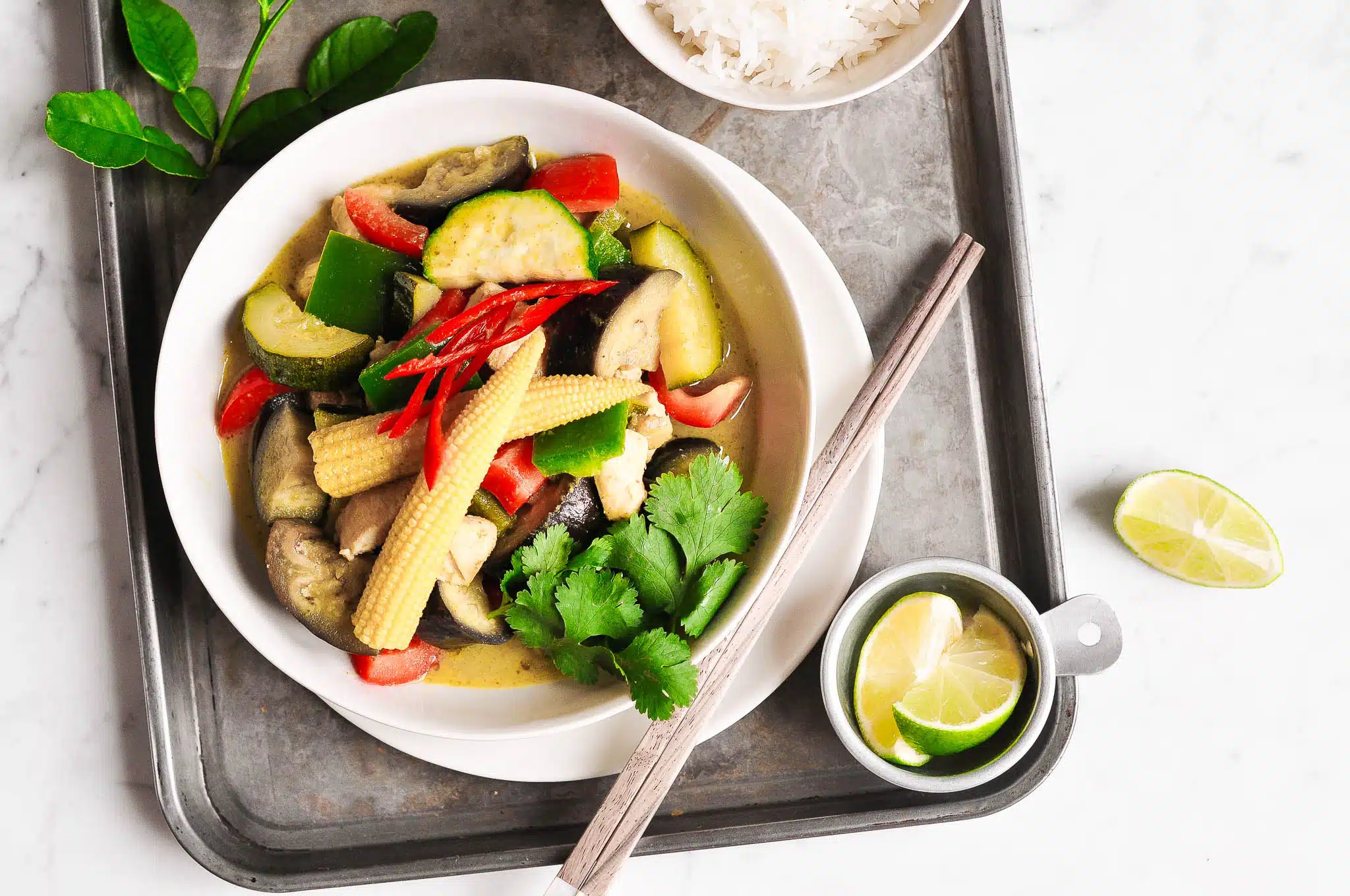
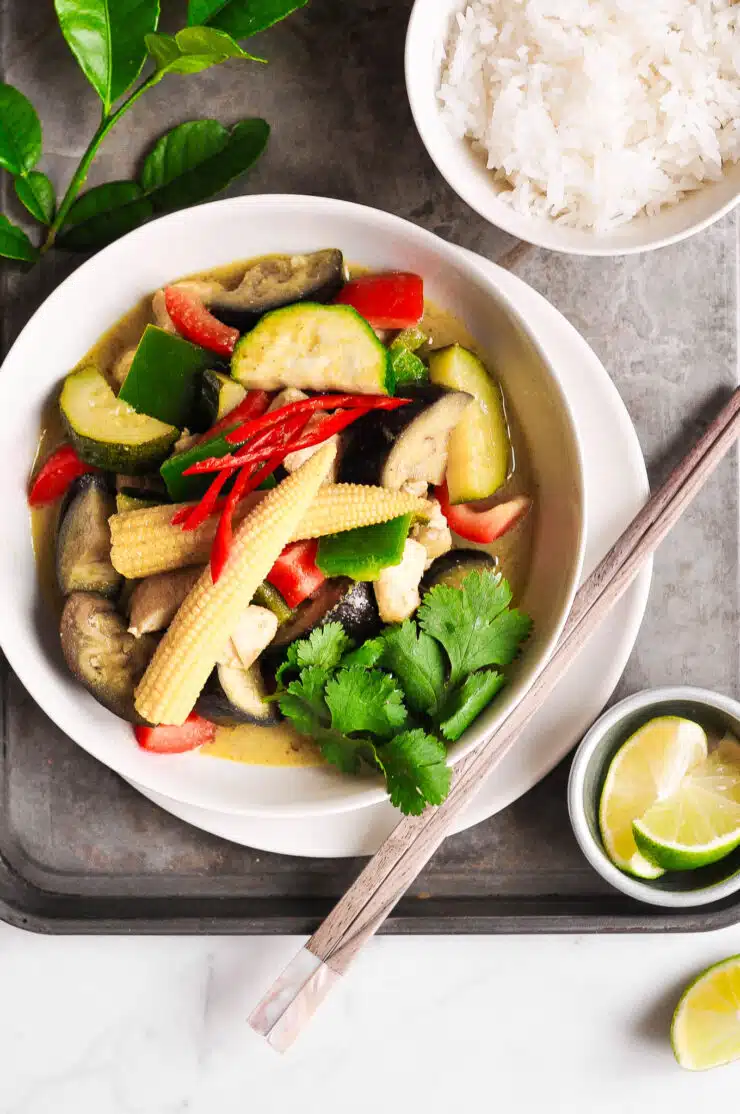
At home, you can use whatever vegetables and protein you like when making a Thai green curry. Typical proteins to use are:
- Chicken: use diced chicken breasts or thighs.
- Beef: use thinly sliced beef fillet, rump or sirloin.
- Prawns (Shrimps): poach raw prawns in the sauce towards the end.
- Tofu: slice firm tofu and add towards the end to warm through.
Vegetables to Use for a Thai Curry
More often than not, I find myself using whatever leftover vegetables I have in the fridge. You could even use a medley of frozen vegetables.
My favourite vegetables to use when making a Thai curry include:
- Aubergine (Eggplant): cut into large dice.
- Baby corn: slice in half lengthwise.
- Baby spinach: stir through before serving.
- Bok choy: simmer the chopped stems in the sauce, and add the leaves before serving.
- Broccoli: cut into small florets.
- Carrots: slice thickly and simmer in the sauce until tender.
- Capsiums (Bell peppers): cut into large dice.
- Cauliflower: cut into small florets.
- Courgette (Zucchini): cut into large dice.
- Green beans: trimmed and chopped into short lengths.
- Mushrooms: use any variety, such as button, King Oyster, shitake and/or oyster.
- Potatoes: cut into large chunks and simmer in the sauce until cooked through.
- Pumpkin: cut into large chunks and simmer in the sauce until cooked through.
Thai Green Curry

Ingredients
For the Thai green curry paste
- 3-4 lemongrass stalks, roughly sliced
- 2-3 red or green chillies, depending on how spicy you like your curries
- 3 garlic cloves
- 3 cm (1 inch) ginger, or galangal, peeled and roughly chopped
- 2 small shallots, or 1 small red onion
- 2 sprigs coriander, (cilantro) leaves, stems and roots
- 1 lime, zested and juiced
- 1 tablespoon fish sauce, or ½ teaspoon shrimp paste
For a Chicken & Vegetable Curry
- 1-2 tablespoons vegetable oil
- 2 small chicken breast fillets, largely diced
- 1 brown onion, largely diced
- 400 ml (oz) coconut milk
- 500 ml (2 cups) chicken stock, or vegetable stock
- 1 teaspoon sugar
- 5-6 makrut lime leaves
- 1 courgette, (zucchini) largely diced
- 1 aubergine, (eggplant) largely diced
- 6-8 fresh baby corn, halved lengthwise
- 1 green capsicum, (bell pepper) largely diced
- 1 red capsicum, (bell pepper) largely diced
- fish sauce, to taste
- coriander, (cilantro) for garnish
Instructions
To Make the Thai Green Curry Paste
- To make the curry paste, place all of the ingredients into the bowl of a food processor, and blitz until you have a fine paste.
To Make a Chicken & Vegetable Curry
- Heat the oil in a large saucepan over medium-high heat.
- Cook the chicken until it is brown all over.
- Add the onion and cook for 1-2 minutes until the onions have softened slightly.
- Use slotted spoon to remove the chicken and onion mixture to a bowl.
- Add 4 tablespoons of the curry paste to the saucepan.
- Cook for a few minutes to release the spices.
- Scoop the cream from the coconut milk into the saucepan, and mix into the curry paste.
- Add the rest of the coconut milk (the liquid), chicken or vegetable stock, and sugar.
- Add the makrut lime leaves.
- Simmer gently for a few minutes.
- Return the chicken and onion mixture to the pan.
- Add the remaining vegetables to the pan and cook until they are tender. Depending on what type of vegetables you use, you might have to add them at different times. For example, carrots and potatoes take longer to cook and should be added first, whilst capsicums (bell peppers) only need a few minutes.
- Taste for seasoning. You might need to add some fish sauce, lime juice, or perhaps more water or stock. If the curry needs more flavour, you could stir through more curry paste and simmer for a few more minutes.
- Serve with Steamed Jasmine Rice.
Kitchen Notes
- VARIATIONS
* Please use this recipe as a guide, and substitute with your favourite protein and vegetables.
* To make a vegetarian version of the curry paste, substitute the fish sauce for soy sauce. - FEEDING CHILDREN
If feeding young children, I always leave out the chillies and serve freshly chopped chillies on the side. It’s not the same, but it’s a good way for the family to enjoy the meal together and for young palates to develop. - STORAGE
Any leftover Thai green curry paste can be kept in the fridge in a sterilised jar for a week or two. - OVEN & STOVE TEMPERATURES
All recipes on this website have been tested on an induction stove and/or with a conventional oven (i.e. an oven without fan). All recipes on this website use temperatures for a conventional oven, unless otherwise mentioned. Convection ovens (i.e. fan-forced ovens) are typically 20°C/70°F hotter than conventional ovens, but please check your manufacturer’s handbook. - CONVERSIONS
To convert from cups to grams, and vice-versa, please see this handy Conversion Chart for Basic Ingredients.
Did you make this recipe?
Please leave a comment below and share your photos by tagging @eatlittlebird on social media and using #eatlittlebirdUpdate
This recipe was first published on 25 January 2017. It has been updated with new photos and more comprehensive recipe notes.

My absolute favorite is Thai Green Curry but I often have to use the curry paste because it’s the fresh ingredients are never available here in Israel. This looks so delicious – takes me back to Thailand.
When I first moved to Switzerland, it was almost impossible to find most Asian ingredients. These days, it’s much easier, especially since the Swiss love to eat Thai and Asian food. But I don’t think there is anything wrong with store-bought curry paste. The one I tried the other week was very good, just very spicy!
Thai green curry is a family favourite. SO much better for you to make the paste yourself as you know what goes into it then
I agree, and the taste is so much more vibrant when made fresh 🙂
I loooooooooooove green curry!! Sadly, my daughter is allergic to seafood. Can you suggest something as an alternative to fish sauce? My son can’t tolerate wheat either so regular soy sauce is out but we can do gluten free soy sauce. You’ve got me wanting a big bowl of curry and rice now! Yum!
Hi Ruth,
I would suggest using gluten-free soy sauce in place of fish sauce. The taste won’t be the same, but it will still be delicious.
I once took a cooking class at a popular vegetarian restaurant in Zurich (called Hiltl), and they showed us how to make a vegetarian/vegan Thai curry which used soy sauce. It’s not a typical ingredient in Thai curries, but I can assure you that their version tastes as authentic as the real thing! In case you are interested, here is their recipe for green Thai curry paste:
Green Thai Curry Paste (Recipe by Hiltl)
1 shallot
50 g garlic cloves
80 g green chillies
10 kaffir lime leaves
2 limes
1 1/2 teaspoon ground coriander
1/2 teaspoon ground cumin
25 galangal
1/2 teaspoon black pepper, crushed
3/4 teaspoon turmeric
1 3/4 teaspoon sea salt
120 ml groundnut oil
Chop the shallot, garlic and chilli. Remove the central rib of the lime leaves and chop the leaves as finely as possible. Wash the limes and grate the peel.
Using a wand mixer or mortar and pestle, blend the chopped ingredients together with the grated lime peel, sea salt and 50 ml oil until you have a fine paste. Add as much oil as is needed until the paste has the required consistency.
Fill the paste in a screw top glass, smooth the top and cover completely with oil. Treated in this way the curry paste will keep fresh in the fridge for 4 weeks.
This curry looks amazing. Sharing it on social media!
Thank you, Igor!
I love Thai green curry. Yours looks sensational!
Thanks, Kate!
I love Thai curries and always looking for recipes from scratch to try. I think I have all the ingredients to give yours a try tonight. Except… my can of coconut never separates to cream on top and liquid on bottom no matter how carefully I take it out of the pantry. So can I just dump the whole can in at once?
Yes, of course! Sometimes I can only find coconut milk in Tetra packs which don’t have any separation between the cream and liquid. To be honest, I don’t think there is any difference to stirring the cream in first vs pouring in the whole can. It’s just how I was taught to make curries and what I see on cooking shows! Hope you will enjoy this recipe 🙂
YUM I love green curry and it’s even better with a homemade curry paste. I have to admit that I use the pre-made jar stuff most of the time as it’s just so easy for midweek dinners after work. Will have to give this homemade curry paste version a go one weekend/Friday night 🙂 thanks for sharing!
I can see how easy and tempting it would be to resort to store-bought curry paste (now that I have tried it myself), but if you get the chance to make it from scratch, it’s totally worth it!
Beautiful photos and a great recipe! I’m in the same boat when the end of the week comes along and veggies are about to go bad. I find curries always do the trick.
Thanks, Britt! Great minds think alike 🙂
I love that you make your green curry paste from scratch. You can tailor it to your own personal tastes and you know exactly what is in it (not to be underestimated).
I am in Bangkok right now and we had Thai Green Curry last night. There they have these cute, small, round eggplants rather than the larger ones we tend to see in the West. Great if you can find them in a supermarket specializing in Asian ingredients. Definitely sold in Australia and the UK.
How lucky you are to be in Bangkok! You must be feasting on delicious food at every meal! The small round eggplants you are talking about are available at the Asian grocers in Zurich (where I live), but my family don’t seem to really like them. I wonder if it’s because they are simply used to the regular eggplants (which we eat quite frequently). But I love them and add them in small quantities for myself 🙂
I have been itching to learn to cook more Asian cuisine, and this seems like a great entrée! I have been pleasantly surprised to find a lot of specialty Asian stores and ingredients here in Belgium, as well, so there’s really nothing stopping me from giving it a go. 🙂
I love making curry but usually resort to pre-made curry paste. Totally going to use this scratch made version next time!
While there is nothing wrong with a pre-made curry paste, you will definitely taste the difference when using a fresh curry paste. Hope you will enjoy this recipe 🙂
I tried this recipe last night and it was surprisingly so easy! I added more chillies for extra kick. Definitely making this again and won’t need to buy store bought paste anymore!
This is a great idea, even for picky eaters! Looks amazing!
I love that this recipe doesn’t use store-bought curry paste! Will definitely try this one out with less chillies 🙂