

Pumpkin Laksa
 posted by Thanh | Eat, Little Bird on January 20, 2012 (last updated Oct 16, 2026)
 I have long been a fan of Nigel Slater, his books having been instrumental in my initial forays into the kitchen, along with Nigella Lawson and, dare I say it, the Australian Women’s Weekly. One of my favourite cookbooks would have to be Appetite, a hefty book filled with amazingly delicious recipes but provided in a manner that encourages the cook to develop some intuition in the kitchen. Rather than call for, say, 100 g of tomatoes, Nigel Slater’s recipes would instead ask for 3-4 medium-sized tomatoes, not only making it a bit easier to shop but also allowing the cook some flexibility.
I have been distracted in recent years by cookbooks from other authors, but this year hopefully marks a revisit of some old favourites. I was only reminded of Nigel Slater recently when hubby and I were browsing in the bookshop and Nigel Slater’s Tender Volume 1 & 2 were being sold together in a limited edition boxed set. Having lusted after these books for some time but trying to sensibly refrain from hoarding too many cookbooks in one year, I couldn’t resist a boxed set. And upon realising that Volume 1 was all about vegetables, and Volume 2 was dedicated to fruit, hubby generously offered the books to me as a gift, on the condition that they supported his New Year’s resolutions to eat more vegetarian and healthy food. Of course, honey …
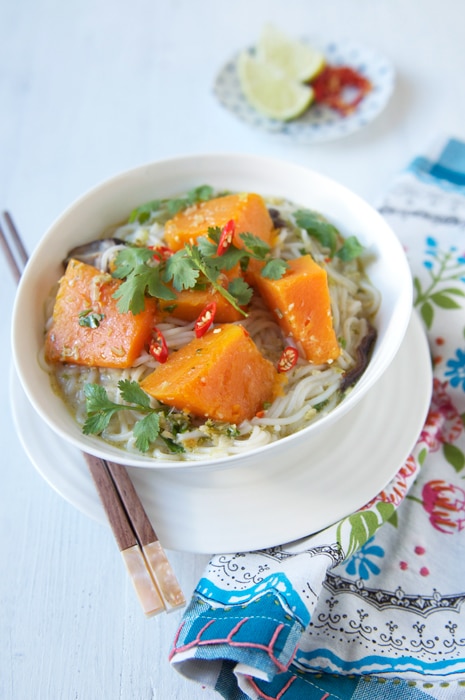
With pumpkins in season, I was instantly taken by Nigel’s recipe for pumpkin laksa in Tender Volume 1. As a lover of all noodle soups, from the robust and herbal hit of a Vietnamese Pho to the equally comforting but milder-flavoured chicken noodle soup of the western palate, and not to mention the 2-minute noodles (or pot noodles) of my student days, I can rarely turn down a recipe for comfort in a bowl.

A typical laksa consists of a hot broth flavoured with curry spices and coconut milk, ladled over a nest of thick vermicelli noodles with either chicken or prawns (or both), some deep-fried tofu puffs, sprinkled with some crunchy bean sprouts and a generous garnish of fresh herbs. So anyone who may have sampled as many laksas as I have might disagree with the name of Nigel Slater’s soup. His soup is not the fiery and aromatic red broth typically served in Malaysian restaurants, but since I can’t remember when I had last slurped my way through a hearty bowl of laksa, nor pinpoint its taste in my memory, I don’t think I am in a position to comment.
But whatever you wish to call this soup, it is pretty delicious. It is not unlike Rachel Allen’s Fragrant Sugar Snap and Beansprout Noodle Laksa from her book, Home Cooking. Both recipes use the same ingredients in the spice paste and the soup, albeit in differing quantities. The spice paste is quick and easy to make and provides a fragrant and spicy base for the soup. You could add any vegetable of your choice – mushrooms, baby corn, snap peas, beans, bok choy, etc – or even slices of raw chicken for a chicken noodle laksa.
Nigel’s suggestion is to add steamed pumpkin which, in the absence of meat, makes this soup quite hearty and filling. The pumpkin also lends a nice sweetness to the soup, a welcome flavour against the gentle spiceness. Next time, I might try to cook the pumpkin in the spicy broth so that the pumpkin can take on some of the flavours of the soup, and also to save on some washing up. That said, it was rather nice to bite into the untampered pumpkin for a mild contrast in taste against all of the other flavours.
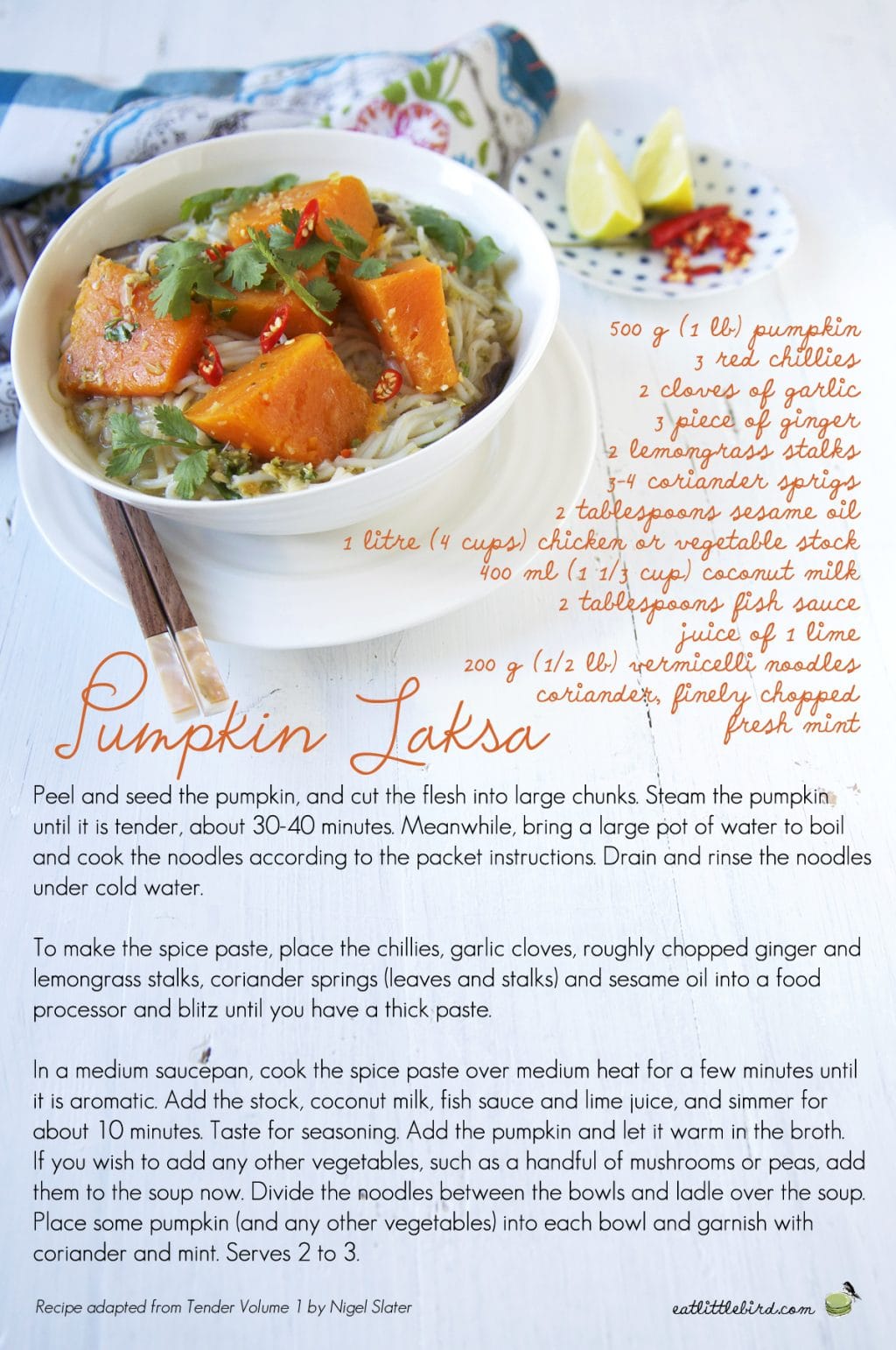
But I was rather perplexed to look at the pan of simmering broth and accept that it was enough for 4. Nigel’s recipe makes about 1 litre of broth and calls for 25 g of noodles per person. I don’t know about you but I would have gone to bed hungry if I was indeed making this recipe for 4. I found the soup to be a little concentrated for my taste and added an extra 300 ml or so of water until I was happy with the balance. I cooked 300 g of noodles and found that, with the extra broth and noodles, it fed the two of us generously with some leftover for my lunch the next day. Perhaps Nigel’s intention for Tender Volume 1 was not only to educate readers about how to cook and prepare certain vegetables, but to also encourage healthy eating of said vegetables through sensible portion controls. I think eating more vegetables, and vegetarian meals in general, is already a congratulatory start for us in this New Year; I might focus on the petite serving sizes another time. So below is my adaptation of Nigel’s recipe for more generous portions.

I have tender vol 1 and I am ashamed to say that I don’t even know of this recipe in the book! So thankyou for bringing it the the fore! We get beautiful organic acorn pumpkins here so I know that I will be doing this soon….lovely post :-))
I’m besotted with pumpkins at the moment and trying to find different ways to cook with them, so I instantly took to this recipe! You can, of course, replace the pumpkin with any other vegetable but the pumpkin itself is an unusual addition to a laksa, and really delicious at the same time.
Oh I so want these books but I mustn’t, shouldn’t, won’t buy anymore! Not this year. Well not this first six months of the year at least ;). That laksa looks yummy indeed Thanh, as you know I’ve only just had my first laksa experience and it will so not be my last. Although you’re right about feeling hungry afterwards – later that night hubby made himself a couple of little ham and chelly rolls as he was hungry! I suspect it was psychological as he has very fixed ideas about what constitutes a “meal” and noodle soup ain’t it! I disagree heartily and will be enforcing such a Neal at least once a week now ;). Love your napkin btw xx
I’m also trying my best to refrain from buying more cookbooks until I have made a decent way through the existing ones, or at least try to be more selective now when buying cookbooks 🙂 I’m surprised I held out for so long on Nigel Slater but I’m so happy to finally own these books! I was really glad to see that your first laksa was a success and I hope Neil will eventually accept that it can indeed be a meal … maybe you need to up the portions? I make a noodle soup at least once a week and no one goes hungry here 😉
Ah it’s totally psychological Thanh – I’m hoping like Pavlov’s dogs, I can eventually convince him it’s a proper meal! Might have to serve his in a giant bowl with extra stock to give the illusion of a big portion 😉
I love Nigel and all his books although he is notorious for his tiny portions. There was a lot of comments on old n.com about having just plain miso soup for supper etc. I grew up on hearty jewish noodle soup and now love spicy soups like tom yam and combining the two would be wonderful. Ive not seen pumpkin here only sweeter squashes so i’ll need to think of a substitute. Ive not made these flavours in ages. Thanks for jogging my memory!!
Just miso soup for dinner?? Even if it was a big bowl with lots of tofu and seaweed, I’m not sure it would fill me up. I’m glad you mentioned that Nigel is known for his small serving sizes because I was worried that I sounded like a greedy piggy!
You could definitely use butternut squash, or even sweet potato, in this soup. I made this again the other day and am surprised by how much I like it!
such stunning photographs and I love that hearty looking soup. I am big fan of Nigel Slater and love his simple approach to cooking.
Thanks, Anita! Great to know another fan of Nigel Slater 🙂
I’ve been coveting this cookbook for quite some time and this post is just reinforcing my desires! I love anything with pumpkin and a bit of heat. what a healthy delicious meal!
Hi Joanne! It is indeed a healthy and delicious meal, and I hope this means you will be able to get your hands on this book very soon 🙂 I usually only roast pumpkin or make it into a soup, so eating it this way has been quite refreshing.
I need to revisit these books of Nigel’s. They’re not my favourite I must admit!
But after seeing that Laksa….:))
Have you cooked from any of the Tender books, Anna? Perhaps it could be a part of your “Off The Shelf” challenge?? 😉 So far, I’m finding the Tender books great for snuggling-on-the-sofa reading, mostly because I’m interested in planting some fruit and veg on my balcony. I love Nigel’s prose that I often forget that I’m reading a cookbook! I think there are some new ideas on how to cook certain vegetables, and if the pumpkin laksa is the only thing I make from this book, I think it would be worth it for me. I can at least say that I’ve used it!
Thanh, I made this soup tonight. I printed it off and made the whole thing, only to remember that I *do* have the book! DOH! Be that as it may, it was really delicious! I would say your portions are more spot on, if you want to make a right meal of it! Also, I added a couple of Kaffir lime leaves (simply because I adore its citrusy perfume) and a bruised but intact lemongrass to the broth as it cooked, along with the pumpkin. It took on the flavours beautifully!
I can see this being a fantastic base to making your own laksa and is open to chucking in as many different types of veg as you’d like.
All in all, an aromatic success!
Oh wow! I saw that you were making laksa tonight and am thrilled to read that you tried this recipe! Your addition of kaffir lime leaves and a bruised lemongrass stalk sound like a great idea – this soup certainly benefits from a citrus kick. And great to see that you cooked the pumpkin in the soup. I’m sure it would have taken on much more flavour this way. You are right that this soup lends itself well to any vege, which is why it reminded me of Rachel Allen’s laksa which I mentioned – she suggests snap peas and beansprouts but you could really use any vege you like.
Thanks for letting me know that you tried this recipe! Txx
It wouldn’t be all that it is without a right good citrus element. What I love about Laksa’s is the ability to really fine tune it to my own palate. And of course all that fresh, clean, spicy flavour satisfies the Indian tastebuds. I love seafood laksa’s too and that will be the next stop.
And of course, yes, I just had to tell you about it!
Here’s an idea for a blog post Creme as you will have more authority on the subject….noodles. There is a boggling choice here and I am never quite sure what is best for a recipe or what the differences are. Something to mooch on perhaps :-))
i blogged an altered version of your recipe tonight. it is AMAZING. truly. thank you for sharing. i’ve linked you on the post xo
I’m so glad you enjoyed this recipe, even with your tweaks, which goes to show just how versatile this recipe is. You’ve reminded me that it has been a wee while since I’ve made this dish, so thank you!
Ohhh I can’t WAIT to try this! Thank you for this great recipe! So YUMMY!!!