

 by
by 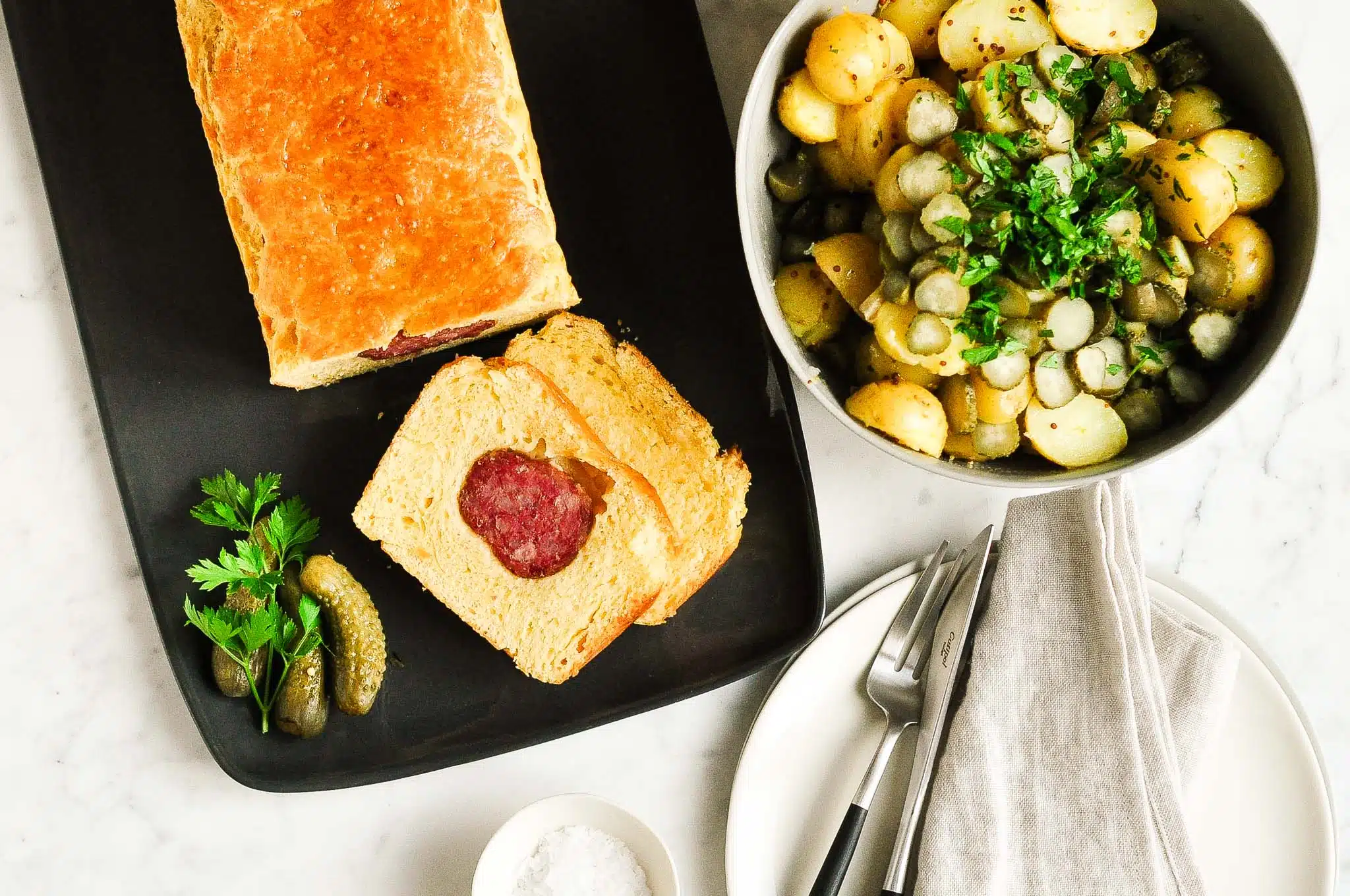
French-Style Sausage Roll
One of the advantages of reading cookbooks like novels (I’m sure you have heard of many foodies using this phrase) is having a repository of recipes stored in the memory for those many moments when I find myself holding an ingredient and wondering how I can cook it.
The other day, whilst I was browsing the different sausages on offer at the supermarket, I saw a Lyonnaise sausage which promptly reminded me of a recipe from A Kitchen in France by Mimi Thorisson where she makes a Lyonnaise Sausage Roll. This is essentially a large sausage baked in a savoury brioche loaf. As an Australian, I find it hard to ignore any form of sausage roll, even if nothing comes close to those which you can find Down Under. But I have even come to love the Swiss Wienerli im Teig, a Wiener sausage simply wrapped in buttery puff pastry.
Aussie-style sausage rolls feature regularly in our home, but as our children are half-French, I try my best to cook a lot of French food as a way for them to connect with the paternal side of their heritage. It’s also a good excuse for me to practise cooking one of my favourite cuisines.
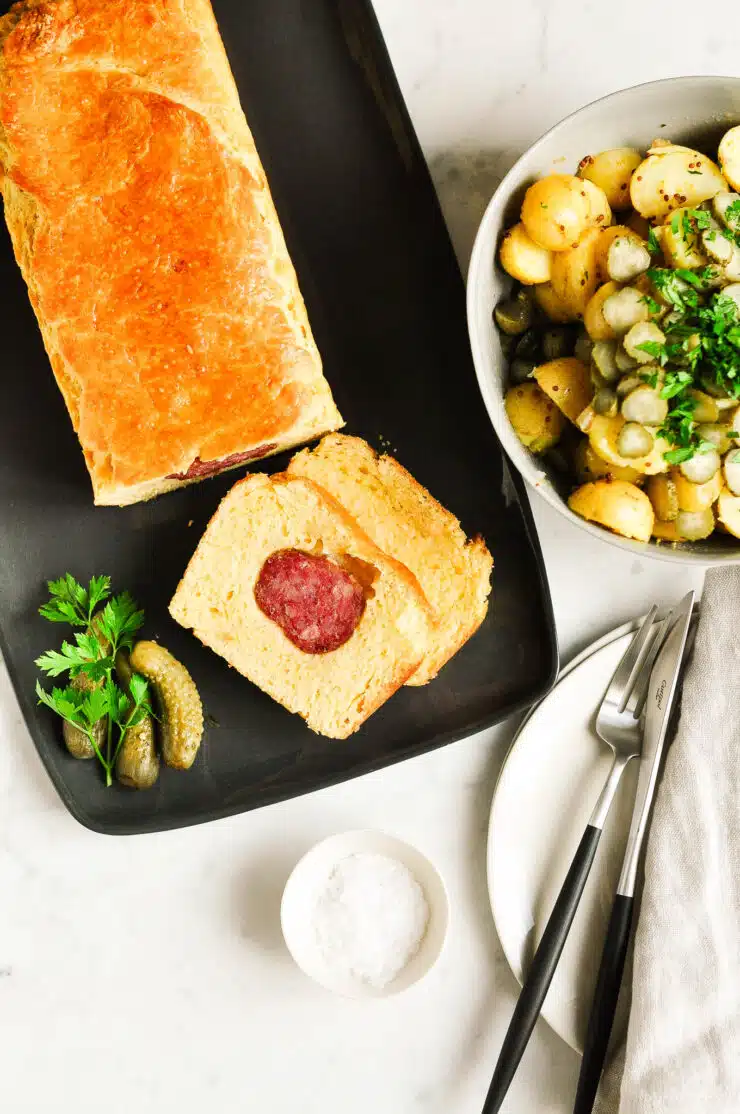
Saucisson de Lyon
So the Lyonnaise sausage found its way into my shopping basket which I set about preparing a few days later. However, in spite of my best efforts to be organised before embarking on this recipe, panic set in when I realised mid-recipe that I had purchased the wrong sausage. Instead of buying the required saucisson de Lyon (an uncooked Lyonnaise sausage), I had instead bought a sauccise de Lyon (a cooked Lyonnaise sausage).
French is clearly not my forte. I blame my husband for my poor French (and the fact that I have devoted the last 10 years to learning German) ????
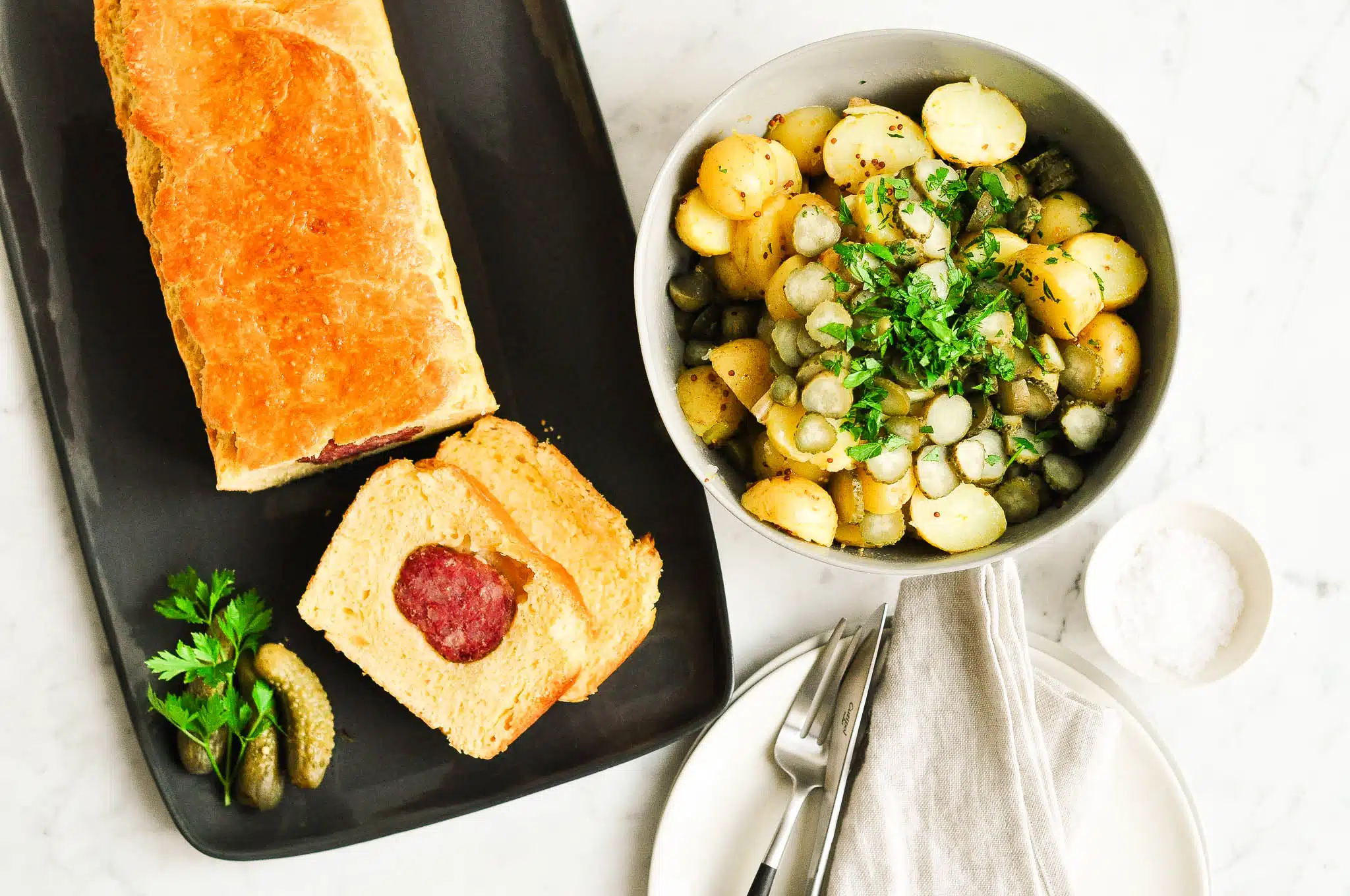
Saucisson Vaudoise
So the brioche dough was still proving in the kitchen, and although I had intended to use the afternoon to take my daughter to the playground for some much needed toddler-energy-burn-off, I figured that it was also in her best interest that I produce an edible and complete meal that evening. So her playground that afternoon was the gourmet food hall downtown which stocks a wide variety of sausages (it being a Swiss delicacy), but the elusive saucisson de Lyon was nowhere to be found.
Thankfully, a kind (Swiss) butcher recommended that I could use a (Swiss) saucisson vaudoise as a substitute, especially since it requires the same cooking preparation as a saucisson de Lyon, and also because it is used by the Swiss-French in their own version of a sausage roll.
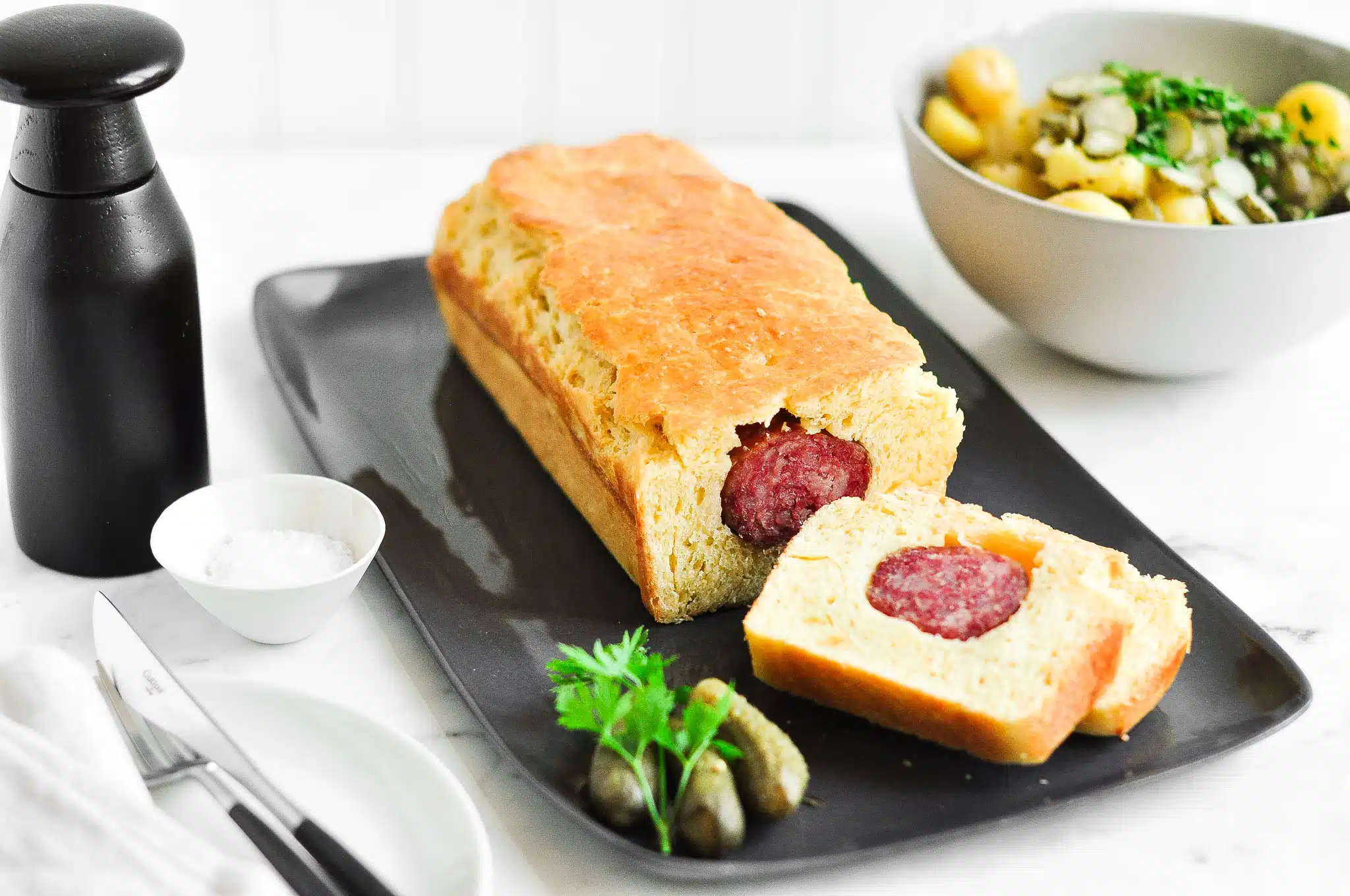
Lyonnaise Sausage Roll
So perhaps I should rename this recipe to Vaudoise Sausage Roll, but I think you could use any good-quality pork sausage for this dish. Ideally, the sausage should be about 20 cm (8 inches) long and 5 cm (2 inches) thick, so that there is a good sausage-to-bread ratio.
If you are in the habit of making bread and brioche at home, this recipe is quite a doddle to make. And like most homemade breads, there will be lots of oohs and aahs as you bring it to the table.
Sausages always go well with a potato salad, so I served it with our usual warm potato and cornichon salad. I can’t wait to experiment with other sausages in this recipe.
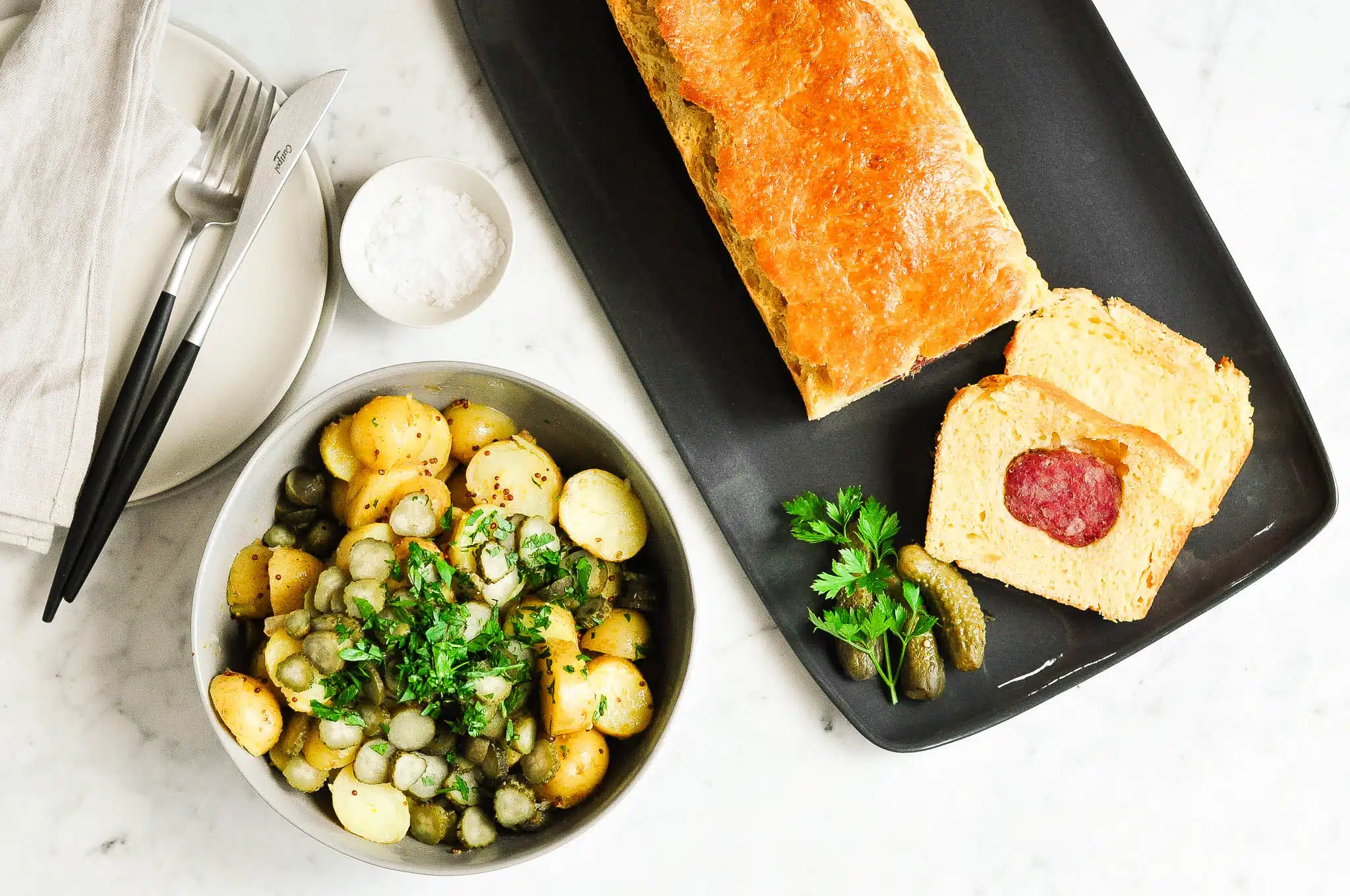

Lyonnaise Sausage Roll

Ingredients
- 240 g (1 ⅔ cup) plain flour, (all-purpose flour)
- 7 g (2 teaspoons) instant dried yeast, see Kitchen Notes
- 20 g (1 ½ tablespoons) sugar
- 1 tablespoon warm water
- 3 eggs
- 100 g (1 stick) unsalted butter, softened
- 1 large good-quality pork sausage, such as a saucisson de Lyon or saucisson vaudoise, 20 cm (8 inches) long and 5 cm (2 inches) thick
- 1 egg, lightly beaten
Instructions
To Make the Dough
- Place the flour, easy-blend yeast and sugar into the bowl of a stand mixer with a dough-hook attachment.
- Mix the ingredients together.
- Add the warm water, 3 eggs and butter.
- Knead the dough on medium speed for 8 to 10 minutes until the dough is soft and elastic, but still slightly sticky. The dough should come away from the sides of the bowl and easily form into a ball.
- Butter a large bowl, place the dough inside, and cover with a clean teatowel.
- Place the bowl in a warm place for 1-2 hours until it has doubled in size.
To Prepare the Sausage
- Meanwhile, cook the sausage according to the packet instructions.
- For a saucisson vaudoise, you will need to cook it in a large pot of water at 75°C for 45-60 minutes.
- Remove the sausage from the water.
- When it is cool enough to handle, remove the casing from the sausage.
- Allow the sausage to cool.
To Make the Sausage Roll
- Generously butter a 24 x 9 cm (9 x 4 inch) loaf tin.
- Remove the dough from the bowl.
- On a lightly floured surface, gently pat the dough and roll it into a rectangle measuring approximately 25cm (10 inches) long, 18cm (7 inches) wide, and 1cm (1/2 inch) thick.
- Place the sausage down the centre of the dough and fold the dough over to wrap the sausage. Tuck in the ends.
- Place the sausage roll, seam-side down, in the loaf tin.
- Place the tin somewhere warm for about 30 minutes, or until the dough has puffed up slightly.
To Bake the Sausage Roll
- Preheat the oven to 200°C/392°F (without fan).
- Place a metal tray on the middle shelf in the oven
- Brush the dough with egg wash.
- Place the loaf tin on the pre-heated metal tray.
- Bake for 25-35 minutes, or until it has risen and is lightly golden.
- Leave the sausage roll to cool in the tin for about 10 minutes before removing it to a serving dish to serve warm.
Kitchen Notes
- RECIPE CREDIT
This recipe is adapted from A Kitchen in France by Mimi Thorisson. Her recipe only calls for one session of proofing, which I think produces a deflated loaf. I recommend a session of proofing once the sausage roll has been formed. Please see my recipe above. - OVEN TEMPERATURES
All recipes on this website state temperatures for a regular oven (i.e. a conventional oven without fan). If you have a convection oven with a fan, please consult the manufacturer’s handbook on how to adjust the temperature and baking time accordingly. - CONVERSIONS
To convert from cups to grams, and vice-versa, please see this handy Conversion Chart for Basic Ingredients.

Oh, I didn’t read that!!
I always, always, always have wanted to make this!!! But here, I don’t find saucisson de Lyon, but I should do like you, don’t you think? Even with a Bratwurst inside, this would be delicious 😛
Easy blend yeast, I suppose is easier to disolve, but it’s like instant yeast, isn’t it?
Have a nice summer, Thanh!!!
Yes, I think you can substitute with any good-quality sausage, but ideally a large sausage so that there is a good bread-to-sausage ratio. I’m sure a Bratwurst would be delicious in this recipe – just have to brown it and cook it first, I think.
And “easy blend yeast” is the same as instant yeast. They seem to be called different things everywhere! To avoid any confusion, it’s the yeast which you can add directly to the flour without mixing it with water first to make it bubble 😉
It’s nice to have a repository of recipes in your head for moments like these! I love baking brioche, but I’ve never made a sausage roll–it sounds delightful!
If you’re familiar with making brioche, this recipe just requires an extra step. My family really enjoyed this recipe 🙂
I absolutely LOVE this! I, too, read cookbooks like novels — they’re so much more interesting and satisfying — and I know exactly what you mean about inspiration from those cookbooks. I’ve never heard of stuffing a bread with sausage like this, but I know it would be a hit with my family!
The moment I saw the recipe, I knew I had to try it and that it would be a hit with my family. Brioche and sausage – it can only be wonderful together 🙂
This looks like an interesting idea! Never heard of stuffing bread like this but I bet it tastes great!
It sounds unusual to bake the sausage into the bread, but I can assure you that it tastes wonderful!
I keep a stack of cookbooks few places in house and go through them religiously! Love making brioche so this is the next best thing!
I hope you will get a chance to try this recipe! It will be a twist to your usual brioche 🙂
This is such a cool idea and love what you have done here. My mind is already wandering off to thinking how I can make this vegetarian. How true that once we become food bloggers, we start reading cookbooks like novels 🙂
Yes, I’m sure there are delicious vegetarian ways to stuff a brioche. And happy to find another cookbook lover 🙂
I made the recipe from Mimi Thorisson’s cookbook and don’t understand the hype. The recipe worked well and the “brioche” bread surrounding the sausage was good but my husband and I found the bread dry and in need of some kind of tasty, liquidy sauce (we tried a small amount of mustard but it wasn’t the answer). As well, the bread-to-meat ration was all wrong—not enough sausage and too much bread. The recipe left us underwhelmed to say the least. Maybe puff pastry would be better?
Hi Sandra,
Many thanks for your feedback. What type of sausage did you use? If you feel the bread-to-meat ratio is off, you could experiment with different and larger sausages.
I think this Lyonnaise Sausage Roll is intended to be eaten as a snack, so no sauce is required. Although, an Australian sausage roll is typically eaten with ketchup, so I can understand your point about it needing some sauce to go alongside. I’ve made this Lyonnaise Sausage Roll a few times, each time served at lunch with a light salad and potato salad, all of which go together nicely.
If you were to use puff pastry instead of the brioche dough, you would end up with something similar to an Australian sausage roll or British “pigs in blankets” 🙂 In which case, you could choose a different sausage which would not require the same cooking or preparation as in this recipe, such as a more traditional pork sausage or Frankfurter sausage which you could use raw before encasing in the puff pastry.
This is a lovely recipe from Mimi Thorisson. I agree that the brioche definitely needs the second stage of proving to allow it to rise more and be softer in texture. I tied this recipe but made small buns instead.
Cannot wait to try this! Love! Looks beautiful and tasty!