

 by
by 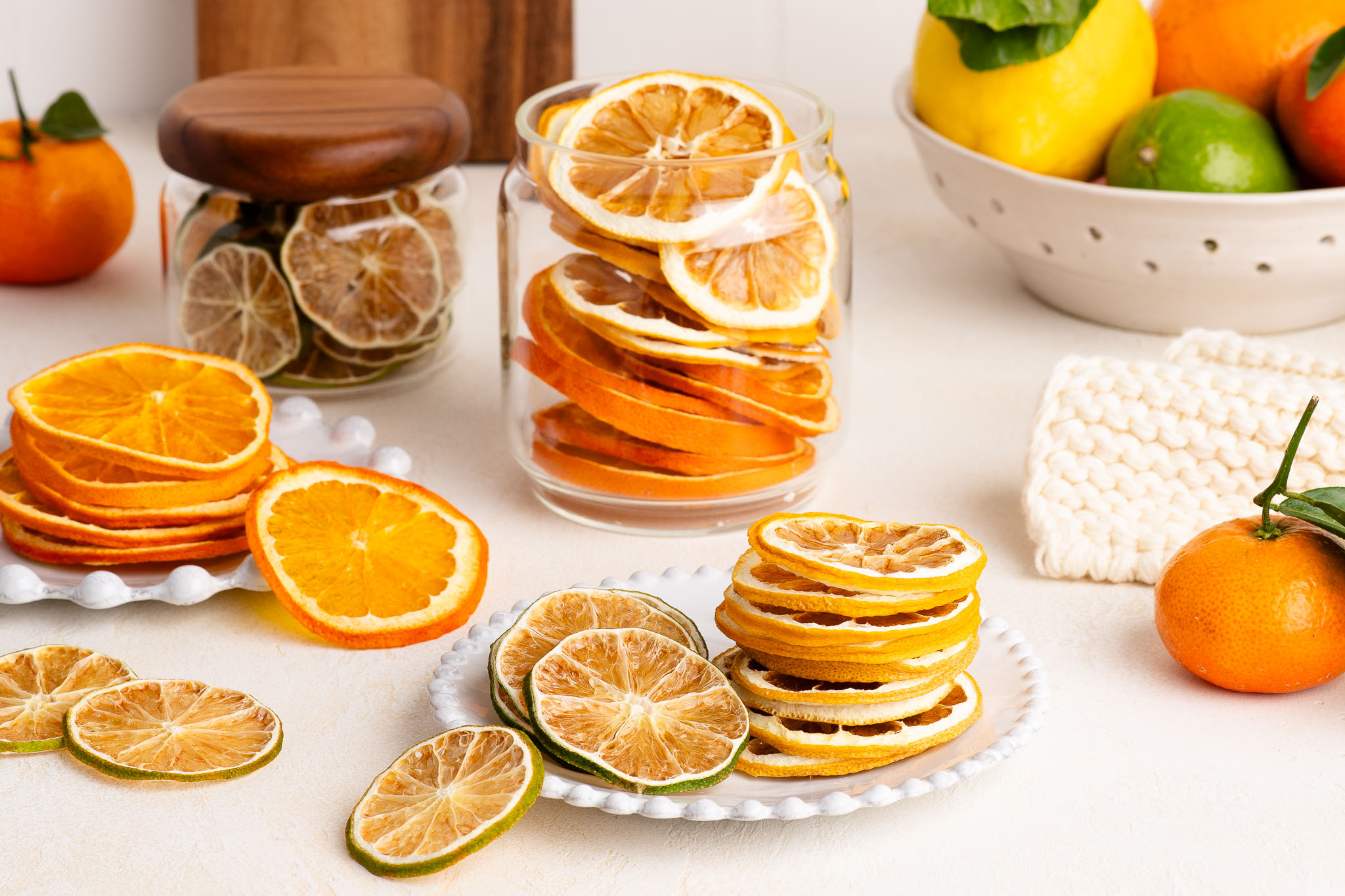
How to Make Dehydrated Citrus
Dehydrating citrus was never really on my radar of things to do, and nor was purchasing a food dehydrator to take up valuable real estate on our tiny kitchen counter. But as someone who drinks a lot of homemade lemon tea, as well as homemade lemon and ginger tea, I started experimenting with different ways of preserving lemons for my daily tea, and I found that dehydrating lemons was by far the easiest method of preserving and storing these fruits.
And once I started dehydrating lemons, I found myself doing the same with a variety of other fruits – oranges, limes, grapefruits, and even ginger and cherry tomatoes!

Dehydrating Citrus for Tea
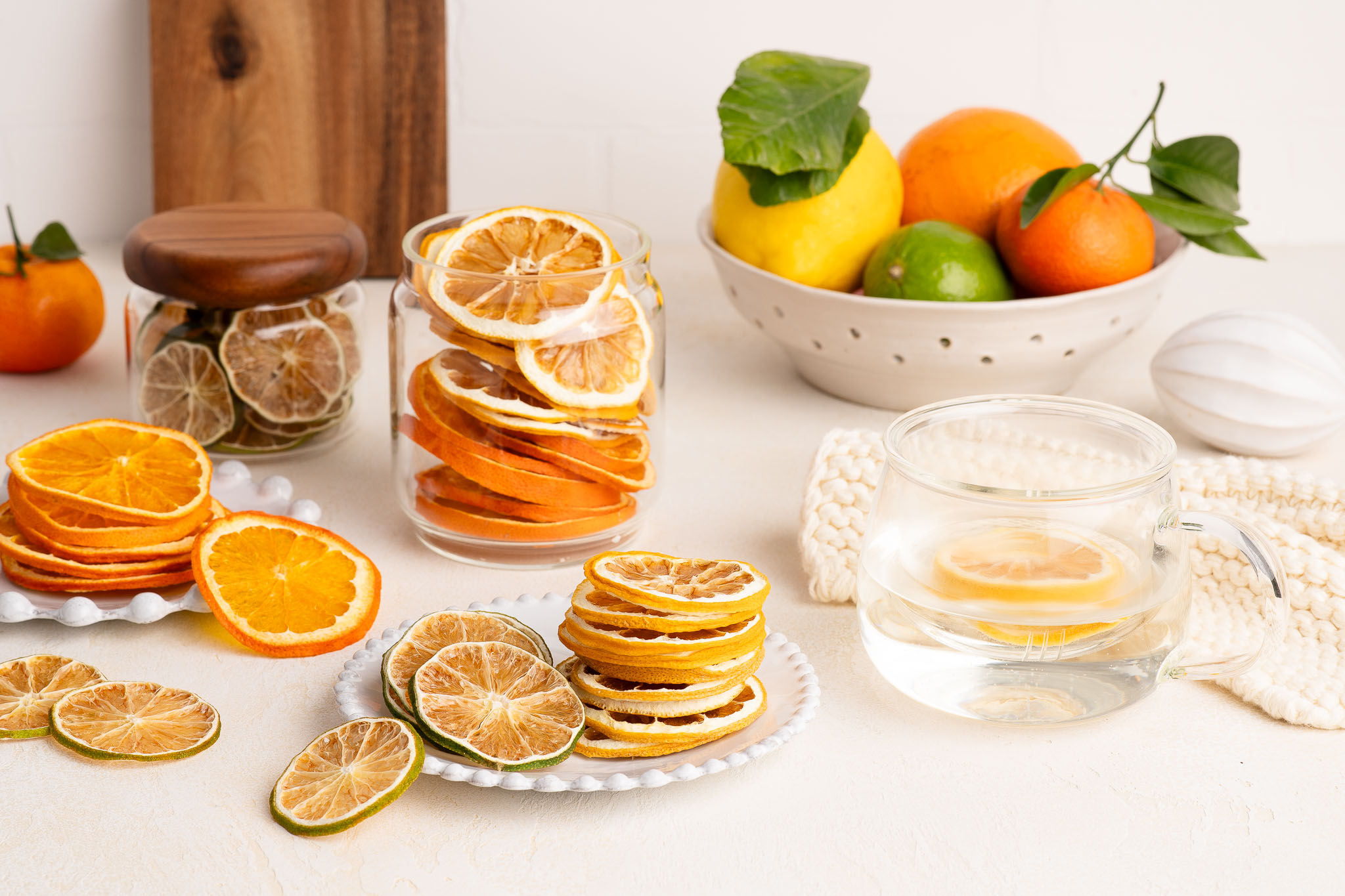
As mentioned above, I started out primarily dehydrating lemons to use in tea. I simply add 1-2 slices of dried lemons to a large teacup, add boiling water, and mix in a teaspoon of honey. I also often add 1-2 slices of dehydrated ginger to my tea as well to aid in digestion, usually in the evenings.
But dehydrated oranges are also lovely in tea, whether on their own or mixed in with your favourite tea bag.
I keep a large glass jar of dried lemon, orange and ginger slices, and mix and match as I please each time I make myself a cuppa. It goes without saying that dehydrated citrus make great gifts for tea lovers.
Dehydrating Citrus for Cocktails and Drinks
Dried citrus are great for garnishing or flavouring cocktails and mocktails.
Or skip the alcohol altogether – simply add some dehydrated lime or lemon slices to a large carafe of still or sparkling water for a citrus-infused water.
In winter, some dried orange slices would work perfectly when serving mulled wine or mulled cider.
In summary, for any drinks that use fresh citrus, you can easily substitute them with their dried counterpart.

Dried Orange Slices for Cakes and Decorations
Dried orange slices can also be used to decorate cakes (likewise with dried lemon slices), as well as using in decorations such as a garland.
Disadvantages of Using a Regular Oven for Dehydrating Food
I started out dehydrating citrus in my oven, which is totally doable and it works completely fine. The main disadvantage is that food needs to be dried at a very low temperature to draw out the moisture, and often for a very long time (sometimes as long as 14 hours or more!). This means that your oven will be occupied for this entire time, which can be an inconvenience if you only have one oven in your home (which is the case for most people).
Using your oven may also not be the most energy efficient method because you will unlikely be using all of the available space in the oven for drying food.

Advantages of Using a Food Dehydrator
Most food dehydrators are small and compact units which are energy efficient due to their size, but also due to their design in allowing you to insert multiple trays with little wasted space. My food dehydrator is about half the size of a small microwave with 4 removable wire racks, about enough space to dehydrate 4-5 lemons at a time.
If you find that you like to dehydrate food on a regular basis, I think a food dehydrator is worth the investment. Most domestic models are small and light, so they are easy to store away when not in use.
As someone who uses the oven on an almost daily basis for cooking, I like to have a separate appliance for dehydrating food. I have a fairly cheap and cheerful model which has, so far, been operating with no problems, so I have been very happy with this purchase.
Once you start dehydrating certain ingredients, the possibilities become endless! My kids love to dry apple rings, and I have even used it to dry cherry tomatoes. For me, it has strangely become an interesting way to preserve food.
How to Dehydrate Citrus with a Food Dehydrator
All food dehydrators come with similar instructions.
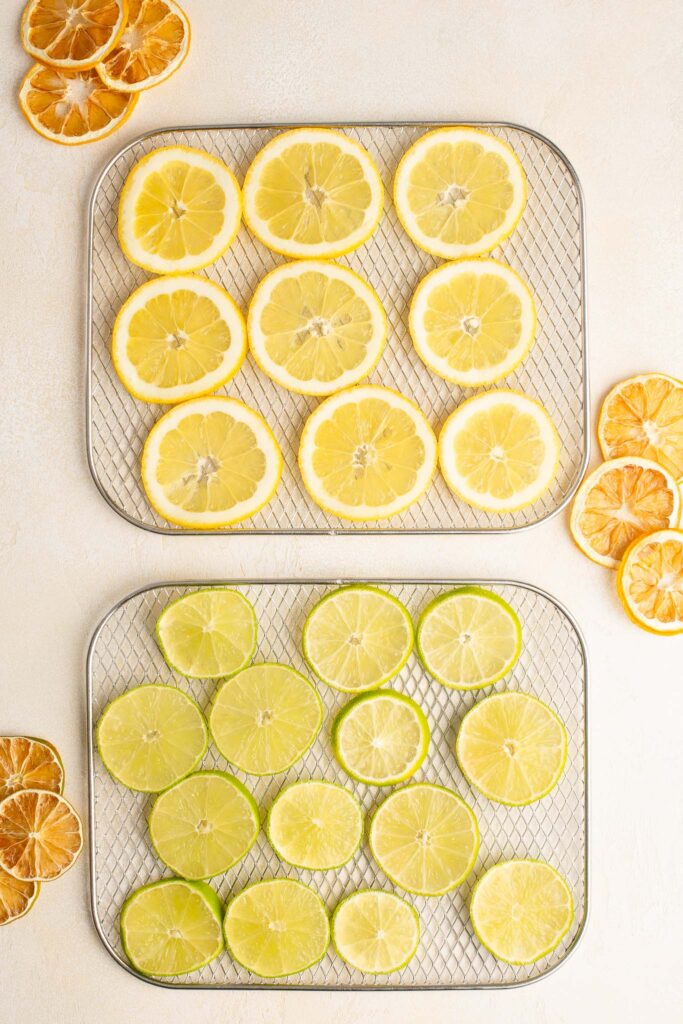
Simply cut your citrus fruits as thinly as possible, about 3-5 mm or 1/4 inch thick. Remove and discard any seeds.
Arrange the citrus slices in a single layer on the wire racks of your food dehydrator.
Dehydrate the citrus at 60°C/140°F for 8-12 hours. Limes generally need less time than, say, oranges. But the dehydrating time usually depends on the thickness of the slices and how juicy the fruits are.
The citrus slices are sufficiently dehydrated when they are completely dry to the touch. If they feel a bit sticky or tacky when you touch them, continue dehydrating them for a bit longer. Any moisture remaining on the citrus slices will cause mould to grow when you store them later.
As some citrus slices will be larger than others, remove the ones that have already dried completely, and continue dehydrating the ones that are still sticky.
You can dehydrate different types of citrus at the same time, but as they will vary in size, some will dry out faster than others.
Store the dehydrated citrus slices in an airtight container, and in a cool and dry place for up to 1 year.
Tips For Using a Food Dehydrator
- Slice the citrus thinly. A very sharp knife is your best friend here, and thin slices will help to reduce the dehydrating time.
- Start with a shorter dehydrating time. If you are unsure about the dehydrating time, consult the manufacturer’s instructions, or set the timer for about 1-2 hours less than the recipe. Depending on the size of your fruits, you may need more or less time than stated in the recipe.
- Use fruits which are in season. Fruits and vegetables usually have the best flavour when they are at the peak of their season, e.g. citrus in winter, apples in autumn, etc. Whilst lemons and oranges are available year round, blood oranges have a short season in late winter/early spring. Seasonal produce are usually also cheaper than buying long-haul off-season.
- Use all the space. If you have some leftover space on the racks, try to think of anything else which you can dehydrate at the same time. Check the manufacturer’s instructions for ingredients with similar dehydrating times. I often dehydrate slices of ginger alongside my citrus; simply wash and peel the ginger, cut off and discard the knobbly bits which are hard to peel, and slice the ginger into thick rounds or slices (about 5mm thick).
- Use at night. Electricity rates are generally cheaper in the evening, so I often set my appliance on after dinner. And as I am usually dehydrating food for about 12 hours, I know that it will be ready for me to check first thing in the morning.


How to Dehydrate Citrus

Ingredients
- fresh oranges, grapefruit, lemons and/or limes, preferably unwaxed and organic
Instructions
- Wash and dry the fruits.
- Using a sharp knife, slice the fruits into thin rounds, about 3-5 mm or 1/4 inch thick.
- Remove and discard any seeds.
- Arrange the citrus slices in a single layer on the wire racks of your food dehydrator.
- Dehydrate them at 60°C/140°F for 8-12 hours, or according to the manufacturer’s instructions. Limes generally need less time than, say, oranges. But the dehydrating time usually depends on the thickness of the slices and how juicy the fruits are.
- The citrus slices are sufficiently dehydrated when they are completely dry to the touch. If they feel a bit sticky or tacky when you touch them, continue dehydrating them for a bit longer. Any moisture remaining on the citrus slices will cause mould to grow when you store them later.
- As some citrus slices will be larger than others, remove the ones that have already dried completely, and continue dehydrating the ones that are still sticky.
- You can dehydrate different types of citrus at the same time, but as they will vary in size, some will dry out faster than others.
- Store the dehydrated citrus slices in an airtight container, and in a cool and dry place for up to 1 year.
Kitchen Notes
- DEHYDRATING TIMES
You can dehydrate different types of citrus at the same time, but as they vary in size, they will dry at slightly different rates. The drying time will also depend on the size of the fruits, as well as how juicy they are. I use the following as a guide:
* Limes – at least 8 hours at 60°C/140°F
* Lemons – at least 10 hours at 60°C/140°F
* Oranges and small grapefruits – at least 12 hours at 60°C/140°F

Thank you! I’ve been searching the internet everywhere for how to dehydrate oranges in a food dehydrator. Just finished my first batch and getting ready for the next. My oranges were quite juicy and they took 13 hours at 60°C.
Hi Carrie,
Thanks for your feedback! Enjoy using your food dehydrator 🙂
Thank you for this recipe. I just finished my first batch of dehydrated oranges to hang as decorations. Looking forward to making more!
Hi Susan,
So glad you enjoyed this recipe!