

 by
by Chicken Liver Pâté
As someone who squirms at the thought of eating livers or offal of any kind, I happen to love chicken liver pâté. Perhaps because it is a crucial component of a Vietnamese Banh Mi, a staple in my childhood diet, that I have long-acquired a taste for this velvety spread.
Vietnamese Banh Mi
A Vietnamese chicken liver pâté is one of many culinary inheritances from the French colonial occupation, and the Vietnamese like theirs with a bit of texture and spice.
It is often made with a mixture of chicken and pork livers and can even include a variety of other meats and offal to add texture and flavour.
Smeared onto the soft interior of a crisp baguette, layered with some garlic mayonnaise, slices of pork belly and a generous touch of picked carrots with fresh coriander and chillies, and you have yourself a lip-smacking Banh Mi.

Chicken Liver Pâté Recipe
The following is my take on a Vietnamese chicken liver pâté. I like to flavour it with lots of freshly, but finely, ground white pepper for a bit of heat, and then pass the mixture through a fine sieve to give it a silky, smooth consistency.
For a more classic French version, I would suggest being more light-handed with the pepper.
What is the Difference Between a Chicken Liver Pâté and a Chicken Liver Parfait?
A chicken liver pâté becomes a chicken liver parfait once it has been passed through a sieve to remove any sinewy bits and to produce a silky and smooth consistency.
This step requires a bit of time and patience (and it can be a bit messy), but the results are absolutely worth it. However, if you are pushed for time, it is completely fine to skip this step as your pâté will still taste great.
How to Serve Chicken Liver Pâté
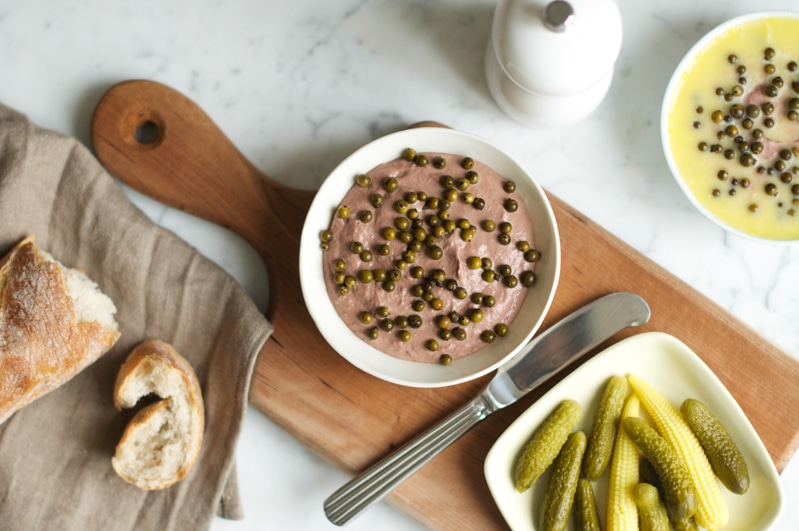
Homemade chicken liver pâté is a great dish to serve as an appetiser with some fresh baguette, but I also have a soft spot for spreading it onto some warm toasted white bread. Add some pickles and a glass of sweet wine and you will have yourself a pretty heavenly meal.
When entertaining, I like to make the chicken liver pâté in small dishes which look more appetising and are easier to serve with small spreaders. But if I am making this for the family, I often make the pâté in a small French terrine which comes with a lid. We then cut thick slices of the pâté for serving or sometimes use a small knife to cut and serve directly from the dish.
I used to always seal the pâté with some clarified butter but have found that most people are unsure about what to do with this layer of fat (you can spread it onto a piece of bread along with the pâté). Traditionally, the butter is to help cut through the richness of the pâté, as well as to stop the pâté from discolouring, but I can see how some people might be put off eating butter in addition to what is already an inherently rich spread.
So, as an alternative, I sometimes omit the layer of clarified butter and simply sprinkle over some brined green peppercorns for both taste and decoration, especially if I am going to serve the pâté a few hours later.
Chicken Liver Pâté

Ingredients
- 500 g (1 lb) chicken livers
- 100 g (1 stick) unsalted butter, softened
- 2 French shallots, or 2 very small red onions, finely diced
- 2 garlic cloves, finely chopped
- 2 tablespoons Madeira
- 4 tablespoons double cream, (heavy cream)
- 1 teaspoon sugar
- 1 teaspoon sea salt
- ½ to 1 teaspoon white pepper, freshly cracked, very finely
- green peppercorns in brine, for decoration
- 100 g (1 stick) unsalted butter
Instructions
- Clean the livers of any fat and sinew.
- Heat about 1 tablespoon of the butter in a large saucepan over medium heat.
- Cook the livers for a few minutes on each side until they are nicely browned but still pink and soft in the centre. You may need to do this in batches, depending on the size of your saucepan.
- Remove the livers to a plate and let them rest.
- Add another 1 tablespoon of the butter to the saucepan.
- Gently sauté the shallots (or onions) and garlic for a few minutes until they have softened.
- Return the livers to the saucepan, together with any juices which have collected in the meantime.
- Increase the heat to medium-high and pour over the Madeira.
- If you are brave, ignite the alcohol and let the flame subside. Otherwise, just let the everything bubble away for a few minutes until most of the liquid has evaporated from the saucepan.
- Pour everything from the saucepan into a food processor.
- Blitz until you have a smooth mixture.
- Add the remaining butter, cream, sugar, salt and white pepper.
- Blitz again until everything is well-combined.
- Taste for seasoning.
- If you want your pâté to have a silky, smooth texture (and therefore make a chicken liver parfait), pass the mixture through a fine sieve. This can be messy work but will produce a more appealing pâté.
- I like to serve pâté in small bowls or ramekins as I think it looks more attractive in small quantities but, you could, of course, make one large serve. Pour the mixture into your bowl (or bowls) of choice and sprinkle over some brined green peppercorns for decoration.
- If you wish to add a layer of clarified butter, simply melt about 100 g (3.5 oz) of unsalted butter in a small saucepan over low heat and let it simmer gently until all of the milk solids rise to the surface. Take the saucepan off the heat and remove the milk solids with a spoon. Line a small strainer with some muslin or cheesecloth and hold it over a small bowl. Strain the melted butter to remove any remaining milk solids. Pour the clarified butter directly over the pâté and leave it at room temperature for about 30 minutes until the butter has set.
- Cover the bowls with clingfilm and leave to set in the fridge for at least a few hours before serving, but overnight is better.
Kitchen Notes
- OVEN & STOVE TEMPERATURES
All recipes on this website have been tested on an induction stove and/or with a conventional oven (i.e. an oven without fan). All recipes on this website use temperatures for a conventional oven, unless otherwise mentioned. Convection ovens (i.e. fan-forced ovens) are typically 20°C/70°F hotter than conventional ovens, but please check your manufacturer’s handbook. - CONVERSIONS
To convert from cups to grams, and vice-versa, please see this handy Conversion Chart for Basic Ingredients.

Oh that looks wonderful! I adore pate too, and am not in any way, averse to the usual offal offerings either! I like the addition of the sharp, brined peppercorns too. And gorgeous, appetising photos as always! you are such a pro!
Well, I like my food nice and spicy and the green peppercorns add that extra heat 🙂
Mmm, I love pate too, but in these more health-conscious times it does seem to have fallen out of favour somewhat. My preference is for a hearty, chunky pate de campagne, but I wouldn’t say no to yours either !
Yes, you are right. Pâté is not exactly the most popular dish for many reasons, health being one of them. But I think everything in moderation is ok 😉 Thankfully, pâté, or pâté en croûte, are commonly eaten in France and Switzerland so I don’t feel too “out there” serving it. I’ve never made pâté de campagne but I know I can sit down to a generous serve and call it dinner!
I love pate too and you just inspired me to try and make it myself too! Yours looks ridiculously delicious, yum.
Hi Carole,
Lovely to hear from you again! I’ve been wondering how you and your plants have been 🙂 Good luck making your own pâté – it’s well worth the effort.
Oh no, I’m going to be the odd one out because I don’t care much for pâté, but you make it sound so delicious. Those green peppercorns look like jewels on the pâté. 🙂
Oh that’s ok, I know pâté is not for everyone 😉 I think it’s only because I’ve been eating it since I was so young that I like the taste. Although, I can’t go anywhere near cooked liver that has been left whole!
I’m a pate lover too! It looks so good!
Thanks, Anna! I know pâté is not for everyone so I’m happy to know of another fan 🙂
This is very authentic….and similar to my French husband’s very favorite pâté here at home…the only difference is that I use crème fraîche instead of double cream…as it is not expensive in Switzerland…but very much so in France!…Do you think I could sub that in your magnificent version?…I love the briny green peppercorn touch as well!
Quick note….you can also use a nice aged porto for the Madère in case you’re out!…It works!…Or Martini & Rossi “Rosso” vermouth….or even Cognac….They all impart different flavor nuances…Thank you for reminding me to make pâté…the autumn weather simply screams for this kind of fare…This served alongside fresh figs and the lovely grapes currently in the market stands …a good Camembert, Brie or Chèvre…with crusty baguette au levain….my idea of dinner heaven!!
It’s nice to hear from another pâté lover! You are right to point out that something other than Madeira can be used in the recipe – I used to use Cognac until I bought a bottle of Madeira specifically for pâté, after noticing that this was the alcohol of choice in Elizabeth David’s recipe for pâté.
The crème fraîche which I have tasted in France tends to be quite thick and creamy, and less tangy than the crème fraîche sold in other countries. In fact, I find that French crème fraîche is almost the same taste and texture as thickened cream in some other countries. If this description sounds similar to the crème fraîche which you use, then I think you could certainly use it in this recipe. In fact, I’m not sure if double cream exists in France …
When we were last in France, I made a pavlova with whipped cream for dessert one day and found it impossible to whip crème entière, which is what I use in Switzerland when double cream is called for in a recipe. After about 30 mins of pointlessly holding an electric whisk in a bowl of runny cream, my mother-in-law decided to tell me that she never uses crème entière to make whipped cream; that she only uses crème fraîche for whipping. Despite being neighbouring countries, I think that what is labelled crème entière and crème fraîche in France are not the same in Switzerland!
This is a great idea, even for picky eaters! Looks yummy!
Beautiful recipe. The paté was so creamy and smooth, and so tasty. Delicious!