

Tomboy Cake
 posted by Thanh | Eat, Little Bird on August 16, 2012 (last updated Nov 22, 2025)
 I recently offered to help out at a kid’s birthday party and somehow ended up with the task of making the actual birthday cake. My first thought was to make Nigella Lawson’s Old-Fashioned Chocolate Cake, a simple two-tiered chocolate cake covered in a thick, chocolate frosting with maybe some (shop-bought) sugar flowers for decoration. Simple. I had made this cake many times before and knew it to be a very reliable recipe.
But as ran my eyes across my sprawling bookshelf of cookbooks, the Miette cookbook caught my eye and, before I could think about it reasonably, I sent a link to my friend to see if she approved of the Tomboy Cake, to which she replied that it was the most beautiful cake she had ever seen. And so I had unwittingly set myself an almost impossibly high challenge and wondered over the coming days how I was going to avoid disappointing the birthday girl.

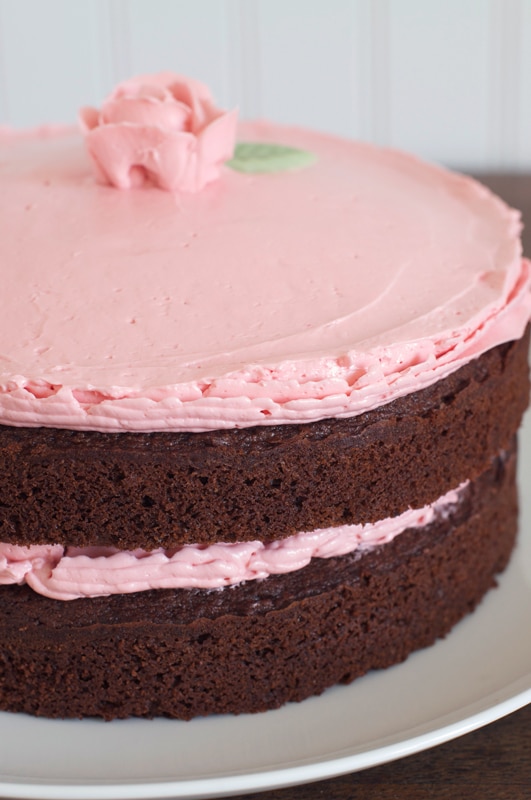
The Tomboy Cake is comprised “simply” of three tiers of chocolate sponge, separated by a piped layer of raspberry buttercream, and elegantly adorned with an understated rose in the centre of the cake. It is called a “Tomboy Cake” because the sides of the cake are left bare and unfrosted, and thereby does not appear as feminine as it would if the whole cake were to be covered in pink frosting. It is a stunning cake to look at and equally deceptive in the level of skill required to achieve such a simple look.
In fact, many of the cakes throughout the Miette cookbook are beautiful and understated. One flick through the book and you almost want to try and recreate everything in it because they look so simple and elegant. But the main flaw with the Miette cookbook is the fact that it is terribly unreliable. I first pre-ordered the book on Amazon in 2011, and within a few weeks of receiving it, Amazon had sent me an email to inform that the book contained many errors and that a corrected version would be sent to me free of charge later in the year. Silly me didn’t discard the first copy and so I had a trying time working out which was the incorrect or correct copy. The Miette website wasn’t too much help either. The publisher’s notice containing the corrections didn’t match either copy which I had, but it gave me a good idea of which was the more updated version. That said, to have published two incorrect versions of the book is fairly poor, in my opinion, not least because one recipe which is affected is the Vanilla Buttercream, a recipe which is referred to throughout the book. It is a bit like receiving a treasured secret recipe, only to later discover that a key ingredient or crucial step is missing, just so your creation will never be like the original.
So knowing that the Vanilla Buttercream would present me with some challenges (especially since it was essentially an Italian meringue buttercream which I had never attempted before), I opted not to make the Double Chocolate Cake from the Miette cookbook, which forms the main component of the Tomboy Cake. A skim through the recipe reveals that the batter needs to be pushed through a sieve to remove lumps and I instantly felt that was too much trouble for me.
So I settled on making Nigella’s Old-Fashioned Chocolate Cake, but to frost it with Miette’s Raspberry Buttercream which is made by mixing the Vanilla Buttercream together with some raspberry juice for colour and flavour. Hence the reason why I have called this cake, the “Old-Fashioned Tomboy Cake”.
The cake itself was relatively stress-free, having been a recipe which I have used for many years. The Vanilla Buttercream, on the other hand, was fraught with complications which I will detail below in the recipe.
And the end result? Not the fault of Nigella nor the authors of Miette, but a rather shabby looking Tomboy Cake, courtesy of my clumsy piping skills. Not matter how much practice I did beforehand on a sheet of baking paper, I just could not perfect the simple piping around the edges, nor the smooth swirl on the face of the cake, twirling elegantly towards the centre. It probably didn’t help that it was about 30°C in my kitchen so that the buttercream was probably too soft to work with.
Once I had assembled both layers of cake, I asked for my husband’s opinion, showing him the cover of the Miette cookbook as a comparison. One look at his face said it all and I was just about to slather the entire cake (including the sides) in Raspberry Buttercream to remove any evidence of my embarrassing piping skills, when my inner self told me not to be such a perfectionist. It was, after all, my first attempt at making an Italian meringue buttercream, and my first attempt at frosting a cake with such a luxurious concoction. But please do not examine the photos too closely …
The cake was, thankfully, gratefully received, and as the party took place outdoors in a picnic setting, no one was really clamouring for an up-close view of the cake. The cake was very delicious and, after all that effort, I’m very glad that I attempted the Tomboy Cake. I still have a long way to go but this has certainly opened up a whole new world to me.

Old-Fashioned Tomboy Cake
It is best to start this cake at least the day before serving. This will give the cake time to firm up so that it is not too crumbly upon serving, and this will also give you time to make the Vanilla Buttercream in advance, and to also pipe a buttercream rose if you are not using a shop-bought sugar rose.
If you are pressed for time, or simply wish to avoid buying specialist piping nozzles to make the buttercream rose, a shop-bought sugar rose would be the stress-free option. I bought some as a back-up, and also because they came with some green sugar leaves which I used on the cake.
I made the cake using the following steps:
1. Make the Raspberry Juice
2. Bake the Old-Fashioned Chocolate Cake
3. Make the Vanilla Buttercream
4. Make the Raspberry Buttercream
5. Pipe the Buttercream Rose
6. Assemble the cake
Steps 1 to 5 were done the day before the party, and step 6 on the day of the party.
Step 1. Raspberry Juice
Recipe adapted from Miette by Meg Ray with Leslie Jonath
500 g (or 2 cups) fresh raspberries
2 tablespoons water
1 tablespoon sugar

Place the ingredients in a small saucepan and cook gently over low-medium heat until the berries have all broken down. This will take about 10 to 15 minutes.
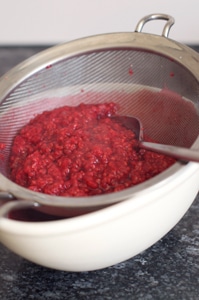
Remove the saucepan from the heat and strain the mixture through a fine sieve into a medium bowl.

Let the raspberry juice cool to room temperature before using.
Step 2. Old-Fashioned Chocolate Cake
Recipe adapted from Feast by Nigella Lawson
Ingredients for a 2-tier cake
200 g (7 oz) plain flour
200 g (7 oz) caster sugar
1 teaspoon baking powder
1/2 teaspoon bicarbonate of soda
40 g (1.5 oz) cocoa powder
175 g (6 oz) unsalted butter, softened
2 large eggs
2 teaspoons vanilla extract
150 ml sour cream
Preheat the oven to 180°C (350°F).
Grease and line the bottom of two 20 cm (8 inch) cake tins.
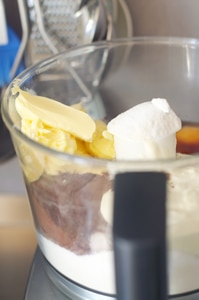
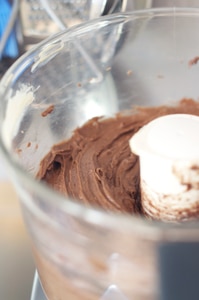
Place all of the ingredients into a food processor and blitz until well combined. The mixture should be thick and smooth.
Alternatively, if you do not have a food processor, cream the butter and sugar in a large mixing bowl. Mix in the flour, baking powder, bicarbonate of soda and cocoa powder. In a medium bowl or jug, whisk together the eggs, vanilla extract and sour cream. Add the liquid ingredients to the mixing bowl and beat until you have a thick and smooth batter.
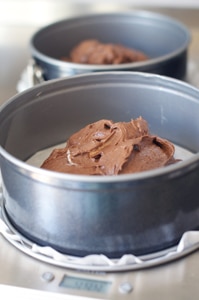
Divide the batter between the two cake tins (approximately 440 g / 16 oz each).
Place the cake tins in the oven and bake for about 25 to 35 minutes, until a skewer inserted in the middle of the cake comes out clean.
Remove the cakes from the oven and leave to cool on a wire rack in their tins. When the cakes are completely cool, invert them onto the wire rack and remove the grease-proof paper. If the cakes are removed from the tin when they are still warm, there is a risk that they will crack and fall apart.
The cakes can be made a day in advance and left uncovered on the kitchen bench overnight.
Step 3. Vanilla Buttercream (Italian Meringue Buttercream)
Recipe adapted from Miette by Meg Ray with Leslie Jonath
2 cups (14 ounces) sugar
1/3 cup water
5 large egg whites
1 teaspoon cream of tartar
3 cups (1 1/2 pounds) unsalted butter, at room temperature
1-2 tablespoons vanilla extract
Due to the errors in the Miette book and inconsistency with the publisher’s note (as mentioned above), I was not very confident in making this Vanilla Buttercream which is, in essence, an Italian meringue buttercream. So thank goodness for YouTube because I came across this wonderful tutorial by Warren Brown. Although the recipe he uses is different to Miette’s, the method is somewhat similar and I found it helpful to see how his version of an Italian meringue buttercream is made. The method below is a mix of Warren Brown’s instructions, together with those found in the Miette cookbook.
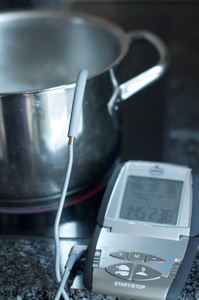
Place the sugar and water in a small saucepan over medium heat. Insert a sugar thermometer (I use a digital thermometer) into the mixture and cook gently until the syrup reaches 238°F. This will take about 5 to 10 minutes.
Once the syrup reaches 238°F, immediately take the saucepan off the heat and set it aside.
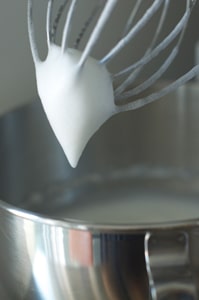
Meanwhile, make sure the bowl of your stand-mixer and wire whisk are both spotlessly clean.
Gently whisk together the egg whites and cream of tartar on low speed.
Once the mixture starts to froth a little, increase the speed gradually to medium.
Once the mixture is both white and frothy, increase the speed and continue whisking until you have soft peaks.
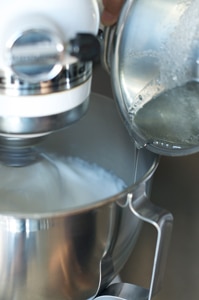
If you have finished making the syrup and it has decreased in temperature, put the saucepan back on the stove and bring it back to 238°F.
With the stand-mixed on medium speed, slowly and gradually pour the syrup into the meringue from the side of the bowl, taking care not to pour the syrup directly on the whisk.
Once all of the syrup has been added, increase the speed to very high and continue whisking until the meringue cools to room temperature, about 70 to 75°F. The book says that this will take about 5 to 10 minutes.
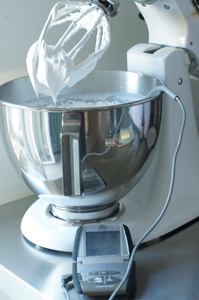
Perhaps it was the due to the hot weather on the day that I made this meringue, but after 30 minutes of mixing on very high speed, my thermometer hovered around 90°F and I saw little chance of it decreasing.
During this lengthy whisking time, the meringue both increased in volume and then decreased, possibly due to the over-whisking. Upon touching the sides of the bowl, I felt that it was at room temperature, albeit a high room temperature due to the scorching weather (and lack of air-conditioning).
So I proceeded with the recipe, despite the fact that the meringue was warmer than it should have been.
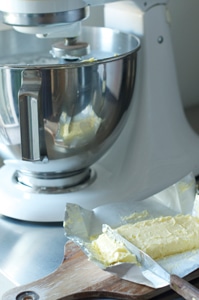
Once you think the meringue is cool enough, turn the stand-mixer on medium speed and gradually add the butter, one tablespoon at a time. Once the tablespoon of butter has been incorporated, add the next tablespoon. Continue until all of the butter has been added.
If the mixture starts to look curdled, increase the speed and continue whisking until the buttercream is thick and smooth. Whisk in the vanilla extract.
Thankfully, my buttercream did not curdle, although I have read that it is a common problem which many people encounter when making either an Italian meringue buttercream or a Swiss meringue buttercream. My guess is that the curdling can occur if the meringue is too warm, or if the butter is too cold. With thanks to the summer heatwave temperatures we’ve been having, I think I was lucky that both my meringue and butter were at roughly the same temperature when combined.
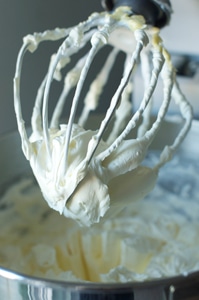
And there you have the Vanilla Buttercream which can be used right away, or covered and put away in the fridge or freezer to use later.
Despite the concern over my over-whisking in an attempt to bring down the temperature of the meringue, I was quite relieved that the finished product looked perfect and tasted delicious.
The Vanilla Buttercream keeps well in the fridge for up to 1 week or in the freezer for up to 2 months in a freezer-lock bag.
The Vanilla Buttercream should be brought to room temperature before using. This takes about 1 hour if chilled and you should beat it well with a spatula or with the paddle attachment in a stand-mixer to make it soft and spreadable before using. If the mixture has been frozen, you can defrost it in the fridge overnight or carefully soften it in a heat-proof bowl over a pan of simmering water.
*Note: If, after chilling or frosting, you find that your buttercream has curdled upon beating, my suggestion would be to keep beating vigorously (preferably with a stand-mixer) until the mixture becomes smooth. Much like if the buttercream curdles once you have added the butter, the trick is to keep on beating as the buttercream will eventually come together in a smooth, creamy mass.
Step 4. Raspberry Buttercream
Recipe adapted from Miette by Meg Ray with Leslie Jonath
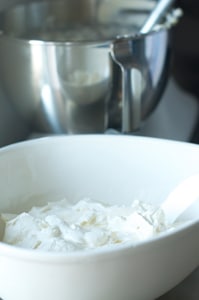
To cover a 3-tier cake, you need about 3 cups of the Vanilla Buttercream.
To cover a 2-tier cake, you need about 2 cups of the Vanilla Buttercream.

For each 1 cup of Vanilla Buttercream, stir in 3 tablespoons of Raspberry Juice.
Alternatively, you can add as much or as little Raspberry Juice as you like until you achieve the desired colour and flavour.

Beat the Raspberry Juice into the Vanilla Buttercream until it is well-combined and smooth.
Step 5. Buttercream Rose
There are, unfortunately, no instructions in the Miette cookbook on how to make the beautiful roses which adorn so many of their cakes. If you wish to try your hand at making a buttercream rose, I found this incredibly helpful tutorial on YouTube by The Cake Eccentric.
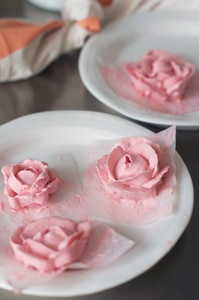
My best advice is to work with buttercream which is recently cold, or to turn on the air-conditioning if you are lucky enough to have it. Once the buttercream starts to soften in the heat, or after you have worked with it for some time, your roses will start to look more like mushrooms and there is no point in continuing until you have returned the buttercream to the fridge to firm up again.
It is also a good idea to make 3 or 4 roses so that you have a selection to choose from later. So save your best roses and pop them in the fridge to firm up overnight. Once they are cold, they will be firm like cold butter and so relatively easy to place on your cake.
Step 6. To Assemble
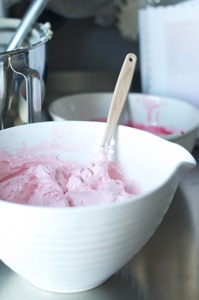
Bring the Raspberry Buttercream to room temperature as per the instructions in Step 3.
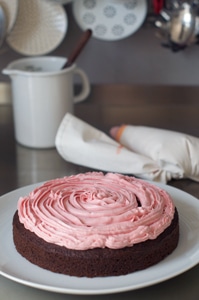
Place one layer of chocolate cake on a cake stand (or cake board). Use a revolving cake stand if you have one, or place a damp cloth underneath. Brush off any crumbs so that you don’t have flecks of brown through your buttercream.
Fit a piping bag with a medium (1/2 or 5/8 inch) star tip and fill the bag with some Raspberry Buttercream.
Hold the bag at a 90-degree angle and pipe a ring of buttercream around the outer edge of the cake, leaving about a 1/8 inch border at the very edge. Slowly spiral inward and fill the centre of the cake with buttercream.

Using a small spatula, smooth the buttercream on the inside, leaving the edges untouched. Push the buttercream out very slightly as you smooth the centre.
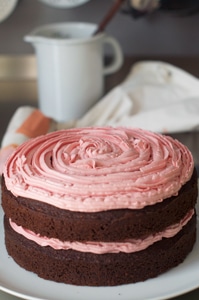
Repeat the above with the remaining layer (or layers) of cake.
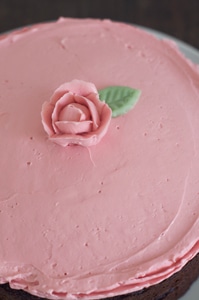
Use a small teaspoon to scoop out a little hole in the centre of the cake to make room for the Buttercream Rose. Carefully nestle the Buttercream Rose in the hole, and arrange a leaf next to it. I used a shop-bought sugar leaf (which was, incidentally, the first thing to disappear from the cake!).
The cake should be served at room temperature when the buttercream is silky and soft. You can keep the frosted cake in the fridge and take it out about 3 to 4 hours before serving.
And wait, there’s more …
If you have ever laid eyes on the cover of the Miette cookbook, you will see that the beauty of the cake lies in its simplicity. The chocolate layers are perfectly even, bulging and voluptuous in form.
Once in a while when I bake two cakes at the same time in the oven, something happens while they are sitting side by side and one will come out of the oven looking a bit uneven, failing to have risen properly in the centre. It is not usually a big deal for me if I will be covering the whole cake in frosting later, providing me with an opportunity to level out the cake with some extra icing.
But this posed a problem for the Tomboy Cake as I definitely could not present a lop-sided cake to my friend, especially since I could foresee that my piping skills were already going to be amateurish.
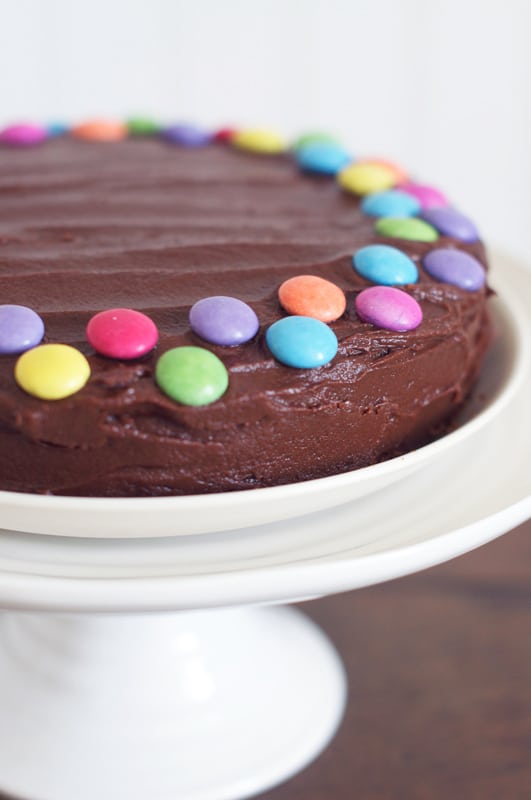
So I halved the recipe for the Old-Fashioned Cake and proceeded to make one more layer, intending to keep the dodgy one for us to eat at home. But upon staring down at the finished Tomboy Cake, I thought the least I could do was perhaps bring a second cake in an attempt to distract everyone from the main centrepiece.
So I proceeded to make half the quantity of chocolate frosting from Nigella’s recipe to cover the lone, uneven layer, and decorated it with Smarties, copying a pattern which I have always eyed fondly from a cookbook by Bill Granger. The second cake hardly took any effort and was a splash of colour and fun next to the Tomboy Cake, perfect for a kid’s birthday party. Be prepared for the Smarties to disappear before it is time to cut the cake!
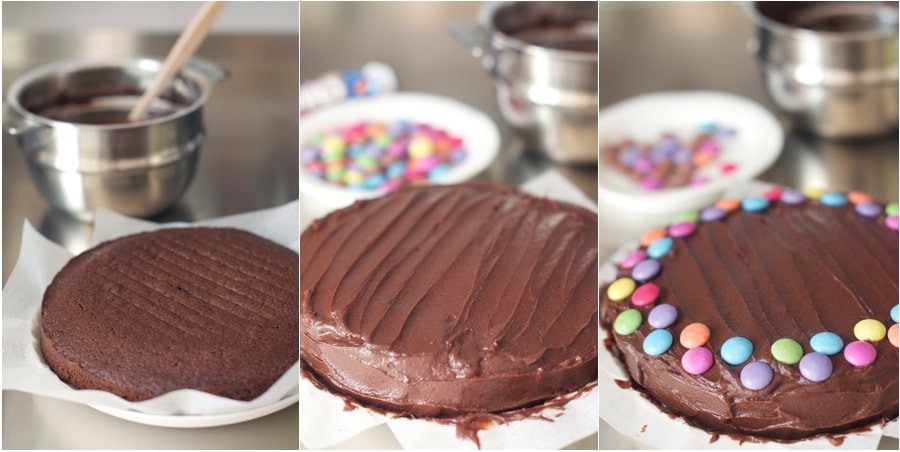
Recipe adapted from Feast by Nigella Lawson
Ingredients to frost a 2-tier cake (halve the quantities to frost a one-layer cake)
75 g (2.5 oz) unsalted butter, softened
175 g (6 oz) dark chocolate
300 g (11 oz) icing sugar
1 tablespoon golden syrup (or corn syrup)
125 ml (1/2 cup) sour cream
1 teaspoon vanilla extract
Melt the butter and chocolate in a bain-marie, or a heat-proof bowl over a pan of simmering water. Remove the pan from the heat and let it cool slightly. Whisk in the icing sugar, golden syrup, sour cream and vanilla extract until you have a thick, spreadable, consistency. If it is too thick, add a teaspoon or so of boiling water to thin the mixture. If the mixture is too thin, add some icing sugar. Use the frosting right away to ice the cake.


Justing LOVING the buttercream rose, it’s so pretty. Can’t wait to try the the cake, it looks lovely, moist and dense, the way a chcolate cake should be! FD xx
Oh you are too kind! It was my first time piping a buttercream rose and I was fairly pleased with the one that ultimately went on the cake. But I would love to try it again when the weather cools down a bit … but at least for now I can use the hot weather as an excuse for anything which looks clumsy 😉
Well done! I definitely wouldn’t turn you away if you brought a cake like that 🙂 You’ve inspired me to want to learn how to do this piping thing properly… this could be dangerous…
Aww thanks, Anna! Well, while the weather is cool in Brissy, it might be a good time to give this buttercream a go 🙂 I’m sure you could do a much better job than me!
Thanh, You have done it again!! What a post!! you baked two cakes, made vanilla & raspberry buttercream, frosted the cakes, made your 1st buttercream rose (all this in a day?) whooo!! Loving the tomboy cake, its a nice way to avoid eating excess frosting (read calories) while enjoying the decadent taste. I have also fallen for the name “tomboy cake”:)
Oh I probably should have given a warning that it was going to be a (very) long post! But thank you 🙂 And you are right – the Tomboy Cake has less calories than a normal, frosted cake … just don’t think too much about how much butter is in the frosting! 😉
I don’t think you should undersell this cake – the frosting looks very pretty! And I love that Nigella recipe – works like a dream every time.
Oh thank you 🙂 And I agree – this recipe from Nigella is indeed very reliable, which is why I am always returning to it.
I haven’t the book, but every Miette recipe I see sounds nice, and everybody says it tastes good, so I’m sure this cake was a winner one 😛 A cake from Nigella, and raspberry buttercream?? Wow!!!
And I love this one, because it’s cute, but it’s simple, not too many decoration that then we don’t eat 😉
Thanks for the step by step, perfect for a clumsy like me!!
Hi Paula,
Yes, all the Miette recipes look very tempting. I just wish the recipes were tested more thoroughly before they were published!
And I went all out with the step-by-step photos for this post, mostly because I gave myself a whole day to make everything (except assemble the cake), which meant I didn’t feel too rushed so I was able to have my camera ready all the time. Plus, I always find step-by-step photos helpful and hope these photos will be helpful to someone else 🙂
i love your thoughts on Miette! i received my copy as a “gift”, 2nd hand. i was also struck by how beautiful the concoctions were and i am SOLD on the concept of using 6″pans / making smaller cakes. however, i’ve only made one cake from it & i probably won’t ever attempt another… for such simple cakes, the recipes are so intricate and multi-stepped and apparently wrong! i will instead draw from the aesthetic of the pieces but use different recipes to achieve the looks.
i think your end result is beautiful, perfect in execution and effort, as well as intention.
Oh, thank you! Another very kind reader 🙂 I think I have a bit of practising to do, hopefully when the weather cools down a bit. I agree with your thoughts on this book – I’m a bit hesitant to try other recipes but I will definitely use the book as inspiration and try to achieve the looks but using other recipes. I think the book should have been better tested before publishing – hopefully they are working on it?
What an interesting story behind the name “tomboy cake”…and beautiful piped roses/photos! Really enjoyed your post 🙂
This looks so tasty! Yum!
I’m a fan of your tomboy cake. I have recently made meringue buttercream with one of my students. Thankfully I had done some reading before he arrived with the recipe as a surprise on the day of his prac, otherwise I would have had no clue what to do when it curdled! I am seriously jealous of your digital thermometer! I must track one down!
Curdling can induce panic, no matter what you are making! Thankfully it didn’t happen to me when making this buttercream.
I bought the digital thermometer some time ago when I was making jam and found that my non-digital sugar thermometer was not very reliable. Even though this digital thermometer is more for checking the temperature of meat, I find that it works perfectly when making jam, syrup, etc. Once you’ve switched to digital, it’s hard to go back!
I think it’s a beautiful cake. It is. The rose is perfect, may not to you because you had some other vision of it but the little rose is sitting beautifully atop that gorgeous brown and pink sweetness. The combination is very classic, flavor and color.
I have been going through your blog and I am so impressed. There is so much simplicity and uniqueness in your blog.
I shall be back!
Thank you for your lovely words! I am fairly pleased with how my rose turned out, not so much with my piping … but the taste was good and that’s what really matters in the end 🙂 I’m happy that you are enjoying browsing through my blog!
so unbelievably darling & delicious!
xo
that seriously is a beautiful beautiful beautiful looking cake. The Old fashioned chocolate cake is a stunner too. In my opinion your piping skills are fantastic. It looks beautiful and so homely. Your friend is lucky to have you to make her daughter’s cake. 🙂
The ‘rose’ tutorial will come handy one day, I know. I want to try this. I looked up this cookbook and this cake is on the cover page isn’t it.? Its an elegant piece.
Yes, the Tomboy Cake is on the cover of the Miette book. There are very many beautiful cakes in the book which I hope I can one day recreate. You are very kind with your words but I do feel I am perhaps better suited to more rustic, homemade-looking cakes 😉 And I think I was the lucky one to have the opportunity to make this cake – it’s not very often that I am asked to make something for a special occasion so I was very happy to experiment with a new recipe 🙂
Some books are just for inspiration, and Miette clearly falls into that category…. Have you baked other other cakes from it? Did the icing have a really nice taste – compared to other icings you’ve tried?
(beautiful pics, and very interesting post).
Oh yes, I think Miette is more a coffee-table book than one that will get a good workout in my kitchen. In some ways, it reminds me of the first Hummingbird Bakery cookbook which was also riddled with errors that I was too scared to try any other recipe from the book.
The Tomboy Cake is the first recipe I have tried from the Miette cookbook, but having said that, I didn’t even make the chocolate cake from the book because I thought the instructions were a little strange. So actually, all I have really made from the book is the Raspberry Buttercream!
The Raspberry Buttercream (and the Vanilla Buttercream) were quite delicious. Even though making the Raspberry Juice was a little extravagant (although I could have used frozen raspberries), it was a nice way to colour and flavour the buttercream instead of using artificial colours and flavours.
I have tasted meringue buttercreams before and I think this one was very good. If I were to make it again, I would be curious to know how much time it would take for the meringue to cool down to 70°F, if at all.
I just love the look of this cake! Your buttercream rose is amazing too! What a shame about the Miette cookbook though as I was thinking of getting this…still, I think I would turn to your adaptation when I make this regardless.
Thanks, Anna! It is a shame about the Miette cookbook as I don’t think it is really fit for the kitchen. That said, it is still a very beautiful book. Hopefully there will be an improved future version which has better instructions and which has been better tested.
Thanh, your cake is gorgeous. I don’t know what you are talking about with your piping skills because the cake looks beautiful, as your cakes always do. I love this cake, I think it would be equally wonderful both as a birthday cake and a wedding cake….anyway I’d like it as a wedding cake 😀
How frustrating that the cookbook was wrong, and both prints. I’ve had my eye on this book for a while, so I think I can safely remove it from the list for now.
You’re very kind but I think there’s much room for improvement 😉
Speaking of weddings, I hope you will post some photos from your wedding … I imagine it will be such a beautiful event and hope we will be able to see some snippets 🙂
As I mentioned above, it is a shame about the Miette cookbook. I would recommend waiting for an improved future version, unless you’re able to get a cheap copy somewhere just to look at the beautiful photos. In terms of baking from it, I think you should be prepared for some trial and error.
Beautiful colors. I now have a craving for Smarties… and cake.
My first thoughts when I saw this cake was that it’s so whimsical, just perfect. You have great piping skills and you’ve convinced me to try out the Italian meringue buttercream, I tried out the famous smb a few days ago and was rather pleased with the result. Only thing is that it’s too warm over here and that has a not so great effect on the buttercream. I was looking for ideas for a cake to take with me to my grandma”s and I think I’ll just borrow your idea but will stick to a store bought rose 🙂
I think a Swiss Meringue Buttercream is not too different from an Italian Meringue Buttercream, though I found the method for the latter to be easier for me. I know what you mean about making buttercream in warm weather – probably not recommended!
I think I was more happy with my rose than my piping here, but a shop-bought rose would definitely making life easier. I often keep a few sugar roses in the pantry for cake decorating. Your grandma is very lucky to have you make a cake for her!
Are you kidding me? That cake looks utterly charming Thanh, so don’t undersell yourself! It has the Miette sensibility, keeping it very clean and feminine in taste. Wonderful!
I have the ebook, but haven’t baked anything out of it. It’s rather imposing in it’s methods and the way it’s written. Also, I don’t know what the corrections are so that’s a worry! This cake however, looks perfect 🙂
Yeah, yeah 😉 This cake next to one of yours would be quite embarrassing!!
The corrections to the book can be found here, but I think it’s only for some problematic recipes. From some reviews I have read online, readers have picked up other inconsistencies here and there, and I think the general instructions throughout the book aren’t great. Shame really because it is such a beautiful book.
Oh thanks for the link, and dinna be daft! That cake is gorgeous and the old fashioned cake is one of my favourites too! Along with Nigella’s fudge cake.
And yes, big pity about the book, it’s rendered useless. Baking can’t afford to be pricey mistakes, be it through cost or effort and the recipes are big on effort.
I just made this (or attempted to), twice. Are the layers supposed to be very thin? Mine look like a few pancakes. I am nit sure if they deflated when I checked them for doneness or what. Any advice? Also, FYI, I used blueberries instead of raspberries and the frosting turned purple, not blue. Thanks in advance for any input.
Hi Amanda,
I’ve made this cake quite often and, whilst they don’t rise a lot, they certainly shouldn’t be flat. Could you have perhaps over-worked the batter? What size tin did you use? If you used anything larger than a 20 cm (8 inch) tin, you will have a flatter cake.
Also, have you checked if your raising agents are still fresh, i.e. that they have not expired?
Now this morning I tried to bring the buttercream to room temperature and the whole thing curdled. It was a mess. I threw it all in the garbage and got a disgusting cake from the grocery store.
Oh dear!! I’m sorry to hear that this didn’t work out for you. From memory, after I had let the buttercream come to room temperature and started to beat it to soften it, it did look like a curdled mess. But after a good few minutes of beating (using my KitchenAid), everything did come together into a smooth, creamy mixture.
From what I have read about buttercreams made from meringue, they do have a tendency to curdle but you just have to keep on beating and beating … I just hope you didn’t give up too soon! Again, sorry to read that this didn’t work out for you 🙁
Yup, Swiss Meringues and Italian Meringue Buttercreams have the habit of curdling too, and it could be because of temperature differences. It’s happened every time I’ve made it! But you can just continue beating, it might feel like forever, but it does come together to a smooth, voluptuous result.
The first time I ever made Swiss Meringue Buttercream it looked like a curdled mess and I threw it out. What I did not know was that if I kept on beating it, it would have come good in the end. These cakes are stunning Thanh! The funny thing is, I just took one of Nigella’s sour cream chocolate cakes out of the freezer but I had space issues. I was thinking of pouring a choc ganache over it and I might just follow your lead and decorate it with smarties 😉
p.s I’ve just made the chocolate raspberry nutella cakes and they look so beautiful! Can’t wait to try one later 🙂
Hi Nicola! Oh shame that you had to find out later that you could have rescued your buttercream! It’s true that so much of baking is a learning experience.
I’m glad I could give you some decorating ideas with the Smarties 🙂 I’ve always wanted to use Bill Granger’s idea and thought this cake looked really fun and colourful at the birthday party.
And gorgeous photos of the Gooey Chocolate Cakes with Raspberries & Nutella! They look absolutely stunning! You and Carrie have tempted me to make another batch, even though I just made some a few days ago!
Thank you so much for this post and the links. I was just starting this frosting and thought I’d better search for a few tips. I’ve chosen to make it because the frosting on Miette’s cupcakes are my favorite frostings ever. Light (tasting anyway) and not too sweet.
I hope the links are helpful to you! They were certainly a great help for me when I was making this cake. And how lucky of you to have actually tried the Miette cupcakes! I think this would make a big difference for anyone baking anything from the Miette cookbook as you would be familiar with the taste and texture of the original thing. Hope your frosting turned out well 🙂
You are being too hard on yourself as this is a BEAUTIFUL looking cake. This is my first visit to your blog and it won’t be my last!
I wonder if the cake could be baked in just one tin (mine is 23 cm) and then cut layers in half. Do you think it would work?
You could try to bake the cake in a larger cake tin but you will have to adjust the baking time accordingly. You could certainly bake one higher cake and slice it to make layers, but you will just need to be careful about getting crumbs on the frosting. Good luck!
Beautiful photos! I was very confused about the pouring syrup steps in making Miette vanilla butter cream when I read the original recipe from their book, haha, thank you for making it clear, am gonna try this lovely cake recently:)
Good luck!! I have nice memories of making this cake 🙂 Although, I don’t think my piping skills have improved in the meantime …
So cute! YUM, these really sound delicious! Beautiful presentation. I can’t wait to try it out!
Hi, after reading this remarkable piece of writing i
am as well cheerful to share my familiarity here with friends.