

 by
by Cooking Artichokes
I adore artichokes. As a child, my mother would boil a whole artichoke for my dinner on those nights when she was preoccupied with other things or, more likely, fed up with cooking and needed to give me a no-fuss dinner. Hard task given that I was a fussy eater for most of my life.
But I always enjoyed my solitary meal of boiled artichokes which I would ceremoniously sit down to in front of the telly, picking off the leaves one-by-one and sucking off what scant flesh there was on the edge of each leaf. Once I was done making my way through all of the leaves (which usually took this fussy eater quite a while), my mum would then cut through the remains to reveal the heart.
As I grew older, I came to realise that the heart was the prize part of the vegetable, and that the artichoke leaves tasted better when dipped in a French vinaigrette.
Serving Artichokes as a Starter
And then suddenly the years flew by and I was only reminded recently of eating artichokes this way when I was invited to dinner at my neighbours place. As a shared starter, they served a boiled whole artichoke on a small platter in the middle of the table where each person could help themselves to a few leaves at a time, dipped into a homemade French vinaigrette.
I was instantly transported to my childhood of exactly the same meal and marvelled that the solitary dinner of my youth could be a shared experience as an adult. I wasn’t sure how one was to eat an artichoke in the company of others but, of course, there is no other way.
How to Buy Artichokes
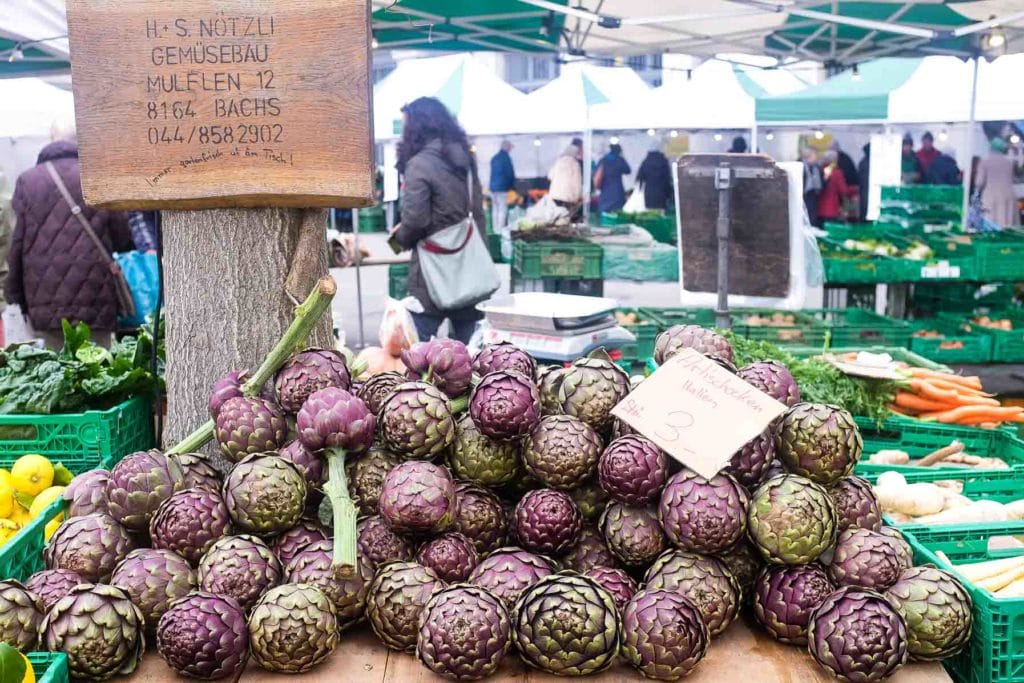
In the northern hemisphere, artichokes are at their peak from about March to June. And if you are lucky enough to live near a farmers’ market, you will know how hard it is to resist buying these beautiful flowers; artichokes are technically not a vegetable, but the bud of a thistle plant.
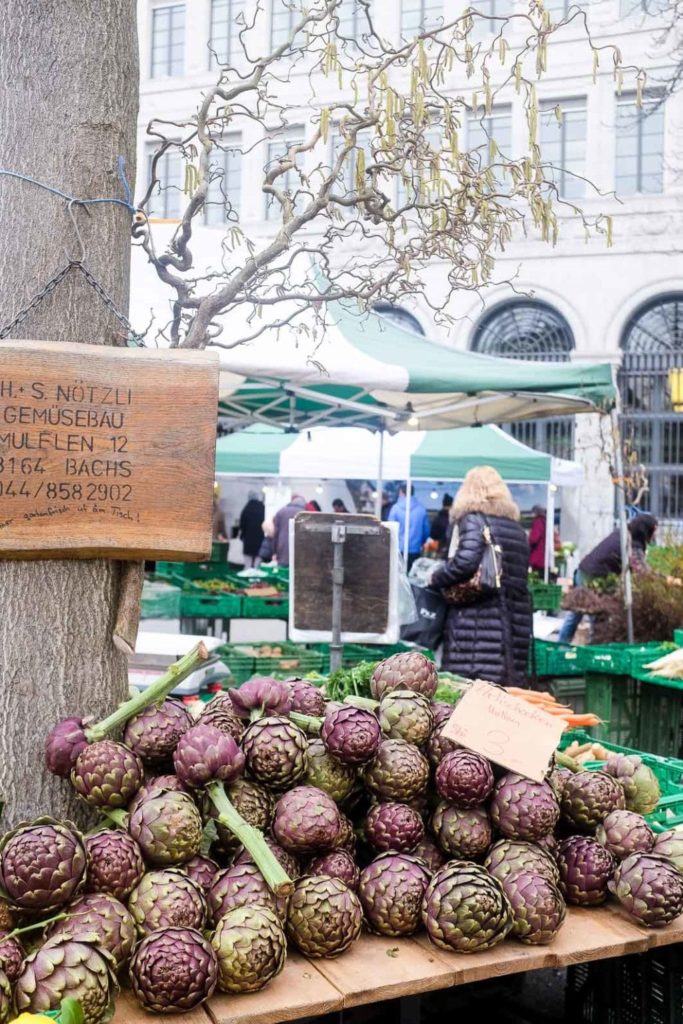
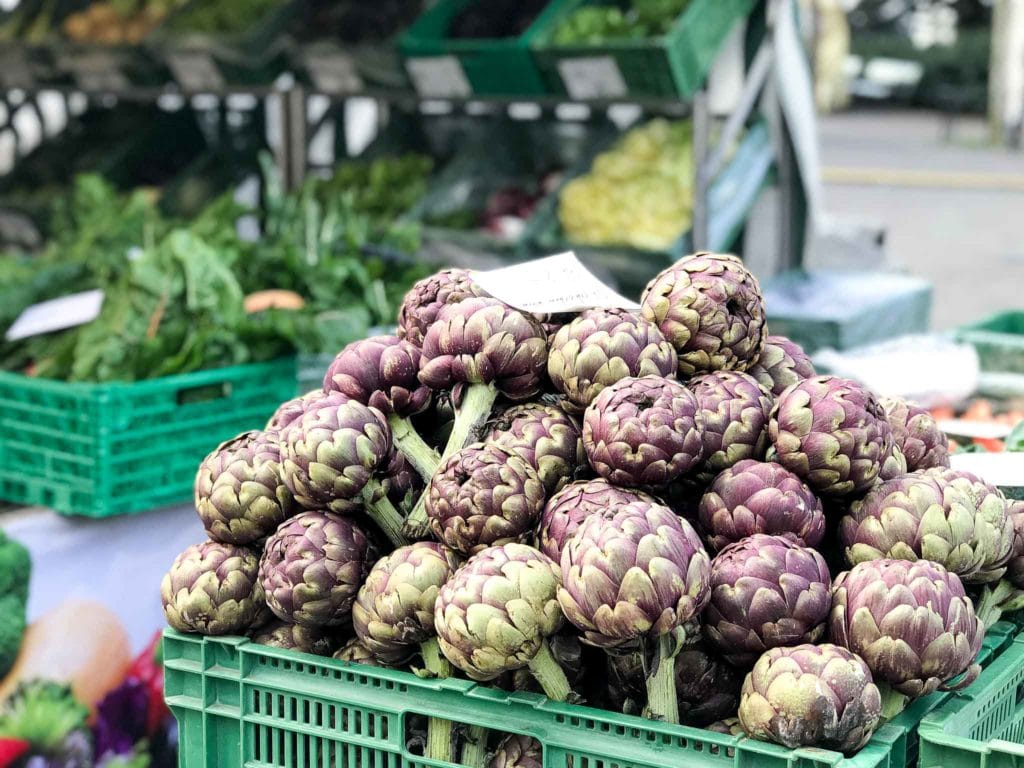
We are lucky to live near a beautiful and bountiful farmers’ market which operates twice a week. When artichokes are in season, many of the stands are often bursting with tables laden full with the gorgeous green and purple hues of this plant.
On offer are usually two types of artichokes – baby artichokes and globe artichokes.
Different Types of Artichokes
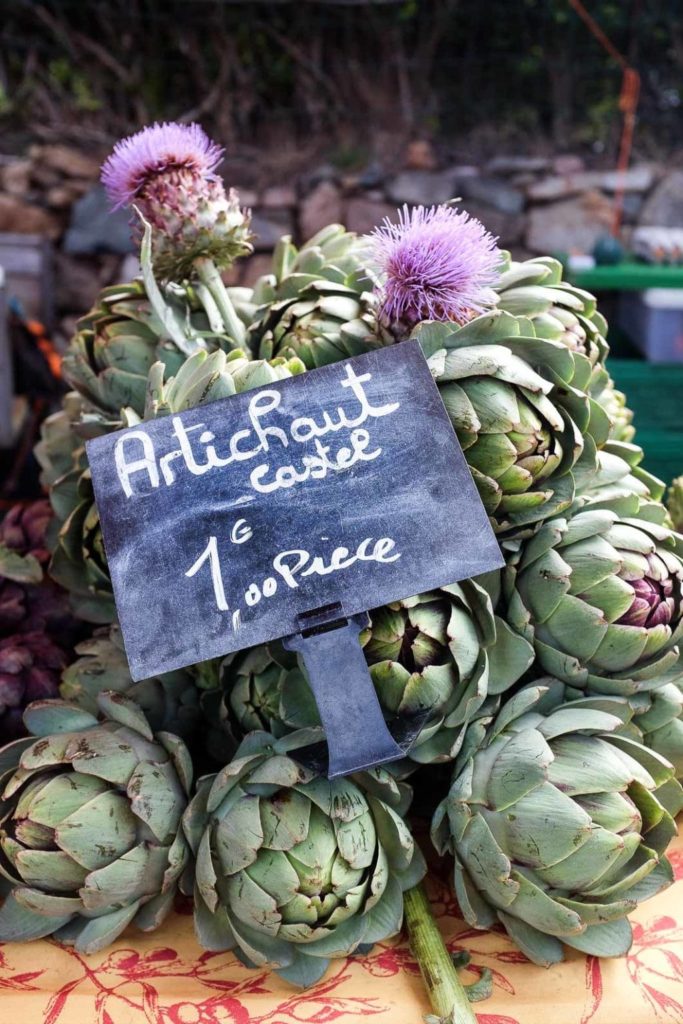
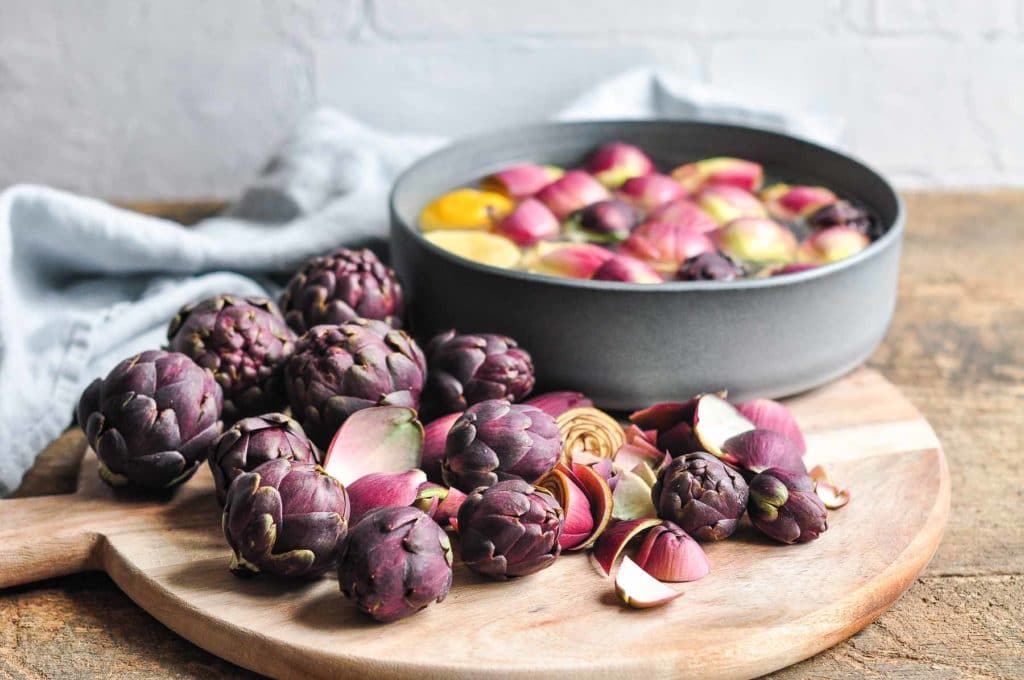
Baby artichokes sold where I live are young artichokes, i.e. they have been harvested early. Usually, you will need to trim part of the stalks and the tips of baby artichokes, but nearly all of a baby artichoke is edible.
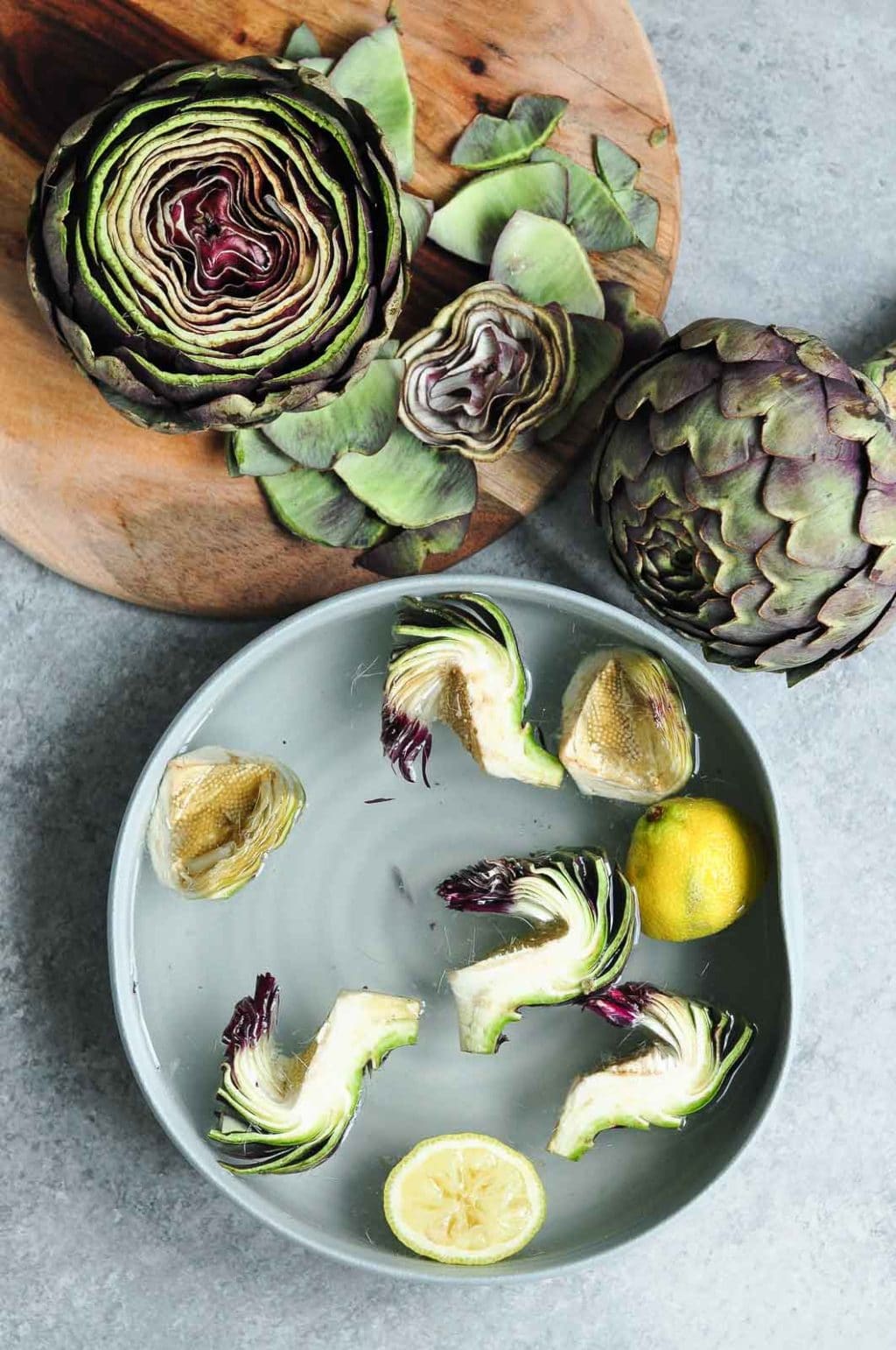
Globe artichokes, on the other hand, require a bit more preparation as they contain a lot of inedible leaves. Globe artichokes are fully mature plants and they can be as large as a grapefruit or small melon. This variety is perhaps more common in households and on restaurant menus.
How to Cook Artichokes
There are several ways to cook artichokes, but boiling is perhaps the most common and easiest method. Boiling artichokes will yield really tender and succulent flesh.
You can also cook artichokes in an Instant Pot or pressure cooker with similarly excellent (and faster) results. Boiling artichokes takes about 45 minutes to 1 hour, but cooking artichokes in an Instant Pot or pressure cooker can be as quick as 5 to 15 minutes!
Grilling is also a popular option for artichokes, but I think this works best with baby artichokes as they don’t require as much time to cook through properly. However, if you cook artichoke hearts first by boiling, or in the Instant Pot or pressure cooker, you can lightly grill them afterwards for a lovely charred flavour.
Likewise, frying also works well with baby artichokes to produce crispy and addictive morsels. Please see my recipe for Roman-Style Fried Artichokes for more information.
How to Eat Artichokes
If you are grilling or frying baby artichokes, they can be served like any other vegetable and eaten with a knife and fork. The whole of the baby artichoke is usually edible, but sometimes the tips of the leaves might be a bit tough.
My favourite way of serving globe artichokes is on a large platter as part of a shared appetiser or light meal. Each person should have their own small bowl of sauce (I recommend either an aioli or French vinaigrette), as well as their own plate. Simply help yourselves to a couple of leaves at a time, dip them into the sauce, nibble the edges of the leaves, and discard any tough parts. Once you get to the middle of the artichoke, remove the soft leaves, slice the artichoke in half, use a teaspoon to remove the fuzzy choke. You will then be left with the artichoke heart, which can be sliced and served.
If you are using globe artichokes, you can trim off all of the inedible stalks and leaves and remove the fuzzy choke until you are left with just the heart, which can be used in recipes where artichoke hearts are braised with other vegetables. This method of extracting the artichoke heart while it is still raw is more difficult than when it has been cooked, but once you have tried artichokes in stews and braises, you will understand that the hard work was worth it!
How to Cook Artichokes

Ingredients
To cook the artichokes
- 1-2 large globe artichokes
- ½ lemon
To make an Aioli
- 2 egg yolks
- 1 teaspoon Dijon mustard
- 2 teaspoons red wine vinegar
- sea salt
- white pepper, freshly cracked
- 200 ml (¾ cup plus 1 tablespoon) sunflower oil
- 2 tablespoons extra virgin olive oil
- 1 small garlic clove
- 1 teaspoon parsley, finely chopped
- 1 teaspoon chives, finely chopped
To make a French Vinaigrette
- 4 tablespoons extra virgin olive oil
- 1 ½ to 2 tablespoons red wine vinegar, or any vinegar
- 1 teaspoon wholegrain mustard
- 1 pinch sugar
- 1 pinch fine salt
- 1 small French shallot, finely chopped
- 1 teaspoon parsley, finely chopped
- 1 teaspoon chives, finely chopped
Instructions
To boil artichokes
- Wash the artichokes in cold water.
- Trim off the woody stalks.
- If you wish, use a very sharp knife to slice off the tip of each artichoke (about 1/3 of the artichoke). This part is usually inedible.
- Place the artichokes in a large pan of boiling water.
- Squeeze in the juice of half a lemon.
- Bring the water back to the boil and then reduce the heat to a simmer.
- Cover the pan with a lid and simmer for about 40 minutes, or until the outer leaves come away from the stem easily.
- Serve the artichokes hot with an Aioli or French Vinaigrette alongside.
- The artichokes can be served on a shared platter, where each person can remove a few leaves at a time, dip the leaves into the sauce, and nibble away the soft (edible) part of the artichoke leaves. Discard any leaves which are tough.
- Once most of the tough outer leaves have been removed, carefully remove all of the remaining soft leaves, and then scrape away the fuzzy part (the choke) remaining on the stem to reveal the artichoke heart. Cut the heart into small pieces to serve.
To cook artichokes in an Instant Pot
- Follow Steps 1 to 3 above as for boiling artichokes.
- Place a steam rack or trivet in the base of the Instant Pot.
- Add just enough water to reach the base of the trivet (about 1/2 to 1 cup of water).
- Bring the water to the boil.
- Squeeze the lemon juice over the cut side of the artichokes.
- Place the artichokes on the trivet with the stems on top (and the cut side facing down).
- Close the lid and set the vent to Sealing.
- Select the Manual mode, and cook at high pressure for 15 minutes if you are using large globe artichokes. Otherwise, you may have to adjust the time if your artichokes are smaller.
- At the end of the cooking time, turn the vent to Venting release the pressure quickly.
- Test the artichokes for doneness. The outer leaves should come away from the stem easily.
- Follow Steps 8 to 10 above as for boiling artichokes.
To cook artichokes in a pressure cooker
- Follow Steps 1 to 3 above as for boiling artichokes.
- Place a trivet at the bottom of the pressure cooker.
- Add just enough water to reach the base of the trivet (about 1/2 to 1 cup of water).
- Bring the water to the boil.
- Squeeze the lemon juice over the cut side of the artichokes.
- Place the artichokes on the trivet with the stems on top (and the cut side facing down).
- Place the lid on the pressure cooker and cook on high pressure for about 15 minutes if you are using large globe artichokes. Otherwise, you may have to adjust the time if your artichokes are smaller.
- At the end of the cooking time, release the pressure quickly.
- Remove the lid of the pressure cooker carefully.
- Test the artichokes for doneness. The outer leaves should come away from the stem easily.
- If the artichokes need more cooking, replace the lid, bring the pressure cooker back to high pressure and cook for a few more minutes.
- Follow Steps 8 to 10 above as for boiling artichokes.
To make an Aioli
- Place the egg yolks, mustard, vinegar, salt and pepper into a small food processor.
- With the motor running, very slowly add the oil (drop by drop), until the mixture starts to thicken and emulsify.
- Taste for seasoning.
- Finely grate the garlic into the mayonnaise. I would suggest adding half a garlic clove first and to taste to see if you want to add more.
- Stir through the chopped herbs.
- If you do not have a food processor, you can also make mayonnaise by simply using a bowl and whisk, but it will take much longer. A handheld blender with a whisk attachment is also very good for making mayonnaise.
To make a French Vinaigrette
- In a small bowl, whisk together the oil, vinegar, mustard, sugar and salt until the mixture has emulsified.
- Taste for seasoning.
- Stir through the shallot and herbs.
Kitchen Notes
- RECIPE FOR FRIED ARTICHOKES
Please see my recipe for Roman-Style Fried Artichokes with Herb Mayonnaise. - STORAGE
Both the aioli and French vinaigrette can be kept covered in the fridge for 1-2 days. - OVEN & STOVE TEMPERATURES
All recipes on this website have been tested on an induction stove and/or with a conventional oven (i.e. an oven without fan). All recipes on this website use temperatures for a conventional oven, unless otherwise mentioned. Convection ovens (i.e. fan-forced ovens) are typically 20°C/70°F hotter than conventional ovens, but please check your manufacturer’s handbook.
- CONVERSIONS
To convert from cups to grams, and vice-versa, please see this handy Conversion Chart for Basic Ingredients.
Did you make this recipe?
Please leave a comment below and share your photos by tagging @eatlittlebird on social media and using #eatlittlebirdUpdate
This recipe was first published on 5 November 2011. It has been updated with new photos and more comprehensive recipe notes.

Ok, I’ll admit it – eating flowers scare me, especially monstrous ones like these bad boys! I have had a rather sheltered upbringing – I would be plonked in front of the tele with beef burger and oven chips not artichokes lol! However, only this week I’ve been tempted to try them through an Indian stew recipe from Aarti Sequeira (think it is less scary to try them in something rather than alone lol!). So tell this foodie-in-training Creme, what does an artichoke taste like? I dare say it can’t taste bad with that aioli!
Believe me, as a kid, I would have much preferred burgers and chips to a whole artichoke! I think artichokes can be commonly found on pizzas or as part of an Italian antipasti where they have been marinated in herbs and oils. I think it’s difficult to describe the taste but they can be a bit bland on their own, which is why they work well with vinaigrette or äioli. I think you’ll just have to try one and find out! 🙂
I adore artichokes, though I have only discovered it after marrying TheScotsman! Its not a common veg in India!
Jo, its hard to describe the taste. Its a savoury, but still sweet, with a tangy finish on the palate. It is not overpowering or fruity or floral. Tastes the same as vegetables do, courgettes for example, but with more flavour.
Lovely article Thanh as always, but I am giggling, cos thats a posh kid’s TV dinner hahah! Nice! Can’t imagine you being a fussy eater! Gives me hope with Hannah!
Not that I want you to give your secrets away, but this is a night shot, with a tungsten light?
LOL!! Hardly posh but might seem that way because I suppose it is an unusual kiddie meal! My mum was probably stuck on what to cook for me one evening and found an artichoke in the fridge which she boiled up for me. And being a fussy eater, she was probably surprised that I enjoyed it and then continued to keep artichokes on hand for me. No complaints from me 🙂
Actually, I took this photo at lunch next to a bright window! I found the dull green of the artichoke after cooking it a bit difficult to photograph, particularly next to the pale yellow mayonnaise. So it is perhaps these colours, together with the dark wooden table, made it look like an evening shot? I actually don’t bother with taking food photos at night. I know there are special settings and lights which you can buy, etc., but I don’t think the photo quality would be the same …
I love artichokes but have had them very rarely. They don’t appear often here, certainly not regularly enough for me to be aware of them and for it to occur to me to buy them just for myself. I’ve always had them with vinaigrette but I can imagine äioli working well. I love foods you sit and fiddle with in contemplative fashion (artichokes, crab, lobster, whole fish that need teasing off the bone etc etc) but as I was always catering for three male persons, such meals were not popular: they preferred meals where you just apply knife and fork and get eating !
Oh I’m like you, Liz, though I can imagine that such foods would drive some people crazy. I know a few people who don’t enjoy “working” for their food, if you will. The artichoke would be an extreme food for them – there is hardly much on the leaves and there is a bit of work involved in getting to the heart, which is generally not that filling on its own!
Here in Oregon we grow LOTS of artichokes in our gardens! It will never choke me, ha!
Lucky you!! I would love a bountiful supply of artichokes in my garden. What do you cook with your artichokes?
Artichokes are very popular in Da Lat (a highland in southern Vietnam). I didn’t eat them growing up in Hanoi, but they are getting more popular now.
I certainly would love to try this recipe out!!
I think I remember seeing artichokes growing in Dalat but it never occurred to me that it was a vegetable used in Vietnamese cooking. Now I am keeping my eyes open!
My mom & I used to eat artichokes when I was growing up & I never was interested in the heart either! She would tell me it was the best part but the little “fuzzies” always turned me off. I know better know!! We always dipped the leaves in red wine vinegar mixed with a dab of olive oil but this garlic mayo sounds delicious.
Hi Patti, it sounds like the vinaigrette is the more usual accompaniment to artichokes, which is what I am used to as well. But the garlic mayo is indeed a delicious alternative 🙂
I love artichokes. I love mayonnaise. I love garlic. How could this get any better?
Indeed, this is a lovely and simple meal 🙂
Wow I love this easy recipe!!! Have a great evening
I love this post for the fact that your ‘tv dinner’ was an artichoke compared to the bog standard nuggest n chips most kids get. It reminds me how smoked salmon sandwhiches were perfectly normal in my household and seen with some bemusement by other kids as a posh once a year thing.
Watching Ina Garten lastnight totally unable to grasp what a ‘pork pie’ was (is it pate wrapped in pastry? – er no!) it fascinates me what is normal to one person and culture and country and so very unusual to others.
I’ve yet to eat a whole chokey like this but do like the hearts on salads but sadly only ever jarred ones.
LOL! You are very right, Julia. What is standard in one household may seem a bit posh or otherwise to others. Growing up, I think I would have loved nuggets and chips as a TV dinner but it just wasn’t something that we ate at home, much to my disappointment as a child but something I can appreciate and understand now. In any event, I am now making up for lost junk food opportunities from my childhood 😉
If you like the jarred artichokes, which are often pickled or marinated in a mixture of oil and vinegar, you will probably like artichokes cooked this way. You won’t know until you try 🙂
P.S. I’ve also been watching Ina Garten while I’ve been in the US at the moment. I think she’s great but I’ve also heard a few comments about French cuisine which is not quite right … Anyway, some American dishes can be quite baffling too!
Mmmm … my friends are growing artichokes @ the community garden. I noticed this recipe in Luke’s book. Next time i’m offered an artichoke from the garden i won’t knock it back.
Simply wish to say your article is as amazing. The clarity on your publish is just excellent and i could assume you’re a professional on this subject. Well along with your permission allow me to take hold of your feed to keep updated with imminent post. Thank you one million and please carry on the enjoyable work.
Do you have the recipe for the vinaigrette that you mention?i found your page looking for a way to servethem without mayonnaise.thanks!
Hi Ariel,
I make a very simple vinaigrette for all of my salads and which I also serve with artichokes. I don’t really have a recipe as much of it is to taste, but the blueprint is essentially:
3-4 tablespoons olive oil
2 tablespoons white wine vinegar (or red wine vinegar)
1 teaspoon grainy mustard (or Dijon mustard)
pinch of sugar
pinch of salt
1 shallot (or half a very small red onion), finely diced
1 tablespoon flat-leaf parsley, finely chopped
Simply whisk all of the above ingredients together and taste for seasoning. If you like a sharper vinaigrette, add a bit more vinegar. The shallots and parsley are both optional but I love the texture and colour that they add. As for the choice of vinegar and mustard, use any that you like – after a bit of experimenting with this blueprint, you will find a blend that suits you.
I made a potato salad and a beetroot salad recently using this vinaigrette. You can see the photos on my Facebook page: https://www.facebook.com/eatlittlebird
Hope this helps!
Oh my goodness this look absolutely amazing! It truly looks delicious!
I grew up eating artichokes they are absolutely delicious though I have never tryed the baby artichokes because there rare in lubbock texas we always have the giant ones my grandma taught me how to boil or stem them would love to try them fried we’ve always ate ours with hellmans mayo which is delicious thanks for the share and all the beautiful stories ????