

 by
by Raspberry Scones
There is a cosy but bustling café in Zurich called Babu’s Bakery & Coffeehouse which is a delight for anyone with a sweet tooth. As you enter the shop, to the left is a large wooden sideboard with an enticing array of cookies and cakes beautifully displayed on antique cake stands.
The front counter is abundant with freshly baked pastries and cinnamon scrolls, waffles and muffins, and their popular carrot cake tray-bake.
But my favourite are their scones. In fact, I think they are the only place in Zurich which sell scones, which makes them even more special. In particular, their Raspberry Scones are pure delight, and here I have tried to recreate them at home.

Raspberry Scone Recipe
To make these Raspberry Scones, you need to start with my recipe for Plain Scones, which make soft and fluffy scones in about 20 minutes from start to finish.
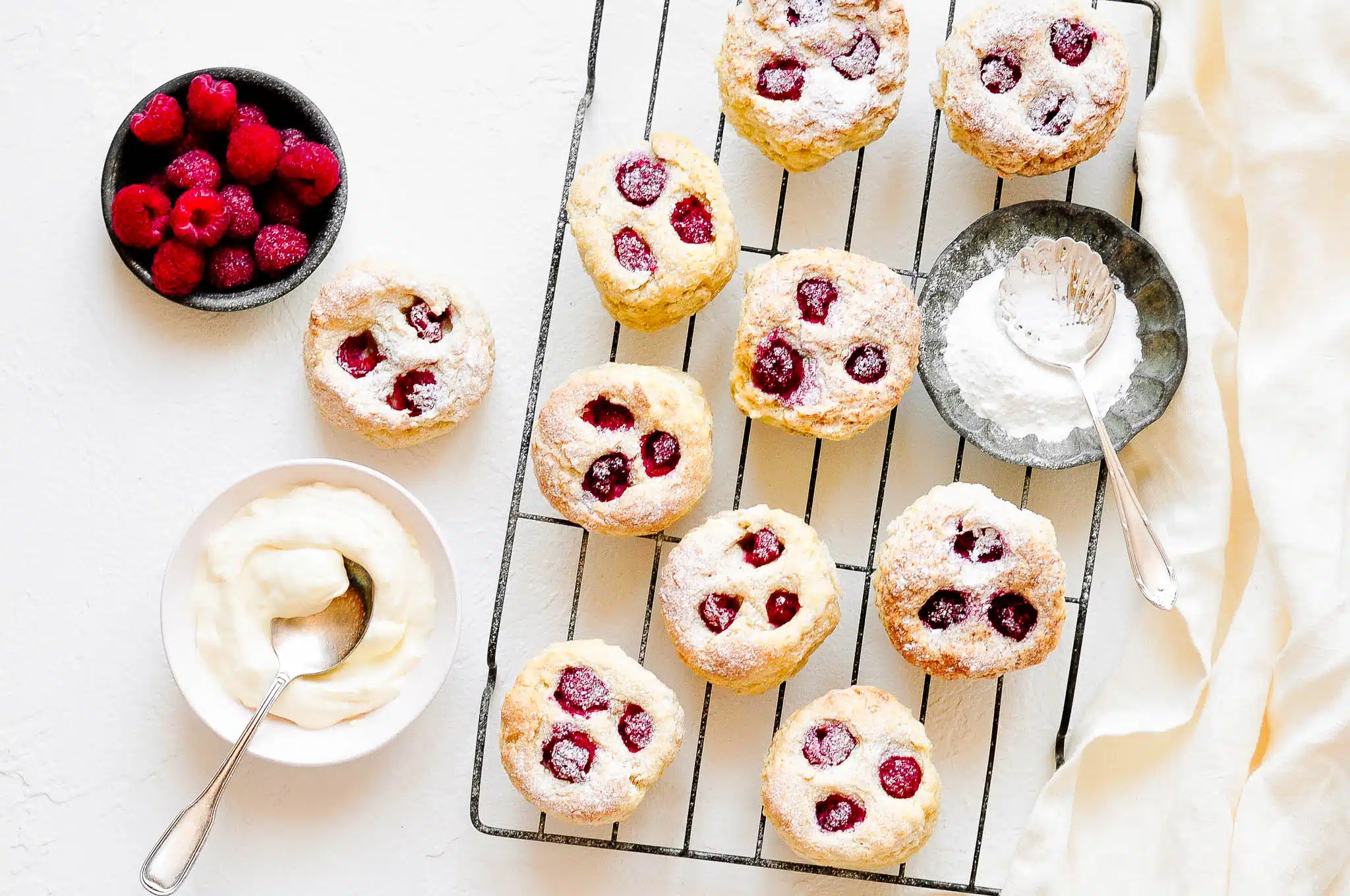
To transform the scones into Raspberry Scones, you need to press some frozen raspberries into each scone. Once baked, the raspberries soften and ooze and provide a tart contrast to the sweet cake. I love it!
How to Make Scones
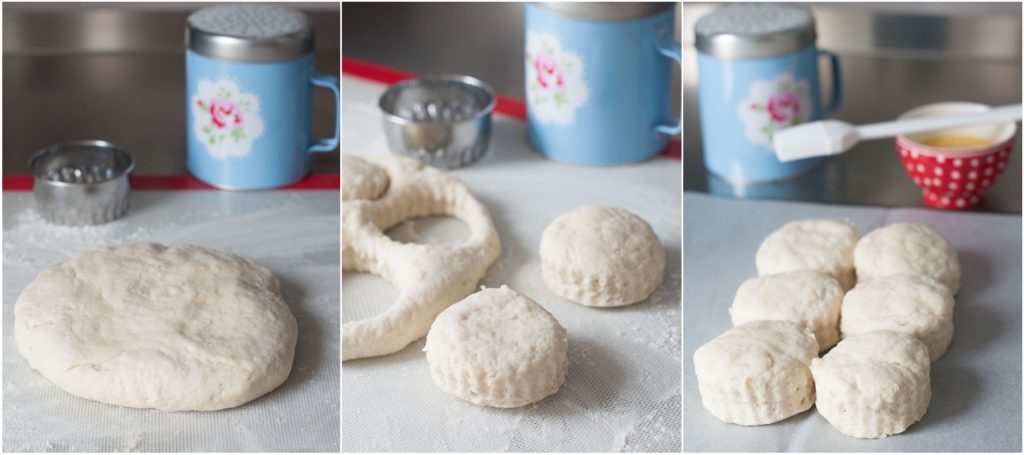
To make scones, you start by rubbing cold butter into the dry ingredients until the mixture looks crumbly and resembles wet sand. You can do this with your fingertips, but I like to use my stand mixer with the flat paddle attachment.
Next, you add the milk to bring everything together into a soft dough. At this stage, you should handle the dough as little as possible to ensure that the scones turn out light and fluffy. Over-working or handling the scone dough too much will result in tough scones.
Once the dough has come together, I use a patting motion to shape the dough.
How to Make Raspberry Scones
To make my raspberry scones, I simply press frozen raspberries into the top of each scone. You can also use fresh raspberries, but as they are quite fragile, you will need to make an indent in the scones (by using the end of a wooden spoon, for example), before inserting the fresh raspberries.
This recipe also works well with other types of frozen berries – think blackberries and even blueberries.

How to Serve Scones
To eat scones, I think they really benefit from some whipped cream and maybe a dollop of jam.
But as I have a habit of making a lot of things from scratch, proper scones are served traditionally with clotted cream, something which is not readily available in Switzerland but which can be made quite easily at home, provided that you organised enough to prepare it in advance.
If you have never heard of, or tried, clotted cream, think of a very thick cream with a rich, buttery taste.
As these scones already contain some fruit, I don’t think it is necessary to serve them with jam. But if you do decide to offer jam (raspberry jam would be my preference here), may I suggest a tip for serving?
My way of serving scones is to split them in half through the centre, spread as much jam as you like on each scone half, and then top with cream. If you spread the cream first on the scones and then apply the jam, you run the risk of the jam sliding off and making things a bit messy … just warning you 😉


Raspberry Scones

Ingredients
For the Raspberry Scones
- 500 g (3 ⅓ cup) plain flour, (all-purpose flour)
- 6 g (1 teaspoon) fine salt
- 25 g (2 tablespoons) caster sugar, (superfine sugar)
- 10 g (2 teaspoons) baking powder
- 50 g (½ stick) unsalted butter, cold and cut into cubes, see Kitchen Notes
- 25 g (1 ½ tablespoons) lard or vegetable shortening, or simply use more butter
- 250-300 ml (1 cup plus 3 tablespoons) milk
For the Egg Wash
- 1 egg
- 1 tablespoon milk
For the Homemade Clotted Cream
- 1 litre (4 cups) double cream, (heavy cream) preferably unpasteurised
Instructions
For the Raspberry Scones
- Preheat the oven to 220°C/430°F (without fan).
- Place a metal tray in the middle shelf of the oven to warm up while you are making the scones.
- Place the flour, salt, sugar and baking powder into the bowl of a KitchenAid or stand mixer.
- Add the butter and lard (or vegetable shortening), and briefly mix with the flat paddle attachment until the mixture resembles damp sand. Alternatively, you can do this by hand by simply rubbing the fats into the flour with your fingertips.
- Slowly add the milk and quickly mix everything together. You may not need all of the milk – just add enough milk until the mixture just comes together into a rough dough. Try not to overwork the dough as this may lead to tough scones later.
- Place the dough onto a floured work surface and pat it into a rectangle or circle shape about 3 cm (1 inch) high.
- Cut your scones with a round cutter. You could also use a teacup or small glass to shape your scones. Dip the cutter into some flour to prevent the dough from sticking to it.
- You can make the scones as little or as big as you like, adjusting the baking time accordingly. I use a 6 cm (2.5 inch) crinkle-edged cookie cutter to make fairly small scones.
- Lightly re-shape the dough as necessary, but try to handle the dough as little as possible.
- Arrange the scones closely together on a baking tray.
- Make an egg wash by lightly beating together the egg and milk.
- Brush the scones with some egg-wash.
- Press some frozen raspberries into each scone.
- Place the tray of scones onto the pre-heated metal tray in the oven.
- Bake the scones in the oven for about 10-15 minutes (depending on size), or until they are lovely and golden.
- You may need to test a scone to make sure that it is fully cooked through in the centre. A digital thermometer inserted in the centre of a scone should read about 85°C (185°F).
- These scones are best served hot or warm, but they are also lovely served at room temperature.
- To stop the scones from developing a hard crust as they cool, cover the warm scones with a clean tea towel. The steam trapped under the tea towel will help to keep the scones soft.
For the Homemade Clotted Cream
- Preheat the oven to 100°C/212°F (without fan).
- Pour the cream into a shallow stainless steel saucepan with oven-proof handles.
- Place the saucepan into the oven, and leave it there for 8 to 12 hours, or overnight. During this time, a thick and golden crust will form on top of the cream. This is the "clotted cream".
- Remove the saucepan from the oven and leave it to cool at room termperature for 10 to 12 hours.
- Scoop off the golden crust (or the “clotted cream”), and place it into a sterilised glass jar. Refrigerate for at least a few hours before serving.
Kitchen Notes
- TIPS FOR MAKING HOMEMADE CLOTTED CREAM
* Unpasteurised cream works best when making clotted cream because it “clots” better. However, you can also get good results with pasteurised cream, but you may need to leave it in the oven for longer.
* What would not work in this recipe is ultra-pasteurised cream (UHT cream).
* The clotted cream will keep in the fridge for 3-5 days.
* The cream which is left below the golden crust can still be used for cooking or baking. - USING FROZEN BUTTER
You can use frozen butter in this recipe and simply grate it into the dry ingredients. - STORAGE TIPS
The scones are best eaten right away, or at least on the day of baking. But I find that if you individually wrap them in clingfilm, they still taste quite fresh one or two days later. - FREEZER TIPS
The scones can be made ahead of time and stored in the freezer. Simply prepare the scones as per the instructions above until you have shaped the scones. If making raspberry scones, press some frozen raspberries into each scone. I like to freeze 2 or 4 scones together in a small zip-lock freezer bag for easy handling. To bake, simply proceed with the remaining instructions above using the frozen scones (there is no need to defrost them first), but they will require an extra 5-10 minutes in the oven (depending on size). - OVEN TEMPERATURES
All recipes on this website state temperatures for a regular oven (i.e. a conventional oven without fan). If you have a convection oven with a fan, please consult the manufacturer’s handbook on how to adjust the temperature and baking time accordingly. - CONVERSIONS
To convert from cups to grams, and vice-versa, please see this handy Conversion Chart for Basic Ingredients.




Is it bad that I really want this for breakfast now? ? They look so adorable they put a smile on my face!
Not at all! I consider scones to be breakfast fare 😉
These scones look absolutely amazing! I don’t think I’d be able to stop at one — or even two. I’m making these for our Easter celebration.
Thanks, Lisa! I hope you will enjoy this recipe 🙂
They look great and I bet they taste amazing! Especially with raspberries in them!
Thanks, Julia!
I love anything raspberry flavor, these look so good and that cream ?
I’m a big fan of raspberries too, especially in baked goods. And clotted cream is irresistible with scones!
Love love these!! I have never made scones yet but Wien you have inspired me
Homemade scones are absolutely lovely! I hope you will get a chance to make them soon 🙂
Sorry for the dumb question, but do you leave the oven ON for 8-12 hours?
I am only have access to PASTEURIZED dairy. Will it still work?
Thanks!
Hi Monika,
Not a dumb question at all! Yes, you have to leave the oven ON for 8-12 hours. I find it best to make this overnight – just pop the saucepan into the oven before you go to bed.
Unpasteurised cream works best in this recipe because it “clots” better. However, I have also made it with pasteurised cream, and the process takes a bit longer, hence why I have suggested up to 12 hours. What would probably not work is ultra-pasteurised cream, i.e. cream that has been ultra heat treated for longer shelf-life and which is sold unrefrigerated.
Whether you are using pasteurised or unpasteurised cream, I would suggest checking on it from about 8 hours to see if a lovely thick crust has formed yet. Hope this helps!
Yours look absolutely gorgeous and no cellulite haha They look so delicate and pretty with the raspberries studded in
Thanks, Maria! The original scones from the coffee shop were much prettier, which is why I was inspired to make my own 🙂
Wow, I had no idea that’s how clotted cream was made! I always assumed it was just heavily whipped cream. This sounds dreamy for a lazy Sunday morning.
Clotted cream is really expensive where I live, so I was curious to try and make it at home. Thankfully, the homemade version is even more delicious 🙂
mmm…this looks delicious!!! I need to try this! I’ve never had anything like this. Looks good!
I have enjoyed reading your recipes, and hope to try a couple soon, great pictures as well. You mention that you have difficulty getting clotted cream in Switzerland, but I think that you’ll find Gruyere double cream gives a similar taste, and I think better with scones than Chantilly cream.
Yes, Gruyère double cream goes very well with scones 🙂 Since I first published this recipe, clotted cream has become readily available in the Coop supermarket. So tea time with scones is now a real treat!