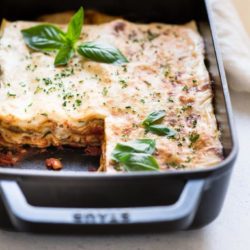
Spinach Lasagna

Serves: 3 to 5
A simple and delicious Spinach Lasagna using a homemade béchamel sauce and marinara sauce. This vegetarian lasagna will be a hit even with the meatlovers! Recipe with step-by-step photos.
Ingredients
For the Tomato Pasta Sauce
- 1 tablespoon olive oil
- 1 small onion, finely chopped
- 2 garlic cloves, finely chopped
- 800 g (28 oz) canned diced tomatoes
- 1-2 teaspoons sugar
- 1 teaspoon sea salt, plus more to taste
- black pepper, freshly cracked
- parsley, finely chopped
- basil, finely chopped
For the Béchamel Sauce (white sauce)
- 120 g (1 stick plus 1 tablespoon) unsalted butter
- 80 g (½ cup) plain flour, (all-purpose flour)
- 1 chicken stock cube, or vegetable stock cube, optional
- 1 litres (4 cups) milk
- 1 bay leaf
- nutmeg, freshly grated
To Assemble the Spinach Lasagna
- 250 g (9 oz) fresh lasagna sheets, see Kitchen Notes
- 80 g (3 oz) parmesan, freshly grated
- 100 g (3 ½ oz) baby spinach leaves, washed and drained
Instructions
For the Tomato Pasta Sauce (For step-by-step photos, please see my recipe for Tomato Pasta Sauce)
- Pour the oil into a medium-sized skillet or saucepan.
- Add the onion and garlic to the cold oil, together with a sprinkle of sea salt.
- Sauté over medium-high heat until the onion and garlic have softened.
- Add the canned tomatoes, together with the sugar, salt and some pepper to taste.
- Simmer the mixture over low-medium heat for about 20 minutes.
- Stir the mixture frequently, and use a wooden spoon to help break down the tomatoes.
- If the mixture has thickened too much, thin it with some boiling water. The tomato sauce needs to be slightly runny as the lasagna sheets will soak up some of the liquid during the baking time.
- Taste for seasoning. Depending on the acidity of your canned tomatoes, you might need to add some more sugar.
- Stir through the chopped herbs, and reserve some herbs for garnishing.
For the Béchamel Sauce (white sauce) (For step-by-step photos, please see my recipe for Béchamel Sauce)
- Melt the butter in a medium-sized saucepan.
- Sprinkle in the flour and stock cube (if using).
- Stir the mixture with a wooden spoon and cook for 1-2 minutes until it browns a little in colour.
- Slowly whisk in the milk and keep whisking until there are no lumps.
- Add the bay leaf.
- Use a wooden spoon to stir the sauce frequently over medium-high heat until the sauce is thick and smooth.
- Take the sauce of the heat and generously grate in some fresh nutmeg.
- Taste for seasoning.
- The sauce will continue to thicken as it cools.
- If you need to thin the Béchamel sauce, simply whisk in some milk until you have the right consistency.
To Assemble the Spinach Lasagna
- Preheat the oven to 180°C (350°F) (without fan).
- Bring a large pan of water to the boil and then add about 1 tablespoon of sea salt.
- Cook the lasagna sheets according to the packet instructions (about 2 minutes per sheet). I tend to cook enough lasagna sheets to form one layer at a time, and while I am assembling the dish, I cook the next batch of lasagna sheets.
- In a baking dish approximately 18 cm x 25 cm (7 inch x 9 inch), spoon a thin layer of tomato sauce on the bottom of the dish.
- Place the lasagna sheet on top.
- Spread another thin layer of tomato sauce on top of the lasagna sheet.
- Scatter over a layer of fresh baby spinach leaves.
- Drizzle over some Béchamel sauce. The Béchamel sauce does not need to completely cover the layer.
- Sprinkle over some grated parmesan.
- Repeat Steps 5 to 9 until all lasagna sheets have been used. For the lasagna dish in the photos above, I used 6 sheets of lasagna.
- I reserve most of the Béchamel sauce for the top layer so that the dish is generously coated in the white sauce.
- Sprinkle the final layer of Béchamel sauce generously with grated parmesan.
- Bake for about 40-45 minutes until the cheese is golden brown and the sauce is bubbling.
Kitchen Notes
- SOFT VS FIRM LASAGNA
If you like a soft lasagna like that pictured in the photos above, I recommend using fresh lasagna sheets as per the recipe. But if you prefer a firm lasagna which can hold its shape upon serving, I would recommend using dried lasagna sheets. I recommend soaking them in hot water (from the tap) for about 20 minutes, but some brands require you to cook them before using, so please check the packet instructions. - MAKE IT VEGETARIAN
Omit the chicken stock cube from the béchamel sauce and use either vegetable stock instead, or leave out the stock cube completely. I add it for a small punch of flavour to the dish, but you could instead sneak in more flavour by adding more parmesan cheese between the layers. - VARIATIONS
This is a very versatile recipe where you can use other vegetables in addition to, or instead of, the spinach. I often make this lasagna with thinly sliced courgettes (zucchini) and/or aubergine (eggplant). This lasagna is also delicious with slices of ham in between the layers. - OVEN & STOVE TEMPERATURES
All recipes on this website have been tested on an induction stove and/or with a conventional oven (i.e. an oven without fan). All recipes on this website use temperatures for a conventional oven, unless otherwise mentioned. Convection ovens (i.e. fan-forced ovens) are typically 20°C/70°F hotter than conventional ovens, but please check your manufacturer’s handbook. - CONVERSIONS
To convert from cups to grams, and vice-versa, please see this handy Conversion Chart for Basic Ingredients.
Serving: 1g, Calories: 285kcal, Carbohydrates: 33.2g, Protein: 8.4g, Fat: 13.4g, Cholesterol: 30.3mg, Sodium: 286.1mg, Fiber: 3.6g, Sugar: 9.1g