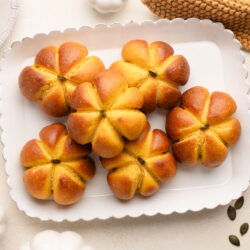
Pumpkin Bread Rolls

Serves: 9 buns
Soft and fluffy Pumpkin Bread Rolls which will bring a touch of autumn to your table. This recipe uses a milk bread dough for the most delicious buttery buns! Recipe with step-by-step photos.
Ingredients
For the Tangzhong
- 14 g (2 tablespoons) white bread flour
- 100 ml (⅓ cup plus 1 tablespoon) milk
For the Japanese Milk Bread Dough
- 350 g (2 ⅓ cups) white bread flour
- 3 ½ g (1 teaspoon) instant dried yeast, see Kitchen Notes
- 6 g (1 teaspoon) fine salt
- 55 g (¼ cup) caster sugar, (superfine sugar)
- 1 egg
- 120 g (4 oz) pumpkin purée, homemade or canned
- 1-2 tablespoons milk
- 50 g (½ stick) unsalted butter, softened
For the Decoration
- vegetable oil
- kitchen string
- 1 tablespoon milk
- 9 pumpkin seeds, pistachio seeds or whole almonds
Instructions
For the Tangzhong
- Whisk the ingredients together in a small saucepan.
- Place the saucepan over low heat.
- Keep whisking until the ingredients form a thick paste. The consistency should be thick enough so that as you whisk the mixture, the whisk leaves lines in the mixture which remains.
- Remove the paste to a small bowl, and set it aside to cool down.
To Make the Dough
- Measure the flour, yeast, salt and sugar into the bowl of an electric stand mixer.
- Mix the dry ingredients together using a dough hook.
- Add the egg, cooled Tangzhong and pumpkin purée.
- Once everything is combined, add enough milk for the mixture to come together in a sticky dough.
- Add the butter, one tablespoon at a time. Wait for each tablespoon of butter to be fully incorporated into the dough before adding the next.
- Continue kneading the dough on medium speed for about 10-15 minutes, or until the dough passes the windowpane test. (See Kitchen Notes below). By this stage, the dough should also be coming away from the sides of the bowl.
- Lightly oil a large, clean mixing bowl.
- Roll the dough into a smooth ball and place it into the mixing bowl.
- Cover the dough with a clean tea towel or bowl cover, and place it somewhere warm for about 1.5 hours, or until it has doubled in size.
Portion the Dough
- Gently remove the dough from the bowl. The dough will deflate as you handle it.
- Divide the dough into 9 equal portions. Use a digital scale for even-sized buns.
Rolling the Dough
- Line a square baking pan with baking paper.
- Roll each piece of dough into a smooth ball. I do this by pulling the edges of the dough into the centre, and then pinching those edges together while shaping the dough into a smooth ball as you do so. The pinched edges form the bottom of the buns.
- Repeat the above steps with the remaining pieces of dough.
- Place the shaped buns into the lined baking pan.
Shaping the Dough into Pumpkins
- Cut 9 pieces of kitchen string measuring 80 cm in length.
- Fill a small bowl with some vegetable oil.
- Dip one piece of string into the oil, and then blot it between some sheets of kitchen paper.
- Lay the string in front of you horizontally.
- Place a piece of dough in the middle of the string (the top of the dough should be facing up).
- Bring the pieces of string together to loosely tie a knot in the centre of the dough.
- Then angle the strings, flip the dough over, and loosely tie a knot on the other side.
- To make buns with 8 segments, tie a knot at 4 cross-sections. To make buns with 6 segments, tie a knot at 3 cross-sections.
- Cut off the excess string (they will otherwise stick to the bun during baking).
- Repeat with the remaining pieces of dough.
Proving the Shaped Dough
- Place the pan somewhere warm, covered with a clean tea towel, for about 30 minutes, or until the buns have puffed up slightly.
Baking the Pumpkin Bread Rolls
- Preheat the oven to 180°C/356°F (without fan).
- Place a metal baking tray on the middle shelf.
- Lightly brush the buns with some milk.
- Bake the buns for about 20-25 minutes, or until they are lightly golden. Check the buns at about 10-15 minutes and, if they are browning too quickly, cover the buns with a loose sheet of foil for the remaining baking time.
- The buns are cooked if an internal thermometer reads 85°C/185°F.
- Leave the buns on the pan for about 5 minutes, before carefully removing the buns to a wire rack to cool completely.
- While the buns are still warm, cut off the strings and gently remove peel them away from the buns.
- Decorate the buns with a pumpkin seed or similar.
Kitchen Notes
- HOMEMADE PUMPKIN PURÉE
To make your own pumpkin purée, cut some fresh pumpkin into large chunks. Steam the pumpkin on medium-high heat for 15-30 minutes until the pumpkin is very tender. The cooking time will depend on how large your pumpkin pieces are. Transfer the cooked pumpkin to a bowl and mash until smooth. Leave to cool completely before using or storing in the fridge or freezer. - WINDOWPANE TEST
Pinch off a small piece of dough, roll it into a ball and use your hands to gently stretch the dough. If the dough can stretch to form a thin sheet and be almost translucent so that you can see the light through it, your dough has passed the "windowpane test". This means that you have kneaded the dough sufficiently and that the dough is ready to be proofed. - MAKE AHEAD TIPS
To start the Milk Bread dough the night before:
* Make the dough as per the recipe.
* Place the bowl of dough (covered) in the fridge to proof overnight, or for at least 8 to 10 hours. During this time, it should have at least doubled in size.
* The next day, proceed with the rest of the recipe. As the dough will be cold, it may require a bit more time for the second proofing period. - DIFFERENT TYPES OF FLOUR
For Swiss readers: I use Zopfmehl (or farine pour tresse) when making bread and enriched dough. - DIFFERENT TYPES OF YEAST
* Please note that there is a difference between instant yeast (also called instant dried yeast or fast-action dried yeast) and dried yeast (also called active dry yeast). If you are not sure what type of yeast you have, please check the packaging for instructions on how to use the yeast.
* With instant yeast, you can add it directly to the flour mixture without having to activate it first.
* With dried yeast, you will need to activate it first (usually in some warm liquid). - PROOFING THE DOUGH
Dough needs a warm environment for the yeast to activate and cause the dough to rise. If you don't have a warm place in your home, try one of the following ideas:
* In the oven with the oven light switched on (works only for some ovens).
* In the oven with a tray of boiling water on the bottom shelf.
* In the oven at a low temperature of about 25-30°C (77-86°F). - OVEN TEMPERATURES
All recipes on this website state temperatures for a regular oven (i.e. a conventional oven without fan). If you have a convection oven with a fan, please consult the manufacturer's handbook on how to adjust the temperature and baking time accordingly. - CONVERSIONS
To convert from cups to grams, and vice-versa, please see this handy Conversion Chart for Basic Ingredients.