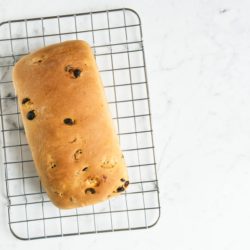
Fruit Loaf

Serves: 3 to 4
An easy and delicious recipe for Fruit Loaf with step-by-step photos. Perfect at breakfast, whether served warm or toasted.
Ingredients
- 350 g (2 ⅓ cup) white bread flour
- ¼ teaspoon fine salt
- 2 teaspoons granulated sugar
- 1 ¾ teaspoon instant dried yeast, see Kitchen Notes
- ½ lemon, zested
- 55 g (½ stick) unsalted butter, melted and cooled slightly
- 150 ml (½ cup plus 2 tablespoons) milk, warmed to 37°C/98°F
- 1 egg, beaten
- 50 g (¼ cup) dried apricots, chopped
- 100 g (½ cup) raisins
Instructions
To make the dough
- Place the flour, salt, sugar, yeast and lemon zest in the bowl of a stand mixer or in a large mixing bowl.
- Add the melted butter, milk and egg.
- Mix everything together until the dough is smooth. This will take about 10-15 minutes using the dough hook, or a bit longer by hand.
First proving session
- Lightly grease a large bowl with some butter or vegetable oil.
- Shape the dough into a ball and place it in the bowl.
- Cover the bowl with a clean tea towel and set it aside somewhere warm for about 1 hour, or until it has doubled in size.
- Meanwhile, soak the raisins and dried apricots in some hot water. After about 45 minutes, drain the dried fruit and dry with some kitchen paper.
To shape the dough
- Once the dough has doubled in size, use your hands to punch it and knock it back.
- Transfer the dough to a lightly floured surface.
- Knead the dried fruit into the dough.
- Roll or flatten the dough into a rectangular shape, about the same length as your loaf pan, and about 1 cm or ½ inch thick. For this recipe, I use a standard loaf pan which measures 13 x 23 cm/5 x 9 inches.
- Roll up the dough and tuck in the ends.
Second proving session
- Lightly grease the loaf pan.
- Place the dough in the pan with the seam-side down.
- Cover the dough with a clean tea towel and leave the pan in a warm place for about 45 minutes or until it has doubled in size.
To bake the fruit loaf
- Preheat the oven to 200°C/392°F (without fan).
- Place the loaf pan in the oven for about 30 minutes, or until it is lightly golden and sounds hollow when tapped on the bottom. If you have a digital thermometer, the bread is cooked if the internal reading is 85°C/185°F.
- Cool the loaf on a wire rack.
- The bread can be served warm, or wrapped in a tea towel and sliced over the next few days.
Kitchen Notes
- MAKE AHEAD TIPS
To start the dough the night before:
* Make the dough as per the recipe.
* Place the bowl of dough (covered) in the fridge to proof overnight, or for at least 8 to 10 hours. During this time, it should have at least doubled in size.
* The next day, proceed with the rest of the recipe. As the dough will be cold, it may require a bit more time for the second proofing period. - DIFFERENT TYPES OF YEAST
* Please note that there is a difference between instant yeast (also called instant dried yeast or fast-action dried yeast) and dried yeast (also called active dry yeast). If you are not sure what type of yeast you have, please check the packaging for instructions on how to use the yeast.
* With instant yeast, you can add it directly to the flour mixture without having to activate it first.
* With dried yeast, you will need to activate it first as per the recipe above. - DIFFERENT TYPES OF FLOUR
For Swiss readers, I use Zopfmehl (or farine pour tresse) when making bread and enriched dough. - VARIATIONS
I like my fruit bread with more bread to dried fruit ratio, so I reduced the quantities of dried fruit in this recipe and restricted it to only raisins and dried apricots the first time I made it. On the second occasion, I added raisins and chopped dried figs. You can also spice up the bread with some ground cinnamon and/or ground cardamon. Really, the variations are quite up to you. - RECIPE CREDIT
Recipe adapted from Warm Bread and Honey Cake by Gaitri Pagrach-Chandra. This is a very simple fruit loaf - think white bread studded with dried fruit. But given it's simplicity, it lends itself well to any personal variations which you desire. In terms of dried fruit, the original recipe calls for:
100 g / 3 1/2 oz currants
55 g / 2 oz sultanas (golden raisins)
2 tablespoons dried cranberries
1 tablespoon candied orange peel - OVEN TEMPERATURES
All recipes on this website state temperatures for a regular oven (i.e. a conventional oven without fan). If you have a convection oven with a fan, please consult the manufacturer's handbook on how to adjust the temperature and baking time accordingly. - CONVERSIONS
To convert from cups to grams, and vice-versa, please see this handy Conversion Chart for Basic Ingredients.
Serving: 4g, Calories: 487kcal, Carbohydrates: 76.4g, Protein: 12.7g, Fat: 15.3g, Cholesterol: 80.7mg, Sodium: 275.7mg, Fiber: 3.5g, Sugar: 21.2g