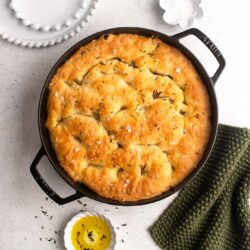
Focaccia with Rosemary and Sea Salt

Serves: 6
A classic Focaccia with Rosemary and Sea Salt which is perfect for appetisers or sandwiches. Recipe with step-by-step photos for making a focaccia in a cast-iron skillet or in a baking pan.
Ingredients
For a Round Focaccia (see Kitchen Notes below for a rectangular focaccia)
- 375 g (2 ½ cups) white bread flour
- 5.25 g (1 ½ teaspoons) instant dried yeast, see Kitchen Notes
- 9 g (1 ½ teaspoons) fine salt
- 8 g (2 teaspoons) caster sugar, (superfine sugar)
- 315 ml (1 ¼ cups) warm water
- 15 ml (1 tablespoon) olive oil, for the dough
- 2-3 tablespoons olive oil, for the pan
Instructions
BEGIN THIS RECIPE ABOUT 4 HOURS BEFORE SERVING
To Make the Focaccia Dough
- Measure the flour, yeast, salt and sugar into the bowl of an electric stand mixer.
- Lightly mix the dry ingredients together with the dough hook.
- Measure the water and 1 tablespoon olive oil into a small measuring jug.
- Slowly add the wet ingredients to the dry ingredients.
- Knead the dough on low-medium speed until all of the flour is combined with the water. This step should take about 2 minutes.
First Mini Proof
- Cover the bowl of dough.
- Place the bowl somewhere warm for 15 minutes.
- Wet your hands with some warm water.
- Pull up the dough from one edge of the bowl, stretching it as you go up, and bringing it down towards the centre of the dough. You can either use your hands or a spatula for this task.
- Repeat this stretching motion with the remaining edges of the dough.
Second Mini Proof
- Cover the bowl of dough again.
- Place the bowl somewhere warm for another 15 minutes.
- By now, the dough should have increased in size.
- Repeat the stretching motion mentioned in the First Mini Proof.
Third Proof
- Cover the bowl of dough.
- Place the bowl somewhere warm for 1 to 1.5 hours, or until the dough has doubled in size.
Fourth Proof
- Drizzle 2-3 tablespoons of olive oil into a cast-iron skillet measuring 26 cm/10 inches in diameter. If you are worried about the focaccia sticking to the pan, you can also line the pan with baking paper first.
- Carefully transfer the dough onto the skillet.
- Fold the bottom third of the dough towards the centre.
- Then fold the top third of the dough towards the centre. You should now have a fat log of dough.
- Turn the dough over so that the seam is facing down.
- Use your fingertips to gently push the dough out to almost fill the pan.
- Cover the dough with a clean tea towel and place the pan somewhere warm for about 1 to 1.5 hours, or until the dough has almost risen to the top of the pan, and it has spread to fill the pan (or most of the pan) with large air bubbles.
To Decorate the Focaccia
- Preheat the oven to 220°C/430°F (without fan).
- Place a metal baking sheet on the middle shelf of the oven.
- Drizzle 2-3 tablespoons of olive oil over the dough.
- Sprinkle with chopped rosemary.
- Oil your hands with some olive oil to prevent the dough from sticking to your fingers.
- Use your fingers to make random indents in the dough, pushing all the way to the bottom. As you do so, push out the dough to fill the baking tray, if necessary.
- Sprinkle the dough generously with sea salt flakes.
- Decorate the dough however you wish (such as with rosemary twigs).
To Bake the Focaccia
- Bake for 15-20 minutes, or until the focaccia is lightly golden.
- I recommend waiting about 15 minutes before slicing the focaccia. This will allow the bread to rest, which will result in a cleaner slice when you cut it with a serrated knife.
- The focaccia is best eaten on the same day.
Kitchen Notes
- MAKE A RECTANGULAR FOCACCIA
To make a rectangular focaccia, I use a non-stick baking pan which measures 23 x 33 x 5 cm/9 x 13 x 2 inches, and I increase the recipe by 25% as follows:
500 g (3 1/3 cup) bread flour
7 g (2 teaspoons) instant dried yeast (see Kitchen Notes)
2 teaspoons fine salt
1 tablespoon caster sugar (superfine sugar)
400-420 ml (1 2/3 cup) warm water, about 40°C/105°F
1 tablespoon olive oil, for the dough
2-3 tablespoons olive oil, for the baking tray - DIFFERENT TYPES OF FLOUR
For Swiss readers: I use Zopfmehl (or farine pour tresse) when making bread and enriched dough. - DIFFERENT TYPES OF YEAST
* Please note that there is a difference between instant yeast (also called instant dried yeast or fast-action dried yeast) and dried yeast (also called active dry yeast). If you are not sure what type of yeast you have, please check the packaging for instructions on how to use the yeast.
* With instant yeast, you can add it directly to the flour mixture without having to activate it first.
* With dried yeast, you will need to activate it first (usually in some warm liquid). - PROOFING THE DOUGH
Dough needs a warm environment for the yeast to activate and cause the dough to rise. If you don't have a warm place in your home, try one of the following ideas:
* In the oven with the oven light switched on (works only for some ovens).
* In the oven with a tray of boiling water on the bottom shelf.
* In the oven at a low temperature of about 25-30°C (77-86°F). - OVEN TEMPERATURES
All recipes on this website state temperatures for a regular oven (i.e. a conventional oven without fan). If you have a convection oven with a fan, please consult the manufacturer's handbook on how to adjust the temperature and baking time accordingly. - CONVERSIONS
To convert from cups to grams, and vice-versa, please see this handy Conversion Chart for Basic Ingredients.