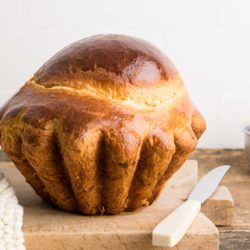
Brioche

Serves: 4 or more
A delicious and authentic French brioche recipe with step-by-step photos.
Ingredients
For the Brioche
- 300 g (2 cups) white bread flour, (see Kitchen Notes below)
- 55 g (¼ cup) caster sugar, (superfine sugar)
- 7 g (2 teaspoons) instant dried yeast, (see Kitchen Notes below)
- 6 g (1 teaspoon) fine salt
- 90 ml (⅓ cup) milk, warmed to 37°C/98°F
- 3 eggs, at room temperature
- 100 g (1 stick) unsalted butter, softened
For the Eggwash
- 1 egg , beaten with a dash of milk
Instructions
Begin this recipe the night before.
Day One
- Measure the flour, sugar, yeast and salt in the bowl of an electric stand mixer.
- Attach the dough hook to the stand mixer and lightly mix the dry ingredients together.
- In a small measuring jug, whisk together the milk and eggs.
- Slowly add the milk and egg mixture to the dry ingredients, and keep mixing until a sticky dough forms. The dough should form together loosely around the dough hook. You may need to scrape down the sides of the bowl once or twice to make sure all of the ingredients are well-incorporated. This step should take about 5-10 minutes on medium speed.
- Add a tablespoon of butter and beat until it has been incorporated into the dough. Repeat with the remaining butter, adding one tablespoon at a time.
- Once all of the butter has been added, keep beating for about 10-20 minutes on medium-high speed.
- The dough is ready when it is soft, sticky and elastic in texture, and when it comes away from the sides of the bowl instead of sticking to the sides. I also recommend doing the "windowpane test", which is to stretch a piece of dough from the dough hook, until it is thin enough that you can almost see through the "window" of dough, and without the dough breaking as you do this test.
- Lightly oil a large bowl. You will need a bowl that is large enough for the dough to at least triple in size.
- Use a dough scraper to scrape the brioche dough into the oiled bowl.
- Place the bowl somewhere warm for the dough to prove for about 1-2 hours, or until the dough has doubled in size.
- Do not touch the dough. Cover the bowl with the risen dough with some clingfilm, and place in the fridge to chill overnight (8 to 10 hours). The dough will continue to rise a bit more in the fridge.
Day Two
- The dough will have risen more overnight in the fridge.
- Punch down the dough to release the air from the dough.
- Gently knead the dough into a smooth ball.
- Generously butter a large brioche pan (or use a non-stick baking spray). I use a brioche pan which is 22.5 cm/9 inches wide.
- Separate the dough into two pieces, about 2/3 for the body and 1/3 for the head.
- Roll the larger piece of dough into a smooth ball. Use your thumbs to create an indent in the centre of the ball. Place this piece of dough into the brioche pan.
- Roll the smaller piece of dough into a smooth ball. Elongate the dough to create a fat log. Insert this piece of dough into the indent of the dough already in the brioche pan.
- Place the brioche pan (uncovered) somewhere warm for 1-3 hours, or until the dough has at least doubled in size. As the dough is quite cold at this stage, it will usually take longer than normal to prove. But much depends on how warm the room is.
- Preheat the oven to 200°C (390°F).
- Place a metal baking sheet in the oven.
- Gently brush the top of the brioche with the eggwash.
- Place the brioche pan on the metal baking sheet (which has been preheating in the oven).
- Bake the brioche for 30-35 minutes, or until it is lightly golden. You might want to check your brioche at about 10-15 minutes to make sure it is not browning too quickly. If so, place a sheet of foil over the brioche to stop it from browning further.
- If you have a digital thermometer, the brioche is cooked if the internal reading is 85°C/185°F.
- Remove the brioche from the oven and let it settle in the pan for about 5-10 minutes before unmoulding.
- Let the brioche cool completely on a wire rack before serving.
Kitchen Notes
- CAKE PAN SIZE
I use a brioche pan which is 22.5 cm /9 inches wide. - DIFFERENT TYPES OF FLOUR
* I recommend using bread flour when making brioche or other types of enriched dough. Bread flour contains more protein than plain flour (all-purpose flour), so look for flour which has 11-13% protein content.
* For Swiss readers, I use Zopfmehl (or farine pour tresse) when making bread and brioche. - DIFFERENT TYPES OF YEAST
* Please note that there is a difference between instant yeast (also called instant dried yeast or fast-action dried yeast) and dried yeast (also called active dry yeast). If you are not sure what type of yeast you have, please check the packaging for instructions on how to use the yeast.
* With instant yeast, you can add it directly to the flour mixture without having to activate it first.
* With dried yeast, you will need to activate it first (usually in some warm liquid). - PROOFING THE DOUGH
Dough needs a warm environment for the yeast to activate and cause the dough to rise. If you don't have a warm place in your home, try one of the following ideas:
* In the oven with the oven light switched on (works only for some ovens).
* In the oven with a tray of boiling water on the bottom shelf.
* In the oven at a low temperature of about 25-30°C (77-86°F). - ELECTRIC STAND MIXER
Given the high butter content, it is easiest to make this brioche using an electric stand mixer or a food processor fitted with a dough hook. However, you can, of course, make the dough by hand if you don't mind a bit of an upper-body workout. - OVEN TEMPERATURES
All recipes on this website state temperatures for a regular oven (i.e. a conventional oven without fan). If you have a convection oven with a fan, please consult the manufacturer's handbook on how to adjust the temperature and baking time accordingly. - CONVERSIONS
To convert from cups to grams, and vice-versa, please see this handy Conversion Chart for Basic Ingredients.