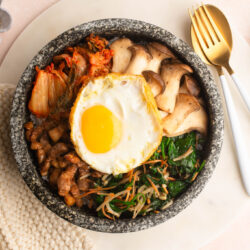
Bibimbap

Serves: 3 to 4
A Bibimbap is a delicious Korean rice bowl served with succulent meat, sautéed vegetables and topped with a golden fried egg. Serve it in a Korean stone bowl for maximum enjoyment! Recipe with step-by-step photos.
Ingredients
For the Steamed Jasmine Rice
- 350 g (1 ½ cup) Jasmine rice
- 500 ml (2 cups) cold water
For the Spicy Gochujang Sauce
- 4 tablespoons (¼ cup) gochujang paste
- 2 tablespoons mirin
- 2 teaspoons sugar
- 2 teaspoons toasted sesame seeds
- 2 teaspoons soy sauce
- 1 teaspoon sesame oil
For the Stir-Fried Pork Belly
- 1 tablespoon vegetable oil
- 500 g (½ lb) pork belly, sliced into batons
- 1 teaspoon sea salt
- black pepper, freshly cracked
For the Stir-Fried Vegetables
- 1 tablespoon vegetable oil
- 500 g (½ lb) King Oyster mushrooms, or other mushrooms, sliced
- 1 teaspoon sea salt
- black pepper, freshly cracked
- 1 teaspoon soy sauce
- 125 g bean sprouts
- 1-2 carrots, grated or shredded
- 150 g spinach leaves
To Serve
- sesame oil
- kimchi
- 1 fried egg, per person
Instructions
For the Steamed Jasmine Rice
- Please see my recipe with step-by-step photos for How to Cook Jasmine Rice.
- The rice takes about 30 minutes to cook, which is enough time for you to prepare the toppings for the Bibimbap.
To Pre-Heat a Dolsot Stone Bowl
- To season a dolsot stone bowl for the first time, please see the Kitchen Notes below.
- Place the bowl on a metal tray in the middle of the oven.
- Turn the oven to 220°C/428°F (without fan).
- Heat the bowl for at least 30 minutes.
For the Spicy Gochujang Sauce
- Whisk all of the ingredients together.
For the Stir-Fried Pork Belly
- Season the pork generously with sea salt and freshly cracked black pepper.
- Heat some vegetable oil in a large pan or wok.
- Stir-fry the pork in batches until they are crispy and caramelised.
- Use a slotted spoon to remove the meat to a bowl.
- There should be a lot of oil in the pan from the rendered pork fat. Remove some of the oil to a small jug and set aside. You should have about 1-2 tablespoons of oil left in the pan to cook the vegetables.
For the Stir-Fried Vegetables
- Add the mushrooms.
- Season with the salt, pepper and soy sauce.
- Cook the mushrooms until they have softened.
- If needed, add some more of the reserved oil.
- If you wish to cook the vegetables separately, remove the mushrooms with a slotted spoon to a bowl. Otherwise, proceed with the next step to cook the vegetables together.
- Add the bean sprouts and carrots.
- Cook for a few minutes until the bean sprouts and carrots have softened.
- Stir through the spinach leaves until they start to wilt.
- Use a slotted spoon to remove the vegetables to a bowl.
To Serve
- If you are using a dolsot stone bowl, carefully transfer it to a thick wooden tray or similar.
- Add a few dashes of sesame oil to the hot stone bowl.
- Fill up the bowl (ceramic or stone bowl) with Steamed Jasmine Rice.
- Arrange the toppings on top of the rice.
- Add some kimchi.
- Top with a fried egg.
- Add 1-2 tablespoons of the Spicy Gochujang Sauce to taste.
- Use a large spoon to give everything in the bowl a good mix. If you are using a stone bowl, press the rice against the bowl to let it crisp up.
- Enjoy!
Kitchen Notes
- HOW TO SEASON A DOLSOT STONE BOWL
Wash the bowl in warm water with soap, then half fill it with water. Place it on a suitable cooktop (I used a gas stove) and simmer over medium heat until all of the water has evaporated. Meanwhile, preheat the oven to 180°C/356°F (without fan). Brush the inside of the bowl with vegetable oil, and carefully transfer it to the oven and bake for 30 minutes. You only need to do this once. - OVEN & STOVE TEMPERATURES
All recipes on this website have been tested on an induction stove and/or with a conventional oven (i.e. an oven without fan). All recipes on this website use temperatures for a conventional oven, unless otherwise mentioned. Convection ovens (i.e. fan-forced ovens) are typically 20°C/70°F hotter than conventional ovens, but please check your manufacturer's handbook. - CONVERSIONS
To convert from cups to grams, and vice-versa, please see this handy Conversion Chart for Basic Ingredients.