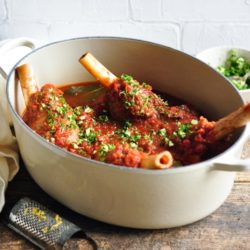
Slow Cooked Lamb Shanks with Red Wine Sauce

Serves: 4 to 6
Slow Cooked Lamb Shanks with Red Wine Sauce, served with a fresh gremolata. The meat is deliciously tender and the rich, full-flavoured sauce is perfect for serving with mashed potatoes, polenta or pasta.
Ingredients
For the Braised Lamb Shanks
- 2-3 tablespoons vegetable oil
- 4 lamb shanks, about 2 kg/4 lb
- 1 large brown onion
- 2 celery stalks
- 1 large carrot
- 3 garlic cloves
- 3 tablespoons tomato paste
- 250 ml (1 cup) red wine, see Kitchen Notes
- 1.2 kg (42 oz) canned diced tomatoes
- 500 ml (2 cups) chicken stock
- 2 teaspoons sugar
- 2 fresh bay leaves
- 1 large orange peel
- sea salt
- black pepper, freshly cracked
For the Gremolata
- ½ cup flat-leaf parsley, finely chopped
- 1 garlic clove, finely chopped
- 1 lemon, zested
To Serve
- risoni, or orzo, cooked according to packet instructions OR mashed potates OR polenta
Instructions
To Make the Slow-Cooked Lamb Shanks
- Preheat the oven to 350°F (180°C) (without fan).
- Heat the oil in a large oven-proof pot which will fit all of the ingredients comfortably.
- Sear the lamb shanks in batches until they are golden brown on all sides.
- While you are searing the lamb shanks, place the onion, celery and garlic into a food processor until finely chopped.
- Remove the lamb shanks to a plate.
- Turn down the heat. If the pan is really hot, remove it from the stove and let it cool a little.
- Add the onion mixture and cook for a few minutes until the vegetables have softenend.
- Stir in the tomato paste and cook for a few more minutes.
- Add the red wine and let the mixture bubble away for a few minutes to allow the alcohol to cook off.
- Add the canned tomatoes, stock, sugar, bay leaves, and orange peel.
- Bring the mixture to a boil and let it simmer gently for a few minutes.
- Return the lamb shanks to the pan, together with any meat juices on the plate. Make sure the shanks are well-submerged in the sauce.
- Place the lid on the pan, and place the pan into the oven for 2 hours to braise. Check the pan every 30 minutes or so to give it a stir.
- After 2 hours, place the pan back on the stove on low heat. Remove the lid.
- Skim off and discard as much fat as you can from the sauce.
- At this stage, the sauce should look quite thin.
- Let everything simmer gently, without the lid, for about 1 hour, or until the sauce has thickened nicely and the meat is very tender.
- Stir the sauce occasionally to make sure that it is not sticking to the bottom of the pan.
- Taste the sauce for seasoning, and add salt and pepper. If it tastes too tart or sour, you might need more sugar.
To Make the Gremolata
- Make the gremolata by mixing together the parsley, garlic and lemon zest.
To Serve
- There are several ways to serve this dish. If the lamb shanks are quite small, I would serve one lamb shank per person. Alternatively, you could pull the meat from the bones, and either serve the meat in large chunks or roughly shredded and mixed through the sauce. The latter is a good option for leftovers.
- Serve the lamb shanks with risoni pasta, mashed potatoes, or polenta.
- Sprinkle generously with gremolata just before serving.
- If you plan to serve this dish with pasta (whether risoni pasta or another type of pasta), I would recommend warming the pasta through the sauce first. To do so, simply remove a few ladelfuls of sauce (or enough to serve with the pasta) into a medium saucepan and bring to the boil. Add the cooked and drained pasta, and stir everything together over high heat until the pasta is flavoured with the sauce. Alternatively, you can serve the pasta separately at the table, but this should be done as soon as the pasta is cooked and drained.
Kitchen Notes
- INSTRUCTIONS FOR SLOW COOKER
* Follow the same instructions as for the stove top.
* Cook on low (95°C/203°F) for 6-8 hours or high (105°C/221°F) for 5-6 hours. The timing may vary depending on the size of the pieces of meat. - WHICH TYPE OF WINE TO USE
I use Côte du Rhone red wine in my cooking (it's the red wine which my French husband drinks on a daily basis), but any full-bodied red wine should work in this dish. Whilst you don't need to use an expensive red wine when cooking, you should always use a wine which you would enjoy drinking - don't cook with something you wouldn't drink! - OVEN & STOVE TEMPERATURES
All recipes on this website have been tested on an induction stove and/or with a conventional oven (i.e. an oven without fan). All recipes on this website use temperatures for a conventional oven, unless otherwise mentioned. Convection ovens (i.e. fan-forced ovens) are typically 20°C/70°F hotter than conventional ovens, but please check your manufacturer’s handbook. - CONVERSIONS
To convert from cups to grams, and vice-versa, please see this handy Conversion Chart for Basic Ingredients.
Serving: 6g, Calories: 532kcal, Carbohydrates: 23.2g, Protein: 67.7g, Fat: 17.7g, Cholesterol: 199.4mg, Sodium: 665.3mg, Fiber: 4.7g, Sugar: 13g