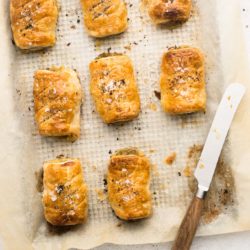
Pork and Sage Sausage Rolls

Serves: 20 or more rolls
No party is complete without a batch of sausage rolls, and these classic Pork & Sage Sausage Rolls will be a hit with your friends and family!
Ingredients
For the Sausage Rolls
- 1 large onion, roughly chopped
- 2 garlic cloves
- 2 small carrots, peeled and roughly chopped
- 1-2 tablespoons olive oil
- 650 g (1 ½ lb) minced pork, (ground pork), or a mix of pork and beef
- 6 sprigs parsley
- 1 teaspoon sea salt
- 1 teaspoon black pepper, freshly cracked
- 1 tablespoon fresh sage, finely chopped, or 1 teaspoon ground sage
- 1 tablespoon fresh thyme, finely chopped, or 1 teaspoon dried thyme
- 1 teaspoon Herbs de Provence, optional
- 1 tablespoon Worcestershire sauce
- 1 cup Panko breadcrumbs, or fresh breadcrumbs
- puff pastry, I use 2 rectangular sheets which are 25 x 42 cm/10 x 16 inch
- sesame seeds, or poppy seeds, optional
For the Egg Wash
- 1 egg
- 1 dash milk
To Serve
- Cherry Tomato Relish
- tomato sauce, ketchup
Instructions
To Make the Sausage Roll Filling
- Place the onion, garlic and carrots into a large food processor.
- Blitz until everything is finely chopped.
- Heat some olive oil in a large pan over medium heat.
- Cook the onion mixture with a good pinch of salt for 3-5 minutes, or until the mixture starts to soften.
- Remove the onion mixture to a large mixing bowl and let it cool completely.
- Meanwhile, add the pork, parsley, salt, pepper, dried herbs and Worcestershire sauce to the food processor.
- Pulse for just a few seconds until the meat has an almost paste-like texture. You can skip this step if you prefer your sausage roll filling to have a chunkier texture.
- Remove the meat mixture to the mixing bowl with the onion mixture, and add the breadcrumbs.
- Use your hands to mix everything together until all of the ingredients are well combined.
- If you want to check the filling for seasoning, I recommend pinching off a small piece of the filling and roll it into a small patty or meatball. Fry the patty in a small pan with some oil, and taste for seasoning.
To Form the Sausage Rolls
- For this recipe, I use 2 rectangular sheets of puff pastry which are 25 x 42 cm/10 x 16 inches in size.
- Cut the pastry in half lengthwise so that you have two narrow strips of pastry (12.5 cm/5 inches wide).
- Use your hands to place the filling in the middle of one strip of pastry. You want to form a long sausage which is roughly one-third of the width of the pastry.
- Make the egg wash by beating the egg and milk together in a small bowl.
- Brush one side of the pastry length with some egg wash.
- Carefully lift one side of the pastry over the sausage filling, and continue until the filling is fully encased in the pastry.
- Make sure the seam is on the bottom.
- Use a sharp knife to cut the sausage roll into whatever lengths you like. For entertaining, I suggest making the sausage rolls about 4 cm/1.5 inches long. Otherwise, I typically cut my sausage rolls about 8 cm/3 inches long.
- Cut a few slits in the pastry of each sausage roll.
- Repeat the above steps with the remaining filling and pastry.
To Bake the Sausage Rolls
- If it is quite warm in your kitchen, I recommend putting the uncooked sausage rolls into the fridge for about 30 minutes before baking. This helps to prevent the pastry from shrinking upon baking.
- Preheat the oven to 200°C/390°F (without fan).
- Place the sausage rolls onto a baking sheet lined with baking paper.
- Brush the sausage rolls with some egg wash.
- Sprinkle the sausage rolls with some sesame seeds, poppy seeds, or just some coarse sea salt and coarsely cracked black pepper.
- Bake for about 20 minutes, or until lightly golden. Depending on how big or small your sausage rolls are, you may need to adjust the time slightly.
- Serve hot or warm with some tomato sauce (ketchup) or Cherry Tomato Relish.
Kitchen Notes
- INSTRUCTIONS FOR AIR FRYER
* Bake fresh sausage rolls at 200°C/390°F for about 12-15 minutes, or until lightly golden.
* Bake frozen sausage rolls at 200°C/390°F for 18-20 minutes, or until lightly golden. - FREEZING SAUSAGE ROLLS
* Follow the recipe above until just before baking the sausage rolls.
* Place the uncooked sausage rolls on a baking tray lined with baking paper, and place the whole tray into the freezer. Once the sausage rolls are frozen, place them into zip-lock freezer bags, and keep them in the freezer.
* Once you are ready to bake, brush the frozen sausage rolls with egg wash (this step is optional), and bake them from frozen. You will need to add another 5-10 minutes to the baking time. - VARIATIONS
* Change the herbs to your liking.
* Substitute the thyme and sage for 1 teaspoon each of cumin seeds and coriander seeds, lightly toasted and then ground with a mortar and pestle.
* Substitute the thyme and sage for 2 teaspoons of fennel seeds, lightly toasted and then ground with a mortar and pestle.
* Omit the carrots for a more traditional sausage roll filling.
* Add fresh spinach (as much or as little as you like) to the onion mixture before blitzing in the food processor.
* Cook 200 g/7 ounces of chopped bacon with the onion mixture. - OVEN & STOVE TEMPERATURES
All recipes on this website have been tested on an induction stove and/or with a conventional oven (i.e. an oven without fan). All recipes on this website use temperatures for a conventional oven, unless otherwise mentioned. Convection ovens (i.e. fan-forced ovens) are typically 20°C/70°F hotter than conventional ovens, but please check your manufacturer’s handbook. - CONVERSIONS
To convert from cups to grams, and vice-versa, please see this handy Conversion Chart for Basic Ingredients.