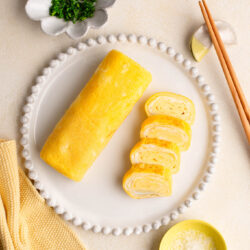
Japanese Omelette (Tamagoyaki)

Serves: 4 as part of a shared meal
Light and fluffy rolled Japanese Omelettes which are perfect for bento boxes, light meals and snacking. Recipe with step-by-step photos.
Instructions
- In a large jug or bowl with a spout, beat the eggs together with the seasoning ingredients. You can use a whisk, a fork or a pair of chopsticks to beat the eggs.
- Heat about 1 tablespoon of vegetable oil in the pan over medium heat. I use a non-stick rectangular pan which measures 15 x 18 cm/6 x 7 inches.
- Pour a thin layer of the egg mixture into the pan, and give the pan a swirl until the mixture fills the pan.
- Cook the first layer until it just starts to set but is still wet. This will ensure each layer will stick together.
- Use a pair of chopsticks or a small spatula - or both - to start rolling up the omelette towards you. Alternatively, you may find it easier to rotate the pan and roll the omelette from right to left (or left to right) - you can experiment and find out which method works best for you.
- Once the omelette is rolled up completely, push it back to the top of the pan.
- If you are using a cast iron pan, you may want to lightly oil the pan with a brush in between layers. If you are using a non-stick pan, you might find that there is no need to add anymore oil.
- Pour another thin layer of egg mixture into the pan, and give the pan a swirl for the mixture to fill the pan.
- Once again, wait until the eggs have just set before starting to roll up the omelette towards you.
- Repeat the above steps until all of the egg mixture has been used.
- Each time, try to make the layers as thin as possible. Also try to keep the heat at medium, or low-medium, so that the omelette does not brown too much on the inside layers (which would prevent the layers from sticking together).
- Once you have finished, gently nudge the omelette against the bottom of the pan to form the rectangular shape. If you wish, you can also leave the finished omelette in the pan for longer and brown it on all sides.
- Carefully remove the omelette to a cutting board.
- Use a sharp knife to cut thick slices.
- Serve warm or cool.
Kitchen Notes
- VARIATIONS
Like for any omelette, you can add other ingredients between the layers, such as:
* Finely chopped ham or bacon
* Very finely chopped capsicums (bell peppers)
* Very finely chopped carrots
* Very finely chopped broccoli
* Baby spinach leaves
* Sliced mushrooms - VIETNAMESE STYLE OMELETTE
I hope no Japanese person will take offence, but I also love to use Vietnamese flavourings in this omelette, especially if I am serving the omelette as part of a Vietnamese meal. For 4 eggs, add 1/2-1 teaspoon of fish sauce, freshly cracked white pepper, and finely chopped spring onions and/or coriander (cilantro). - OVEN & STOVE TEMPERATURES
All recipes on this website have been tested on an induction stove and/or with a conventional oven (i.e. an oven without fan). All recipes on this website use temperatures for a conventional oven, unless otherwise mentioned. Convection ovens (i.e. fan-forced ovens) are typically 20°C/70°F hotter than conventional ovens, but please check your manufacturer’s handbook. - CONVERSIONS
To convert from cups to grams, and vice-versa, please see this handy Conversion Chart for Basic Ingredients.